Models to Study the Pace of Play in Golf
Qi Fu and Ward Whitt
Department of Industrial Engineering and Operations Research, Columbia University, New York, NY 10027-6699, [email protected],[email protected], http://www.columbia.edu/∼ww2040
Successive groups of golfers playing on an 18-hole golf course can be represented as a network of 18 queues in series, but the model needs to account for the fact that, on most holes, more than one group can be playing at the same time, but with precedence constraints. We show how to approximate the model of group play on each hole by a conventionalG/GI/1 single-server queue, without precedence constraints. To approximate the distribution of the sojourn time for each group on a full 18-hole golf course, we consider an idealized model consisting of 18 i.i.d. holes in series. We combine these approximations to obtain a series of 18 i.i.d. conventional single-server queues. We then apply heavy-traffic approximations to develop relatively simple analytical formulas to show how the mean and variance of the sojourn time depends on key parameters characterizing group play on each stage of a hole. Simulation experiments confirm that the approximations are effective. Thus, we provide useful tools for the analysis, design and management of golf courses. The techniques also should be useful more broadly, because many service systems combine the four complicating features of the system studied here: (i) network structure, (ii) heavy-traffic conditions, (iii) transient performance and (iv) precedence constraints.
Key words: pace of play on golf courses; queues with precedence constraints; transient behavior of queues; heavy traffic; queueing networks; queues in series
History: draft: November 6, 2013
1. Introduction
In this paper we develop new stochastic queueing models, and approximate performance formulas for those models, that can be used to help design and manage golf courses in order to control the pace of play. As emphasized by Riccio (2012, 2013), there is a need to control the pace of play, because the time to play a full round of golf has often become excessive. Kimes and Schruben (2002), Tiger and Salzer (2004) and Riccio (2012, 2013) already developed queueing models of groups playing on a golf course and applied computer simulation to study the pace of play. These models can be used to balance the competing objectives of having as many groups as possible
play each day and keeping the expected times for those groups to play a full round as short as possible. They also can be used to examine the consequence of different tee-time schedules and the exceptional delays caused by lost balls and unusually slow groups. However, these models have not previously led to analytical performance formulas.
An important feature of golf that needs to be captured by these models is the fact that different groups of golfers interact on many of the holes. Typically, the groups move forward in a first-come first-served (FCFS) order, determined by their scheduled tee times on the first hole. However, typically, two groups can be playing on a par-4 hole at the same time, while three groups can be playing on a par-5 hole at the same time. This simultaneous play and the conventions for managing it introduces precedence constraints, as studied in queueing theory based on the max-plus algebra in Baccelli et al. (1992, 1989) and Heidergott et al. (2006). A conventional par-3 hole is more elementary because only one group can play on it at the same time, but there also is the modified par-3 hole “with wave-up,” which allows two groups to play at the same time there too; see Riccio (2012, 2013).
These complicated precedence constraints tend to rule out conventional queueing theory and make simulation the only viable analysis tool. However, Whitt (2013) recently developed stochastic queueing models of group play on each of the holes (par-4, par-5, par-3, and par-3 with wave-up), with appropriate precedence constraints, and showed how to analytically determine the maximum possible throughput as a function of the times required for the groups to complete each stage of play on each hole. The maximum throughput was identified as the departure rate on a “fully-loaded” hole, i.e., when there always is a group ready to start playing whenever an opportunity arises.
An important contribution of that work is exposing how the random times required for groups to play the stages on each hole translate to the distribution of the time between successive groups clearing the green (completing play) on that hole when the hole is fully loaded. For example, on a par-4 hole three stages of play can be identified, which require random timesSi, 1≤i≤3. It was
shown for the model introduced there that the times between successive groups clearing the green on a fully-loaded par-4 hole should be distributed as
Y ≡(S1∨S3) +S2, (1)
where a∨b≡max{a, b}; see §3 and §4. Formula (1) is useful because it shows how changes in the random stage playing timesSi will affectY, which itself characterizes the possible pace of play on
the hole.
In this paper, we go further by proposing a way to approximate the initial queueing model for group play on a par-4 hole, where two groups can be playing simultaneously, by a conventional
G/GI/1 single-server queue with unlimited capacity and the FCFS service discipline, having i.i.d. service times,withoutany precedence constraints. The main idea is to let the approximating i.i.d. service times in the conventional queueing model be distributed asY in (1) above. We show that this approach is effective to approximate the group waiting times before starting to play on each hole when the queue tends to be heavily loaded, which is the common case for golf courses. However, further adjustments are needed to approximate departure times and sojourn times; e.g., see §5.2.
We also develop parametric approximations for the distributions of the stage playing times Si,
which lead to parametric approximations for the distribution of Y in (1). The most promising of these is a triangular distribution to capture the usual relatively low variability, as in Tiger and Salzer (2004), plus a modification to allow for occasional lost balls; see §6.4 and §6.5. This produces tractable models of the triple (S1, S2, S3) and Y depending on a 5-tuple of parameter values (m, r, a, p, L), where each parameter captures a separate property of the model. In particular, the three random variablesSi are assumed to be independent and are given symmetric triangular
distributions on the intervals [mi−a, mi+a], where m1=m3=m2/r=m. Thus S1 is distributed the same as S3, both having mean m, while E[S2] =rm, so that the ratio E[S2]/E[S1] =r can be controlled separately. The variability of the three random variablesSi is specified by the single
parametera. We then assume that lost balls occur only on the first stage (including the tee shots) of each hole, with that happening on any hole with probabilitypand leading to a fixed large timeL
for stage 1 (corresponding to a maximum allowed delay). Thus the parameter pair (p, L) captures rare longer delays.
We also create an associated, idealized, more-highly-structured model of group play on theentire golf coursethat enable us to apply more of established queueing theory. In particular, we think that many insights can be gained by considering the simplified model in which all holes are identical. That is done partly because golf courses are often designed to require approximately equal time for groups to play each hole. When that is not nearly the case, then experience indicates that it should suffice to focus attention only on the bottleneck holes. The idealized model is intended for the case in which the course is approximately balanced. Since the par-4 hole is average in length and most common, we focus on analyzing a par-4 hole and a series of independent and identically distributed (i.i.d.) par-4 holes in series. If the course is not balanced, then the approximation may still be useful if the par-4 holes are the bottleneck holes, as evidently occurs when wave-up is used on the par-3 holes. Simulation can be used to verify that the insights gained from analyzing this idealized repetitive identical par-4 course apply to any other specific configuration of holes of the four types, using the models in Whitt (2013). Simulation can also be used to determine if even more detail provides valuable insight.
For the idealized model of multiple groups playing on an 18-hole golf course containing identical par-4 holes, we develop analytical approximation formulas. The approximation formula for the expected time required for group n to play the idealized 18-hole golf course, assuming constant intervals between scheduled tee times on the first hole, developed in §8 is
E[V18,n]≈E[Y] n+ 17−n−1 ρ + 7.2 p nc2 Y + 18E[S3], (2) where ρ is the traffic intensity (assumed to satisfy ρ≥1), S3 is the random stage-3 playing time, while E[Y] andc2
Y are the mean and squared coefficient of variation (scv, variance divided by the
square of the mean) of the random variableY in (1).
To develop the approximation in (2), we draw on heavy-traffic limits and approximations for the transient performance of a heavily loaded series of 18 G/GI/1 queues in series from Iglehart and Whitt (1970a,b) and Harrison and Reiman (1981). We especially draw on a previous simulation study by Greenberg et al. (1993) related to the heavy-traffic limits in Glynn and Whitt (1991).
There the focus was on analyzing the performance of a very large network of identical single-server queues in series. An efficient simulation algorithm was developed to simulate the performance of very large numbers of customers flowing through very large numbers of queues (e.g., millions) using techniques of distributed-event parallel simulation. Here we exploit results of those simulations to derive approximations for the mean and standard deviation of the heavy-traffic limit, which is a complex functional of 18-dimensional Brownian motion, exhibited in Theorem 3 of Glynn and Whitt (1991).
While we think that the issues addressed and the techniques developed in this paper can be useful to design and manage golf courses, we think that the value can be far greater, because the golf course illustrates four complicating features that are common in many service systems: (i) network structure, (ii) heavy-traffic conditions, (iii) transient performance and (iv) precedence constraints. There is a quite substantial literature on queueing systems with one or two of these features, but many service systems actually have all four. For example, that is substantiated by careful analysis of healthcare systems, as in Armony et al. (2011) and references therein.
Here is how the rest of this paper is organized: First, in §2 we illustrate how the approximation in (2) can be used to help design and manage golf courses. Then, in §3 we review the model of successive groups playing a par-4 hole from Whitt (2013) and in §4 we review results from Whitt (2013) for that model under the condition that the hole is fully loaded. The fully-loaded model was used to determine the maximum possible throughput. In §5 we develop the new approximating
G/GI/1 model. In§6 we consider alternative models of the stage playing times that enable us to calculate the mean E[Y] and scv c2
Y as needed in approximation (2) and other approximations.
In particular, we consider exponential, uniform and triangular distributions for the stage playing times. (Triangular distributions were considered in Tiger and Salzer (2004).) We also analyze the consequence of rare long delays, as caused by lost balls. In §7 we report results of simulation experiments showing that the approximating G/GI/1 model can provide a useful approximation for the transient performance. In §8 we develop and evaluate the approximations for the sojourn time on the full golf course, consisting of 18 identical independent par-4 holes in series. Finally, in
§9 we draw conclusions. In the e-companion we show that the model approximation is also effective for steady-state performance, provided that the traffic intensity is not too low.
2. Application to Manage the Pace of Play
Before we review the model from Whitt (2013) and develop the new standard queueing model approximation, we start by showing how the approximate performance formula in (2) above can be applied in the design of a golf course. In particular, we show how to apply formula (2) to determine the number of groups that should be allowed to play each day, and thus the (assumed constant) interval between tee times ∆, as a function of the key model parameters (E[Y], c2
Y, E[S3])
and specified performance constraints. Thus, if there is a target number,ν, of groups to play each day, we can see how the other parameters should be set; i.e., which can guide the design and management of the golf course.
To do so, we formulate an optimization problem, aiming to maximize the numbernof groups the play each day for specified model parameters (E[Y], c2
Y, E[S3]) subject to constraints. LetV(ρ, n)≡
E[V18,n(ρ)] be the expected sojourn time on the course for groupn (from tee time to clearing the
green) as a function of the traffic intensityρ≡E[Y]/∆, where ∆ is the fixed interval between tee times. We approximateV(ρ, n) by (2) above, assuming thatρ≥1. LetG(ρ, n)≡E[G18,n(ρ)] be the
time for group nto clear the green on the last (18th) hole, which is just V(ρ, n) plus the tee time for groupn, which is (n−1)∆ = (n−1)E[Y]/ρ. It is natural to consider the following optimization problem:
maximize n (3)
such that V(ρ, n)≤γ and G(ρ, n)≤τ for ρ≥1.
For example, if we were to aim for 4-hour rounds over a 14-hour day, then we would have
γ= 240 minutes and τ = 840 minutes. The tee times would then be restricted to the interval [0, τ−γ] = [0,600] minutes.
From (2), we have the following functions of the model parameters andn:
V(ρ, n) = V(1, n) + (n−1) 1−1 ρ and
G(ρ, n) = V(ρ, n) +(n−1)E[Y]
ρ =V(1, n) + (n−1)E[Y], (4)
where
V(1, n) = A+B√n, with A≡18([E[Y] +E[S3]) and B= 7.2E[Y]pc2
Y. (5)
Since feasible numbers of groups must be integer, we round down to the nearest integer; let ⌊x⌋
be the floor function, the greatest integer less than or equal to x.
Theorem 1. (optimal solution) The functions V(ρ, n) in (4) is increasing in n and ρ, while the
function G(ρ, n) is increasing in n and independent ofρ, provided that n≥0 and ρ≥1. Hence, if there is an optimal solution, then one of the two constraints must be satisfied as an equality. If the first constraint onV is binding, then the optimal decision variables areρ∗
γ= 1 and
n∗
γ=⌊[(γ−A)/B]
2
⌋ (6)
for A and B in (5). If the second constraint on G is binding, then ρτ is unconstrained (but should be ρτ= 1 to minimize V(ρ, n∗γ) and the optimal nis
n∗ τ=⌊( √ b2+ 4ac−b]/2a)2 ⌋ (7) wherea=E[Y], b=B= 7.2E[Y]p c2 Y and c=τ−A+E[Y] =τ−17E[Y]−18E[S3].
Proof. First, suppose that the first constraint involving V is binding. SinceV(ρ, n) is increasing in both ρ and n, in order to achieve the largest value of n, it suffices to restrict attention to
ρ=ρ∗
γ= 1. We then find n∗γ by solving the equationV(1, n) =γ using (5), which yields (6). Next,
suppose that the second constraint is binding. First observe that ρ does not appear, so that it suffices to solve the equation G(1, n) =τ, which yields a quadratic equation in x≡√n, whose solution is given in (7).
Theorem 1 implies that it suffices to focus on ρ= 1 in the optimization problem. This should be consistent with intuition, because it is impossible to achieve throughput faster than the bottleneck rate achieved at ρ= 1. Since we achieve ρ= 1 by setting ∆ =E[Y], we see the importance of determiningE[Y], which is done in Whitt (2013).
Example 1. To illustrate Theorem 1, suppose that τ = 840, γ= 240, E[Y] = 6, E[S3] = 4 and
c2
Y = 0.025. Then A= (18)(6 + 4) = 180, B= 7.47 so that n∗γ= [(240−180)/7.47]2=⌊64.5⌋= 64,
while a= 6, b=B = 7.47 and c= 666, so that n∗
τ =⌊97.9⌋= 97, Hence, we see that the first
constraint onV is binding. The maximum value ofn satisfying both constraints is n∗
γ= 64. Since
the design is inefficient, we see that management has a strong incentive to increasenaboven∗
γ= 64
in order to gain more revenue, but it can only do so by causing the expected times for playing a full round to exceed the target. Thus, this analysis evidently explains what is commonly occurring on golf courses today.
We say that a golf course design is efficient if the two constraints in (3) areboth binding at the optimal solution. An efficient design has the advantage that it should not be necessary to increase throughput at the expense of golfer experience (excessive times to play a round). At the same time, it should not be necessary to restrict the throughput in order to achieve a target bound on the time to play a round. Efficiency depends on the constraint limits γ and τ as well as the model parameters. The following elementary result characterizes an efficient design.
Proposition 1. (efficient design) An efficient design for (γ, τ) occurs if and only if there is an
nef such that
V(1, nef) =γ and V(1, nef) + (nef−1)E[Y] =τ (8) That in turn is achieved by nef =n∗γ in (6) if and only if
τ=γ+ (nef−1)E[Y]. (9) Thus, for any specified (γ, E[Y]), there is a uniqueτ that yields efficiency.
To illustrate, in Example 1, since n∗
τ= 97>64 =n
∗
γ, that design is not efficient. Finally, suppose
that we want to haveν groups play the course each day of lengthτ withV(ρ, n)≤γ for alln≤ν, where 0< γ < τ. Thus, we let ν=n∗
γ in (6), so that ν=γ−18(E[Y] +E[S3]) 7.2E[Y]p c2 Y (10) We can then see what parameter triples (E[Y], c2
Y, E[S3]) satisfy target (10). We can aim for an
efficient design by having ν=n∗
3. Stochastic Model of Groups Playing a Par-
4
Hole
In this section we review the stochastic model of successive groups of golfers playing a par-4 hole developed in Whitt (2013). The group typically contains a few individual players, but the model describes the progress of the group as a whole. The model incorporates the key property that two successive groups can be playing on a par-4 hole simultaneously.
There arefive stepsin the group play on a par-4 hole, each of which must be completed in order before the group moves on to the next step. The first step is the tee shot (one for each member of the group), denoted by T; the second step is walking up to the balls on the fairway, denoted by W1; the third step is the fairway shot (one for each member of the group), denoted byF; the fourth step is walking up to the balls on or near the green, denoted by W2; the fifth and final step is clearing the green (by all members of the group), denoted byG, which may involve one or more approach shots and one or more putts on the green for each player in the group.
The model next aggregates the five steps into three stages, which are important to capture the way successive groups interact while playing the hole. In particular, the three stages are:
(T, W1)→F→(W2, G) (11)
Stage 1 is (T, W1), stage 2 is F and stage 3 is (W2, G).
Assuming an empty system initially, the first group can do all the stages, one after another without constraint. However, for n≥1, group n+ 1 cannot start stage 1 until both group n+ 1 arrives at the tee and group n has completed stage 2, i.e., has cleared the fairway. Similarly, for
n≥1, groupn+ 1 cannot start on stage 2 untilbothgroupn+ 1 is ready to begin there and group
n has completed stage 3, i.e., cleared the green. These rules allow two groups to be playing on a par-4 hole simultaneously, but under those specified constraints. We may have groupsnandn+ 1 on the course simultaneously for all n. That is, group n may first be on the course at the same time as group n−1 (who is ahead), but then later be on the course at the same time as group
n+ 1 (who is behind). The groups remain in their original order, but successive groups interact on the hole. The group in front can cause extra delay for the one behind.
Let An be the arrival time of thenth group at the tee of this hole on the golf course. LetSj,n be
the time required for groupnto complete stagej, 1≤j≤3. Following queueing terminology, these are also called the stage playing times. These stage playing times are made up of the activities of the individual group members in each component of the stage. Thus, the stage playing times themselves should result from careful modeling and data analysis, and should depend on the size of the group and its characteristics, but these are the primitives in this model.
We now specify the performance measures, showing the result of the groups playing on the hole. LetBn be the time that groupnstarts playing on this hole, i.e., the instant when one of the group
goes into the tee box. LetTn be the time that groupncompletes stage 1, including the tee and the
following walk; letFn be the time that groupncompletes stage 2, its shots on the fairway; and let
Gn be the time that group ncompletes stage 3, and clears the green. Clearly, Gn is the group-n
departure or completion time, whileBn is the group-nstart time.
The mathematical model from Whitt (2013) relating the primitives to the performance random variables consists of the following four-part recursion:
Bn ≡An _ Fn−1, Tn≡Bn+S1,n, Fn ≡(Tn _ Gn−1) +S2,n and Gn≡Fn+S3,n, (12)
where ≡ denotes “equality be definition” and aW
b≡max{a, b}. As initial conditions, assuming that the system starts empty, we set F0≡G0≡0. The two maxima capture the two precedence constraints specified above.
The model in (12) extends directly to any number of par-4 models in series. We simply let the completion times Gn from one queue be the arrival times at the next queue (ignoring the times
in between, which could be treated separately). The principal time-oriented performance measures are: the waiting time (of the nth group before starting to play on the hole), W
n=Bn−An; the cycle time (the total time group n is actively playing this hole, possibly including some waiting there),Cn≡Gn−Bn; and the sojourn time (the total time spent by group nat the hole, waiting
time before starting to play; it does not include any waiting time after play has started, which can occur.
4. Model of a Fully Loaded Par-
4
Hole
In order to determine the capacity of a par-4 hole, i.e., the maximum possible throughput, Whitt Whitt (2013) focused on a fully-loaded hole, i.e., all groups are at the hole at time 0 ready to play, i.e., An≡0 for all n. Given the recursion in (12), it actually suffices to have only the weaker
condition An≤Fn−1 for all n≥1. Since we will also exploit the results for the fully-loaded par-4 hole, we review the main results for it from Whitt (2013), where the proofs can be found.
Under the fully-loaded condition, the recursion in (12) reduces to
Bn ≡Fn−1, Tn≡Bn+S1,n,
Fn ≡(Tn _
Gn−1) +S2,n and Gn≡Fn+S3,n, (13)
Again, as initial conditions, assuming that the system starts empty, letF0≡G0≡0.
4.1. The Intervals Between Successive Green Clearing Times
The main conclusion from Whitt (2013) is that the intervals between the times that successive groups clear the green on a fully-loaded par-4 hole has relatively simple structure that facilitates further analysis. The first step in exposing that structure is the observation that the fairway completion times can be represented directly as partial sums.
Theorem 2. (representation forFnas a partial sum) For the fully-loaded par-4hole with recursion
in (13), Fn=Fn−1+Yn, n≥2, so that Fn= n X k=1 Yk, n≥1, (14) where Yn≡(S1,n _ S3,n−1) +S2,n, n≥2, and Y1=S1+S2. (15) The representation in Theorem 2 can be exploited to establish asymptotic results for the succes-sive green-clearing (completion) timesGnofngroups playing a fully-loaded par-4 hole, under basic
stochastic assumptions. The basic idea is that Gn differs very little from Fn, so that Gn has the
same asymptotic behavior as Fn as n→ ∞. The results require assumptions on the stage playing
times. The next result is a strong law of large numbers (SLLN) for the green clearing times. Theorem 3. (SLLN for the green clearance timesGnfor the fully-loaded model)Consider the
fully-loaded par-4 model in which the sequence of stage playing-time random vectors {(S1,n, S2,n, S3,n) :
n≥1} is i.i.d. each distributed as the positive random vector (S1, S2, S3) with finite means. Then ¯ Gn≡ Gn n →E[Y]<∞ w.p.1, (16) where Y ≡(S1 _ S3) +S2. (17)
Additional results, including a central limit theorem (CLT), appear in Whitt (2013).
4.2. Cycle Times in a Fully-Loaded Model
By the analysis in the previous subsection, the long-run average time between successive groups completing play of a fully-loaded par-4 hole isE[Y] forY in (17), while the time each group spends on the par-4 hole is the cycle timeCn≡Gn−Bn. The cycle times in a fully-loaded par-4 hole are
in steady state for all n≥2, with a mean that is greater than E[Y]. Moreover, the difference can be quantified.
Theorem 4. (the cycle times Cn for the fully-loaded model) In the fully-loaded par-4 model, for
n≥2, the cycle times simplify to
Cn≡Gn−Bn=Yn+S3,n, (18) so that, if the stage playing times come from three independent sequences of i.i.d. random vari-ables {Si,n:n≥1}, i= 1,2,3, then the distribution of Cn is independent of n for all n≥2, with
E[Cn] =E[Y] +E[S3]for alln≥2and, trivially, Cn⇒C≡Y +S3∗, whereS∗3 is a random variable
independent of Y and itself distributed as S3.
4.3. The Moments of Y
Since the random variable Y in (17) plays a critical role, it is important to have expressions for its moments. LetG andGi be the cdf”s ofY andSi, respectively, e.g., Gi(x)≡P(Si≤x) and let
¯
Gi(x)≡1−Gi(x) be the complementary cdf (ccdf).
Theorem 5. (moments of Y) Consider the fully-loaded par-4 model. (a) If S1 and S3 are
inde-pendent, then E[Y] = Z ∞ 0 G∗(x)dx, where G∗(x) ≡G¯1(x) + ¯G2(x) + ¯G3(x)−G¯1(x) ¯G3(x). (19)
(b) If, in addition, the random variables S1, S2 and S3 are mutually independent and the cdf ’s
G1 andG3 have densities g1 and g3, then
V ar(Y) =V ar(S2) +V ar(S1 _ S3), (20) where, E[(S1 _ S3)2] = Z ∞ 0 E[S2 1|S1> x]P(S1> x)g3(x)dx + Z ∞ 0 E[S2 3|S3> x]P(S3> x)g1(x)dx (21) and E[(S1 _ S3)] = Z ∞ 0 [ ¯G1(x) + ¯G3(x)−G¯1(x) ¯G3(x)]dx. (22) We develop specific models of the stage playing times in§6 below, which we apply to obtain even more tractable expressions for the moments ofY. We now introduce our model approximation.
5. The Approximating Conventional
G/GI/
1
Single-Server Queue
We now propose to approximate the given par-4 model specified in §3 by a conventionalG/GI/1 single-server model with unlimited waiting space, the FCFS discipline, the given arrival process of groups to the hole and i.i.d. (aggregate) service times, with an independent exceptional first service time. In this approximating model, only one group is being served at a time, ignoring all other groups. For that purpose, we assume that the stage playing times come from three independent
sequences of i.i.d random variables {Si,n:n≥1} for 1≤i≤3, whereSi,n is distributed asSi with
cdfGi.
The underlying idea is to let the new aggregate service times be approximately equal to the successive intervals between groups clearing the green, ∆n≡Gn−Gn−1,n≥1, in the fully loaded
model analyzed in§4. We anticipate that this approximation strategy should be effective when the exact model is heavily loaded, which is the principal case of interest case for golf courses.
By Theorem 3.4 of Whitt (2013), these random variables ∆n forn≥2 come from a somewhat
complicated 2-dependent sequence. However, from Theorem 3, we see that we can choose a closely related sequence of i.i.d service times that produces the same SLLN behavior as ∆n by letting
these approximate i.i.d. service times be distributed asY ≡(S1WS3) +S2forn≥2, as in (17). (By Theorem 3.3 of Whitt (2013), they also have the same CLT behavior.) However, we let the first service time beY∗
1 ≡S1+S2+S3 as experienced by the first group to play the hole. Hence that is our main approximation. (Thus we use the same notationYn.)
5.1. The Classical Recursion
Thus, the approximating G/GI/1 model is specified by the sequence of arrival times{An:n≥1}
and the sequence of mutually independent service times {Yn:n≥1}, whereYn
d
=Y, n≥2, for Y
in (17) and Y1 d =Y∗
1 ≡S1+S2+S3. Then we can apply the classical single-server queue recursion:
Bn ≡An _
Dn−1 and Dn≡Bn+Yn, (23)
where D0≡0. The variables Dn are the departure times in the conventional single-server model.
However, the actual approximate departure times we use are defined differently in §5.2. (We do
not useDn as an approximation for Gn in§3.)
The exceptional behavior ofFn forn= 1 in Theorem 2 explains the exceptional first service time.
We remark that there is a literature on queues with exceptional first service, which can be traced from citations to the early paper Welch (1964), but that literature focuses on queues in which the first service time of every busy period is exceptional. In contrast, here only the very first group
has a different service time. This exceptional first service time will affect the transient behavior, but not the limiting behavior, the steady-state limits forρ <1 and, after scaling, the heavy-traffic limits for ρ≥1.
We regard the main approximations following directly from (23) as being for the group waiting times at the tee (before teeing off), defined by Wn ≡Bn−An. We next develop the remaining
approximations.
5.2. Approximations for the Group Sojourn and Departure Times
The appropriate approximation for the group sojourn times requires care, because we should not just add the waiting timeWn to the approximating aggregate service time Yn, as we would in the
conventional G/GI/1 single-server model in which customers are served one at a time. Instead, we let the the sojourn time approximation for the model in§3 be independent sum of the waiting time and the cycle timein §4.2, i.e.,
Un≈Wn+Cn, (24)
where Cn is independent of Wn. That is appropriate because the cycle time is the time spent by
the group on the hole (in the fully loaded model). By Theorem 4, the cycle time is the independent sum ofY andS3, so that both the means and variances add:
E[Un]≈E[Wn] +E[Y] +E[S3] and V ar(Un)≈V ar(Wn) +V ar(Y) +V ar(S3), n≥2. (25)
where the mean and variance of the waiting timeWn are obtained from the G/GI/1 model above.
For the exceptional first, group,
E[U1]≈E[S1] +E[S2] +E[S3] and V ar(U1)≈V ar(S1) +V ar(S2) +V ar(S3). (26)
The departure times from group n from the hole (and thus the arrival times at a subsequent hole) are necessarilyGn=An+Un. Thus we have the approximations
using (25) and (26) above.
We will primarily consider the case of a a fixed deterministic schedule of start times (tee times) with constant intervals in between on the first hole. For deterministic arrivals, the arrival time mean and variance used in (27) areE[An] =An= (n−1)EY /ρandV ar(An) = 0 above.
For a following queue, the arrival timesAn are the departure timesGn, using (27), and not using
Dn in the recursion (23). For any queue after the first, the arrival time mean and variance, will be
obtained from (27) for the previous queue. We observe that successive waiting times are typically not nearly independent. Hence, successive sojourn times Un and interdeparture times Gn−Gn−1 are typically not independent either.
Given the derived green clearing times Gn, we have associated approximations for the number
of of groups at the hole, either waiting or playing, as seen be groupnupon arrival, Na
n, and at an
arbitrary time,N(t). As in formulas (2.3) and (2.4) of Whitt (2013), these are defined as
Na
n≡n−1−max{k≥0 :Gk≤An}, n≥1. (28)
and
N(t)≡Na
n+ 1, An−1≤t < An. (29)
6. Alternative Stage Playing Time Models
In this section we develop alternative models for the stage playing times Si that lead to alternate
overall approximating aggregate service-time random variables Y to use in the approximating
G/GI/1 model. We first consider exponential stage stage playing times, because of the appealing tractability of the exponential distribution. However, the exponential distribution evidently is too highly variable for the golf course application. To consider more appealing less-variable alternatives, we also consider uniform and triangular stage playing times; triangular distributions were used in Tiger and Salzer (2004). Finally, we develop a model to account for the extra variability caused by an exceptional long delay, as occurs with a lost ball. Rare long stage service times can have a dramatic impact, as shown by Riccio (2012, 2013).
6.1. Independent Exponential Stage Playing Times
We can obtain explicit expressions for the moments of Y whenS1,S2 and S3 are mutually inde-pendent exponential random variables. The following is an easy consequence of Theorem 5. Corollary 1. (moments of Y for independent exponential stage playing times) For the
fully-loaded par-4 hole in which Si are mutually independent exponential random variables with means
µ−i1, i= 1,2,3, then E[Y] = 1 µ1 + 1 µ2 + 1 µ3− 1 µ1+µ3 (30) and V ar(Y) = 1 (µ1+µ2)2 +V ar(Z), (31) where E[Z2] =P(S 1< S3)E[S23] +P(S3< S1)E[S12] = µ1 µ1+µ3 2 µ2 3 + µ3 µ1+µ3 2 µ2 1 (32) and E[Z] =P(S1< S3)E[S3] +P(S3< S1)E[S1] = µ1 µ1+µ3 1 µ1 + µ3 µ1+µ3 1 µ3 . (33)
If, in addition, µ1=µ3, then Z d =S1 d =S3, so that V ar(Y) =V ar(S2) +V ar(S1 _ S3) =E[S2]2+ E[S1] 2 2 +V ar(S1). (34)
Proof. First, we obtain (30) directly from the relation
Y = (d S1
_
S3) +S2=S1+S2+S3−S1
^
S3, (35)
and the property that the minimum of exponential variables is exponential with a rate equal to the sum of the rates. For (31), we use (20) and
(S1
_
S3) = (S1
^
S3) +Z, (36)
where, by the lack of memory property, these are independent with (32) and (33) holding. For the special case in whichS1
d
6.2. Parametric Models with Special Structure
We now introduce additional structure in the stage playing time distributions in order to obtain models with only a few parameters. In particular, in the spirit of p. 94 of Riccio (2012), we assume that S1,S2 andS3 are mutually independent random variables with
S1 d
=S3, (37)
so that one parameter can be the means E[S1] =E[S3]; i.e., we have
m=E[S1] =E[S3] =E[S2]
r . (38)
Hence there are only the two parametersmandrbeyond the distributions ofS1 andS2. Moreover, we let S2 have a distribution of the same type as S1.
Example 2. (a concrete exponential example) We now consider a concrete example of the expo-nential stage playing times satisfying (37) and (38) in (38). For this example, we have
E[Y] =(3 + 2r)m 2 , V ar(Y) = (5 + 4r2)m2 4 and c 2 Y ≡ V ar(Y) E[Y]2 = 5 + 4r2 (3 + 2r)2. (39) Following p. 94 of Riccio (2012) again, we now letm= 6 andr= 1/2. First, forr= 1/2,E[Y] = 3m/2, var(Y) = 3m2/2 and c2
Y = 3/8 = 0.375. From (39), we see that, for m= 6, E[Y] = 12 and
V ar(Y) = 54. We look atm= 6 throughput the paper, but the valuem= 6 gives reasonable sojourn times on the golf course only in the case of deterministic stage playing times. For realistic random stage service times, a more realistic value evidently would bem= 4.
6.3. Independent Uniform Stage Playing Times
As a first step toward considering more realistic models of the stage playing times, we now assume that all three random stage playing times are independent uniform random variables satisfying (37) and (38). In particular, we assume that
Si
d
whereU≡U[0,1] is uniformly distributed on the interval [0,1] and 0≤ai≤1. That is tantamount
to assuming that Si is uniformly distributed on the interval [mi−ai, mi+ai]. Since E[U] = 1/2
andV ar(U) = 1/12, we see that E[Si] =mi andV ar(Si) =a2i/3.
We further simplify by assuming that the parameters ai in (40) coincide, i.e.,
a1=a2=a3=a, (41)
so that only two parameters remain:m anda. With those simplifying assumptions, we have
S1∨S3=m−a+ 2a(U1∨U2)), (42)
where U1 andU2 are two i.i.d. uniform random variables on [0,1]. Since
FU1∨U2(t)≡P(U1∨U2≤t) =P(U1≤t)
2
=t2, 0≤t≤1,
we have E[U1∨U2] = 2/3,E[(U1∨U2)2] = 1/2 and V ar(U1∨U2) = 1/18. Hence,
E[S1∨S3] =m+ a 3 and V ar(S1∨S3) = 2a2 9 , (43) so that E[Y] = (1 +r)m+a 3 and V ar(Y) = 5a2 9 . (44)
Example 3. (the uniform analog of Example 2)
Paralleling Example 2, suppose that m= 6 andr= 1/2. If a= 3 (which is as large as possible), then E[Y] = 10.0, V ar(Y) = 5.0 and c2
Y = 0.05; ifa= 1, then E[Y] = 9.333, V ar(Y) = 0.5555 and
c2
Y = 006377. Notice that the mean is substantially smaller than in the corresponding exponential
example, but c2
Y is much smaller. From (2), we see that it is important to look at p c2 Y. In the exponential case,p c2 Y = 0.612, whereas fora= 1, p c2
6.4. The Case of Independent Triangular Stage Playing Times
Aiming for an even more realistic model, as in Tiger and Salzer (2004), we now assume thatSi has
a symmetric triangular distribution. In particular, paralleling (40), let
Si
d
=mi−ai+ 2aiT, (45)
where T≡T[0,1] is a (symmetric) triangular distribution on the interval [0,1] with density
fT(x) = 4t, 0≤t≤0.5, and 4−4t, 0.5≤t≤1. (46)
so that E[T] = 1/2 andV ar(T) = 1/24.
That is tantamount to assuming that Si has a triangular distribution on the interval [mi−
ai, mi+ai], so that E[Si] =mi and V ar(Si) =a2i/6. We further simplify by assuming that (41)
and (38) hold, so that there are only the three parameters m, r and a. With that simplifying assumption, we have
S1∨S3=m−a+ 2a(T1∨T2), (47) where T1 andT2 are two i.i.d. triangular random variables on [0,1].
Since P(T≤t) = 2t2, 0 ≤t≤1/2, and P(T≤t) = 1−2(1−t)2, 1/2 ≤t≤1, we have P(T1∨T3≤t) = P(T≤t)2= 4t4 and fT1∨T3(t) = 16t 3, 0 ≤t≤1/2, (48) P(T1∨T3≤t) = (1−2(1−t)2)2 and fT1∨T3(t) = 8[−1 + 5t−6t 2+ 2t3], 1/2 ≤t≤1,
so that E[T1∨T3] = 37/60 and V ar(T1∨T3) = 101/3600. Hence,
E[S1∨S3] =m+ 7a 30 and V ar(S1∨S3) = 101a2 900 (49) and E[Y] = (1 +r)m+7a 30 and V ar(Y) = 251a2 900 . (50)
Example 4. (triangular analog of Example 2) Just as in Examples 2 and 3, suppose thatm= 6 and
r= 1/2. Ifa= 3 (which is as large as possible), thenE[Y] = 9.7,V ar(Y) = 2.51 andc2
Y = 0.02667; if
a= 1, thenE[Y] = 9.233,V ar(Y) = 0.2789 andc2
Y = 0.003271. Notice that the mean and variance
are both slightly smaller than in corresponding the uniform case. We will find that it is important to look at p
c2
Y. In the exponential case, p c2 Y = 0.612, whereas for a= 1, p c2 Y = 0.0572, which is 10.7 times smaller.
6.5. Modification for Occasional Lost Balls
The uniform and triangular distributions capture the lower variability we expect to have in group playing times under normal circumstances. However, there can be unexpected delays, such as are caused by a lost ball, which makes the time much longer than it would be otherwise. To avoid excessive delays, golf courses often impose an upper limit on the playing time of each group on each hole, such as 20 minutes.
To model these rare events in a relatively simple way, we consider random extra delays at an upper limit. For simplicity, we assume that a lost ball can only occur on the tee shot, so we only modify the distribution of S1. We first let this upper limit be the constant value L minutes. We then assume that such unexpected events occur for each group on the first stage of each hole with probabilityp. So we introduce the two extra parametersp andL.
Thus given any of the models forSidiscussed above, this modification leads to a new distribution
forS1. Let the new random time for group play on stage 1 be ¯S1, and let ¯Y, be the new random time between successive times to clear the green, which is still defined by (17), but with ¯S1 replacing
S1. Now we have
P( ¯S1=S1) = 1−p and P( ¯S1=L) =p. (51) Then the first two moments of ¯S1 are
E[ ¯S1] = (1−p)E[S1] +pL and E[ ¯S2
1] = (1−p)E[S 2 1] +pL
so that V ar( ¯S1) = (1−p)[σ2 S1+p(L−E[S1]) 2]. (53) Then ¯ Y = ( ¯S1∨S3) +S2.
However, for bounded stage playing times such as occur with the uniform and triangular distri-butions, we can go further. If, in addition to (37) and (38), we have
P( ¯S1> S3) = 1, (54) then we have ¯ Y = ¯S1+S2, E[ ¯Y] =p(L+rm) + (1−p)E[Y] and E[ ¯Y2] =p(L+rm)2+ (1 −p)E[Y2]. (55)
Hence we can combine the lost-ball feature with one of the models in §6.3 and §6.4 to obtain a tractable model. If we add condition (41), then we obtain tractable models depending on the parameter 5-tuple (m, r, a, p, L). We can thus incorporate the rare lost ball with the usual low variability of the uniform or triangular distribution to obtain a final estimate of the pace of play. In particular, we can combine (55) and (50) to obtain the first two moments of ¯Y for thetri+LB
model with parameter 5-tuple (m, r, a, p, L):
E[ ¯Y] =p(L+rm) + (1−p) (1 +r)m+7a 30 E[ ¯Y2] =p(L+rm)2+ (1−p) 251a2 900 +E[ ¯Y] 2 . (56)
Example 5. (Example 4 revisited with the triangular distribution and lost balls) For example, Let Si have triangular distributions as in §6.4 with parameters m, r anda. Since E[S1] =m and
V ar(S1) =a2/6. E[ ¯S1] = (1−p)m+pL and E[ ¯S2 1] = (1−p) m2+a2 6 +pL2, (57)
Suppose that we use the parameters m= 6 and r= 1/2 for the triangular distribution, as in Example 4, and letp= 0.05 andL= 12 for the lost balls. Then
E[ ¯S1] = 0.95(6) + (0.05)(12) = 6.3 and E[ ¯S2 1] = (0.95) 36 +9 6 + (0.05)(144) = 42.825 (58) so that V ar( ¯S1) = 42.825−(6.3)2= 42.825 −39.69 = 3.135 (59) SinceV ar(S1) = 1.50, the variance of S1 increased by more than a factor of 2.
The next step is to determine the distribution of ¯Y. Notice that
P( ¯Y = 12 +S2) = 0.05 = 1−P( ¯Y =Y). (60) Hence, E[ ¯Y] = (0.05)(15) + (0.95)(9.7) = 0.75 + 9.215 = 9.965 and E[ ¯Y2] = (0.05)(226.5) + (0.95)(96.6) = 11.325 + 91.77 = 103.095 (61) so that V ar( ¯Y) = 103.095−(9.965)2= 103.095 −99.30 = 3.795 and c2 ¯ Y = 3.795/(9.965) 2= 0.03822 (62) As expected,c2 ¯ Y is greater thanc 2
Y = 0.02667, by a factor of about 1.5, butc
2 ¯
Y is still 10 times smaller
than for the exponential distribution. It is thus natural to regard the exponential distribution as a crude upper bound.
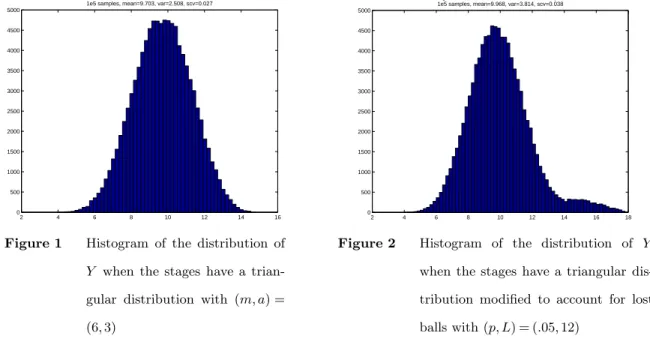
We show histograms of Y when the stage playing times have the triangular distribution with (m, r, a) = (6,0.5,3) in Figure 1 and that triangular distribution modified to account for lost balls with (p, L) = (.05,12) in Figure 2. The lost balls clearly produce a heavier upper tail, but within a reasonable range, becauseY remains bounded above by ( ¯S1∨S3) +S2≤12 +(3 +3) = 18 (compared to ((S1∨S3) +S2≤([6 + 3]∨[6 + 3]) + (3 + 3) = 15 for the triangular distribution).
2 4 6 8 10 12 14 16 0 500 1000 1500 2000 2500 3000 3500 4000 4500 5000
Mixed triangle service distribution, m=6,a=3 1e5 samples, mean=9.703, var=2.508, scv=0.027
Figure 1 Histogram of the distribution of
Y when the stages have a trian-gular distribution with (m, a) = (6,3) 2 4 6 8 10 12 14 16 18 0 500 1000 1500 2000 2500 3000 3500 4000 4500 5000
Mixed triangle w. lost ball service distribution, m=6,a=3,p=0.05,L=12 1e5 samples, mean=9.968, var=3.814, scv=0.038
Figure 2 Histogram of the distribution of Y
when the stages have a triangular dis-tribution modified to account for lost balls with (p, L) = (.05,12)
7. Simulation Comparisons for the Transient Performance
In this section we show that the approximatingG/GI/1 model in§5 with exceptional first service in §5, with the sojourn time adjustment in§5.2, provides an effective approximation for the transient performance of the exact model in§3. We consider the case of identical par-4 holes in series. To do so, we report simulation results estimating the mean and standard deviation of the sojourn time of groupn on each hole and on the firsth holes for the cases (h, n) = (10,20) and (18,100).
7.1. Sojourn Times
We now label the variables with two subscripts, the first indexing the hole and the second indexing the group. With this notation, we now aim to approximate the sojourn time of groupnon holeh,
Uh,n≡Gh,n−Ah,n, for various holesh and the total sojourn time of group non the firsth holes,
Vh,n≡U1,n+· · ·+Uh,n. (63)
We illustrate by displaying simulation results for the cases (h, n) = (10,20) and (18,100).
For our first experiment, we consider the all-exponential model with independent all-exponential stage playing times with parameters (m, r) = (6,0.5), having meansE[S1] =E[S3] = 6,E[S2] = 3, as in Example 2, and constant intervals between tee times on the first hole. The interval between tee
times is used to adjust the traffic intensity. We perform the transient simulations for three values of the traffic intensityρ, defined byρ≡λE[Y]: 0.9, 1.0, and 1.1. The simulations are based on 2000 independent replications. This consistently makes the half-width of 95% confidence intervals less than 5% of the estimated means and 10% of the estimated standard deviations.
We find that the sojourn times over several holes tend to be approximately normally distributed, so that the mean and standard deviation serve to describe the entire distribution. Figure 3 illus-trates by showing the histogram of the sojourn timesV10,20forρ= 0.9 (on the left) andρ= 1.1 (on the right) estimated for the exact model in§3. (The approximation produces very similar plots.)
150 200 250 300 350 400 450 0 20 40 60 80 100 120 140
Sojourn time distribution for 20th customer through 10 holes (Exact model ρ=0.9) 2,000 samples, mean=283.042, variance=1168.396
time (minutes)
Figure 3 Histogram of the sojourn times
V10,20 in the all exponential
model with forρ= 0.9
200 250 300 350 400 450 500 0 20 40 60 80 100 120 140
Sojourn time distribution for 20th customer through 10 holes (Exact model ρ=1.1) 2,000 samples, mean=324.379, variance=1319.566
time (minutes)
Figure 4 Histogram of the sojourn times V10,20
in the all exponential model with for
ρ= 1.1
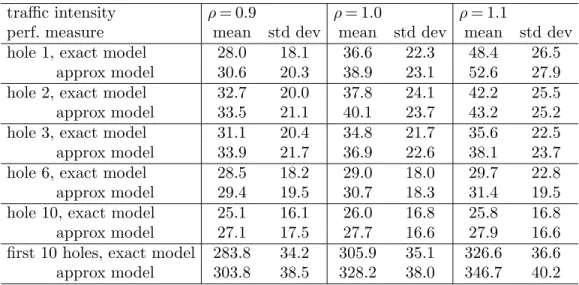
We give simulation estimates of the mean and standard deviation of these sojourn times Uh,20 for the exact and approximate models in Table 1 for holesh= 1,2,3,6 and 10 and the total sojourn timeV10,20. Overall, we see that the mean sojourn time may increase fromh= 1 toh= 2 but then
gradually declines thereafter; the standard deviations evidently decline only after h= 3. We see that the approximate model consistently overestimates the mean and standard deviation but not by too much. It overestimates the mean and standard deviation of V10,20 for ρ= 0.9 by 7% and 12%, respectively.
Table 1 Simulation comparison of the transient performance predicted by the exact model in§3 and the approximate model in§5: estimates of the mean and standard deviation of the sojourn times of group 20 on several
holes, (Uh,20), and over the first 10 holes, (V10,20), for a series of i.i.d. par-4 holes with exponential stage playing
times, for three traffic intensitiesρ= 0.9, 1.0 and 1.1
traffic intensity ρ= 0.9 ρ= 1.0 ρ= 1.1
perf. measure mean std dev mean std dev mean std dev hole 1, exact model 28.0 18.1 36.6 22.3 48.4 26.5
approx model 30.6 20.3 38.9 23.1 52.6 27.9 hole 2, exact model 32.7 20.0 37.8 24.1 42.2 25.5 approx model 33.5 21.1 40.1 23.7 43.2 25.2 hole 3, exact model 31.1 20.4 34.8 21.7 35.6 22.5 approx model 33.9 21.7 36.9 22.6 38.1 23.7 hole 6, exact model 28.5 18.2 29.0 18.0 29.7 22.8 approx model 29.4 19.5 30.7 18.3 31.4 19.5 hole 10, exact model 25.1 16.1 26.0 16.8 25.8 16.8 approx model 27.1 17.5 27.7 16.6 27.9 16.6 first 10 holes, exact model 283.8 34.2 305.9 35.1 326.6 36.6 approx model 303.8 38.5 328.2 38.0 346.7 40.2
We now focus on the different stage playing time distributions. In particular, as in Examples 2, 4 and 5, we now consider the exponential distribution with (m, r) = (6,0.5), the triangular distribution (tri(m, a)) for (m, r, a) = (6,0.5,3), that same triangular distribution with the lost ball parameters (p, L) = (0.05,12). In all cases we let E[S1] =E[S3] = 2E[S2] =m= 6. In Examples 2, 4 and 5 we have calculated the means and variances of Y for each of these three cases. They are, respectively,
(E[Y], V ar(Y)) = (12.00,54.00), (9.70,2.51) (9.97,3.80).
Even though the stage playing times have identical means in all three models, they have different variability, which affects both the mean and variance of Y. The mean and variance of Y in turn strongly affect the mean sojourn timesE[Uh,n] and E[Vh,n].
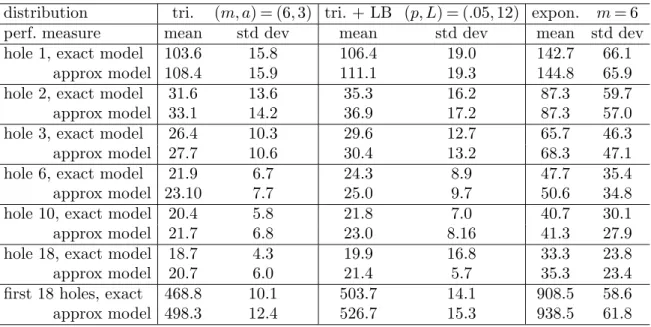
Table 2 gives simulation estimates of the mean and standard deviation of these sojourn times
Uh,100 for the exact and approximate models for holes h= 1,2,3,6,10,18 and the total sojourn time V18,100. (Now we consider (h, n) = (18,100 instead of (10,20).) These results are again based
on 2000 independent replications. For the less variable triangular stage playing time distribution, the half-width of 95% confidence intervals is consistently less than 1% of the mean estimate and
5% of the standard deviation estimate.
Again, we see that the mean sojourn time may increase from h= 1 to h= 2 but then gradually declines thereafter; the standard deviations evidently decline only after h= 3. We see that the approximate model consistently overestimates the mean and standard deviation but not by too much.
Table 2 Simulation comparison of the transient performance predicted by the exact model in§3 and the approximate model in§5: estimates of the mean and standard deviation of the sojourn times of group 100 on several holes, (Uh,100), and over the full course of 18 holes, (V18,100), for a series of i.i.d. par-4 holes with traffic
intensityρ= 1.1 and three stage playing time distributions, as in Examples 2, 4 and 5.
distribution tri. (m, a) = (6,3) tri. + LB (p, L) = (.05,12) expon. m= 6 perf. measure mean std dev mean std dev mean std dev hole 1, exact model 103.6 15.8 106.4 19.0 142.7 66.1
approx model 108.4 15.9 111.1 19.3 144.8 65.9 hole 2, exact model 31.6 13.6 35.3 16.2 87.3 59.7 approx model 33.1 14.2 36.9 17.2 87.3 57.0 hole 3, exact model 26.4 10.3 29.6 12.7 65.7 46.3 approx model 27.7 10.6 30.4 13.2 68.3 47.1 hole 6, exact model 21.9 6.7 24.3 8.9 47.7 35.4 approx model 23.10 7.7 25.0 9.7 50.6 34.8 hole 10, exact model 20.4 5.8 21.8 7.0 40.7 30.1 approx model 21.7 6.8 23.0 8.16 41.3 27.9 hole 18, exact model 18.7 4.3 19.9 16.8 33.3 23.8 approx model 20.7 6.0 21.4 5.7 35.3 23.4 first 18 holes, exact 468.8 10.1 503.7 14.1 908.5 58.6 approx model 498.3 12.4 526.7 15.3 938.5 61.8
We also simulated the standardD/GI/1 model with service times distributed asY, without any exceptional first service times. We found that the exceptional first service times did not significantly alter the results, but it is important to include the sojourn time adjustment in §5.2.
7.2. Negative Dependence
When we consider the sojourn time over several holes, we might think that the variance should be approximately the sum of the variances on the individual holes, but the simulation experiments show that is not nearly the case. The estimated sum of the variances of the sojourn times on the first 10 holes in Table 1 and over the first 18 holes in Table 2 is much larger than the variance of
the sojourn time over all the holes. We make an explicit comparison in Table 3. Fortunately, we see that this effect is well captured by the approximation. Table 3 shows that the ratio is greatest for the least variable triangular distribution.
Table 3 A comparison of the variance of the sojourn time ofngroups overhholes with the sum of the variances of the sojourn times in the six experiments in Tables 1 and 2
case var. of sum sum of vars. ratio
exponential with ρ= 0.9 V ar(V10,20) P10 i=1V ar(Ui,20) exact 1197 3418 2.85 approx. 1412 3413 2.41 exponential with ρ= 1.0 V ar(V10,20) P10 i=1V ar(Ui,20) exact 1234 3835 3.10 approx. 1440 3936 2.73 exponential with ρ= 1.1 V ar(V10,20) P10 i=1V ar(Ui,20) exact 1342 4353 3.24 approx. 1617 4393 2.72 triangular withρ= 1.1 V ar(V18,100) P18 i=1V ar(Ui,100) exact 102.7 1071 10.4 approx. 154.1 1297 8.4
tri. and LB withρ= 1.1 V ar(V18,100) P18 i=1V ar(Ui,100) exact 200.3 1651 8.2 approx. 236.2 1881 8.0 exponential with ρ= 1.1 V ar(V18,100) P18 i=1V ar(Ui,100) exact 3823 23291 6.09 approx. 3434 22893 6.66
We also estimated the correlations c(j, k) of the sojourn times on holes j and j+k for all j
andk. We find that these correlations are consistently negative with absolute values that decrease in j and k, with c(j,1)≈ −0.14 for the triangular distribution and c(j,1)≈ −0.10 for the tri and
tri+LB distributions, respectively, forj≥4.
8. The Time Required for a Group to Play a Full Round of Golf
In this section we develop and evaluate heavy-traffic (HT) approximations for the time required for each successive group to play a full round of golf on the idealized course containing a series of 18 i.i.d. par-4 holes.
LetGh,nbe the time that groupnclears the green on holeh(completes play on the firsthholes).
in fact have to wait for other groups in front of them.) Let Vh,n=U1,n+· · ·+Uh,n be the sojourn
time of groupnon the firsth holes. These three performance descriptors are related by
Vh,n=Gh,n−A1,n. (64)
Here we assume that the tee times are evenly spaced deterministic times so that
A1,n=
n−1
λ =
(n−1)E[Y]
ρ , (65)
where λ is the arrival rate and 1/λ is the fixed interval between successive scheduled group tee times on the first hole, withλchosen so that the traffic intensityρ=λE[Y] is some specified value, with Y as in (17). Here we consider cases in which ρ≥1, so that groups are usually ready to tee off at the first green whenever the opportunity arises.
8.1. The Standard Series-Queue Model
We first consider the standard series-queue model, with i.i.d ·/GI/1 queues in series, each having service times distributed as Y in (17). We evaluate HT approximations from Iglehart and Whitt (1970a,b), elaborated upon in Glynn and Whitt (1991), Greenberg et al. (1993), Harrison and Reiman (1981), Reiman (1984) based on stochastic-process limits where we let n→ ∞ for fixed
ρ≥1. We compare to the simulations of both this same model and the exact golf-course model, focusing on the sojourn time of groupn= 100 on the firsth= 18 holes.
A reference case is the series of deterministic·/D/1 queues with the deterministic arrival process and deterministic service times with meanE[Y], Then
GD,stdh,n = (n+h−1)E[Y], A1,n= (n−1)E[Y] ρ and V D,std h,n =G D,std h,n −A1,n. (66)
For example, with n= 100, h= 18, ρ= 1.1 and S1=S6= 2S2= 6 and Y = 9.0, so that
GD,std18,100= (117)9 = 1053, A1,100= (99)9
1.1 = 810 and V
D,std
18,100= 1053−810 = 243. (67) From this example, we see that these deterministic stage service times would make the pace of play far too slow. Before we introduce the important variability, which will slow the pace of play
even more, we see that the required time for 100 groups to play on the course is 1053/60≈17.5 hours, which could just be realized in mid-summer, from 5:00 am until 10:30 pm, while the sojourn time of the last group is just over 243/60≈4 hours. That sojourn time is composed of 18×9 = 162 minutes of service time and 81 minutes waiting to tee off at the first hole. Thus, we probably want to have ρ <1.1. More importantly, the extra variability raises these times to untenable levels.
To treat the case of stochastic service times, we apply the heavy-traffic (HT) limit in which
n→ ∞ for a series of standard ·/GI/1 queues, where the service times at the queues come from independent sequences of i.i.d. random variables distributed asY in (17), with meanE[Y] and scv
c2
Y ≡V ar(Y)/E[Y]
2. Given that ρ
≥1, there will almost always be groups ready to start play on the first hole whenever the opportunity arises. Thus,we can apply Theorem 3.2 of Glynn and Whitt (1991), which reduces to previous HT limit in Iglehart and Whitt (1970a,b), as noted in Remark 3.1 there. That HT limit is in turn a special case of more general HT limits for open networks of queues in Harrison and Reiman (1981), Reiman (1984) and Ch. 14 of Whitt (2002). The connection to this earlier work is seen by observing that, forh≥2,GD,std
h,n is approximately the departure time
in a series network of h−1 queues with traffic intensity ρ= 1 and interarrival-time distribution equal to the service time distribution onY. (We consider the service time on the first hole as the interarrival time to the rest of the model.)
For h≥2, The HT limit takes the form
GD,stdh,n −(n+h−1)E[Y] √
n ⇒σYDˆh(1) as n→ ∞, (68)
where ˆDh(1) is a complex function of (h)-dimensional standard Brownian motion (BM), as arises
in the caseE[Y] =V ar(Y) = 1. (The termh−1 on the left could be omitted because it is asymp-totically negligible as n→ ∞ when divided by √n, but we include it to be consistent with (66) above.) The key approximation stemming from the HT limit is
GD,stdh,n ≈E[Y]n+h−1 +pnc2
YDˆh(1)
. (69)
It remains to evaluate the distribution of the random variable ˆDh(1) appearing in (68) and (69).
et al. (1993). In particular, we apply Table 5 of Greenberg et al. (1993) to produce the approxima-tion
E[ ˆDh(1)]≈bh
√
h and SD[ ˆDh(1)]≈ch (70)
where bh and ch are constants that in general should depend on h with bh↑2 as h↑ ∞, while ch
decreases. For h= 10, bh≈1.62 andch≈0.65; for h= 100, bh≈1.95 andch≈0.45. Hence, we use
the approximationsb18≈1.7 and c18≈0.6, yielding
E[ ˆD18(1)]≈1.7√h≈7.2 and SD[ ˆD18(1)]≈0.6 (71) Since Vstd
h,n =G D,std
h,n −A1,n, we can combine the results to approximate the distribution of the
sojourn timeVstd h,n. SinceA1,n is deterministic, SD[Vstd h,n] =SD[G D,std h,n ]. (72)
Combining (69), (71) and (72), we obtain the approximations
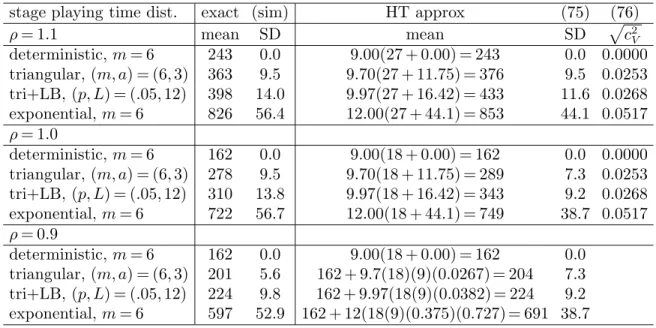
E[Vstd 18,n]≈E[Y] n+ 17−n−1 ρ + 7.2 p nc2 Y and , SD[Vstd 18,n]≈0.6E[Y] p nc2 Y. (73)
For the case n= 100, we obtain
E[Vstd 18,100]≈E[Y] 27 + 7.2p100c2 Y and SD[Vstd 18,100]≈0.6E[Y] p 100c2 Y (74)
To evaluate the quality of the approximation in (74), we simulated the standard model with i.i.d. service times distributed asY in (17) with traffic intensityρ= 1.1 (arrival rateE[Y]/1.1) and
ρ= 1.0 for the stage playing time distributions in Table 2. The results are shown in Table 4. For
ρ= 1.0, the approximations for the mean sojourn time of group 100 over 18 holes with the tri,
tri+LBandexpstage service time distributons are, respectively, 3.9% high, 10.6% high and 3.7% high.
For the cases with ρ≥1, Table 4 shows that (73) and (74) provide useful approximations for the mean E[V18,n] and standard deviation SD[V18std,n], showing the dependence upon the five key
Table 4 Comparison with simulation estimates of the heavy-traffic approximation in (74) for the mean and standard deviation ofVstd
18,100, the sojourn time in the standard model, for service times distributed asY in (17)
with four different stage playing times satisfying (38) withm= 6, based on 2000 replications,ρ= 0.9, 1.0 and 1.1
stage playing time dist. exact (sim) HT approx (75) (76)
ρ= 1.1 mean SD mean SD pc2 V deterministic,m= 6 243 0.0 9.00(27 + 0.00) = 243 0.0 0.0000 triangular, (m, a) = (6,3) 363 9.5 9.70(27 + 11.75) = 376 9.5 0.0253 tri+LB, (p, L) = (.05,12) 398 14.0 9.97(27 + 16.42) = 433 11.6 0.0268 exponential,m= 6 826 56.4 12.00(27 + 44.1) = 853 44.1 0.0517 ρ= 1.0 deterministic,m= 6 162 0.0 9.00(18 + 0.00) = 162 0.0 0.0000 triangular, (m, a) = (6,3) 278 9.5 9.70(18 + 11.75) = 289 7.3 0.0253 tri+LB, (p, L) = (.05,12) 310 13.8 9.97(18 + 16.42) = 343 9.2 0.0268 exponential,m= 6 722 56.7 12.00(18 + 44.1) = 749 38.7 0.0517 ρ= 0.9 deterministic,m= 6 162 0.0 9.00(18 + 0.00) = 162 0.0 triangular, (m, a) = (6,3) 201 5.6 162 + 9.7(18)(9)(0.0267) = 204 7.3 tri+LB, (p, L) = (.05,12) 224 9.8 162 + 9.97(18(9)(0.0382) = 224 9.2 exponential,m= 6 597 52.9 162 + 12(18(9)(0.375)(0.727) = 691 38.7 variables E[Y], ρ, n, h and c2
Y. For example, from (73), we see that the mean E[V18,n] is directly
proportional to E[Y].
Our main focus is on cases with ρ≥1, but Table 4 also includes results for ρ= 0.9 to show what happens. Table 4 shows that there are no dramatic changes; we can obtain reasonable rough estimates for the mean values atρ= 0.9 by subtracting the difference of the values atρ= 1.1 and
ρ= 1.0 from the value for ρ= 1.0. However, the approximations for ρ= 0.9 have a very different basis. For ρ <1, we use a variation of the approximation for the steady-state mean from Whitt (1983), which is discussed in the appendix. For the standard deviation, we draw on (73), assuming that SD(Vstd
18,n(ρ)) for ρ <1 has the same value as in the approximation for ρ= 1.0. 8.2. Approximation for the Golf Model
To obtain the corresponding approximation for the sojourn time in the golf model, we need to include the sojourn time adjustment in§5.2. To do so for the mean, we should add 18E[S3] to the approximation for the mean E[Vstd
18,n] in (73) and (74) above. That yields the final approximation
approximation E[V18,n]≈E[Y] n+ 17−n−1 ρ + 7.2 p nc2 Y + 18E[S3]. (75) Unlike the approximation formula for the standard model in (73), the approximation for the mean
E[V18,n] in (75) isnotdirectly proportional toE[Y]. However, it is directly proportional tom if we
assume that (38) holds.
For the standard deviation, there evidently is dependence among these stage playing times used in the adjustment. Hence, we advocate the simple approximation
q c2 V18,n≈ q c2 V18std,n =SD[V std 18,n] E[Vstd 18,n] , (76)
where the terms on the right are given in (73). This method allows us to exploit the thorough study in Greenberg et al. (1993).
We compare the approximation to simulation estimates in Table 5.
Table 5 Comparison of the heavy-traffic approximation for the mean sojourn time of group 100 on the full 18-hole golf course,E[V18,100], in (75) with simulation estimates for four different stage playing times satisfying (38)
withm= 6 based on 2000 independent replications,ρ= 0.9, 1.0 and 1.1
stage playing time dist. exact (sim) model approx (sim) HT approx (75)
ρ= 1.1 mean SD mean SD mean SD deterministic, m= 6 351 0.0 351 0.0 351 0.0 triangular, (m, a) = (6,3) 469 10.1 498 12.4 484 12.2 tri+LB, (p, L) = (.05,12) 503 14.2 526 15.3 531 14.2 exponential,m= 6 908 61.7 938 61.0 961 50.0
ρ= 1.0 mean SD mean SD mean SD deterministic, m= 6 270 0.000 270 0.000 270 0.000 triangular, (m, a) = (6,3) 382 9.9 411 12.7 396 10.0 tri+LB, (p, L) = (.05,12) 416 14.4 437 15.3 440 11.8 exponential,m= 6 807 59.0 832 60.5 852 44.1
ρ= 0.9 mean SD mean SD mean SD deterministic, m= 6 270 0.000 270 0.000 270 0.000 triangular, (m, a) = (6,3) 306 6.6 312 8.8 312 7.9 tri+LB, (p, L) = (.05,12) 330 11.9 335 11.9 332 8.9 exponential,m= 6 683 56.2 707 60.6 852 44.0
Table 5 show that the HT approximation gives a useful approximation for the meanE[V18,n] and
standard deviationSD[V18,n]. From Tables 4 and 5, we see that the errors in Table 5 are primarily
The approximation formulas in (75) and (76) effectively reveal the important (and somewhat complex) dependence upon the six key variablesE[Y],ρ,n,k,c2
Y andE[S3]. For the mean, first
E[V18,n]≈E[Y]An+ 18E[S3], (77) where An≡An(ρ, c2Y) = (n+ 17) + n−1 ρ + 7.2 p nc2 Y. (78)
For example, suppose thatn= 1.1 andρ= 1.1. For the exponential stage playing time model with
E[S1=E[S3] = 2ES2] =m= 6, E[Y] = 12, E[S3] = 6 andAn= 117−90 + 7.2
√
37.5 = 27 + 44 = 71, so that 7.2p
nc2
Y contributes 62% ofAn. In contrast, for the triangular distribution with (m, a) =
(6,3),E[Y] = 9.7, E[S3] = 6 and An= 117−90 + 7.2
√
2.667 = 27 + 11.8 = 38.8. For the triangular distribution, the meanE[Y] is 81% of the mean in the exponential case, while 7.2p
nc2
Y contributes
only 30% ofAn.
9. Conclusions
In this paper we developed a modeling framework for analyzing the pace of play on golf courses. We started in §2 by illustrating how the reslting approximation formulas can be used to analyze the pace of play. Then in §3 we reviewed the stochastic queueing model of successive groups of golfers playing on a generic par-4 hole from Whitt (2013). This model captures the random times required for groups to complete play on separate stages of the hole, but the model is complicated by the fact that more than one group can be playing on each hole at the same time. In §5 we proposed a new approach for approximating this model by a conventional G/GI/1 single-served model in which only one group is playing on the hole at any time. The main idea is to let the approximating “aggregate” service times be chosen to appropriately match the successive times between successive groups clearing the green (competing play) on that hole in the fully-loaded version of the original model. Hence in §4 we also reviewed the analysis of the fully-loaded par-4 model. We use this approximating G/GI/1 model to directly approximate the waiting times, but a modification is needed to approximate the sojourn and departure times, as shown in §5.2.
Both the original stochastic models from Whitt (2013) and the corresponding approximating conventional models introduced here extend directly to models of play on an 18-hole golf course with any configuration of these holes, but we suggest focusing on 18 identical holes to conveniently derive important insights, because then relatively simple analytical approximation formulas are readily available. In particular, we propose (75) and (76) as approximations for the mean and standard deviation of the sojourn time of groupnon the entire 18-hole golf course (provided that
nis not too small, which is appropriate if we focus on the last group to play).
To focus on key aspects of group play on each hole, in§6 we developed alternative models of the stage playing time distributions. We think that the model combining the triangular distribution with the possibility of lost balls is especially promising. It has the parameter 5-tuple (m, r, a, p, L), where each parameter captures a different aspect of the model. Extending the model to asymmetric triangular distributions, skewed to the right, would evidently be even more realistic.
We conducted simulation experiments to show that these approximating conventional G/GI/1 single-served models and the analytical approximation formulas provide good performance approx-imations for the more complex original model under heavy loading, which is the principal case for golf courses. The analytical performance formulas for the conventional model can be used to obtain important insights. The approximation formulas can be used to quickly perform back-of-the-envelope calculations to understand how the golf course performance depends on the interval between successive tee times and the stage playing times.
There are many remaining problems. One important next step is to examine data of group play on golf courses and estimate the distributions of (i) the waiting times and the times to play each hole for successive groups, and (ii) the stage playing times Si on each hole. It also remains to
examine alternative ways to control the pace of play.
Acknowledgement
We thank Lucius J. Riccio for suggesting this general line of research and for many helpful discus-sions. The second author received support from NSF (NSF grants CMMI 1066372 and 1265070).


![Table 5 Comparison of the heavy-traffic approximation for the mean sojourn time of group 100 on the full 18-hole golf course, E[V 18 ,100 ], in (75) with simulation estimates for four different stage playing times satisfying (38)](https://thumb-us.123doks.com/thumbv2/123dok_us/1116540.2648597/33.918.164.757.631.958/comparison-traffic-approximation-sojourn-simulation-estimates-different-satisfying.webp)