ABSURDIST-ETHICS AND RADICAL AGENCY IN AIDS CINEMA: EROTIC GENEALOGIES, ABSURD LAUGHTER,
AND GROTESQUE AESTHETICS
Samantha Michele Riley
A dissertation submitted to the faculty of the University of North Carolina at
Chapel Hill in partial fulfillment of the requirements for the degree of Doctor of Philosophy in the Program of Comparative Literature.
Chapel Hill 2013
Approved by:
Juan Carlos González Espitia
Inger S. B. Brodey
María DeGuzmán
Alice A. Kuzniar
© 2013
ABSTRACT
SAMANTHA MICHELE RILEY: Absurdist-Ethics and Radical Agency in AIDS Cinema:
Erotic Genealogies, Absurd Laughter, and Grotesque Aesthetics (Under the direction of Juan Carlos González Espitia)
Absurdist-Ethics and Radical Agency in AIDS Cinema explores a queer theory of ethics based in a grotesque humor aesthetic. Trans-historical and trans-cultural in nature, this
project focuses on key examples from cinema, literature, and popular culture, illustrating the
ethical paradigm of a postmodern absurdist-ethics. Drawing on theories of the absurd as a
form of metaphysical revolt and notions of ethical relativity, the dissertation argues that
Absurdist AIDS Cinema imagines a postmodern ethics in which the representation of radical
modes of behavior offers, however controversially, not nihilism but affirmation. The
cathartic choice to live absurdly is embodied through radical engagements with HIV in
filmmakers’ Rosa von Praunheim’s A Virus Knows No Morals (Germany, 1985), Laura
Muscardin’s Days (Italy, 2001), and Samy’s Animal (India, 2007). The assessment of AIDS
humor, barebacking, and the virus fashioned through an aesthetic akin with grotesque humor,
shows that AIDS should not be read simply as a living death sentence void of agency and
meaning, but as a reimagining of ethical discourses surrounding quality of life. Vis-à-vis a
postmodern climate, this study proposes an absurdist-ethics signaling that humans who
embrace the absurd may wield agency and yield harmony and catharsis. In essence, an
absurdist-ethics offers readers an interdisciplinary tool through which to discover a positive
TABLE OF CONTENTS
LIST OF FIGURES ... v
INTRODUCTION: SEEKING RADICAL AGENCY & AIDS ... 1
CHAPTER I: AIDS HUMOR: EIN VIRUS KENNT KEINE MORAL [A VIRUS KNOWS NO MORALS] 1985 ... 26
CHAPTER II: GROTESQUE AESTHETIC: MIRUGAM [ANIMAL] 2007 ... 59
CHAPTER III: BAREBACKING IN CINEMA: GIORNI [DAYS] 2001 ... 87
CHAPTER IV: IN CULTURAL PRACTICE: BAREBACKING AS RADICAL AESTHETIC INSTANTIATION ... 127
CHAPTER V: ESPERPENTO AS RADICAL AGENT ... 175
CONCLUSION: CIRCUS ... 214
LIST OF FIGURES
Figure
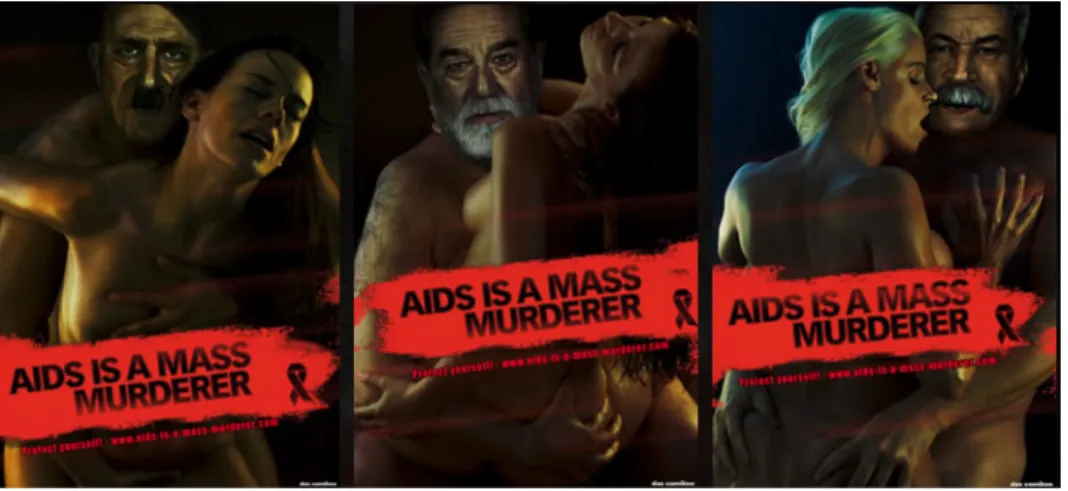
1. AIDS is a Mass Murderer Poster ... 61
2. Fits on every cucumber! ... 61
3. Satirical Warning ... 131
INTRODUCTION
SEEKING RADICAL AGENCY & AIDS
The working title of this work was “AIDS is Absurd,” which should indicate that this
study is not a typical one. In most contexts, reports on HIV/AIDS focus on how to quell,
overcome, or move beyond the trauma of the epidemic. Countless studies aim to identify the
nature of the virus and theorize how to control and, if possible, eradicate its presence in the
body. There are also many narratives, rendered and recorded in all types of media, that relate
the story of those who have succumbed to AIDS, as well as those who have survived.
Narratives that lend perspective on certain subgroups are also to be found. Since the mid
1980s, over two hundred contributions from all over the world to the genre of Global Queer
AIDS Cinema have narrated stories about gay men infected with HIV. What makes Queer
AIDS films particularly unique is the fact that a handful demonstrates the possibility for
radical agency in the face of a deadly epidemic. In contrast, most fictional and non-fictional
scholarly and popular renditions do not allow for such politically precarious gestures.
A theory that promotes the negotiation of radical agency from HIV/AIDS is risky
business. By agency, I do not mean activism or modes of survival. In theory, locating radical
agency in HIV means the representation of politically potent and controversial images and
ideas that engage with the aesthetics and ethics of death. Many people would surely find such
depictions repulsive, politically dubious, and/or morally defunct. Indeed, the aesthetics of
radical agency in and through death as I frame it here may be seen as equating to celebrating,
AIDS, and yet, I propose that there is precedence in their exhibition, specifically with regards
to a theory of ethics concerning endgame engagements. I call this theory an absurdist-ethics,
which I argue one may trace throughout time, exhibited in response to moments of greater
cultural trauma, including during times of epidemics, war, and genocide, as well as a retort to
even the most culturally minor moments of individual human engagement with death, and in
particular as related to those who participate in high-risk behaviors as modes of community
formation.
As I theorize in this paper, an absurdist-ethics is a theory of risk management, which
equation includes the possibility of yielding a model of life lived more intensely by indulging
in the absurd, in the grotesque, and in death. This viewpoint challenges hegemonic codes of
ethics represented by ideals associated with the philosophical tradition of Western
Enlightenment, rationalism, and Humanism, which dictates that life is to be valued above all,
and that sickness and death should be avoided, possibly at any cost. At the same time, an
absurdist ethics demonstrates a pervasive skepticism towards any transcendent notion of
good or evil. Instead, my model relies much upon an existential philosophical stance, insofar
as it explains why an individual would find humor in pain, erotize decay, and seek death, if it
equates to finding agency, and/or as a means to foster community, and/or perchance to
increase her or his quality of life.
A theory of an absurdist-ethics edicts that one risks one’s life in order to acquire a
standpoint of agency that may in theory yield catharsis, pleasure, and possibly, a
multiplication or increase of one’s quality of life for the price of intensity. Vouching
political standing, as well as social and familial support as a result of the exhibition of such a
radically unorthodox stance on life.
I contend that a theory of an absurdist-ethics is not, however, unique to the AIDS
epidemic, and must be set as well in relation to larger historical contexts of tragedy and
catastrophe, times during which I believe this same code of ethics has been exhibited, at the
very least in various cultural aesthetic forms of art. My project and its starting point focus on
a specific cultural-temporal point of reference, with the subgenre of AIDS film in the corpus
of Queer Cinema from the last thirty years. While conducting research in trends to the genre
over time, I discovered the presence of instances of radical modes of agency, evidenced from
the start, and up until the most recent additions to AIDS Cinema. I discovered three key films,
each of which depicts a specific yet different metaphor of agency concerning HIV. These
films may be dismissed as anomalies, but as I began to reflect on the political charge of each
film, I came to the conclusion that the ethical core of each narrative is the same. When
situated side-by-side, these films and their singular offerings of a narrative as a metaphor of
agency via HIV render a comprehensive model that points to my understanding of an
absurdist-ethics. When applying this model to the context of HIV/AIDS, one can better
understand how the trauma of HIV and AIDS, individually and as a collective human
epidemic, may be turned into an active production of complex forms of agency, a head-on
engagement with the pain of one’s inevitable death and the body’s decimation: how and why
one might, in forms of art and in modes of the ‘real,’ laugh, coddle, and/or acquiesce sexually
to austere engagements with politically contentious narrations of cultural trauma such as the
More specifically, from a Global Queer AIDS Cinema, I draw upon three metaphors
of agency in HIV. The three images engage with the topic of the epidemic through an
aesthetics of humor and the grotesque, as well as the eroticization of the virus marked by
high-risk behavior, and instantiate my theory of a radical absurdist-ethics. In Chapter one, I
introduce the first queer film that strikes me as belonging to the unconventional ethical
tradition of an absurdist-ethics, German director Rosa von Praunheim’s A Virus Knows No
Morals [Ein Virus kennt keine Moral] (1985). Through the placement of campy, controversial vignettes—AIDS concentration camps and live enactments of burials, for
example—the absurd as represented in Virus embodies an ethical stance, whereby one would
in theory embrace the horrific through a gallows humor in order to yield agency and invoke
systemic change necessary for social activism. In Virus, AIDS as visualized through the
aesthetics of the absurd is depicted largely by means of humor. I argue that in this film, the
model of an absurdist-ethics draws upon laughter as a form of engaging with the affect that
permeates the absurd. This humorous, absurd AIDS film therefore expresses at once a
disavowing laugh in face of trauma and tragedy, which I contextualize trans-historically in
the larger tradition of the absurd. I contend that the absurd permeates the art forms of those
artists responding to, and expressing an absurdist-ethics.
Virus is one of the very first films produced about AIDS in the mid 1980s, and the message that may be gleaned from a reading of the absurdist-ethics of the film invokes a call
to arms. In other words, I claim that von Praunheim made Virus in order to shock his
intended spectators, largely of the gay community in Berlin in 1985, into reassessing their
position vis-à-vis HIV. The absurdist scenarios surrounding the topic of the epidemic in the
fully understood the threat that the spread of HIV posed to them. By casting the most
extreme circumstances in Virus, one may imagine that von Praunheim hoped that spectators,
or better yet, a community of intended gay German spectators, would take heed and thereby
situate themselves thereafter more proactively with regards to their safety and that of others.
In turn, AIDS humor may induce community formation, which in theory, would be a
community of AIDS activists.
In order to demonstrate the larger implications and applications of my ethical model,
in this same chapter I compare AIDS humor to Holocaust humor, which I also identify as
participating in an absurdist-ethics. I build upon other scholars’ descriptions of how
Holocaust humor has been employed historically in order to explain more clearly the
dynamics at play, and the value in representing the unrepresentable in my ethical paradigm.
These depictions have in common the fact that most people may reject them as
counter-enlightenment, and/or morally and politically defunct. Still, a topic such as the AIDS
epidemic or the Holocaust may become so bogged down by the trauma of the event, that one
may find no other possibility of engagement. An absurdist-ethics illustrates how one may, in
theory, yield catharsis from the most extreme depictions of the unnamable by making use of
the most radical aesthetic designs from which to step back, consider, and come to terms with
that which may otherwise be inaccessible.
In Chapter two, I familiarize readers with the aesthetics of the grotesque as the second
key element of an absurdist-ethics. I discovered the image of the grotesque invoked by a
Hindi film from the Global Queer AIDS Cinema. Filmmaker Samy elucidates in Animal
[Mirugam] (2007) how it takes a radically grotesque and notably absurdist shock to reawaken
serial-rapist-turned-philanthropist. This film exemplifies why certain cultural art forms may depict
controversially what most would render a victimized, vulnerable body, such as the HIV
mythical body, alternatively as an eroticized, grotesque body, represented by the director as
an object not solely of disgust, but also largely of the spectator’s desire.
In terms of chronology, Animal is the most recent film produced, and the reading of
the narrative via a model of an absurdist-ethics suggests the director chose to depict the
disease through a radical, grotesque aesthetic in order to motivate spectators to think about
how even and despite the dissemination of information and medications concerning the
spread of HIV, there are still places in the world—and in this case, specifically those parts
where AIDS is most rampant, i.e., India—where not much has changed as in comparison to
North Atlantic countries in terms of controlling the spread of the virus. The film points at
how the locus of the virus has relocated to the economically poorer Global South, while the
Global North had the means to squelch the spread of the epidemic to a much larger extent.
Animal is, in part, a critique of the ineffectiveness of the Global North in disseminating power and knowledge in order to halt the continued growth of the epidemic in the Global
South. The narrative implies that an apathetic stance of governments and/or organizations
operating specially from within larger cities in the Global South have overestimated the
effectiveness of strategies they employ to educate persons living outside the center. The film
shows how these policies are not able to account for the fact that transmitted knowledge may
not be received as expected by those persons living in peripheral villages. As a result, minor
communities suffer most of all from lack of information about protection from the spread of
Like in the previous chapter, I set the historical backdrop of the aesthetic tradition of
the grotesque, calling upon similar cultural forms that also represent an absurdist-ethics. I
begin by drawing upon the grotesque depictions of HIV in a German anti-AIDS campaign,
which also notably summons up a comparison between Hitler and the virus. I glean from the
paradigm of absurdist-ethics to show how this advertisement juxtaposes desire and the
grotesque to prompt the viewer to challenge an assumed indifferent cultural stance towards
the epidemic, in particular in Germany, where the rate of infection has slowed dramatically
since the late 2000s in comparison to the ever-rising rate in the mid 1980s. Finally, I offer a
comparison between the narrative in Animal and other depictions of the grotesque, which
also employ the rationale of an absurdist-ethics.
In Chapter three and four, I approach a third and last image of an absurdist-ethics as
represented through a model of a high-risk sexual practice that in theory eroticizes and
embraces the virus. Presented in a third film of a Queer AIDS Cinema, directed by Italian
filmmaker Laura Muscardin, Days [Giorni] (2001), it delivers an intimate portrayal of
barebacking, which refers to a high risk gay sexual cultural practice in which gay or bisexual
men in theory have sex with other gay or bisexual men in spite of and because of the
possibility that a partner may contract or infect another with the HIV virus. Just like the game
of Russian roulette, the enticement of the mythology surrounding the practice of barebacking
lies centrally in the risk, and in this case, in one’s vulnerability and/or contagious status. This
instantiation of an absurdist-ethics is perhaps the most radical of the three presented in this
study, and the image of barebacking serves as a radical representation of my model of an
absurdist-ethics. I set barebacking, as a metaphor of radical agency, to the backdrop of a
specific models, such as Socrates and Foucault’s discussions on strategic relationships, as
points of comparison and contrast to show how artists and thinkers may have historically
invoked a model of an absurdist-ethics as represented in the mythical guise of death as
possessing transmutable powers of agency.
While most people would only acknowledge the risk of having unprotected sex when
HIV is in play, the model of barebacking in the film Days focuses instead more centrally on
reward, which is crucial to my paradigm. I show how a theory of an absurdist-ethics explains
how the reward in this scenario is that some gay men, through the act of barebacking, would
feel a great amount of pleasure that goes beyond mere sex, whereby becoming infected with
HIV equates to a form of initiation into a community of belonging. In the context of the film,
and for the purposes of me elucidating on the model of an absurdist-ethics, this community
may be understood as a mythical construction of the ‘gay community,’ and at the same time,
a virtual community of barebackers in the Internet. Community in this vein would always be
virtual and mythical. At the same time, the reward is coded as real, but so is the exposure
from the risk, i.e., in this model, one may assume that most barebackers will eventually
contract HIV, and likely die from AIDS.
Days is situated between Virus and Animal in terms of chronology, whereby the director’s stance towards the virus comes out a moment in time a few years after the
introduction of more effective medicine therapies in the late 1990s in the United States and in
Western Europe, and in the case of the film, in Italy. My reading of Days through a lens of an
absurdist-ethics first suggests that director Muscardin focuses thematically on what some
may read as an unconcerned, and therefore riskier or irresponsible position towards the
As a comparison, in Virus, von Praunheim invokes a model of an absurdist-ethics,
seeking radical agency in absurdist aesthetic depictions of HIV charging spectators with a
bolt of energy to push them to acquire knowledge concerning the virus and take heed. In
Animal, Samy gleans agency from the grotesque and its rendition of HIV, in order to jolt spectators out of any possible delusion that the dissemination of knowledge has somehow
proved effective with regards to the Global South. Finally, as it is done in Virus and Animal,
in Days Muscardin also draws possible radical agency from the provocations of her model of
barebacking, which she ascribes to an absurdist-grotesque aesthetics. In a way, the
representation of HIV in Days is the pinnacle of the most extreme and fullest representation
of an absurdist-ethical paradigm put into film. Muscardin gleans agency from the intended
epistemic shock the film’s thematic introduces. Even if seemingly mythical, the film
exemplifies how an absurdist-ethics may actually look like on the ground through an
aesthetic representation of the absurdist-grotesque model of barebacking. While a director
may seek agency in radical models that depend upon an absurdist-ethics, in order to provoke
spectators to reevaluate their own positions toward the epidemic, Days goes one step further
in providing a model that is based on a minor community that may in reality put into practice
this radical form of ethics.
Muscardin suggests in her film that even when knowledge, power, and medication are
disseminated effectively in the portrayed society, the assumed or intended result of that
distribution may still not take into account the choices of individual human agency. In other
words, while one might expect that when individuals have the tools and knowledge to control
the spread of the virus throughout the population as well as in the body, some will however
practices and take medications to control the occurrence of opportunistic diseases, Muscardin
offers the point of view of a model of a minor community, that of so-called barebackers, who
react in an oppositional manner by continuing to spread the virus with purpose, in the name
of the community, as well as in the name of rugged individualism. The director shows that
barebackers choose to court death as a radical form of agency in the face of sickness, dying,
and death.
I contend that the model of barebacking in Days provides an instantiation of the
aesthetics of an absurdist-ethics, whereby to give or to contract HIV when barebacking
would be read as a form of radical absurdist revolt. This model suggests, however
problematically, that the participation in an absurdist and self-annihilating activity like
barebacking may be read not only as a form of interpersonal enlightenment, as other scholars
suggest (cf. Bersani, Dean), but also and even more significantly, as an intellectual and
aesthetic experience grounded in an ethical core. To illustrate Muscardin’s model, in Chapter
four I approach testimonies from blogs, chat rooms, medical journals, and scholarly books
and articles on the topic of barebacking in order to give readers a better idea of some, but
certainly not all, real models of barebacking put into practice. Following the logic of the
philosophical framework of absurdist-ethics, I thus read barebacking, as represented largely
through Muscardin’s viewpoint, as representative of a prototypical form of absurdist revolt.
My study shows that this is one of the few possible ethical forms of living within the realm of
a despotic and politically antagonistic, if not defunct climate of catastrophe and trauma,
present in the wake of the AIDS epidemic, a time I characterize as belonging to a postmodern
In Chapter five, I identify and deepen my understanding of the nature of the particular
aesthetic model that I argue goes hand-in-hand with the paradigm of an absurdist-ethics,
which I denote as culminating in the aesthetic form of the esperpento, a term coined and
illustrated in the works of early 20th
century Galician writer Ramón del Valle-Inclán
(1866-1936). The esperpento may be understood broadly as the representation of
society [as] reflected in a concave mirror that distorts physical reality
grotesquely, which reflection becomes a metaphor for internal deformity. This is part of Valle-Inclán’s technique and the concave mirror one of the tools he employs. In this perspective, he is allied to the aesthetics of Expressionism and Futurism: “Men and objects will be stripped as clean as possible and looked at through a magnifying glass for great effect …The easiest way to do this is through the grotesque.” (Lima, 33; Lima quotes Valle-Inclán)
I contend that works of art that engage with an absurdist-ethics deliver representations
of traumatic events by drawing upon the tradition of both the absurd and the grotesque,
oftentimes with the aim of provoking the viewer intellectually through laughter, disgust, or
desire. In the context of HIV/AIDS, the affect of the esperpento as a politically charged form
of an absurd-grotesque aesthetics, calls forth the deepest fears the epidemic invokes. Affect
reveals itself visually as death, or more complexly in one’s psyche, as a schizophrenic
multitude of affective forms. This paradigm opens channels, however controversial, for
political agency and change in what may otherwise appear as a closed down postmodern
space. In other words, change only occurs because the protagonist is physically and morally
grotesque, and change is induced only when he is infected by HIV, dying, and ultimately,
possibly only after he has succumbed to death. The visualization of the esperpento aesthetic,
as configured in the absurdist-grotesque fashioning of the virus should, in theory, incite
The esperpento represents a way of signifying and understanding the visual and/or
situational representations of a mythical body infected with HIV as something that has other
facets beyond physically and psychologically distressing individuals and communities. When
read through a theory of absurdist-ethics, the mythical AIDS body, as a gestalt of the
esperpento, may be read as a representation of agency. This agency is incarnated through an
intentional humorous and repellant engagement with death and decay, and even through its
eroticization. The esperpento makes a production of the role of the depersonalization of the
individual, in lieu of the collective mass, which Valle-Inclán felt could be described and
explained through
Freudian evaluation of human behavior, disgust with the social and economic evils of industrialization, and the ravages of war [which Valle-Inclán depicted in a manner not dissimilar to the masks of Carnival players] in caricatures, stylizations, puppets or marionettes rather than psychologically developed characters. Such types are farcical rather than tragic, however, because the playwright’s desire is to satirize [as a] serious statement on the fallen nature of humanity, the resultant is no longer farcical. (Lima, 32-33)
From these cursory definitions of the esperpento, one may already visualize the role such an
aesthetics plays in my aesthetic-ethical paradigm, in particular the reference to the use of
mirrors that warp what is reflected in them—also an allusion to the carnivalesque, as a means
of self-discovery and as a medium from which to glean enlightenment. This is the function of
the lens of a model of absurdist-ethics as a philosophical tool. The warping mirror as a
metaphor of my model is essentially a grotesque lens, signifying a doubling and a mirroring
of reality, whereby the distorted images the spectator perceives are, in theory, a ‘truer’
representation of reality, which is distorted. Reality is distorted. Yet, the spectator is unable
to make this connection until s/he looks into the mirror and then, looks back critically at
aesthetics, may be extended to other cultural moments of tragedy to understand the ethically
complex possibility for agency, even though it may be considered by the status quo as
counter-enlightenment, profane, immoral, and disgusting representations of death coded as
forms of desire.
I emphasize that in the space of this study, in the case of barebacking in particular,
while I do discuss some realities of the phenomena, versus the mythology surrounding it, I do
not aim to provide here any psychological, cultural-anthropological, or sociological rendition
or conclusions about its ‘real’ practice. More importantly, it is not my intention to present
here a defense à outrance of the practice of barebacking, nor a heroization or glorification of
those involved in its practice. I understand that the issue of barebacking has produced deep
controversy among many sectors of society, as well as in different communities affected by
HIV, but my interpretation of barebacking is one that sees it as a cultural practice that may be
assessed to gain a new, complex perspective of ethics today. This evaluation is not
synonymous with an encouragement or an apologia of barebacking. Instead, what I intend is
to consider how our culture is more and more structured around the inherited idea of freedom,
and that there are spaces, like barebacking, that test its boundaries. My analysis should be
read in terms of the philosophical and literary as a work of comparative literature and cultural
studies. I am interested in the cultural manifestations of this model of absurdist-ethics in the
aesthetics exhibited in certain art forms, chiefly in queer cinema. Similarly, I am only
interested in the work being done in terms of aesthetics and not the actual work a spectator
and/or even director or author may undergo in terms of trauma work or trauma theory, two
In terms of the discussion of films, I focus more on the narrative, but not without a
discussion of their visual aspects. While it might be argued that mainstream works of film
studies should or do focus more on cinematic techniques than narrative, in truth, many
scholars that engage with minor cinemas, Queer Cinema included, find the narrative equally,
if not oftentimes more important than cinematography. For example, Michele Aaron suggests
that many films of the New Queer Cinema sport poor aesthetic strategies (Aaron, 3). The
reason for this seemingly unorthodox approach, in the case of minor cinema, is that many
directors are novices to the practice, have small budgets, and focus more explicitly on getting
a ‘minor’ story across. The object of the queer film theorist is not necessarily analyzing only
those films with sophisticated film techniques, but instead even those films, however artless
in terms of cinematography, which suggest a gay subtext. As Susie Bright points out in
Celluloid Closet (1995), a documentary on history of queer cinema, “It’s amazing how if you’re a gay audience and you’re accustomed to crumbs, how you will watch an entire movie
just to see somebody wear an outfit that you think means that they are homosexual. The
whole movie can be a dud, but you’re just sitting there waiting for Joan Crawford to put on
her black cowboy shirt again.”1
In other words, what defines queer cinema is not methods of
cinematography but instead the queer narrative. Therefore, when I discuss queer films in this
paper, I too focus actually more on the narrative, as that is central to my argument, but I will
also highlight the cinematography when it impacts the narrative in compelling and
sophisticated ways. Another caveat is that the characters depicted in the films, or the
narratives that unfold around them, do not necessarily represent the real. In the particular
Absurd sub-genre of a Global AIDS Cinema, these are not fully developed characters, but
instead flatter ones, although in the complex guise of the comical, the absurd, and the
grotesque. In fact, in the case of the minor cinemas, as I discuss more completely in the
ensuing chapters, the mythical persona of persons with AIDS, particularly those represented
in these three films, must be understood as fictional, mythical, and fantastical, and in any
case, purely satirical.
While my own research started in film, and my theory developed in response to the
connections I made between the films Virus, Animal, and Days, I do not see this ethical
model as being limited to queer content, nor just to the medium of cinema. Instead, I want
my model of absurdist-ethics to be a wide-wielding interdisciplinary tool. My project is not
just to divulge the impetus behind AIDS humor, grotesque representations of the
eroticization of the virus, or barebacking, but also to display the wider historical legacies,
implications, and evidence of the framework this model supports and produces. To bolster
each chapter and to more sufficiently illustrate a comprehensive model of an absurdist-ethics,
I provide evidence and examples chiefly from literature, painting, the theater, and the digital
media of the Internet. In doing so, I want to demonstrate that an absurdist-ethics may be
applied to many endgame historical topics and events, not just to the AIDS epidemic. By
providing such exemplars as a work of comparative literature, this conglomeration should
supply a necessary well-rounded, interdisciplinary approach of cultural studies, which helps
readers grasp the widespread indications and implications of my model of absurdist-ethics.
Finally, I also theorize how the exhibition of an absurdist-ethics emerges during
periods of catastrophe or crisis, as part and parcel of a postmodern mentality, a time in which
metaphors of endgame engagement are more common, sometimes including radical
as seductive, indulgingly disgusting, humorous, and even delightful. This course of action is
set up in opposition to what some would read as the ideals of rationalism, humanism, and the
enlightenment, which would dictate that fair and just representations of those affected by
illness and catastrophe would and should only be read as victims, which oftentimes renders
such subjects void of agency. Consistently, I argue that such moments of rupture express
postmodern mentalities that arise in times of chaos and disillusion when hegemonic ideals go
bankrupt. In such moments, I theorize, one can more clearly identify the simultaneous and
non-coincidental emergence of an absurdist-ethics, which promises agency where it
otherwise would not have been possible.
When I use the term postmodernity, I understand it as Fredric Jameson formulated.
He defined it by the fact that people today live in an age that
has forgotten how to think historically in the first place. In that case, it either ‘expresses’ some deeper irrepressible historical impulse (in however distorted a fashion) or effectively ‘represses’ and diverts it, depending on the side of ambiguity you happen to favor. Postmodernism, postmodern consciousness, may then amount to not much more than theorizing its own condition of possibility, which consists
primarily in the sheer enumeration of changes and modifications. Modernism also thought compulsively about the New and tried to watch its coming into being (inventing for that purpose the registering and inscription devices akin to historical time-lapse photography), but the postmodern looks for breaks, for events rather than new worlds, for the telltale instant after which it is no longer the same […].
(Postmodernism, ix)
The postmodern mentality or condition is not a new phenomenon, but an ahistorical event
that can be traced along with the existence of the absurdist-ethical theory I am purposing,
through the deliberations of a mode of what I would qualify more closely as existential
philosophy. In the context of this study, I demonstrate most specifically how an
absurdist-ethics may be traced in cultural art forms produced in the wake of post-AIDS culture, which
What ultimately is at stake in this study is my offering of a tool to better understand
the instantiation of certain representations of the human condition under duress, aesthetic
forms that appear politically radical and abhorrent, and yet suggest evidence of the possibility
of radical forms of agency, underpinned not by absolute nihilism or destruction, but instead,
however controversially, by an ethical paradigm that promises a moment of reprisal in the
face of death, whether that be an epidemic, a holocaust, or the thought of one’s own
inevitable death and demise.
While I argue that this model is not new, I am however the first to suggest this
particular lineage of thought. I trace its origins through a path of thinking that philosophers
have followed long before, including Kant’s theory of enlightenment, as well as Nietzsche
and Camus’s conception of ethics. In order to expand the understanding of how the body is
fashioned and erotized in death, read through the lens of the absurdist-ethical paradigm, I
incorporate Deleuze’s ideas on the mythical configurations of the body as related to the
aesthetics of the esperpento. More specifically, I insert my own rendition of a Kantian
enlightenment, which I argue interconnects with my absurdist-ethics. When assessing
absurdist AIDS films, and taking in absurd-grotesque representations of HIV, I propose that
such art forms gesture towards and/or induce provocation, so that in theory a spectator might
experience a moment of recognition and reevaluation in terms of her or his own position
vis-à-vis moments of cultural crisis, as well with regards to his or her own relationship to death.
A more nuanced exploration of the key term of the absurd is required here, especially
because I also draw my theory of an absurdist-ethics from specific considerations of Camus
on the absurd, as a form of metaphysical and physical revolt, and its intersection with
claim on the belief that life has no moral value. But by taking into consideration questions of
agency, I also develop a derivative of Camus’s theory of the absurd that is more politically
potent. First, when I use the word absurd, I initially refer to what Camus insists on in The
Myth of Sisyphus (1942): “I judge the notion of the absurd to be essential and consider that it can stand as the first of my truths,” which must be accepted in order to comprehend the
phenomenological and intellectual experiences of one’s world, to ultimately lay bare the
nature of consciousness and human existence (31).2
Engagement with the absurd takes place
when the individual becomes aware of life itself through “Cartesian, solipsistic, existential
encounters with truth, morality, ethics, and theology” (Sagi 20). The absurd is a central
component to life but, as theorized by Camus, people do not or cannot come to this
conclusion unless they have suffered and found a vehicle, an absurd one, through which they
may navigate their state of suffering and discover its absurdist core. In Camus’ words:
“Living is keeping the absurd alive. Keeping it alive is, above all, contemplating it” (Myth
54). Camus continues that the absurd man is one who “assured of his temporally limited
freedom, of his revolt devoid of future, and of his mortal consciousness, lives out his
adventure within the span of his lifetime” (66). For the absurd man, “the absurd is his
extreme tension, which he maintains constantly by solitary effort, for he knows that in that
consciousness and in that day-to-day revolt he gives proof of his only truth, which is defiance”
(55). Revolt, both metaphysical and physical, is the key form of action and agency in order to
accomplish the goal of seizing and sustaining awareness. In contrast, suicide would be the
negation of life and its value.
2 This quote has been widely translated as: “The absurd is the essential concept and the first truth.” However, in
To further my inquiry, I look to Nietzsche, who also provides a helpful illustration of
ethics that complements Camus’ ideas. Nietzsche’s conception of an ethics of life relies on
the master/slave dialectic—notably, a strategic relationship—whereby ethics or the “noble
mode of valuation” is the will of the master according to his taste and preference
(“Genealogy,” 10). The antithesis of ‘good’ and ‘evil’ is dependent on a bureaucracy of
power. Nietzsche turns this constellation on its head improbably, reversing the valuation. As
reported by Nietzsche, ethics are wielded not by the master, but in truth by the slave. In his
work “On the Genealogy of Morals” (1887), he clarifies:
The slave revolt in morality begins when ressentiment itself becomes creative and gives birth to values: the ressentiment of natures that are denied the true reaction, that of deeds, and compensate themselves with an imaginary revenge. While every noble morality develops from triumphant affirmation of itself, slave morality from the outset says No to what is ‘outside,’ what is ‘different,’ what is ‘not itself’; and this No is its creative deed. (472)
Forced to its furthest conclusion, Nietzsche provides a malleable code of ethics that does not
hinge solely on ideals of good and evil, but instead on truculence or acts of revolt, crimes
committed by the Untertanen or the disenfranchised minorities as represented by the masses.
Their offenses are what Nietzsche deems the creative deeds of revolt. One therefore speaks
of an ethics of difference; this exception circumscribes what is good and what is evil, and
replaces it with the right to life that underpins the justification of the so-called enlightened,
‘Western’ cultural conceptions of human rights.
Finally, I rely on Deleuze to help me further explain the dynamics of an ethics that
embraces an absurdist-grotesque aesthetics. I identify this dynamic in radical forms of
exhibition of the human, visualized or portrayed in art as the inhuman, the animal, or the
unrepresentable. Two Deleuzian concepts are particularly relevant here: a narrowed form of a
specifically as a becoming ethical, Deleuzian scholars Ian Buchanan and Adrian Parr deduce
that:
The qualitative leap through pain, across the mourning landscapes of nostalgia, is a gesture of active creation, one that affirms new ways of belonging. It is a fundamental reconfiguration of our way of belonging in the world that acknowledges the pain of loss whilst moving beyond this pain. This is the defining moment of becoming-ethical: the movement across and beyond the pain, loss and negative passions. The real aim of the process is to overcome the stultifying effects of passivity that pain can produce. In this way, the internal disarray, fracture and pain provide the ethical conditions for transformation. (89-90; my emphasis)
Becoming ethical, as I apply it in this study, is a becoming of an absurdist-ethics across the spectrum of human experience, including within the experience of those individuals and
communities confronted historically with HIV/AIDS, such as the queer community.
Becoming absurdist-ethical affects the course by which minor communities might
metaphorically signify alternate allegiance. Becoming absurdist-ethical is also an expedient
by which to visualize and reflect on the self as an individual and as a collective, and also as a
minor subject, taking into account one’s body, tongue, and mind.
I rely on Deleuze and Guattari to extend my argument to humor, whereby humor is a
mechanism through which a collective subject can be perceived through language, as a
two-dimensional object; as a surface, and as a body without organs, as pure affect. Absurdist
humor may be perceived as an ethical form, not one that is easily identifiable, but instead one
that follows rules applicable only to a minor level. The source of origin, in a sense, is always
displaced; and upon closer inspection, only chaos is to be found. Only by following the
greater gesture of the system, does the chaos, which is made up of what Deleuze calls
‘nomadic singularities’ or ‘mad particles,’ also take shape in the form of signification, and
thereby assumes real ethical value. Deleuze illustrates this point in his work on The Logic of
The tragic and the ironic give way to a new value, that of humor. For if irony is the coextensiveness of being with the individual, or of the I with representation, humor is the coextensiveness of sense with nonsense. Humor is the art of the surfaces and of the doubles, of nomad singularities and of the always displaced aleatory point; it is the art of the static genesis, the savoir-faire of the pure event, and the ‘fourth person singular’—with every signification, denotation, and manifestation suspended, all height and depth abolished. (159-160)
In this case, one should not read the affect of humor, the grotesque, or the grotesquely erotic
as nonsense, i.e., as that which is opposed to sense, but instead, as having one and the same
makeup and structure as sense, in the same fashion as the warping mirror I mentioned when
discussing Valle-Inclán’s esperpento. On the localized level, that which appears to be
nonsense may be guilelessly recognized as only nonsense; but on the minor level, nonsense
and sense together have a clear interdependent, dialectical relationship and purpose, whereby
the product of that relationship is an absurdist-ethical stance towards enlightenment. They
enact a mechanics by which the absurd expresses an ethical charge. Within an
absurdist-ethical paradigm, one relies on radical forms of humor, the grotesque, or the erotic, to exact a
call to an unorthodox, counter-hegemonic, yet for some, in theory, a more intense, and
controversially, perhaps even more valuable, existential state of being in a professedly
senseless historical postmodern state, in particular after tragic events in world history.
Deleuze would nevertheless not agree entirely with my interpretation of humor,
because he believes that the absurd is a dichotomous appellation, whereby nonsense is
diametrically opposed to sense, instead of both terms being categorized as part and parcel of
the same body. He proposes that
As I espy it, Deleuze reduces the complexities of the absurd in comparison to how many
other philosophers, present and past, have applied it productively. In my opinion, in the
excess that a dialectics between sense and nonsense produces, one identifies much queer
potential and energy. As an illustration, Wim Tigges in An Anatomy of Literary Nonsense
(1988) points out that: “In nonsense, language creates a reality, in the absurd, language
represents a senseless reality” (128; emphasis in the original). This reality is not withal senseless itself. Put plainly, I do not read absurdist art as meaningless. I interpret those works
as critical of greater social and political issues, but in a manner that is not immediately or
easily recognizable. As it happens with any innovative art, one has to work oftentimes to
unravel and decode the messages at hand. This intelligence is also often multiple and
convoluted in its own right, but valuable, philosophically speaking, nonetheless.
Michael Holquist, in his essay on “What is a Boojum? Nonsense and Modernism,”
also challenges Deleuze, putting his definition of the absurd on its head. He frames his
argument as such: “The absurd points to a discrepancy between purely human values and
purely logical values …The Absurd is a contrast between systems of human belief, which
may lack all logic, and the extremes of logic unfettered by human disorder. Nonsense is play
with order only” (129). The absurd reduces the human to an animal and demands that one ask
fundamental questions about logic, reason, and above all the value of ethical assertions. In
this configuration, one is looking for absolutes. What concerns me here again is the ethical
that underlies the animal, even the non-living, the alien, the absent, the unthinkable, and the
unrepresentable, all of which flourish only on a micro level.
Consequently, as Tigges invokes, “I think it is not so much the aim of the absurdists
meaning for man ‘(c)ut off from his religious, metaphysical, and transcendental roots’ (Esslin
1968: 23, quoting Ionesco)” (129). This meaning makes more sense in light of what writers
such as Samuel Beckett, Albert Camus, James Joyce, and Franz Kafka were doing, all of
whom employed the absurd in their writing in one fashion or another, and which I reference
and discuss further in ensuing chapters. These artists were not trying to tear down the world
and make it nonsensical, nor depict it as void of sense, nor structure; but instead they
endeavored to evince life’s complexities and paradoxes, its disappointments, and how this
forever romanticized and oftentimes religiously-laden fate of death and dying is simply
unavoidable and even, however bitter that sounds, candidly logical. Even if the world seems
to have no meaning because signification is not to be found, and bodies appear beyond
representation, humans will inevitably create structures of substance, and invent other modes
of living to fill the psychological void, to disavow the meaninglessness.
In consequence, absurdist behavior can in part be described as a form of fatalism,
whereby one tests the limits of the written or spoken word, the artist’s signature, or even the
penetration and contamination of the flesh, as it happens in barebacking. As Stanford Lyman
and Marvin Scott address in A Sociology of the Absurd (1989):
One response to the anxious and frustrating awareness of being on a fatalistic time track is the attempt to gamble with fate by seeking to alter the seeming inevitable. […] He or she can subjectively experience both personal freedom and active control over events. One manifestation of this phenomenon involves taking risks. Flaunting fate and history’s directive, a man or a woman may allow the free play of impulses to disorganize the predicted, frustrate the dictated, or wreak havoc in the ordered world. (36)
At the same time, one must recognize the dynamic at work here with respect to gestures of
fatalism and even realism as it applies to postmodernity, and in particular how it applies to
absurd in his pivotal work on The Theater of the Absurd from 1961. In this essay, Esslin theorizes:
For [the absurdist artist,] there is no contradiction between the desire for realism and the basic absurdity of the situations that inspire him. Like Ionesco he regards life in its absurdity as basically funny—up to a point. ‘Everything is funny; the greatest earnestness is funny; even tragedy is funny. [We try] to get to this recognizable reality of the absurdity of what we do and how we behave and how we speak.’ (206)
One may think of absurdist art, therefore, as something that represents at once the inadequacy
of language, the paradox of meaning and sense, as well as an alternate world that is tragic,
grotesque, self-reflexive, and philosophical. This absurdist world must have at the same time
its own logic and its own absurdist-ethics. This kind of ethics functions through a dialectics
of living and death. That which pervades or fills up the body of this absurdist-ethics is the
affect of laughter or humor, in the guise of the absurd and the grotesque, as well as that
which shocks and scares, including high-risk acts of revolt.
I aim to provide a comprehensive model of an absurdist-ethics modeled on examples
of HIV as represented in Queer Cinema, but I also hope that this new lens of ethics might
find further application as a philosophical tool. An absurdist-ethics should prove useful to
scholars considering more sympathetically why certain individuals and/or sub-cultural
groups might whole-heartedly and in good conscience participate in radical modes of living
that the rest of the world might find abhorrent. Specifically, my model of an absurdist-ethics
should provide a means to better understand how some may justify ethically doing that that
which most people in the world would deem unthinkable, because in theory, and however
risky, even the realm of the unthinkable may provide agency for some.
In conclusion, I claim that an absurdist-ethics in essence proposes that within the
and harmony. Therefore, at its most radical conclusion, laughing at that which is taboo,
eroticizing decay and death, and invocating high-risk models of behavior such as
barebacking might be read as metaphors for postmodern, consensual living, dedicated to
certain kind of quality of life. In this context, such endgame engagements would not
represent delinquency, immorality, or evil, but instead in fact possibly virtuosity, health, and
the good. Within the logic of the model of an absurdist-ethics, even such radical mythical
configurations could be considered moral agents within the theoretical parameters of
postmodernity, and capable perhaps even of inciting a political charge in spectators, which at
the very least may compel the viewer to reassess their own philosophical position vis-à-vis
their own ethical stance on quality of life.
CHAPTER I
AIDS HUMOR: EIN VIRUS KENNT KEINE MORAL [A VIRUS KNOWS NO MORALS] 1985
Did you hear about the two Polack junkies? They were shooting up one day, and one of them took the needle and shot up. And then the second one took the needle from the first one and shot up with it. The first Polack said, “Are you crazy? Why did you shoot up with the same needle I used? Don’t you know I have AIDS?” And the second Polack said, “Oh, that’s OK. I’m wearing a condom.” (Goodwin, More Man Than You’ll Ever Be: Gay Folklore and Acculturation in Middle America, 84) The death of 30 million people is no laughing matter. It is tragic, and the epidemic’s impact
on human civilization cannot be described adequately; but that does not stop people from
trying to put their thoughts, experiences, and emotions about that event into words,
principally through media or the arts. To laugh or make jokes about HIV and AIDS sounds
perhaps just as “barbaric” as Theodor W. Adorno deemed art after Auschwitz.
In order to demonstrate the larger implications and applications of my ethical model,
in this chapter I compare AIDS humor to Holocaust humor, which I also identify as
participating in an absurdist-ethics. I build upon scholarly descriptions of how Holocaust
humor has been employed historically in order to explain more clearly the dynamics at play
and the value in representing the unrepresentable in my ethical paradigm. In a second
instance, I introduce the first queer film that strikes me as belonging to the unconventional
ethical tradition of an absurdist-ethics, German director Rosa von Praunheim’s A Virus
example—the absurd, as represented in Virus, embodies an ethical stance whereby one would
in theory embrace the horrific through a gallows humor, in order to yield agency and invoke
the systemic change necessary for social activism.
Following this line of logic, one may better understand why Adorno suggested that
there may be no other way to represent the aesthetics of a culture marked by atrocity or
tragedy than besides through the lens of the barbaric. In his essay on “Cultural Criticism and
Society, ” published in 1955, Adorno implied that one must recognize the grotesque nature of
the act of poetry writing in Germany after World War II (WWII) in order to understand the
nature of aesthetics in the post-Holocaust cultural landscape:
Cultural criticism finds itself faced with the final stage of the dialectic of culture and barbarism. To write a poem after Auschwitz is barbaric. And this corrodes even the knowledge of why it has become impossible to write poetry today. (Prisms, 34)
In other words, after WWII, any creation of art in the name of culture can only reify the
barbaric culture that produced the Holocaust. Calling art culture, instead of a product of
barbarism, is an act of denial that is symptomatic and at the same time reinforces the knowledge-power paradigm that participates in perpetuating the lie that German culture
could be anything but barbaric after the fact. If one applies this dictum to the AIDS epidemic,
one might say that anyone who could conceive of a comedy about AIDS is disrespecting the
lives of those who have fallen victim to the virus. Even more, one could accuse such
directors of being homophobic. Following this logic, to call a comedic AIDS film a work of
art is just as nonsensical as calling a poem after Auschwitz a work to be commended as high
Inevitably, from such catastrophic events arise questions about the ethics of life and death. In
Adorno’s case, he exacts that “Auschwitz confirmed the philosopheme of pure identity and
death” (Negative Dialectics, 362). The only viable solution to living after such a happening
might oftentimes mean, in truth, behaving in absurd ways through habits that may discern
themselves in cultural forms, more often than not, as something humorous; take the work of
playwright Samuel Beckett for instance.
Many Beckett scholars, such as Lois Gordon, read his work as “a product of and
testament to his times;” a time of devastation (5):
Beckett witnessed, literally, extremes in human destruction hitherto inconceivable to the civilized mind. He lived through two terrible depressions […]; two world wars; and virtually two civil wars […]. He witnessed the power of totalitarianism as it swept through the modern world […]. Throughout, one must speculate, he could not help but observe the degrees of caring and indifference, of pettiness and megalomania that accompanied each event—the panoply of human behavior, from self-sacrifice to utter barbarism, that were the personal and national responses to each of these occurrences. (6)
Gordon draws upon Beckett’s so-called “siege in the room,” a phrase he coined to describe
his most creative period, after WWII. During this time, Beckett wrote his influential play,
Waiting For Godot (1948-1949). One may reasonably accept Gordon’s hypothesis that one may trace “how the world from 1906 to 1946 formed the man who would create the
definitive literary forms of our time” (6). Beckett was writing in a post-world war climate,
which I would characterize as maintaining a postmodern mentality of political impassivity, in
which people were trying to bespeak the atrocities of the Holocaust and the atomic bomb. It
figures that Beckett does what I allege many AIDS films do; he uses humor as a means to
express very serious issues of identity, life, and death in response to a time marked by
Beckett’s play Endgame (1957) is a good example of his writing that expresses a
process of an impossible Vergangenheitsbewältigung [dealing with the past]. This drama,
which Beckett considered one his darkest and most absurd, is set to the backdrop of a
wasteland, a reflection of the post-WWII political climate. The main protagonist Hamm is
confined to a chair, while his servant Clov must forever wait upon his master, always on his
feet, wanting to leave, but never mustering up the energy. Hamm’s legless parents live in
trashcans and continually bicker about banal issues. Beckett describes how Endgame was
“rather difficult and elliptic, mostly depending on the power of the text to claw, more
inhuman than Godot” (qtd. in Oppenheim, 290, fn. 8). Clearly, the author was not striving to
write a text that was sympathetic, overtly mournful or soothing, but one that “clawed” at the
truth of the near impossibility of conceiving of a viable ethics by which to abide after WWII.
The narrative should be read as an allegory of the impossibility of agency in the post-war
political climate. The palpable absurdist-ethical paradigm therein expresses itself as an
affective product of humor evinced by the absurdist strain of comedy.
Nell, Hamm’s legless mother, delivers the telling line in Endgame, which makes no
mistake about the drama’s correlation between humor and the absurd: “Nothing is funnier
than unhappiness […] Yes, yes, it’s the most comical thing in the world. And we laugh, we
laugh, with a will, in the beginning. But it’s always the same thing. Yes, it’s like the funny
story we have heard too often, we still find it funny, but we don’t laugh any more” (19).
From the perspective of an absurdist-ethics, Beckett was able to express the philosophical
conundrum experienced by many after WWII, when people inquired how a god could allow
such destruction, such suffering, and the death of an estimated 53.5 million lives. Beckett
shaken human relationship to values, morality, and the notions of right and wrong, or good
and evil.
The war forced people to experience an existential crisis, compelling them to question
and reevaluate the nature of human existence and human society. I argue that if one were
only to accept the hegemonic dogma at that time of crisis, be it that of the Church,
rationalism, and/or humanism, without questioning its core, one may not achieve a
meaningful degree of reflection or catharsis. Only through a model of ethics that provides an
alternative means to distance oneself from the subject at hand, such as the controversial yet
viable absurdist-ethics, can one possibly engage philosophically with subjects that are shut
down by a paradigm of ethics that has failed to save millions of people from death and
destruction.
Nevertheless, an absurdist-ethics is not precipitated only on notions of anguish or
grief. In the case of Beckett, one may also discern sentiments of hope. Beckett’s pessimistic
dramas depend on an ethical framework that allows for the possibility of testing viable ways
to live. In Aesthetic History (1970), Adorno, who was a contemporary critic of Beckett’s,
discovered ethical value in the author’s craft and especially in his application of the absurd:
Beckett’s plays are absurd not because of the absence of meaning, for then they would be simply irrelevant, but because they put meaning on trial; they unfold its history. […] Today this is the capacity of art: Through the consistent negation of meaning of artworks. Works of the highest level of form that are meaningless or alien to meaning are therefore more than simply meaningless because they gain their content (Gehalt) through the negation of meaning. (201)
Just as an absurdist-ethics appears at first to prescribe a negation of life through the
embracing of death, absurdist comedic art forms like Beckett’s dramas are in truth invested
Following Adorno’s lead, Gilles Deleuze and Félix Guattari describe the existential
transformation, which the Jewish people undertook as a devastating result of becoming
exiled or becoming “nomadic:”3
Let misfortune befall us: this formula punctuates Jewish history. It is we who must follow the most deterriotorialized line, the line of the scapegoat, but we will change its sign, we will turn it into the positive line of our subjectivity, our Passion, our proceeding or grievance. We will be our own scapegoat. We will be the lamb. (135)
In a similar way, the mythical configuration of the ‘LGBTQ community’ may be read as
deterriotorialized, a condition some have called a ‘queer diaspora,’ part of what some
consider a minor cultural diaspora. Absurdist art represents a facet of such minor diasporic
cultures which have been metaphorically lost and which yet may possibly be regained
through the belonging and allegiances within that same minor community. Such art forms
would express, complex moments of subjugation, dislocation, and even death, and at the
same time a reunion, overcoming, survival, and betterment in the quality of life as a result of
active engagement, intellectually and/or spiritually, in the cultural construction of the minor
community.
To better understand the dynamics of absurdist art as part and parcel of minor
cultures, I look to how Deleuze and Guattari assumed the term as descriptive of Franz
Kafka’s writings. The authors see Kafka’s work as prototypical illustrations of that which is
humorous and yet deeply serious, anarchic, and yet still very potent politically as a mode of
agency. They argue that from Kafka’s own relationship to minor cultural engagements stems
a serious form of existential laughter, specifically Kafka’s position as a Czech Jew writing in
3 The terms becoming-nomadic and nomadic singularities come from Deleuze and Guattari’s book A Thousand
German, and living in Christian Germany. But there is one more element that is relevant to
my discussion of an absurdist ethic and its relation to death; Deleuze and Guattari do not
mention that Kafka was terminally ill at the time when he wrote his most influential works of
literature, and that he had started the only serious sexual relationship in his life during the last
few months of his life. Despite the fact that Kafka was dying, and his fiancé’s family warned
her against staying with a sick morose man, the two engaged in what was possibly Kafka’s
most intense relationship at his weakest physical state, in the face of his own demise.
While some might glean a surface reading of Kafka’s works, which delivers
renditions of sinister tales that defy meaning, what Deleuze and Guattari discover in Kafka is
an ethics of enlightenment through the medium of absurdist laughter that is spawned by his
own minoritarian position. Kafka could only have produced such an intense form of
aesthetics because he was already always a part of the periphery, the Other, and the outside.
He could never write from an insider’s perspective or from hegemony because he was a part
of minor cultures. He was an outsider linguistically, religiously, and socially, and also
because of his failing health; in Deleuze and Guattari’s words:
There is a Kafka laughter, a very joyous laughter that people usually understand poorly. It is for stupid reasons that people have tried to seek a refuge far from life in Kafka’s literature, and also an agony, the mark of an impotence and a culpability, the sign of a sad interior tragedy. Only two principles are necessary to accord with Kafka. He is an author who laughs with a profound joy, a joie de vivre, in spite of, or because of, his clownish declarations that he offers like a trap or a circus. [It is an] enunciation [that] forms a unity with desire, beyond laws, states, regimes. Yet the enunciation is always historical, political, and social. A micropolitics, a politics of desire that questions all situations. Never has there been a more comic and joyous author from the point of view of desire; never has there been a more political and social author from the point of view of enunciation. Everything leads to laughter […]. (Kafka, 41-42)
The untrained reader of Kafka may, at first, be struck by Deleuze and Guattari’s
obscure and disillusioning situations in world literature. Most have read or heard of his
Metamorphosis (1915) and Gregor’s unanticipated transformation into a bug-like existence, or Kafka’s short story, A Hunger Artist (1922), in which a circus performer is literally
starved for attention. The stories depict humans struggling with the auspices of a will to do
that which is moral or ethical, and both wrestle with a need to persevere and survive before
and in spite of the gaze of the Other. Both inevitably embody absurd-grotesque aesthetic
forms and die early deaths.
At first glance, these stories do not appear to be humorous, but we are not talking
about slapstick comedy. Absurdist laughter is an extreme form of psychic and bodily reaction,
which one can gage in different hues, from the darkest hue of the Kafkaesque laugh to a kind
of lighter Borgesian laugh. The latter sense of a Borgesian laugh I draw from Foucault’s The
Order of Things (1966), where he investigates taxonomies and genealogies of meaning and sense. Foucault talks about confronting absurdist situations in his writing, from which the
absurd gives rise to laughter, but it does not necessarily make the context funny. Foucault
describes this type of laughter as essentially disorienting and reorienting because the absurd
artist explores end-of-world—dystopic and utopic—possibilities, as well as alternate and
fantastic realities. Foucault elucidates on Argentinian writer Jorge Luis Borges’ account of
reading a reference on how animals are categorized in a certain Chinese encyclopedia. The
thinking behind this ordering system is so radically different from the way Foucault thinks,
from ‘Western’ thought, that he experiences a philosophical crisis and at the same time, this
disorientation causes him to laugh:
of existing things, and continuing long afterwards to disturb and threaten with collapse our age-old distinction between the Same and the Other. (xvii)
The passage Foucault references was taken from Borges’ “The Analytical Language of John
Wilkins,” a piece of fiction on the idea of a universal language. In contemplating the
absurdity of such an attempt, Borges crafts an encyclopedic entry:
This passage quotes a ‘certain Chinese encyclopedia’ in which it is written that ‘animals are divided into: (a) belonging to the Emperor, […] (m) having just broken the water pitcher, (n) that from a long way off look like flies.’ In the wonderment of this taxonomy, the thing we apprehend in one great leap, the thing that, by means of the fable, is demonstrated as the exotic charm of another system of thought, is the limitation of our own, the stark impossibility of thinking that. (qtd. in The Order of Things, xv)
Borges defines the role of laughter as a mode of enlightenment sparked by humankind’s
encounter and engagement with its limited philosophical capabilities to understand
paradigms outside that which one might consider rationalist thought. To laugh an absurdist
laugh signals the philosophical recognition of such paradigms, and through the medium of
laughter, one may in theory gain a stance of agency in the face of emotional or political
bankruptcy or a climate of postmodern physical and/or intellectual defeatism.
I locate this strain of absurdist humor in certain AIDS narratives in fictional film that
fall within the spectrum of the extreme logical consequences signaled by Borges. This type
of film expresses a disavowing laugh while coloring, expanding, and enriching an ethics of
life that re-inscribes those affected by the epidemic with a reason to live, attempting to raise
their morale, even if this intention is not an apparent or conscious wish. AIDS, like other
cultural traumas and catastrophes, has generated much humor since the epidemic began, not
only in AIDS films, but also in other art media in which absurdist humor appears to frame the