Published Online February 2012 in SciRes (http://www.SciRP.org/journal/ce) http://dx.doi.org/10.4236/ce.2012.31018
Challenges Facing Techinical Training in Kenya
Antony K. Sang
1, George M. Muthaa
2, Zacharia K. Mbugua
31Department of Curriculum, Instruction and Educational Management, Egerton University, Egerton, Kenya 2Department of Curriculum, Instruction and Educational Management, Chuka University College, Chuka, Kenya
3Faculty of Education and Resources Development, Chuka University College, Chuka, Kenya Email: [email protected]
Received October 6th, 2011; revised November 10th, 2011; accepted November 20th, 2011
Technical education is necessary if Kenya is to industrialize by the year 2030. Relevant skills have to be given in Technical training institutions. The training in T.T.Is should therefore be market driven. The current study was designed to investigate on challenges facing skill training in T.T.Is. This study focused on the adequacy of training facilities, relevance of facilities, relevance of curriculum and the trainers’ level of qualifications. Descriptive survey research design was used for the study. Snowball sampling technique was used to identify T.T.I graduates and their employers became automatic respondents. A sample size of one hundred and sixty eight respondents was used for the study. The study found out that training facilities used by T.T.Is are inferior to facilities used in industries and business organizations Majority of respondents indicated that T.T.I graduates posses’ very irrelevant skills in relation to skill needs in industries and business organizations. This implies that training policies need to be urgently re-viewed to ensure that training is market driven. The study recommends an urgent overhaul of the training curriculum to enhance adequacy of skill training to skill needs in industries and business organizations.
Keywords: Challenges; Skills; Relevance and Adequacy
Introduction
The history of Technical and Vocational Education and Training (T.V.E.T) in Kenya is as old as the formal education. The British government used this type to produce critical hu-man resources needed to develop the then Kenya colony. The Koech Commission of 1999 observed that the country needed construction workers, home, office furniture, and agricultural workers. Sifuna (1992) observes that industrial training in basic skills had started by 1921.
To facilitate the realization of expanded human resource, the United Nations Economic Commission for Africa and UNESCO jointly sponsored the May 1961 Addis Ababa Conference of African States on Human Resource Development and Training. The conference recommended that Africa’s priority in human resource training and development should be accorded to en-suring that an adequate proportion of the population receives at secondary and post secondary levels the kind of skills required for economic development, UNESCO (1961: p. 4).
This conference emphasized the need to match human re-source training to economic development. The conference un-derscored the point that economic growth and diversification would require a greatly expanded reservoir of human resource with relevant technical skills and abilities. The conference pointed out that the chief source for development of technical skills and abilities would be the technical curricula of the for-mal school system. It noted thatTechnical and Vocational edu-cation must be reinforced at various levels to train individuals with “Polyvalent” abilities, able to adopt to changing human resource demands. Expanded programmes of technical educa-tion are mandatory if urgent need for qualified specialists to run the existing and projected economic institutions are to be met, UNESCO (1961: p. 6).
The G.O.K (1981), recommended the 8-4-4 education system
in an effort to promote technical education. Sifuna (1992) states that this recommendation had its basis on the previous govern-ment efforts to emphasis non-formal education, which were elaborated in various forums such as:
1) The International Labour Organization Mission Report on employment, income and equality; a strategy for increasing productive employment of 1972.
2) The recommendations of the National Committee on Educational Objectives Policies of 1975.
The G.O.K (1981), further recommended the establishment of Technical Training Institutes (T.T.Is) from former Technical Secondary Schools as tertiary institutions for teaching of prac-tical skills to facilitate direct employment, self-employment and employment in the informal sector. In spite of the emphasis placed on technical education by conferences and commissions, an International Labour Organization (ILO) Report of 1992 ob- served that young people coming out of the technical institu- tions lacked employable skills (Kerre, 1992). This puts to ques- tion the quality of skill training in T.T.Is. This observation calls for a systematic study to establish the challenges facing techni- cal training in Kenya. This study was thus an attempt to deter- mine the challenges hampering the imparting of skills offered in Technical Training institutes to its graduates.
Statement of the Problem
determine challenge facing training in the technical training institutions in Kenya.
Objectives of the Study
The study aimed at assessing the adequacy of training facili- ties appropriateness of such facilities, the relevance of T.T.I curriculum to industrial skills needs and the capacities of the T.T.I trainers to instruct effectively.
Significance of the Study
It is hoped that the findings and recommendation of this study will assist educational planners, educational policy mak-ers and other interested parties in planning and making appro-priate decisions concerning human resource training and de-velopment. This study will also help address training needs thus respond to changing human resource demands. Finally it’s an-ticipated that this study will help fill gaps in research in this area.
Methodology
This study was conducted using descriptive survey research design. This design was appropriate for the study as it enabled the researcher to gather facts on the challenges facing technical training in Kenya. This study was based in the eight T.T.Is and industries where graduates of these T.T.I’s are employed. The study targeted the trainers in T.T.I’s to represent informed spe-cialists. The T.T.I graduates and employers were targeted to represent the users and consumers of training skills respectively. 400 T.T.I trainers, approximately 48,000 graduates of T.T.Is and their employers formed the population of the study. An approximated frame population of 70,000 was targeted by the study.
Snowball sampling technique was used to identify T.T.I graduates to be included in the study and their respective em-ployers who became automatic respondents. A sample size of 384 respondents was selected for the study. These consisted of 48 H.O.Ds, 168 graduates and 168 employers. Kathuri and Pals (1993) holds that a sample size of 382 for a population of 70,000 should be considered minimum. The chosen sample size satisfied this requirement.
Questionnaires were used for the study. Gall, Borg and Gall (1996) points out that questionnaire are appropriate for studies since they collect information that is not directly observable as they inquire about feelings, motivation, attitudes and accom-plishment as well as experiences of individuals. Questionnaires were chosen on the basis of these strengths.
Reliability of the instruments was tested after piloting. All items were split into two and then Spearman Brown prophecy formula was used to calculate a split half correlation co-effi-cient. A correlation coefficient of 0.849, 0.885 and 0.921 were realized for the graduates, employers and H.O.Ds question-naires respectively. The instruments were therefore considered reliable.
Results and Discusions
Demographic Data
The study sought to establish the training background of the H.O.Ds in the T.T.Is. The respondents were asked whether they
were graduates of T.T.Is. Most respondents (70.8%) are gradu-ates of T.T.Is compared to (29.2%) of the H.O.Ds who are graduates of other training institutions. This could suggest that either graduate teachers from other training institutions are few or that T.T.Is are not attractive to these graduates.
The study inquired on achievements of graduates at gradua-tion. The T.T.Is are mandated to train technicians, craftsmen and artisans (G.O.K, 1999). 52.4% and 39.9% of respondents qualified with diplomas and craft respectively. Only 4.2% and 3.6% of the total respondents indicated higher diploma and artisan as their levels of qualifications at graduation. The ma-jority of T.T.I graduates are diploma holders. The 2003/2005 National Development Plan decried the training imbalance of technologists to craftsmen to artisans, which is 1:3:12 com-pared to an optimal of 1:5:30 (G.O.K, 2002). The current train-ing in the T.T.Is does not therefore serve to remedy the labour force disparity.
The organization type was sought. The service category lead at 58.9%, manufacturing 38.1% and extraction 3%. This may probably explain the distribution of T.T.I graduates on em-ployment in the various industries. The study established that majority of the T.T.I graduates are employed in the service industries and business organizations. Only a small proportion of the T.T.I graduates are employed in the extraction industries.
Graduate respondents were asked to indicate the reasons that made them join T.T.Is. Majority (91.1%) of the graduate re-spondents joined T.T.Is to acquire skills for employment while 5.4% sought T.T.I training for self-fulfillment. 2.4% of respon-dents indicated that they were influenced by their parents to enroll for T.T.I training whereas 0.6% of respondents indicated that they opted for T.T.I training since they were short of op-tions. Only 0.6% of the respondents indicated that they enrolled for T.T.I training due to other reasons which they did not dis-close though they had been asked to do so.
Trainers of T.T.Is
Trainers are a critical component of the training requirements. The G.O.K, (2005) emphasizes on the need for adequate staff-ing for the effective education at all levels of trainstaff-ing. An item in the H.O.D questionnaire sought to inquire on the adequacy of trainers in the departments. Majority of the respondents (72.9%) indicated that the trainers were not adequate while (27.1%) of the respondents indicated that the trainers were adequate to implement the training duties in the department.The shortage of trainers therefore emerged as one of the challenges facing T.T.Is in Kenya.
The trainers’ level of qualification is critical in determining the efficiency of the training process. Aduda (2003) observes that the trainer should possess higher qualification to effectively execute the training duties. The study sought information on the academic qualifications of T.T.I trainers. Most of the trainers (32.1%) are either diploma holders or first-degree holders in each case. About 22.2% and 13.6% of the trainers were said to have higher diploma and masters respectively. The study estab-lished that majority of the trainers were either diploma holders or first degree graduates. This is despite the fact that most T.T.I graduates left the institutions with a diploma qualification. It is therefore clear that the T.T.Is are poorly staffed with highly skilled instructors, making the quality of training low.
indicated that the situation was managed by hiring part time teachers, whereas 21.2% of the respondents identified multi- grade teaching as a solution. 3.0% of the respondents indicated that trainees were left to learn on their own. The study estab-lished the T.T.Is resulted to desperate moves in managing staff shortages which included the hiring of part-time lecturers as the most commonly used option. Multi-grade teaching was used as an option where the trainers combined trainees taking similar units though at different levels into the same classroom, work-shops or laboratories. Other option that included the giving of assignments to students, omission of optional units/subjects from the time table were given as options adapted in an effort to address the problem of staff inadequacy. In effect the shortage of staff and the pre-occupation of T.T.Is with part-time instruc-tors hampers the continuity of programmes and their quality.
The study further sought information on the H.O.Ds’ level of academic qualifications. Most H.O.Ds (37.5%) were diploma holders. 29.2% of the H.O.Ds have either higher diploma or first degree qualifications each. Only 4.2% of the H.O.Ds had a master’s qualification. The H.O.Ds are expected to serve as the reference persons in the departments, however, despite this revelation by the study these departments have majority of the trainees graduating with the diploma level of qualification. The findings of the current study are concurring with the revelations of an inspection in Kenya Polytechnic conducted in 1996 which found out that, majority of the trainers held an ordinary diploma (Aduda, 2003).
The study sought to establish the frequency to which trainers went for industrial attachment. This was meant to assess the frequency of trainers’ interaction with the industries. Majority of the respondents (52.1%) indicated that trainers are never attached in the industries. Approximately 22.9% indicated that attachment of trainers was not often done while 14.6% and 4.2% indicated that attachments for trainers are often done and very often taken respectively. The study established that indus-trial exposure of the trainers through indusindus-trial attachments was minimal. This in itself is a weakness given that T.T.I graduates require extensive practical exposition through industrial at-tachments.
Facility Availability
The G.O.K (2005) observes that training facilities are critical if education in Kenya is to meet the technological market skill needs and move the country to the vision 2030. The availability of training facilities is critical to quality teaching and training. Majority of the H.O.D respondents (83.3%) indicated that training facilities were not adequate compared to only 16.7% of respondents who indicated that the physical facilities were adequate. This implies that the H.O.Ds felt that T.T.Is operated with inadequate training facilities.
The graduates’ opinion was also sought in reference to the adequacy of the physical facilities. Majority of the graduate respondents (63.1%) indicated that the training facilities in T.T.Is were inadequate while 36.9% indicated that the facilities were adequate. This implies that majority of the T.T.I graduates felt that they were trained using inadequate training facilities. A hypothesis was postulated to determine the significance of dif-ference in the mean of the opinions held by the H.O.Ds and graduates on the availability of training facilities in the T.T.Is. The computed p-value (1.00) is greater the critical p-value (0.05) the null hypothesis was therefore accepted as true. There
was no significant difference in the opinions of H.O.Ds and the graduates.
The study sought information on the effects of the availabil-ity of training facilities to the T.T.I training. Majoravailabil-ity of re-spondents (85.4%) indicated that availability of training facili-ties did affect the relevance of skills to market skill needs whereas 14.6% felt that facility availability had no effect on skill relevance.
The study therefore sought information on the relevance of the training facilities to facilities used in industries and business organizations. Respondents were asked to rate the training fa-cilities in term of relevance to those used in industries. The H.O.D respondents (45.8%) indicated that the training facilities were slightly relevant to the facilities used in the industries whereas 25% of the respondents felt that the facilities were relevant. About 14.6% of the respondents rated the facilities as obsolete while 10.4% had no opinion on the relevance of the T.T.I training facilities to those used in the industries. Only 4.2% of the respondents felt that the facilities were very rele-vant. The graduates’ opinion on the relevance of training facili-ties used in T.T.I compared to those used in industries and business organizations was sought. Respondents (44%) felt that the training facilities used in T.T.Is were slightly relevant to those used in the industries while 27.4% rated the facilities as relevant, 14.9% of the respondents indicated that the facilities were obsolete whereas 8.9% of the respondents rated the facili-ties to be very relevant. Only 4.8% of the respondents held no opinion on the level of relevance of training facilities used by T.T.Is to facilities used in the industries and business organiza-tions. The study established that certain courses used facilities that were completely out of tune with facilities used in indus-tries and business organizations.
Employers’ opinion on the relevance of T.T.Is’ training fa-cilities was also sought. 39.9% of the respondents rated the training facilities as slightly relevant, while 35.7% of respon-dents felt that the training facilities were obsolete. About 17.9% of the respondents indicated that the training facilities were relevant, while 2.4% of the respondents rated the facilities to be very relevant. 4.2% of the respondents did not give their opin-ion on this.
The study sought information on the state of training equip-ments in T.T.Is. The H.O.Ds were asked to rate the training equipments ranging from obsolete to modern. At 47.9% the H.O.Ds felt that the training facilities are good, 22.9% were non-committal on the state of facilities, 14.6% rated the facili-ties as bad, 12.5% said the facilifacili-ties were obsolete whereas only 2.1% of respondents rated the facilities as modern. Though a reasonable proportion of respondents rated the training equip-ments as good a greater proportion of respondents rated the equipments obsolete (12.5%) compared to the 2.1% who rated the equipments as modern. Modern referred to the training equipments being in tandem with the equipments used in the industries while obsolete referred to the situation where the training equipments were absolutely out of tune with the equip- ments used in industries and business organizations.
rated the T.T.I training equipments as obsolete compared to the proportion that rated the training equipments as modern. A hy- pothesis was postulated to determine the significant difference in the opinion of graduates and H.O.Ds towards T.T.I training equipments. The p-value (1.00) computed is greater than the critical p-value (0.05). There is no significance difference in the respondents’ opinions on training equipments.
The study sought the respondents’ opinion on the need to modernize the training equipments. Majority of the respondents (97.9%) indicated that there was urgent need to modernize the training equipments used in T.T.Is. Only 2.1% felt that mod-ernizing the equipments was not a priority.
The study sought information on the effects of the obsolete training equipments to relevance of T.T.I training. Majority of respondents (90%) indicated that the facilities eroded the rele-vance of training to market skill needs whereas 10% of respon-dents indicated that the state of the training equipment did not have effect on the relevance of training to market skill needs. This data indicated that training equipments compromised the relevance of T.T.I taught skills to skill needs in industries and business organizations.
Relevance of Training Curriculum
The study sought to establish the relevance T.T.I taught skills to the employment market skills in industries and business or-ganizations in Kenya. Respondents (29.2%) and (27.1%) indi-cated that the courses offered by the T.T.Is were relevant and irrelevant to the market skill needs respectively, while 16.7% held no opinion on the relevance of courses offered, whereas 14.6% and 12.5% felt that the courses offered were very rele-vant and very irrelerele-vant respectively. The data reveals that about 40% of respondents indicated that the courses were either irrelevant or very irrelevant to the market skill needs in indus-tries and business organization. This observation made from the trainers in T.T.Is means that T.T.Is are engaged in training ac-tivities they doubt to serve the consumers. This calls for a serious scrutiny of current skills offered by T.T.Is to align them to the industrial and business organizations’ skill needs.
The study sought to know the extent to which the courses taught in T.T.Is covered the market skill needs in industries and business organizations. H.O.Ds were asked whether the T.T.I training covered all market skill needs of the industries and business organizations. Majority of the respondents (87.5%) indicated that the training did not cover adequately the market skill needs whereas at a response rate of 12.5% respondents indicated that T.T.I training covered all the market skill de-mands. This observation by the H.O.Ds illustrates a situation that calls for urgent attention to ensure that the T.T.I training satisfies the skill needs in industries and business organizations if the country is to realize the vision 2030. Graduates were asked to state whether T.T.Is training covered all the skill de-mands by the industries and business organization. Majority of the respondents (76.8%) indicated that the training did not sat-isfy the market skill needs while 23.2% of respondents felt that training covered all the market skill demands.
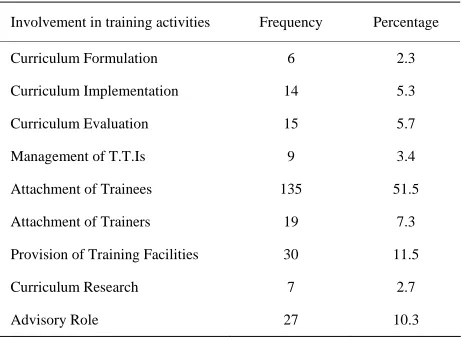
An item was included in the employers’ questionnaire, which sought information on the training activities in which employ-ers participated in training. Majority of the respondents (51.5%) indicated that they provided attachment to T.T.I trainees, 11.5% of respondents indicated that they provided training facilities to T.T.Is, 10.3% of the respondents indicated that they offered
advisory services to T.T.Is. About 7.3% of respondents offered attachment opportunities to trainers whereas 5.7% of the re-spondents were involved in curriculum evaluation, 5.3% of respondents were involved in curriculum implementation, while 2.7% of employers participated in curriculum research, 3.4% of respondents were involved in the management of T.T.Is. Only 2.3% of the respondents indicated that they participated in cur-riculum formulation. This information is reflected on Table 1.
The studysought information on whether T.T.Is carried out market survey to establish skill needs in industries and business organizations. Majority of the respondents (72.1%) indicated that no market surveys were carried out by T.T.Is while 27.1% indicated that they conducted market surveys to establish mar-ket skill needs. The data revealed that, T.T.Is trained without respect to the market skill demands. This may result in discon-nection between skill training and the market skill needs. This observation is in agreement with the G.O.K (2005) observation on the sessional paper number one that technical education in Kenya has failed to address the industrial skill needs.
Conclusion
The major reason why graduate joined T.T.I was to secure skills for employment. Given the reasons training institutions should endeavour to produce graduates who are marketable to industries and business organizations. This will be feasible when the internal efficiency and the external efficiency of T.T.Is are achievable.
Despite the fact that T.T.Is offer more diploma courses, ma-jority of the trainers are diploma holders and mama-jority of the heads of departments are also diploma holders. Having trained in similar institutions, the majority of the T.T I. trainers there-fore train at the same level of the academic achievement with no added advantage except age and classroom experience.
Most T.T.Is operates with inadequate staff. This compro-mises the quality of teaching and learning since the short fall in the number of trainers is addressed through hiring part-time teachers, multi-grade teaching, and the students individualized learning engagements. Multi-grade teaching refers to a situation where students at different levels of learning are taught in the same workshops, laboratories or classrooms. This affects the interactive capacity between the students and the teachers.
[image:4.595.308.539.568.738.2]Technical training institutes operate with inadequate training
Table 1.
Employers involvement in training activities.
Involvement in training activities Frequency Percentage
Curriculum Formulation 6 2.3
Curriculum Implementation 14 5.3
Curriculum Evaluation 15 5.7
Management of T.T.Is 9 3.4
Attachment of Trainees 135 51.5
Attachment of Trainers 19 7.3
Provision of Training Facilities 30 11.5
Curriculum Research 7 2.7
facilities. Majority of the respondents indicated that T.T.Is op-erated without adequate physical facilities, did not have ade-quate training tools and T.T.Is lacked adeade-quate training materi-als. The lack of training facilities compromises the relevance of T.T.I taught skills to market skill needs in industries and busi-ness organizations. Most of the training equipments found in T.T.Is are not technologically in tandem with equipments found in industries and business organizations. The training equip-ments are inferior to the equipequip-ments used in industries and business organizations. This state of training equipments eroded the relevance of T.T.Is taught skills to market skill needs. It is therefore concluded that there is urgent need to modernize equipments and provided adequate facilities to ensure that graduates coming out of T.T.Is acquire skills relevant to the employment market skill needs in industries and business or-ganizations.
Majority of the T.T.I trainers have never had the opportunity for industrial attachment. This implies that T.T.I trainers are not privy to technology and information used in industries and business organizations which were perceived to be superiour to those used in the T.T.Is. The lack of attachment opportunities for trainers denies them the interactive opportunity to learn and appreciate latest technology.
REFERENCES
Aduda, D. (2003). Technical training reeling under neglect. Daily Na-tion, 2 June 2003, 11.
Gall, M. D., Borg, W. R., & Gall, J. P. (1996). Education research, an introduction. New York: Longman Publishers.
Government of Kenya. (1981). Report of the Presidential Working Par- ty on the establishment of the second university. Nairobi: Govern-ment Printer.
Government of Kenya. (1999). Report of the totally integrated quality education and training. Nairobi: Government Printer.
Government of Kenya, (2002). Economic survey. Nairobi: Government Printer.
Government of Kenya. (2005). Kenya education sector support pro-gramme 2005-2010: Delivery of quality education and training to all Kenyans. Nairobi: Government Printer.
Kathuri, N. J., & Pals, D. A. (1993). Introduction to educational
re-search. Njoro: Egerton University.
Kerre, B. W. (1992). Innovative strategies in the implementation of the 8-4-4 curriculum in Kenya. (Mimeographed). Nairobi: Kenyatta Uni- versity, Centre for Curriculum Studies in Africa.
Sifuna, D. N. (1992). Prevocational subjects in primary schools in the 8-4-4-education system in Kenya. International Journal of Education Development, 12, 133-145. doi:/10.1016/0738-0593(92)90035-K UNESCO. (1961). Final report, conference of African states on the