IDENTIFYING AND DESCRIBING PROSODIC DOMAIN INTERACTION WITH DURATION AND HYPERARTICULATION
Alice Anne Drozdiak
A thesis submitted to the faculty of the University of North Carolina at Chapel Hill in partial fulfillment of the requirements for the degree of Masters of Arts in the Department of Linguistics
Chapel Hill 2011
ABSTRACT
IDENTIFYING AND DESCRIBING PROSODIC DOMAIN INTERACTION WITH DURATION AND HYPERARTICULATION
(Under the direction of Elliott Moreton)
ACKNOWLEDGEMENTS
I thank the faculty of the UNC Linguistics department, and the members of my committee, Jen Smith and Katya Pertsova. Their continued patience, guidance, and support made this thesis possible. Additionally, I would like to thank my advisor, Elliott Moreton. Not only have his efforts helped shape this thesis, but my interest and passion for linguistics as well. The graduate students in the department have also garnered my sincere gratitude: they are easily the brightest, kindest, funniest, most curious group of people I have ever met. I look forward to maintaining our friendships through the coming years.
I also thank my parents, Russell and Kathleen Drozdiak; not only did they raise me to love language, but to see the beauty in rigorous persuits of knowledge. My sister Sara, I thank for helping me through the trials of graduate school in the way only an older sister can. I thank my younger sister, Caroline, for constantly reminding me what an exciting place the world is. Additionally, I thank my brother-in-law, Mark, for helping me keep things in perspective.
TABLE OF CONTENTS
LIST OF TABLES...iv
LIST OF FIGURES...v
Chapter 1. INTRODUCTION...1
1.1 Prosodic constituency...1
1.2 Definitions of prosodic terms...2
1.3 Measuring pitch accent...4
1.4 Word-final lengthening as a prosodic phenomena...5
2. REVIEW OF THE LITERATURE...7
2.1 Acoustic correlates of pitch accent...7
2.1.1 Pitch accent and duration...9
2.1.2 Pitch accent and hyperarticulation...9
2.2 Acoustic correlates of prosodic boundaries...10
2.2.1 Prosodic boundaries and duration...11
2.2.2 Prosodic boundaries and hyperarticulation...11
2.3 Interaction between pitch accent and prosodic boundaries...13
3. HYPOTHESIS AND GOALS...15
3.1 Determining the presence of prosodic domain interaction...15
3.2 Acoustic description of hyperarticulation in diphthongs...15
! ! 3.3 Determining the phonological nature of prosodic domain interaction...16
4. METHODS...18
4.2 Stimuli...20
4.3 Subjects...23
4.4 Unusable data...23
4.5 Recording...24
4.6 Data coding...24
5. RESULTS...27
5.1 Verifying assumptions...27
5.2 Describing hyperarticulation in diphthongs...29
5.3 Evidence of hyperarticulation due to word position...34
5.4 New analysis of duration...35
5.5. The problem with /ei/...37
6. DISCUSSION...39
7. LARGE SCOPE IMPLICATIONS...41
8. CONCLUSION...42
LIST OF TABLES
1. Stimuli...20
2. Duration...27
3. Pitch accent MANOVA...34
LIST OF FIGURES
1. Hyperarticulation of diphthongs...16
2. Stop measurement...25
3. Nasal measurement...25
4. Vowel measurement...29
1.INTRODUCTION
By drawing on knowledge of pitch accent, hyperarticulation, and prosodic word boundaries, this study explores the interaction of prosodic domains. This work assumes that pitch accent causes hyperarticulation (de Jong 1995, Turk & White 1999), that segments can be hyperarticulated (de Jong 1995, Turk & White 1999, Ortega-Llebaría 2008), and that the domain of pitch accent extends beyond the end of the last segment of the pitch accented syllable (Turk & White 1999). This study also relies on the assumption that word boundaries cause lengthening (Cho 2010). In addition to providing supporting evidence to the above claims, the current work also shows that pitch accent and word boundaries interact, and that the interaction is observable through exaggerated word-final lengthening. Also, this study will show that word boundaries themselves can be hyperarticulated. Finally, a new method for describing hyperarticulation in diphthongs will be presented.
1.1PROSODIC CONSTITUENCY
most important questions that has been explored by researchers in the past few decades[:] whether speakers differentiate between boundary and prominence information in speech production, and if so, how” (351).
My work proposes a new mechanism for correlating behavior to prosodic domain using articulatory evidence; additionally, my study sheds light on the interaction between pitch accent, an intonational phenomenon, and word-final lengthening, a boundary phenomenon. By
examining American English, the current study seeks to identify interaction between pitch accent and word-final lengthening, and to provide an acoustic description if it does in fact exist.
Additionally, this study examines both whether or not word boundaries (a non-segmental part of an utterance) can cause hyperarticulation, as well as whether or not word boundaries can
themselves be hyperarticulated. This research will inform the study of interaction between prosodic domains (pitch accent and right-edge word boundaries).
1.2DEFINITIONS OF PROSODIC TERMS
Pitch accent differs from stress in that stress is primarily a metrical feature, whereas pitch accent is an intonational feature associated with a metrically strong position (Ladd 2008). Though both pitch accent and metrical stress are events of prosodic prominence, they are prominent in different ways. Pitch accent is the most prominent intonational event in a phrase; metrical stress is the most prominent metrical event in a foot. Another way to think about the distinction is to draw an analogy with music. Metrical features are similar to the rhythmic features of music: the timing, beats, and so on. Intonational features are similar to aspects of music like pitch and melody. In fact, Ladd uses a musical example to illustrate an interaction between metrical and intonational features in speech (2008:57). In terms of the phonological hierarchy, pitch accent is considered more prominent; there is generally one pitch contour to an entire utterance (usually involving one or two accents). Metrical stress, on the other hand, occurs several times throughout an utterance on a lower level of prominence, once per foot. Although pitch accent and metrical stress are distinct, the two are related: indeed, a “defining characteristic of a pitch accent in English” is its occurrence on a metrically strong syllable (Beckman et al 1986).
Acoustically, the manners in which pitch accent and metrical stress express prominence vary greatly. Metrical stress prominence is expressed through any number of articulatory processes, while intonational prominence is primarily expressed through contours of the F0. If
we remember that tones are analogous to musical pitch and melody, this isn’t surprising: the F0 is
the acoustic correlate of pitch in speech (Ladefoged 2003).
seeks to use acoustic evidence to offer insight into the interaction of two prosodic domains existing in different levels of a hierarchy. Specifically, this research explores the possibility of hyperarticulation acting upon non-segmental elements (like word boundaries) as well as the possibility of word-boundaries as exhibiting hyperarticulatory force.
1.3MEASURING PITCH ACCENT
As previously mentioned, this study attempts to determine whether or not pitch accent interacts with word boundaries. In order to test any hypothesis regarding these issues,
measurement techniques must be identified and developed. Since the target prosodic processes on several levels share acoustic correlates, this endeavor is not without its challenges.
Specifically, this research requires an acoustic correlate that is unique to only one of the two elements in this study (pitch accent and word-final lengthening). As increased duration is characteristic of both, I will set it aside for the moment.1 Instead, I propose hyperarticulation as
an acoustic correlate of pitch accent but not word-final lengthening.
De Jong describes hyperarticulated speech in English as speech that is “[...] strongly motivated by the communicating of lexical distinctions, and is therefore characterized by greater phonemic contrast” (1995: 493).2 That is to say, hyperarticulation is a process in which two
phonemic segments become more dissimilar, thus creating an increase in phonemic distinction between the two. De Jong effectively presents counter-evidence to previous theories suggesting that hyperarticulation is only the movement of segment towards a more open sound, or merely the lowering of the jaw. The literature suggests that hyperarticulation is not assigned to solely
1 As I will describe later, however, duration measurements are far from irrelevant to this study.
one feature of a sound, but can affect “backness, roundness, and point of articulation” in vowels (499). In some cases, however, it seems that hyperarticulation of individual features is sufficient. For example, Ortega-Llebaría found in Mexican Spanish that “duration3 cues the stress contrast
in the absence of” other prominence-inducing elements (2008:163). That is to say, only one feature of the sound (duration) was hyperarticulated to produce prominence. Additionally, Fletcher et al. (1996) found that some subjects speaking Australian English denoted pitch accent using nothing more than variation in F0, while others adjusted features like frontness and
backness to create contrast between pitch accent and non-pitch accent syllables. Typologically, hyperarticulation is not exclusive to one type of feature; neither is it always confined to one feature in a sound or always applied to all features of a sound. The regularity with which it occurs in pitch accent syllables in English make it a good metric with which to evaluate
phonological pitch accent assignment. This study uses hyperarticulatory evidence of increased phonemic distinction as a measurement for pitch accent; diphthongs are the target segments. Such a method will help distinguish between the effects of two prosodically-conditioned phenomena: pitch accent and word-final lengthening. This distinction is crucial to the goal of this study. If the aim of my research is to determine both whether or not word boundaries induce hyperarticulation, as well as whether or not hyperarticulation can act upon word boundaries, then it is necessary to have a strategy for measuring these phenomena.
1.4WORD-FINAL LENGTHENING AS A PROSODIC PHENOMENA
Cho (2010:351) suggests that “prosodic strengthening serves a dual function” in that it may signal both prominence as well as boundaries. This observation further motivates one major
2. REVIEW OF THE LITERATURE
2.1ACOUSTIC CORRELATES OF PITCH ACCENT
As F0 is the indicator of pitch, the F0 contour is often used to identify pitch accent. By
identifying either the highest or lowest frequency of F0 (the extrema), we can often identify the
primary prosodic focus of an intonational contour. Intonational contours in English can be categorized into six “accent shapes.” They are described using H to designate a tone relatively high in pitch, and L for tones with relatively low pitch. Since some tone contours consist of more than one tone, the tone that is associated with the prosodically prominent syllable is notated with a *. This all leads to a list of accent shapes that include H*, L*, H*+L, H+L*, L*+H, and L +H*.4
F0 extrema have been correlated with pitch accent alignment in English both with direct
alignment (Shue et al 2010, Ladd et al 2008) and by correlating increased F0 range (Xu et al
2004). That is to say, in Shue et al. (2010), the F0 extrema occur with predictable regularity in
the syllable that was contextually denoted as pitch accent. In Xu et al. (2005), if a local pitch accent was dynamic (consisted of a rise or a fall as part of its target goal), the authors found that the range displayed in the rise or fall of the F0 was greater than that found in non-pitch accent
syllables5.
4 See Beckman et al (1986) for a more thorough treatment.
English is not the only language in which F0 extrema have been correlated to pitch
accent. In German, Mücke et al (2009:321) looked at F0 as an independent variable changing by
dialect, syllable structure, and “accent status in the intonational hierarchy”, which refers to pitch accent as the most prominent member. The author found that F0 extrema did indeed correlate to
prominent intonational events (pitch accent). Additionally, other studies have relied on the correlation of F0 extrema and pitch accent. In Ladd et al’s (2000) study of Dutch, the authors
used a correlation of F0 extrema and intonational targets (pitch accent) when exploring the
relationship between F0 alignment (the dependent variable) and phonological vowel length (the
independent variable). Using these studies as precedent, my study relies partially on F0
measurements to determine if pitch accent elicitation on certain target words has been successful. Pitch accent syllables have other correlates, both acoustic and articulatory. In research done on English speakers, kinematic evidence points towards the lowering of the jaw in pitch accent syllables (Summers 1987, de Jong 1995, Fletcher et al 2010)6. Additionally,
stress-induced lengthening found in the literature is applicable to pitch accent (de Jong 1995, Edwards et al 1991, Shue et at 2009, Summers 1987). This evidence of lengthening is important for the hypothesis that hyperarticulation (which includes increased duration7) is an acoustic metric with
which to identify pitch accent implementation. Identifying such measurable acoustic correlates is necessary for analyzing the data in this study, with the goal of determining whether or not hyperarticulation acts only upon segements, as well as whether or not word boundaries induce hyperarticulation. This distinction is necessary: the primary goal of this study is to identify
6 Each of these authors performed tests in which pitch accent was the independent variable, and various articulatory events were the dependent variables. For example, Summers (1987) examined jaw and lip position, while Fletcher et al (2010) looked at jaw and tongue position. De Jong (1995) recorded jaw, lip, and tongue position.
whether or not certain elements are inducing hyperarticulation (word boundaries) as well as whether or not hyperarticulation can operate on elements other than segments (word boundaries). 2.1.1PITCH ACCENT AND DURATION
! In Turk & White (1999), the authors explore duration in consonants belonging to pitch accented words and syllables in Scottish English, with duration as the dependent variable and pitch accent status the independent variable. The authors found that consonants lengthened in pitch accented conditions. From these results, we can say with confidence that pitch accent induces lengthening in consonants that are members of the constituent bearing the pitch accent. Similarly, Turk & Sawusch’s (1997) work also show that lengthening is indeed related to the issue of constituency: in a similar test, the authors found that consonants lengthen only when the following pitch accented syllable “belonged to the same syllable, foot, or word” (173).
According to these findings, the influence of pitch accent seems to be bounded by some prosodic constituent, even if that constituent varies or isn’t always easily identified. Additionally, duration itself is not sufficient for measuring pitch accent: if the segment in question also occurs at a prosodic boundary, then pitch accent-induced lengthening and word-final lengthening may be indistinguishable. In the ongoing effort to identify prosodic constituencies and describe their interaction, my study proposes using a combination of duration measurements and
hyperarticulation to differentiate between the influence of pitch accent and word-final lengthening.
2.1.2PITCH ACCENT AND HYPERARTICULATION
Phonemically, hyperarticulation is an increase in the phonemic distinction of two segments; acoustically, hyperarticulation in vowels is a “formant structure [...] which is more different from those of a uniform tube” than a non-hyperarticulated example of the same vowel (491). The
specific formant behavior de Jong describes can be conceptualized as the movement of vowels away from schwa8; when pictured in a vowel quadrilateral, imagine the hyperarticulated vowels
moving away from the center. As such, F1 and F2 can be used to measure hyperarticulation. By
using formant values to plot vowels on the quadrilateral, it is easy to make a comparison between hyperarticulated and non-hyperarticulated vowels and their relationship in space. By using pitch accent as the independent variable and formant values (F1 and F2), Johnson (1993) presents such
findings. In a study comparing hyperarticulated and “less carefully produced” vowels, the author finds that “the hyperarticulated versions of the vowels generally had more extreme vowel
formants than did the less carefully produced vowels” (519). That is to say, by plotting vowels with formant values, the author found that hyperarticulated vowels moved further away from schwa. These findings support the use of hyperarticulation (as measured by formant values in the vowel space) as a measurable acoustic correlate of pitch accent in English. One of this study’s contribution to the examination of hyperarticulation in vowels is to examine diphthongs; though present literature makes suggestions about simple vowels, ambiguity remains over how hyperarticulation will manifest itself in diphthongs.
2.2ACOUSTIC CORRELATES OF PROSODIC BOUNDARIES
Keeping in mind Cho’s observation that boundary-induced lengthening is typologically commonly attested, this section explores the evidence behind such a statement. Additionally,
2.2.1 explores previous research regarding hyperarticulation at prosodic boundaries. This literature bears directly on one of this study’s goals: to find evidence (or counter-evidence) of hyperarticulation at word boundaries,
2.2.2PROSODIC BOUNDARIES AND DURATION
Turk and White (1999) note that higher-order hierarchical boundaries produce more extreme boundary lengthening in English; that is to say, the lengthening found at the edge of an intonational phrase is greater than that found at the edge of a word (171). In their study, Turk & White look at consonants in final positions and find that they are longer than in word-initial positions in English. Additionally, in another English study, Fougeron and Keating (1997) point out that lengthening has been found at the edges of prosodic edges, especially in
consonants (3728).
2.2.3PROSODIC BOUNDARIES AND HYPERARTICULATION
There is little evidence that suggests that prosodic houndaries induce hyperarticulation. Cho (2010) notes that “[...]domain-final elements may involve spatial expansion, though not as robustly as temporal expansion, the former often being inconsistent across speakers (cf. Byrd et al., 2006) or non-observable (Edwards et at., 1991; Beckman et al., 1992)”. In other words, there is evidence of slight phonemic movement at word boundaries that seems to mimic
hyperarticulation, but it is inconsistent, minimal, and unreliable; there is little typological
evidence of boundary-induced hyperarticulation, as well. Even more importantly, any increased hyperarticulatory action in word-final positions happens more frequently and reliably in
is safe to say that any regular hyperarticulation found in this study of diphthongs is likely to be a result of pitch accent, not boundary effects. Hyperarticulation, then, remains a viable choice for distinguishing pitch accent as a prominence marker from boundary-induced lengthening effects; using these tools, the current study provides information about the interaction of these two domains.
In addition to Cho’s (2010) observations, Fougeron and Keating (1997)9 show that
hyperarticulated speech is uncommon in word-final positions for English speakers, especially in vowels. The authors use electropalatography to measure linguopalatal contact instead of acoustic correlates; the current study associates evidence of “careful articulation” with hyperarticulation. Indeed, they define “weakened” and “strengthened” as “less extreme articulations” and “more extreme articulations,” respectively (3729). While a kinematic correlate like jaw lowering may not be enough to show the articulatory effects of hyperarticulation, linguopalatal contact provides specific information about constriction within the oral tract and therefore more accurate insight into the acoustic properties of hyperarticulation.
The increase in articulatory strength Fougeron and Keating (1997) refer to is “[...] more extreme earlier in utterances and [declines] gradually over the course of utterance” (3728). The authors make similar observations, noting that “domain-final articulations are reduced [...]” due to their later position within the prosodic domain (3729). In fact, the data shows that the
domain-final vowel measured in the study showed the least amount of articulatory strengthening (3734). They go on to state that segments that are strengthened are less likely to experience coarticulatory effects; since segments in the word-final position are identified as weakened, we
can assume that these segments will not have the coarticulatory resistance that hyperarticulated segments have. After previously establishing the correlation between hyperarticulation and articulatory strengthening as measured by the authors, their evidence further suggests that hyperarticulation is not found in word-final positions, especially not in vowels. This study provides additional data that supports these claims, further establishing the relationship between prosodic boundaries and hyperarticulation.
2.3 INTERACTION BETWEEN PITCH ACCENT AND PROSODIC BOUNDARIES
Little is known about the specific interaction between pitch accent and prosodic
boundaries, especially word boundaries. While looking at English, Turk & White (1999) suggest that pitch accent interacts with syllable-final consonants in the form of exaggerated lengthening, but they do not extend their study further to examine the interaction of pitch accent on higher-level prosodic constituents (like words). Additionally, their study looks only at consonants, whereas this study examines diphthongs. The logical step in the examination of prosodic domain interactions is to ask the same questions of higher-level constituents: Does the presence of pitch accent exaggerate word-final lengthening, or is increased duration simply a case of word-final lengthening and pitch accent-induced lengthening occurring simultaneously? Additionally, an examination of hyperarticulation (an increase in phonemic distinction) offers a new type of evidence with which to examine such an interaction. While exaggerated lengthening may not be present, exaggerated hyperarticulation would point to the same result: an interaction between the two prosodic domains, rather than separate simultaneous processes.
3. HYPOTHESIS AND GOALS
3.1DETERMINING THE PRESENCE OF PROSODIC DOMAIN INTERACTION
As previously stated, the nature of prosodic interactions has not been entirely described acoustically, nor has it been accounted for completely in a phonological model. This study aims to add another piece or two to the puzzle. By examining the acoustic correlates of two prosodic domains (pitch accent and word-final lengthening), I describe the acoustic behavior at their intersection and draw conclusions about their interaction. The current study hypothesize that the domains of pitch accent and word-final lengthening interact in acoustically measurable way.
If pitch accent and final lengthening interact, then we can expect different word-final diphthongs in pitch accented words than in non-pitch accented words to behave differently to a significant degree. That is to say, if greater lengthening is observed in word-final positions of pitch accented words than can be explained by an additive model, then we assume that there is an interaction between the two domains. Additionally, if pitch accented words show more
hyperarticulation in word-final positions than in non-pitch accented words, we assume that there is an interaction between the two domains. The data will also show whether or not right-edge word boundaries induce hyperarticulation, and whether hyperarticulation can act upon word boundaries.
3.2ACOUSTIC DESCRIPTION OF HYPERARTICULATION IN DIPHTHONGS
Another goal of this study is to describe hyperarticulation in American English
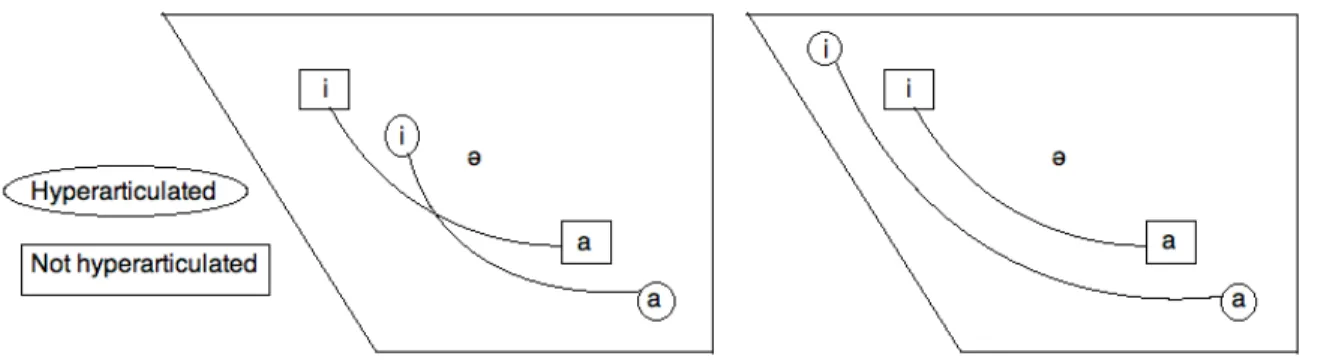
show an increase in phonemic distinction, but distinction from what? One prediction is the nucleus of the diphthong moving further away from schwa, as de Jong (1995) suggested that vowels move further away from acoustic behavior associated with a uniform tube10. This
observation could be interpreted in several ways. Firstly, both the offglide and nucleus could maintain their position relative to another, but move further away from schwa as one unit. Another possibility is that the increase in phonemic distinction is realized as a distinction
between the offglide and the nucleus, in which case the subsegments would move not only away from schwa but apart from each other, as well. Below are two diagrams that illustrate the possible results: the diagram on the left illustrates a hyperarticulated diphthong wherein the nucleus and offglide move as one unit, further away from schwa. In the figure to the right, “greater phonemic contrast” refers not only to movement away from schwa, but internal movement separating the nucleus and offglide. This study looks at the behavior of formant values to determine which of these possibilities describes hyperarticulation in diphthongs.
Figure 1: Hyperarticulation of diphthongs
3.3DETERMINING THE PHONOLOGICAL NATURE OF PROSODIC DOMAIN INTERACTION
In addition to using a pitch accent/non-pitch accent comparison to determine the presence of domain interaction, a comparison of lexical stress position will inform our knowledge of
mental models employed in the interaction between prosodic domains, currently an issue in prosodic phonology. If there is no interaction between the two domains, it is evidence that mental grammars do not necessarily take into account overlapping domains or constituents. If, however, a significant interaction is found, it implies that mental grammars can “see”
overlapping domains. This suggests an even more complex phonological procedure takes place that simply layering different constituents or levels of hierarchy on top of one another.
We know that right-edge word boundaries lengthen adjacent segments; since lengthening can also be a realization of hyperarticulation, one could hypothesize that word boundaries are actually exhibiting hyperarticulatory force on those segments. If this is in fact the case, the data should show an increase of hyperarticulatory behavior in diphthongs that appear in a word-final position instead of a word-initial syllable. If, however, word boundaries are not
hyperarticulating segments, and lengthening is the primary acoustic correlate, the data should show hyperarticulation of diphthongs to be roughly the same regardless of word position.
4. METHODS
4.1DESIGN
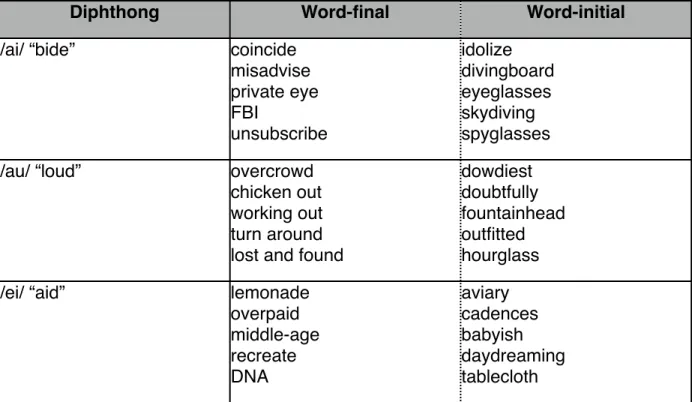
Trisyllabic target words were chosen, with a set containing diphthongs in a lexically stressed initial syllable as well as a set containing diphthongs in a lexically stressed final syllable. Three diphthongs (/ai/, /ei/, and /au/ ) were chosen. All words had diphthongs in lexically
stressed positions. Words were trisyllabic in order to develop a set of words (those with primary lexical stress) wherein the diphthongs were as far from the right edge of the word as possible, thus eliminating final lengthening as a suspect for durational increase in the lexically stressed syllable when the target words were uttered in a pitch accent situation. These words were also contrasted with the trisyllabic words with the diphthong in the word-final syllable. By having diphthongs in both a word-initial and a word-final syllable, they can be compared both in duration and formant structure to determine how much of Turk et al’s (1999) results was due to final lengthening and how much was due to pitch accent-induced lengthening.
The morphemic makeup of the target words varies; for example, divingboard is a compound, misadvise is dimorphemic, and lost and found is a lexicalized phrase. Frazier (2006) states that “vowels in morphologically complex monosyllables are longer than in
measurement that the word-initial and word-final diphthongs will be measured. This study predicts that pitch accent assignment will result in an increased duration with the associated segments, regardless of the morphological makeup of the word.
The test words were contextualized in a sentence with the format, “Mary ____ but she doesn’t ____.”11 The second blank was filled with a word that helps elicit pitch accent on the
target word through means of comparison. This frame was selected after collecting pilot data on four possible frame sentences; it was chosen for the reliability with which subjects produced pitch accent in the desired positions. Additionally, pitch accent words were italicized. Each word was read in two contexts: one with pitch accent and one without pitch accent. In order to avoid any secondary stress effects on the target word, sentences in which the target word was non-pitch accented elicited pitch accent on the word immediately preceeding or following the target word. Target words were not be at the beginning or end of an utterance in order to avoid non-pitch accent prominence effects, in addition to avoiding tonal crowding (Shue et al 2010) as well as truncation and compression (Grabe et al 2000). An outline of the token count is listed below:
3 diphthongs x 2 pitch accent statuses = 6 6 x 2 word positions = 12 categories 5 words x 12 categories = 60 words 60 words X 7 subjects = 420 tokens
4.2STIMULI
Diphthong Word-final Word-initial
/ai/ “bide” coincide
misadvise private eye FBI unsubscribe idolize divingboard eyeglasses skydiving spyglasses
/au/ “loud” overcrowd
chicken out working out turn around lost and found
dowdiest doubtfully fountainhead outfitted hourglass
/ei/ “aid” lemonade
overpaid middle-age recreate DNA aviary cadences babyish daydreaming tablecloth
! Sentences below are presented in pairs to show the pitch accent and non-pitch accent conditions that were compared. Sentences were randomized before being presented to test subjects.
/ai/ “bide” word-final
1.. The eclipse will coincide with the meteor shower, but the two are not related to each other. 2. The eclipse will coincide with the meteor shower, but the comet won’t come until next month. 3. I don’t want to misadvise you about your classes, but you might want to drop a course.
4. He didn’t misadvise you about your classes, but he didn’t give good advice to Claire. 5. My aunt called a private eye during her divorce, but my uncle just used a lawyer.
6. My aunt called a private eye during her divorce, but my uncle used one before they split up. 7. My cousin wants to join the FBI after college, but my brother wants to join the police. 8. The police called the FBI after they found the suspect, but they should have called before.
9. I tried to unsubscribe yesterday to the magazine, but I accidentally renewed my subscription. 10. I tried to unsubscribe yesterday to the magazine, but it won’t take effect until next week.
/ai/ “bide” word-initial
11. Francine might idolize her grandmother, but she does realize that everybody has flaws. 12. Eleanor might idolize the president, but I think she actually just respects him.
13. Greg jumped off the divingboard yesterday at the pool, but his brother jumped off the side. 14. Emily jumped off the divingboard yesterday at the pool, and her sister will jump off today. 15. Adam wears eyeglasses regularly during the day, but Grace wears contacts instead.
16. Megan wears eyeglasses regularly during the week, but Larry just wears them for reading. 17. Sam wants to go skydiving on vacation, but Harry would rather go sailing.
18. Deborah wants to go skydiving alone, but her mother insists that she go with a professional. 19. Timmy got several spyglasses for his pirate toy box, but Danny only got eyepatches.
20. Matt bought several spyglasses for the trip, but Victor thought one was enough.
/au/ “loud” word-final
21. The meeting might overcrowd the room, but it won’t be packed.
22. The meeting might overcrowd the room, but I don’t think that many people will come. 23. Robert might chicken out after learning the risks, but at least he will admit it.
24. Derek might chicken out after he thinks about it, but I think he will go through with it. 25. You must turn around after you’re blindfolded, not just stand there.
26. You must turn around after you’re blindfolded, not beforehand.
27. Sara was working out when you called, not just ignoring your phone call. 28. Jacob likes working out before dinner, but Katie prefers to go after dinner.
29. Brandon found his coat in the lost and found at school, but Laura found hers in the cafeteria. 30. I found my coat at the fair’s lost and found, but my husband found his at the office.
/au/ “loud” word-initial
31. Theresa has the dowdiest dress, but Cassie has the oldest dress.
34. Josie doubtfully looked at me, but Michal was so skeptical he just looked at his feet. 35. The campers reached the fountainhead yesterday, but the guides made it to the lake. 36. The traveler reached the fountainhead yesterday, but he is still waiting for his companions. 37. Edward is never outfitted for the camping trip, but he brings a lot of experience to the group. 38. Stan is never outfitted for our trips, so we always have to share our supplies with him. 39. The children broke the hourglass during the game, but at least the lamps are still intact. 40. The children broke the hourglass during the game, and they lost the TV control afterwards.
/ei/ “aid” word-final
41. Elizabeth likes lemonade during the summer, but Jessica likes to drink iced tea. 42. Carol likes lemonade during the summer, but she prefers to drink iced tea. 43. Will was overpaid for his work, but that doesn’t mean he did anything wrong.
44. Linda was overpaid for her work, but she admits it and tries to help the other employees. 45. There was one middle-age couple at the theater, but it was mostly elderly couples.
46. There was one middle-age couple at the theater, but most people over 40 were there alone. 47. She wants to recreate every scene, but I think she should use her own ideas.
48. The director wants to recreate every scene, but he will only have time for a few. 49. The patient’s DNA could give us some clues, but blood tests are inconclusive.
50. The patient’s DNA could give us some clues, but instead the doctors ordered a blood test.
/ei/ “loud” word-initial
51. Elaine goes to the aviary every week, but Ivan goes to the museum.
52. Amanda goes to the aviary every week, but Samantha only goes every other week. 53. I listen to the drummer’s cadences in the song, but I’m not as interested in the words. 54. I listened to the drummer’s cadences in the song, but the bass player’s part is actually better. 55. Tom is never babyish when he doesn’t get his way, but you can tell that he’s upset.
56. Heather is never babyish about failure, but Nancy sometimes throws tantrums. 57. Barbara is always daydreaming in class, but at least she isn’t talking.
60. We needed a clean tablecloth for the party, but we could only find the dirty one.
4.3SUBJECTS
Subjects were between 18 and 35 years old, and were not selected if they were not native speakers of English, or if they spoke a dialect of English that monophthongizes diphthongs. There were a total of 7 subjects, 4 female and 3 male. All subjects were compensated with candy.
4.5UNUSABLE DATA
A total of 13 subjects were recorded, but six of those 13 were later found to be unusable. Five of those subjects failed to produce pitch accent on the desired target word with enough regularity in both iterations to be unusable. One subject was later found to monophthongize diphthongs regularly, and thus was unusable.
In cases where a token taken in the first iteration was unusable (most often due to failed pitch accent elicitation, but sometimes due to unclear pitch accent or inconclusive spectrogram and wavelength cues for effective measurement), the corresponding token from the second iteration was used. In some cases, however, the “incorrect” pitch accent production in the first iteration was repeated in the second, rendering that token completely unusable.12 Additionally,
the target word lemonade raised an interesting problem: several speakers shifted lexical stress when reading the word in a pitch accent context. In other words, speakers said lemonade with final lexical stress when it was not pitch accent, but produced initial lexical stress when lemonade appeared in a pitch accent context.
4.5RECORDING
The subject read the stimuli from a binder while recording on a MacBook Pro computer using a head-mounted microphone. Data was stored on the same password-protected computer. Each sentence was presented on one page, with only one sentence per page; as a result, the subjects only saw one sentence at a time. After completing one iteration of all stimuli, the subject was given a brief break while I reset the recording software (Praat 5.1.23). The subject then repeated the process for a total of two iterations.
4.6DATA CODING
Measurements taken in this experiment include duration of the entire diphthong in both the pitch accent and non-pitch accent contexts for both word-initial and word-final lexically stressed vowels, as well as formant readings in the diphthong. In order to take accurate readings of F1 and F2 in both the nucleus and the offglide, I will use the method outlined in Moreton
(2004). The F1 maximum was identified as the point at which the measurements for the nucleus
are taken, and the F2 maximum will function as the point at which the measurements for the
offglide are taken for /ai/ and /ei/. For /au/, the offglide was measured at the F2 minimum. This
measurement technique avoided taking values that are too close to the transition between the nucleus and offglide, as well as formant measurements that may have been affected by transitions between the onset and offset consonants.
Measurements for the diphthongs required identifying start or stop points in the surrounding segments. Start and stop points for voiced fricatives were identified as the
when applicable, the end of a voicing bar (Duez 2006). The beginning of voiced consonants
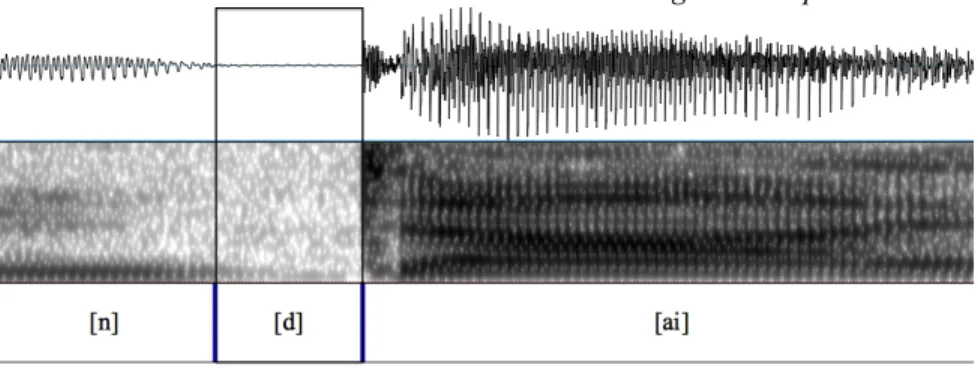
were identified as the point at which the waveform becomes “smaller, with a less varied shape” (Ladefoged 2009, 141). Figure 2 shows an example from pilot data; the [d] outlined in the rectangle has been identified using the methods detailed above.
Measuring of [ɹ] duration followed the methods in Colantoni (2006), which determines the onset “by a change in waveform” and “a drop in intensity;” similarly, the offset were identified as “a change in waveform” and “an increase in intensity” (26). Colantoni also uses a lowered F1 as an indication of rhoticism; an obviously
lowered F1 was be used
as a landmark for [ɹ]. For nasals,
measurement relied on the changes “denoted by sharp spectral
changes which occur at the beginning and end of the period of oral closure” (Glass 1984). For Figure 2: Stop measurement
5. RESULTS
5.1VERIFYING ASSUMPTIONS
Turk and White (1999) examined whether or not consonant segments belonging to a pitch accent unit lengthened with regard to their non-pitch accent counterparts. Using three native speakers of Scottish English, they verified results from an earlier study (Turk & Sawusch 1997). They found that pitch accent consonants did indeed lengthen. In my first comparison, I examine my data to see if the same pattern found in consonants holds true for diphthongs.
Durations were extracted from the data in two steps. First, I used a text grid to annotate a spectrogram in Praat for each speaker, identifying the boundaries of each diphthong (see
Methods). The text grid was then processed with a Perl script to determine the exact duration of each diphthong. Using a log linear regression, data from all speakers were consolidated into an overall measurement duration for all possible combinations of pitch accent status (pitch accent vs. non-pitch accent) and word position (initial vs. final). The following chart summarizes the results.
Duration Data in seconds
Duration Data in seconds All confidence levels are 95%.All confidence levels are 95%. Table 2
Diphthong Position in word Accent Mean Estimate Lower Confidence Upper Confidence
/ai/ final non-PA 0.1532 0.1399 0.1678
/ai/ final PA 0.2308 0.1974 0.2699
/ai/ initial non-PA 0.1416 0.1305 0.1537
/ai/ initial PA 0.1808 0.1630 0.2006
/au/ final non-PA 0.1385 0.1215 0.1578
/au/ final PA 0.2207 0.2088 0.2333
/au/ initial PA 0.1705 0.1578 0.1843
/ei/ final non-PA 0.1152 0.1077 0.1233
/ei/ final PA 0.1903 0.1577 0.2296
/ei/ initial non-PA 0.1087 0.1023 0.1154
/ei/ initial PA 0.1442 0.1279 0.1626
Regardless of word position, diphthongs in pitch accent syllables were longer than diphthongs in non-pitch accent syllables. A further statistical analysis showed this difference in duration to be significant. Turk and White’s results were confirmed and extended: the same pitch accent-induced lengthening found in consonants is also found in diphthongs.
An additional purpose of this comparison is to determine whether or not my data shows word-final lengthening, as would be expected. That is to say, diphthongs in word-final syllables should have a longer duration than those in word-initial positions, regardless of pitch accent status. By looking at the above chart a second time, and comparing word-initial durations to word-final positions, it is easy to see that durations in the word-final position are always longer than their counterparts in the word-initial position. This difference in duration was found to be statistically significant.
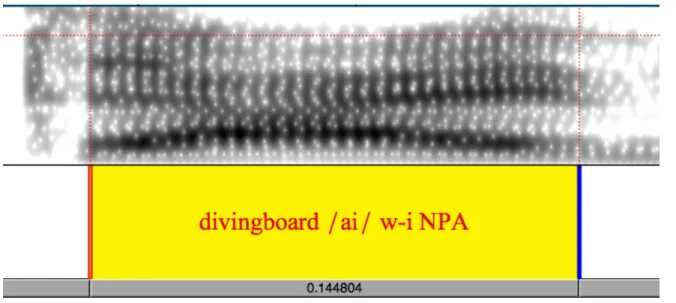
Figure 4: Vowel measurement
The result of the first comparison confirms the assumptions used in the foundation of this study; namely, that pitch accent-induced lengthening is found not only in consonants but in vowels (specifically diphthongs) as well.
This comparison also verifies that the measurement techniques used in the study are valid. They are able to reproduce commonly-attested acoustic behavior: that of increased duration associated both with pitch accent and word-final lengthening.
5.2DESCRIBING HYPERARTICULATION IN DIPHTHONGS
Before this study, hyperarticulation in diphthongs had been described only minimally (Moreton 2004). Two possible acoustic behaviors are discussed in section 3.3. These two outcomes present different interpretations of de Jong’s (1995) observation that hyperarticulated vowels move further away from a neutral vowel.
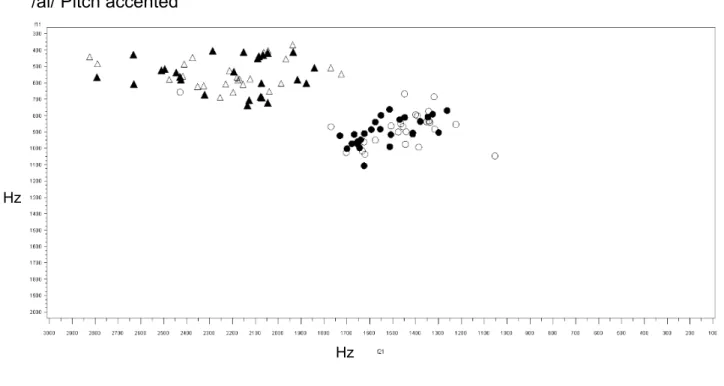
vowel space. In the three graphs presented here, circles are diphthong nuclei, and triangles are offglides. Empty shapes represent measurements taken from word-initial positions, while filled shapes represent those values taken from word-final positions.
Though more clearly in some than in others, each pair of plots shows the nuclei circles moving away from the offglides triangles. As is especially clear in /ai/ and /au/, the nuclei and offglides do not maintain their distance between each other in their movement away from schwa. Indeed, the increase in phonemic contrast in these data show an increase in distance between the nuclei and offglides in pitch accent contexts. This supports the hypothesis that diphthongs hyperarticulate internally, not as a single unit.
/ai/ Pitch accented
Figure 5: Scatterplots
Hz
/ai/ Non-pitch accented
/au/ Pitch accented Hz
Hz
Hz
/au/ Non-pitch accented
/ei/ Pitch accented Hz
Hz
Hz
/ei/ Non-pitch accented
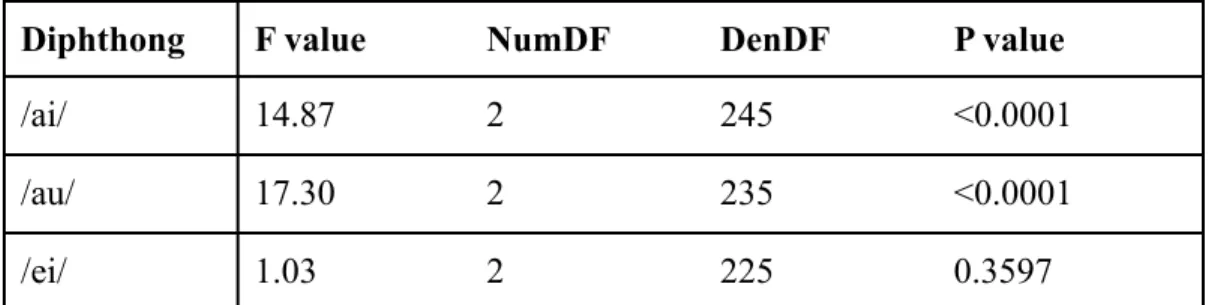
Visually, the graphs above seem to show a significant increase between clusters of nuclei and clusters of offglides when the diphthongs are pitch accented. The table below shows the results of a fixed effect13 multivariate ANOVA. A MANOVA was chosen because this study
examines two correlated dependent variables; since vowel space is actually a measurement of two formants, any statistical analysis must take into consideration both dependent variables (F1
and F2). The P value for /ai/ and /au/ is lower than 0.1, leading to the rejection of the null
hypothesis (that the distribution of data points is due to chance). In other words, /ai/ and /au/ in pitch accented contexts showed significant distancing between the nucleus and the offglide. These data support the hypothesis not only that pitch accent hyperarticulates diphthongs, but that hyperarticulation of diphthongs consists of increased distance within the vowel space of the nucleus and diphthong in /ai/ and /au/.
13 Our fixed effect model consisted of two selected variables (F1 and F2), and no random effects were used. Hz
Table 3: Independent variable: Pitch accent MANOVA Table 3: Independent variable: Pitch accent MANOVA Table 3: Independent variable: Pitch accent MANOVA
Pitch accent and hyperarticulation in diphthongs: MANOVA results Pitch accent and hyperarticulation in diphthongs: MANOVA results Pitch accent and hyperarticulation in diphthongs: MANOVA results Pitch accent and hyperarticulation in diphthongs: MANOVA results Pitch accent and hyperarticulation in diphthongs: MANOVA results
Diphthong F value NumDF DenDF P value
/ai/ 14.87 2 245 <0.0001
/au/ 17.30 2 235 <0.0001
/ei/ 1.03 2 225 0.3597
The diphthong /ei/, however, clearly does not match the same pattern. Its P value is noteably higher than those for /ai/ and /au/. Possible explanations for these results will be explored later.
5.3EVIDENCE OF HYPERARTICULATION DUE TO WORD POSITION
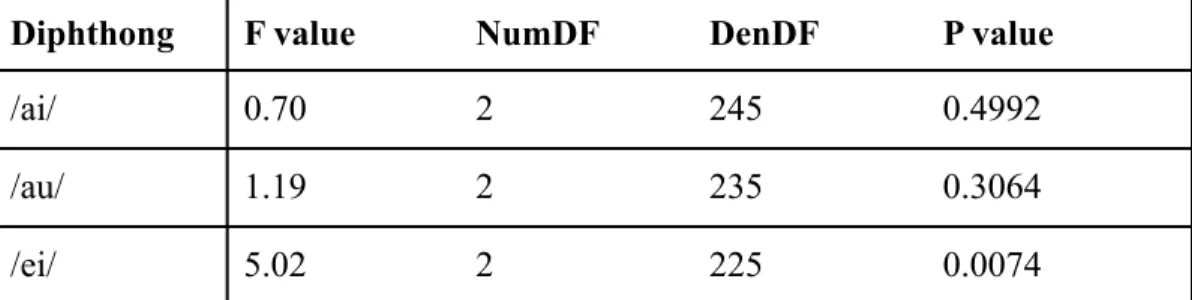
If hyperarticulation were exaggerated in word-final positions, we would expect to see an increase in phonemic distinction between the offglide and the nucleus when found at a right-edge word boundary. By re-examining the data and the scatter plots above, we find that this is not the case. If the solid symbols represent diphthongs in word-final positions, and empty symbols represent diphthongs in word-initial positions, we see that the space between the nucleus and the offglide is approximately equal for both sets.. That is to say, we would expect the solid shapes to be further apart than the empty shapes if word position effected hyperarticulation.
As in the analysis of pitch accent on hyperarticulation14, a MANOVA was run on the data.
Pitch accent status was the independent variable, and F1 and F2 were the two dependent
being a result of chance. Listed below are the results of the MANOVA on word position and hyperarticulation.
Table 4: Independent variable: Word position MANOVA Table 4: Independent variable: Word position MANOVA Table 4: Independent variable: Word position MANOVA
Word position and hyperarticulation in diphthongs: MANOVA results Word position and hyperarticulation in diphthongs: MANOVA results Word position and hyperarticulation in diphthongs: MANOVA results Word position and hyperarticulation in diphthongs: MANOVA results Word position and hyperarticulation in diphthongs: MANOVA results
Diphthong F value NumDF DenDF P value
/ai/ 0.70 2 245 0.4992
/au/ 1.19 2 235 0.3064
/ei/ 5.02 2 225 0.0074
In both /ai/ and /au/, the P value as well as the F value show that the results are not significantly different than chance; this suggests that word position does not play a part in hyperarticulation. As in the previous analysis, however, /ei/ proves to be the exception. This inconsistancy will be discussed in a later section.
5.4NEW ANALYSIS OF DURATION
In 5.1, I use measurements of duration to verify and expand upon Turk and White’s findings. In 5.2, I examine the implications of a formant analysis as evidence of
hyperarticulation. In 5.3 the study found that hyperarticulation was not exaggerated in word-final positions. In a further analysis of the durations in my data, I show more evidence from
exaggerated lengthening that point to an interaction between pitch accent and word-final lengthening.
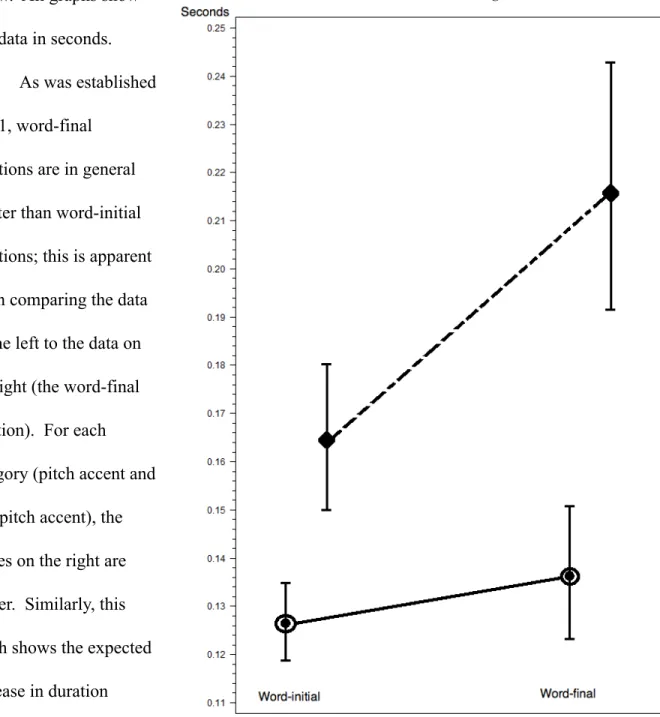
below. All graphs show raw data in seconds.
As was established in 5.1, word-final
durations are in general greater than word-initial durations; this is apparent when comparing the data on the left to the data on the right (the word-final position). For each category (pitch accent and non-pitch accent), the values on the right are higher. Similarly, this graph shows the expected increase in duration explained in 5.1: the
values represented as filled blocks (the pitch accent values) are higher than their non-pitch accent counterparts (represented by concentric circles) regardless of position.
In addition to illustrating the confirmed hypotheses discussed in Comparison 1, this graph describes findings unique to this study. In Figure 6, both the solid line and the dotted line
represent the slope of comparison between word-initial and word-final positions for their respective pitch accent statuses. If pitch accent and position did not interact, the increase in duration due to pitch accent would be the same both in word-initial and word-final positions; simply put, the lines would be parallel. As such, the dotted line is steeper, and to a statistically significant degree. While producing the log linear model, parametric tests showed significance in the interaction between word position and pitch accent; the low test statistic Z value of -4.84 corresponds with a probability listed as <.0001.
5.5 THE PROBLEM WITH /ei/
In the examination of hyperarticulation in formant values, /ei/ performed differently than the other two diphthongs with regards to each independent variable: pitch accent and word position. In a pitch accented context, /ei/ did not show any significant increase in phonemic distinction between the nucleus and the offglide. This is obvious not only from the scatterplots, but from the probability values found in the mathematical model (see Table 4).
What remains uncertain, however, is whether or not /ei/ is moving at all in response to pitch accent. Though the scatterplot is unclear, it is possible that /ei/ is hyperarticulating by moving away from schwa as a unit; this was discussed as a potential model for diphthong hyperarticulation in 3.3, but was rejected on the basis of data from /ai/ and /au/. In order to determine whether or not this is a case, a different analysis is necessary: instead of comparing the difference between the nucleus and the offglide across different accent conditions, the
overall vowel may change its location in the vowel quadrilateral. This may also be interpreted as a kind of hyperarticulation. Such a result would raise further questions about modeling
hyperarticulation in diphthongs: Either certain diphthongs hyperarticulate according to different models (/ai/ and /au/ hyperarticulating internally while /ei/ hyperarticulates in relationship to schwa), or the internal hyperarticulation model still holds phonetically for /ei/, but is not fully expressed for some reason15. If, indeed, /ei/ is operating within a different model, I suggest it is
because the American English diphthong /ei/ can be homophonous with the American English /e/, and thus may be categorized differently in the mental grammar. Further research is needed to explore these possibilities and their ramifications.
Another startling finding is the behavior of /ei/ with regard to word position. Unlike /ai/ and /au/, /ei/ has a P-value that is less than 0.1 as well as an F-value of 5.02; both measures indicate a significant relationship between word position and hyperarticulation. Such a result runs counter to the results for the other diphthongs, as well as previous research that speaks to the dearth of attested boundary-induced hyperarticulation. In addition, this unusual pattern is not immediately recognizeable in the scatterplots; that is to say, for both /ei/ scatterplots, the solid and empty shapes appear to have a similar distribution.
6.DISCUSSION
The major theoretical goal of this study was to identify any interaction between pitch accent and word-final lengthening, provide an acoustic description, and determine two things: whether or not word boundaries cause hyperarticulation, and whether or not hyperarticulation can act upon word boundaries.
This study presented two possible characteristics of pitch accent/word-final lengthening interaction. The first was exaggerated hyperarticulation, which would be realized in an even greater increase in phonemic contrast between the nucleus and offglide when the diphthong was found in both pitch-accented and word-final positions. The data, however, did not reflect this pattern. Hyperarticulation occurred in pitch accented contexts, but it was not exaggerated by the presence of a right-edge word boundary. If the presence of word-final lengthening was a result of word boundaries causing hyperarticulation, we would expect diphthongs to show
hyperarticulation, as well. The data have shown that hyperarticulation did not in fact occur in the presence of right-edge word boundaries. Hyperarticulation in diphthongs was found only in pitch accented contexts and was not dependent on word postition.
Exaggeration in lengthening, however, presents evidence of domain interaction. Word-final lengthening was found to be even greater in pitch accent words. Indeed, it was exaggerated to a point that could not be explained by a simple additive process of word-final lengthening with pitch accent-induced lengthening. This shows that there is an interaction between the two
The implication of this data answers the question posed about hyperarticulation: this increased lengthening in the presence of both hyperarticulation and a right-edge word boundary suggests that the boundary itself is being hyperarticulated. Since there was no accompanying
exaggeration of diphthongal hyperarticulation, we assume that this exaggerated lengthening is in fact hyperarticulation of already-present word-final lengthening. This shows that
7.LARGE SCOPE IMPLICATIONS
As mentioned in the introduction, this study ultimately informs a discussion of prosodic constituency. The constituency of prosodic units, however, is not universally agreed upon. For example, Beckman and Edwards (1990) point out that prosodic constituents are sometimes conflated with syntactic constituents, like lexical words. Indeed, some authors argue that
prosodic constituents are determined by syntactic ones (Klatt 1975), though such conclusions are not necessarily accepted as conventional wisdom. Additionally, as has been discussed previously in this work, issues of constituency have been complicated by the fact that many prosodic
8. CONCLUSION
The major theoretical goal of this study was to identify interaction between pitch accent and word-final lengthening, provide an acoustic description of such an interaction, and determine two things: whether or not word boundaries cause hyperarticulation, and whether or not
hyperarticulation can act upon word boundaries.
This work builds upon current knowledge of prosodic domains and associated phenomena. Previous to this study, it had already been established that pitch accent causes hyperarticulation (de Jong 1995, Turk & White 1999), and that the domain of pitch accent extends beyond the end of the last segment in the syllable carrying pitch accent (Turk & White 1999). Additionally, this study operated on the assumption that segments alone can be
hyperarticulated (de Jong 1995, Turk & White 1999, Ortega-Llebaría 2008). In addition to the unique theoretical contributions in this work, the current study also provided additional
supporting data to these assumptions. The data show that pitch accent does indeed induce hyperarticulation (specifically in diphthongs), and that word boundaries cause lengthening. In addition to bolstering already-present claims, this study provides new information about the nature of hyperarticulation, and the distinction (and interaction) between boundary information and promininance information.
other words, the difference between word-initial and word-final diphthong length would be the same in both pitch accented and non-pitch accented words16 Instead, this study found
lengthening in pitch accented word-final diphthongs exaggerated to a proportionally greater degree than in non-pitch accented word-final diphthongs. Since such an exaggeration cannot be explained by a simple additive process of hyperarticulatory lengthening with word-final
lengthening, this data strongly suggests that the word boundary itself is being hyperarticulated. This discovery answers some of the major theoretical questions about the domain of hyperarticulation that motivate this study; namely, that hyperarticulation can indeed work on non-segmental aspects of an utterance. Additionally, these data show that boundary information and lengthening information can be distinguished by examining rates of duration.
The nature of this interaction also informs the discourse surrounding hyperarticulation and right-edge word boundaries. If word-final lengthening were just a manifestation of hyperarticulation, then an increase in diphthong hyperarticulation would also be expected. Instead, word position was found to have no effect on formant values in /ai/ and /au/, thus suggesting that word-final lengthening is not the result of boundary-induced hyperarticulation. Such findings reinforce previous research and answer one of the main questions posed by this study: Do right-edge word boundaries induce hyperarticulation? The answer seems to be no, but evidence from /ei/ confounds the situation slightly.
Beyond reproducing word-final lengthening and pitch-accent behavior, this study presents a description of hyperarticulation in diphthongs previously undiscussed. Additionally, pitch accent-induced hyperarticulation was shown to act upon non-segmental features of an
utterance, and word position was shown to have little influence on hyperarticulation. Ultimately, this study showed that pitch accent and right-edge word boundaries interact: pitch accent induces hyperarticulation, and hyperarticulation can in fact act upon word boundaries. As phonological processes act over prosodic constituents, it is possible that overlaps between domains of said constituents may spark adjustments to such processes.
In summary, in addition to building upon existing literature, this study offers new and significant findings to inform the discussion of phonological domain interaction. While
REFERENCES
Anderson, H. 1972. Diphthongization. Language, 28, 11-50.
Beckman, Mary E. and Jan Edwards (1990). Lengthenings and shortenings and the nature of prosodic constituency. Papers in Laboratory Phonology I: Between the Grammar and Physics of Speech. Cambridge: Cambridge University Press.
Beckman, Mary E., Jan Edwards, and Janet Fletcher. Prosodic structure and tempo in a sonority model of articulatory dynamics. Papers in Laboratory Phonology II: Gesture, Segment, Prosody. ed. Docherty, G. and R. Ladd. Cambridge: Cambridge University Press.
Beckman, Mary E. and Janet B. Pierrehumbert (1986). Intonational structure in Japanese and English. Phonology Yearbook, 3, 255-309.
Byrd, D. (2006). Relating prosody and dynamic events: Commentary on the papers by Cho, Nacas, and Smiljanic. Laboratory Phonology 8: Varieties of Phonological Competence. ed. Goldstein, L, D. Whalen and C. Best. New York: Mouton de Gruyter.
Cho, Taehong (2004). Prosodically conditioned strengthening and vowel-to-vowel coarticulation in English. Journal of Phonetics, 32, 141-176.
--. (2010). Laboratory Phonology. The Continuum Companion to Phonology. ed. Kula, Nancy C., Bert Botman, and Kuniya Nasukawa. London and New York: Continuum International Publishing Group.
Colantoni, Laura (2006). Increasing Periodicity to Reduce Similarity: An Acoustic Account of Deassimilation in Rhotics. Selected Proceedings of the 2nd Conference on Laboratory Approaches to Spanish Phonetics and Phonology, ed. Manuel Díaz-Campos. 22-34. Somerville, MA: Cascadilla Proceedings Project.
de Jong, Kenneth (1995). The supraglottal articulation of prominence in English: Linguistic stress as localized hyperarticulation. Journal of the Acoustical Society of America, 97 (1), 491-504).
Duez, Danielle (2006). Consonant and Vowel Duration in Parkinsonian French Speech. Journal of Multilingual Communication Disorders, 4, 1. 45-57.
Fletcher, Janet and Mary E. Beckman and Jonathan Harrington (1996). Accentual-prominence-enhancing strategies in Australian English. Proceedings of the Sixth Australian International Conference on Speech Science and Technology. 577-580. Adelaide, Australia.
Fougeron, Cécile and Patricia A. Keating (1997). Articulatory strengthening at edges of prosodic domains. Journal of the Acoustical Society of America, 101, 6. 3728-3740.
Frazier, Melissa (2006). Output-Output Faithfulness to Moraic Structure: Evidence from American English. Proceedings of NELS 36, 1. Christopher Davis, Amy Rose Deal and Youri Zabbal (eds.), 1-14.
Glass, James Robert (1984). Nasal Consonants and Nasalized Vowels: An Acoustic Study and Recognition Experiment. Master’s thesis, Massachusetts Institute of Technology.
Grabe, Esther and Brechtje Post, Francis Nolan, and Kimberly Farr (2000). Pitch accent realization in four varieties of British English. Journal of Phonetics, 28, 161-185.
Halle, Morris and Jean-Roger Vergnaud (1987). Stress and the Cycle. Linguistic Inquiry, 18, 45-84.
Hayes, Bruce (1995). Metrical Stress Theory: Principles and Case Studies. Chicago: University of Chicago Press.
Hyman, Larry M. (2006). Word-prosodic typology. Phonology, 23, 225-257.
Klatt, Dennis H. (1976). Linguistic uses of segmental duration in English: Acoustic and perceptual evidence. Journal of the Acoustical Society of America, 59, 1208-1221.
--. (1975). Vowel lengthening is syntactically determined in connected discourse. Journal of Phonetics, 3, 129-140.
Ladd, D. Robert (2008). Intonational Phonology. Cambridge: Cambridge University Press. Ladd, D.R. and Astrid Schepman, Laurence White, Louise May Quarmby, and Rebekah
Stackhouse (2009). Structural and dialectal effects on pitch peak alignment in two varieties of British English. Journal of Phonetics, 37, 145-161.
Ladd, D.R. and Ineke Mennen and Astrid Schepman (2000). Phonological conditioning of peak alignment in rising pitch accents in Dutch. Journal of the Acoustical Society of America, 107 (5), 2685-2696.
Lehiste, I. and G. E. Peterson (1961). Transitions, glides, and diphthongs. Journal of the Acoustical Society of America, 33. 268-277.
Moreton, Elliott (2004). Realization of the English postvocalic [voice] contrast in F1 and F2.
Journal of Phonetics, 32, 1-33.
Mücke, Doris and Martine Grice, Johannes Becker, and Anne Hermes (2009). Sources of variation in tonal alignment: evidence from acoustic and kinematic data. Journal of Phonetics, 37, 321-338.
Ortega-Llebaría, Marta (2008). Comparing the ‘Magnifying Lens’ Effect of Stress to that of Contrastive Focus in Spanish. Selected Proceedings of the 3rd Conference on Laboratory Approaches to Spanish Phonology. 155-166. Somerville, MA: Cascadilla Proceedings Project.
Picart, Benjamin, and Thomas Drugman and Thierry Dutoit (2010). Analysis and Synthesis of Hypo and Hyperarticulated Speech. 7th ISCA Speech Synthesis Workshop. Kyoto, Japan. Pike, Kenneth L. (1947). On the Phonemic Status of English Diphthongs. Language, 23,
151-159.
Sánchez Miret, Fernando (1998). Some reflections on the notion of diphthong. Papers and Studies in Contrastive Linguistics, 34, 27-51. Poznan, Poland: Adam Mickiewicz University.
Shue, Yen-Liang and Stefanie Shattuck-Hufnagel, Markus Iseli, Sun-Ah Jun, Nanette Veuilleux, and Abeer Alwan (2010). On the acoustic correlates of high and low nuclear pitch accents in American English. Speech Communication, 52, 106-122.
Soltau, Hagen and Alex Waibel (2002). Acoustic models for hyperarticulated speech. 7th International Conference on Spoken Language Processing. Denver, CO.
Summers,W.V. (1987). Effects of stress and final-consonant voicing on vowel production: Articulatory and acoustic analysis. Journal of the Acoustical Society of America, 82, 47–863. Turk, Alice E. and Laurence White (1999). Structural influences on accentual lengthening in
English. Journal of Phonetics, 27, 171-206.
Van Heuven, Vincent J. (1994). What is the smallest prosodic domain? Phonological Structure and Phonetic Form: Papers in Laboratory Phonology III. Ed. Patricia A. Keating.
Cambridge University Press.