Reassembling the city through Instagram
John D Boy
and Justus Uitermark
How do people represent the city on social media? And how do these representations feed back into people’s uses of the city? To answer these questions, we develop a relational approach that relies on a combination of qualitative methods and network analysis. Based on in-depth interviews and a dataset of over 400 000 geotagged Instagram posts from Amsterdam, we analyse how the city is reassembled on and through the platform. By selectively drawing on the city, users of the platform elevate exclusive and avant-garde establishments and events, which come to stand out as hot spots, while rendering mundane and low-status places invisible. We find that Instagram provides a space for the segmentation of users into subcultural groups that mobilise the city in varied ways. Social media practices, our findings suggest, feed on as well as perpetuate socio-spatial inequalities.
Key words social media; network analysis; Instagram; Amsterdam; visual culture; information and communi-cations technology
Sociology Department, University of Amsterdam, NL-1018 WV, Amsterdam, The Netherlands Email: [email protected]
Revised manuscript received 27 March 2017
Introduction
The contemporary city is beset with inequalities, not only in terms of the material distribution of resources and amenities, but also in terms of recognition and visibility. Areas and groups considered undesirable –
thebanlieue, the disabled, the elderly, immigrants, the
homeless – are frequently degraded or rendered invisible, while spaces of upscale consumption and sanitised tourist havens are elevated. Many studies have drawn attention to the ways in which authorities use their power to promote specific representations of the city and shape it according to their ideologies and interests (Lefebvre 1991; Scott 1998). In this context, the proliferation of distributed media technologies is often heralded as a seismic shift: the power to represent the city is no longer concentrated in the elites control-ling the state and mass media, but is distributed as people use their smartphones to produce and circulate messages of their own making (Castells 2009). How-ever, we do not yet know how representations of the city circulate through these networks. Researchers are only just beginning to study how the proliferation of social media changes social relations among city dwellers (e.g. Grahamet al.2013; Hampton and Katz 2016; Leszczynski and Crampton 2016). How do people represent the city on social media? And how do these representations feed back into people’s uses of the city? We develop an approach that traces the relations underlying social media representations to answer these questions. We apply our approach in a study of how the city of Amsterdam is reassembled through
Instagram. Instagram revolves around images. Users take pictures and optionally apply filters to them. They then share them, making them discoverable by adding hashtags. Initially used by digital photography enthusi-asts to add filters and effects to their photos, Instagram has since its launch in 2010 ascended to join the ranks of the world’s most popular social networking sites. In 2016, 32 per cent of online adults in the USA used Instagram (Greenwood et al. 2016). In the Nether-lands, Instagram has 3.2 million users, of which 1.5 million are daily users (Van den Veeret al.2017). For these reasons, Instagram is a compelling case to study how the ubiquity of communication technologies and the acceleration of image-sharing are changing rela-tions of urban dwellers among each other and with their environments. We study this process in a case study of Amsterdam. Like many other cities, Amster-dam has been gentrifying rapidly in the last decades (Hochstenbach 2017). Our analyses demonstrate how social media representations reflect and reinforce processes of gentrification as Instagram users partake in the aestheticisation of everyday life and promote places of high-end consumption.
Our paper is organised as follows. First, we elabo-rate our relational framework for analysing the online– urban interface. We then explain how we use a combination of data sources and methods to grasp patterns at both macroscopic and microscopic levels. We begin the presentation of our results with a qualitative account of how users interact with the city and each other through the platform. Subsequent sections use network analyses and computational
techniques to map patterns of stratification and segmentation among users as well as places. We conclude by outlining practices through which Insta-gram users develop uneven networks, claim space and selectively imbue places with symbolic value. These social media practices, our findings suggest, feed on as well as perpetuate inequalities in the city.
A relational approach to the interface
between the city and social media
While people’s experience of place has always been shaped by communication–whether informal conver-sation on the street corner or news accounts drawn from mass media – the proliferation of media tech-nologies has provided users with the capacity to instantly share their impressions and images with distant audiences. ‘The key feature of wireless com-munication’, Castells notes,‘is not mobility but perpet-ual connectivity’(2009, 69).
How digital technologies impinge on urban space can be understood in different ways. One way is to view the interface between the city and social media as a
membrane that filters images and impressions: only
some are recorded and circulated, most are not (De Waal 2014). Selectivity as such is not unique to digital media; histories of photography have long noted that photographers do not consider everything to be equally worthy of capturing (Bourdieu et al. 1990; Kotchemi-dova 2005; Sontag 1977; West 2000). What has changed is that images can now be instantly uploaded and shared (Sarvas and Frohlich 2011). While mobile technologies allow users to instantly and incessantly feed thoughts and images into their timelines, this, too, is an uneven process. Users are, by necessity, highly selective about where, with whom and through which channels they communicate.
Alternately, we can view the interplay between digital technologies and urban space in dramaturgical terms. In this conception, social media are stages on which users enact performances. Social media users do not merely represent a city or self that is prior and external to the process of representation, but rather are engaged in an ongoing production. Jill Walker Rettberg (2014) has argued that digital media enable modes of self-fashioning; social media users come to understand, communicate, and shape their selves through commu-nication technologies (see also Hess 2015; Schwartz and Halegoua 2015). The photographer, the subjects on display and the surroundings are in a reciprocal relation. The ‘selfie’ – a digital self-portrait – is exemplary in that users develop an understanding of who they are as they craft intimate images for public display. While the selfie genre is numerically less prominent than commentary would lead one to expect,1 other images shared on Instagram – group portraits,
still lifes – are also carefully staged, composed and edited.
Although these conceptions of social media as membrane and as stage have their roots in conflicting epistemologies, for the purpose of tracing how the city is reassembled, it is neither necessary nor productive to choose one over the other.2Reassembling the city is a creative and open process, but it plays out on the uneven terrain of the city. As such, the array of subject positions that can be enacted is bounded. Instagram users can only stage a performance in an exclusive club if they have access to that club. They can only fill their timelines with pictures of exquisite fare if they can afford going tohaute cuisinerestaurants. We conceive of the reassembling of the city through social media as a recursive process: Instagram users selectively and creatively reassemble the city as they mobilise specific places in the city as stages or props in their posts. Instagram images, in turn, become operative in chang-ing the city (de Souza e Silva and Sutko 2011; Hoelzl and Marie 2015). To capture this recursive process of reassembling the city through Instagram, we adopt a relational perspective that examines relations and practices microscopically and macroscopically (Elias 1978; Uitermark 2015).
some posts, places and people and not others (cf. Grahamet al.2013).
These individual acts contribute to stratification as some users and posts achieve greater recognition than others. While social media are often described as ‘horizontal’networks (e.g. Castells 2009 2012), research shows that they frequently are highly unequal, with a few users receiving the bulk of attention (Zhu and Lerman 2016). Users’interactions also create
segmen-tation. Social media afford users opportunities to
associate with like-minded people in segmented net-works colloquially known as ‘bubbles’. In the urban context, this results in what Robson and Butler (2001) call‘social tectonics’and what De Waal (2014) refers to as‘living apart together’: urbanites may live in diverse cities, but they selectively associate with others to create homogeneous networks and demarcate their domains. While we know that Instagram users dispro-portionally belong to select segments of the population, it is nevertheless likely that selective association among users results in the formation of subgroups.
Data and methods
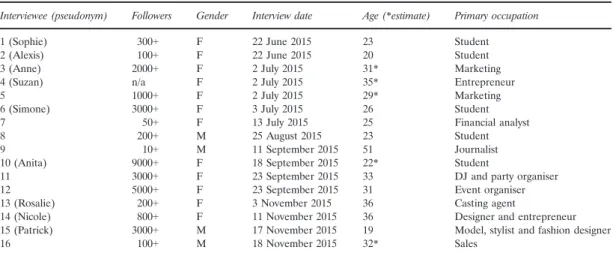
Our approach investigates practices and patterns of Instagram use microscopically and macroscopically. On a microscopic level, we researched how people see their worlds and especially the city through Instagram by analysing our corpus of Instagram posts (see below) on an ongoing basis to get a sense of who is using Instagram and what pictures they post. We selected posts both by drawing random samples of hundreds of posts and users, and by exploring the representation of specific places. We also conducted in-depth interviews with 16 active Instagram users between June and November 2015 (Table 1), had informal conversations with Instagram users and used the platform ourselves
to become acquainted with its functionality and conventions. We recruited six of our interview respon-dents through personal and on-campus networks, and the remaining ten we approached after identifying them as central users in various parts of the city using the methods described below. During the in-depth interviews, we asked a range of questions to get a sense of our respondents’ backgrounds and subsequently discussed how they used Instagram. We also looked at their feeds and had them talk about images they posted.
On a macroscopic level, we examine the broader patterns of stratification and segmentation that emerge from users’interactions (see also Boy and Uitermark 2016). We collected the data for this analysis through Instagram’s application programming interface (API). At the time of our research, the Instagram API allowed queries for posts published in a geographic area. We executed a series of such queries covering the area of Amsterdam at regular intervals using a research tool we developed (Boy 2015). Our initial corpus consists of nearly one million geotagged Instagram posts originat-ing from the Amsterdam municipal area gathered over a 12-week span between 19 April and 12 July 2015. Our corpus contains only posts that are geotagged.3This is likely a skewed and small portion of overall Instagram activity, but since we are particularly interested in Instagram as alocativevisual medium, this selectivity is justified. Further, since our main interest is in how city dwellers use social media in their everyday lives, we considered only users who had at least two posts at least four weeks apart to eliminate likely tourists, bringing down the number of posts to 480 000. These posts were created by more than 30 000 users. Each post contains a dozen pieces of metadata, including a timestamp, user data, location data (coordinates and in some cases a named location), a caption (if provided by
Table 1 In-depth interview subjects
Interviewee (pseudonym) Followers Gender Interview date Age (*estimate) Primary occupation
1 (Sophie) 300+ F 22 June 2015 23 Student
2 (Alexis) 100+ F 22 June 2015 20 Student
3 (Anne) 2000+ F 2 July 2015 31* Marketing
4 (Suzan) n/a F 2 July 2015 35* Entrepreneur
5 1000+ F 2 July 2015 29* Marketing
6 (Simone) 3000+ F 3 July 2015 26 Student
7 50+ F 13 July 2015 25 Financial analyst
8 200+ M 25 August 2015 23 Student
9 10+ M 11 September 2015 51 Journalist
10 (Anita) 9000+ F 18 September 2015 22* Student
11 3000+ F 23 September 2015 33 DJ and party organiser
12 5000+ F 23 September 2015 31 Event organiser
13 (Rosalie) 200+ F 3 November 2015 36 Casting agent
14 (Nicole) 800+ F 11 November 2015 36 Designer and entrepreneur 15 (Patrick) 3000+ M 17 November 2015 19 Model, stylist and fashion designer
the user) and hashtags (e.g. #amsterdam or #cappuc-cino). About 24 hours after they were posted, we also collected the responses (likes and comments) each post received.4The resulting dataset of responses has over 17.5 million entries, of which 1.1 million originated from local users.5 Figure 1 provides a map of the geographical distribution of Instagram posts in our corpus. The basis of our network analysis are the‘likes’ and comments through which users engage with each other. These practices weave webs of uneven relations, with some posts and users receiving a lot of recognition and acquiring central positions, and other posts and users taking more marginal positions. We consider a user to have a tie with another if she either commented on or liked that user’s posts during the 12-week window. The topology is constructed by considering these ties as directed edges between users, who are represented as nodes.6Ties are weighted according to the sum of comments and ‘likes’.7 We look at these network topologies for the city as a whole as well as at the neighbourhood level.
To studystratification, we look at the distribution of ‘likes’and comments among users. Rather than simply
counting the number of likes and comments, we also want to take into account the prominence of the users engaging in these acts of recognition: if a very prominent user likes a post or writes a comment, this should count more than when a peripheral user does the same. For this reason, we use the Page Rank algorithm –first developed to rank search results for the Google search engine (Brin and Page 1998) – to map the distribution of recognition and identify central users. If there were no bias toward certain images, users and places, we would expect to find a more or less random pattern of ties. If, on the other hand, Instagram users express clear preferences for certain users and places, we would find a skewed distribution.
To study segmentation, we identify communities of users who have relatively strong direct and indirect ties. We detect communities in an unweighted network of reciprocated ties. We opt for the Infomap community detection algorithm (Rosvall and Bergstrom 2008), which has performed well in comparative tests (Lanci-chinetti and Fortunato 2009) and is widely used among network analysts. To characterise the groups obtained from community detection, we looked up the accounts
Figure 1 The distribution of geo-tagged Instagram posts in our Amsterdam corpus
Note: Hotter colours indicate more posts. Overall density of Instagram use roughly corresponds with socio-economic status and historicity. The historical centre and the gentrifying 19th-century districts around it, such
of the most central users in each subgraph to see what their backgrounds are and what images they post in their timelines (cf. Boy and Uitermark 2016; Uitermark
et al. 2016). We also looked at the places cluster
members tagged. Users who tag places are not simply there; they want to show others that they are there. Place tags thus serve as markers of identity and lay a symbolic claim to a place.
Seeing the world through Instagram
Instagram feeds are colourful and variegated, but at the same time, Instagram projects a certain image of the world. What Instagram users see as they scroll through their feeds, what they post and how they use the platform to navigate social and urban worlds are marked by this prevailing aesthetic. Instagram posts capture moments– moments set apart by their refined beauty and good vibes. They are rarely spectacular, but rather capture an individual’s street-level view of daily urban life, lovingly arranged possessions or convivial occasions. In one picture we find a large group of cyclists waiting for a green light at an intersection; in another, a Jeff Buckley record sleeve artfully propped up atop a record player; in a third, we see young women and men dressed for a special occasion, smiling and enjoying drinks together. And of course we also find selfies, latte art and beautifully plated avocado toast. As Henri Lefebvre noted, moments can be distinguished from mere instants, as the former entail‘the hope of reliving that moment or preserving it as a privileged lapse of time, embalmed in memory’(2002, 343). Instagram users train their eye to spot slices of the world around them worthy of embalming. In the process of reassembling their life-world in this manner, the everyday is relentlessly aestheticised to the point that it never appears as the merely ordinary or mundane.8Looking through a stream of Instagram posts, one sees a seemingly interminable series of peak moments. Instagram thus conveys aes-thetic norms that induce a degree of conformity
(Bour-dieuet al. 1990) in how individuals use the platform.
This conformity has been the subject of numerous parodies, a sure sign that media practices on Instagram are subject to a set of unwritten rules.9 In fact, the exception proves the rule, because even reflexive and critical users do not play outside them. They, too, are enticed to use the platform to engage in strategies of distinction and the digital marking of space.
One of our respondents, Alexis, has a highly developed critical reflexivity about Instagram. She pokes fun at users who show off their preference for exquisite food or healthy lifestyles, for instance, by posting a picture captioned‘I hate refined deserts’, in which she poses next to a well-composedhaute cuisine dessert and sticks her middle finger out to the camera. When asked directly in the interview, she stated that
she never tags places. However, as the interviewer went through her Instagram feed, it appeared that she had, in fact, geotagged many of her holiday photos. One recent post in Amsterdam also featured a place tag. It was a post that pictured her with friends at Walter’s, a bar on Javastraat that is among the most prominent Instagram places in the gentrifying neighbourhood Indische Buurt. Alexis was perplexed that she did that.
Alexis: I don’t think I have–well, maybe here. Oh! It says. . .
Interviewer: You tagged the location, Walter’s. This is on Javastraat.
Alexis: Yeah, I did. Interesting. Yeah, I did it here. Yeah. That was nice. [. . .] Yeah, it was new then, and it was very nice, it was very–dinner was very good, and a friend of mine worked there, she was our waitress. Maybe, I don’t know why. . .maybe also to show,‘I went to the new cool place!’I don’t know what was going through my mind.
Here we begin to see why the city on Instagram looks much more appealing and glamorous than in everyday real life. Simone, a respondent whom we identified through her central position in her neigh-bourhood network, was more explicit about these strategies:
Interviewer: How do you find that a new restaurant has opened that you want to go to and those kinds of things?
Simone: Yeah, mostly Instagram, actually. I follow a lot of people from around here. There’s always someone who hears about it, and then it just spreads so quickly. You just see people going there, and. . .yeah. Sometimes I’m the first, sometimes someone else is the first, but I always like to be one of the first to go. It’s like a little–it’s not really a competition, but in a way it also is, a little bit. [laughs].
She attributes her success in this competition to her heightened ambient awareness:
I always look around. If I see new places and it’s something that really interests me–it’s like a gift. I see everything. I actually see, if you have a big street with shops and it’s completely chaotic, I still see if there’s a new place opening there, because it’s just something I notice. I see everything. My doctor says that it has something to do with my ADHD [laughs], that I look at everything. [. . .] I’m kind of obsessed with my surroundings, so that’s where my focus goes.
simply too perfect to be believable. There are accept-able levels of preening and peacocking, but there is also a point where one has clearly overdone it.‘Of course I’ll be, like, posting some photogenic stuff, and when I wake up I can look like shit. But nah, I’m not a catfish’, explained Patrick. Even Simone, the highly strategic user who regards Instagram as a competition of sorts, expressed sometimes being bothered by its prevailing aesthetic:‘People just want to see nice photos. But it does make everything look nicer than it is, so you can’t really see what someone’s life is actually about. So in that way it’s quite fake’.
The idea that the selective presentation of one’s life amounts to a ‘fake’ was taken up by many of our respondents as they scrolled through their own pic-tures. As we looked through her pictures together, Rosalie reflected,
It’s funny. Why do I do this? It’s because. . .I have to think about it. . .I think it’s also a really nice way to look at your own life and maybe you want to see your life like this. Well, of course it’s fake, because I’m not always this happy, you know. But in a certain way it isn’t. I think it’s the way Iwant
to see life or something? Yeah, I think so.
Sophie said she often feels social pressure looking through her social media feeds, because everyone always seems to be doing impressive things. But mostly she appreciates how Instagram users curate their images: ‘You can just scroll, and you’re looking at it, like,“pretty!”And the pictures are always very happy, and everybody is so healthy!’ This exclamation came over as at once delighted and exasperated.
Instagram’s aesthetic norms apply not just to people and experiences but also to places. Just like some people used to put pins in a map of the world to mark where they have been, our respondents switch on geolocation for the pictures they take on their travels. Having recently gone on vacation to Curacßao for the first time, Nicole told us that‘there were very, very nice places that I myself don’t want to forget, so I tagged some places where some pictures were taken’. When we looked at their maps of geotagged pictures, the first thing that came out is that our respondents frequently tag places abroad, both because they take many pictures when they travel and because they want to have their pictures’ geographical coordinates. Such geotagged histories in turn help others navigate. Several respondents look up Instagram pictures before they go on a trip to get a preview of the scenery and the places and their patrons. Alexis was planning a trip to Morocco and had used Instagram to decide which places to travel to, and Sophie was seeking out Parisian Instagram users to see what places she could visit during her study-abroad semester.
The same logic applies when respondents use Instagram to navigate in their own city. When they
see an appealing picture, they may get the idea to join the user or to visit the place at a later point in time. Instagram in a sense serves as a personalised brochure with appealing events and places. For some, Instagram has taken the place of apps like Yelp whose main function is to seek out, review and recommend places (cf. Zukinet al. 2015). Anita told us, ‘I try to follow people that are similar to me, similar interests. So I check their feed usually to see if they have been somewhere that they have recommended’. Simone said of Instagram that, to her, ‘it’s a search engine’ – a search engine for places. The new places our respondents brought up–such as Walter’s in Indische Buurt–are part and parcel of gentrification. Instagram confirms the status and visibility of these places, further boosting their competitive position and their role as engines of gentrification. In this sense, Instagram not only feeds on but also reinscribes socio-spatial inequalities.
The stratified world of Instagram
Mundane acts of recognition in the form of ‘likes’, comments or place tagging result in stratification, making some posts, users and places stand out while others remain an undifferentiated part of the ever-flowing stream. Who and what is able to rise to prominence? This section first demonstrates that Instagram’s figurations are very uneven and introduces the figures that sit at the zenith of the symbolic universe, enjoying the lion’s share of the attention and recognition given to Instagram users in the city. These hubs in the network are successful symbolic entrepre-neurs who are in a distinguished position to shape how other users perceive the city. We then introduce the places that come out on top.
Centre stage
while others are as young as 18. The clear majority of the central accounts are run by women.11In the 22 areas of the city we studied, 14 had accounts run by women in the most central location of the local network. A third characteristic most account owners share is that they work in the creative professions, broadly conceived. Seven work in fashion as stylists, designers, models or boutique store owners; six work in entertainment as DJs, party organiser, actresses or singers; the remaining ones work in marketing or public relations as writers, editors or artists. The star account at the city level is run by a woman in her thirties who works as a model, DJ, travel and fashion writer, and more. It is hard to determine how, exactly, she makes a living. On her website she calls herself‘a professional socialite’.
We know from surveys that Instagram users are overwhelmingly adolescents and young adults, and we know that a greater proportion of women use Insta-gram than men. In this regard, the central nodes are quite typical. It is also noteworthy that, although these users are overwhelmingly white and Dutch, there are a few exceptions. For instance, in several of the neigh-bourhoods that make up the South-East area of Amsterdam, the central accounts are owned by black women and men.
While these occupations, particularly in fashion, marketing and entertainment, are strongly represented in Amsterdam, the cultural capital of the Netherlands, it is nonetheless striking that they are so strongly represented among the star accounts. These profes-sions prepare people to be successful symbolic entre-preneurs. The skills learned in these fields can be applied to craft a successful online image. It is also not
clear whether these users’ Instagram activity is even distinct from their professional life. Their‘social life’ on Instagram may just be an extension or outgrowth of their professional life and vice versa, to the extent that the lines are completely blurred. A pair of city marketers who run a highly visible Instagram account confirmed this in the course of our interview:
Anne: Last night it was so warm and I couldn’t sleep at all, so I just put a chair in front of the window, opened the window and thought I’d read a book. So I was reading the book, and every two pages I was like–I wanted to grab my phone. This is not normal! I just put my phone away in another room. Okay, I don’t want–I just want to read right now. But the constant–it’s just in your head all the time. You just want to grab it. It’s ridiculous. Because we do it all day long, and you share all day long.
Interviewer: It’s hard to confine that to your work hours.
Suzan: But that’s something–you know, work hours, for us. . .
Anne: We don’t really have work hours.
Suzan: We don’t work, and we don’t have a private life.
If we look not only at the number one users in each neighbourhood but at some of the lower-ranked top users, we mostly find accounts run by individuals who share many of the same characteristics: young, female, with a connection to marketing, public relations, fashion, entertainment and lifestyle. These users may not work directly in fashion, for instance, but they are fashion enthusiasts who maintain blogs on the subject. Similarly, we find food bloggers who are hobbyist restaurant reviewers. In these cases the distinction between work life and social life is blurred as well. We also find full-time city marketers who hype local scenes
Figure 2 Weighted indegree distributions for Instagram users in Amsterdam
and explicitly turn to Instagram to promote what the city has to offer. For these individuals, too, the personal and the professional overlap: their feeds combine pictures of their clients’ places, mainly stores and restaurants, with personal impressions of waterfronts, parks or time spent with friends.
Assembling heat maps
When Instagrammers in Amsterdam tag places in their posts to advertise their presence there, they favour certain kinds of locations. The urban imagination promoted by Instagram sees the city as a collection of ‘hot spots’, and what is in between these hot spots gets the cold shoulder. In fact, fewer than two dozen locations account for one fifth of all location-tagged posts. Topping the list, Vondelpark, the city’s second-largest park to the southwest of the city centre, is tagged more than twice as often as the second most popular location, a former gasworks that now houses cultural events, start-ups and bars. Several other parks and public landmarks are among the most commonly tagged locations, including the Central Station train hub and well-known art museums.
Toward the top of the list we also find several concert venues and event spaces. It is noteworthy that Paradiso, a venue with a seating capacity of around 1500, appears far more frequently than arenas that host concerts by superstars that can seat tens of thousands. Other commonly tagged places include nightlife loca-tions in the city centre, such as lounges and clubs. These frequently host glamorous parties that are promoted on Instagram and then have an afterglow there when attendees share their pictures from the night. Users also signal their presence at other tempo-rary events, especially music festivals, fashion shows, but also a weekend-long food truck festival. Further down the list we find restaurants, bars, coffee houses and retail stores. While there are several hundred posts tagged at Starbucks and Coffee Company franchises, they are far outweighed by posts tagged at independent establishments owned and operated by local entrepre-neurs. The same is true for stores. Quirky concept stores that sell vintage clothing alongside premium coffee roasted in small batches frequently appear toward the top of the list, while H&M chain stores are tagged only sparsely. Much like they are more inclined to post from the small concert venue than a big arena, Instagram users are more likely to promote independent boutique establishments than major out-lets. Whereas Zukin et al. found that ‘[t]he lifestyle pages of local media give prominent coverage to the opening of new art galleries, restaurants, and designer clothing boutiques’and that most‘elected officials and community development groups praise new stores and restaurants as signs of capital reinvestment’(2009, 49), our findings suggest that Instagram users–and perhaps
social media users generally–are also highly selective in their coverage and very appreciative of places that signal and drive gentrification.
The segmented worlds of Instagram
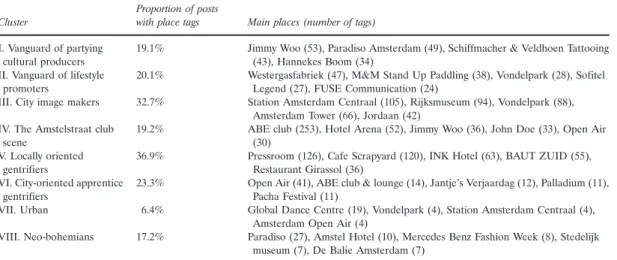
The Infomap community detection algorithm finds eight large clusters of more than 100 users who have a more or less pronounced profile (Table 2). Before discussing the clusters and their place within the city, it is perhaps important to point out that divisions between these clusters are not always very sharp. We see interactions between the various clusters, as shown in Figure 3. Additionally, there are places that are tagged by users from different clusters. For instance, the Amsterdam Open Air festival attracts a remarkably diverse Instagram constituency, as does Vondelpark. The existence of these spaces of mutual identification suggests that group boundaries are permeable. How-ever, we also see that the clusters are distinctive in some important ways. While there are no strict boundaries between clusters and all clusters are inter-nally heterogeneous, we can nevertheless provide rough descriptions of the different clusters to give an impression of how group formation plays out on Instagram.
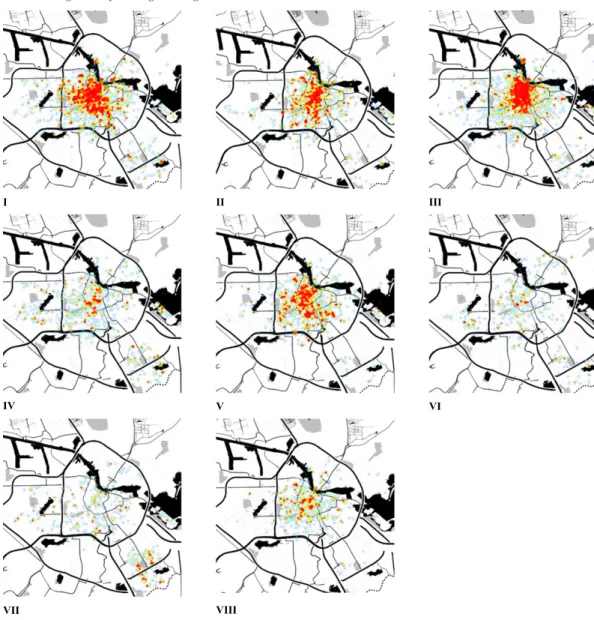
Clusters I and II are the most central in the overall network (Table 2; Figure 2). These clusters are over-whelmingly made up of people involved in creative professions who cultivate hedonistic and spectacular lifestyles (cluster I) or aesthetic and ascetic lifestyles (cluster II). The figures introduced above as occupying centre stage can overwhelmingly be found in these clusters. When we look at the locations of posts (Figure 4), both of these central clusters cover large parts of Amsterdam. The geographies of both clusters are similar, but cluster I features more posts from the recently gentrified neighbourhoods of De Pijp and Oud-West, whereas cluster II features more posts from the established and chic Zuid neighbourhood.
The cluster of ‘city image makers’(cluster III) has many users specialising in film or photography who love taking the city as their object. They are expert image makers, both amateur and professional, who picture the city from original angles, but they focus their lenses on the same landmarks and landscapes as tourists do, including the canals, museums and historical districts. Their streams are full of pictures of characteristic streets or buildings. This cluster also contains a number of expats who register what they find beautiful as they get to know the city. Users in this cluster are more likely than most users to tag places in their posts.
at Club AIR, as DJs or party organisers. Parties are the speciality of the members of this cluster; all the places they tag are large festivals or well-known clubs in Amsterdam’s city centre. Cluster IV brokers between groups that are on the periphery of the network, clusters VI and VII, and the central clusters I and II.
This may be due to the efforts of party organisers and DJs to bring together different subcultures in clubs on Amstelstraat and elsewhere.
The cluster of‘locally oriented gentrifiers’ (cluster V) stands out because users in this cluster frequently tag places. The density of posts is comparatively high in
Table 2 Overview of the eight largest clusters obtained from community detection on relations among over 30 000 Instagram users in Amsterdam
Cluster
Proportion of posts
with place tags Main places (number of tags)
I. Vanguard of partying cultural producers
19.1% Jimmy Woo (53), Paradiso Amsterdam (49), Schiffmacher & Veldhoen Tattooing (43), Hannekes Boom (34)
II. Vanguard of lifestyle promoters
20.1% Westergasfabriek (47), M&M Stand Up Paddling (38), Vondelpark (28), Sofitel Legend (27), FUSE Communication (24)
III. City image makers 32.7% Station Amsterdam Centraal (105), Rijksmuseum (94), Vondelpark (88), Amsterdam Tower (66), Jordaan (42)
IV. The Amstelstraat club scene
19.2% ABE club (253), Hotel Arena (52), Jimmy Woo (36), John Doe (33), Open Air (30)
V. Locally oriented gentrifiers
36.9% Pressroom (126), Cafe Scrapyard (120), INK Hotel (63), BAUT ZUID (55), Restaurant Girassol (36)
VI. City-oriented apprentice gentrifiers
23.3% Open Air (41), ABE club & lounge (14), Jantje’s Verjaardag (12), Palladium (11), Pacha Festival (11)
VII. Urban 6.4% Global Dance Centre (19), Vondelpark (4), Station Amsterdam Centraal (4), Amsterdam Open Air (4)
VIII. Neo-bohemians 17.2% Paradiso (27), Amstel Hotel (10), Mercedes Benz Fashion Week (8), Stedelijk museum (7), De Balie Amsterdam (7)
Figure 3 Graph of ties between clusters
the rapidly gentrifying 19th-century districts (the ring around the canal district). Several of the most central accounts in this cluster are run by marketing entrepreneurs who assist gentrifiers in navigating the city: they picture places (sometimes for a fee) that appeal to gentrifiers’ taste for branded authenticity. This cluster is locally oriented: users organise around places with a neighbourhood vibe. Through their pictures and discourse, they promote new establish-ments that they consider real assets to the neighbour-hood because of their authentic and local feel, as expressed for instance by the availability of local craft beers.
The most central users in the cluster of‘ unpreten-tious partygoers’(cluster VI) are young women in their early 20s. Their timelines are full of pictures at parties where they pose with young men displaying their toned bodies. Some of the places they go to are exclusive but not vanguard; they include places where football players are known to hang out. Other places, such as Jantje’s Verjaardag, are unpretentious venues known to attract a clientele from outside Amsterdam pejoratively referred to as ‘provincials’. While it is likely that a number of people in this cluster live outside Amster-dam, the geography of their posts suggest that quite a few live in Amsterdam West and Amsterdam Noord.
I II III
IV V VI
VII VIII
Figure 4 The distribution of geo-tagged Instagram posts from Amsterdam for different clusters of users
Whereas the other clusters post from cultural land-marks in these districts (e.g. Pllek, NDSM, Eye Film Museum), the people in this cluster post from these districts’residential areas. The posts in this cluster are only unpretentious by comparison; some of the pictures outside of party situations are suggestive of aspirations to high-class metropolitan living, as the users pose in the urban landscape with glasses of wine or cups of coffee.
Cluster VII largely consists of women and men of colour in their early 20s. Many users within this cluster showcase their affinity for locally inflected expressions of hip-hop culture. Remarkably, no more than 6 per cent of posts have place tags. In the rare cases that places are tagged, these are mostly in the Bijlmer, a predominantly black neighbourhood on Amsterdam’s south-eastern periphery. However, this does not mean that the life-worlds of users in this group are confined to this neighbourhood; while the Bijlmer is this cluster’s centre of gravity, their posts come from all over Amsterdam. Members of this cluster also have a strong local identity, as expressed in displays of Amsterdam streetwear brands Patta and Filling Pieces. While they are proud of their city, members in this cluster lack places that they identify with and mark as their own. Our respondent Patrick, who lives in the Ganzenhoef section of the Bijlmer, put it like this:
If you live in de Pijp, of course you can just point your camera, just like this, 180 degrees, and then move your camera. [. . .] Yeah, I think it’s easier then. Because if you stand on the block right here, in Ganzenhoef, and you point the same camera 180 degrees, like I just told you, you will only see, like, there’s a dude slanging crack over there. There’s a couple of kids having fun, sure, kicking a ball. Or there’s, like, a junkie asking people for money. Or you have a lot of guys smoking weed. It’s not really positive, as people would say.
Creative professionals and artists mostly make up cluster VIII. This‘neo-bohemian’cluster has compar-atively more men who are somewhat older than the members of other clusters. This cluster is the only one where at least some (male) users seem to consciously and ironically reject an overly slick appearance. They sport untrimmed hair and picture bizarre situations, such as a man posing with a huge inflatable banana while ironically making overtures to a woman. Some of them might attract the label of‘hipster’. The range of places they tag is remarkable: we find chic establish-ments (Amstel Hotel) and places for the cultural elite (De Balie) alongside the low-brow performances of the Toppers.
In short, we can see how the segmentation of the city occurs not only through residential segregation but also through more complex spatial sorting on the interface of social media and the city (Graham 2005). When people use social media to navigate the city, social
media bubbles reflect and reinforce socio-spatial divi-sions within the city. Although the boundaries among groups are not very sharp (there are connections between the groups both in terms of mutual‘likes’or comments and in terms of places tagged), it is striking that we can observe very different ways of relating to the city. Some groups–notably the cluster of‘locally oriented gentrifiers’(cluster V)–conspicuously display the places where they congregate and consume, while other groups – notably the ‘urban’ cluster (cluster VII)–have very few places to claim as their own. The uneven access to different parts of the city thus translates into inequalities in Instagram’s symbolic geography.
Conclusion
While much of the literature emphasises that the wide distribution of social media results in horizontal networks with considerable critical potential, our study of Instagram paints a more complex picture. We find that Instagram users act out aesthetic and lifestyle ideals as they craft images and strategically display aspects of their life-worlds. Instagram constitutes a distinctive way of seeing that composes an image of the city that is sanitised and nearly devoid of negativity. The feeds are full of desirable items, attractive bodies, beautiful faces, healthy foods, witty remarks and impressive sceneries. The messiness and occasional gloom and doom of the city have no place there. Instagram users are acutely aware of the images’ selectivity; it is what excites them about the platform and it is also what, occasionally, causes them stress as they feel they have to follow suit and produce images that their followers will appreciate.
boost their own status by picturing themselves in certain places, they also boost the status of those places. By producing and circulating appealing pictures of these places, users promote trendy bars, restaurants, coffee houses and stores. While it is plausible that Instagram users help to aestheticise neoliberal urban-ism, they do so in particular ways. They do not bring attention to large chains or big brands but picture distinctly local and often small places. The proprietors of these places lack the scale to set up massive marketing campaigns, but their patrons advertise their products through social media, thus giving a boost to their businesses.
While all Instagram users creatively reassemble elements of their life-worlds to fashion their identity displays, there are marked inequalities among users in terms of the places they display. Our analyses show some types of users are way more likely to tag places than others. While the results reveal subtle variations, there are also some striking differences that signal pronounced inequalities that emerge on the online–offline interface. For instance, we found that users in a cluster of gentrifiers are six times more likely to tag places than users in a cluster of young women and men of colour. This suggests that some groups have greater symbolic and spending power to reassemble the city, and Instagram is a tool they use to achieve this.
We consider the analysis presented in this paper as part of a broader endeavour to explore the interface between social media and the city under conditions of deep mediatisation (Couldry and Hepp 2016). Materi-ality or visceral experience do not become less impor-tant but are increasingly intertwined with images and messages circulating through a range of communication circuits. Mapping these new layers becomes increas-ingly essential to address perennial issues in geograph-ical and urban scholarship. It is in this spirit that our analysis combines computational analyses with more traditional methods and integrates them into a frame-work that enables us to examine how representations shape and reflect socio-spatial inequalities.
Acknowledgements
We thank Christian Bröer, Nick Couldry, Marianna D’Ovidio, Mandy de Wilde, Jack Jen Gieseking, Linda van de Kamp, Sander van Haperen, Dorien Zandber-gen, and the Transactions reviewers for helpful com-ments and suggestions. We are grateful to Irene Bronsvoort for her research assistance as well as her feedback. This work was funded in part by the Research Council of Norway (no. 231344). [Correction added on 07 August 2017, after first online publication: Funding information was previously omitted and has been added in this version.]
Notes
1 Like Manovich et al. (2014), we found that selfies account for a small proportion of all images shared on Instagram. In a small random sample from our corpus that we studied (n=131), only 9.1 per cent of images were selfies.
2 Our relational framework is inspired by assemblage thinking without fully embracing assemblage theory (see Baker and McGuirk 2016).
3 On Instagram, users can opt whether to attach their location to posts on a post-by-post basis. At the time of our research they also had the option to name their own location or leave the location field blank. This changed in August 2015 when Instagram removed the ‘Add to Photomap’feature from its mobile apps.
4 While there is an occasional‘long tail’of activity, most activity on a post happens in the first few hours. When fetching likes, we are limited to the 140 most recent likes, so for some very popular posts, we are unable to retrieve all activity.
5 We stored metadata in a database, but in an effort to respect users’privacy, we did not save the media file attached to posts. When needed for content analysis, we retrieved these media files later. We could only do so if the user had not deleted the post in the interim or set their account to private, which means that we could not see posts the users did want to display publicly. Even though the users we discuss in this paper often have many followers and share images freely, we do not report on the users or their posts in detail on the assumption that they may not have realised their posts were publicly available (cf. Marwick and Boyd 2014; Nissenbaum 2009).
6 We used the igraph software package (Csardi and Nepusz 2006).
7 Because we were unable to retrieve the full number of likes for very popular posts, we used a logarithmic scale for the edge weights (see Boy and Uitermark 2016). 8 On the aestheticisation of the self and of everyday life,
see Skeggs (2004).
9 See, for instance, the brilliant animation titledClichesby Hierophante (2015). The artist notes that, by parodying
‘our tendency to be unoriginal on social media’, he also reproduces a cliche.
10 The shape of the Page Rank distributions, not shown here, closely follows the shape of the indegree distribu-tions. Their shape is best described by a stretched exponential distribution.
11 On the gendered work of self-branding on social media, see Duffy and Hund (2015).
References
Axelrod R M1997The complexity of cooperation: agent-based models of competition and collaborationPrinceton University Press, Princeton NJ
Bourdieu P, Boltanski L, Castel R and Chamboredon J-C 1990
Photography: a middle-brow artWhiteside S trans Stanford University Press, Stanford CA
Boy J D2015Kijkeens: a tool for researchersZenodo https://doi. org/10.5281/zenodo.34500
Boy J D and Uitermark J 2016 How to study the city on InstagramPLOS ONE11 e0158161
Brin S and Page L 1998 The anatomy of a large-scale hypertextual web search engine Computer Networks and ISDN Systems30 107–17
Castells M 2009 Communication power Oxford University Press, Oxford
Castells M2012Networks of outrage and hope: social move-ments in the internet agePolity, Cambridge
Couldry N and Hepp A2016 The mediated construction of realityPolity, Cambridge
Csardi G and Nepusz T2006 The igraph software package for complex network research InterJournal Complex Systems 1695
de Souza e Silva A and Sutko D M2011 Theorizing locative technologies through philosophies of the virtual Communi-cation Theory21 23–42
De Waal M2014The city as interfaceNAi, Rotterdam
Duffy B E and Hund E2015‘Having it all’on social media: entrepreneurial femininity and self-branding among fashion bloggers Social Media + Society1 https://doi.org/10.1177/ 2056305115604337
Elias N1978What is sociology?Hutchinson, London
Graham S D N2005 Software-sorted geographiesProgress in Human Geography29 562–80
Graham M, Zook M A and Boulton A2013 Augmented reality in urban places: contested content and the duplicity of code
Transactions of the British Institute of Geographers38 464–79
Greenwood S, Perrin A and Duggan M 2016 Social media update 2016Pew Research Center, Washington DC
Hampton K N and Katz V S2016 Communication in city and community: from the Chicago School to digital technology
American Behavioral Scientist60 special issue.
Harvey D 1989 The condition of postmodernity Blackwell, Oxford
Hess A2015 The selfie assemblage International Journal of Communication9 18
Hierophante 2015 Cliches (https://vimeo.com/151297208) Accessed 10 August 2016
Hochstenbach C 2017 Inequality in the gentrifying city Unpublished PhD thesis University of Amsterdam
Hoelzl I and Marie R2015Softimage: toward a new theory of the digital imageIntellect, Bristol
Kelley J K2014 Urban experience takes an informational turn: mobile internet usage and the unevenness of geosocial activityGeoJournal79 15–29
Kitchin R and Dodge M 2011 Code/space: software and everyday lifeMIT Press, Cambridge MA
Kotchemidova C2005 Why we say ‘cheese’: producing the smile in snapshot photography Critical Studies in Media Communication22 2–25
Lancichinetti A and Fortunato S2009 Community detection algorithms: a comparative analysisPhysical Review E80 056117
Lefebvre H1991The production of spaceNicholson-Smith D trans Blackwell, Oxford
Lefebvre H 2002 The critique of everyday life, vol. 2: foundations for a sociology of the everydayMoore J trans Verso, New York NY
Leszczynski A and Crampton J2016 Introduction: spatial big data and everyday lifeBig Data & Society3 https://doi.org/10. 1177/2053951716661366
Manovich L et al. 2014 Selfiecity (http://selfiecity.net) Accessed 24 March 2015
Marwick A and Boyd D 2014 Networked privacy: how teenagers negotiate context in social mediaNew Media & Society16 1051–67
Nissenbaum H2009Privacy in context: technology, policy, and the integrity of social lifeStanford University Press, Stanford CA
Rettberg J W2014Seeing ourselves through technology: how we use blogs, selfies and wearable devices to see and shape ourselvesPalgrave Pivot, New York NY
Robson G and Butler T2001 Coming to terms with London: middle class communities in a global city International Journal of Urban and Regional Research25 70–86
Rosvall M and Bergstrom C T2008 Maps of information flow reveal community structure in complex networksProceedings of the National Academy of Sciences105 1118–23
Sarvas R and Frohlich D M2011 From snapshots to social media: the changing picture of domestic photographySpringer, New York NY
Schelling T C 2006 Micromotives and macrobehavior W.W. Norton, New York NY
Schwartz R and Halegoua G R2014 The spatial self: location-based identity performance on social mediaNew Media & Society17 1643–60
Scott J C 1998 Seeing like a state: how certain schemes to improve the human condition have failed Yale University Press, New Haven CT
Skeggs B2004Class, self, cultureRoutledge, London
Sontag S1977On photographyFarrar, Straus and Giroux, New York NY
Uitermark J2015 Longing for Wikitopia: the study and politics of self-organizationUrban Studies52 2301–12
Uitermark J, Traag V A and Bruggeman J2016 Dissecting discursive contention: a relational analysis of the Dutch debate on minority integrationSocial Networks47 107–15
Van den Berg M2017Gender in the post-Fordist urbanPalgrave Pivot, New York NY
Van den Veer N, Boekee S and Peters O2017Nationale social media onderzoekNewcom, Amsterdam
West N M 2000 Kodak and the lens of nostalgia Virginia University Press, Charlottesville VA
Zhu L and Lerman K2016 Attention inequality in social media (http://arxiv.org/pdf/1601.07200) Accessed 26 April 2016
Zook M A and Graham M2007 Mapping DigiPlace: geocoded internet data and the representation of placeEnvironment and Planning A: Planning and Design34 466–82
Zukin S, Trujillo V, Frase F, Jackson D, Recuber T and Walker A 2009 New retail capital and neighborhood change: boutiques and gentrification in New York City City & Community8 47–64