INVESTIGATING INFANT CRYING PERSISTENCE AND CRY ACOUSTIC FEATURES AS EARLY RISK INDICATORS FOR SOCIAL ADJUSTMENT: DEVELOPMENTAL
ASSOCIATIONS WITH INFANT VAGAL TONE AND ATTACHMENT STRESS
Jacek Kolacz
A dissertation submitted to the faculty of the University of North Carolina in partial fulfillment of the requirements for the degree of Doctor of Philosophy from the Department of Psychology
and Neuroscience
Chapel Hill 2016
ii © 2016 Jacek Kolacz
iii ABSTRACT
Jacek Kolacz: Investigating Infant Crying Persistence and Cry Acoustic Features as Early Risk Indicators for Social Adjustment: Developmental Associations with Infant Vagal Tone and
Attachment Stress
(Under the direction of Jean-Louis Gariépy)
The present pair of studies used hypotheses derived from the Polyvagal Theory (Porges, 2007; 2011) to assess the capacity of infant crying persistence and cry acoustic features to predict social adjustment in toddlerhood, and to elucidate the mechanisms that account for this relation. In view of this theoretical framework, behavioral cry frequency and acoustic features may serve as early markers of the functioning of the neural social engagement system.
iv
attachment stress which predicted poorer social relatedness. Crying persistence in infancy did not predict vagal tone in infancy and toddlerhood, but higher vagal tone placed children at risk of poorer social relatedness. A second study, based on a subset of the overall study sample (n = 37), assessed infant cries for mean fundamental frequency and its variability, as well as overall cry modulation depth. More smoothly-modulated cries were related to higher RSA during the cry bout as well as higher RSA during a free-play parent-child interaction at 6 months. Behaviorally, children who avoided a stranger in the lab at 24 months had more unstable cries as infants. The results of this pair of studies suggests that infant cry persistence and acoustic cry features may be promising early indices of the developing social engagement system. Examining these cry characteristics at a time when the social behavioral repertoire is still nascent and it organization highly sensitive to the quality of the social context presents a promising new avenue for
v
ACKNOWLEDGEMENTS
This document is deeply indebted to the following people: Jolanta & Jerzy, my parents, whose support, love, and – most of all – example made all this possible; My brother Jakub, for being a partner in intellectual exploration for nearly 30 years; Greg Lewis, for his continued mentorship and kindness; Maria Davila, for her wisdom; Stephen Porges, who continues to be an inspiration, for giving me a chance and a dataset; Keri Heilman, the endlessly patient data guru; Steven Holochwost, for his generous advice; Martha Cox, for her kindness; Lilly Shanahan, who opened a door for exploring new ideas and testing highly novice statistical skills, and whose lab space afforded me a beautiful arboretum view and the world’s most comfortable dissertation writing chair; and the committee members, who endured more than a month of defense
vi
TABLE OF CONTENTS
LIST OF FIGURES.……….……….……….……….….x
LIST OF TABLES.………..………...………xi
CHAPTER 1: INTRODUCTION………..………..…....1
Infant cries and social adjustment………...…………..………4
Cry persistence and social adjustment………..………...……….4
Acoustic features of vocalizations……….……….…..6
The Polyvagal Theory – A Neural Link between Vocalizations and Social Development………..……….……….7
Infant crying and vagal tone………...…………10
Cry persistence and vagal tone……….…..12
Cry acoustic features and vagal tone……….………..15
Relations between cry behavior and cry acoustic features……….18
Vagal tone and social adjustment………...…18
Crying and attachment stress………..20
Attachment stress and child social adjustment………..………..23
vii
The present studies………...………..26
Study 1………...………26
Measurement model specific aims ………...28
Structural model specific aims……….………..………30
Study 2 ……….………..32
CHAPTER 2: METHOD ……….………..35
Participants……….………35
Study design ………..………35
Cry persistence measurement………...………..36
Cry acoustic feature measurement ……….37
Cry elicitation ………37
Cry acoustic features ……….38
Vagal tone measurement ……….……….……….40
Attachment stress measurement ………41
Social adjustment measurement………...………..42
Stranger approach ………..………42
Early Childhood Behavioral Questionnaire (ECBQ) ……….43
viii
Analytic plan ……….………44
Study 1 ……….……….45
Study 2 ……….……….47
CHAPTER 3: RESULTS ……….….………48
Study 1 ………..48
Missingness analysis ………..…….………..48
Reliability of cry diary data ………...48
Convergence of retrospective reports ………48
Combined cry diary and retrospective report measurement model...……..….…..51
Social adjustment measurement model ……….………52
Vagal tone measurement model ………...………..58
Final model examination ……….………..63
Indirect effect testing ………..….………..66
Planned comparisons with alternate models ……….……….…………67
Ad-hoc comparisons with alternate models ………..………….67
Study 2 ………..……….68
Differences in key variables as a function of inclusion in study 2 ………..68
ix
Cry persistence and modulation depth ……….……….……….69
Cry modulation depth and vagal tone ………...………..69
Cry modulation depth and attachment stress ………...………...72
Cry modulation depth and social adjustment ………..…………..72
CHAPTER 4: DISCUSSION ………74
Study 1 ……….………..74
Limitations ………81
Study 2 ……….……….……….83
Limitations ………..………..87
Conclusion ……….89
APPENDICES ………..……….90
Supplemental material ……….………..90
x
LIST OF FIGURES
Figure
1 The neural social engagement system……….……… 9 2 Study 1 conceptual model………...…… 27 3 Spectrogram and modulation power spectrum example………. 39 4 Simplex model assessing prospective cry diary reliability …….……….….………. 50 5 Final study 1 model………...……….. 65 6 Study 2 regression results………..………. 71 7 6-month cry modulation depth differences between children
xi
LIST OF TABLES
Table
1 3-month cry diary variable descriptive statistics……….……… 49
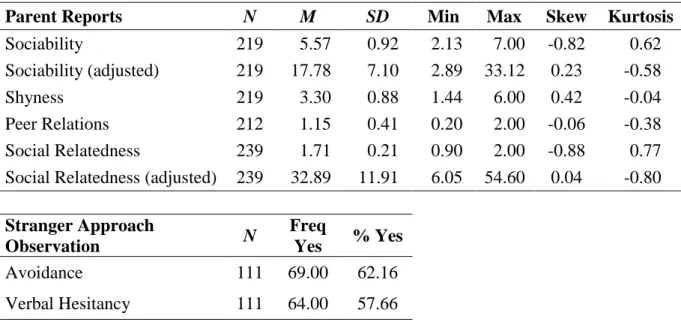
2 Social adjustment measured variable descriptive statistics………..………… 53
3 Social adjustment continuous variable Pearson correlations………..…………. 54
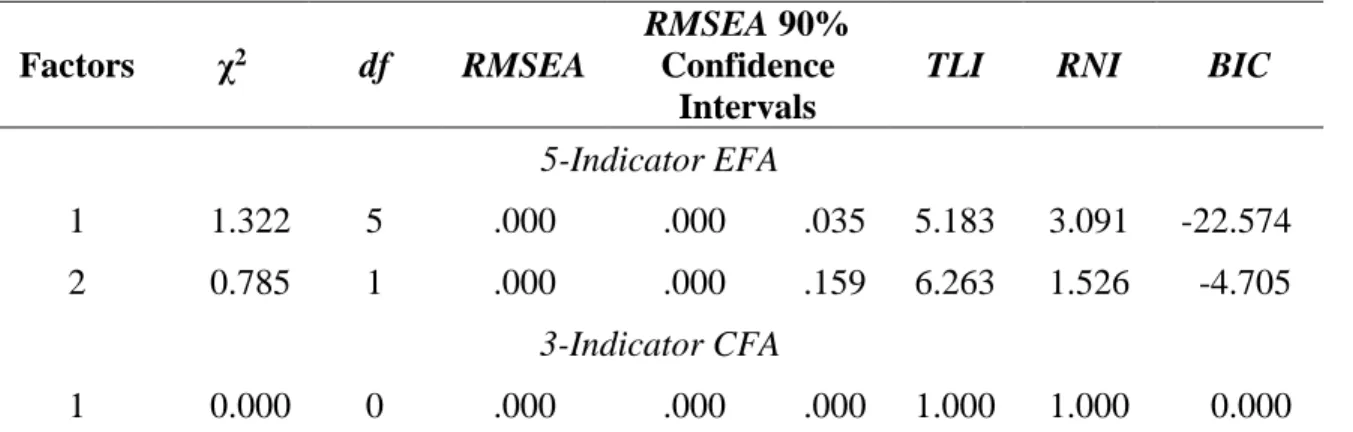
4 Exploratory factor analysis (EFA) and confirmatory factor analysis (CFA) model fit statistics……….…….. 56 5 Standardized exploratory factor analysis (EFA) and confirmatory factor analysis (CFA) factor loadings……….. 57 6 Vagal tone indicator descriptive statistics………...………. 59
7 Latent vagal tone measurement model fit statistics………...……….. 61
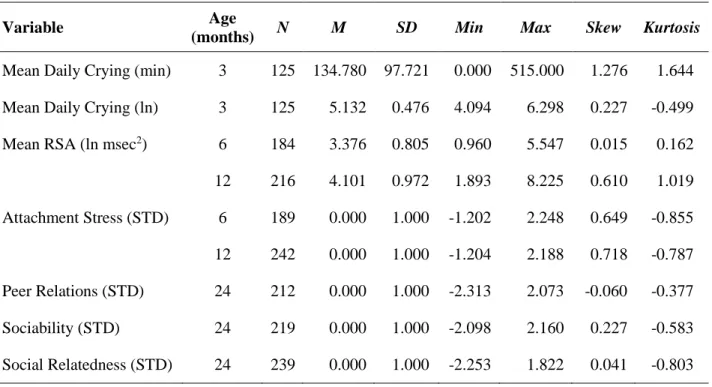
8 Study 1 measured variable descriptive statistics………..………… 62
9 Study 1 measured variable correlations………..…………. 64
1
CHAPTER 1: INTRODUCTION
Persistent crying – characterized by frequent, extended, inconsolable bouts of distress, often with unusually high and variable acoustic cry features - is among the most common infant problems reported by mothers (Barr et al., 2000; Forsyth et al., 1985). It is estimated to affect between 5 - 19% of infants between 2 weeks and three months of age (Lucassen et al., 2001). In the majority of cases, this condition remises without intervention (Barr, 1998). Despite the transitory time course of persistent crying, a growing body of research points to behavioral frequency of infant crying and acoustic features to have lasting predictive value for children’s social adjustment, a propensity for positive social relationships and positive, engaged reactions to novel social situations. (e.g., Papousek & von Hofacker, 1998; Salley, Miller, & Bell, 2013). Given that the social relationships have been found to be of importance for promoting adaptive development and reducing risk of clinical pathology (e.g., Choukas-Bradley & Prinstein, 2014; Bagwell, Newcomb, & Bukowski, 1998; Hartup, 1996; Parker & Asher, 1987), understanding the emergence of individual differences in social development in the first years of life and its developmental origins may lead to greater ability to assess early risk and inform intervention efforts. However, little research has examined the mechanisms that underlie the link between infant crying and social development, perhaps in part because of the limited availability of conceptual models that provide specific testable hypotheses about these relations.
2
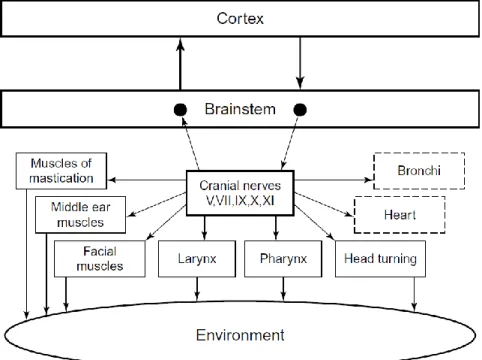
neural social engagement system that facilitates affiliative social behaviors and promotes regulation of arousal states through interactions with others (Porges, 2007; see Figure 1). The key functional conduit of this body-face connection is made possible by the activity of the myelinated branch of the vagus nerve. The development of the social engagement system occurs rapidly during the first years of life, both shaping and being shaped by the parent-infant
relationship, children’s first social context. This provides a developmental biopsychosocial foundation for neural and behavioral organization that contributes to individual differences in children’s social adjustment. The following pair of studies aim to examine the biopsychosocial developmental sequence that can account for the prediction of social adjustment from infant crying persistence and cry acoustic features.
The first study focuses on the role of infant crying persistence and social adjustment. Within the framework of the Polyvagal Theory, cry persistence may reflect early neural
development of the social engagement system and regulation of distress states. Further, persistent crying may augment parental attachment stress (e.g., Papousek & Hofacker, 1998), reduce
3
West, & Mendes, 2014). Thus, a third mediation pathway will be examined wherein the parent attachment stress induced by persistent crying may exacerbate difficulty with the vagal
regulation of bodily states and, in turn, lead to problems of social adjustment in toddlerhood. A second study examines a similar pattern of relations but focuses, instead, on infant cry acoustic features. As part of the social engagement system, the regulation of bodily states by the vagus nerve is anatomically integrated with the muscles of the larynx and pharynx, which affect the modulation of vocalizations (Porges, 2007; Porges & Lewis, 2009). As such, differences in cry pitch and its modulation may also serve as indicators of vagal tone. Emerging evidence shows that high pitch and variability of infant cries are a risk factor for Autism Spectrum
Disorders, which are marked by severe social deficits (Esposito & Venuti, 2010; Sheinkopf et al., 2012, Esposito et al., 2014). However, to my knowledge, no previous study has examined the predictive power of cry features for social adjustment within a normative sample. Not only may cries with high and unstable pitch reflect problems with the vagal regulation as part of the neural social engagement system, they may also promote parent stress by virtue of their aversive
qualities (Zeskind & Marshall, 1988; Gustafson & Green, 1989). Thus, like cry persistence, these acoustic features may also form part of a biopsychosocial developmental pathway that places infants on a path toward poorer social adjustment in later childhood. The analysis in study 2 examines the relations of infant cry acoustic features with infant vagal tone, parent stress, and social adjustment during toddlerhood.
4
datasets. In the first, a developmental model of parent attachment stress and neural regulation mediating the link between cry persistence and social adjustment in toddlerhood is examined using structural equation modeling with latent variables. The second study, focused on cry acoustic features, serves as an exploratory analysis in light of the relatively incomplete status of the extant literature and modest sample for testing hypotheses. This study provides a test of the relations between infant cry acoustic features and social adjustment, parent attachment stress, and neural regulation of bodily stateswithin a normative population in the hope that this exploration will inform future, more comprehensive models.
Infant Cries and Social Adjustment
5
and its implications for development features much theoretical and methodological overlap. The term crying persistence will be used throughout this document, though literature summaries will strive to adhere to the source nomenclature as closely as possible. While ease of crying onset, length of crying bouts, and soothability may all contribute to crying persistence, all may reflect an underlying propensity for distress or mobilization states. Thus, the operational definition of crying persistence used in this study is, simply, the quantity of crying time.
Individual differences in infant crying and distress have been widely linked to social adjustment. In one study, four-month old infants were exposed to a series of visual, auditory, and olfactory experiences in a laboratory setting (Kagan & Snidman, 1999). Of these infants, about 20% displayed consistent strong reactions that included crying in response to the stimuli. When these children were compared to their low-reactive peers at age 4.5 years, they showed fewer spontaneous comments and smiles with an unfamiliar adult and were more inhibited with unfamiliar peers. In addition, a recent longitudinal study found that among a broad range of temperamental measures, children’s negative affect in response to sensory qualities of
stimulation at age two (a measure of the intensity of negative reactions to sensory experiences) was the only child characteristic that predicted social responsiveness at age 4, with higher levels of sensory discomfort predicting higher level of impairments in social cognition, communication, and social motivation (Salley, Miller, & Bell, 2013; however, by age 3 a wider range of
6
high incidence of relationship disorders cried more in infancy than their peers (Papousek & von Hofacker, 1998). In contrast to this positive evidence, one prospective study found that infants who had colic did not differ from non-colic infants in social or peer competence by four years of age (Canivet, Jakobsson, & Hagander, 2000). However, there is a general convergence within the literature that points to long lasting predictive value for social development from infant crying and distress.
Acoustic features of vocalizations. In addition to varying in crying persistence, infants also vary on the acoustic features of cries, such as frequency (i.e., pitch) and its modulation. Although such acoustic features have not, to my knowledge, been studied in relation to social development in normal populations, they have been increasingly used to examine risk for the development of autism spectrum disorders (ASD). Because these disorders are often marked by moderate to severe social deficits, their relation to cry features may shed additional light on the role of neural vocalization regulation on atypical social development.
Elements of infant’s cries have been linked to ASD in several studies. Infants who would later receive an ASD diagnosis do not display the typically-developing trajectory of decreasing fundamental frequency (F0, typically perceived as the pitch) of cry over the first years of life in
comparison with those who would go on to develop typically (Esposito & Venuti, 2010). It has also been found that six-month-old infants at risk for autism spectrum disorder, as identified by an older sibling with the diagnosis, produce pain-related cries that are higher and more variable in their fundamental frequency than their low-risk peers (Sheinkopf et al., 2012). Additionally, in this study, children that would go on to receive an ASD diagnosis had cries that were among the most variable in F0 range as infants. In a study of 15-month old high- and low- ASD risk
7
F0 than their low-risk peers (Esposito et al., 2014). Among these, three toddlers that would later
receive an ASD diagnosis produced cries that had among the highest F0 values. Though based on
limited samples, this evidence points to infant crying as a potentially informative tool for predicting the emergence of clinical levels of social adjustment problems.
Overall, there is evidence that both infant cry persistence and vocalization acoustic features are predictive of social adjustment. However, little is known about the developmental mechanisms that account for this link. Part of this gap may be explained by a lack of application of guiding theoretical frameworks for generating hypotheses and examining mechanisms. I now turn to a recent theoretical framework to guide the building of a model that explores potential developmental mechanisms.
The Polyvagal Theory – A Neural Link between Vocalizations and Social Development
Traditional views of the autonomic nervous system have focused on two major branches – the sympathetic nervous system (SNS) and parasympathetic nervous system (PNS). These branches connect the brainstem with target organs throughout the body, with many organs being innervated by both branches. Signals transmitted by the SNS and PNS include both efferent transmission – signals traveling from the brainstem to the organs that influence their function – and afferent transmission – signals traveling from the organs to the brain that provide
information about the status of target organs. As recent advances have allowed for
disaggregating SNS and PNS contributions to heart regulation (Newlin & Levenson, 1979; Bernston et al., 1997; Granger et al., 2007), we are now in the position to more precisely
8
frameworks with increasing precision regarding the anatomical and functional properties of the autonomic nervous system.
One such framework that has stimulated novel psychophysiological hypotheses is the Polyvagal Theory (Porges, 2007; 2011). This framework focuses on the autonomic nervous system as a key neural regulator of social engagement and distress states that mobilize the body for activation and communication of pain or danger signals to others. The neural structure of the social engagement system is composed of a visceromotor component, the myelinated vagal circuit that innervates the heart and bronchi, and a somatomotor component, which includes neural pathways that innervate the muscles of the face and head (see Figure 1). The somatomotor pathways regulate the facial muscles, which facilitate emotional expression; the middle ear muscles, which aid to extract the human voice from background sounds; the muscles involved with head turning and tilting, which permit social gesturing and orientation; and the laryngeal and pharyngeal muscles that regulate vocal characteristics.
9
10
head muscles to communicate alarm. When myelinated vagal activity is withdrawn during these states, mobilization (fight or flight) states are instigated through increased sympathetic-adrenal activity or immobilization is cued through the unmyelinated dorsal vagal complex (DVC; Porges, 2001).
The Polyvagal Theory provides an evolutionary biopsychosocial approach to the study of social development and opens up opportunities for novel research questions and hypotheses. In this view, social communication is functionally integrated with body states and thus provides an evolutionarily-selected mechanism for relaying and receiving information about internal states between conspecifics (Porges & Lewis, 2009). This view emphasizes the role of infant crying in communicating internal states to caregivers, with internal states being reflected in onset and length of cry, soothability, and the acoustic features of cries. In this framework, ease of cry elicitation reflects autonomic threshold for distress originating from within and without, persistence of crying during soothing efforts reflects openness to social regulation of distress states, and cry acoustic features reflect vagal regulation of the larynx and pharynx. This framework provides a novel approach to studying the role of these features in children’s social development, including the parent-child relationship and engagement with peers and strangers. I first turn to a more specific review of the role of the vagal tone as a regulator of cry features before examining its function in social development.
Infant Crying and Vagal Tone
11
indicative of distressed states and crying persistence may reflect difficulties with regulation of distress reactions. More generally, the integration of vocal modulation, body states, and the social engagement system points to infant crying as a potential early marker of the functioning of the neural circuits that underlie social communication.
The most commonly used indices of autonomic function have focused on the regulation of the heart. The heart is dually innervated at the cardiac sinoatrial (SA) node by both the SNS and the myelinated vagus nerve of the PNS. The effect of these branches on heart rate (or, its inverse, heart period) are mutually antagonistic. Increases in PNS activity slow the timing between heart beats while increases in SNS shorten these intervals. Thus, heart rate can be used as an index of overall autonomic activity on the heart, but lacks specificity about the neural source of such control. An increase in heart rate, for instance, could be caused by a withdrawal of vagal activity, an increase in sympathetic activity, or a combination of both (Berntson, Cacioppo, & Quigley, 1991).
The activity of the myelinated vagus nerve, which is predicted by the Polyvagal Theory to be central to states of social engagement and most intimately linked with the acoustic features of vocalizations, has been found to be largely responsible for heart rate variability related to respiration (Berntson et al., 1997). Robust vagal activity increases heart rate during inspiration and decreases it during expiration. The amplitude of this rhythm, termed respiratory sinus arryhtmia (RSA), serves as an index of cardiac vagal activity (Porges, 1985). Vagal influence on the heart includes both tonic and situational influences. Tonic influence reflects a general
strength of regulation by the myelinated vagal system, which is termed vagal tone. Flexibility in withdrawing vagal influence as needed metabolic resource allocation for mobilization or
12
occur rapidly in response to changes in physical demands, such as fight/flight responses, or psychological demands, such as changes in attention (Porges, 2011). Thus, inter-individual and intra-individual variability in the respiratory cardiac rhythm provide a sensitive index of
myelinated vagus nerve influence on the heart, allowing a tool for linking the regulation of internal states with external behavior such as crying persistence.
Cry persistence and vagal tone. Though colic or excessive/persistent crying has been described as a medical condition for hundreds of years (von Rosenstein, 1771), only about 5% of persistently crying infants can be diagnosed with an organic cause (Barr, 1998). One widely hypothesized etiology for persistent crying is that it may be the result of low threshold for autonomic arousal or an autonomic regulatory profile characterized by high SNS and low PNS activity (often described as “imbalance”; Lester et al., 1990; Carey, 1984). From a polyvagal perspective, persistent crying may be reflective of low threshold for social engagement system withdrawal and difficulty with the re-engagement of this circuit to promote calm, restorative states. Such difficulties may be reflected in low tonic vagal activity on the heart.
13
colic symptoms can be relieved by anticholingeric medication (Lucassen et al., 1998; Hall, Chesters, & Robinson, 2012), a key neurotransmitter in both sympathetic and parasympathetic signaling. Such findings support the role of autonomic activity in colic but lack specificity about how individual circuits – such as the myelinated vagus nerve - may influence crying persistence.
Although little research has been conducted on the relations between clinical levels of crying (i.e., colic or persistent crying), a parallel line of developmental research has examined crying and soothability variation within normal populations. These normative and clinically-focused lines of research rarely intersect. However, because the clinical status of colic or persistent crying may be merely the high range of a normal distribution of infant crying persistence (Barr, 1991; Lindberg, 2000), studies with normal populations may provide key insights on this problem as well. Colic and persistent crying may reflect both a low threshold for initiating crying and less responsiveness to soothing efforts for reducing distress. Thus, research examining both the threshold for inducing crying and how easily crying can be soothed may reflect key constructs for examining relations between autonomic activity and individual
differences in infant crying. In this realm, developmental researchers conceptualize infant crying behavior as reflective of temperamental differences in physiological reactivity and, often,
regulation (Rothbart, 2011; Fox, 1989; Kagan, 1982).
14
their mothers than those who did not. This finding is consistent with the role of the myelinated vagus nerve in state regulation (Porges, 2011) as its efficient use protects children from resorting to recruiting more metabolically taxing systems (such as the SNS). Furthermore, vagal tone measured at 9 months of age predicts mother ratings of difficult temperament in toddlerhood, such that children with higher vagal tone in infancy are less “difficult” in toddlerhood (Porges et al., 1994). In another study, higher resting vagal tone that was averaged across multiple
assessments during the course of a year was related to less parent-rated distress to frustration at 18 months (Stifter & Jain, 1996).
15
examine multi-system physiological groupings, children in the group with the lowest resting vagal tone had lower parent ratings of distress to sensory stimulation than the two groups with the highest vagal tone levels (Kolacz et al., 2016).
In sum, substantial research supports both high and low vagal tone may place children at risk of persistent crying. This suggests that this relation may not be linear, but may instead follow a curvilinear pattern, creating an “optimal” relation with moderate levels of vagal tone predicting low persistent crying. Although to my knowledge this relation has not yet been tested, this analysis – as will be detailed later – examines both linear and non-linear links.
16
Neural projections that are part of the vagal complex from the lower brain stem (cranial nerves IX to XII) regulate muscles of larynx, pharynx, chest, and upper neck (Lester &
Boukydis, 1990). These projections coordinate breathing, as well as frequency modulation and temporal patterning of vocalizations (Lester, 1984). The cry sound is part of the expiratory phase of respiration during which sound is produced by the larynx, also known as the “voice box”, which contains the vocal folds and the glottis. During vocalizations, the glottis and vocal folds close. Air pushed through the closed vocal folds results in a pressure drop that causes the folds to rapidly open and close, the speed of which is called the fundamental frequency (F0) and is
typically perceived as the vocalization pitch (LaGasse, Neal, & Lester, 2005). This opening and closing occurs at approximately 250 to 450 cycles per second (Hz) in a typical newborn cry (LaGasse, Neal, & Lester, 2005) and does not differ between males and females (Reby et al., 2016). Vocal frequency (pitch) is modulated via the laryngeal muscles, which alter the shape and tension of the vocal folds. Increased tension in these muscles is accompanied by decreased variability in the modulation of vocalizations (Stevens & Hirano, 1981). In infant cries,
variability in pitch suggests instability in the neural control of the vagal cranial complex and is associated with neural damage or elevated risk status (LaGasse, Neal, & Lester, 2005). Thus, a smoothly modulated cry can be used as a marker of well-regulated control of the laryngeal musculature (Lester & Zeskind, 1982).
17
formant of a typical cry occurring at approximately 1100 Hz and the second formant around approximately 3300 Hz (LaGasse, Neal, & Lester, 2005). Although typically only the first two formants are measured (LaGasse, Neal, & Lester, 2005), the full range of formants covers a much wider frequency band, the qualities of which may influence the effect that cries have on caregivers. Besides these frequency characteristics, neural regulation also influences the
temporal patterning of infant cries. Duration of cry utterance, duration of inspiratory period, and number of rapid, unvoiced sounds have all been related to parasympathetic function and the neural control involved in respiration (LaGasse et al., 2005).
Empirical evidence has emerged to support a functional relation between vagal regulation with frequency and temporal cry acoustics. In a study of neonate’s responses to circumcision, fundamental frequency was found to be highest and cry duration to be shortest during the most invasive (and presumably most painful) parts of the procedure (Porter, Porges, & Marshall, 1988). This indicates that such acoustic features may be modulated in accordance to differing metabolic demands due to challenges. In this study, infants also showed stable within-person differences in their cry features that were associated with myelinated vagal activity. Infants with the highest levels of vagal tone prior to the procedure had the lowest fundamental frequency of cries and children with the lowest vagal tone had the highest fundamental frequency. Further, cry fundamental frequency was correlated with vagal tone measured during the procedure. In a separate study, reduced fundamental frequency, its variance, and utterance duration were all found to relate to more pronounced reductions in RSA following a social challenge (Stewart et al., 2013). Recently, infant RSA during sleep was found to negatively predict minimum, mean, and maximum cry F0 for 5-month-old infants that had been born pre-term (Shinya et al., 2016).
18
via anatomical differences in overall body size and vocal fold lengths – was taken into account. Taken together, these studies support a functional connection between frequency and modulation of vocalizations and the neural regulation of body states in response to challenges.
Relations between cry behavior and cry acoustic features. The shared neural connections between autonomic regulation and both crying persistence and cry acoustic features suggests that the behavioral and acoustic features of infant cries are related. Indeed, many infants that cry persistently have higher pitch and greater pitch variability than normally crying infants (Lester et al., 1990). Research has repeatedly shown that infants meeting Wessel’s criteria for crying amount also demonstrate distinct acoustic features including higher and more variable fundamental or dominant frequency than their peers that were matched on demographics and clinical features (Lester, Boukydis, Garcia-Coll, Hole, & Peucker, 1992; Zeskind & Barr, 1997). In addition, when the mothers of infants with colic were played recordings of infant cries, they reported their infant’s cries as more urgent and arousing than mothers of comparison infants. Thus, it is likely that both crying persistence and cry acoustic features may share a common physiological basis.
Vagal Tone and Social Adjustment
19
source of soothing (Porges & Furman, 2011). Differences in myelinated vagal activity may thus be critical to the development of children’s social adjustment. Social adjustment can be
conceptualized as the quality of social relationships (e.g., Crick & Dodge, 1994). However, because social lives include not only long-term relationships but interactions with strangers, social adjustment will be used in this set of studies to refer to a propensity for positive social relationships as well as positive and engaged reactions to novel social situations.
Empirical evidence has accrued to support the role of vagal tone in children’s social adjustment. For example, fourteen-month-olds with high vagal tone approached a strange experimenter more readily and maintained less proximity to their mother when the stranger was present than those with low vagal tone (Fox, 1989). Twelve-month olds who withdrew vagal tone during a cognitive test were rated by observers as more engaged with the experimenter, more emotionally positive, less fearful, and less irritable (Stifter & Corey, 2001). Also, stronger vagal withdrawal in response to a lab assessment at 9 months predicted decreased incidence of mother-reported social withdrawal and aggression when children were 3 years of age (Porges et al., 1996). Further, two- to three-year-old children with higher vagal suppression to challenge spend more time visually orienting to the experimenter (Calkins, 1997). By preschool age, children with higher vagal suppression to challenge are rated as more sociable by their parents (Doussard-Roosevelt, Montgomery, & Porges, 2003).
20
study, inhibited children with the least variable heart rates were more likely to remain inhibited at subsequent lab visits compared to their inhibited peers with relatively more variable heart rates. In addition, children in this study who were inhibited and maintained a high and stable heart rate differed from their uninhibited peers and their inhibited peers with low and variable heart rate. These children observed unfamiliar peers for longer periods of time and stayed closer to their mother during a play session. This evidence supports the notion that the vagal system may be a key factor in the development of stable social adjustment differences across childhood. In sum, empirical evidence supports the notion that higher vagal tone and stronger vagal
withdrawal to challenges are related to children’s level of sociability and lack of inhibition in the presence of unfamiliar persons.
Crying and Attachment Stress
Whereas internal vagal activity may be one mediator between infant crying and social development, attachment stress - which reflects stress on the bond between parent and child – may also be implicated in this link. Such stress can be detrimental to a parent’s sense of closeness with the child and perceived ability to observe and effectively respond to the child’s needs (Abidin, 1995). Crying is one of the first social signals used to by the infant to
communicate within the parent-child relationship and is utilized often during the first months of life. The persistence and acoustic features of this signal may have effects on the developing infant-parent relationship, and those impacts may have implications for children’s social
21
In the first months of life, infants rely on parents for regulation of their internal states (Hofer, 1987; Tronick, 1989). The neonate’s earliest emerging and most reliable signal for distress is the cry. Crying communicates to the caregiver that the infant is in need and motivates action by inducing arousal states in the caregiver. Though the infant cry is a necessary and adaptive aspect of the infant-caregiver bond, crying persistence and unusually arousing acoustic features of the cry can contribute to attachment stress. Persistent and acoustically aversive infant cries may create a stressful social context for the caregiver-child dyad and limit opportunities for positive social interactions between parent and child. These differences in the quality of the parent-child relationships can set the stage for emerging differences in the social behavior of children both within and outside the family system.
Although, to my knowledge, no study has specifically examined the effect of persistent crying on attachment stress, evidence shows that many aspects of the parent-child relationship may be substantially affected by infant cry behaviors. Mothers who are referred for clinical help due to infant persistent crying have high rates of partnership conflicts, low self-efficacy,
depression, anxiety, exhaustion, anger, and marital distress (Papousek & Hofacker, 1998). Such disruptions can extend long after the remission of persistent crying or colic. Compared to parents of children who did not have colic, parents of children whose colic went into remission
continued to have higher maternal anxiety, depression, and psychological distress (Humphrey & Hock, 1989; Pinyerd, 1992), low feelings of parental competence and more separation anxiety (Stifter & Bono, 1998), higher ratings of being bothered by infant’s temperament (Jacobson & Melvin, 1995), and less satisfaction with family functioning (Rautava et al., 1995; Räihä et al., 1996). However, some studies have failed to show a difference in the long-term effects of
22
have not been found to differ in anxiety and postnatal depression (Clifford et al., 2002). In addition, one study failed to find differences in mothers’ self-reported responsivity after the resolution of colic in comparison to mothers whose infants did not have colic (Stifter &
Braungart, 1992). In spite of these inconsistencies, the majority of studies provide evidence for the detrimental effect of persistent infant crying on maternal mental health, mother-child relationships, and overall family function. These alterations may be especially evident in heightened parental attachment stress, affecting both the bonding and caregiving aspects of the parent-child relationship.
In addition to amount of crying, a range of studies has demonstrated that the acoustic features of infant cries are related to the perceived aversion and salience of the cries in adult raters. Fundamental frequency of infant cries positively predicts adult’s ratings of their arousing, urgent, distressing, and aversive responses (Zeskind & Marshall, 1988). Further, relative power concentrated in higher frequency bands (3 kHz or above) is positively related to adult
23
subjective experiences based on only brief audio clips, it can be hypothesized that extensive periods of exposure to aversive cries from an infant could augment attachment stress that is induced by infant crying.
Attachment Stress and Child Social Adjustment
The parent-infant relationship is a crucible for early social development. Within these relationships, physiological states are co-regulated and social communication expectancies and skills emerge with both parent and child contributing to the infant’s burgeoning capacity for social engagement (Bowlby, 1988). With time, increasingly more complex capacities for social engagement emerge in the dyad, including social referencing, imitation, and joint attention (Carpenter, Nagell, & Tomasello, 1998). These all contribute to a growing repertoire of social skills and expectations which children will bring with them as their social circles grow to include peers and adults within a larger community. Thus, the patterns established within the parent-child relationship in the first years provide a key arena for the development of these expectations and abilities.
24
relationships may be disrupted by stress placed on the dyad’s attachment relationship early years of caregiving. General parenting stress is associated with increased levels of insecure attachment with both mothers and fathers in 18-month-olds (Jarvis & Creasey, 1991; Hadadian & Merbler, 1996). Further, parenting stress has been found to predict increased negative perceptions of the child, hostile attributions about the child’s behavior, and harsh discipline practices (Pinderhughes et al., 2000). This effect of stress on the parent-child relationship can be apparent in children’s social functioning, even outside the home. For instance, parent-reported stress has been found to be negatively related to children’s social competence as rated by their preschool teachers
(Anthony et al., 2005). In sum, observed relations between attachment stress, its effects on the quality of the parent-child relationship, and social behaviors point to attachment stress as a potential mediator between infant crying and social adjustment. While such effects may be accounted for via disruptions in the parent-child relationship, it is also possible that attachment stress may directly influence children’s vagal regulation.
Maternal Influences on Children’s Vagal Tone
The myelinated vagus is immature at birth. In humans, the first months of life are marked by rapid development of this system, with proliferation of myelinated fibers, increasing
25
assigned to a skin-to-skin contact program (Kangaroo Care) and compared to pre-term infants that received a standard care regimen. Those that received the skin-to-skin contact intervention showed more mature vagal tone and more mature state regulation (longer quiet sleep and alert wakefulness states) compared to their peers (Feldman & Eidelman, 2003). This supports the proposition that social experiences are important contributors to the physiological development that supports social engagement.
Though the above-described intervention was designed to manipulate touch, emerging research has begun to examine the profound impact that parent’s emotional and arousal states can have on their infant’s own internal states through non-tactile transmission. In a study that experimentally manipulated mother’s stress, infants had an increase in heart rate when reunited with their mothers who were just negatively evaluated (who had an increase in their SNS activity) while infants had a decrease in heart rate when reunited with mothers who were not evaluated (who did not have an increase in SNS activity prior to reunion; Waters, West, & Mendes, 2014). A follow up study that utilized a similar design but included an additional manipulation of mother’s ability to have touch contact with the child showed that SNS activity synchronized in infant-mother pairs only when mothers were able to have tactile contact;
26
the eyes, innervation of the larynx and pharynx, as reviewed above), such results provide a vivid illustration that the coordination of the face and head with the vagus nerve create a dynamic system that promotes social and physiological coordination between interacting partners, even without the use of touch.
While such effects have been studied in short-term experimental manipulations, it is possible that interaction patterns built over time influence the development of vagal tone in the infant. For instance, a mother-infant relationship characterized by high attachment stress may promote dampened vagal tone in the infant. On the contrary, low attachment stress may promote more opportunities for positive interactions between mother and child, scaffolding the child’s organization of vagal tone over time in ways that support sociable predispositions. Taken together, this research suggests an indirect mediation between attachment stress and social adjustment via effects on the myelinated vagus nerve that regulates bodily states and conditions the neural social engagement system.
The Present Studies
27
28
In order to test the above-described structural model, key construct measurement models are established. First, a cry persistence measurement model is used to assess whether cry data drawn from two samples - which were collected from two nearly identical study designs - as well as two measurement occasions – a cry diary report and a retrospective persistent crying report – reflect a single underlying construct. Cry diary reports collected over the course of three days are also examined for daily reliability in order to support their use in the measurement model. A second measurement model is examined for social adjustment, using an exploratory and confirmatory factor analysis to assess the factor structure of multiple parent reports and lab observations of children’s responses to a strange adult. To my knowledge, no study has
examined the factor structure of the measures used here. However, given that children may differ in their social relations with familiar peers and adults and in their responses to strangers
(Rothbart, 2011), it is tentatively hypothesized that two factors – reflecting social relatedness and shyness – may emerge. Third, a vagal tone measurement model is tested to examine whether the relations among several discrete epochs drawn from a single interaction may reflect an
underlying vagal tone construct. The fourth key construct, attachment stress, is measured using a single indicator latent variable with internal consistency estimate drawn from a previous study. Thus, there is no specific aim associated with this construct. In sum, the following measurement and structural aims are examined.
29
Specific Aim 1: Examine the cry persistence measurement model by 1) assessing stability of daily cry diary reports, 2) assessing the association between parent-reported crying persistence methods using daily cry diaries and retrospective recalls, and 3) to justify combining observed variable measurement information from two comprable samples.
Hypothesis: Infant crying persistence measurement will demonstrate day-to-day stability in daily cry diary reports, converge between daily diaries and retrospective measurement methods, and converge between samples.
Specific Aim 2: Examine the structure of social adjustment across multiple parent-report measures and laboratory observations elicited by a stranger’s approach.
Hypothesis: It is tentatively expected that social adjustment may reflect two related constructs of social relatedness with familiar adults and peers as well as shyness or social reticence in interactions with strangers.
Specific Aim 3: Examine whether vagal tone as measured by multiple epochs during a mother-infant interaction can be described as a single latent underlying construct.
30
Structural model specific aims. The following specific aims are examined in regards to the structural model.
Specific Aim 4: Examine the association between infant crying persistence and social adjustment in toddlerhood.
Hypothesis: Persistent crying in infancy will predict poorer social adjustment in toddlerhood.
Specific Aim 5: Examine whether the association between infant crying persistence and social adjustment in toddlerhood is mediated by parent attachment stress.
Hypothesis 1: Infant persistent crying will be related to elevated parent attachment stress.
Hypothesis 2: Parent attachment stress during infancy will negatively predict social adjustment in toddlerhood.
Hypothesis 3: Parent attachment stress during infancy will mediate the relation between infant crying persistence and toddler social adjustment.
31
Hypothesis 1: Infant crying persistence will be associated with vagal tone. Based on the literature above, three possible relations may be observed: Crying persistence may be a) positively related to vagal tone, b) negatively related to vagal tone, or c) exhibit a curvilinear relation with vagal tone with more persistent crying related to both high and low values.
Hypothesis 2: Vagal tone will negatively predict social adjustment in toddlerhood.
Hypothesis 3: Vagal tone in infancy will mediate the relation between infant crying persistence and social adjustment in toddlerhood.
Specific Aim 7: Examine whether a dual mediation model accounts for the relations between infant cry persistence and social adjustment in toddlerhood. This model will test whether persistent infant crying promotes elevated attachment stress, resulting in decreased infant vagal tone, which – in turn – confers risk of social adjustment problems in toddlerhood.
Hypothesis 1: Parent attachment stress during infancy will predict lower infant vagal tone.
Hypothesis 2: The link between infant crying persistence and social adjustment in toddlerhood will be accounted for by a 3-part pathway that includes both parent
32
attachment stress, parent attachment stress will in turn predict lower infant vagal tone, and low infant vagal tone will in turn predict poorer social adjustment in toddlerhood.
To my knowledge, this study is the first to test a comprehensive mediation model of the developmental mechanisms that link persistent infant crying to social adjustment. In addition, it is among the first large-scale studies to examine vagal tone as a potential underlying correlate of persistent crying. Finally, the examination of mechanisms through which persistent crying, though it may eventually remiss on its own, provide information about future risk for problems of social adjustment and may inform the identification of intervention targets and designs.
Study 2. Study 2 serves as an exploratory study of the relations among infant cry acoustic features, cry persistence, vagal tone, parent attachment stress, and social adjustment in
toddlerhood. In service of this goal, a subset of infants that cried during the 6-month Still Face paradigm were drawn from a larger longitudinal sample (n = 37; see below). Study aims are explored using bivariate correlations, scatterplots, and single predictor regressions due to the novelty of many of these questions and the modest sample of infant cry acoustic feature data that were available for analysis. The following specific aims are examined.
Specific aim 1: Examine the relation of cry persistence to cry pitch and modulation.
33
Specific aim 2: Examine the relation of infant cry pitch and modulation to vagal tone.
Hypothesis: Infant cry pitch and modulation of the cry signal will be negatively related to vagal tone.
Specific aim 3: Examine how infant cry pitch and its modulation are related to attachment stress.
Hypothesis: Infant cry pitch and modulation of the cry will positively predict attachment stress.
Specific aim 4: Examine how infant cry pitch and modulation are related to social adjustment.
Hypothesis: Higher infant cry pitch and greater modulation of the cry will predict poorer social adjustment in toddlerhood.
To my knowledge, this is the first study to examine the predictive utility of cry acoustic features within a normative (non-ASD risk) sample. The above hypotheses are derived from largely untested predictions from the Polyvagal Theory. Their examination may help inform theoretical models of biopsychosocial development and future empirical models of infant risk for deficits in physiological regulation and social development. In addition, this study is - to my knowledge - the first study to utilize the modulation power spectrum (MPS; Singh & Theunissen, 2003; see below) for the quantification of infant cries. This method may serve as a better
34
35
CHAPTER 2: METHOD
Participants
Both proposed studies use data collected from two longitudinal samples composed of families from a large Midwestern city (total n = 391). Infants in both studies were recruited via local hospitals, clinics, parenting magazines, and internet advertisements. At recruitment, the combined sample was 49% female, 40% Caucasian, 37% African American or Black, 17% Hispanic or Latino/a, 6% Native American, and 4% Asian or Pacific Islander. Participating families were socioeconomically diverse, with 57% of household incomes totaling $50,000 or more, 27% totaling less than $50,000, and 21% of families receiving public assistance. Study 1 utilizes the full combined sample while study 2 is restricted to the subsample of infants who cried during the lab Still Face procedure for the purpose of assessing their cry acoustic features (n = 37; see below). This subsample was 51% female, 61% Caucasian, 29% African American or Black, and 21% Hispanic or Latino/a. Household incomes were $50,000 or greater in 66% of families, less than $50,000 in 34%, and 23% of families received public assistance.
Study design
36
below). During this session, parents also completed a series of questionnaires that included the Parenting Stress Inventory (PSI). When children were 24 months, they took part in another series of lab tasks that included a play session with a parent and the stranger approach procedure (Lab-TAB; Goldsmith et al., 1999). During this visit, parents completed the Early Child Behavioral Questionnaire (ECBQ) and Infant-Toddler Social Emotional Assessment (ITSEA). Participants in the second sample were recruited between 6 and 24 months (Growing Baby Study; n = 242). In this sample, 32% (n = 76) children had their first lab visit at 6 months, 35% had their first lab visit at 12 months, 33% had their first visit between 12 and 24 months (n = 78). The average age at first lab visit was 13.09 months (SD = 6.21). At this first lab visit, parents completed a
retrospective cry diary report. These families then participated in a series of lab visits with the same procedures as those in sample 1, of which the 6-, 12- and 24-month lab visit data were used for the purpose of analysis.
Cry Persistence Measurement
37
retrospective reports of cry patterns using the History of Cry/Reflux (Boukydis, 2008). These reports were obtained from the families shortly after they were recruited. This form asked parents to retrospectively report whether their infants had periods of persistent crying, age when persistent crying began and ended, and report the total number of hours per day that the infant cried, and the month at which the infant stopped crying for more than 3 hours per day. These reports will be combined to create a binary persistent crying variable (1 = persistent crying between birth and 3 months, 0 = no persistent crying between birth and 3 months).
Cry acoustic feature measurement
Cry elicitation. At the 6 month lab visit, children took part in a modified Face-to-Face Still Face (FFSF) paradigm (Tronick et al., 1978; Mesman et al., 2011). During the protocol, infants were placed in a high chair with an experimenter seated approximately 50 cm away at the infant’s eye level. Mothers were not present. The protocol consisted of three 2-minute
38
Cry acoustic features. Infant behavior during the Still Face was video recorded and the procedure was coded for infant crying. A total of 49 infants cried during the Still Face. Audio data in the video recordings were processed with a 5500Hz low-pass filter during analog signal acquisition. Audio files were extracted from video files using the Matlab mmread function (Richart, 2005). To examine acoustic features of these vocalizations, audio files were then manually edited to isolate cry vocalizations only. Sounds such as noises associated with infant movement (e.g., kicking), non-cry vocalizations (e.g., fussing, cooing), dysphonation (chaotic vocalizations without harmonic structure), and extended stretches of silence were removed prior to analysis using Audacity software (Audacity Team, 2014). Then, a band-pass filter (0.2 – 6 kHz) was applied prior to acoustic analysis.
The resulting audio files were analyzed for mean fundamental frequency and its
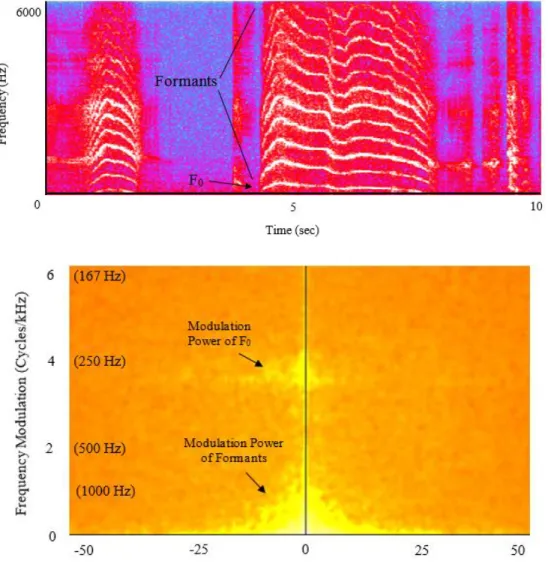
variability (see top panel of Figure 3) using the SHRP Matlab function (Sun, 2002-2016). Audio files were first separated into sequential 40ms windows with 30ms overlap. The resulting
windows were decomposed using a Fast Fourier transformation. F0 was identified as the first
peak above floor noise within each window and a mean across all windows was computed. Variability was operationalized as the bandwidth in which the fundamental varies between 50% and 100% of its peak energy.
39
Figure 3. Spectrogram and modulation power spectrum example. Top panel: Spectrogram of an infant cry with representations of fundamental frequency (F0), the lowest band in the
vocalization, and formants; Bottom panel: Modulation power spectrum of an infant cry with representations of fundamental frequency (F0) and formants; frequencies coarsely align in decreasing value along the y axis moving away from the origin; temporal changes are
40
temporal representations of sounds have been found to characterize auditory neuron’s higher level processing of isolated natural sounds (Theunissen & Elie, 2014) and organization of the auditory cortex includes features detectors that correspond to specific spectro-temporal patterns (Norman-Haignere, Kanwisher, & McDermott, 2015).Thus, the MPS serves as a functional representation of sound processing that occurs in high level auditory neurons. The MPS was applied to 1.5-second sequential time slices with 50% overlap and averaged over the length of the audio file. Each audio file was assessed for total modulation depth, operationalized using the square root of the ratio between power at origin (0, 0), reflecting unmodulated sound, to power in the rest of the spectrum (Singh & Theunissen, 2003).
Of the 200 children with complete videos of the lab visit, 189 completed the Still Face (n
= 11 showed distress prior to the Still Face and were deemed too upset to conduct the procedure). Of these, 49 children cried in response (25.93%). Prior to analysis, cry audio files were examined for quality and several files were removed. Reasons for removal included audio files having few cry sounds or total crying time lasting less than 20 seconds (n = 3). In addition, because
modulation of the cry exhalation (i.e. wail) was of interest, files were removed if they featured predominantly fussing or choking sounds (n = 8). Finally, one file was removed due to the infant’s unusual high-pitched cry (n = 1). This resulted in 37 files for use in the analysis.
Vagal Tone Measurement
41
segments were a play session between the mother an infant, a play session with the experimenter that preceded the Still Face, and the Still Face. At the 12 month visit, data was used from the mother-child play session only. Once collected, heart period data derived from the ECG signal were edited for artifacts using CardioEdit software (Brain-Body Center, Chicago, IL). The resulting files were analyzed for respiratory sinus arrhythmia (RSA) magnitude, the variance in the beat-to-beat heart rate pattern in the frequency band associated with spontaneous breathing (.24 to 1.04 Hz in young children). RSA was computed for 30-second epochs using algorithms developed by Porges and Bohrer (1990; Porges, 1985) and implemented in CardioBatch software (Brain-Body Center, Chicago, IL). In study 2, the means of the 30 second epochs for each
segmented were calculated.
Attachment stress measurement
42
available, Cronbach’s alpha is reported for parent reports due to their use by the measures’ original authors). PSI data are available for 289 families (6 months n = 189, 12 months n = 242).
Social adjustment measurement
Stranger Approach. At the 24 month lab visit children participated in a series of
43
Early Childhood Behavioral Questionnaire (ECBQ). When children were 24 months old, parents completed the ECBQ (Putnam, Gartstein, & Rothbart, 2006), a 201-item measure
designed to assess temperament characteristics in children between ages 18 and 36 months. Items are on a 7-point Likert-type scale reflecting the typicality of toddler’s behavior during the two weeks immediately prior to the assessment (1 = never, 7 = always). Subscales are designed to aggregate behavior across a variety of contexts and eliciting events, demonstrating moderate to strong longitudinal stability correlations between 18 and 36 months (Putnam, Gartstein, & Rothbart, 2006). The present analysis will utilize the Sociability and Shyness subscales, which have been found to reflect distinct aspects of social adjustment in children (Putnam, Gartstein, & Rothbart, 2006). Sociability assesses the extent to which children seek and take pleasure in interactions with familiar others. Items in this subscale include “When around large gatherings of familiar adults or children, how often did your child want to be involved in a group activity?” and “When a familiar child came to your home, how often did your child seek out the company of the child?”. Internal consistency for this subscale has been found to be high for children aged 24-months (α = .89; Putnam, Gartstein, & Rothbart, 2006). The shyness subscale assesses the extent to which children show slow or inhibited approach and/or discomfort in social situations that involve novelty or uncertainty. Items in this subscale include “When approaching unfamiliar children while playing, how often did your child watch rather than join?” and “In situations where s/he is meeting new people, how often did your child become quiet?”. Internal consistency for this subscale has also been reported to be very good (24 months: α = .82; Putnam, Gartstein, & Rothbart, 2006). ECBQ data are available for 219 children.
44
development (Carter et al., 2003). Items range on a 3-point scale based on how well the item describes the target child or how often the target child engages in a type of behavior: 1) Not true/rarely; 2) Somewhat true/sometimes, 3) Very true/often. Test-retest scores over a 1.5 month interval were moderate to high for individual subscales (r range= .69 - .85). The prosocial peer relations and social relatedness index will be utilized from this study. The prosocial peer relations is a 5-item subscale that includes items such as “Plays well with other children” and “Takes turns when playing with others”. Internal consistency for this subscale has been found to approach acceptability (α = .66; Carter et al., 2003). The social relatedness index is composed of 10 items and includes items such as “Likes being cuddled, hugged, or kissed by loved ones”. Internal reliability for this subscale has been found to be α = .56 (Carter et al., 2003). ITSEA data are available for 239 children at age 24 months.
Analytic Plan
45
models estimated using FIML did not converge. WLSMV estimates, which did not substantially differ from FIML results in compared models, are reported for consistency.
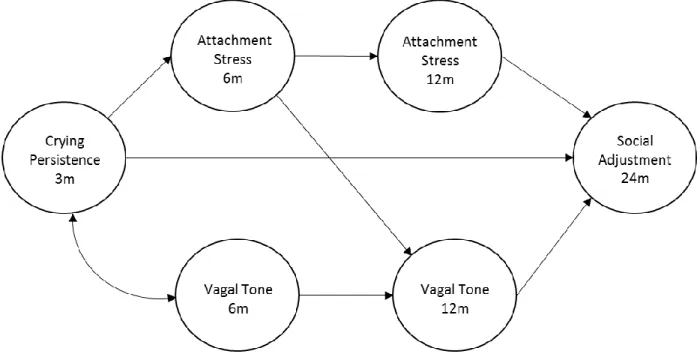
Study 1. The first study, using the total combined sample (n = 391), examines the role of infant crying persistence in the development of individual differences in social adjustment. Further, the potential mediating roles of vagal tone and parent attachment stress in this link are examined (see conceptual model in Figure 2). Measurement models are first examined, followed by structural models.
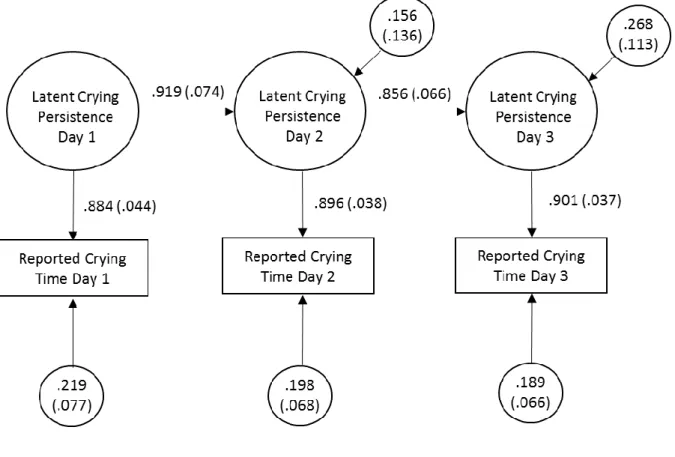
To assess the cry persistence measurement model, reliability of cry diary data was assessed using a simplex model. This method entails using longitudinal structural equation modeling to estimate a latent variable for each observed measure that represents a “true” score taking into account measurement error (Heise, 1969; 1970; Joreskog, 1979; Wiley & Wiley, 1970). In this application, day 1 daily crying true scores was used to estimate day 2 true scores, which, in turn, was used to estimate day 3 true scores. The prediction of each day’s score from the previous day’s score was used to assess reliability. In order to permit model identifiability, the model was specified with a stationary error variance assumption (Biemer, Christ, & Wiesen, 2009). Once reliability of cry diary data was assessed, a latent factor measurement model for cry persistence was examined. In sample 1, data from cry diaries was used to extract a latent crying persistence factor. Then, this factor was used to predict retrospective parent reports of cry persistence in the first 3 months of life.
46
measures with substantial convergence were fit to a latent factor model. For this purpose, all participants (n = 391) were randomly divided into an exploratory and confirmatory group. In the exploratory group, an exploratory factor analysis (EFA) was conducted. Factor retention was guided by examination of the scree plot (Cattell, 1966), model fit, and simple structure among factor loadings. Model fit was evaluated using the root mean squared error of approximation and its 90% confidence intervals (RMSEA; Steiger & Lind, 1980; Steiger, 1990), the Tucker-Lewis Index (TLI; Tucker & Lewis, 1973); the Relative Noncentrality Index (RNI; McDonald & Marsh, 1990), and the Bayesian Information Criterion (BIC, calculated as χ2-[df*(ln(n))]; Schwartz,
1978; Bollen et al., 2014). As suggested by Hu and Bentler (1999), good fit to the data was assessed by an RMSEA value near .06 or lower as well as TLI and RNI values near .95 or greater. The BIC fit index was used to examine whether the tested model was superior to the full
saturated one (reflected by negative values). The resultant factor structure was then tested on the other half of the sample using a confirmatory factor analysis, using the model fit criteria
described above. The two samples were then recombined for confirmatory factor extraction in order to assess relations with predictors in all further modeling, ensuring maximum power for detecting effects. The final measurement model for latent vagal tone was assessed at 6 and 12 months using the above-described model fit criteria.
To test the structural models, the resulting social adjustment factor was regressed on the cry persistence factor. Mediating variables were added cumulatively to allow for close
47
crying persistence. However, given the nature of the study aim to assess whether infant crying can be used as a risk indicator and the timing of cry persistence which precedes the 6 month vagal tone collection, cry persistence was included as a predictor of 6-month latent vagal tone when assessing indirect effects. Otherwise, the two variables are specified as covarying. The indirect effects of the mediation paths were examined as compound parameters (Bollen, 1987).
48
CHAPTER 3: RESULTS
Study 1
Missingness analysis. Predictive patterns of missing values were examined for all study variables using logistic regressions. Six-month attachment stress percentile score negatively predicted missing values on 24-month parent-reported sociability (B = -0.418, SE = .1742, p = .017, OR = .659). Parent-reported sociability could thus be considered missing at random and ignorable in models where 6-month attachment stress is included (Allison, 2001). Missing values on all other variables were unrelated to the values on any previous time point.
Reliability of cry diary data. Parent reports of infant crying time were positively skewed and day 2 and 3 reports were highly kurtotic. Thus, these variables were transformed to adhere to normal distribution assumptions using the equation y = (ln(x + 60)). Raw and adjusted variable descriptive statistics are presented in Table 1. The transformed variables were used for all further analysis. Next, daily cry diary reports were assessed for day-to-day reliability using a simplex model. The results showed that parent reports of daily cry hours were highly stable (Day 1/Day 2
β = .919, SE = .074; Day 2/Day 3 β = .856, SE = .066; see Figure 4). These reliability estimates did not significantly differ from one another (Wald’s χ2= 0.00, df = 1, p = .998). Thus, cry
persistence over the 3 measurement days was found to be stable.
49 Table 1. 3-month cry diary variable descriptive statistics
Variable N Mean SD Min Max Skew Kurtosis
Day 1 Crying (Minutes)
125 Raw 131.90 98.04 0.00 420.00 0.99 0.56 Adjusted 5.13 0.51 4.09 6.17 -0.05 -0.58 Day 2 Crying
(Minutes)
119 Raw 134.21 115.06 0.00 735.00 1.92 5.86 Adjusted 5.13 0.53 4.09 6.68 0.25 -0.24 Day 3 Crying
(Minutes)
50
51
less likely to retrospectively report their infants as having persistently cried (5.57%, n = 5) than those parents in the growing baby sample, who did not complete cry diaries (27.0%, n = 61; χ2=
17.04, df = 1, p < .001). This discrepancy in rates of reporting persistent crying was examined in relation to age of retrospective reports. All families in the fussy baby sample – who had cry diary data – completed retrospective cry reports when children were 24 months. However, families in the growing baby sample completed retrospective reports at their first visit, which for the
majority of families was prior to 24 months and, for some families, as early as 6 months. To test whether report timing was responsible for the reporting discrepancy, the retrospective persistent crying designation was regressed on age of retrospective report collection in the growing baby sample. The results did not support an age-related difference in probability of retrospectively reporting a child as having cried persistently at age 3 months (B = .026, SE = .024, p = .293, OR
= 1.026). Thus, the reason for the discrepancy in categorizing persistent crying by study remains unknown. Though it was decided that the convergence of retrospective reports and cry diaries would be assessed as planned, this surprising result highlighted the need to compare all future models for consistency between a cry diary-only measurement model and that which includes retrospective reports as well.