
Open Access
Study protocol
Tests for predicting complications of pre-eclampsia: A protocol for
systematic reviews
Shakila Thangaratinam*
1, Arri Coomarasamy
2, Steve Sharp
3,
Fidelma O'Mahony
4, Shaughn O'Brien
4, Khaled MK Ismail
4and
Khalid S Khan
1Address: 1Academic Unit of Obstetrics and Gynaecology, Birmingham Women's Hospital, Birmingham, UK, 2Assisted Conception Unit, Guy's and
St Thomas Hospital, London, UK, 3NLH Specialist Library for ENT and Audiology, John Radcliffe Hospital, Oxford, UK and 4Academic Unit of
Obstetrics and Gynaecology, Keele University School of Medicine, University Hospital of North Staffordshire, Stoke-on-Trent, UK
Email: Shakila Thangaratinam* - [email protected]; Arri Coomarasamy - [email protected]; Steve Sharp - [email protected]; Fidelma O'Mahony - fidelma.o'[email protected];
Shaughn O'Brien - shaughn.o'[email protected]; Khaled MK Ismail - [email protected]; Khalid S Khan - [email protected] * Corresponding author
Abstract
Background: Pre-eclampsia is associated with several complications. Early prediction of complications and timely management is needed for clinical care of these patients to avert fetal and maternal mortality and morbidity. There is a need to identify best testing strategies in pre eclampsia to identify the women at increased risk of complications. We aim to determine the accuracy of various tests to predict complications of pre-eclampsia by systematic quantitative reviews.
Method: We performed extensive search in MEDLINE (1951–2004), EMBASE (1974–2004) and also will also include manual searches of bibliographies of primary and review articles. An initial search has revealed 19500 citations. Two reviewers will independently select studies and extract data on study characteristics, quality and accuracy. Accuracy data will be used to construct 2 × 2 tables. Data synthesis will involve assessment for heterogeneity and appropriately pooling of results to produce summary Receiver Operating Characteristics (ROC) curve and summary likelihood ratios.
Discussion: This review will generate predictive information and integrate that with therapeutic effectiveness to determine the absolute benefit and harm of available therapy in reducing complications in women with pre-eclampsia.
Background
Hypertension is a common medical complication of preg-nancy, affecting about 6–8% of all pregnancies[1]. Hyper-tensive disorders in pregnancy consist of a group of disorders that include pre-eclampsia, latent or chronic essential hypertension, a variety of renal diseases, and
transient (gestational) hypertension. The definitions used to distinguish these disorders differ, leading to uncer-tainty about their prevalence, natural history and response to treatment. Pre eclampsia is associated with several complications[2] and remains one of the largest single cause of maternal and fetal mortality and morbid-Published: 11 August 2008
BMC Pregnancy and Childbirth 2008, 8:38 doi:10.1186/1471-2393-8-38
Received: 27 March 2008 Accepted: 11 August 2008
This article is available from: http://www.biomedcentral.com/1471-2393/8/38
© 2008 Thangaratinam et al; licensee BioMed Central Ltd.
BMC Pregnancy and Childbirth 2008, 8:38 http://www.biomedcentral.com/1471-2393/8/38
Page 2 of 7 (page number not for citation purposes) ity[3,4]. They have been reported to account for 14% of
direct maternal deaths and 18% of fetal or infant deaths[3,4].
Once the diagnosis of pre-eclampsia is established, timely management is of the essence to avoid or minimise mor-tality and morbidity. Clinical prediction of disease com-plications using a combination of patients' characteristics, symptoms, physical signs and investigations all of which we consider tests, forms the basis of clinical care in these situations[5]. Therefore, there is a need for guidance regarding the best testing strategies with which to predict the development of complications in pre-eclampsia. As well as allowing clinicians to avoid unnecessary interven-tions in low risk groups, this would allow high-risk groups to benefit from monitoring of disease severity, use of anti-hypertensive therapy, administration of anticonvulsants, and antenatal corticosteroids[6,7].
Methods
A systematic quantitative overview of studies of complica-tions of pre-eclampsia will be conducted to obtain sum-mary estimates of accuracy of all available tests.
The proposed methodology is in line with the guidance of the NHS Centre for Reviews and Dissemination[8] and that of the Cochrane Methods Working Group on Screen-ing and Diagnostic tests[9]. The investigation will be car-ried out in the following recommended steps: (i)
Question formulation, (ii) Study selection and identifica-tion, (iii) Study quality assessment, (iv) Data extraction and (v) Data synthesis. Our strategy for each of these steps will be based on a prospective protocol, which is outlined below:
Question formulation
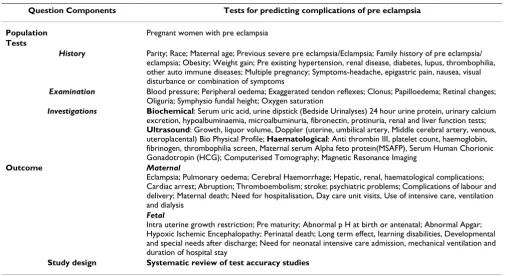
The tests to be considered by the review are specified in the form of structured questions in Table 1. We have gen-erated a priority list based on importance to clinical prac-tice using a modified Delphi survey.[10] An exhaustive list of the tests and outcomes in the prediction of pre eclamp-sia were sent to experts in the field. Each one of the issues were rated according to their importance to clinical prac-tice and ranked accordingly. The review will focus on the prioritised tests obtained from the survey.
Study identification and selection
We have a thorough search protocol by which literature is identified via general bibliographic databases including MEDLINE and EMBASE. Specialist computer databases like DARE (Database Of Abstracts of Reviews of Effective-ness), MEDION (a database of diagnostic test reviews set up by Dutch and Belgian researchers), the Cochrane Library and relevant specialist registers of the Cochrane Collaboration, particularly the Pregnancy and Child Birth group are searched. Individual experts and those with an interest in this field will be contacted to uncover grey lit-erature. SciSearch will be used to identify frequently cited
Table 1: Structured questions for systematic review of test accuracy studies
Question Components Tests for predicting complications of pre eclampsia
Population Pregnant women with pre eclampsia
Tests
History Parity; Race; Maternal age; Previous severe pre eclampsia/Eclampsia; Family history of pre eclampsia/ eclampsia; Obesity; Weight gain; Pre existing hypertension, renal disease, diabetes, lupus, thrombophilia, other auto immune diseases; Multiple pregnancy; Symptoms-headache, epigastric pain, nausea, visual disturbance or combination of symptoms
Examination Blood pressure; Peripheral oedema; Exaggerated tendon reflexes; Clonus; Papilloedema; Retinal changes; Oliguria; Symphysio fundal height; Oxygen saturation
Investigations Biochemical: Serum uric acid, urine dipstick (Bedside Urinalyses) 24 hour urine protein, urinary calcium excretion, hypoalbuminaemia, microalbuminuria, fibronectin, protinuria, renal and liver function tests;
Ultrasound: Growth, liquor volume, Doppler (uterine, umbilical artery, Middle cerebral artery, venous, uteroplacental) Bio Physical Profile; Haematological: Anti thrombin III, platelet count, haemoglobin, fibrinogen, thrombophilia screen, Maternal serum Alpha feto protein(MSAFP), Serum Human Chorionic Gonadotropin (HCG); Computerised Tomography; Magnetic Resonance Imaging
Outcome Maternal
Eclampsia; Pulmonary oedema; Cerebral Haemorrhage; Hepatic, renal, haematological complications; Cardiac arrest; Abruption; Thromboembolism; stroke; psychiatric problems; Complications of labour and delivery; Maternal death; Need for hospitalisation, Day care unit visits, Use of intensive care, ventilation and dialysis
Fetal
Intra uterine growth restriction; Pre maturity; Abnormal p H at birth or antenatal; Abnormal Apgar; Hypoxic Ischemic Encephalopathy; Perinatal death; Long term effect, learning disabilities, Developmental and special needs after discharge; Need for neonatal intensive care admission, mechanical ventilation and duration of hospital stay
2008
(page number not for citation purposes)
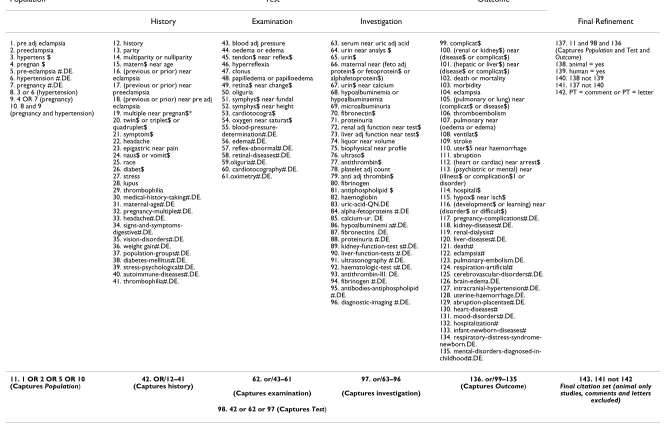
History Examination Investigation Final Refinement
1. pre adj eclampsia 2. preeclampsia 8. 3 or 6 (hypertension) 9. 4 OR 7 (pregnancy) 10. 8 and 9
(pregnancy and hypertension)
12. history 13. parity
14. multiparity or nulliparity 15. matern$ near age 16. (previous or prior) near eclampsia
17. (previous or prior) near preeclampsia
18. (previous or prior) near pre adj eclampsia
19. multiple near pregnan$* 20. twin$ or triplet$ or quadruplet$
21. symptom$ 22. headache 23. epigastric near pain 24. naus$ or vomit$ 25. race
43. blood adj pressure 44. oedema or edema 45. tendon$ near reflex$ 46. hyperreflexia 47. clonus
48. papilledema or papilloedema 49. retina$ near change$ 50. oliguria
51. symphys$ near fundal 52. symphys$ near height 53. cardiotocogra$ 54. oxygen near saturat$ 55.
blood-pressure-63. serum near uric adj acid 64. urin near analys $ 65. urin$
66. maternal near (feto adj protein$ or fetoprotein$ or alphafetoprotein$) 67. urin$ near calcium 68. hypoalbuminemia or hypoalbuminaemia 69. microalbuminuria 70. fibronectin$ 71. proteinuria
72. renal adj function near test$ 73. liver adj function near test$ 74. liquor near volume 75. biophysical near profile 76. ultraso$
77. antithrombin$ 78. platelet adj count 79. anti adj thrombin$ 80. fibrinogen
100. (renal or kidney$) near (disease$ or complicat$) 101. (hepatic or liver$) near (disease$ or complicat$) 102. death or mortality 103. morbidity 104. eclampsia
105. (pulmonary or lung) near (complicat$ or disease$)
110. uter$5 near haemorrhage 111. abruption
112. (heart or cardiac) near arrest$ 113. (psychiatric or mental) near (illness$ or complication$1 or disorder)
114. hospitali$ 115. hypox$ near isch$
116. (development$ or learning) near (disorder$ or difficult$)
138. animal = yes 139. human = yes 140. 138 not 139 141. 137 not 140
142. PT = comment or PT = letter
11. 1 OR 2 OR 5 OR 10
(Captures Population) (Captures history)42. OR/12–41 62. or/43–61 (Captures examination)
97. or/63–96
(Captures investigation)
136. or/99–135
(Captures Outcome) Final citation set (animal only 143. 141 not 142 studies, comments and letters
excluded)
BMC Pregnancy and Childbirth 2008, 8:38 http://www.biomedcentral.com/1471-2393/8/38
Page 4 of 7 (page number not for citation purposes) articles. Hand-searching of selected specialist journals and
conference proceedings will be done to identify reports of studies for the review. Reference lists of articles obtained by iterative search will be checked as an adjunct to other methods[11]. Language restrictions will not be applied. A comprehensive database of relevant articles will be con-structed. The search will be updated every year to enable inclusion of current evidence in the reviews and including other databases like SCOPUS where needed. A search
term combination was constructed after exhaustive plan-ning and piloting of possible search concepts capturing the relevant population, tests and outcomes. Our search terms and flow chart of search strategy are shown in Table 2 and in Fig 1. An initial search in Medline yielded 11711 citations. The search strategy was adapted for searching in Embase to obtain a total of 19500 citations. From this citation set, studies will be selected for inclusion in the review in a two-stage process.
Flow diagram of study selection process in Medline Figure 1
Flow diagram of study selection process in Medline.
TEST OUTCOM E
n=21218 POPULATION
OR
n=3789602
n=12527
n=11711
HISTORY EXAMINATION INV ESTIGATION
n=1750218 n=410518 n=1627858
Figure 1: Flow d iag ram o f stud y sele ction process
Animal only, letters excluded n=3387126
In the first stage the electronic searches will be scrutinised by two independent reviewers and full manuscripts of all citations that are likely to meet the predefined selection criteria will be obtained. All available reports, irrespective of language will be included to reduce bias[12]. Subse-quent final inclusion or exclusion decisions will be made on examination of these manuscripts. In cases of dupli-cate publication, the most recent and complete versions will be selected. Two reviewers will then independently select the studies, which meet predefined and explicit cri-teria regarding population, tests, outcomes and study design (Table 1). These criteria will be piloted using a sample of papers and agreement between reviewers will be measured. When disagreements occur, the two review-ers will meet and if necessary the issue will be resolved by consensus involving a third reviewer.
Study quality assessment
A review of papers meeting the eligibility criteria will be conducted by the same reviewers who judged eligibility,
but this time rating the methodological quality of the pri-mary research. Methodological quality is a reflection of the degree to which the study design, conduct and analysis has minimised bias in addressing the research question. This ensures a high level of internal validity (i.e. the degree to which the results of an observation are correct for the patients being studied). The potential sources of bias and variability arising from spectrum composition and other variations in test protocol or the use of reference standard in individual studies will be considered when interpreting the results[13]. In addition to using study quality as possible explanation for differences in results, the extent to which primary research met methodological standards is important per se for assessing the strength of any conclusions that are reached[8]. We will evaluate ele-ments of study design which are likely to have a direct relationship to bias and variability in a test accuracy study [13-19]. The criteria for study validation are shown in Fig 2.
Criteria for quality assessment to be used in the review of tests predicting complications of pre eclampsia Figure 2
Criteria for quality assessment to be used in the review of tests predicting complications of pre eclampsia.
a) Generic quality items · Recruitment of subjects (consecutive or random sample) · Blinding of observers assessing the out-come to the findings of the test · Verification of diagnosis by outout-come in all tested cases · 90% or more of enrolled population followed up
b) Specific quality items related to features of this project Population Description of spectrum composition Test Adequate description of test and its measurements determining cut-off level for abnormality a priori Outcome Complications of pre eclampsia
Study samp le
Test po si tiv e Test n egat ive
Out come present
True posit ive
Test
Out come absent
False posit ive
Out come
Out come absent
True negati ve Out come
present
False negati ve
The popul at ion
A clinically appropriate consecutive or random
sample
The test
Measure ment Cut-off for abnormality
Out come
The Outco me
Assessment blind to test result
Verified fully in both test positive and test negative
cases
Esti mat ion of t est accu racy
BMC Pregnancy and Childbirth 2008, 8:38 http://www.biomedcentral.com/1471-2393/8/38
Page 6 of 7 (page number not for citation purposes)
Data extraction
The extraction of study findings will be conducted in duplicate using a pre-designed and piloted data extraction form to avoid any errors. Two authors will independently extract information from each article in order to construct 2 × 2 tables of the diagnostic test result and outcomes. Any disagreement will be resolved by consensus. Given the extent of insufficient reporting in the medical literature, we propose to obtain missing information from investiga-tors whenever possible. It is otherwise impossible to dis-tinguish between what was done but not reported and what was not done. To avoid introducing bias, unpub-lished information will be obtained in writing, and will be coded in the same fashion as published information with equal regard for inter-coder agreement. In addition to using multiple coders to insure the reproducibility of the overview, sensitivity analyses around important or ques-tionable judgements regarding the inclusion or exclusion of studies, the validity assessments and data extraction will be performed.
Data synthesis
We will explore causes of variation in results from study to study (heterogeneity), synthesise results from individual studies (meta-analysis) if appropriate[8,15] and assess for the risk of publication bias. Heterogeneity of results between studies will be graphically assessed looking at the distribution of rates, sensitivities and specificities in the ROC (Receiver Operating Characteristics) curve and like-lihood ratios using Forest plots. To explore causes of het-erogeneity we will conduct a sensitivity analysis by subgroups to see whether variations in population charac-teristics, tests, outcomes and study quality affect the esti-mate accuracy. Conclusions regarding the typical estiesti-mate accuracy will be interpreted cautiously if there is signifi-cant heterogeneity. Individual factors explaining hetero-geneity will also be analysed using meta-regression to determine their unique contribution allowing for other factors. We will conduct meta-analyses to generate sum-mary estimates of likelihood ratios (LRs), diagnostic odds ratios (ratio of LRs) and area under receiver operating characteristic (ROC) curves as appropriate[15,20,21]
The risk of publication bias is expected to be high in reviews of test accuracy[22]. Analysis for assessing the risk of publication bias will be carried out by producing fun-nel plots of accuracy estimates against corresponding var-iances. In the absence of publication bias it is to be expected that the point estimates will fill a funnel shape in the plot. Large gaps in the funnel indicate a group of pos-sible 'missing' publications. These omissions are due to small studies showing limited accuracy and are unlikely to be missing at random. This phenomenon will also be sta-tistically evaluated using Egger's test [23].
Discussion
In the same way as systematic reviews of effectiveness of treatments in Obstetrics have been pursued over the last decade, research on test accuracy also needs systematic reviewing[14,24]. One of the questions remaining after establishing effectiveness evidence for magnesium sul-phate, steroids and anti hypertensives is to identify those who will benefit most from these interventions[25,26]. Relying on the inclusion and exclusion criteria of the trials alone is not sufficient for determining who should and shouldn't get these treatments. Women at high risk of complications of pre-eclampsia are likely to benefit most whilst in low risk women, therapy may cause more harm than good. Therefore, what is required is the prediction of risk of complications (such as eclampsia) of pre-eclamp-sia.
Information on women's risk stratification can be obtained from test accuracy reviews, which provide post test probabilities for a clinical outcome targeted by treat-ment. Integration of these with evidence for therapeutic effectiveness will enable generating estimates of Number Needed to Treat (NNT). The lower the risk, the higher the NNT and the lower are our and women's expectation of benefit from treatment. Conversely, the higher the base-line risk, the lower the NNT, the higher are our expecta-tion of benefit and the more inclined we would be to recommend, and women to accept therapy[24,27]. This will serve to rationalise clinical decision-making.
This project will collate and synthesise the available evi-dence regarding the value of the tests for predicting com-plications of pre-eclampsia. The systematic overviews will assess the quality of the available evidence and provide estimates of rate (or risk) of complications of pre-eclamp-sia given various patient characteristics and other find-ings. It will identify a set of tests that have maximal predictive value to aid in therapeutic decision-making. An estimate of the magnitude of the benefits will be gauged by integration of the knowledge about risk with evidence of therapeutic effectiveness for various interventions. This will help to formulate practice recommendations and spe-cific recommendations for future research.
Competing interests
The authors declare that they have no competing interests.
Authors' contributions
Publish with BioMed Central and every scientist can read your work free of charge
"BioMed Central will be the most significant development for disseminating the results of biomedical researc h in our lifetime."
Sir Paul Nurse, Cancer Research UK
Your research papers will be:
available free of charge to the entire biomedical community
peer reviewed and published immediately upon acceptance
cited in PubMed and archived on PubMed Central
yours — you keep the copyright
Submit your manuscript here: BioMedcentral
Acknowledgements
TIPPS review group
Shakila Thangaratinam (Clinical Lecturer), Khalid S Khan (Professor in Obstetrics and Gynaecology) affiliated to Education Resource Centre, Birmingham Women's Hospital, Birmingham, B15 2TG, UK.
Khaled M K Ismail (Senior Lecturer/Consultant), Fidelma O'Mahony
(Senior Lecturer/Consultant), Shaughn O'Brien (Professor in Obstetrics and Gynaecology) affiliated to Academic Unit of Obstetrics and Gynaecol-ogy, Keele University School of Medicine, University Hospital of North Staffordshire, Stoke-on-Trent, ST4 6QG, UK.
Steve Sharp (Electronic Information Librarian) affiliated to NeLH Special-ist Library for ENT and Audiology, Radcliffe Infirmary, Oxford, OX2 6HE, UK.
Arri Coomarasamy (Sub specialist in Reproductive Medicine & Surgery) affiliated to Assisted Conception Unit, Guy's Hospital, London, UK
References
1. World Health Organization: The hypertensive disorders of preg-nancy. Report of a WHO Study Group; 1987.
2. Duvekot JJ, Peeters LLH: Maternal haemodynamic adaptation to pregnancy. Obstet Gynecol Surv 1994, 49:S1-S14.
3. HMSO: Report on Confidential Enquiries into Maternal Deaths in the United Kingdom 1997–99. 2001.
4. Montan SSNSN: Hypertension in Pregnancy – foetal and infant outcome. Hypertension in pregnancy 1987, B6:337-348.
5. Coomarasamy A, Papaiannou S, Gee , Khan KS: Aspirin to prevent pre-eclampsia in women with abnormal uterine artery dop-pler: a meta-analysis. Obstet Gynecol 2001, 98:861-866.
6. Duley L, Henderson-Smart DJ, Knight M, King JF: Antiplatelet drugs for prevention of pre-eclampsia and its consequences: systematic review. BMJ 2001, 322:329-333.
7. Coomarasamy A, Gee H, Khan KS, Braunholtz D: Aspirin has clin-ically significant benefit in high risk groups – Summary NNT can mislead clinicians. eBMJ 2001.
8. Khan KS, Ter Riet G, Glanville J, Sowden AJ, Kleijnen J: Undertaking Systematic Reviews of Research on Effectiveness. In CRD's Guidance for Carrying Out or Commissioning Reviews. 4. 2001 Centre for Reviews and Dissemination (CRD), University of York. CRD Report. 9. Cochrane Methods Working Group on Systematic Reviews of Screening and Diagnostic Tests: Recommended Methods. 6-6-1996. .
10. Thangaratinam S, Ismail K, Sharp S, Coomarasamy A, O'Mahony F, Khan KS, O'Brien S: Prioritisation of tests for the prediction of preeclampsia complications: a Delphi survey. Hypertension in Pregnancy 2007, 26:131-138.
11. Alderson P, Green S, Higgins JPT: Cochrane Reviewer's Hand-book 4.2.2. 2004.
12. Egger M, Zellweger-Zahner T, et al.: Language bias in randomised controlled trials published in English and German. Lancet
1997, 350:326-329.
13. Whiting PJ, Rutjes AWS, Reitsma JB, Bossuyt PM, Glas Afina S, Klei-jnen J: Sources of Variation and Bias in Studies of Diagnostic Accuracy A Systematic Review. Annals of Internal Medicine 2004,
40:189-202.
14. Khan KS, Dinnes J, Kleijnen J: Systematic reviews to evaluate diagnostic tests. J Obstet Gynecol Reprod Biol 2001, 95:6-11. 15. Deeks JJ: Systematic reviews in health care: Systematic
reviews of evaluations of diagnostic and screening tests. BMJ
2001, 323:157-162.
16. Jaeschke R, Guyatt GH, Sackett DL: Users' guide to the medical literature. II. How to use an article about a diagnostic test. A. Are the results of the study valid? JAMA 1994, 271:389-391. 17. Lijmer JG, Mol BW, Heisterkamp S, Bonsel GJ, Prins MH, Meulen JHP van der, et al.: Empirical evidence of design-related bias in studies of diagnostic tests. JAMA 1999, 282:1061-1066. 18. Bossuyt PM, Reitsma JB, Bruns DE, Glasziou PP, Gatsonis CA, Irwig
LM, et al.: Towards complete and accurate reporting of
stud-ies on diagnostic accuracy:The STARD initiative. Family Prac-tice 2004, 21:4-10.
19. Chein PFW, Khan KS: Evaluation of a clinical test. II: Assess-ment of validity. Br J Obstet Gynecol 2001, 108:568-572.
20. Jaeschke R, Guyatt GH, Sackett DL: Users' guide to the medical literature. III. How to use an article about a diagnostic test. B. What are the results and will they help me in caring for my patients? JAMA 1994, 271:703-707.
21. Honest H, Khan KS: Reporting of measures of accuracy in sys-tematic reviews in diagnostic literature. BMC Health Serv Res
2002, 2(1):4.
22. Song F, Khan KS, Dinnes J, Sutton A: Asymmetric Funnel Plots and the Problem of Publication Bias in Meta-analyses of Diagnostic Accuracy. Int J Epidemiol 2002, 31:88-95.
23. Egger M, David SG, Schneider M, Minder C: Bias in meta analysis detected by a simple, graphical test. BMJ 1997, 315:629-34. 24. Khan KS, Honest , Bachmann LM: A generic framework for
mak-ing clinical decisions integratmak-ing diagnostic and therapeutic research evidence in preterm birth. Fetal and Maternal Med-icine Review. Fetal and Maternal Medicine Review 2003, 13:239-249. 25. The Magpie Trial Collaborative Group: Do women with pre-eclampsia, and their babies, benefit from magnesium sul-phate? The Magpie Trial: a randomised placebo-controlled trial. Lancet 2002, 359(9321):1877-90.
26. Chein PFW, Khan KS, Arnott N: Magnesium sulphate in the treatment of eclampsia and pre-eclampsia: an overview of the evidence from randomised trials. Br J Obstet Gynaecol 1996,
103(11):1085-91.
27. Coomarasamy A, Braunholtz D, Song F, Taylor R, Khan KS: Individ-ualising use of aspirin to prevent pre eclampsia: A frame-work for clinical decision making. BJOG 2003, 110(10):882-888.
Pre-publication history
The pre-publication history for this paper can be accessed here:


![Inequalities for convex and s convex functions on Δ = [a, b] × [c, d]](data:image/gif;base64,R0lGODlhAQABAIAAAP///wAAACH5BAEAAAAALAAAAAABAAEAAAICRAEAOw==)