Comparison of Physical Properties of an Iranian and a German
Dental Stone Type IV According to ADA Specifications
M. Sabouhi1, N. Khodaeian2 , M. Soltani3, E. Ataei4
1Assistant Professor, Department of Prosthodontics, School of Dentistry, Isfahan University of Medical Sciences, Isfahan, Iran 2Dental Implant Research Center and Assistant Professor, Department of Prosthodontics, School of Dentistry, Isfahan University of
Medical Sciences, Isfahan, Iran
3Dentist
4Assistant Professor, Department of Operative Dentistry, School of Dentistry, Shahid Sadoughi, University of Medical Sciences,
Yazd, Iran
Corresponding author: N. Khodaeian, Dental Implant Research Center and Assistant Professor, Department of Pros-thodontics, School of Dentistry, Isfahan University of Medical Sciences, Isfahan, Iran [email protected] Received: 29 Feb 2012 Accepted: 18 Nov 2012
Abstract
Background and Aim: Dental stone type IV and V are predominantly used for con-struction of cast and die in fixed prosthodontics and must have some special proper-ties. The aim of this study was to compare the three physical properties of an Iranian a German dental stone type IV.
Materials and Methods: In this experimental study, setting time, setting expansion and compressive strength properties were evaluated according to ADA specification No.25for Iranian Tara and German Gildand type IV dental stone. For setting time, setting expansion and compressive strength tests, Vicat apparatus, extensometer and universal testing machine were used, respectively. Data were compared to ADA spe-cification No.25 for dental stone type IV and statistically analyzed using t-test with a 0.05 level of significance.
Results: Mean of setting expansion for Iranian and German dental stone were 0.024±0.011 and 0.0245±0.009, respectively and were within the limits of ADA spe-cification and there was no statistically significant difference between them (p=0.966). Mean of setting time for Iranian and German dental stone were 44.5±0.70 and 17.29±0.41 and mean of compressive strength for Iranian and German dental stone were 16.17±0.97 and 20.15±1.96 and both specifications were not within the limits of ADA specification, but statistically significant differences were found be-tween groups (p<0.001).
Conclusion: Iranian dental stone type IV could not fulfill 2 out of 3 tested ADA spe-cification and modification of this stone is necessary for use in fixed prosthodontics laboratory processes.
Key Words: Calsium sulfate, Compressive strength, Physical properties
Journal of Islamic Dental Association of IRAN (JIDAI) Spring 2013 ;25, (2)
Introduction
Gypsum products are widely used in dentistry and especially in prosthodontics [1]. Gypsum used in dentistry are a form of calcium sulfate hemihydrate (CaSO4.½H2O), which is classified into five types according to the American Dental Association (ADA) specification #25. Although these types have identical chemical formula, they pose
differ-ent physical properties making each of them desir-able for different purposes [2]. There are various properties that could be evaluated for dental stones, but according to ADA specification #25 five main properties are considered to assess dental stones which are as follow: setting time, fineness, setting expansion, compressive strength and consistency (Table 1).
Cast and die used for indirect casting technique must have specific properties in order to construct a favorable restoration which is especially more important for implant-supported restorations. Type IV and V dental stones are the most frequently used materials for fabrication of casts and dies, due to their perceived dimensional accuracy, low cost and ease of use [1,3-4]. There are some studies evaluating the physical properties of Iranian dental stones [5-7], but there is no study evaluating the physical properties of type IV Iranian dental stone. Therefore, the aim of this study was to compare three physical properties of one Iranian and one German type IV dental stone.
Materials and Methods
An Iranian dental stone type IV (Tara 250, Khey-zaran, Isfahan, Iran) and a German dental stone type IV (Gildand, Germany) were used in this ex-perimental study. There was no analytical proce-dure for evaluating the sample size. Sample size, the way for preparing the samples and the condi-tion of study were in accordance with ADA speci-fication #25 and similar studies [5-11]. The envi-ronment with a temperature of 23±2ºC and a
hu-midity of 50±10% was considered for all devices at least 15 hours before study.
Setting time was determined through already estab-lished methodology [8], using Vicat apparatus (Is-fahan, Iran). This apparatus allowed the analysis of the setting time through the insertion of a metallic needle (1 mm diameter and 50 mm length) con-nected to a vertically mobile aluminum rod, under a total weight of 300g. A PVC cylinder with an internal diameter of 70 mm in top and 60 mm in bottom and height of 40mm was attached to a 100×100 mm glass plate. The plaster mass was mixed according to manufacturer’s recommenda-tions and shed into the cylinder with the aid of a vibrator (Whip mix Corp., Louisville, KY) and then placed under the Vicat apparatus. The needle was placed at a distance of 0.5 mm from the gyp-sum surface and abruptly set free 2 minutes before the mass lost its superficial luster, then sequential insertions were carried out every 15 seconds in different areas (standardized in quadrants), until the needle could not fully penetrate the mass any longer [12]. The time spent between the beginning of the mixing up to the point where the needle could not fully penetrate the mass any longer was measured with chronometer and setting time was
Type
Setting time (min)
Setting expansion at 2hours
Compressive strength (MPa)
Fineness
Testing consistency (mm)
Powder/water ratio
Min % Max %
passes
1506m
%
sieves
75 6m
%
Type I(plaster, impression) 4±1 0/00 0/15 4 98 85 -- 0/40-0/75
Type II(plaster, model) 12±4 0/00 0/30 9 98 90 30±3 0/45-0/50
Type III(dental stone) 12±4 0/00 0/20 21 98 90 30±3 0/28-0/30
Type IV(dental stone, high
strength) 12±4 0/00 0/10 35 98 90 30±3 0/22-0/24
Type V(dental stone, high
strength, high expansion) 12±4 0/01 0/30 49 98 90 30±3 0/18-0/22
Table 1. Properties of five types dental stones according to ADA
obtained [5,8]. This procedure was done twice for each dental stone.
Setting expansion was determined with expansion meter device constructed with impervious stainless steel. This device consisted of a V-shaped gutter fixed on a base and a mobile steel cube of 30±1 mm height and 200±10 g weight. The gutter shell thickness was 4 mm with an internal diameter of 30±1 mm and the angle of two opposite sides was 90 degrees. The gutter was open at one side and closed on the other side. A micrometer (Ericsson, Hudiksvall, Sweden) with 0.005 mm accuracy, fixed in place using aluminum bearing, was used to measure the expansion of plaster models. At the start of the test, the length between the moving part of steel cube and fixed part of V-shaped gutter was adjusted to 100±1 mm using a digital caliper (CCCP, Russia) with an accuracy of 0.05 mm. Then, the bottom of the V-shaped gutter was cov-ered with a 0.1 mm thickness latex rubber dam (Dentorama, Stockholm, Sweden) to prevent limit-ing the expansion of gypsum [13]. Water and powder was mixed according to the manufacturer’s instructions and shed into the V-Shaped gutter us-ing the vibrator. The top of the gutter was covered with a sheet of latex rubber dam to prevent evapo-ration of water. The measurement was done one minute before setting and two hours after mixing and then the percentage of expansion was calcu-lated according to following formula: :
where LFwas the final length and Lowas the initial length. This procedure was done twice for each dental stone.
To test compressive strength, 5 split stainless and impervious teflon cylinders with diameter of 20±0.2 mm and height of 40±0.4 mm were used. Initially, each teflon mold was placed on a glass plate and then water and powder was mixed ac-cording to the manufacturer’s instructions and poured into the molds to be slightly overfilled us-ing the vibrator. Before the surface of the mixture lost its luster, the second glass had been placed on it, so that the plaster surface was in contact with the glass. The molds was separated 45±1 minutes after mixing and samples were maintained in
envi-ronment with 23±2 ºC temperature and 95±5% humidity. Any sample with porosity or fracture was excluded and new sample was prepared. Com-pressive strength test was done for all samples us-ing universal testus-ing machine (lnstron Corp., Can-ton, Mass) with the force of 5±2 KN/min.
The data were statistically analyzed by SPSS soft-ware (Version 16) using t-test with 0.05 level of significance.
Results
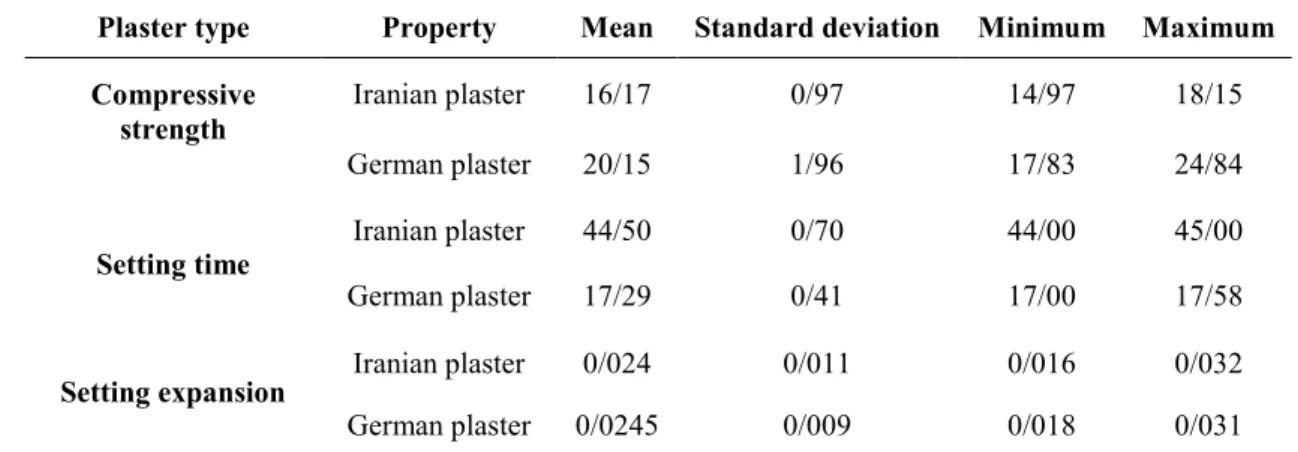
The results were summarized in table 2. The mean of compressive strength of Iranian and German dental stones were 16.17±0.97 and 20.15±1.96 MPa, respectively which both were below the ADA standards. The mean compressive strength of two dental stone had statistically significant differ-ences with each other and also with standard value (35MPa) using t-test (p<0.001). The mean of set-ting expansion of Iranian and German dental stones were 0.024±0.011% and 0.0245±0.009%, respectively which both were within the standard range (0-0.1%) and did not have any significant difference (p=0.966).
The mean of setting time of Iranian and German dental stones were 44.5±0.70 and 17.29±0.41 mi-nutes, respectively. Although both values were more than the standard range (12±4 min), they had a statistically significant difference with each other (p=0.001).
Discussion
This study evaluated and compared setting time, setting expansion and compressive strength of two type IV dental stones.
Setting time
The time between start of mixing water and gyp-sum and completion of setting is called setting time [14]. This time should not be too short to get the appropriate time from technician, and not too long to waste the time of the laboratory personnel. This time is usually determined by one kind of penetra-tion test and based on the ADA specificapenetra-tion #25, this was determined with standard Vicat apparatus
[2]. Setting time of different dental stones depend on factors such as water-powder ratio, time and speed of spatulation, temperature of water and en-vironment, composition of water and powder, hu-midity of environment and the colloidal system (blood and saliva)[1,15]. Factors that reduce set-ting time are reduced water-powder ratio, increase time and speed of spatulation, adding Terra Alba, increase salt such as sodium chloride or 0.4 potas-sium sulfate and increase the temperature of water and environment from 23 ºC to 30 ºC. The oppo-site factors increase the setting time [15]. The re-sults of this study showed that the mean of setting time of Iranian and German dental stones were 44.5±0.70 and 17.29±0.41 minutes, respectively, which were more than the ADA standard setting time (12±4 min) but the difference between Iranian dental stone and standard value was more than that of German dental stone. In the study of Lucas et al. the setting time of evaluated type IV dental stone was 10 minutes, which was within the normal range [11].
Von Fraunhafer and Spiers [16] and Brukl et al. [17] showed that increasing of 5% potassium chlo-ride and potassium bicarbonate could lead to de-creased setting time. Distilled water was used in this study because the minerals in the water of dif-ferent regions could affect the setting time of gyp-sum.
Setting expansion
Expansion of gypsum during calcium sulfate hy
dration has been discussed [18-19] and the linear expansion of 0.06 to 0.5 is expected based on the gypsum composition and calcination process [1,20]. Based on ADA standards, setting expansion of type IV dental stones range from 0 to 0.1%. In this study setting expansion of Iranian and German dental stones were 0.024±0.011% and 0.0245 ± 0.009%, respectively which were within the ac-ceptable range of ADA. In a study by Abdollah, setting expansion of a type IV dental stone was 0.013±0.012%, which was lower than the present data [10]. Dimensional stability of gypsum is of upmost importance in dental casts, because changes in cast surface lead to poor quality pros-theses [21-28]. Success and adaptation of casting restorations depend on the dimensional accuracy, strength and ability to construct the details of mate-rials used for die. The margin of restoration will be in more contact with tooth finish line, if the die has above qualities and the problems resulting from marginal discrepancies of restoration such as ce-ment solution [21], caries [22-23], pulpal involve-ment [24]. Increase microbial plaque [25], change in subgingival flora [26] and gingival inflammation [27-28] will be reduced to a minimal level.
The accuracy and stability of master cast are the primary essentials in the manufacture of implant-supported prostheses. Marginal discrepancies and lack of seal in implant-supported prostheses in-crease the solution of cement in margin and can lead to eccentric forces applied to the implant [13].
Plaster type Property Mean Standard deviation Minimum Maximum
Compressive strength
Iranian plaster 16/17 0/97 14/97 18/15
German plaster 20/15 1/96 17/83 24/84
Setting time Iranian plaster 44/50 0/70 44/00 45/00
German plaster 17/29 0/41 17/00 17/58
Setting expansion Iranian plaster 0/024 0/011 0/016 0/032
German plaster 0/0245 0/009 0/018 0/031
Table 2.Statistical parameters of compressive strength, setting time and setting expansion of two studied dental stones
Moreover, marginal discrepancies can lead to plas-tic deformation of the metal framework, porcelain detachment, fracture of implant system compo-nents and plaque accumulation, and thus plays an important role in the survival rate of prostheses [29-30].
If the gypsum used for making master cast had small expansion rate and was stable, the adaptation of restoration made through indirect technique could improve. Based on Anusavice [1] and O’Brien [20], chemicals that regulate the setting time of gypsum products, result in reduced expan-sion rate during calcium sulfate hydration. Hence, manufacturers can simultaneously control the set-ting time and decrease expansion rate by control-ling the accelerators and inhibitors.
Factors which increase the setting expansion are reduced water-powder ratio, increase time and speed of spatulation, increase environment and water temperature from 23 ºC to 30 ºC and adding materials like sodium chloride. On the other hand, adding materials like potassium sulfate can lead to decrease in setting expansion of gypsum products [1,13,17,31]. Lauten Schlager and Corbin in a study about relationship between porosity and ex-pansion of dental stones, concluded that with in-creasing water-powder ratio, the density and ex-pansion of gypsum will decrease [32].
Compressive strength
Strength of type IV and V dental stones especially in complex fixed prostheses is very important. Strength is a basic requirement in fabrication of porcelain margins and where the need for fabrica-tion of transfer coping exists. Therefore, use of type IV dental stone impregnated with resin or copper coated die will be recommended in this sit-uation due to better dimensional stability and strengths compared with type IV and V dental stones [33-34]. However, the use of gypsum prod-ucts is easier. Compressive strength of type IV dental stone must be at least 35 MPa according to ADA standards. In this study compressive strength of Iranian and German dental stones were 16.17±0.97 and 20.15±1.96 MPa, respectively, and
both values showed significant differences with the standard value.
Compressive strength of one type IV dental stone in Abdullah study was 38.27±0.32 MPa which was within the ADA standard range [10]. Compressive strength of gypsum depends on water-powder ra-tio. Decreasing of this ratio leads to increase in compressive strength. Increase time and speed of spatulation and changes in environment and water temperature do not affect the compressive strength of gypsum [15,20].
Setting time and compressive strength of Iranian and German dental stones were not within an ac-ceptable range and this is probably due to the high water-powder ratio. However, setting time and compressive strength values of German dental stones were closer to ADA specification #25. Con-sistency and ability to reconstruct details, which are two main features of ADA standards, were not evaluated in this study. Among three properties that were evaluated, Iranian dental stone failed to achieve two ADA standards.
Conclusion
1. Setting expansion of Iranian and German type IV dental stones were within the standard range of ADA.
2. Setting time and compressive strength of Iranian and German type IV dental stones were not within the standard range of ADA.
3. The differences between setting time and com-pressive strength values with standard values were higher for Iranian type IV dental stone when com-pared to German type IV dental stone.
Acknowledgment
This paper was based on a thesis submitted to the School of Dentistry, Isfahan University of Medical Sciences, in partial fulfillment of the requirements for DDS degree. This study was supported by Isfa-han University of Medical Sciences Grant no.384181. The authors do not have any direct fi-nancial relation with the commercial identities mentioned in this paper.
1- Anusavice KJ. Gypsum products. In: Phillips’ science of dental materials. 11th ed. St. Louise: Mosby Elsevier; 2006, 255-81.
2- American National Standards/American Dental Association, Specification 25 for dental gypsum products. New York: American National Standards Institute; 2000, 244-53.
3- Winkler MM, Monaghan P, Gilbert JL, Lauten-schlager EP. Comparison of four techniques for monitoring the setting kinetics of gypsum. J Pros-thet Dent. 1998 May;79(5):532-6.
4- He LH, van Vuuren LJ, Planitz N, Swain MV. A micro-mechanical evaluation of the effects of die hardener on die stone. Dent Mater J. 2010 Aug; 29(4):433-7.
5- Golbidi F, Kiani M, Ebrahimi M. Evaluation of physical properties of Khodabandeloo plaster (An in vitro study). J Dent Sch Shahid Beheshti Med Sci Univ. 2006 Summer;24(2):235-42.
6- Golbidi F, Davari M. Evaluation of three phyis-ical properties of iranian stones. Dent J Islamic Ass of Dent. 2003 Jan;14(4):51-64.
7-Golbidi F. Davari M. Comparision of consistenscy and setting time of iranian and foreign stones. Res Med Sci. 2000 Autumn; 5(3):257-9.
8-American Dental Association: Specification No. 25 for dental gypsum products. In ADA: Guide to Dental Materials and Devices. Chicago: ADA; 1973, 253-8.
9- Duke P, Moore BK, Haug SP, Andres CJ. Study of the physical properties of type IV gypsum, re-sin-containing, and epoxy die materials. J Prosthet Dent. 2000 Apr;83(4):466-73.
10- Abdullah MA. Surface detail, compressive strength, and dimensional accuracy of gypsum casts after repeated immersion in hypochlorite so-lution. J Prosthet Dent. 2006 Jun;95(6):462-8. 11- Lucas MG, Arioli-Filho JN, Nogueira SS, Ba-tista AU, Pereira Rde P. Effect of incorporation of disinfectant solutions on setting time, linear di-mensional stability, and detail reproduction in den-tal stone casts. J Prosthod. 2009 Aug; 18(6):521-6. 12- Rudd KD, Morrow RM, Brown CE Jr, Powell JM, Rahe AJ. Comparison of effects of tap water
1970 Nov;24(5):563-70.
13- Heshmati RH, Nagy WW, Wirth CG, Dhuru VB. Delayed linear expansion of improved dental stone. J Prosthet Dent. 2002 Jul;88(1):26-31. 14- Breault LG, Paul JR, Hondrum SO, Christen-sen LC. Die stone disinfection: Incorporation of sodium hypochlorite. J Prosthod. 1998 Mar; 7(1): 13-6.
15- Powers JM, Sakaguchi RL. Gypsum products and inverstment. In: Craig's restorative dental ma-terials. 12th ed. St. Louis: Mosby Elsevier; 2006, 313-36.
16- Von Fraunhofer JA, Spiers RR. Strength test-ing of dental stone: A comparison of compressive, tensile, transverse, and shear strength tests. J Bio-med Mater Res. 1983 Mar;17(2):293-9.
17- Brukl CE, McConnell RM, Norling BK, Col-lard SM. Influence of gauging water composition on dental stone expansion and setting time. J Pros-thet Dent. 1984 Feb;51(2):218-23.
18- Scaranelo RM, Bombonatti PE, Rister RP, Bombonatti R, Bombonatti JF. Influência de so-luções desinfetantes cloradas no tempo e na ex-pansão de presa de dois tipos de gesso. Rev Odont de Araç. 2004 Jun-Jul;25(1):44-8.
19- Twomey JO, Abdelaziz KM, Combe EC, An-derson DL. Calcium hypochlorite as a disinfecting additive for dental stone. J Prosthet Dent. 2003 Sep; 90(3):282-8.
20-O'Brien WJ. Gypsum products. In: Dental ma-terials and their selection. 4th ed. Chicago: Quin-tessence; 2008, 38-61.
21-Jacobs MS, Windeler AS. An investigation of dental luting cement solubility as a function of the marginal gap. J Prosthet Dent. 1991 Mar; 65(3): 436-42.
22-Phillips RW, Swartz ML, Lund MS, Moore BK, Vickery J. In vivo disintegration of luting ce-ments. J Am Dent Assoc. 1987 Apr; 114(4):489-92.
23-Preston JD. Rational approach to tooth prepara-tion for ceramo-metal restoraprepara-tions. Dent Clin North Am. 1977 Oct;21(4):683-98.
24-Goldman M, Laosonthorn P, White RR. Micro-leakage–full crowns and the dental pulp. J Endod. 1992 Oct; 18(10):473-5.
25-Khu CH, King NM, Lee AM, Yiu CK, Wei SH. A pilot study of the marginal adaptation and sur-face morphology of glass-cermet cements. Quin-tessence Int. 1996 Jul;27(7):493-501.
26-Lang NP, Kiel RA, Anderhalden K. Clinical and microbiological effects of subgingival restora-tions with overhanging or clinically perfect mar-gins. J Clin Periodontol. 1983 Nov; 10(6):563-78. 27-Schwartz NL, Whitsett LD, Berry TG, Stewart JL. Unserviceable crowns and fixed partial den-tures: Life-span and causes for loss of serviceabili-ty. J Am Dent Assoc. 1970 Dec; 81(6):1395-401. 28-Walton JN, Gardner FM, Agar JR. A survey of crown and fixed partial denture failures: Length of service and reasons for replacement. J Prosthet Dent. 1986 Oct;56(4):416-21.
29-Castillo-de-Oyagüe R, Sánchez-Turrión A, López-Lozano JF, Albaladejo A, Torres-Lagares D, Montero J, et al. Vertical misfit of laser-sintered and vacuum-cast implant-supported crown copings luted with definitive and temporary luting agents. Oral Med Oral Patol Oral Cir Bucal. 2012 Jul 1; 17 (4):e610-7.
30-Beuer F, Aggstaller H, Edelhoff D, Gernet W, Sorensen J. Marginal and internal fits of fixed den-tal prostheses zirconia retainers. Dent Mater. 2009 Jan; 25(1):94-102.
31-Mahler DB, Ady AB. An explanation for the hygroscopic setting expansion of dental gypsum products. J Dent Res. 1960 May-Jun;39(3):578-89. 32-Lautenschlager EP, Corbin F. Investigation on the expansion of dental stone. J Dent Res. 1969 Mar-Apr; 48(2):206-10.
33-Ragain JC, Grosko ML, Raj M, Ryan TN, Johnston WM. Detail reproduction, contact angles, and die hardness of elastomeric impression and
gypsum die material combinations. Int J Prosthodont. 2000 May-Jun;13(3):214-20.
34-Aramouni P, Millstein P. A comparison of the accuracy of two removable die systems with intact working casts. Int J Prosthodont. 1993 Nov-Dec; 6 (6):533-9.