By Samantha Hovaniec
A Thesis submitted to the faculty of the University of North Carolina in partial fulfillment of the requirements
of a degree with Honors in Political Science.
2015
Approved by:
_________________________________ Adviser (Dr. Kevin McGuire)
_________________________________ (Dr. Isaac Unah)
Judicial Elections and Their Implications in North Carolina
Samantha Hovaniec
Abstract
This paper explores the impact that systems of judicial elections have on judges’ decision making. I argue that elections force judicial candidates to depend on private campaign contributions in order to be elected, and that lawyers and law firms who frequently appear in court have the greatest incentive to contribute to judicial campaigns. Therefore, I contend that judicial elections create a system where campaign contributions could generate biases in judges’ behavior in favor of the parties that contributed to their campaigns. I expect that there will be a significant and positive relationship between lawyers’ campaign contributions and judges’ decisions in the years following their elections. To test this theory, I compiled a dataset that compares the campaign
contributors of the four North Carolina Supreme Court judges who were elected in 2006 with the lawyers and firms that argued cases before them in 2007 and 2008. I then conducted an empirical analysis of the impact of contributions on judicial decisions. The results of this analysis suggest that there is a significant and positive relationship between lawyers’ campaign contributions and judges’ decision making. I also analyzed the
Introduction
In recent years, many prominent figures in the legal community have advocated against systems of judicial elections due to the possibility that financial contributions to judges’ election campaigns will hinder their ability to issue impartial rulings once elected. The American Bar Association issued a report stating, “while there are many threats to judicial independence, one of the more pervasive problems is the nature and cost of running for the bench” (American Bar Association 2002). Don Willet, a justice on the Texas Supreme Court, also acknowledged the belief that “donations drive decisions,” and claimed that judicial elections are “toxic to the idea of an impartial, independent judiciary” (Cohen 2013). Even retired U.S. Supreme Court Justice Sandra Day O’Connor has led efforts to abolish judicial elections and encouraged states to instead select judges through merit based systems (Schwartz 2009). These criticisms highlight the growing concerns that judicial elections inherently limit judges’ ability to make decisions independently and impartially.
that judges, who are supposed to decide cases independently from outside influences, will display a bias in favor of the parties that contributed to their campaigns.
Currently, 22 states use some variation of judicial elections to select their judges (American Bar Association). If there is a possibility that judicial elections prevent judges from issuing impartial rulings, it is important to research this topic and its implications in order to ensure the integrity of nearly half of the states’ judicial systems. Although there is a large body of literature that has already explored the topic of judicial elections, much of the existing research has been conducted within a small number of states that have notoriously competitive elections and strongly ideologically divided courts. As a result, there is a need for further examination of judicial elections in additional states in order to reach a more satisfying conclusion about whether judicial elections inherently create biases in judicial behavior. Additionally, some states have experimented with programs that provide public financing for judicial elections in order to reduce judges’ dependence on private donations and eliminate the probability of resulting biases. The impact of public financing programs has not been widely explored in the existing literature, and their implications for judicial elections merit further research as well.
be operationalized in North Carolina and present the results from my empirical analysis. Finally, I will discuss the implications of these results for systems of judicial elections and propose options for further research to supplement these findings.
Literature Review
There has been significant research performed on the subject of judicial elections in recent years, but there remains a need for additional research. While many studies have explored the relationship between campaign contributions and judicial decisions
specifically, the majority of these studies have focused on individual states with highly competitive elections and strongly ideologically divided courts. As a result, there is a gap in the literature and a need for further exploration of judicial elections in a greater
number of states and under a wider variety of political environments. In the following literature review, I summarize the methodologies and findings of previous studies in order to demonstrate how my research will expand upon these studies and provide a more comprehensive understanding of judicial elections.
through tactics as simple as increasing the number of signs stating the candidate’s name in the community has been shown to significantly increase their electoral support (Kam and Zechmeister 2013). As a result, these findings suggest that because of the lack of public interest and informed voters in judicial elections, candidates can significantly increase their possibility of being elected merely by increasing their advertising efforts and making voters more aware of their name.
Because name recognition and advertising are crucial components in judicial elections, large-scale advertising campaigns have come to play a substantial role in elections as well. In 2008, candidates in nearly 75 percent of state supreme court
elections utilized television advertising as part of their campaigns (Hall 2015). However, these types of major advertising campaigns are also expensive. As can be expected with the increase in advertising efforts, the average cost of judges’ election campaigns has substantially increased in recent years (Bonneau and Hall 2009). These findings demonstrate that extensive advertising campaigns are becoming a central feature of modern judicial elections, and suggest there is a need for significant campaign
contributions in order to fund them. As a result, it can be assumed that candidates must to some extent rely on campaign contributors in order to fund a successful campaign.
(McCall 2003). These findings suggest that judicial elections create a framework within which judicial biases could exist, as allowing judges to decide cases involving their past campaign contributors provides an opportunity for them to show favoritism towards their contributors and reward them for their financial support.
In order to empirically test whether judicial elections actually lead to biases in judges’ behaviors, multiple researchers have examined whether a statistical relationship exists between campaign contributions and judicial decisions. Ware (1999) found that there was a significant correlation between judges’ votes and the interests of their campaign contributors in the Supreme Court of Alabama. Waltenburg and Lopeman (2000) similarly found that there was a correlation between campaign contributions and judges’ decisions in the Alabama, Kentucky, and Ohio supreme courts. However, as Cann (2007) points out in his critique of past research, these studies do not establish that a causal relationship exists between contributions and decisions merely by showing that the two are correlated. In fact, one of the central arguments against their methodology is that the causal direction between contributions and decisions could run in the opposite direction. Parties who believe a certain judge would be more inclined to vote in their favor, such as a large business and an ideologically conservative judge, would be likely to contribute to that judge’s campaign to increase his or her probability of being elected. If the judge ruled in favor of the contributor once elected, it may not be an attempt to
contributors tend to support judges who are inherently more likely to rule in their favor, not prove that judicial elections encourage biased judicial behaviors.
There have been a variety of attempts to expand upon this methodology and better establish a causal relationship between contributions and decisions in the literature as well. McCall (2003) attempted to show that a causal relationship exists by studying only the ideologically conservative judges on the Texas Civil Supreme Court. She found that judges were significantly more likely to stray from their ideology and issue liberal rulings when the lawyer representing the more liberal side of the case had contributed to the judges’ election campaigns. By looking exclusively at cases where judges ruled against their typical ideologies, the study increases the likelihood that the judges’ decisions were actually caused by lawyers’ donations instead of the judges’ natural leanings towards the same ideologies as their contributors. However, this methodology is not easily replicable in other states where supreme court judges lack such consistent and distinct ideologies and voting tendencies. As a result, while this study provides useful insight about judicial elections and supports the idea that elections generate judicial biases, its methodology cannot be easily replicated in additional states.
judges’ ideology, Cann’s methodology reduces the probability that judges ruled in favor of their contributors for reasons other than rewarding them for their financial support. Cann found that campaign contributions were correlated with judges’ decisions even after controlling for ideology, which supports the theory that judicial elections encourage favoritism on the bench. However, because the study only examined the implications of judicial elections in one state, conducting a similar analysis in additional states and political environments would be a beneficial addition to his research. Additionally, Cann’s methodology of classifying rulings in individual cases as either liberal or
conservative can be subjective and creates a possibility for error. As a result, controlling for ideology using a more objective methodology would also be an important
contribution to the literature.
An alterative to examining the relationship between contributions and decisions by directly controlling for judges’ ideology can be observed in Songer and Sheehan’s research (1992). The authors classified litigants in federal appellate court cases on a scale from one to four based on how relatively advantaged or disadvantaged the parties were likely to be in court. Advantaged parties or “upperdogs” were assumed to be those with a greater probability of winning their cases due to factors like being repeat players in court and having access to better litigation resources than the “underdogs” or relatively less advantaged parties. They classified litigants into one of four parties ranging from least advantaged to most advantaged: individual litigants, businesses, state and local
individuals winning only 12.5 percent. Their findings suggests that certain types of litigants can be considered relatively advantaged and more likely to receive favorable decisions from judges, so these relative advantages should be controlled for when studying the relationship between judicial decisions and campaign contributions as well. By incorporating Songer and Sheehan’s methodology into a study of judicial elections, it is possible to control for the possibility that lawyers who are able to provide financial contributions to judges’ campaigns represent parties who have better financial and litigation resources that provide them with inherent advantages in court. Controlling for these advantages increases the probability that lawyers’ financial contributions are motivating judges to rule in their favor, not the litigants’ advantages over the other party.
Songer and Sheehan’s underdog methodology can also be used as a proxy to control for judges’ ideologies. The authors acknowledge that judges may have inherent biases towards stronger or weaker litigants. For example, they suggest that judges who can be considered ideologically liberal could be likely to exhibit a “pro-underdog bias” and lean towards protecting the rights of parties that typically lack advantages in court such as individuals and criminal defendants. On the other side, judges with conservative ideologies could be expected to support the more advantaged upperdogs such as big businesses and the government. There are many nuances to using litigants’ relative advantages as a proxy for ideology because the advantages of litigants vary across individual cases within these classifications, so it is not possible to claim that one
research offers a different approach to control for both litigants’ natural advantages and judges’ ideologies in order to further establish a causal relationship between campaign contributions and judges’ behavior.
Although the majority of the literature appears to reveal that judicial elections lead to biases in judicial behavior, other studies fail to find a relationship between contributions and decisions. Cann, Bonneau, and Boyea (2012) studied judicial elections in Michigan, Nevada, and Texas. After controlling for judges’ ideology, they found a significant relationship between campaign contributions and judges’ decisions in Michigan but not in Nevada or Texas. This suggests that judicial elections are not inherently harmful, as judicial elections do not generate biases in at least some
environments. Their findings merit further research on judicial elections within additional states in order to provide a more complete understanding of the types of environments and electoral systems that encourage judicial elections to have harmful implications on judges’ impartiality.
There is also a need for further research on the effects that state regulations and financing reforms have on judicial elections and biased decision making. Public financing programs for judicial campaigns can be considered beneficial because they allow
they allowed the challengers to acquire the name recognition that they lacked. As a result, regulations that cap campaign expenditures or limit expenditures to publicly provided funds could limit challengers’ ability to effectively campaign and therefore increase the incumbency advantage. Because there is not a general consensus on the effectiveness of campaign financing reforms and their implications have not been widely examined in the literature, further examination of these programs would be beneficial as well.
Overall, the existing literature suggests that systems of judicial elections create an opportunity for biased judicial behavior and demonstrates that in many cases these biases actually occur. However, there is also a lack of evidence that a relationship exists
between campaign contributions and judges’ decisions in some states. My research will provide a better understanding of these inconsistencies and the implications of judicial elections by studying their effects in North Carolina, a state that has been largely left out of the existing research. By expanding upon the scope of the existing literature, this study will help explain whether judicial elections inherently encourage biased judicial decisions or whether certain circumstances and political environments make them more likely to occur. Additionally, I will study elections under North Carolina’s public financing program in order to further the research regarding the effectiveness of campaign financing reform efforts.
Theory
judges through judicial elections that are either partisan or nonpartisan. Another type of selection process is merit selection, where a nominating committee selects a pool of judicial candidates based on their qualifications and the governor appoints judges from this group of candidates. Many merit selection systems also include retention elections, where the electorate has the opportunity to decide whether judges should remain on the bench after they have served for a period of time (American Bar Association 2008).
The debate over which method of selection is optimal largely centers around judicial independence. Judicial independence is the idea that judges should be able to make legal decisions without the influence of the other branches of government or any factors unrelated to the specific cases. Charles Geyh summarizes methods of judicial selection as a struggle to “ensure that justices are independent enough to follow the facts and law without fear or favor, but not so independent as to disregard the facts or law to the detriment of the rule of law and public confidence in the court” (2008: 87). Each of the possible systems of selecting judges creates some type of threat to judges’ ability to decide cases impartially, and the existing research is still undecided as to which option is the most optimal for maintaining judicial independence.
Judicial elections were originally thought to be a type of selection that would increase judicial independence. They were first established as a reform of judicial appointment systems, which were perceived as encouraging political cronyism and preventing judges from making impartial decisions regarding the legislative and
reward for appointing them to the bench. As a result, elections were considered a better alternative because they decreased judges’ dependence on other branches of government in order to obtain office.
However, judicial elections also pose a threat to judicial independence. Because the electorate is widely uninformed in judicial elections, candidates must rely largely on name recognition in order to be elected (Lovrich and Sheldon 1984; Kam and
Zechmeister 2013). As explained in the previous section, this creates a need for large-scale advertising campaigns and has encouraged a multitude of judicial candidates to utilize expensive advertising strategies such as television advertisements (Hall 2015). As some candidates begin to use these farther reaching and more expensive advertising methods in their election campaigns, it is likely that others will feel pressured to employ similar methods in order to maintain name recognition and remain competitive. The growing importance of extensive election campaigns and the necessity of large contributions in order to fund them are likely to make candidates dependent upon
campaign contributors in order to achieve election. As a result, it is theoretically possible that judicial elections do not increase judges’ independence relative to appointment systems, but merely shift judges’ dependence from other government branches to their campaign contributors.
elections. Lawyers and law firms who frequently appear in front of the court are one of the parties most likely to be affected by and interested in the outcome of judicial
elections, as their livelihood will be directly impacted by the judges who are elected. As a result, lawyers and firms will have the greatest incentive to contribute to judges’ election campaigns, possibly because they desire to increase the likelihood that a judge will be elected who is ideologically more likely to rule in favor of the types of litigants they represent. However, it is also possible that lawyers and firms are driven to contribute by an expectation that supporting judges’ campaigns will encourage the judge to show favoritism towards them and their clients, or that failing to contribute will lead to a bias against them. Because judicial elections at least create an opportunity for judges to exhibit favorable behavior towards their contributors, it is possible that lawyers and firms are driven to donate because they expect to be rewarded for their support.
However, it could also be the case that judges rule in favor of lawyers who contributed to their campaigns for reasons other than their contributions. It is possible that the lawyers who donate to judges’ campaigns are able to do so because their firms tend to represent wealthier clients and as a result have more financial resources. Having larger amounts of capital could provide these lawyers with better litigation resources, providing them with an advantage in court that would make judges more likely to vote in their favor. Additionally, lawyers could display a tendency to support judicial candidates who are ideologically more inclined to support the types of litigants they tend to
represent. For example, a law firm that generally represents defendants in criminal trials could contribute to a liberal leaning judge, under the assumption that he or she would be more likely to favor criminal defendants. If the judge later voted in favor of that law firm, it may be due to a natural ideological inclination instead of a response to the firm’s financial support. In order to analyze the effect of contributions on judicial behavior, it is important to separate the effects of donations from firms’ advantages and judges’
ideological leanings. By classifying litigants into ranked classifications following the underdog method of Songer and Sheehan (1992), these factors can better be controlled in order to isolate the effects of campaign contributions.
appear before the judge, it is possible that the judge will still display some amount of bias in their favor because of the donations associated with their firm. Therefore, I predict that donations from both the individual lawyers arguing a case before recently elected judges and other parties from their law firms are likely to have an influence on judges’ behavior.
It is also important to note that if contributions to judges’ campaigns have an influence on judicial decision making, the effect of a contribution is likely to be strongest immediately following the judge’s election. As the time since a judge’s election
increases, the amount that individual lawyers and firms contributed to his or her election campaign is likely to become less prominent in the judge’s mind. As a result, judges are less likely to display favorable behavior based on contributions over time and judges elected in different years are likely to show different degrees of biases in their decisions. In order to account for the possible influence of time diminishing the importance of contributions on decisions, I will only take into account judges’ decisions in the two years following their election.
Additionally, it is possible that the value of marginally increasing a lawyer’s campaign contribution varies by the nominal amount of his or her contribution.
Increasing one’s donation by a set nominal amount does not seem as significant when the size of the original donation was already large. For example, increasing one’s
have a consistent influence on judges’ decisions across different contribution amounts and large contribution amounts are likely to skew the results, I will use the log
transformation of the amount that lawyers contribute to judges’ campaigns rather than nominal amount of their contributions. A log transformation will adjust the scale of contribution amounts to account for outliers and more effectively model the data.
The possibility of large campaign contributions influencing judges’ decisions is likely to have the most severe implications in the context of state supreme courts. The decisions of state supreme courts can only be appealed to the U.S. Supreme Court when the cases involve federal law, and even then the Supreme Court actually decides only a small proportion of the appeals it receives each year (Hall 2015). As a result, the
decisions of state supreme courts are rarely subjected to further review. This suggests that if state judges make decisions that are biased by campaign donations, these decisions will likely have lasting implications for the parties involved and could permanently hinder their ability to receive an impartial ruling. In order to ensure the integrity of states’ judicial systems and protect individuals’ ability to receive a fair trial it is necessary to more closely examine the implications of judicial elections in state supreme courts, so my study will focus on the relationship between contributions and decisions in the Supreme Court of North Carolina.
Because of the growing controversy surrounding judicial elections and the
Court of North Carolina from 2004 until it was repealed in 2013. Participation in the program was optional, but candidates were required to receive donations from at least 350 registered voters and to reach a set threshold of qualifying contributions in order to receive state funds. The bill also established $1000 contribution limits for all judicial campaigns and created spending restrictions for the candidates receiving state funds (Judicial Campaign Reform Act 2002). Candidates for the Supreme Court who met the criteria for receiving state funding and chose to opt into the program generally received more than $200,000 from the state to fund their campaign (Goldberg et al 2004).
Although North Carolina’s public funding program was designed to increase the independence of the judiciary, there remained at least a potential for bias under the program because it still required candidates to privately solicit a threshold level of funds in order to receive public funding. By not completely eliminating private campaign contributions, the program left open the possibility that lawyers and law firms would provide the required donations and that biased judicial decisions would still result. However, it is likely that participation in this type of program would reduce the
Methodology and Data
In order to empirically study whether campaign contributions from lawyers and law firms encourage biases in judges’ decision making, I examined the 2006 elections of the North Carolina Supreme Court. The year 2006 was selected because four of the seven seats on the court were up for election. North Carolina Supreme Court judges are elected on a rotating basis to serve an eight year term and typically only one or two judges face the electorate at a time, so an election including four seats offers a greater than average quantity of candidate data. Additionally, the four judges who were elected in 2006 had a variety of experience on the court. Two of the judges were incumbents who were
reelected, one was elected for his first term, and one was elected to retain her seat after being appointed by the governor to fill a vacancy. The diversity of the judges’
experiences incorporates a variety of political circumstances into the data, which increases the generalizability of the results. The 2006 elections were also significant because they fell under the period of North Carolina’s public financing program for judicial elections. Three of the four judges elected in 2006 participated in the state’s financing program (Democracy North Carolina 2010), so the data allows the effects of campaign contributions to be examined within the context of both privately funded and publicly funded campaigns.
the opinions specified the names of the law firms that the lawyers represented, so it is possible that there were additional firms involved that are unrepresented in the dataset. Whether each judge voted in favor of the petitioner or the respondent was also obtained from the Court’s opinions and coded into the dataset. The cases where it was unclear how the judges voted were not included in the dataset. The opinions from 2006 were also excluded in order to prevent any confounding influences from the election campaigns and fundraising efforts of the judges running for reelection that year. Over the two year period, there were 154 usable cases that were included in the data.
Campaign contribution data was obtained for each of the judges elected in 2006 from the North Carolina State Board of Elections. This data contains the names,
occupations, and employers of each individual that contributed to the judges’ election campaigns as well as the amount that each individual donated. The number of
To create the central dataset used in my study, I matched the names of the lawyers and law firms who argued each case with the names of the individuals and employers who contributed to the judges’ campaigns. By merging the campaign contributions dataset with the judicial decisions dataset, I created a dataset that shows whether each judge voted in favor of the petitioner and how much money each judge received from the lawyers and law firms on each side of the case. From this, I created variables for both the petitioners and respondents that measure whether the party’s lawyer (or that lawyer’s firm) contributed any amount of money to the judge’s election campaign. I also created comparable variables that reflect the actual dollar amounts of lawyer and firm
contributions. In order to normalize the effect of extreme values in the distribution of these contributions, I used a log transformation for these variables. Additionally, I created a variable that represented whether or not each judge voted in favor of the petitioner in each of the cases argued before him or her.
To control for certain types of parties having advantages in their financial and litigation resources and for judges’ ideological tendencies to lean towards specific types of litigants, I replicated Songer and Sheehan’s “underdog” approach (1992). I modified the classification system that they used to rank the relative advantages of each party in order to better accommodate the types of parties that frequently appear in state court cases. From the least advantaged to the most advantaged, the categories that I used to classify litigants were: criminal defendants, individuals, businesses, local governments, county governments, city governments, state government agencies, and the state
that represented the ranking of the petitioner subtracted by the ranking of the respondent. Positive values of the variable reveal that the petitioner is likely to be the relatively advantaged party while negative values suggest that the respondent is likely to be more advantaged. This variable serves as a control variable to reinforce the influence of donations on judges’ vote by showing donations were not associated with a confounding factor like some law firms having greater financial or litigation resources.
Results and Analysis
The data also revealed that lawyers contributed a significant amount of judges’ private campaign funds (Figure 2). For three of the four judges elected in 2006,
contributors who listed their occupation as “lawyer” or “attorney” provided more than 30 percent of the judges’ private contributions. Notably, lawyers contributed 64 percent of Justice Hudson’s private funding and gave a nominal amount of more than $99,000 to Justice Martin’s campaign. The amount of campaign funding provided by lawyers suggests that they play a significant role in judges’ election efforts. Because this data suggests that judges are to some extent dependent on lawyers for their extensive financial support, it is possible that judges will face pressure to show favoritism towards lawyers in order to reward them for their support.
$50,714.53
$226,344.06
$344,634.90
$83,534.95 $211,050.00
$0.00
$100,424.65
$211,050.00
0 50000 100000 150000 200000 250000 300000 350000 400000 450000 500000
Hudson Martin Parker Timmons-Goodson
Sources of Campaign Funding (2006)
Public Funds Private Contributions
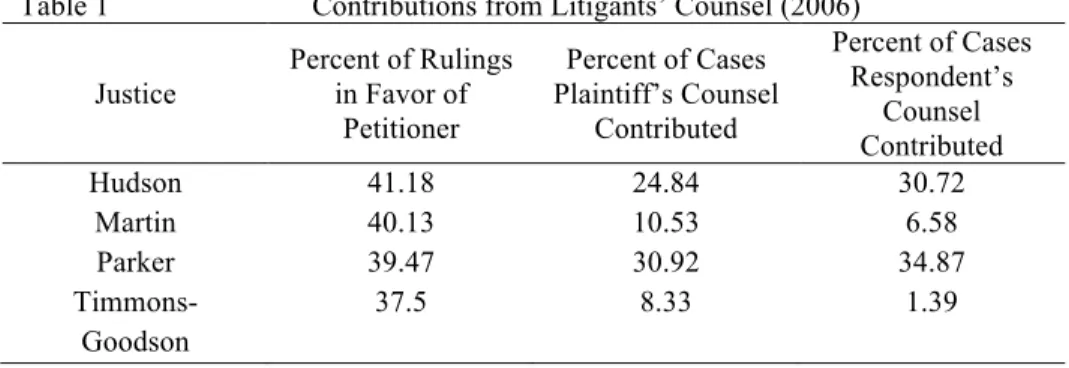
The data also reveals that there is often an opportunity for judges to reward their contributors, as many of the lawyers who contributed to judges’ election campaigns later argued cases in front of them (Table 1). For Justice Hudson and Justice Parker, more than 30 percent of the cases argued before them in 2007 and 2008 included at least one litigant whose lawyer or firm donated to their election campaign. While the percentage of cases where the counsel of at least one litigant contributed was lower for Justice Martin and Justice Timmons-Goodson, the petitioner still contributed to Justice Martin’s campaign in more than 10 percent of the cases and to Justice Timmons-Goodson’s campaign in more than 8 percent of cases. These findings are important because they reveal that there is an opportunity for judges to show favoritism towards one side in many of the cases argued before them, which suggests that it is at least possible that judicial elections have harmful implications for judicial independence.
$32,500.00
$99,171.49
$46,390.00 $26,650.00
$18,010.77
$127,172.57
$298,244.90
$56,884.95
0 50000 100000 150000 200000 250000 300000 350000 400000
Hudson Martin Parker Timmons-Goodson
Lawyers' Campaign Contributions (2006)
Contributions from Non-Lawyers Contributions from Lawyers
Table 1 Contributions from Litigants’ Counsel (2006) Justice
Percent of Rulings in Favor of
Petitioner
Percent of Cases Plaintiff’s Counsel
Contributed
Percent of Cases Respondent’s
Counsel Contributed Hudson 41.18 24.84 30.72
Martin 40.13 10.53 6.58 Parker 39.47 30.92 34.87
Timmons-Goodson
37.5 8.33 1.39
In order to analyze the relationship between lawyers’ campaign contributions and judges’ decisions, I first used a difference of proportions test. Using only the votes of the judges who were elected in 2006, the test compared the proportion of judges’ votes that were in favor of the petitioner based on whether the petitioner’s lawyer or law firm contributed to their campaigns (Table 2). The results showed that judges were
significantly more likely to vote in favor of the petitioner when the petitioner’s counsel contributed than they were if the petitioner’s counsel did not contribute. I also ran a difference of proportions test that compared judges’ votes for the petitioner based on whether the respondent’s counsel did or did not contribute (Table 3). In this test, judges were significantly less likely to vote in favor of the petitioner when the respondent’s counsel contributed to their campaign. Because there was a significant difference in judges’ voting behavior in both tests based on whether the litigants’ counsel contributed to the judges’ campaigns, the results suggest that lawyers’ campaign contributions do have an influence on judges’ votes.
Table 2 Judges’ Votes by Petitioners’ Contributions Petitioner’s
Counsel Contributed
Petitioner’s Counsel Did Not
Contribute Proportion of
Votes in Favor of Petitioner
Table 3 Judges’ Votes by Respondents’ Contributions Respondent’s
Counsel Contributed
Respondent’s Counsel Did Not
Contribute Proportion of
Votes in Favor of Petitioner
30.4 41.7 Note: The results were significant at the p < .05 level.
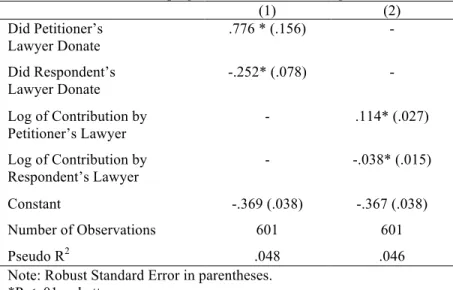
I then used a regression to study the correlation between campaign contributions and judges’ votes. Because the dependent variable, whether or not each judge voted in favor of the petitioner, is a binary variable, I used a probit regression. For the independent variables I used dummy variables representing whether or not the litigants’ counsel on each side contributed any amount of money to judges’ campaigns (Table 4, 1). The results revealed that there was a significant and positive relationship between a lawyer or the lawyer’s firm donating any amount of money to a judge’s election campaign and the judge then ruling in favor of that lawyer’s client.
variables representing lawyers’ contributions and judges’ votes, both when contributions were represented as a dummy variable and as a log transformation of the contribution amount, the results provide further evidence that lawyers’ campaign contributions impact judges’ decision making.
Table 4 Counsels’ Campaign Contributions and Judges’ Votes (1) (2) Did Petitioner’s
Lawyer Donate
.776 * (.156) - Did Respondent’s
Lawyer Donate
-.252* (.078) - Log of Contribution by
Petitioner’s Lawyer
- .114* (.027) Log of Contribution by
Respondent’s Lawyer
- -.038* (.015) Constant -.369 (.038) -.367 (.038) Number of Observations 601 601
Pseudo R2 .048 .046
Note: Robust Standard Error in parentheses. *P < .01 or better
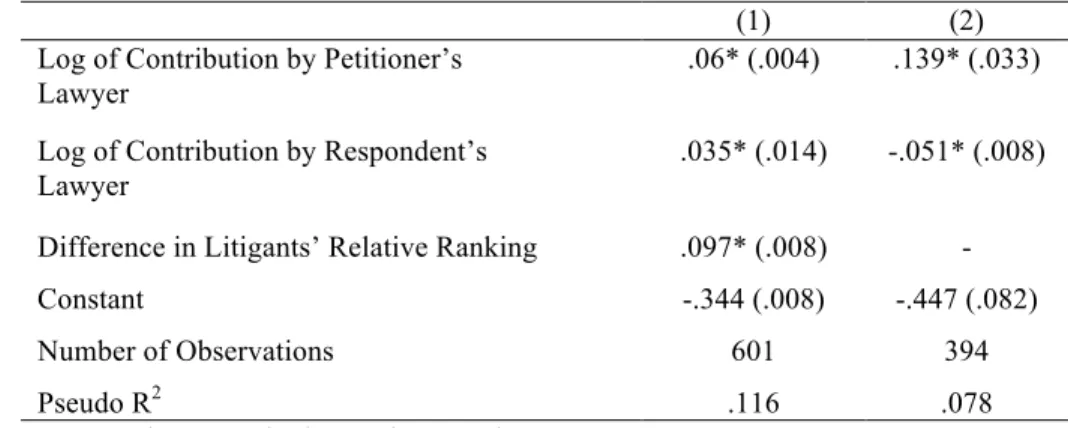
money. This contradicts the theory that donating to a judge’s campaign causes a bias in the contributor’s favor, as it shows contributions actually harming contributors. Because a positive relationship between respondents’ donations and judges’ votes for the
petitioner was not observed until the control variable was included in the model, the results suggest that including litigants’ differences in rank without any constraints has an unintended effect on the data.
Table 5 Judges’ Votes and Counsels’ Contributions, Controlling for Litigants’ Advantages
(1) (2) Log of Contribution by Petitioner’s
Lawyer
.06* (.004) .139* (.033) Log of Contribution by Respondent’s
Lawyer
.035* (.014) -.051* (.008) Difference in Litigants’ Relative Ranking
Constant
Number of Observations Pseudo R2
.097* (.008) -.344 (.008) 601 .116 - -.447 (.082) 394 .078 Note: Robust Standard Error in parentheses.
*P < .01 or better
(2) only includes cases where Difference in Litigants’ Relative Ranking < -2 or > 2.
example, if two litigants are classified into consecutively ranked categories, they may be similar enough that there are not actually any distinctions between their advantages even though their different rankings would suggest that there were. Adding a constraint on the differences in litigants’ ranking allows the variable to more closely represent actual and significant variations in litigants’ advantages. With these restraints on the control
variable, the results met the theoretical expectations. The petitioners’ donations showed a significant and positive relationship with judge’s votes in favor of the petitioner, and the respondents’ donations showed a significant and negative relationship with judges’ votes for the petitioner. Because the control variable attempts to account for judges’ ideology and litigants’ inherent advantages, these results expand on earlier findings and more strongly suggest that judges’ votes in favor of their contributors are actually the result of lawyers’ contributions and not confounding factors.
To better understand the impact that lawyers’ contributions have on judges’ decisions, I also estimated the predicted probabilities of judge voting in favor of the petitioner at different values of lawyers’ contributions. As a whole, the four judges elected in 2006 voted in favor of the petitioner in 39.6 percent of the cases argued before them in 2007 and 2008. When the lawyer or firm representing the petitioner contributed $100 to a judge’s campaign, the predicted probability of the judge voting in the
rulings in favor of their clients. This further indicates that judicial elections may have harmful implications for judicial independence and the impartiality of state judges.
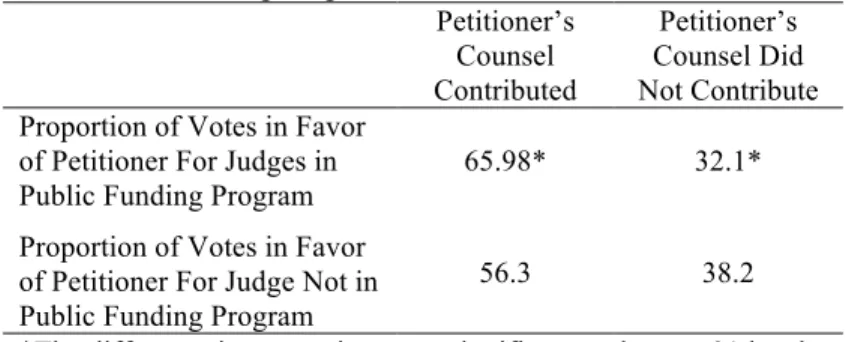
In order to examine the ability of the state’s public financing program to reduce judicial biases based on campaign contributions, I first ran a difference of proportions test that only included the three judges who participated in the public financing program. The test examined the difference in judges’ votes for the petitioner based on whether or not they received contributions from the petitioner’s counsel (Table 6). The test revealed that there was a significant difference in the judges’ votes based on whether the litigants’ counsel contributed to their campaigns, and that the judges were significantly more likely to vote in favor of the petitioner if the petitioner’s counsel donated to their campaign. This suggests that even though the judges received state campaign funding and were therefore not entirely dependent upon private donations to fund their campaigns, they were still influenced by the private contributions they did receive and displayed preferential treatment towards their contributors.
Table 6 Judges’ Votes by Participation in Public Campaign Financing Program
Petitioner’s Counsel Contributed
Petitioner’s Counsel Did Not Contribute Proportion of Votes in Favor
of Petitioner For Judges in Public Funding Program
65.98* 32.1* Proportion of Votes in Favor
of Petitioner For Judge Not in Public Funding Program
56.3 38.2 *The difference in proportions was significant at the p < .01 level.
I also performed a regression to examine the correlation between campaign contributions and judges’ decisions including only the three justices who opted into the state’s public financing program (Table 7, 1). I used the log transformation of each counsels’ campaign contributions as the independent variables, the judges’ votes as the dependent variable, and controlled for the differences in the litigants’ relative advantages. The regression showed that there was a positive correlation between lawyers and firms’ contributions and judges’ decisions. The positive coefficient for the petitioners’
contributions reveals that as the petitioners’ counsels donate more money, judges are more likely to rule in favor of the petitioner. The negative coefficient for the respondents’ contributions suggests that as the respondents’ counsels donate more money, judges are less likely to rule in favor of the petitioner. Although the judges included in this
Table 7 Judges’ Votes and Counsels’ Campaign Contributions by Participation in Public Financing Campaign
(1) (2)
Log of Contribution by Petitioner’s Lawyer .139* (.024) .017* (.064) Log of Contribution by Respondent’s Lawyer -.049* (.024) .068* (.086) Constant -.4 (.085) -.379 (.135) Number of Observations 396 101
Pseudo R2 .0796 .008
Note: Robust Standard Error in parentheses. *P < .05 or better
(2) only includes cases where Difference in Litigants’ Relative Ranking > -2 or < 2.
In comparison, I ran an identical regression using the only judge elected in 2006 who did not opt into the state’s public financing program (Table 7, 2). Contrary to what was expected, neither contributions from the petitioners’ lawyers nor the respondents’ lawyers had a significant influence on the judge’s votes, even though the judge was entirely dependent on private donations. These findings indicate that although the state’s campaign funding program was theoretically likely to reduce judges’ dependence on private donations and therefore decrease their likelihood of biased decision making, in actuality participation in the state’s program did not appear to eliminate the judges’ biases in favor of their contributors.
Conclusion
to the judges’ campaigns even after controlling for the relative advantages of litigants, the findings suggest that campaign contributions could to some extent create biases in
judicial decision making. Additionally, this research began to delve into the topic of public financing programs for judicial elections and found no evidence that receiving public funding from the state reduced the likelihood that judges displayed favoritism towards their contributors.
As this study finds evidence that campaign contributions could hinder judges’ impartiality and independence, it reveals a need for further exploration of the topic of judicial elections. Although the results indicate that there is a positive correlation
between campaign contributions and judges’ decisions, it fails to fully establish a causal relationship. Future studies could further these findings by including additional controls such as more direct measures of judges’ ideology in order to better indicate a causal relationship between contributions and decisions. It would also be beneficial for future research to examine the impact of public funding programs in additional states where the requirements and restrictions vary in order to better understand the potential for campaign reform programs to reduce judicial biases.
Bibliography
American Bar Association. “State Judicial Selection Snapshot.” American Bar
Association.
<http://www.americanbar.org/groups/committees/american_judicial_system/subc ommittee-on-state-courts/resources/state_judicial_selection_snapshot.html>. American Bar Association Standing Committee on Judicial Independence. 2002. “Public
Financing of Judicial Campaigns.” Chicago: American Bar Association.
American Bar Association. 2008. “Judicial Selection: The Process of Choosing Judges.”
Coalition for Justice.
<http://www.americanbar.org/content/dam/aba/migrated/JusticeCenter/Justice/Pu blicDocuments/judicial_selection_roadmap.authcheckdam.pdf>.
Bonneau, Chris. 2007. “The Effects of Campaign Spending in State Supreme Court Elections.” Political Research Quarterly 60 (September): 489-499.
Bonneau, Chris W., and Melinda Gann Hall. 2009. In Defense of Judicial Elections. New York: Routledge.
Cann, Damon M. 2007. “Justice for Sale? Campaign Contributions and Judicial Decisionmaking.” State Politics and Policy Quarterly 7 (Fall): 281-297.
Cohen, Andrew. An Elected Judge Speaks Out Against Judicial Elections. 2013 (9/3/13). The Atlantic.
Democracy North Carolina. 2010. “Special Interest Funding Declines in State Court Elections as 77% of the Top Judges Qualify for Public Funds.”
<http://www.democracy-nc.org/downloads/JudicialPublicFinPRDec2010.pdf>. Geyh, Charles Gardner. 2008. “Methods of Judicial Selection and Their Impact on
Judicial Independence.” Daedalus 137: 86-101.
Goldberg, Deborah, Craig Holman, and Samantha Sanchez. 2002. The New Politics of
Judicial Elections. Washington, DC: Justice at Stake Campaign.
Goldberg, Deborah, Sarah Samis, Edwin Bender, and Rachel Weiss. 2004. The New
Politics of Judicial Elections 2002. Washington, DC: Justice at Stake Campaign.
Hall, Kermit L. 2005. “Judicial Independence and the Majoritarian Difficulty.” In
Institutions of American Democracy: The Judicial Branch, Kermit L. Hall and
Kevin T. McGuire, eds. New York: Oxford University Press.
Hall, Melinda Gann. 2015. Attacking Judges: How Campaign Advertising Influences
Judicial Campaign Reform Act, NC Stat. §163-278 (2002).
Kam, Cindy D. and Zechmeister Elizabeth J. 2013. “Name Recognition and Candidate Support.” American Journal of Political Science 57 (4): 971-986.
Lovrich Jr., Nicholas P. and Charles H. Sheldon. 1984. “Voters in Judicial Elections: An Attentive Public or an Uninformed Electorate?” The Justice System Journal 9 (1): 23-39.
McCall, Madhavi. 2003. “The Politics of Judicial Elections: The Influence of Campaign Contributions on the Voting Patterns of Texas Supreme Court Justices, 1994-1997.” Politics & Policy 31 (June): 314-343.
Schwartz, John. Effort Begun to End Voting for Judges. 2009 (12/23/09) New York Times.
Songer, Donald R. and Reginald S. Sheehan. 1992. “Who Wins on Appeal? Upperdogs and Underdogs in the United States Courts of Appeals.” American Journal of
Political Science 36 (1): 235-258.
Waltenburg, Eric N. and Charles S. Lopeman. 2000. “Tort Decisions and Campaign Dollars.” Southeastern Political Review 28(2): 241-263.