Matthew S. Zimo. Considerations on Migrating to an Open Source Integrated Library System. A Master’s Paper for the M.S. in I.S degree. April, 2018. 50 pages. Advisor: Bradley Hemminger
There is a large amount of published case studies of school, public, and academic
libraries migrating from proprietary to open source integrated library systems (ILS). This is an attempted case study of a special library’s migration to an open source ILS. The most promising ILSs for US-based special libraries are Koha and OPALS.
Headings:
Integrated library systems (Computer systems)
Special libraries
Library automation
CONSIDERATIONS ON MIGRATING TO AN OPEN SOURCE INTEGRATED LIBRARY SYSTEM
by
Matthew S. Zimo
A Master’s paper submitted to the faculty of the School of Information and Library Science of the University of North Carolina at Chapel Hill
in partial fulfillment of the requirements for the degree of Master of Science in
Information Science.
Chapel Hill, North Carolina
April 2018
Approved by
_______________________________________
Table of Contents
Contents
Table of Contents ... 1
Introduction ... 2
Literature Review ... 6
Integrated Library Systems ... 6
History and Development of Integrated Library Systems ... 6
Description of Current Integrated Library Systems ... 7
Overview of Different Open Source Integrated Library Systems ... 9
Why Migrate to Open Source Integrated Library Systems? ... 10
The Most Popular Open Source Integrated Library Systems for Special Libraries ... 11
Special Libraries ... 12
The North Carolina Biotechnology Center Library ... 12
Methods ... 14
Data Collection ... 15
Results and Conclusion... 17
Technical Information about the Current ILS ... 17
Who Uses Presto and How They Use It ... 19
What the LSI Staff Like About Presto ... 20
What the LSI Staff Do Not Like About Presto... 23
What the LSI Staff Want from a New System ... 24
Koha ... 25
Evergreen ... 26
OPALS ... 27
Preliminary Suggestion ... 28
Aftermath... 29
Limitations, or Lessons Learned ... 30
Bibliography ... 32
Appendix A: Interview Guide ... 41
Introduction
The use of computers in libraries has radically transformed the way libraries and library
staff work. In the 1960’s. libraries began to migrate their catalog records onto computer
systems. These were the first steps in a decades-long process where libraries modernized
their existing processes and services by incorporating computer systems, a process known
as “library automation”(Borgman, 1997; De Gennaro, 1983). The development of the
MARC (MAchine-Readable Cataloging) standards and shared catalog services like the
OCLC (Ohio/Online Computer Library Center) are hallmark achievements of library
automation. Another product of library automation is the Integrated Library System
(ILS). Integrated Library Systems are software suites consisting of “modules” such
Online Public Access Catalogs (OPACs), circulation management tools, and even
community bulletin boards(Fayen, 2010, pp. 2809–2810). The modular nature of ILS
architecture is designed to adapt to the needs of different libraries. Instead of a
one-size-fits-all approach to software, ILSs allow different libraries to select the specific modules
they need for their processes.
The first ILSs were commercial products that ran on proprietary software. In the past two
decades, developers have created free open source ILSs. While such open source ILSs
may be free to download and install, the library may still have to pay for associated
increasingly expressing dissatisfaction with commercial ILS and migrating their ILSs to
open source platforms (Breeding, 2007a, p. 29, 2007b, p. 40).
A good deal of professional and research literature has been published about public and
academic libraries that have migrated from commercial to open source ILSs (Conc, 2013;
Krishnamurthy, 2008; Satphathy & Maharana, 2012; Singh, 2013b). However, there is
comparatively less published research into how special libraries fare when they migrate
to an open source ILS. Shumaker (2010) defines special libraries as “libraries that have
one or more of the following attributes: a focus on specialized information resources,
usually of a limited subject scope; a focus on a specialized and limited clientele; and the
delivery of specialized services to that clientele” (p. 4966). Because special libraries
differ from traditional libraries in essential areas like patron base, collection management
practices, and services offered, they may have substantially different requirements for
ILSs. Studies into special libraries’ experiences migrating to open source should offer
insight on the adaptability of library automation systems. In this paper, I will examine a
special library’s migration from a proprietary, subscription-based ILS to an open source
one.
I intern at the library at the North Carolina Biotechnology Center (NCBiotech).
NCBiotech is a state sponsored non-profit organization whose mission is to promote
economic development in the field of biotechnology within North Carolina. The
NCBiotech library is unusual because it rarely lends out materials for patron use. Instead,
the library provides access to certain databases and market research reports. The library’s
subscriptions with the publishers of these resources only permit patrons to use them in the
books and movies available for checkout, its patrons primarily come to access the
Pitchbook database and to read market research reports. To save costs, the library director
wants the library to switch library management systems. For many years the library has
used Inmagic Presto, a web-based integrated library system suite, to manage its collection
(Lucidea, 2018). The library pays roughly $30,000 for a three-year subscription to Presto
and is presently in the third year of its current subscription. The library director is
interested in switching to a free, open-source integrated library system (ILS) such as
Koha. The library director also hopes that the new system will serve as a central records
management system for NCBiotech.
I proposed a project in which I conduct a literature review of reports of libraries
switching to open-source ILS. I would next carry out a needs assessment of the
NCBiotech library staff and use the results of that assessment to choose a new ILS.
Finally, I would study the library’s transition to the new ILS and report my findings. This
project is interesting because most of the literature I have found so far about libraries
migrating to new ILSs had been about public or academic libraries and not special
libraries like the one at NCBiotech.
My research questions are the following: 1) What is the landscape of open-source ILSs
available today? What are their strengths and weaknesses? What have other special
libraries used? 2) How does the NCBiotech library’s transition to a new ILS go? Are
there any unexpected benefits or drawbacks? Do the costs of switching to a new system
outweigh the financial savings? How does the library staff respond to the new system?
I planned to find the answers to the first question through a thorough literature review. I
their opinions of the new system. I would transcribe the interviews and code their
responses to common themes to evaluate their opinions of the new system and the
transition. The library director approved of my idea and will allow me to work on the
project at work. I do not know if the transition from Presto to the new system would have
require library staff to work extra hours or if the library would have been unavailable to
Literature Review
Integrated Library Systems
Integrated Library Systems are “software application and hardware that organize, track,
and make accessible library information resources” (Pruett & Choi, 2013, p. 435). In the
following sections of the paper I will discuss the history and development of integrated
library systems, the current landscape of integrated library systems, special libraries, and
the library at NCBiotech.
History and Development of Integrated Library Systems
The roots of the modern Integrated Library System (ILS) come from the nationwide
frenzy of library automation that overtook university campuses in the 1960s and 70s
(Mason, 1971, pp. 187–188). One goal of library automation was the ability of a library
to share its electronic catalog information with another library. For this to work, libraries
would have to store catalog information in a standard format. To this end, the Library of
Congress created the MARC (MAchine Readable Cataloging) format in the early 1960’s
and unveiled the MARC II format in 1968 (Borgman, 1997, p. 221). When the University
of California at Santa Cruz opened in 1965, its library stored all catalog information on a
computer terminal using a MARC variant instead of a card catalog (Millsap, 1996, p. 80).
Florida Atlantic University was also founded in the early 1960s. Its first library director
was tasked with creating a “computer-based library system” (Heiliger, 1964, p. 181;
Primich & Richardson, 2005, p. 121). The Ohio College Library Center (OCLC) became
Because these early systems ran on large mainframe computers built by IBM or Bell Labs
and lacked intuitive interfaces, they were mostly maintained by technical staff rather than
librarians (Kinner & Rigda, 2009, p. 402). Soon, companies developed online public
access catalogs (OPAC), which allowed librarians and eventually the general public to
access and search catalog records on a computer in the library (Fayen, 2010, p. 2809). In
the 1980s, serials databases that abstracted the latest journal articles became operational,
providing library patrons easier access to the latest research publications (Lynch, 2000, p.
63). Concurrent with the development of patron-facing system improvements was the
development of new software modules that automated librarian work processes such as
tracking circulation, acquisitions control, bibliographic control, and authority control
(Andrews, 2007, p. 573; Fayen, 2010, pp. 2810–2811). These complex software suites
became known as “Integrated Library Systems” (Kinner & Rigda, 2009, p. 403).
During the 1980s and early 90s, the commercial ILS market flourished (Kinner & Rigda,
2009, p. 404). The number of ILS vendors began to contract in the late 1990s when
public access to the World Wide Web and web search engines became more
commonplace (Markey, 2007). Since then, many ILS vendors have goneas out of
business or merged with other vendors. Marshall Breeding reports that there were 30
major library systems vendors in 2017 (Breeding, 2017b).
Description of Current Integrated Library Systems
Private companies developed the first ILSs, and today the majority of ILS
implementations in use remain commercial packages (Breeding, 2017b). An alternative to
proprietary software is open source software, which is free to download, modify, and
There are numerous advantages to using open source software instead of proprietary
software. As stated above, open source software is free to download and install and
comes with no licensing fee. Because the software is maintained and updated by the
users, open source software can have more user-focused features than proprietary
software (Genoese & Keith, 2011, p. 127; Goh et al., 2006, p. 362). The use of open
source software also appeals to librarians’ values of equal access and freedom of
information (Palmer & Choi, 2014, p. 12; Riewe, 2008, p. 2).
The disadvantages of using open source software include the lack of formal technical
support that comes with a product purchased from a vendor. Open source software is
sometimes considered less easy to use than proprietary software (Goh et al., 2006, p.
362). Additionally, numerous open source library system projects become dormant
because they require the ongoing maintenance of active, usually unpaid users (Aksulu &
Wade, 2010, 2010, p. 589; Londhe & Patil, 2015).
Despite these drawbacks, interest in adoption of open source ILSs is increasing, largely
stemmed from dissatisfaction with commercial products (Breeding, 2007b, p. 40). Singh
(2013a) surveyed “key decision makers” at 73 libraries and found that only 33% of them
had a definite preference for proprietary ILSs. Furthermore, in their comprehensive
literature review of open source software research, Aksulu and Wade (2010) devised a
taxonomy of 15 different open source software applications from 304 published works.
They found that two of the largest application areas “libraries, archives, databases and
repositories” and “content, information and knowledge management systems” (pp. 583,
639).1
Overview of Different Open Source Integrated Library Systems
One of the first open source ILSs was Koha. It was developed in New Zealand in the late
1990s. The Horowhenua Library Trust, which managed three public libraries in the
southern island, wanted to migrate from its current ILS out of concern for Y2K problems.
The Trust commissioned a local development company called Katipo to create a new
open source ILS. The ILS, which is a Maori word for “gift,” was released on January 3,
2000 (Breeding, 2017a, pp. 9–10; Koha Library Software Community, 2017c). In his
latest report on ILS installations, Marshall Breeding (2017b) states that Koha is the fourth
most popular ILS worldwide (p. 29).
The OPALS (OPen source Automated Library System) ILS was created in the early
2000s by six school library systems in New York (OPALS, 2018b). It is mostly used by
school libraries in the state of New York (Breeding, 2017b, p. 34).
Another popular open source ILS is Evergreen. It was created in 2006 by the Georgia
Public Library System to assist in creating a union catalog of public libraries. A spinout
company called Equinox was created in 2007 to support migration and development
(Oyelude, 2016, p. 1). The company transitioned into a nonprofit in 2016 (Breeding,
2017b, p. 29).
Many open source ILSs come from a family of free database software developed by the
United Nations called the Central Documentation System/Integrated Set of Information
Services, or CDS/ISIS. ILSs in the “ISIS family” include WEBLIS, J-ISIS, Winisis, and
ABCD (de Smet, 2010, p. 327).
Other open source ILSs include the Kuali Open Library Environment, Learning Access
ILS, and PYTHEAS, which were developed in the United States. ILSs developed abroad
PhpMyLibrary (Phillipines), GnuTeca (Brazil), Emilda (Finland), and NewGenLib
(India) (OSS-ILS Research, 2017b).
Why Migrate to Open Source Integrated Library Systems?
Since the release of the first open source ILS in 2000, much research has been published
concerning how and why libraries and library consortia migrate their systems to open
source ILSs. The most obvious reason that libraries migrate to open source ILSs is that
they are cheaper to use than proprietary systems (Brooke, 2013, p. 4; Rafiq, 2009; Riewe,
2008, p. 43; Singh, 2013c, pp. 210–211). This may be the reason much of the literature
on open source ILSs come from developing countries where library budgets are
especially limited (Makori & Osebe, 2016; Oukrich, Bouikhalene, & Askour, 2016;
Sarma, 2016; Satphathy & Maharana, 2012; Shafi-Ullah & Qutab, 2012). While there is
no purchase or licensing cost for open source software, unless libraries already have
servers and programmers on staff to manage the ILS, they still have to pay an outside
company for those services (Boss, 2008; Macan, Fernández, & Stojanovski, 2013, p.
138).
Another advantage of migrating to an open source ILS is that there is less of a threat of
losing support service. If a company who makes a proprietary ILS goes out of business or
stops updating one of their ILSs, a library using that ILS would be forced unable to
continue using it because the library staff does not have access to the ILS source code.
The ILS industry has undergone considerable change in the past few years, with a small
number of companies acquiring competition and discontinuing their products (Breeding,
2016, pp. 31–32, 2017b, p. 23; Riewe, 2008, p. 44). The Westchester Academic Library
ILS to an open source one because their ILS was acquired by a different company and the
directors suspected the ILS would be discontinued (Genoese & Keith, 2011, p. 126).
A related benefit to using open source ILSs is that a library does not have to “lock-in” to
a specific vendor for technical support (Macan et al., 2013, p. 138; Riewe, 2008, p. 43).
Many different companies provide support services for open source ILSs, and a library
can change service providers without having to change ILSs (Singh, 2014, p. 692).
Furthermore, there is voluminous free online technical documentation and community
support available for open source ILSs (Phillips, 2009).
The Most Popular Open Source Integrated Library Systems for
Special Libraries
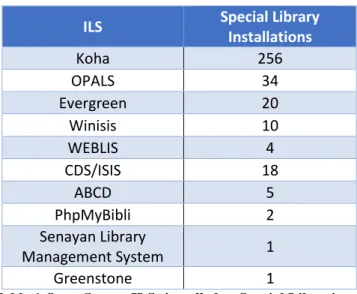
Marshall Breeding maintains a web database called Library Technology Guides that
tracks libraries, ILS vendors, and what ILSs libraries use (Breeding, 2017c). A search of
Special Libraries returned 1356 results, 356 of which use an open source ILS. Of those
libraries, ten different open source ILSs were used. The results from my search is
described in the table below.
ILS Special Library
Installations
Koha 256
OPALS 34
Evergreen 20
Winisis 10
WEBLIS 4
CDS/ISIS 18
ABCD 5
PhpMyBibli 2
Senayan Library
Management System 1
Greenstone 1
By far, the most popular open source ILS is Koha followed by OPALS, Evergreen and
CDS/ISIS family systems.
Special Libraries
Examples of special libraries include hospital libraries, law libraries, and corporate
libraries. Because special libraries provide resources and services to a narrower patron
base than public or academic libraries, special librarians can anticipate their patrons’
information needs and be more proactive in their resource allocation and information
services (Shumaker, 2010, p. 4969). For example, a librarian at a car manufacturing
company might regularly share a report with the company’s employees that compiles and
summarizes recent research from engineering journals.
Such special libraries that are part of companies or organizations are sometimes called
“corporate information centers.” As Spiegelman and Carlson (2010) explain, “The goal
of the corporate information center…is to provide pinpoint access to exact information in
the shortest time possible….The corporate information center client values its collection,
but values its services more” (p. 1313). Corporate information centers have to be
responsive the changing needs of their parent organization in order to justify their
expenses during annual budget planning (pp. 1319–1320).
The North Carolina Biotechnology Center Library
The North Carolina Biotechnology Center is a state-funded nonprofit organization
headquartered in Research Triangle Park, North Carolina. It was established in 1982 by
the North Carolina General Assembly to promote economic development by funding
research and development in biotechnology (Olmos, 1986). The Biotechnology Center’s
who operate the Center’s library. The library is a blend of a corporate information center
and special library in that it maintains the Biotechnology Center’s intranet, archives, and
contact management system, but it also provides resources and services for entrepreneurs
and bioscience researchers from outside the organization (North Carolina Biotechnology
Center, 2018).
Such resources for external patrons include market research reports from BCC Research
and Kalorama Information on life science and biotechnology-related subjects. The library
also subscribes to several business and biotechnology-related databases: PitchBook,
which tracks business funding activities (PitchBook Data, 2018), BioPharm Insight,
which focuses on business developments in the pharmaceutical and biotechnology
industries (BioPharm Insight, 2018), and AdisInsight, which covers drug research and
development, clinical trials, and business deals (Springer International Publishing AG,
2018). The NCBiotech librarians also provide custom market research services for
patrons, creating and delivering reports or data sets that match the patrons’ specific
information needs.
Aside from the custom research reports, all of NCBiotech’s library information resources,
and even many of the information resources used by other units of NCBiotech, are
Methods
The second part of my paper is a case study that explores the North Carolina
Biotechnology Center library’s selection of and transition to a new open source
Integrated Library System (ILS). According to Darke, Shanks, and Broadbent (1998),
case study methodology is “well suited to understanding the interactions between
information technology (IT)-related innovations and organizational contexts” (p. 274).
The unit of analysis of my study is the organization itself, including its staff, equipment,
and workflows.
My research questions are:
1. What are the needs for the North Carolina Biotechnology Center library’s new
ILS?
2. How does the Biotechnology Center choose whether or not to transition to a new
ILS?
3. What are the effects of the switch (or lack thereof) to a new ILS for the rest of
organization?
Wildemuth (2017) writes that case studies employ multiple methods of data collection in
pursuit of generating rich descriptions (p. 54). In my study, I used unstructured interviews
as my primary data gathering method. I also worked at the organization during this time
Data Collection
I planned to use purposive and convenience sampling techniques to select interview
subjects. I planned to interview the vice president of the Life Science Intelligence Unit
(the library director), one member of the IT team, and one staff librarian. The first
subject, in addition to being a trained librarian, also provides a management perspective.
The IT employee would provide a deeper insight into the current technological
infrastructure within the organization and what limitations there might be for a new
system. The staff librarians are the people who interact with the current system the most,
and I hoped that they would provide insight into how the system is used and what their
needs were for a replacement system. As stated above, I work at the organization, and
since I am personally acquainted with all of the subjects, I knew recruitment would not be
difficult.
Instead of conducting several individual interviews, the library director suggested we
have a group interview in a conference room. The conference room is a private location
with closed doors and no windows facing inside. The conference room also has a
projector and computer, which allowed us all to use the ILS together. I used a digital
voice recorder to record the audio from the interview, and I partially transcribed it for
content analysis. To protect the privacy of the interview subjects, I scrubbed identifying
information such as names and replaced them with assigned subject identification
numbers.
I used the semistructured interview technique, which allowed me to adjust the order and
wording of questions and to ask clarifying questions if a subject’s answer was not
satisfactorily detailed. In a semistructured interview, the researcher prepares an interview
p. 249). I planned to perform a test interview with another library staff member before
my main interview to determine any changes I might have needed to make to the
interview guide, but there was not enough time to do so. The complete interview guide is
provided in the appendix. During the interview, I only took notes to check off the
questions and topics from the interview guide and to write down issues I wanted to
follow up on later in the interview.
Because I work at the North Carolina Biotechnology Center library, I also collected data
as a participant observer over the course of the study. I planned to help implement the
transition to a new ILS, which would have given me the opportunity to closely observe
and record the process of the transition. I transcribed the interview and used NVivo
software to perform a content analysis on the transcript to help find common themes from
the interview. I also obtained some information about the different ILSs nformation about
Results and Conclusion
After conducting the group interview, I transcribed the audio and coded the content using
NVivo software. The themes I’ve found in this content analysis were: general technical
information about the current system in use, who uses the current system and how they
use it, what they like about the software, what they do not like about it, what they want
from a new system. In the following sections, I will discuss these themes one by one. I
anonymized all interview subjects by assigning them each a randomly generated number.
Technical Information about the Current ILS
The North Carolina Biotechnology Center’s current ILS is called Presto, published by
Inmagic. Figure 1 shows NCBiotech’s Presto home screen.
The NCBiotech library has used Presto since 2010. Before 2010, the library used a
different Inmagic product. There was no formal selection process when the Center
migrated to Presto.
45: Well, before [24] and I even came here, we already were working with a company called Inmagic, and that was the catalog that we used…. And so, when they came out this, which was a cloud-based solution we moved to that. There wasn’t really a…
24: No selection process
When I asked who is trained as the Presto administrator, 45 responded, “I guess I’m
probably the most trained. [14]’s been doing a little more of that, lately...All of the LSI
team have administrator rights to do it, but I don’t know if anybody else does anything in
depth.” The LSI staff decided to have the system and much of the data stored on an
off-site server—the library staff does not know what operating system the Presto server runs
on, and I was unable to find that information in the “help” menu or the Presto website—
and the records can be exported in CSV format. Subject 45 explained that this was not
always the case:
[Records] can definitely be exported as CSV, now. That wasn’t the case in the beginning, and that was a hurdle [inaudible] continued to develop the software. We were pretty early adopters of it. We helped iron out a number of bugs
[chuckles] in the beginning. But they keep adding more features. Another feature they have that we haven’t been able to play around with is the ability
to...supposedly, there’s a way to set it up so that you put a file in a folder and it would create a record in Presto automatically using the metadata of the file. But I haven’t played around with that yet to see if it’s possible, and I don’t know how well it works when we’re not hosting the data on our server. There’s been some glitches sometimes when we’ve tried to do things, because we’re not hosting it.
NCBiotech’s staff also use a few other software suites to organize and share information
with each other: InterAction, a contact management system that tracks people,
web browser and provides staff members information relevant to their specific
department; Smartsheet, a web-based project management application used to track
progress on tasks; and Helpspot, an online help desk ticketing system used to track
research IT issues and research requests.
The preponderance of different information platforms makes it somewhat of a challenge
for LSI staff to decide where to put certain information resources, as subject 45
explained:
Yeah, and that was when I was starting to feel a little bit, being torn between where to put certain documents. Like, should I put them in [Ourspace] if they’re of use to a particular unit or should I create a browsable collection for them, kind of thing. So, there’s still a little bit of that in my head of... where do I put what? Between this and [Ourspace].
I asked if there was anything on Ourspace that belonged on Presto. Subject 24 replied:
There’s nothing from Ourspace that I could think of that would need to come over. We really, I know if somebody asks me, I really try and say, “If it’s a document at all it’s got to go in here. If it’s anything that CorpComm creates it’s got to go in here.” This is like, the inventory, the archive, etcetera.
Who Uses Presto and How They Use It
In addition to serving as the library catalog system, each unit of the Biotechnology Center
uses Presto to store and organize their information resources.
24: One of the databases in Presto is the resource database. Every unit has data in the resource database…. So, what we need, again is a way to have a database management system that lets us manage different kinds of data, and Presto has been that system to date.
The NCBiotech collection is relatively small. Table 2 shows the number of records for
each content type in NCBiotech’s ILS. As you can see, photos make up the largest
portion of the catalog. One content type, metrics and accolades, is in the process of being
Presto, but most of the photos are used by members of the corporate communications
staff, and it seems safe to assume that most of those records are created by their staff. All
of the books, market research reports, audio-visual materials, fiction books, and metrics
and accolades records are created and maintained by LSI staff.
Content Type Number of Records
resources 82
market research reports 515
photos 10213
books 382
electronic documents 384
websites 80
videos audios 173
fiction books 118
metrics and accolades
(migrated) 126
Total 12073
Table 2 Number of Records by Content Type in the NCBiotech ILS
Currently, Presto is only accessible to center staff. As two subjects stated, the vendor
even pitched Presto as a corporate intranet system.
45: And this was promoted to us at one point as an intranet solution, because you can actually, as you can see at the top on that black bar, you can link to other things like [the NCBiotech corporate intranet site] or the web, and so, internal and external things you can link to. And the first page that you get to...that can be configured for multiple types of users and so on.
Non-staff patrons can only search Presto on a work station computer in the NCBiotech
library.
What the LSI Staff Like About Presto
The LSI staff like Presto’s flexibility with creating different content types with different
fields.
associated with, a set of permissions...It’s all very flexible as far as how you set each one.
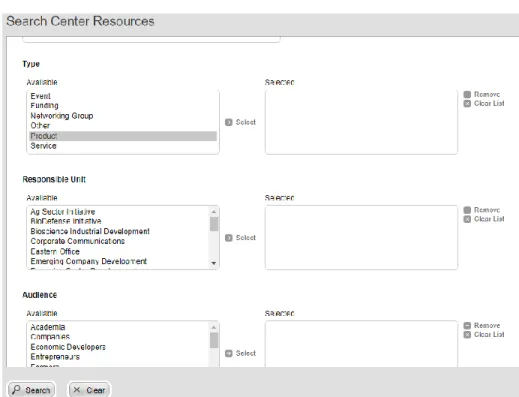
Figure 2 shows the nine different content types in the Presto ILS. Figure 3 shows some of
the fields and values associated with the “Resources” content type.
Figure 2 The Nine Content Types in NCBiotech's ILS
Some on the NCBiotech library staff also praised Presto’s report generation and
advanced, full text searching capabilities, comparing it favorably to the Center’s
collaborative work management system Smartsheet.
45: And we actually ended up…[moving] the stuff from the Metrics and Accolades database, which was here, to Smartsheet because it seemed to make more sense to manage that there. The reason that we wanted Resources for
example [in Presto] was so that they could create a real nice easy report that could be handed out.
37: It’s used by the public. Used by the clients.
45: And I think that’s the main difference between the two, probably. Is that Smartsheet you can’t do a nice report like that.
24: Well you can’t, I mean, searching. It’s like searching in Excel. Like “find.” It’s not a “search” or an advanced search. We want the searching capabilities of [Presto]…. The fact that you can upload a pdf and this can search the contents of the pdf. Last I heard it was still doing that. The fact that it does the reports.
There’s just a lot of nice public facing features, and “public” in this case being our staff and the external public.
The staff also appreciate how Presto manages to be easy to use and highly customizable
when it comes to granting administrative permissions.
45: I think the extent of permission control is really good in this system…. That you can go in and say, “This person is in this role, therefore they only see these content types, or even, only see these fields within these content types, or can only edit but not delete.” You know, there’s lots of granularity there as far as controlling people’s permissions.
14: And there have been one or two instances where [45 has] been out where I had to go and tweak something or add someone and it’s relatively intuitive to do, too. It’s not difficult to make those changes.
45: Which is interesting because I don’t find it the most user friendly on the user side, but on the admin side it seems to be a lot easier.
The LSI staff have been pleased with the technical support from their vendor. Subject 45
I think it’s been very good, and we’ve had some technically challenging
questions, like I said, because we were some of the early adopters, and there were things we wanted to do with the photos database… where we wanted to link in to a location on our server to pull those photos. So it wasn’t a real URL, and there had to be some code written and stuff like that in the background, and they’ve been really good about all of that. And not charging us extra every time they need to do a bit of development for us.
Another feature of Presto that the subjects like is the ability to copy information from one
record into a new one.
14: One thing that I, that’s really handy for me, and [45] probably agrees, is when you’re adding the new market reports, if it’s an update to a pre-existing report you can copy the record, and all that is copied over. So then you just update what you need to. Instead of having to fill out each line of it, which saves… in some months it doesn’t make a difference, but in these months where they add 20 or 30
reports... it saves a whole lot of time.
45: Definitely saves time, yeah.
What the LSI Staff Do Not Like About Presto
The interview subjects listed a handful of aspects about Presto that they do not like. The
first and greatest drawback is its cost, as subject 24, stated, “[Cost] is the only reason
we’re looking for a new system.” Aside from cost, the LSI staff mentioned the unintuitive
user interface and buggy performance of certain modules.
Despite participant 24’s high praise for Presto’s reporting feature, 45 gave the feature a
more mixed review:
45: Yeah, so their system uses a third party... it’s kind of based on [a] Crystal Reports-type SQL reporting design, but it’s not quite. And so, it’s glitchy, sometimes, as far as getting what you need out of it, but it’s easier than some could be. You know, it’s workable.
It appears that program bugs have been a persistent feature of Presto for all eight years
that the NCBiotech library has used it as an ILS. Another librarian agreed that, aside from
37: I’m basically always going into the search screen to delve into a content type and conducting my search from there, is basically always how I’m using it. But I think that past that, the interface... is not the most intuitive. When I’m generating a report I always have to dig around to get, to figure out, to remember how to add it to the cart, find the right report. I’m just always...every time I have to make a report I’m refreshing my memory on how to make a report. So, I think it, kind of adds your options in funny places when you’re needing to operate it.
On the buggy search interface, subject 14 added, “Sometimes you can hit enter and
search, but sometimes if you searched that word before you have to hit enter twice or you
have to click the button.” Subject 45 summarized, “It’s very clunky from the user’s
standpoint.”
What the LSI Staff Want from a New System
The LSI staff provided a limited selection list of required features for a new LSI. The
number one criterion was that it cost less than Presto. Subject 24 stated that they want a
system that does not require a great deal of technical expertise: “The nice thing and the
reason we need a system like Presto is we don’t have another database management
system that doesn’t require a lot of... knowledge.” The subjects also explained that they
want a system that allows NCBiotech to organize different types of data that is, in subject
45’s words, “flexible and easy enough to create a whole new content type with new
fields.” The new system would need to have robust search capabilities. Subject 24
repeatedly emphasized the importance of search functionality, and said that the new
system would ideally be accessible from the corporate intranet:
The interviewees also stated that they would want the capability to create a
publicly-accessible OPAC that members of the general public can access and search, in the event
that the staff decide to create one:
45: And we actually, at one point, we actually thought along the way, too, that [Presto] might eventually be opened up for clients to search...
24: External
45: External people. Cause you can put it out there with certain permissions and limitations so that they could search our catalog or search our market reports or that sort of thing. So that’s always a possibility as well. So, we definitely don’t... I don’t think we’d want a replacement solution that wouldn’t allow us those
flexibilities.
24: Right. In terms of replacing it we’re not looking for an intranet system. We would like to be able to make it live externally, should we choose to do so.
I asked the subjects if they prefer technical support for a new ILS to be in the same time
zone as NCBiotech, subject 24 replied that support has to be responsive the same day, but
not necessarily immediately: “They just can’t be in Russia.”
Lastly, in order to save the cost of paper, the LSI team wants to replace printed copies of
their market research reports with digital files stored on Amazon Kindle e-readers. For
this to happen, the new ILS would have to work on the Kindle platform. I found three
open source ILSs that I felt could be good candidates to replace Presto: Koha, Evergreen,
and OPALS.
Koha
The official Koha community website lists two vendors in the United States who offer
support services for Koha: ByWater Solutions and Equinox Open Library Initiative
(Koha Library Software Community, 2018) As mentioned above, Equinox also supports
migration and ongoing support and hosting services for the NCBiotech ILS. One vendor
replied to me within the time frame with an estimate that totals one third of what the
NCBiotech library currently pays its vendor. NCBiotech library staff require the potential
new ILS to support custom content types, views, reports, and permissions. Koha’s
documentation describes how it supports custom item types (Koha Community, 2017).
Other special libraries that have used Koha praise the customizability of views and
permissions (Avery, 2016, pp. 263–265; Singh, 2013c, p. 213). While Koha does have a
customized report generation tool, Müller (2011) writes it, “does require some
experimentation in the choice of data options in order to obtain the desired end result” (p.
68). In a Special Libraries Association online discussion thread, several librarians
specifically praised ByWater Solutions for their responsive technical support (Mann,
2016). Koha In his 2011 review of 20 open source ILSs, Müller (2011) Koha was the
only ILS to pass through the three rejection criteria of licensing, community
development, and mature functionality (p. 72). The Koha website boasts it supports full
text searching (Koha Library Software Community, 2017a). However, this capability is
only possible if the library integrates two other software packages with Koha (Anuradha,
Sivakaminathan, & Kumar, 2011).
Evergreen
I was not able to obtain a price quote from an Evergreen vendor for migrating, hosting,
and maintaining NCBiotech’s ILS. The Opensource ILS research project at the
University of Tennessee estimates that the cost for a collection of NCBiotech’s size is
$2,500 for the first year and $1000 for every year after that (OSS-ILS Research, 2017a).
currently pays its vendor for Presto. While Evergreen does not offer full text searching
capabilities, it does provide a “did you mean…” feature that suggests alternate spellings
for search queries with few results (Yang & Hofmann, 2010, p. 146). Müller (2011) notes
that Evergreen has the most advanced permission control and most intuitive report
generation feature (pp. 68–69). Previous research suggests that Evergreen users find
technical support slow, but that might be because Evergreen was still a relatively new
product at the time those studies were carried out (Riewe, 2008, p. 49). Singh (2014)
found that Evergreen users have more available channels for technical support than Koha
users (p. 695).
OPALS
OPALS is the least expensive option available to the NCBiotech library. The price of
migration, hosting, and maintenance is $1250 for the first year and $1000 for every year
afterward (Media Flex, 2018). OPALS supports custom data types (OPALS, 2018a), but
by default only provides catalog search functionality. However, OPALS runs on the same
platform as Koha: Linux operative system, Apache server software, MySQL database
management system, and Perl scripting language (Koha Library Software Community,
2017b; OPen-source Automated Library System, 2017). Theoretically, the method
Anuradha, Sivakaminathan, and Kumar (2011) used to enable full text searching in Koha
would also work with OPALS. There are no mentions of OPALS in the Special Libraries
Association forum, but five librarians reviewed OPALS on the website Capterra, and all
praised the responsive technical support from the vendor Media Flex (Capterra, 2018).
ILS Price Search Customizabilit
Koha
$9000 1st
year, $2000 subsequent years Federated and Catalog, Full-text possible with additional development Yes
great reviews from Special Libraries Association members
OPALS $1000/year
Catalog only, Full-text possible with
additional development
Yes great reviews from
librarians on Capterra
Evergree n
~$1500/yea r
Federated, Spell
Checking Yes
no recent reviews available, unenthusiastic older
reviews
Presto $10,000/yea
r Federated, Full Text Yes
good reviews from LSI staff
Table 3 Evaluation Criteria for ILSs
Preliminary Suggestion
Table 3 summarizes how Koha, OPALS, and Evergreen compare to each other according
to the requirements specified by the LSI staff at NCBiotech. I was unable to verify if any
of the ILSs work on a Kindle, so I did include that criterion in the table. Presto is by far
the most expensive ILS option, but it is the only one with guaranteed full text search
capabilities. Even though full text search is theoretically possible in Koha and OPALS,
there is no guarantee that vendors would be willing or able to add that functionality. It is
easy to find reviews of OPALS and Koha online and Koha reviews from special
librarians. There are fewer reviews of Evergreen’s technical support, and those reviews
are less than glowing. All four ILSs offer customizable user types, materials types, and
reports. I suggest that the NCBiotech library test two open source ILSs: OPALS and
Koha. Even though Koha is the most expensive open source ILS, its popularity among
special libraries, glowing reviews from special librarians, large developer community,
and potential for full text searching leads me to prefer it over Evergreen. OPALS has a
smaller special library user base, but its cost is so low and librarian reviews are so
the staff is satisfied with OPALS, they would not have to test out Koha. The only definite
conclusion is that the library should not renew its subscription to Presto. I prepared a
presentation of my findings and delivered it to senior members of the LSI staff in early
April. A copy of my presentation is included in the appendix. In the following section, I
describe how they responded and what steps they wish to take next.
Aftermath
Unbeknownst to me, a major development had occurred before I delivered my
presentation to members of the LSI staff. BCC, a major publisher of market research
reports that the NCBiotech library subscribes to, announced that they have an online
platform with full text search functionality. Potentially, this platform could replace
Presto, and the LSI staff would no longer need to catalog their market research reports.
This removes the requirement for full text search functionality in the new ILS.
At the end of my presentation, two LSI staff members expressed skepticism at the low cost of the OPALS system.
45: It makes you wonder how good it is, a migration. That’s cheap enough that I start to worry that we have to do all the data mapping.
24: That’s way cheap. [I show the OPALS migration website] Uh-oh. Bibliographic records. We don’t have MARC records.
45: Yeah, that’s why they can migrate quickly, because all the fields are still…
24: Which, you know, I’m fine with not going with the cheapest one designed for schools. I have a lot of concerns about that one, anyway.
I had never realized that NCBiotech’s records were not stored in MARC format! The LSI
staff asked me to correspond with the Koha vendor to confirm that they can migrate our
non-MARC record data into Koha before agreeing to set up a trial database. If the vendor
does not support non-MARC record migration, they will search for another digital
Limitations, or Lessons Learned
The original intention of this research paper was to analyze the North Carolina
Biotechnology Center library’s entire migration process from one integrated library
system to a new, open source ILS. I understood that the three-month period I had to
evaluate, choose, and observe the migration was brief, but I felt it was possible to
complete the project because there are only a few viable open source ILSs to choose from
and the library’s collection is small. At the very least, I expected the NCBiotech library
staff to have the opportunity to use and evaluate one open source ILS. Because my
research used convenience sampling and not random sampling, my findings are not
generalizable to the greater population of special libraries.
Unfortunately, this was not the case. I was only able to answer the first of my three
research questions: What are the NCBiotech library’s needs for an ILS. Vendors were
less responsive to my inquiries than I ever could have expected. Perhaps this is because I
corresponded with them via my work email instead of telephone, or maybe the vendors
did not take my inquiries seriously because my email signature says I am an intern.
Whichever reason it was, the vendors only replied after many weeks. I did not think that I
could make more progress on my project without hearing from vendors first, but that
might not have been the case. In retrospect, I should have talked to my boss and paper
Darke, Shanks, and Broadbent (1998) write that successfully completing case study
research within the field of information systems:
[Requires] certain qualities and skills on the part of the researcher: initiative, pragmatism, the ability to take advantage of unexpected opportunities, and optimism and persistence in the face of difficulties and unexpected events, especially during data collection activities. (p. 287)
I began this research project with a great deal of optimism and initiative, but I became
less optimistic when I did not hear back from potential ILS vendors. I wanted to consult
with an open source ILS vendor in order to find out if it was possible to use the ILS the
same way that NCBiotech uses Presto, as a shared document resource center and
cataloging system. If I corresponded with other librarians who use open source ILSs,
perhaps I could have gotten that information before I ran out of time. I had a fixed idea in
my head about how the study should go, and this study required flexibility.
My most glaring oversight was neglecting the fact that the NCBiotech library does not
store records in MARC format, and that changes the process that their records can
migrate to a new system. Future work on this project will examine how LSI staff decide
which ILS is a better fit for the organization, how the migration process goes, and how
Bibliography
Aksulu, A., & Wade, M. (2010). A comprehensive review and synthesis of open source
research. Journal of the Association for Information Systems; Atlanta, 11(11),
576–656.
Andrews, M. (2007). Changing markets, changing relationships: How libraries and
vendors respond to the “next generation” challenge. Library Hi Tech, 25(4), 562–
578. https://doi.org/10.1108/07378830710840518
Anuradha, K. T., Sivakaminathan, R., & Kumar, P. A. (2011). Open‐source tools for
enhancing full‐text searching of OPACs: Use of Koha, Greenstone and Fedora.
Program, 45(2), 231–239. https://doi.org/10.1108/00330331111129750
Avery, J. M. (2016). Implementing an open source integrated library system (ILS) in a
special focus institution. Digital Library Perspectives, 32(4), 287–298.
https://doi.org/10.1108/DLP-02-2016-0003
BioPharm Insight. (2018). BioPharm Insight. Retrieved March 30, 2018, from
http://www.biopharminsight.com/
Borgman, C. L. (1997). From acting locally to thinking globally: A brief history of
library automation. The Library Quarterly: Information, Community, Policy,
67(3), 215–249.
Boss, R. W. (2008). “Open Source” Integrated Library System software (Online Report).
https://alair.ala.org/bitstream/handle/11213/258/Open%20Source%20ILS%20Soft
ware.pdf
Breeding, M. (2007a). An update on open source ILS. Computers in Libraries, 27(3), 27–
29.
Breeding, M. (2007b). It’s time to break the mold of the original ILS. Computers in
Libraries, 27(10), 39–41.
Breeding, M. (2016). Power plays: Library systems report 2016. American Libraries,
47(5), 30–37, 39, 42–43.
Breeding, M. (2017a). Koha: The original open source ILS. Library Technology Reports;
Chicago, 53(6), 9–17.
Breeding, M. (2017b). Library Systems Report 2017. American Libraries, 48(5), 22–35.
Breeding, M. (2017c). Library technology guides. Retrieved March 17, 2018, from
https://librarytechnology.org/
Brooke, T. (2013). Open source Integrated Library Systems in public libraries. School of
Information Student Research Journal, 3(2). Retrieved from
http://scholarworks.sjsu.edu/slissrj/vol3/iss2/3
Capterra. (2018). OPALS reviews and pricing. Retrieved March 31, 2018, from
https://www.capterra.com/p/82990/OPALS/
Carlock, R. (2008). Open source integrated library systems. Nebraska Library
Association Quarterly, 39(4), 5–11.
Conc, T. (2013). Choosing free library software: Experiences of the Faculty of
Humanities and Social Studies in Zagreb. In P. Biljanovic, Z. Butkovic, K. Skala,
Convention on Information and Communication Technology, Electronics and
Microelectronics (MIPRO) (pp. 647–653). Opatija, Croatia.
Darke, P., Shanks, G., & Broadbent, M. (1998). Successfully completing case study
research: Combining rigour, relevance and pragmatism. Information Systems
Journal, 8(4), 273–289. https://doi.org/10.1046/j.1365-2575.1998.00040.x
De Gennaro, R. (1983). Library automation & networking perspectives on three decades.
Library Journal, 108(7), 629–635.
de Smet, E. (2010). Some ISIS-software history and technical background on the new
FOSS Integrated Library System ABCD. Liber Quarterly: The Journal of
European Research Libraries, 19(3–4), 324–335.
Fayen, E. G. (2010). Integrated Library System (ILS). In M. J. Bates & M. N. Maack
(Eds.), Encyclopedia of Library and Information Sciences (Third Edition, Vol. IV,
pp. 2808–2819). Boca Raton, FL: CRC Press.
Genoese, L., & Keith, L. (2011). Jumping ship: One health science library’s voyage from
a proprietary ILS to open source. Journal of Electronic Resources in Medical
Libraries, 8(2), 126–133. https://doi.org/10.1080/15424065.2011.576605
Goh, D. H., Chua, A., Khoo, D. A., Khoo, E. B., Mak, E. B., & Ng, M. W. (2006). A
checklist for evaluating open source digital library software. Online Information
Review, 30(4), 360–379. https://doi.org/10.1108/14684520610686283
Heiliger, E. (1964). New libraries on new campuses. College & Research Libraries,
Kinner, L., & Rigda, C. (2009). The integrated library system: From daring to dinosaur?
Journal of Library Administration, 49(4), 401–417.
https://doi.org/10.1080/01930820902832546
Koha Community. (2017). Creating an item type. Retrieved March 23, 2018, from
https://koha-community.org/manual/17.11/en/html/01_installation.html#create-a-item-type
Koha Library Software Community. (2017a). About. Retrieved March 23, 2018, from
https://koha-community.org/about/
Koha Library Software Community. (2017b). Download Koha. Retrieved March 24,
2018, from https://koha-community.org/download-koha/
Koha Library Software Community. (2017c). History. Retrieved March 16, 2018, from
https://koha-community.org/about/history/
Koha Library Software Community. (2018). Support companies by country. Retrieved
March 31, 2018, from
https://koha-community.org/support/paid-support/country/#usa
Krishnamurthy, M. (2008). Open access, open source and digital libraries: A current
trend in university libraries around the world. Program, 42(1), 48–55.
https://doi.org/10.1108/00330330810851582
Londhe, N. L., & Patil, S. K. (2015). Success and abandonment of OSS library
management systems. DESIDOC Journal of Library & Information Technology,
35(6), 398–407.
Lucidea. (2018). Inmagic Presto KM System. Retrieved March 30, 2018, from
Lynch, C. (2000). From automation to transformation: Forty years of libraries and
information technology in higher education. Educause Review, 35(1), 60–68.
Macan, B., Fernández, G. V., & Stojanovski, J. (2013). Open source solutions for
libraries: ABCD vs Koha. Program, 47(2), 136–154.
https://doi.org/10.1108/00330331311313726
Makori, E. O., & Osebe, N. M. (2016). Koha enterprise resource planning system and its
potential impact on information management organizations. Library Hi Tech
News, 33(4), 17–23. https://doi.org/10.1108/LHTN-01-2016-0005
Mann, A. (2016, September 30). Migration to Koha ILS. SLA Connect. Thread. Retrieved
March 31, 2018, from
https://connect.sla.org/communities/community-home/digestviewer/viewthread?GroupId=127&MID=2952&CommunityKey=c23
28467-48f8-42c5-b7ad-6c449b63cbb8&tab=digestviewer
Markey, K. (2007). The online library catalog: Paradise lost and paradise regained?
D-Lib Magazine, 13(1/2). https://doi.org/10.1045/january2007-markey
Mason, E. (1971). The great gas bubble prick’t; or, computers revealed-by a gentleman of
quality. College & Research Libraries, 32(3), 183–196.
https://doi.org/https://doi.org/10.5860/crl_32_03_183
Media Flex. (2018). Automation Services. Retrieved March 23, 2018, from
http://mediaflex.net/search_product.jsp?category=A&page_no=1
Millsap, L. (1996). A history of the online catalog in North America. In L. C. Smith, &
R. C. Carter (Eds.), Technical services management, 1965-1990 : A quarter
century of change and a look to the future : Festschrift for Kathryn Luther
Müller, T. (2011). How to choose a free and open source integrated library system.
OCLC Systems & Services: International Digital Library Perspectives, 27(1), 57–
78. https://doi.org/10.1108/10650751111106573
North Carolina Biotechnology Center. (2018). Life science intelligence. Retrieved March
18, 2018, from https://www.ncbiotech.org/resources/lsi
Olmos, D. (1986, March 3). N.C.’s genes right for biotech firms. Charlotte Observer, p.
4D.
OPALS. (2018a). Item types. Retrieved March 23, 2018, from
http://help.opalsinfo.net/7-administration-2/system-preferences/system-preferences-2/#add-a-new-item-type
OPALS. (2018b). Overview of Open Source and “OPALS.” Retrieved March 16, 2018,
from http://help.opalsinfo.net/about/opals-history/#Content-bal-title
OPen-source Automated Library System. (2017). Special libraries. Retrieved March 24,
2018, from http://wordpress.hyperion.scoolaid.net/special-libraries/
OSS-ILS Research. (2017a). Evergreen. Retrieved March 31, 2018, from
http://opensource-ils.cci.utk.edu/content/evergreen
OSS-ILS Research. (2017b). Other ILS. Retrieved March 17, 2018, from
http://opensource-ils.cci.utk.edu/content/other-ils
Oukrich, J., Bouikhalene, B., & Askour, N. (2016). A comparative study of the open
source digital library software. Presented at the International Arab Conference on
Information Technology (ACIT 2016). Retrieved from
http://acit2k.org/ACIT/index.php/proceedings/acit-2016proceeding
Oyelude, A. A. (2016). Open source software for library systems – 1. Library Hi Tech
Palmer, A., & Choi, N. (2014). The current state of library open source software research:
A descriptive literature review and classification. Library Hi Tech, 32(1), 11–27.
https://doi.org/10.1108/LHT-05-2013-0056
Phillips, L. (2009). Information sharing innovations: Open source CMS and ILS. PNLA
Quarterly, 74(1), 4–5.
PitchBook Data. (2018). PitchBook. Retrieved March 30, 2018, from
https://pitchbook.com/
Primich, T., & Richardson, C. (2005). The integrated library system: From innovation to
relegation to innovation again. The Acquisitions Librarian, 18(35–36), 119–133.
https://doi.org/10.1300/J101v18n35_09
Pruett, J., & Choi, N. (2013). A comparison between select open source and proprietary
integrated library systems. Library Hi Tech, 31(3), 435–454.
https://doi.org/10.1108/LHT-01-2013-0003
Rafiq, M. (2009). LIS community’s perceptions towards open source software adoption
in libraries. International Information & Library Review, 41(3), 137–145.
https://doi.org/10.1080/10572317.2009.10762808
Riewe, L. (2008). Survey of open source integrated library systems. Master’s Theses.
Retrieved from http://scholarworks.sjsu.edu/etd_theses/3481
Sarma, G. K. (2016). OPAC module in open source library management software: A
comparative study. DESIDOC Journal of Library & Information Technology,
Satphathy, S. K., & Maharana, R. K. (2012). Awareness and adoption of open source
software among LIS professionals of engineering colleges of Odisha. DESIDOC
Journal of Library & Information Technology, 32(5), 421–426.
Shafi-Ullah, F., & Qutab, S. (2012). From LAMP to Koha: case study of the Pakistan
legislative assembly libraries. Program-Electronic Library and Information
Systems, 46(1), 43–55. https://doi.org/10.1108/00330331211204557
Shumaker, D. (2010). Special libraries. In M. J. Bates & M. N. Maack (Eds.),
Encyclopedia of Library and Information Sciences (Third Edition, Vol. VII, pp.
4966–4974). Boca Raton, FL: CRC Press.
Singh, V. (2013a). Challenges of open source ILS adoption. Proceedings of the American
Society for Information Science and Technology, 50(1), 1–4.
https://doi.org/10.1002/meet.14505001115
Singh, V. (2013b). Experiences of migrating to an open-source Integrated Library
System. Information Technology & Libraries, 32(1), 36–53.
Singh, V. (2013c). Why migrate to an open source ILS? Librarians with adoption
experience share their reasons and experiences. Libri, 63(3), 206–219.
https://doi.org/10.1515/libri-2013-0016
Singh, V. (2014). Expectations versus experiences: Librarians using open source
integrated library systems. The Electronic Library, 32(5), 688–709.
https://doi.org/10.1108/EL-10-2012-0129
Spiegelman, B. M., & Carlson, N. F. (2010). Corporate information centers. In M. J.
Bates & M. N. Maack (Eds.), Encyclopedia of Library and Information Sciences
Springer International Publishing AG. (2018). AdisInsight databases. Retrieved March
30, 2018, from
http://www.springer.com/gp/adis/products-services/adisinsight-databases
Wildemuth, B. (2017). Applications of social research methods to questions in
information and library science (Second edition.). Santa Barbara, California:
Libraries Unlimited, an imprint of ABC-CLIO, LLC.
Yang, S. Q., & Hofmann, M. A. (2010). The next generation library catalog: A
comparative study of the OPACs of Koha, Evergreen, and Voyager. Information
Appendix A: Interview Guide
Pre-interview warming up to develop a rapport
Thank them for taking the time for the interview.
Ask them about how their day is going.
Essential questions (Probing questions in parentheses)
When, how, and why did you choose the current ILS?
How do you use the current ILS? (Just for cataloging?)
o Who interacts the most with the current ILS? (Would you like for more
people to use it?)
How many records are there in the current ILS?
How is a record created in the current ILS? (Is it different depending on what type of record?)
How is a record updated? (Are records connected to each other? Are they ever
deleted?)
Is the information stored on a server on site or elsewhere?
o What operating system does the current ILS run on?
o How are the records stored? (File format)
Are there any aspects of the current ILS that you really like? (Interface? Ease of use? Technical support?)
What don't you like about the current ILS? (Besides price?)
What are the absolute necessities you need for a new ILS? (Need to transfer records from existing system?)
Appendix B: Presentation to LSI Staff
ncbiotech.org
Towards an ILS Solution for
NCBiotech
Compiled by Matt Zimo April 2018
Compiled for North Carolina Biotechnology Center, Life Science Intelligence NCBiotech Life Science Intelligence
ncbiotech.org About Us
2 The North Carolina Biotechnology Center
The North Carolina Biotechnology Center accelerates life science economic development through innovation, commercialization, education and business growth. Our vision is to transform North Carolina into a global life science leader. ncbiotech.org
Life Science Intelligence at NCBiotech
Life Science Intelligence at NCBiotech (LSI) specializes in the intersection of life science innovation and business. We inform business decisions by delivering targeted bioscience market and scientific insight. ncbiotech.org/library
ncbiotech.org About the Research Analyst
3
Matt Zimo
Library Intern
Matt is a Master’s student in Information Science at UNC Chapel Hill. Before coming to NCBiotech, he studied database design and implementation at Portland Community College. He received hi undergraduate degree from Reed College in Russian.
ncbiotech.org 4
Request and scope Note about authorship The Current ILS Requirements for new ILS Top Three Open Source ILS Options Suggested Next Step
ncbiotech.org Request and scope
5
The North Carolina Biotechnology Center currently pays $31,500 for a 3-year term subscription to Inmagic Presto ILS. The LSI unit would like to consider open source ILS solutions that save the unit money.
This report examines how the NCBiotech Center staff use Presto, what they like and don’t like about it, and what they want in a potential alternative solution. The report then summarizes three potential alternative ILSs. I only considered open source alternatives for this report.
ncbiotech.org Note about authorship
6
All sources are fully cited in the footnotes. Because of the nature and intended use of this report by the client and to save time, much of the text in this report was extracted directly, word-for-word, from the cited sources without the use of quotation marks. In other words, we are not claiming authorship of this information. Notes from the analyst are formatted in italics, and anything summarized or re-written by the analyst is cited to show that distinction.
ncbiotech.org The Current ILS - Presto
7
•In use since 2010
•12073 active records
(including 126 Metrics and Accolades)
•$31, 500 for three-year term
•$250 for increased storage renewal