Minimizing the number of tool switches in flexible manufacturing
cells subject to tools reliability using genetic algorithm
Hiwa Farughi1*, Mohsen Dolatabadiaa1, Vahed Moradi2, Vida Karbasi2, Sobhan Mostafayi1
1
Department of Industrial Engineering, University of Kurdistan, Sanandaj, Iran
2
Bonab Branch, Islamic Azad University
[email protected], [email protected], [email protected], [email protected], [email protected]
Abstract
Nowadays, flexible manufacturing systems play an effective role in a variety of production and timely response to the needs of their customers. Flexible manufacturing cell is a part of this system that includes machines with flexibility in manufacturing different parts. For many years, minimizing the number of tool switches in the machines has been studied by the researchers. Most research in this field has not considered the limitations related to life and failure of the tool. Therefore, it is necessary to provide a model that, because of restrictions on tool life, the number of tool switches for a flexible cell is minimized. In this study, the impact of the tools reliability on minimizing the number of tool switches is examined. First, a mathematical model is presented for the problem. Because of the complexity of the problem, exact solution of the problem in medium or large sizes is not possible in a reasonable time. Therefore, genetic meta-heuristic algorithm has been used for solving the problem and Keep tools needed soonest (KTNS) policy has been used to determine the optimal arrangement of tools. Then, some examples of such problem have been solved to evaluate the performance of the presented algorithm.
Keywords: tool switches, reliability, Flexible Manufacturing Systems, genetic algorithm
1- Introduction
Production of products and providing services require planning and control as one of the main reasons for the continued existence of human society. Appropriate and timely response to customers' orders, the timely procurement of raw materials, and optimal use of resources and production facilities are the results of proper planning in manufacturing systems. The success of the production in this decade needs to process which can react quickly to changing market conditions (Crama and Van De Klundert, 1997). A flexible system is a system that combines flexibility in manual production, and the speed of production in mass production (Buyurgan et al., 2004) Because of high flexibility of the machines in these systems, and performing various operations on a part, as well as different parts in sequence to enter the manufacturing system, tool switches on the machine tool is necessary.
*Corresponding author.
ISSN: 1735-8272, Copyright c 2017 JISE. All rights reserved
Journal of Industrial and Systems Engineering
Vol. 10, special issue on Quality Control and Reliability, pp 17-33 Winter (February) 2017
The issue raised in this study is minimizing the number of tool switches in flexible manufacturing systems in terms of reliability tools. Reliability is a concept that recently has been discussed in issue of tool switches. Typically, in relation to the machine and tools scheduling, the underlying assumption is that machines and tools are constantly active and available. But the system usually works in an environment which is faced with serious uncertainty. Therefore, the machine and tool may be disabled for the specific period. Calculation of reliability is essential to forecast tool life correctly. Reliability of tool shows the probability of much wear of tool than a certain pre-determined value at a certain time of operations (Rodriguez and de Souza, 2010). The lack of accurate prediction of tool life and as a result, not knowing of switching time of tools leads to unpredictable delays. After determining the optimal time to replace tools, it is required that the model be designed to minimize the number of the tool switches. In none of the studies, the problem of minimizing the number of tool switches in flexible manufacturing cells with regard to the reliability of the tool has been studied. In this study, it is tried to provide a model that the number of tool switches in the manufacturing cells subject to reliability of the tools be minimized. In this study, the results of literature review are presented in the second section. The exact definition of the problem is presented in the third section. In the fourth section, in order to evaluate the performance of algorithms some problems are solved. In the fifth section, the results of the study are summarized, as well as suggestions for future research are presented.
2- Literature Review
Tool Management in flexible manufacturing systems is an essential part of production management. A review of this issue, by Gray et al. (1993) show that the lack of consideration of tool management will lead to low performance of the systems. According to the Shirazi and Frizelle (2001) survey, it is known that a number of large companies do not have a manner for managing the tool. This issue was evaluated for the first time by Tang and Denardo (1988). A method by Tang and Denardo (1988) entitled Keep Tools Needed Soonest (KTNS) is provided to solve this problem and it is proved that, if the parts sequence is fixed, this policy will provide the best way for tool placement. Crama et al., (1996) have examined the minimum number of tool switches on a CNC machine for the case that the switching time is the same. In this paper it is proved that the problem of tool switches is NP-hard for the case that tool magazine capacity is at least two. Laporte et al. (2004) have provided two integer linear programming models to solve the problem of minimizing the number of tool switches, which one of them is solved using a branch and cut algorithm, and the other one is solved using branch and bound algorithm. Ghiani et al. (2010) have provided a branch-and-bound algorithm to solve the problem as a problem of nonlinear Hamiltonian cycle, and based on their results, the proposed algorithm has good performance compared with study of Laporte et al. (2004).
One of the basic assumptions in Placement Tool is sequencing jobs. Bard (1988) has presented a nonlinear integer programming model for solving the problem of sequencing of jobs in order to minimizing the number of tool switches. The end result of this problem is to minimize the time for the completion of the last job. Das et al. (2009) have used a Lagrangian relaxation innovative method to solve the problem, and has been assumed that the time of switching is the same. Akturk et al. (2003) have raised the problem of sequencing of jobs in view of the tool switching because of the failure, in which the objective is to minimize the total time required to complete jobs.
Adjiashvili et al. (2015) have revisited the tool switching problem on a flexible manufacturing machine. They have also presented a polynomial algorithm for the problem of finding a switching plan that minimizes the number of tool switch instances on the machine, given a fixed job sequence. Chaves et al. (2016) have provided a new hybrid heuristic based on the Biased Random Key Genetic Algorithm (BRKGA) and the Clustering Search (CS), applied to the minimization of tool switches problem.
Fawzan and Sultan (2003) have offered a tabu search algorithm to minimize the number of tool switches on a flexible machine. In fact, the model proposed by Tang and Denardo (1988) is solved using another method. Crama et al. (2007) have examined the complexity of the tool switching with regard to non-identical instruments. The research has proved that this problem is NP-complete and it has been shown that, if the tool storage is fixed, and to be considered as input, the time of problem solving is a polynomial. If you can group the jobs, or switching time is long, minimizing a number of
steps to replace tool compared to minimizing the number of tool switches will have better performance. It is studied by Tang and Denardo (1988) for the first time. Konak et al., (2008) have solved minimizing the number of tool switching using tabu search algorithm. Song and Hwang (2002) have studied the problem of placement tool. The objective function is to minimize motion of tool transfer during tool insertion in the toolbox. Hirvikorpi et al. (2006) has examined scheduling of a flexible system with the aim of minimizing the average time to complete the jobs by sequencing jobs and decisions of the tools management. A genetic algorithm was used to solve the model.
Altumi (2009) has presented a model in which the order of processing jobs, the placement tool and how to allocate spare tools with the objective of minimizing cost and maintaining optimum system reliability are considered. Zeballos (2010) has presented a Constraint programming approach to schedule a flexible system, which includes a model and search strategy, and the limitations of the tool life, tool magazine capacity and number of tools in the system considered. Akturk et al. (1996) have presented a new method to minimize production costs, which include costs of machining time and cost of machine downtime due to tool switches. In this paper it is proved that this problem is NP-complete. Akturk et al. (1996) have presented a model to optimize the arrangement of tools and tool storage tank operation sequences. The overall objective is to minimize the cost of production using the concept of sharing tools, and consider the dual tank for the tool on the machine to minimize placement tools taking into account the limitations of the tool life and the availability of tools and limited tool magazine. Kwon and Fischer (2003) have provided a new model for calculating erosion of tool and its life. Turkcan et al. (2007) have studied the problem of tools management, timing and placement tools in a flexible system. The decision on the optimum conditions for machining and how to allocate tools in the environment including CNC machines.
Raduly-Baka and Nevalainen (2015) have investigated the complexity of the modular tool switching problem arising in flexible manufacturing environments. The modules can hold a number of tools necessary for the jobs. Also, they have considered the complexity of the problem of arranging tools into the modules, so that the work for module and tool loading is minimized. Amaya et al. (2012) have studied the tool switching problem is well known in the domain of flexible manufacturing systems. The tools to be loaded / unloaded at each step to process the jobs, such that the total number of tool switches must be minimized. In addition to, they have combined a Genetic Algorithm with three different local search heuristics: hill climbing, tabu Search and Simulated Annealing. Catanzaro et al. (2015) have investigated the job Sequencing and tool Switching Problem (SSP), a NP-hard combinatorial optimization problem arising from computer and manufacturing systems. In addition to, they have developed a new integer linear programming formulations for the problem. Konak and Kulturel-Konak (2007) have proposed an Ant Colony Approach to minimize the number of tool switching instants, when the tool switch time is independent of the number of tool switches. The algorithm was applied to solve large sized instances of practical importance. Konak et al. (2008) apply two Tabu Search approaches to solve this problem and show that they find solutions close to optimal in reasonable times. Yanasse and Rodrigues (2007) have presented an exact enumeration scheme for solving minimization of tool switches based on partial ordered job sequences. To obtain an initial upper bound for the optimal solution value for the enumeration scheme, a heuristic is proposed based on the same partial ordered idea. Amaya et al. (2010) have provided the minimization of tool switches problem using several hybrid cooperative models where spatially-structured agents are endowed with specific local search/ population-based strategies.
Usually, the research that has been done in calculating tool life, the number of effective parameters on machining conditions are considered to calculate tool life. These conditions include feed rate, cutting speed, depth of cut and so on. Due to the limited tool life at different time intervals, reliability can be considered for tools, and as a result, the failure rate can be defined for the tool. Tool reliability can be calculated with different approaches. The major methods consider the tool reliability as a function of its life, but the tool reliability can be calculated subject to machining tool conditions of the operating environment. Common distribution in calculating the reliability is the Weibull distribution. This distribution has high flexibility to define reliability. Machining conditions can also be considered in this distribution.
We assume that the density function of the tool life over time is equal to
f t
( )
andT indicates the tool life. Reliability of the tool at time t is shown asR t
( )
, andF t
( )
is cumulative distribution function of tool life at the moment t.(1) 0
0
( )
(
)
( )
( )
(
) 1
( ) 1
( )
t
t
F t
P T
t
f t dt
R t
P T
t
F t
f t dt
=
< =
=
> = −
= −
∫
∫
Equation (1) shows the calculation of tool reliability, and according to different distributions which are defined for
f t
( )
, reliability comes in many different forms.2-1- Weibull distribution
If distribution function of tool life is Weibull, reliability tool is calculated according to the equation (2).
(2) 1
1
0
( )
( ) 1
( ) 1 ( )
t
t t
t
t
f t t e
F t t e dt e
R t F t e
β
β β
β
β α
β
β α α
β
α
β
α
β
α
−
−
− −
−
−
=
= = −
= − =
∫
In equation (2),
α
andβ
are fixed parameters and represent the distribution form. The problem of determining the optimal time to replace tool when tool works in a similar machining conditions is widely studied. The optimal time to replace tool is obtained through minimizing the expected costs per unit of time. But in a flexible manufacturing system, the situation is different, and each tool works in different machining conditions, and performs different operations. As a result, the replacement time of tool in addition to time, is a function of the machining conditions. Liu et al., (2001) have been examined the problem related to determining the optimal time to replace tool in a flexible manufacturing system. The number of jobs assigned to the tools and machining conditions is specified, and each tool has a failure rate, and the failure rate is dependent on the tool life and condition of machining. For each tool, reliability is defined according to tool work time and machining conditions, and then dynamic programming algorithm has been used to determine the optimal time to replace the tool subject to tools reliability. The model used for reliability is as (3-2).(3)
=
In equation (3), reliability is a function of time and the machining conditions. And , and , respectively are speed, feed rate, depth of cut. T is machining time.
α
andλ
are fixed parameters. Unknown parameters in this equation are calculated using the maximum likelihood method.Das et al. (2003) were introduced a Preventive Maintenance Planning Model to improve the performance of cellular manufacturing systems with regard to machine reliability and resource utilization. The model presented is based on an approach of a combination of cost and reliability. Colledani and Yemane (2013) have investigated the impact of the risks and potential losses due to the uncertainty of the available data to calculate the reliability of machines to design manufacturing systems. Lin and Chang (2012) have focused on the assessment of the reliability of performance of a production system with multiple product lines based on network analysis, and considered machine capacity due to the failure, partial failure or maintenance randomly. Han et al., (2006) have analyzed the reliability of flexible manufacturing cells using fuzzy fault tree, which is based on the triangular fuzzy membership function. Das and Abdul-Kader (2011) have provided a multi-objective integer
programming model to design a cellular manufacturing system, so that, remains optimal for the entire multi-period planning horizon, taking into account dynamic changes in part demand and machine reliability. Sakhaei et al., (2016) have developed a robust optimization approach to solving a linear mixed-integer programming model to solve the dynamic cellular production system with unreliable machines and production planning problem at the same time. The proposed model includes dynamic cell configuration, the movement between cells, machines reliability, operators allocation, multiple operating routes and concepts of into the production planning, which aim of this study is to minimize the costs of downtime and relocation of equipment, training and hire the operators, shortage and inventory. You and Pham [26], have discussed the reliability estimation of the CNC system based on the collected field failure data from a manufacturing factory using the maximum likelihood estimate (MLE) and uniform minimum variance estimate (UMVUE) methods. Also, they have proposed the confidence intervals of the mean residual lifetime and reliability function. Makis (1995) has presented a probability model to compare the performance of reliable manufacturing cells and a manufacturing cell that doesn't have a hundred percent reliability. Cell includes a machine, a robot for moving parts and pallets for components. Failure rate is a constant for the robot and machine in the event that there is not one hundred percent reliability. The time between two failures is an exponential distribution with a fixed rate. Wang et al. (2001) have proposed a new method for calculating reliability tools. Log-normal and Weibull distribution are studied to calculate reliability, and finally, a new model is introduced which introduces the relationship between failure rate and reliability. Factors related to geometric features of the tool and the work part, and processing factor is considered in this model. The equation (4) is provided to calculate the reliability.
(4)
(
)
(
)
0 1
1 0 0 1
( )
exp t
A A R t
A A A A
+ =
+ +
In this equation,
A
0andA
1, are the factors related to the intrinsic properties of tools and machining conditions. The results show that calculation by this model is easier log-normal distribution. It is noteworthy that, mean time to failure is more sensitive than the processing time. In other words, the machining conditions have a greater impact on tool failure. Rodriguez and Souza (2010) have provided a model based on the concepts of reliability where critical tools are identified, and time of switching for them is specified based on reliability defined. A Weibull statistical distribution is defined for drilling tool wear, and reliability of drilling process is modeled. In fact, the reliability of a series of operations is considered, and after doing any work, system reliability is calculated. If this amount is less than the minimum defined, the job with the highest reliability has been detected, and tools used in it are replaced. Wang et al. (2013) have discussed how to calculate tools reliability, if with increasing time the tool failure rate increases, then log-normal distribution can be used.3- Problem Definition
This study is aimed to minimize the number of tool switches in a flexible manufacturing cell with single machine. Weibull distribution is used to calculate tools reliability, which is a function of time for processing parts.
3-1- Assumptions
Assumptions of the problem are as follows.
1. Parts are always available in the flexible cell input and there is the evacuated space to drain them at output.
2. Machine used in flexible cells studied is CNC.
3. Jobs are already known, and a subset of the tools needed to do each job is fixed. 4. A machine at a given moment can't do more than one part.
5. Cell studied has process and operations flexibility properties, namely the availability of the necessary tools in the tool magazine and machine is able to process multiple operations. 6. There is always C tools in machine tool magazine with limited capacity.
8. Machine is equipped with tool magazine which includes all the necessary tools to process a part.
9. Tool reliability is a function of time for use of tool. The replacement time of tool is significant compared to machining time.
3-2- Mathematical model
The notation used in the mathematical model is as follows:
3-2-1 Indices
i is the index related to tools (i =1, 2,...,m) andj is the index related to parts are the same jobs (j =1,2,...,n) and k is the index related to stage or position in the sequence (k =1, 2,...,n).
3-2-2-Parameters
C
indicates tool magazine capacity.nis the number of parts (jobs) which are ready for processing.m
is total number of tools needed to process all the parts. A is a zero andm n
×
matrix, each column represents tools needed for production and processing of that part.N
n=
{
1,...,
n
}
is a set of part.{
1,...,
}
m
N
=
m
is a set of all tools. a is the cost of tool i. ib
j is the price of part j. d is machining cost per unit of time.T
ijis machining time of jth part by the tool i. E is the cost of tool switching.α
and are parameters of the Weibull distribution.3-2-3-Variables
jk
x
is equal to one, if the part j is placed in stage k in the entry sequence, and otherwise is zero.yik is equal to one, if the tool i at the start of the stage k in the tool magazine, and otherwise is zero.Fik indicates the need of part of k th stage to tool i, and is equal to one, if the job of k th stage needs to tool i, otherwise it is zero.GT ik is cost of machining of a piece is assigned to the k th stage to tool i.ik p is equal to 1, if the tool i at the beginning of k th stage is replaced with new tools.
ik
R is ith tools reliability at the beginning k th stage.
ik
h is zero and one variable, and when is equal to 1, which tool i be replaced at the beginning of the k th stage.
ik
T S is total time for the use of the tool i as long as the
k th stage begins. According to the assumptions and variables and defined parameters, mathematical model of the problem is defined as follows.
min F(y)=
(
ik Tik)
k i
E h
⋅
+
G
∑∑
. :s t
1
1
,
n
jk n
k
x
j k
N
=
=
∀
∈
∑
1
1 , n
jk n
j
x j k N
=
= ∀ ∈
∑
1
,
m
ik m n
i
y
C
i
N
k
N
=
≤
∀ ∈
∈
∑
,
,
ij jk ik m n n
A x
≤
y
∀ ∈
i
N
k
∈
N
j
∈
N
,
,
ik jk ij ik m n n
j
L
=
∑
x T F
∀ ∈
i
N
k
∈
N
j
∈
N
(5)
(6)
(9) (8) (7)
Equation (5) is the objective function, and minimizes the total cost of the tool switching and machining. Constraint (6) and (7) ensure that each part is assigned to only one stage, and at every step, just a part is processed. Constraint (8) ensures that, at any stage, the number of tools on the machine does not exceed the capacity of the tool magazine. Constraint (9) shows that, at every stage, all the necessary tools to process the part assigned must be on the machine. Constraint (10) calculates the machining time of part which is assigned to k th stage by tool i. Constraint (11) calculates the price assigned to k th stage. Constraint (13), calculates the cost of using the tool for the next step or the cost of using the new tools. Two things may be happened: Tools is replaced, and do the job of the next stage, or tools are not replaced, and do the job of the next stage. Constraint (14) indicates how to calculate the cost of processing at the beginning of the first stage. Constraint(15), ensures that decision-making about replacing worn tools i by new tool at the beginning of thek th stage is provided that the job assigned to the k th stage needs the tools i, otherwise, switching of ith tool by new tools is not significant. Constraint (16) shows that, at any stage, if there is a tool on the machine that wasn't before, one tool switching is necessary. Constraint (17), shows how to calculate the duration of using each tool at the start of each stage which depends on whether or not to replace at the previous steps. Constraint (18), shows how to calculate tools reliability for each step due to the time of the use of tools until beginning of that stage. As previously mentioned, in this constraint,
α
andβ
are parameters related to the Weibull distribution. Constraint (19) and (20) indicate setting the initial parameters. And constraint (21) shows the allowed values of variables.4- Problem-solving approach
As mentioned in the literature, the problem of minimizing the number of tool switches when the tool magazine capacity is more than 2, is NP-hard (Gray et al., 1993). Clearly, this problem will be
,
k jk j n
j
B
=
∑
x b
∀
j k
∈
N
,
,
ik jk ij m n n
j
F
=
∑
x
⋅
A
∀ ∈
i
N
k
∈
N
j
∈
N
[
]
(1
)
(
1
)(
1)
,
1
Tik ik ik i ik ik ik ik i k ik ik
m n
G
P
F
a
L
d
P
F
R
a
B
R
L
d
i
N
k
N
+
=
⋅
⋅
+
⋅ + −
⋅
⋅
−
+
+
⋅
⋅
∀ ∈
∈
−
(
)
1 1 1
Ti i i i m
G
=
F
⋅
a
+
L
⋅
d
∀ ∈
i
N
,
ik ik m n
P ≤F ∀ ∈i N k ∈N
(
)
1 1 , 1 ,
ik i k ik m n
y + + −y ≤h + ∀ ∈i N k ∈N
(
1 , 1)
, 1 1 ,ik i k i k ik m n
TS = −P − ⋅TS − +L − ∀ ∈i N k ∈N
(
)
exp ( / ) ,
ik ik m n
R = −TS
α
β ∀ ∈i N k ∈N1 0
i m
T S = ∀ ∈i N
1 0
i m
p = ∀ ∈i N
{ }
,
,
,
,
0,1
ik ik ik ik ik
x
y
h
P F
∈
, GT ik,Lik,Bk,T Sik,Rik ≥0(11)
(12) (13)
(14)
(15)
(16)
(17)
(18) (19) (20) (21)
Chromosomes Representation
Generate Population Fitness
Selective Cross Over
Mutation
Mating Pool
Replacement Fitness
Stop Condition
more complicated subject to tools reliability. Therefore, to solve the problem with medium and large size, genetic algorithm is used.
4-1- Genetic Algorithm (GA)
Overall genetic algorithm flowchart is shown in figure 1. Steps of algorithm are described in detail as follows.
Figure1. General flowchart of GA algorithm
4-1-1- Create an initial population
Usually the approach used to create the initial population in genetic algorithms is creating random solutions to the number of population. In the problem studied, initial population with number of
Psize
is created, which according to the results of trial and error, the best value for this number is equal to 60.4-1-2- Evaluation (fitness)
In the present study, for a solution obtained, the number of tool switches is considered, as well as, the time needed to replace worn tools by new tools are determined, then the total cost of machining and tool switching as objective function value of obtained solution, is considered. The exponential function is used to convert to the objective function into the maximizing problem, and fitness of a solution is obtained as equation (22).
i
i
f
=
e
−φ (22)In this equation,
φ
iis the objective function value obtained from the solution i, andf
i is the fitness value obtained for the solution i.4-1-3- Selection
There are many ways to choose, which one of the common methods is roulette wheel selection, which has been used for mentioned problem. This method was first suggested by Holland, and is one of the appropriate methods of random choices, and original idea is the probability of selection. The
probability of selection corresponding to each chromosome is calculated on the basis of its fitness. If
k
f is the fitness value of kth chromosomes, its probability of being selected is as follows:
(23)
1
n
k k i
i
p f f
=
=
∑
Now, chromosomes are sorted based on pk , and qk that is the cumulative value of pk is obtained as follows (24).
(24)
1
k
k i
i
q p
= =
∑
4-1-4- Crossover
The most important genetic operator in the genetic algorithms is crossover operator. Single-point method, which is used for the problem studied, is briefly described.
In single-point method, two chromosomes are combined by random selection like P. P is a value less than or equal to the length of the chromosome. If N is the number of genes in chromosomes, using two parent chromosomes, two children are generated as follows. A child is generated by copying the genes 1 to P-1 from first parent chromosome and genes P to N are generated by the second parent chromosome. Second child, similarly, is generated by copying genes P 1 to P-1 from the second parent and genes P to N are generated by the first parent.
4-1-5- Mutation
Mutation is another operator that provides other solutions, and makes search in the intact spaces of problem. For the problem studied, three types of mutation operator are used and one of them is chosen randomly in iterations.
4-1-6- Swap mutation
In this case, random two points are selected from a chromosome, and they are replaced with each other.
4-1-7- Reverse mutation
In this mutation, first two random points of a chromosome are selected, and then the sequence of jobs between these two points is reversed.
4-1-8- Insertion mutation
In this case, after selecting two random points of the chromosome, the site of the first point selected is transferred to after the second selected point site.
5- Some examples and parameter settings
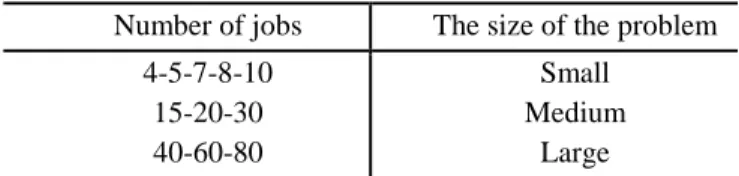
In this section, how to set the parameters is developed in the meta-heuristic algorithm and some problems as example are presented, and then the performance of exact solution software to solve the mathematical model proposed is evaluated using Genetic Algorithm, and the results are provided. The proposed algorithm is performed in software environment MATLAB and using a laptop with a 3.2 GHz CPU and 4 GB memory. Also, the mathematical model encoded in GAMS and solved. Due to the fact that the mathematical model presented is a non-linear model, in the software GAMS, the solver BARON is used to solve the model, it is one of the best nonlinear models' solvers. This work was conducted to evaluate the model. Some examples with the number of 4 to 80 jobs is generated and investigated. Studying the Amaya et al. (2010), some problems as example in small, medium and large sizes were classified. These categories are summarized in Table 4-1. It should be noted that, the number of 5 examples has been provided for each case.
Table 1. Different types of problems
Number of jobs The size of the problem 4-5-7-8-10
15-20-30 40-60-80
Small Medium
Large
According to research conducted by Wang et al. (2001), Weibull distribution as the equation (25) is used to define the tool reliability.
) 25 (
( )t/
R
e
β
α
−
=
In equation (25), parameter
α
is equal to 90, and the parameterβ
is equal to 3. Of course, this setting parameters is so that, even on smaller issues, spare tools is required(Speed of reduction in tool reliability after processing each job must be so that, for example, after processing 2 or 3 jobs by tools, we have to replace tools), and performance of the mathematical model should be evaluated. Machining times are in seconds, and have a uniform distribution between [20, 35].Price of each tool is selected from uniform interval [10,20] and price of each part is selected from the interval [400,600]. Machining cost per unit is equal to 5 and the cost of any tool switching is equal to 50.The number of tools required for each part has been selected randomly and from the uniform range 1 to a maximum tool magazine capacity. Due to its importance, parameters setting for the performance of algorithms, after solving many examples and studies, and data from trial and error, genetic algorithms parameters are shown in Table 2.Table 2. Parameters setting for genetic algorithm Genetic Algorithm
3000
Max −it
60
Psize
0.7
Pc
0.2
Pm
Also, the time needed to solve the problems in small, medium and large sizes, respectively 200, 500 and 1000 seconds is considered.
5-1- The computational results
Given that, this model is a non-linear model, and that time needed for solving mathematical model using GAMS software is too long, in a way, that even in small and close to the medium sizes, the problem doesn't provide solution in a reasonable time, first, at the small sizes, the performance of the algorithm is compared with solution of the GAMS software to ensure the validity of the algorithm and mathematical models presented in the previous section. Maximum running time for the GAMS software is intended 7200 seconds. As long as the GAMS software obtains an optimal solution before the maximum time (7200 seconds) intended for implementing it, the solution obtained from the software is considered as the optimal solution, and to compare the performance of genetic algorithm, the average time to converging to the solution obtained from GAMS is considered, and in fact, the time needed to reach the algorithm's solution to the optimal solution is considered as criterion for comparing the performance of algorithm with GAMS exact solution. Of course, this time for GA algorithm is obtained from implementation of the algorithm for 10 times. Therefore, for a problem with small size, which there is their optimal solution, stop condition is to achieve optimum solution derived from the exact solution of the problem. However, in the case that GAMS software isn't able to solve the problem before the maximum time defined, stop condition for the algorithm is the same defined time for small problems (200 seconds), and then, the average quality of the solutions obtained from 10 times running algorithm.
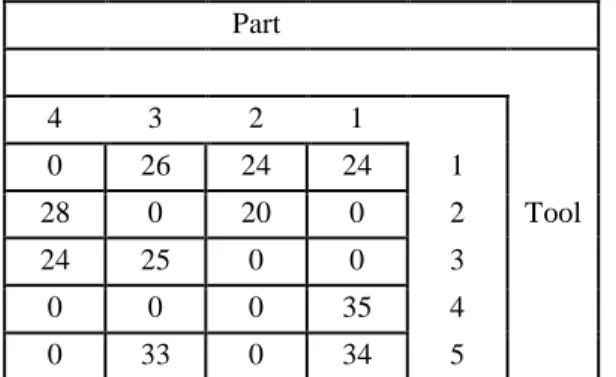
First, to understand the problem, an example is presented of the small size including all input parameters, and the results have been investigated by GAMS and algorithm presented. The problem has 4 jobs, 5 tools and tool magazine capacity is equal to 3. The price of tools is presented in Table
3and the price of the parts is shown in Table 4. Requirements Matrix and machining time Matrix are shown in tables 5 and 6, respectively.
Table 3. The price of tools for the example given
5 4 3 2 1 Tool
17 12 18 10 12 Price
Table 4. The price of part for the example given
4 3 2 1 Piece
499 424 599 409 Price
Table 5. Tool Requirements Matrix for the example given
Part
4 3 2 1
0 1 1 1 1
1 0 1 0 2 Tool
1 1 0 0 3
0 0 0 1 4
0 1 0 1 5
Table 6. Machining times Matrix, for the example given
Part
4 3 2 1
0 26 24 24 1
28 0 20 0 2 Tool
24 25 0 0 3
0 0 0 35 4
0 33 0 34 5
After solving the example by the software GAMS, and metaheuristic algorithm presented, software GAMS after 10 seconds has provided the optimal solution, which is equal to 1540. Genetic algorithm has been implemented to solve this example for 10 times. Genetic algorithm on average in 3.0 seconds has converged to the optimum solution. So we can say that the performance of the algorithm is better than software GAMS.
The results of the comparison of GA algorithm and software GAMS for the problem with the small size is shown in Table 7. To report the results, each problem is defined as
m n c
∗ ∗
, where m represents the number of jobs (parts), n represents the total number of necessary tools andc
is tool magazine capacity.Table 7. Comparison of the results of GA and GAMS for small-sized problems
GA GAMS
Example
Problem
m n c∗ ∗
Time Objective
function Time
Objective function 0.4 0.2 0.4 0.3 0.2 1851 1917 1614 1540 1518 15 15 3 10 18 1851 1917 1614 1540 1518 1 2 3 4 5
3 * 5 * 4
2.0 2.0 3/0 2.0 7/0 2452 2103 2392 2039 2206 27 30 25 33 40 2452 2103 2392 2039 2206 1 2 3 4 5
4 * 7 * 4
200 200 200 200 200 5693 4175 5195 5546 5382 7200 7200 7200 7200 7200 without solution without solution without solution without solution without solution 1 2 3 4 5
5 * 9 * 8
As is clear from the results in Table 7, the model has 8 by GAMS for work, for none of the examples do not provide an answer at the time of 7200 seconds. As a result, GAMS for solving mathematical model by more than 7 in sample size issues produced, not possible. Therefore, sample problems to solve in software GAMS maximum of 7 because it was observed that by solving different examples; the exact solution of problems, up to 7 seconds to conclude in 7200, and for larger sizes do not provide an answer. On the other hand, as can be seen, the algorithm presented has better performance than the mathematical model, and in less time, provides a similar or better solution than the mathematical model.
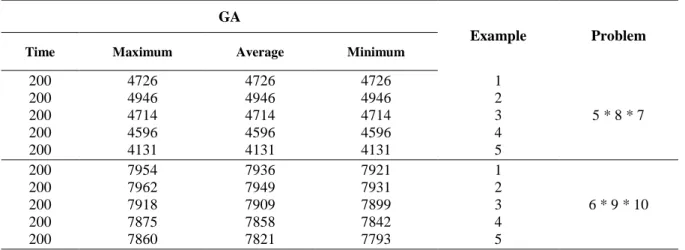
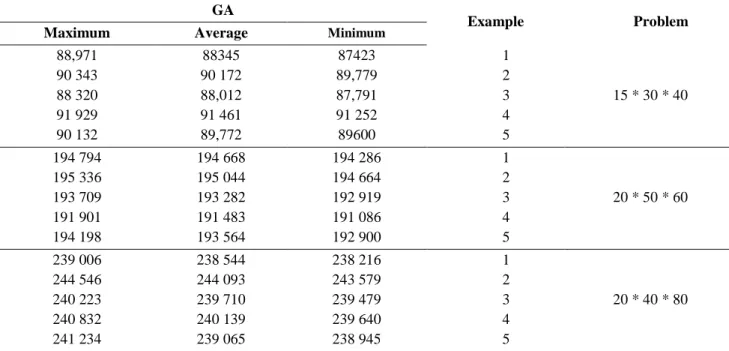
To compare the performance of GA algorithm in small, medium and large sizes, the results of solving problems are presented in Tables 8, 9 and 10.
Because, algorithm performance was evaluated in sizes less than 7 jobs, in this case, the small size is defined 7 to 10.
As noted, the solution time for the problems with the small, medium and large sizes, is considered respectively 200, 500 and 1000 seconds, and also the results for each example are obtained from the algorithm implementation for 10 times. To resolve any of the problems, values of minimum, average and maximum of objective function obtained from the algorithm are obtained, and compared with each other. Stop condition for algorithm is the maximum number of repetitions or time defined for problem solving.
Table 8. Results of GA for problems with small size GA
Example Problem
Time Maximum Average Minimum
200 200 200 200 200 4726 4946 4714 4596 4131 4726 4946 4714 4596 4131 4726 4946 4714 4596 4131 1 2 3 4 5
5 * 8 * 7
200 200 200 200 200 7954 7962 7918 7875 7860 7936 7949 7909 7858 7821 7921 7931 7899 7842 7793 1 2 3 4 5
Table 9. Results of GA for problems with medium size GA
Example problem
Maximum Average Minimum
14345 15891 16249 15852 14735 14452 16007 16433 15943 14812 14411 15944 16393 15912 14799 14378 15895 16310 15894 14770 1 2 3 4 5
7 * 12 * 15
17712 17711 18504 19242 18074 17982 17858 18758 19560 18231 17830 17791 18682 19344 18154 17730 17739 18619 19242 18111 1 2 3 4 5
8 * 20 * 15
48355 46 399 46 757 47019 47031 48821 46839 47 004 47347 47 514 48701 46 774 46936 47 154 47407 48450 46 736 46 841 46 871 47304 1 2 3 4 5
10 * 25 * 30
Table 10. Results of GA for problems with large size GA
Example Problem
Maximum Average Minimum
88,971 90 343 88 320 91 929 90 132 88345 90 172 88,012 91 461 89,772 87423 89,779 87,791 91 252 89600 1 2 3 4 5
15 * 30 * 40
194 794 195 336 193 709 191 901 194 198 194 668 195 044 193 282 191 483 193 564 194 286 194 664 192 919 191 086 192 900 1 2 3 4 5
20 * 50 * 60
239 006 244 546 240 223 240 832 241 234 238 544 244 093 239 710 240 139 239 065 238 216 243 579 239 479 239 640 238 945 1 2 3 4 5
20 * 40 * 80
According to the results, it is observed that due to the complexity of the problem, mathematical models are able to find an optimal solution in a reasonable time only for problems with small size and don't have good performance to solve the problem in medium and large sizes. As it is clear from the results of Table 7, genetic algorithm act faster than mathematical model proposed. Since, large-scale problem is concerned, it is more important.
6- Conclusion
This study is aimed to minimize the number of tool switches in flexible manufacturing cells subject to the tools reliability. Tool reliability is studied as a parameter affecting this issue. The aim is to determine the sequence of jobs (the parts that processing should be applied on them), so that the cost of tool switching and machining is minimized. A flexible machine is considered, and the machine has tool magazine with limited capacity. Some parts are ready to be processed by the machine. Tool
requirements matrix for each part is determined, and the total number of tools needed to process all parts is more than the tool magazine capacity of the machine.
First, a mathematical model is proposed to solve the problem, and since the problem is NP-hard, genetic meta-heuristic algorithm is used to solve the problem. Also, the algorithm KTNS is used to minimize the number of tool switches in a specified sequence.
Genetic algorithm uses a set of basic solution to solve the problem, the size of this set for the problem is constant and considered equal to 60. In each iteration and each size of the problem, the initial population is fixed. In other words, by increasing the size of the problem, the number of initial population does not change.
According to the specifications mentioned for genetic and according to the results, we can say that, in general, genetic algorithm has good performance to solve the problem presented in a reasonable time. Given the machining conditions, and its impact on tools reliability, and in consideration of this issue in the proposed model could be a good subject for further research. Most studies have used similar assumptions to minimize the number of tool switches. Therefore, having tools with different size can be proposed as a new assumption for future studies. Due to the complexity of the problem and the quality of the solutions obtained from the GA algorithm, other algorithms can be offered for problem solving or so, the efficiency of the proposed algorithm can be increased.
References
Adjiashvili, D., Bosio, S. and Zemmer, K., 2015. Minimizing the number of switch instances on a flexible machine in polynomial time. Operations Research Letters, 43(3), pp.317-322.
Akturk, M.S., Ghosh, J.B. and Gunes, E.D., 2003. Scheduling with tool changes to minimize total completion time: a study of heuristics and their performance. Naval Research Logistics (NRL), 50(1), pp.15-30.
Akturk, M.S. and Avci, S., 1996. Tool allocation and machining conditions optimization for CNC machines. European Journal of Operational Research, 94(2), pp.335-348.
Al-Fawzan, M.A. and Al-Sultan, K.S., 2003. A tabu search based algorithm for minimizing the number of tool switches on a flexible machine. Computers & industrial engineering, 44(1), pp.35-47.
Altumi, A., 2009. USING GENETIC ALGORITHM IN FMS PART ASSIGNMENT AND TOOL LOADING WITH RELIABILITY CONSIDERATIONS TOOL SHARING ALLOWED. Journal of
Engineering Research (Al-Fateh University) Issue, 11, p.100.
Amaya, J.E., Cotta, C. and Fernández-Leiva, A.J., 2012. Solving the tool switching problem with memetic algorithms. Artificial Intelligence for Engineering Design, Analysis and Manufacturing,
26(02), pp.221-235.
Amaya, J.E., Cotta, C. and Leiva, A.J.F., 2010. Hybrid cooperation models for the tool switching problem. In Nature Inspired Cooperative Strategies for Optimization (NICSO 2010) (pp. 39-52). Springer Berlin Heidelberg.
Bard, J.F., 1988. A heuristic for minimizing the number of tool switches on a flexible machine. IIE
transactions, 20(4), pp.382-391.
Buyurgan, N., Saygin, C. and Kilic, S.E., 2004. Tool allocation in flexible manufacturing systems with tool alternatives. Robotics and Computer-Integrated Manufacturing, 20(4), pp.341-349.
Catanzaro, D., Gouveia, L. and Labbé, M., 2015. Improved integer linear programming formulations for the job Sequencing and tool Switching Problem. European Journal of Operational Research,
244(3), pp.766-777.
Chaves, A.A., Lorena, L.A.N., Senne, E.L.F. and Resende, M.G.C., 2016. Hybrid method with CS and BRKGA applied to the minimization of tool switches problem. Computers & Operations
Research, 67, pp.174-183.
Colledani, M. and Yemane, A., 2013. Impact of Machine Reliability Data Uncertainty on the Design and Operation of Manufacturing Systems. Procedia CIRP, 7, pp.557-562.
Crama, Y., Moonen, L.S., Spieksma, F.C. and Talloen, E., 2007. The tool switching problem revisited. European Journal of Operational Research, 182(2), pp.952-957.
Crama, Y. and Van De Klundert, J., 1997. Cyclic scheduling of identical parts in a robotic cell.
Operations Research, 45(6), pp.952-965.
Crama, Y., Oerlemans, A.G. and Spieksma, F.C., 1996. Minimizing the number of tool switches on a
flexible machine (pp. 191-223). Springer Berlin Heidelberg.
Das, K. and Abdul-Kader, W., 2011. Consideration of dynamic changes in machine reliability and part demand: a cellular manufacturing systems design model. International Journal of Production
Research, 49(7), pp.2123-2142.
Das, K., Baki, M.F. and Li, X., 2009. Optimization of operation and changeover time for production planning and scheduling in a flexible manufacturing system. Computers & Industrial Engineering,
56(1), pp.283-293.
Das, K., Lashkari, R.S. and Sengupta, S., 2007. Machine reliability and preventive maintenance planning for cellular manufacturing systems. European Journal of Operational Research, 183(1), pp.162-180.
Ghiani, G., Grieco, A. and Guerriero, E., 2010. Solving the job sequencing and tool switching problem as a nonlinear least cost hamiltonian cycle problem. Networks, 55(4), pp.379-385.
Gray, A.E., Seidmann, A. and Stecke, K.E., 1993. A synthesis of decision models for tool management in automated manufacturing. Management science, 39(5), pp.549-567.
Han, B.T., Zhang, C.B., Sun, C.S. and Xu, C.J., 2006. Reliability analysis of flexible manufacturing cells based on triangular fuzzy number. Communications in Statistics—Theory and Methods, 35(10), pp.1897-1907.
Hirvikorpi, M., Nevalainen, O.S. and Knuutila, T., 2006. Job ordering and management of wearing tools. Engineering optimization, 38(2), pp.227-244.
Konak, A., Kulturel-Konak, S. and Azizoğlu, M., 2008. Minimizing the number of tool switching instants in Flexible Manufacturing Systems. International Journal of Production Economics, 116(2), pp.298-307.
Konak, A. and Kulturel-Konak, S., 2007, April. An ant colony optimization approach to the minimum tool switching instant problem in flexible manufacturing system. In 2007 IEEE Symposium on
Computational Intelligence in Scheduling.
Kwon, Y. and Fischer, G.W., 2003. A novel approach to quantifying tool wear and tool life measurements for optimal tool management. International Journal of Machine Tools and
Manufacture, 43(4), pp.359-368
Laporte, G., Salazar-Gonzalez, J.J. and Semet, F., 2004. Exact algorithms for the job sequencing and tool switching problem. IIE Transactions, 36(1), pp.37-45.
Lin, Y.K. and Chang, P.C., 2012. Reliability evaluation for a manufacturing network with multiple production lines. Computers & Industrial Engineering, 63(4), pp.1209-1219.
Liu, P.H., Makis, V. and Jardine, A.K., 2001. Scheduling of the optimal tool replacement times in a flexible manufacturing system. IIE Transactions, 33(6), pp.487-495.
Makis, V., 1995. Optimal replacement of a tool subject to random failure. International journal of
production economics, 41(1), pp.249-256.
Raduly-Baka, C. and O.S. Nevalainen, The modular tool switching problem. European Journal of Operational Research, 2015. 242(1): p. 100-106.
Rodriguez, C.E.P. and de Souza, G.F.M., 2010. Reliability concepts applied to cutting tool change time. Reliability Engineering & System Safety, 95(8), pp.866-873.
Sakhaii, M., Tavakkoli-Moghaddam, R., Bagheri, M. and Vatani, B., 2016. A robust optimization approach for an integrated dynamic cellular manufacturing system and production planning with unreliable machines. Applied Mathematical Modelling, 40(1), pp.169-191.
Shirazi, R. and Frizelle, G.D.M., 2001. Minimizing the number of tool switches on a flexible machine: an experimental study. Proceedings of the Institution of Mechanical Engineers, Part B:
Journal of Engineering Manufacture, 215(2), pp.253-261.
Song, C.Y. and Hwang, H., 2002. Optimal tooling policy for a tool switching problem of a flexible machine with automatic tool transporter. International Journal of Production Research, 40(4), pp.873-883.
Tang, C.S. and Denardo, E.V., 1988. Models arising from a flexible manufacturing machine, part I: minimization of the number of tool switches. Operations research, 36(5), pp.767-777.
Turkcan, A., Akturk, M.S. and Storer, R.H., 2007. Due date and cost-based FMS loading, scheduling and tool management. International Journal of Production Research, 45(5), pp.1183-1213.
Yanasse, H.H. and Rodrigues, R.C.M., 2007. A partial ordering enumeration scheme for solving the minimization of tool switches problem. In INFORMS ANNUAL MEETING SEATTLE (pp. 299-299).
You, D. and Pham, H., 2015. Reliability Analysis of the CNC System Based on Field Failure Data in Operating Environments. Quality and Reliability Engineering International.
Zeballos, L.J., 2010. A constraint programming approach to tool allocation and production scheduling in flexible manufacturing systems. Robotics and Computer-Integrated Manufacturing, 26(6), pp.725-743.
Wang, K.S., Lin, W.S. and Hsu, F.S., 2001. A new approach for determining the reliability of a cutting tool. The International Journal of Advanced Manufacturing Technology, 17(10), pp.705-709.
Wang, D., Song, C. and Barabási, A.L., 2013. Quantifying long-term scientific impact. Science,