1
Evaluation of North Carolina Laws SB 20
and HB 850 and Development of Revised
Drug Policy for UNC System Schools
Student Team
Kristina Felder Phil Hanson Sayaka Hino
Ariana Katz Casey McCormick
Michael Wilson
Partner Organization and Preceptors
North Carolina Harm Reduction Coalition Robert Childs, MPH
Leilani Attilio, MPH, BSN, RN
Faculty Adviser
Dr. Christopher Ringwalt, DrPH
2
Abstract
Background
Drug overdoses have reached epidemic proportions, becoming the leading cause of unintentional injury deaths in the United States (U.S.), surpassing motor vehicle accidents in 2009 (Jones et al, 2013). To address this rising problem, North Carolina recently enacted Senate Bill 20 (SB 20), a Good Samaritan overdose prevention legislation that provides legal protection for those who call for medical help in the case of a drug overdose. This law also removes civil and criminal liability for prescriptions and use of naloxone, an opioid overdose reversal drug. Additionally, North Carolina’s House Bill 850 (HB 850) was enacted to reduce the spread of blood-borne diseases by providing legal protection for those who declare a clean syringe to a law enforcement officer prior to being searched. The first aim of the Capstone project was to evaluate these policies to understand their impact in the populations they are intended to benefit. Through the second aim of the project, the Capstone team advocated for revision of the University of North Carolina’s (UNC) system-wide drug policy to reflect the intent of the newly enacted laws. Methods
To evaluate the policies, we conducted 78 three to five minute interviews with those at risk of experiencing and/or witnessing unintentional overdose at five sites in North Carolina. We analyzed this data to assess individual knowledge of the new laws and how this knowledge may result in behavior change. To advocate fora revision of the UNC system drug policy, we conducted in-person interviews with stakeholders at UNC-Chapel Hill (UNC-CH) using semi-structured interview guides, and telephone interviews with administrative counterparts at other campuses, using a revised and shortened interview guide. Additionally, we conducted a web-based survey about campus drug policy and use to UNC-CH students. We then analyzed data from the interviews and surveys to inform a policy brief and executive summary, which were then disseminated to relevant system stakeholders.
Results
Our evaluation findings revealed that a majority of participants were unaware of the components of the newly enacted laws. Additionally, mistrust of law enforcement played a large role in participant’s intended behavior during an overdose or police search. These findings were summarized in a manuscript and submitted to the International Journal of Drug Policy. Three key ideas informed the revision of the UNC system-wide policy and the accompanying policy brief and executive summary: support received for the revised policy; information obtained on inadequacies in the current zero-tolerance policy; and methods suggested for implementation of the policy.
Discussion
3
Acknowledgements
The 2013-2014 Capstone team would first like to acknowledge our preceptors, Leilani Attilio and Robert Childs, faculty adviser, Dr. Christopher Ringwalt, and experts in the field with whom we
4
Acronyms and Public Health Terms
CDC – Centers for Disease Control and Prevention
Harm Reduction – Strategies and ideas aimed at reducing negative consequences associated with drug
use
HB 850 – House Bill 850; Possession of Needles/Tell Law Officer Law
HIV – Human Immunodeficiency Virus
IDU – Injection Drug User
IRB – Institutional Review Board
NC – North Carolina
NCHRC – North Carolina Harm Reduction Coalition
RAs – Resident Assistants
SB 20 – Senate Bill 20; 911 Good Samaritan/Naloxone Access Bill
SSDP – Students for Sensible Drug Policy
UNC-CH – University of North Carolina- Chapel Hill
UNC System – University of North Carolina System Schools
UDO - Unintentional Drug Overdoses
5
Table of Contents
Abstract ... 2
Acknowledgements ... 3
Acronyms and Public Health Terms ... 4
Table of Contents ... 5
Introduction ... 6
Figure 1: Logic Model ... 8
Background ... 9
Background of NC Bills SB 20 and HB 850 ... 10
Necessity of Evaluation of State Laws ... 10
Background of Drug Use on College Campuses ... 11
Necessity for Revised Drug Policy at UNC ... 12
Rationale for Capstone Project Methods ... 12
Methods ... 13
Project Aim 1: Evaluation of SB 20 and HB 850 ... 13
Project Aim 2: UNC Policy Brief ... 15
Skills Applied and Acquired ... 18
Results ... 19
Project Aim 1: Evaluation of SB 20 and HB 850 ... 19
Project Aim 2: UNC Policy Brief ... 21
Discussion ... 23
Project Aim 1: Evaluation of SB 20 and HB 850 ... 24
Project Aim 2: UNC Policy Brief ... 25
Limitations ... 27
Sustainability and Next Steps ... 28
Impact on Student Team ... 29
Conclusion ... 29
Appendix A: Deliverable Tables ... 30
Appendix B: References ... 35
6
Introduction
The purpose of this Capstone Summary Report is to summarize our Capstone experience and to serve as a record of the Capstone work conducted over Fall 2013 and Spring 2014 semesters. The Capstone partner organization, North Carolina Harm Reduction Coalition (NCHRC), based in Durham, NC, is the only comprehensive harm reduction program in the state of North Carolina (NC) (NCHRC, 2014). NCHRC focuses on grassroots advocacy and coalition building throughout NC, while also providing resources and direct services to drug users, sex workers, law enforcement officers, and those affected by overdose, sexually transmitted diseases and human immunodeficiency virus (HIV), and the larger community (NCHRC, 2014). The 2013-2014 NCHRC Capstone team built on the political advocacy work of the 2012-2013 Capstone team. NCHRC, with the help of the 2012-2013 Capstone team, successfully led efforts to pass Senate Bill 20 (SB 20), the Good Samaritan/Naloxone Access law in April 2013 (Bailey, Glasser, Haller, Rich & Rupp, 2013). The purpose of this year’s Capstone team was to continue efforts by NCHRC to promote harm reduction practices in the state.
7
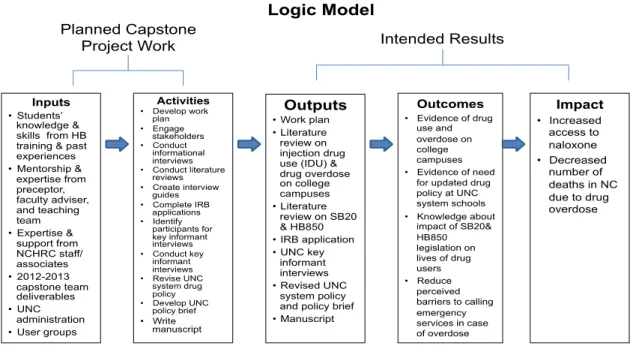
To achieve project goals, the Capstone project included eight deliverables: for each aim of the project, we completed Internal Review Board (IRB) applications, literature reviews, and key informant interview guides, which led to a manuscript to disseminate the evaluation of SB 20 and HB 850 and a policy brief used to recommend revisions to the UNC system drug policy. More detailed descriptions of these deliverables can be found in Appendix A.
8
Figure 1: Logic Model
The background section of this summary report discusses the significance of UOO and related
prevention policies and provides a rationale for the methods we used for both parts of our Capstone project. The methods section discusses how the Capstone team produced and disseminated the
9
Background
SB 20 and HB 850 target opioid users in two different ways: 1) preventing overdose from opioid deaths, and 2) preventing spread of blood-borne diseases like HIV and Hepatitis C from injection drug (such as heroin) users.
The use of opioids has been on the rise in the United States since the 1990s (Manchikanti et al, 2012). This increase is in part due to liberalization of laws regarding prescription of opioids as well as a shift to improve previously minimal pain management treatments (Manchikanti et al., 2012). One result of this shift was an increase in drug overdoses. In 2009, drug overdoses became the leading cause of unintentional injury deaths in the United States (U.S.), surpassing motor vehicle accidents (Jones et al., 2013; Davis, Webb, & Burris, 2013; North Carolina Institute of Medicine, 2011). In NC, the rate of unintentional drug overdose (UDO) deaths steadily increased from 4.8 to 11.4 per 100,000 people from 2000-2010 (CDC, 2012; Whitmire & Adams, 2010). Currently in NC, UDOs are the second leading cause of injury deaths (North Carolina Institute of Medicine, 2011).
Colleges and universities experience high rates of drug use and overdose risk, but overdose prevention policies rarely exist on college campuses (Casa, 2007; SSDP, 2013). Students for Sensible Drug Policy (SSDP) found that of the 244 U.S. colleges and universities with some form of Good
Samaritan policies, 168 schools (69%) have Good Samaritan policies that cover all drugs and alcohol, and 30% cover only alcohol (SSDP, 2013). Of the 168 schools with Good Samaritan policies concerning all drugs and alcohol, 68% are located in states where Good Samaritan laws have been passed (SSDP, 2013).
10
Background of NC Bills SB 20 and HB 850
In 2013, NC enacted two new harm reduction laws, SB 20 and HB 850. A recent review of data in NC shows that over half of all UDOs result in death before paramedics arrive, because of lack of access to reversal medication and fear of prosecution (Davis, Webb, & Burris, 2013). To address this, SB 20 provides legal protection for the individual overdosing and the person calling for medical help in the case of a drug overdose. SB 20 also removes civil liabilities from doctors who prescribe naloxone, an
effective, non-addictive medication that reverses the effects of an opioid overdose through injection or inhalation. Naloxone, also known by its brand name Narcan®, removes opioids from receptors in the brain, restoring breathing that had been suppressed by the opioids (Davis, Webb, & Burris,
2013). Furthermore, SB 20 permits trained laypersons to deliver the drug in good faith, removing criminal and civil liability.
HB 850 provides legal protection for those who declare a clean syringe to a law enforcement officer prior to search, reducing the risk of officers acquiring blood-borne diseases. While other states addressed this risk by implementing full decriminalization of syringes or syringe exchange programs, NC passed this unique partial decriminalization bill (Burris, Strathdee, & Vernick, 2002). HB 850 is
considered a partial decriminalization because it is still illegal to carry syringes without a prescription in NC. The impact of these policies, however, has not been evaluated, which potentially limits the benefits to the populations they are intended to reach.
Necessity of Evaluation of State Laws
11
UOO death (Banta-Green, et al., 2011). In addition, no evaluation studied perceptions of naloxone, the number of incidents in which naloxone was utilized, or the proportion of cases in which immunity was granted to individuals after the implementation of these laws. This lack of evaluation limits the ability to advocate for similar policies elsewhere.
At the beginning of our Capstone project, NC’s HB 850 was the only one of its kind, and as such, no evaluations of similar laws’ implementation or impact on drug users existed. While syringe exchange programs have been shown to reduce the spread of HIV and other blood-borne diseases, the effectiveness of a policy providing immunity for notifying an officer of syringe possession is unknown (Wodak & Cooney, 2006). Thus, an evaluation in NC is necessary to understand this new law’s impact on promoting safe syringe practices and reducing harm.
Background of Drug Use on College Campuses
12
rates of underage drinking and binge drinking, neglecting the growing issue of prescription drug abuse (Casa, 2007). Updating UNC system policies to reflect the new NC drug policies is an important step in reducing future drug overdoses among college students.
Necessity for Revised Drug Policy at UNC
A national survey on drug and alcohol use on college campuses found that UNC students reported higher rates of opioid use than a national comparison sample (Core Institute, 2011). This concerning statistic draws attention to the importance of protecting students from drug-related harm, such as unintentional overdoses. While students in states with Good Samaritan laws are granted certain legal protections, students enrolled in universities without Good Samaritan policies remain subject to separate disciplinary actions for infractions of university drug policies. Within the UNC system, the alcohol policy is maintained on individual campuses, while the Board of Governors of the UNC system controls the drug policy for all system schools (D. Blackburn, personal communication, October 9, 2013).
As of October 2013, no college or university in the U.S. has officially established a policy promoting access to naloxone (R. Childs, personal communication, October 7, 2013). In addition, no studies have investigated the best way to introduce naloxone on college campuses or examined the feasibility of providing naloxone on campus. This gap in knowledge presents a challenge to reducing the rise in opioid-related injuries and deaths.
Rationale for Capstone Project Methods
13
deaths - fear of academic consequences - while simultaneously providing a stopgap through naloxone access. At the state level, the passage of SB 20 and HB 850 is necessary, but not sufficient, in preventing UOO deaths. The potential for a policy-to-practice gap necessitates further investigation. We therefore took a two-pronged approach to address these problems: first, an evaluation of SB 20 and HB 850 among those at risk in NC; and second, advocating for an effective new drug policy within the UNC system.
Methods
Project Aim 1: Evaluation of SB 20 and HB 850
Orientation
14
Instrument Development
We developed our interview guide using an iterative process. After completing our first draft, we sought feedback from NCHRC outreach members in Durham and a pastor in Fayetteville who works directly with drug users, to tailor the guide to our population of interest. After incorporating their feedback, we met with our preceptors and faculty adviser and further refined the interview guide to specifically assess change in behavioral intent resulting from knowledge of the law. The final interview guide had four hypothetical scenarios: three scenarios that targeted SB 20 and one that targeted HB 850. For each scenario, participants were asked to describe what they would do in that situation, and asked if they knew of the specific component of the bill described by the scenario. Participants were then provided with a brief summary of the law, and then asked if they would act differently now having knowledge of the new laws. This follow-up behavioral question was intended to assess change in behavioral intent associated with knowledge of specific components of SB 20 and HB 850. An example scenario is shown in Appendix C. In February, the survey tool was revised to include more open-ended questions regarding behavioral intent in order to obtain richer qualitative data.
Data Collection
We obtained human subjects approval from the IRB at UNC-CH to conduct these interviews. From December 2013 to March 2014, we recruited, consented, and collected data in five urban areas in NC. At study completion, we had conducted 78 brief, anonymous interviews with those at risk of experiencing and/or witnessing UOO; 19 in Durham, 25 in Raleigh, five in Chapel Hill, 26 in
15
Data Management and Analysis
We recorded data on paper and then transferred it into an Excel spreadsheet for management and analysis. We coded knowledge questions as “0” for No and “1” for Yes. Once data collection was complete, we imported the data from Excel into Statistical Analysis System (SAS) 9.3 for further analysis. In order to familiarize ourselves with the data, we conducted frequencies for all variables to understand the distribution of responses, and we ran further descriptive univariate statistics. Next, we conducted bivariate analyses (specifically Fisher’s exact test) to understand variable distribution based on recruitment setting (methadone clinic or community). All group members reviewed the qualitative responses from behavioral questions. Three members then identified themes, and coded all participant responses individually. We compiled these codes into a matrix, and discussed any differences in order to reach a consensus. We then composed a manuscript reporting our key results, which we will submit to the International Journal of Drug Policy after a final review by project stakeholders.
Project Aim 2: UNC Policy Brief
Orientation
Originally, the goal of the policy aim of the project was to revise the policy on UNC-CH’s campus to provide naloxone in the residence halls and train resident assistants (RAs) as an overdose prevention strategy. Our preceptors suggested that we meet with Dr. Nabarun Dasgupta, an
16
regularly communicated and updated stakeholders throughout our project to ensure professional
relationships. This effort opened up opportunities for our team to meet with stakeholders whom we hope will have significant roles in sustaining our project after we graduate.
Instrument Development
Our team developed a questionnaire for key stakeholders across UNC system campuses, through an iterative process. We sent the first draft of the survey to the Dean of Student Wellness at UNC-CH as well as to our preceptor and faculty adviser. This original guide sought to understand how much the stakeholders knew about the drug policies at their school and how effective the policies were. We later revised the survey to include more questions about the inclusion of drugs into current Good Samaritan policies, as well as the feasibility of making naloxone accessible on their respective campuses.
To assess student knowledge of drug policies and perception of drug use at UNC-CH, we
developed a Qualtrics survey that was sent via email and completed anonymously. Our preceptors, faculty adviser, and contact at UNC-CH Student Wellness reviewed the draft survey. With the incorporated feedback, a shorter, more refined survey focused on three core areas: students’ knowledge of the UNC system’s drug policy, perception of drug use at UNC-CH and ability/willingness to obtain and administer naloxone in the case of an overdose. The mixed-methods survey included questions about student
awareness of drug policy and drug use at UNC-CH, followed with open-ended response questions to gain further insight into students’ knowledge and behavior related to opioid use.
Data Collection
In-17
person interviews used a semi-structured interview guide, whereas phone interviews used a revised and shortened guide. Participants were recruited via email and consented to interviews through their response. To augment our qualitative data to support the need for a policy revision, we developed and distributed the anonymous Qualtrics survey, to undergraduate and graduate students through UNC-CH’s mass email system, as well as a UNC School of Public Health listserv. Students could choose to enter their name into a raffle after completing the survey, recorded separately from their survey responses, with one student being selected to win a $25 Amazon gift card.
Data Management and Analysis
For qualitative interviews, we used detailed notes from the interviews as data instead of full transcripts. We wrote memos and coded the notes to reveal important themes and key quotes that we used to inform the policy brief. These themes centered on support for a revised policy, the need for a new policy, and implementation capacity. For the Qualtrics survey, we were able to generate reports directly from the Qualtrics software to determine descriptive statistics for participant knowledge, as well as compile all open-ended qualitative responses in one place. We reviewed the qualitative data from the Qualtrics survey to discern key concepts and quotes pertaining to the themes mentioned above: need for a revised policy, support for that policy, and implementation capacity.
Reporting Methods
Based on qualitative and quantitative results from the interviews and Qualtrics survey, as well as information from our literature review, we composed three key policy products: the revised drug policy with explanation of revisions, a six-page policy brief, and an executive summary. The revised policy emphasized a harm reduction approach and advocated for an evidence-based drug policy for the UNC system, most importantly for adoption of the key principles of SB 20. Next, we included the rationale for each of the changes we had made. Additionally, we included a policy brief, which consisted of a
18
Through Dean Blackburn and other stakeholders, we learned that the UNC system manages the drug policy for all campuses under the system, and that the Board of Governors is the entity that determines this policy. To influence the Board of Governors, we targeted the UNC Campus Security Initiative, a newly established commission, which works to address issues of public safety, offenses against persons, and reporting and awareness. We presented our policy deliverables to the Campus Security Initiative, the UNC system stakeholders, outreach director of the Students for Sensible Drug Policy (SSDP), and legislators who supported SB 20.
Skills Applied and Acquired
19
Results
Project Aim 1: Evaluation of SB 20 and HB 850
We completed a total of 78 brief interviews with individuals at risk of experiencing or witnessing a UOO in Durham, Greensboro, Chapel Hill, Charlotte, and Raleigh. We organized results by bill (SB 20 and HB 850) and by interview setting (community or methadone clinic).
SB 20
We assessed knowledge pertaining to five components of SB 20 via three scenarios. Table 1 illustrates the percentage of participants with correct knowledge concerning components of SB 20. Table 1: Participant knowledge regarding five components of SB 20
Component of the Law n(%) with correct
knowledge
No prosecution for a small of amount of drugs in the possession of the person who calls in an overdose situation
20 (25.64%)
No prosecution for drug paraphernalia in the possession of the person who calls in an overdose situation
22 (28.21%)
No prosecution of overdose victim for possession of a small amount of drugs 20 (25.64%) Prosecution of overdose victim on parole/probation for a small amount of drugs 59 (75.64%) No criminal charge for using naloxone in good faith 54 (69.23%)
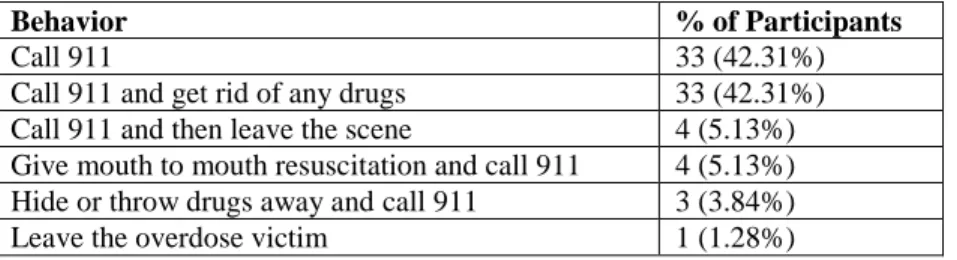
We categorized participants’ behavioral intent in the case of witnessing an overdose into six actions, which is displayed in Table 2.
Table 2. Participant behavioral intent regarding witnessing an opioid overdose
Behavior % of Participants
Call 911 33 (42.31%)
Call 911 and get rid of any drugs 33 (42.31%) Call 911 and then leave the scene 4 (5.13%) Give mouth to mouth resuscitation and call 911 4 (5.13%) Hide or throw drugs away and call 911 3 (3.84%) Leave the overdose victim 1 (1.28%)
20
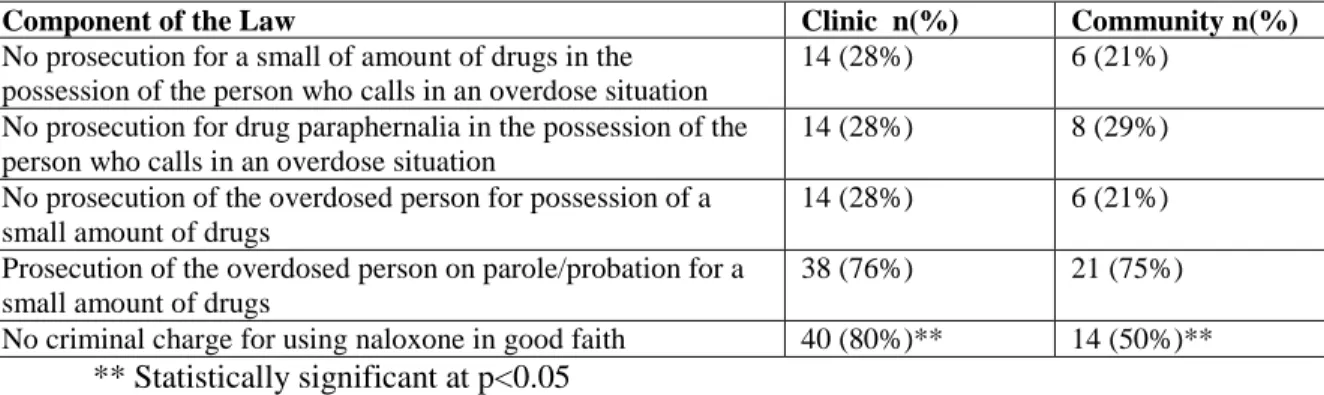
20 among clinic and community interviews. Clinic participants (71%) were significantly less likely to call the ambulance if the individual overdosing were on parole or probation compared to 100% of community participants (p<0.05).
Table 3. Participant knowledge regarding components of SB 20 by interview setting
Component of the Law Clinic n(%) Community n(%)
No prosecution for a small of amount of drugs in the possession of the person who calls in an overdose situation
14 (28%) 6 (21%)
No prosecution for drug paraphernalia in the possession of the person who calls in an overdose situation
14 (28%) 8 (29%)
No prosecution of the overdosed person for possession of a small amount of drugs
14 (28%) 6 (21%)
Prosecution of the overdosed person on parole/probation for a small amount of drugs
38 (76%) 21 (75%)
No criminal charge for using naloxone in good faith 40 (80%)** 14 (50%)** ** Statistically significant at p<0.05
HB 850
We assessed knowledge pertaining to three components of HB 850 among participants via three separate dichotomous survey questions. Table 4 illustrates the percentage of participants with correct knowledge concerning components of HB 850.
Table 4. Participant knowledge regarding components of HB 850
Component of the Law n (%) with correct knowledge
No criminal charge for the possession of a syringe if declared to a law enforcement office prior to search
20 (26.32%)
Criminal charge for the possession of drugs and other drug paraphilia if declared prior to search
71 (93.42%)
Criminal charge for syringe with residue on it even if declared prior to search 68 (89.47%)
Table 5 demonstrates how knowledge regarding components of HB 850 varies between clinic participants and community participants.
Table 5. Participant correct knowledge regarding components of HB 850 by setting
Component of the Law Clinic n (%) Community n (%)
No criminal charge for the possession of a syringe if declared to a law enforcement office prior to search
21
Criminal charge for the possession of drugs and other drug paraphilia if declared prior to search
45 (90) 26 (100%)
Criminal charge for syringe with residue on it even if declared prior to search
46 (92) 22 (84.62%)
Qualitative Results
Participant responses to the open-ended behavioral questions resulted in six themes: decision-making benefits and drawbacks, emotional benefits and drawbacks, feeling that the law could go further, and behavior dependent on the law enforcement officer. Representative ideas are listed in Table 6. Table 6. Themes and representative ideas
Themes Representative Ideas
Benefits: Decision-making Wouldn’t have to think twice about calling 911
Benefits: Emotional Law encourages less fear
Drawbacks: Decision-making If on parole, maybe the person overdosing would rather “go” that way instead of going back to jail
Drawbacks: Emotional Still afraid to call; doesn’t trust the system
Law could go further If law covered residue, would feel more comfortable declaring Behavior depends on law officer If law officer told him he couldn’t be charged with needle, would be
more likely to declare it
Project Aim 2: UNC Policy Brief
The results from the 12 qualitative interviews with UNC stakeholders and Qualtrics survey of students informed the development of the policy brief and the revisions to the system’s drug policy. Through these conversations and data analysis, we gathered support for the new policy, identified inadequacies of the current policy, and brainstormed methods to implement the revised policy.
22
to get better, they would be providing an incredibly valuable service to the community. Former users would be given a chance to live up to their potential, get off drugs, and give back to the community."
The Qualtrics survey of UNC-CH students yielded 298 responses. Only 23% of those students responded that they knew the UNC system’s policy on drug use. Common sources of knowledge for those who were aware of the policy were emails from the university, first-year orientation, word of mouth, and employment at UNC-CH. When asked if they knew any students who use, or have used, drugs other than alcohol or tobacco, 54% of respondents said yes. Students cited marijuana (100%), stimulants (42%), and opioids (32%) as the most commonly used drugs, and cited off-campus housing as the most common place drug use occurs (60%), followed by fraternity or sorority housing (24%). Fourteen (12%)
respondents had heard of a student overdosing on a drug while at UNC-CH. Five of those students cited opioids as the cause of the overdose, three cited alcohol, and the rest were unknown. Outcomes of these overdoses included: taking the victim to the hospital, letting the victim “sleep it off,” and four students indicated that the victim died as a result of their overdose. When asked about naloxone, 45% of respondents had heard of it, 88% indicated that they would be somewhat willing or very willing to administer the drug to an overdose victim if trained to do so, but only 7% knew how to obtain it.
Our findings informed the revisions to the current UNC system drug policy and the
recommendations for implementation. The two key revisions centered on using a harm reduction and evidence-based approach by incorporating the Good Samaritan and naloxone access intent of SB 20. Our revisions suggest that UNC system members neither be penalized for possession of a small amount of drugs or paraphernalia if they seek medical assistance in the case of an overdose, nor for the possession and/or administration of naloxone in good faith. We also focused on changing the current zero-tolerance policy, which has predetermined disciplinary actions, to one that uses a case-by-case basis to best
23
education, counseling, and treatment rather than the previous emphasis on penalties. We framed these revisions in terms of the University mission statement, which prioritizes individuals leading responsible, productive, and personally satisfying lives (University of North Carolina, 2014). Administrators’ input, in addition to the Qualtrics survey results, helped create realistic and adoptable implementation suggestions. Our recommendations for implementing the proposed changes to the policy covered three areas: campus and community training, naloxone access and availability on campuses, and evidence-based campus resources. These recommendations included incorporating drug overdose education and training into the mandatory first-year orientation for students; requiring campus police to carry naloxone in patrol cars; and ensuring that a qualified health professional provides input in the plan of action for individuals violating the drug policy. Since off-campus housing was the most commonly cited location for student drug use, we also recommended that students be allowed to remain living on-campus if in violation of the drug policy, unless found to be a clear and immediate threat to their own or others safety.
To increase awareness of overdoses at UNC-CH, we planned and executed an Overdose Prevention Awareness Day on UNC-CH’s campus. This event coincided with NCHRC sponsored
Overdose Prevention Awareness Days across colleges and universities in NC, in order to educate students about SB 20 and HB 850 and train individuals on how to use naloxone. The Capstone team handled publicity for the event and day-of logistics and advocacy, while NCRHC staff headed up the naloxone trainings and distribution to UNC-CH students, UNC-CH Campus Safety officers, and Chapel Hill Police Department officers. We partnered with UNC-CH Campus Wellness and the Orange County Health Department, and as a result, close to 100 students received education on the newly enacted NC laws.
Discussion
24
those they are intended to benefit. Addressing these issues can narrow the policy-to-practice gaps
experienced at both state and university level and improve efforts to reduce unintentional opioid overdose deaths in at-risk populations.
Project Aim 1: Evaluation of SB 20 and HB 850
The results of our SB 20 and HB 850 evaluation demonstrate three major themes related to their implementation: a lack of knowledge about the new laws; a lack of knowledge about naloxone and where to obtain the drug; and lastly, the sentiment that the laws’ partial protections make them irrelevant to many individuals at risk of experiencing or witnessing UOO. The substantial lack of knowledge indicates a need for increased outreach to educate the intended policy beneficiaries. Our data also revealed low levels of knowledge about naloxone and where to obtain this life-saving drug, indicating the need for improved dissemination of information about and increased access to naloxone. A complete
dissemination plan, including education of both community members and law enforcement officers, should be developed if these policies are going to be successful. Lastly, participants expressed the belief that the laws do not protect enough people, and are therefore not as effective as they could be. SB 20 does not provide amnesty to those individuals already on parole or probation; therefore this law is not relevant to a large sector of the user population. Moreover, HB 850’s failure to protect individuals carrying used syringes, combined with a lack of access to clean syringes, creates a major gap between implementation and practice, leaving many drug users vulnerable for prosecution. In order to decrease this gap and ensure that HB 850 protects as many people as possible, the law needs to be amended to allow for declaration of used syringes.
25
experienced or witnessed an overdose and thus, feel more confident in their ability to successfully handle an overdose situation on their own. Community participants may be less likely to declare a syringe because of a collective history with law enforcement resulting in an overall distrust of the police. Given the varying responses solicited between participants at community versus clinical settings, additional research is necessary to better understand the complex set of factors impacting one’s willingness to administer naloxone in the case of an overdose, call for help on behalf of an overdose victim, and/or declare syringes to an officer.
Knowledge of the law resulted in reported changes in behavioral intent; a few participants reported that the law would make them more comfortable declaring a syringe, and one participant stated he would not run from cops if he knew he could not be prosecuted for possessing a needle. Our qualitative analysis illustrated the fact that many participants stated the law could go further if the law included needles that had drug residue, if the officer told people about the law prior to searching and if there was both a safe method to dispose of dirty needles and access clean needles. Our data suggests that allowing law enforcement to pursue charges for individuals on probation or parole is a barrier to the ideal
implementation of the law. It should be noted that the intent of these laws is to save lives, and any loophole or provision that maintains avenues for charging or prosecuting individuals with crimes is likely to minimize the effectiveness of the laws. These qualitative results enhance the findings stated above that the two laws do not go far enough in providing the population at risk of overdose with ample protection.
Project Aim 2: UNC Policy Brief
26
resulting in a feeling of less accountability to university policies. As these policies are not as readily enforced off-campus as in residence halls, this sense of freedom could lead to an increase in the risk of drug overdoses from diminished fear of disciplinary action. There should, therefore, be particular attention given to how university policies can impact off-campus student populations and how the university can provide better services to ensure safety and health of off-campus students. Dissemination of such policies and services should be widespread and tailored to those living off-campuses, for example by posting information via the Chapel Hill transit system. In addition, increased efforts should be made to provide education and resources to off-campus students, particularly in relation to access to naloxone.
The disparity between the number of students willing to administer naloxone and the number of students aware of how to obtain naloxone highlights a critical area for implementation of our proposed policy. Increasing access to naloxone would provide at-risk students and other members of the university community with the appropriate tools to reverse overdoses and reduce the number of victims who are left to “sleep it off,” as our survey showed happened to many. The same coordinated approach between reduced penalties and increased access to naloxone that was taken in SB 20 should be taken in university policy settings, otherwise members of the UNC community will still be at risk for opioid overdose deaths.
In addition to disseminating information about naloxone access to students, our findings also illustrate the need to improve dissemination of the UNC system drug policy on the UNC-CH campus. The lack of knowledge about this policy could reflect the underlying issue that universities are more willing to discuss alcohol than drug use. The greater acceptance of alcohol use than opioid use in American culture could lead to its higher rate of discussion at UNC-CH. This suggests that if drug policies are to receive the same amount of attention by university administrators and policy-makers, further media coverage and discussion of the growing issue of opioid use in college settings is needed.
27
change in the drug policy, however they were much more comfortable supporting Good Samaritan policies for alcohol overdoses than for drug overdoses. This reluctance to address drug issues may stem from the fear that a Good Samaritan policy may be perceived as implicitly condoning drug use, or admittance of a problem of campus drug abuse. As school and student reputation is highly prioritized, appropriate framing of the issue in terms of student health and safety is needed to promote acceptance of a Good Samaritan drug policy. Furthermore, more research that demonstrates the prevalence of opioid use in college populations across the nation and the benefits of Good Samaritan policies on university campuses could stimulate discussion of opioid use. This increase in awareness could facilitate the UNC system to accept a Good Samaritan drug policy.
Limitations
The field of harm reduction is sometimes controversial, as it is seen as condoning behaviors that are viewed as unacceptable. These social stigmas associated with drug use make it difficult to identify and access the population of interest for these types of projects. NCHRC was able to make those connections for our group, which would not have been possible without their support. However, our access to the drug using population was still restricted, which may have limited the quality of our data. The project also had a number of limitations due to the change in the work plan from its original form and multiple changes throughout the process. The evaluation of SB 20 and HB 850 component changed dramatically during the first semester, as our community liaisons had health problems or other conflicts. This limited our time for data collection and, ultimately, our sample size for the evaluation. In terms of the policy brief
development, the last-minute change in work plan and project scope required more background work to better understand UNC system policy. This led to additional changes in gathering information to inform our policy brief, specifically by interviewing stakeholders at all of the UNC system campuses.
28
range of information and develop a multitude of different skills, but limited the scope of each arm to a more narrow exploration of intricacies, confounders, and complexities. For example, because of time constraints, we were unable to interview stakeholders on each campus within the UNC system, thus limiting the representativeness of our policy brief.
Sustainability and Next Steps
Given that this evaluation of SB 20 and HB 850 was the first of its kind on knowledge of and behavioral responses to these new laws, we are encouraged that the results facilitated the submission of a grant proposal to fund further dissemination and implementation of the laws in NC. A next step for our partner organization, NCHRC, would be to incorporate the findings of our research into a policy revision proposal for SB 20 and HB 850 that addresses the current deficits, which could be brought before the NC state legislature. While NCHRC’s outreach work is invaluable and has increased awareness in its own right, collaboration with other organizations that disseminate policy changes and educate the community will prove beneficial. Since the community has served as such a valuable resource for our evaluation, we believe that the maintenance of these relationships is vital to the sustainability of future efforts.
While the short-term goal of our team’s project at UNC-CH is to deliver a policy
recommendation to the UNC system Board of Governors, multiple steps can be taken to further these efforts. Using our team’s recommendations for dissemination, NCHRC can continue to build
relationships with the aforementioned stakeholders and advocate for the implementation of the revised policy. Furthermore, our policy revisions that incorporate naloxone are the first of its kind, allowing for NCHRC to serve as a national resource for universities wanting to adopt their own naloxone policies. We also suggest the pursuit of continued media coverage on the rise of opioid use on college campuses.
A large part of the success of our project at the UNC system level has been through the connections we have made at the various campuses across the system. An important first step in
29
have developed throughout the policy revision process. Additionally, it will be important to share information about the process by which we drafted the policy brief and provided recommendations for dissemination. We also suggest organizing self-sustaining student organizations at each campus, creating a network of advocates for future policy issues. We believe there is great potential for these organizations, such as chapters of SSDP, to continue along the path we have started. NCHRC can tap into these
networks and continue advocacy efforts with those stakeholders with whom we have built relationships.
Impact on Student Team
Throughout the Capstone experience, our team gained skills in various areas, namely qualitative and quantitative research methods, working with vulnerable populations, cultural humility, survey development, and policy and scientific writing techniques. Given that our team had six members and a preceptor who traveled quite frequently, our team learned the importance of communication, scheduling, delegation, and methods whereby to handle large team dynamics. Our team also learned to frame public health concepts in ways that were clear and understandable to those outside the public health arena. Finally, our team learned how to maintain professional interactions with members of local law
enforcement, policy makers, researchers, clinicians, and university officials. All of these skills and lessons learned have shaped our team and provided us each with a unique, valuable skill set that will be
applicable in a variety of professional settings,.
Conclusion
30
research, and proposed revisions to the UNC system drug policy to share with system stakeholders. NCHRC can utilize our findings to propose revisions of SB 20 and HB 850 to the NC legislature, and continue supporting efforts to revise the UNC system drug policy by maintaining relationships with UNC system stakeholders with whom we have created connections over the course of the year.
Appendix A: Deliverable Tables
Deliverable I: User Group IRB Application
Format: ~5 page online application
Purpose: To outline the steps taken to protect the rights and welfare of key informants. Intended Audience(s): UNC Office of Human Research Ethics
UNC Capstone team
Activities: Feedback on draft of proposal collected in person from Human Research Ethics staff
Submitted determination form to Institutional Review Board Application returned with stipulations
Modifications to application were made and the application was re-submitted
Application for research approved
Application archived by UNC Office of Human Research Ethics
Recommendations: Future Capstone teams should begin working on IRB application early to allow enough time between submission of application and projected start date of research, in case full board review is needed
31
Deliverable II: College Campus IRB Application
Format: ~5 page online application
Purpose: To outline the steps that were taken to protect the rights and welfare of key informants
Intended Audience(s): UNC Office of Human Research Ethics UNC Capstone team
Activities: Submitted determination form to Institutional Review Board Application returned with stipulations
Modifications to application were made and the application was re-submitted
Application for research approved
Application archived by UNC Office of Human Research Ethics
Recommendations: Future Capstone teams should begin working on IRB application early to allow enough time between submission of application and projected start date of research, in case of full board review
Future Capstone teams or NCHRC would need to submit a modification to the application if this were to be used for research
Deliverable III: Literature Review- Opioid & Other Drug Overdose on College Campuses
Format: ~6 page Microsoft Word document
Purpose: To summarize the nature and extent of opioid use and overdose on college campuses
To identify US college campus drug and alcohol policies and how these policies affect illegal drug use on campus in order to inform policy change on UNC-CH campus
Intended Audience(s): NCHRC
Activities: Developed research questions to guide the formative research Decided which literature to review
Decided how to evaluate and track the ideas, research methods, and results of each publication
Conducted literature review Summarized findings
Disseminated literature review to stakeholders at NCHRC
Recommendations: Future Capstone teams could use this literature review to build upon and create an updated version with new research as it pertains to their specific deliverables
NCHRC could use this literature review in future policy change
campaigns to demonstrate the paucity of research and evaluations on drug policies
Deliverable IV: Key Informant Interview Guide and Qualtrics Student Survey – IDU & Drug Overdose on College Campuses
Format: ~10 question interview guide tailored to participant
32
To identify campus stakeholders and allies for UNC system policy change
Intended Audience(s): UNC-CH Campus Health Services
UNC Chapel Hill Office of Residential Life UNC Board of Directors
UNC Department of Conduct UNC-Chapel Hill students
UNC Chapel Hill Office of Fraternity and Sorority Life Activities: Drafted interview questions for 20-45 minute interviews
Drafted survey questions for online student survey
Received feedback on interview guide from UNC stakeholders Revised interview guide based on feedback
Finalized interview guide
Modified guide for each participant as needed Utilized guide in interviews with key stakeholders
Recommendations: NCHRC should consider including stakeholders from other North Carolina Universities to further drive policy changes on college campuses
Deliverable V: UNC Policy Brief – IDU & Drug Overdose on College Campuses
Format: 4 page Microsoft Word document
Purpose: To communicate to UNC stakeholders the current prevalence of and response to opioid overdose on college campuses.
To make recommendations to UNC system policy components that reflect key components of SB 20 relevant to college campuses Intended Audience(s): UNC Campus Security Initiative
UNC-Chapel Hill Campus Health Services UNC-Chapel Hill Office of Residential Life UNC Board of Directors
UNC Department of Conduct UNC-Chapel Hill students
UNC-Chapel Hill Office of Fraternity and Sorority Life NCHRC
Activities: Identified participants for interviews
Conducted key informant interviews and sent out Qualtrics survey to students
Analyzed interview data
Summarized literature review and key informant interview results in policy brief
Submitted policy brief to policy expert for feedback Incorporated feedback into policy brief
Disseminated policy brief to UNC Campus Security Initiative committee to advocate for policies supporting SB 20 on UNC campuses
Recommendations: UNC Campus Security Initiative should incorporate policies suggested in brief into system-wide drug policy
33
Deliverable VI: User Groups Literature Review – SB 20 and HB 850 Evaluation
Format: ~6 page Microsoft Word “at-a-glance” report
Purpose: To summarize evaluations of key components of SB 20 and HB 850 in the US or elsewhere and to identify the extent to which those at risk of experiencing and/or witnessing UOO have been participants in evaluating change resulting from key components of SB 20 and HB 850
Intended Audience(s): NCHRC
Activities: Developed research questions to guide the formative research Decided which literature to review
Decided how to evaluate and track the ideas, research methods, and results of each publication
Conducted literature review Summarized findings
Disseminated literature review to stakeholders at NCHRC
Recommendations: NCHRC could use this literature review to continue push toward UNC policy changes or naloxone programs
Future Capstone teams could use this literature review to build upon and create an updated version with new research as it pertains to their specific deliverables
Deliverable VII: User Groups Key Informant Guide- SB 20 and HB 850 Evaluation
Format: 5-7 question interview guide
Purpose: To find out if those at risk of opioid overdose know about SB 20 and HB 850
To assess community members’ behavioral intent in the event of an overdose or law enforcement officer search in order to understand strengths and limitations of SB 20 and HB 850
Intended Audience(s): NCHRC
Activities: Drafted interview questions for submission to user group expert for feedback
Incorporated expert feedback Piloted interview guide
Revised interview guide based on pilot feedback Finalized interview guide
Sent to preceptors at NCHRC Identified participants for interviews
Utilized guide in interviews with key stakeholders
Recommendations: Future Capstone team and NCHRC stakeholders should consult with user experts to develop and revise interview guides
NCHRC could use this guide in the future to collect more information from community members
Deliverable VIII: Manuscript
Format: 10-page manuscript for publication
Purpose: To disseminate results of evaluation of community members’ attitudes about key components of SB 20 and HB 850 to an academic audience
34
Analyzed interview data
Decided on journal to send for publication Reviewed journal requirements
Drafted outline of manuscript for expert feedback Incorporated manuscript expert feedback
Drafted introduction and methods sections
Compiled and edit all sections, references and appendices Sent draft manuscript to expert for feedback
Incorporated manuscript expert feedback Finalized manuscript
Disseminated manuscript for publication
Recommendations: NCHRC could use the manuscript to advocate for further improvements on the drug policies
Future Capstone teams should address implications of conducting research in vulnerable populations without providing education/support resources
Deliverable IX: Overdose Prevention Awareness Day
Format: On-campus event promoting OD prevention
Purpose: To educate UNC-CH students about SB 20 and HB 850 and to train individuals on how to use Naloxone.
Intended Audience(s): UNC-CH students
Activities: Created promotional materials to distribute around campus Rented table and booked space in the Pit
Coordinated with preceptors to provide NCHRC swag as prizes for raffle Coordinated with preceptors to provide informational sheets about SB 20
and HB 850
Partnered with Campus Health and Orange County Health Department to increase promotion of event and attract more attention
Talked with approximately 100 students about the new laws Provided trainings to UNC-CH students, UNC-CH Campus Safety
officers, and Chapel Hill Police Department officers on how to administer Naloxone
35
Appendix B: References
Bailey, J., Glasser, A., Haller, C., Rich, N., & Rupp, B. (2013). Preventing unintentional drug overdose in North Carolina by advocating for policies that support overdose prevention. (Unpublished Master’s thesis). University of North Carolina, Chapel Hill.
Banta-Green, C. J., Kuszler, P. C., Coffin, P. O., & Schoeppe, J. A. (2011). Washington’s 911 Good Samaritan drug overdose law-Initial evaluation results. Alcohol & Drug Abuse Institute, University of Washington, November.
Banta-Green, C. J., Beletsky, L., Schoeppe, J. A., Coffin, P. O., & Kuszler, P. C. (2013). Police Officers’ and Paramedics’ Experiences with Overdose and Their Knowledge and Opinions of Washington State’s Drug Overdose–Naloxone–Good Samaritan Law. Journal of Urban Health, 1-10. Burris, S., Strathdee, S., & Vernick, J. (2002). Syringe Access Law in the United States: A State of the
Art Assessment of Law and Policy. Retrieved from
http://www.publichealthlaw.net/Research/PDF/syringe.pdf.
Casa, N. C. (2007). Wasting the best and the brightest: substance abuse at America's Colleges and Universities. New York (US): Columbia University-National Center on Addiction and Substance Abuse.
Center for Disease Control and Prevention (CDC). (2012a). New HIV Infections in the United States – National Center for HIV/AIDS, Viral Hepatitis, STD, and TB prevention. Retrieved from
http://www.cdc.gov/nchhstp/newsroom/docs/2012/HIV-Infections-2007-2010.pdf.
Centers for Disease Control and Prevention (CDC). (2012b). Drug-Poisoning Death Rates - National Vital Statistics System, United States, 2010. MMWR 2012; 61:995.
Centers for Disease Control and Prevention (CDC). (2011). Morbidity and mortality weekly
36
Centers for Disease Control and Prevention (CDC). (2009). Surveillance for Acute Viral Hepatitis — United States, 2007. Morbidity and Mortality Weekly Report: Surveillance Summaries, 53, SS03. Retrieved from http://www.cdc.gov/mmwr/preview/mmwrhtml/ss5803a1.htm.
Core Institute, Southern Illinois University (2011). University of North Carolina Core Alcohol and Drug Survey Executive Summary. Retrieved from
http://campushealth.unc.edu/sites/campushealth.unc.edu/files/2011%20UNC%20Chapel%20Hill_ Executive%20Summary%20Report_Form%206_2011_0.pdf.
Davis, C. (2013). Legal interventions to reduce overdose mortality: Naloxone access and overdose good samaritan laws. The Network for Public Health Law. Retrieved from http://www.networkforphl.org/_asset/qz5pvn/network-naloxone-10-4.pdf.
Davis, C., Webb, D., & Burris, S. (2013). Changing law from barrier to facilitator of opioid overdose prevention. The Journal of Law, Medicine & Ethics, 41(s1), 33-36.
Duke University Student Affairs. A-Z Policies. Retrieved from http://studentaffairs.duke.edu/conduct/z-policies.
Elon University. University Alcohol and Other Drug Policies. Retrieved from http://www.elon.edu/e-web/students/substance_education/policies.xhtml.
Frieden, T.R. (2010). A framework for public health action: The health impact pyramid. American Journal of Public Health, 100(4), 590-595.
Lord, S., Brevard, J., & Budman, S. (2011). Connecting to young adults: an online social network survey of beliefs and attitudes associated with prescription opioid misuse among college students. Substance Use & Misuse, 46(1), 66-76.
37
Manchikanti, L., Helm II, S., Fellows, B., Janata, J., Pampati, V., Grider J.S., & Boswell, M.V. (2012). Opioid epidemic in the United States. Pain Physician, 15, ES9-ES38.
McCabe, S. E., Knight, J. R., Teter, C. J., & Wechsler, H. (2005). Non‐medical use of prescription stimulants among US college students: prevalence and correlates from a national survey. Addiction, 100(1), 96-106.
North Carolina Department of Health and Human Services (NCDHHS). (2012) North Carolina Epidemiologic Profile for HIV/STD Prevention and Care Planning. Noth Carolina Division of Public Health. Retrieved from
http://www.epi.state.nc.us/epi/hiv/epiprofile1210/Epi_Profile_2010.pdf.
North Carolina Harm Reduction Coalition (NCHRC). (2014). Overview. Retrieved from http://www.nchrc.org/about/overview/
North Carolina Institute of Medicine. (2011). Healthy North Carolina 2020: A Better State of Health. Morrisville, NC.
Quintero, G. (2009). Rx for a party: a qualitative analysis of recreational pharmaceutical use in a collegiate setting. Journal of American College Health, 58(1), 64-72.
Seal, K. H., Thawley, M. R., Gee, M. L., Bamberger, J., Kral, A. H., Ciccarone, D., . . . Edlin, B. R. (2005). Naloxone distribution and cardiopulmonary resuscitation training for injection drug users to prevent heroin overdose death: a pilot intervention study. Journal of Urban Health, 82(2), 303-311.
Straus, M., Ghitza, U., & Tai, B. (2013). Preventing deaths from rising opioid overdose in the US–the promise of naloxone antidote in community-based naloxone take-home programs. Substance Abuse and Rehablitation, 4(1), 65-72.
38
University of North Carolina. (2014). Our Mission. Retrieved
from https://www.northcarolina.edu/?q=about-our-system/our-mission.
University of North Carolina at Chapel Hill. (1996). Policy on Student Possession and Consumption of Alcoholic Beverages in Facilities of The University of North Carolina at Chapel Hill. Retrieved from http://policies.unc.edu/policies/student-alcohol/.
University of North Carolina at Chapel Hill. (2000). Policy on Illegal Drugs. Retrieved from http://policies.unc.edu/policies/illegal-drugs/.
Walley, A. Y., Xuan, Z., Hackman, H. H., Quinn, E., Doe-Simkins, M., Sorensen-Alawad, A., . . . Ozonoff, A. (2013). Opioid overdose rates and implementation of overdose education and nasal naloxone distribution in Massachusetts: interrupted time series analysis. BMJ: British Medical Journal, 346.
Warren Wilson College. College Policies, Regulations, & Practices. Retrieved from http://www.warren-wilson.edu/~studentlife/handbook/chapter06.php.
Whitmire, J. T., & Adams, G. W. (2010). Unintentional overdose deaths in the North Carolina Medicaid population: prevalence, prescription drug use, and medical care services. State Center for Health Statistics.
39
Appendix C: Example Scenario for Project Aim 1
Scenario 1
Yesterday, Sean and his friend, Pam, were shooting up and Sean noticed that Pam wasn’t moving and it appeared she had passed out. He looked closer and saw that Pam’s lips were blue. He couldn’t tell if she was still breathing. Sean thought she was overdosing. Sean was thinking about calling the
ambulance. They still had a small amount of drugs on them. Behavioral Question
1. What would you do in this situation?
Knowledge Question
1. If Sean called the ambulance, could he be prosecuted for having a small amount of
drugs?
2. What about if he has drug paraphernalia on him like a needle?
3. If the ambulance came, could Pam be prosecuted for having a small amount of drugs?
Review Summary of Law
Neither a person who is overdosing nor a person who calls for help when seeing someone overdose will be prosecuted for having small amount of drugs or drug paraphernalia at the scene of the overdose. [Explain further details on drug amounts and types covered as needed].
Follow up Behavioral Intent Question
1. Now that you know that you can't be prosecuted for having a small amount of drugs or