The Barbershop Skin Cancer Learning Project (SCALP): Program and
Evaluation Plan
By
Rebecca Wertman
A Master’s Paper submitted to the faculty of the University of North Carolina at Chapel Hill
in partial fulfillment of the requirements for the degree of Master of Public Health in
the Public Health Leadership Program.
Chapel Hill, NC 2010
____________________________________ Advisor:
____________________________________ Date
____________________________________
Second Reader:
____________________________________ Date
____________________________________
Third Reader:
Abstract
Melanoma incidence is increasing worldwide;1, 2 the greatest increase in incidence is in the subpopulation of men age greater than 50 years.3 Studies suggest that melanoma of the scalp and neck may have worse survival at 5 years than does melanoma occurring in other anatomic locations.1, 4, 5 One possible explanation for this discrepancy is the fact that melanoma of the scalp and neck tends to be detected at a later stage because of its relatively obscure location. Screening that leads to earlier detection of melanoma may result in an improved prognosis if the lesion is thin at detection.6
Table of Contents
Introduction page 3
Background page 4
Melanoma Pathophysiology and Treatment page 4
Epidemiology of melanoma page 5
Screening for melanoma page 6
Review of the Literature page 8
Search Strategy page 8
Community-based skin screening programs page 10
Public health programs set in barbershops page 14
Computer-based skin lesion training for non-experts page 20
Implications of the Literature Review page 24
Program Plan page 26
Background and Rationale page 26
Program Context page 28
Application of Program Theories page 33
Goals and Objectives page 35
Logic Model page 37
Implementation Plan page 38
Evaluation Plan page 43
Rationale and Approach to the Evaluation page 43
Evaluation Design and Methods page 45
Evaluation Planning Tables page 48
Evaluation Dissemination Plan page 52
Discussion page 53
References page 56
List of Tables
Table 1. Literature Review Search Criteria page 10
Introduction
Melanoma, cancer of the melanocytes, is the most dangerous type of skin cancer. It occurs most frequently in fair-skinned people and the risk of developing melanoma increases with age. Other risk factors include a family history of melanoma, a history of extensive sun exposure, and a large number of nevi.1, 7 Melanoma incidence is rising worldwide, though melanoma mortality appears to have remained stable.1, 2 The anatomic location of melanoma may influence the patient’s prognosis and survival.8, 9
One recent study found that patients with melanoma on the scalp and neck have worse survival than patients with melanoma in other locations.4 Potential explanations for this survival difference include biological factors such as the tumor’s access to the lymphatic and vascular system, as well as the fact that lesions on the scalp and neck are usually detected at a later stage due to their relatively hidden location. This explanation has important public health implications – earlier detection of scalp and neck melanomas may improve prognosis for these patients and increase their survival.
Earlier detection may take the form of community screening for melanoma, which has been shown to be both feasible, valid, and valued by the public.10, 11 A novel setting for community screening may be within barbershops. Several other public health programs have been successfully implemented in barbershops, including STD/HIV education programs, prostate cancer education, and hypertension education programs.12-14 Furthermore, screening in
barbershops would target efforts at one population thought to be at higher than average risk: older men.3
skin lesions on clients’ scalp and neck. SCALP aims to reduce the morbidity and mortality of scalp and neck melanomas through screening and earlier detection of the lesions.
Background
Melanoma Pathophysiology and Treatment
Cutaneous malignant melanoma is a skin cancer that develops from the melanocytes, the cells that produce melanin, either de novo or from an existing pigmented lesion such as a nevus.7 Melanin is the chemical that gives skin its color, however its main function is to protect the deeper layers of the skin from the harmful ultraviolet (UV) rays in sunlight. Noncutaneous melanocytes also exist and can be sites of primary melanoma lesions.7 When skin is exposed to UV light, melanocytes increase production of melanin, however excessive amounts of UV light can cause mutations to occur in the melanocytes’ DNA, allowing the cells to proliferate
abnormally and become cancerous.1 Signs that melanoma has developed include a change in the size, shape, of color of a nevus, or scaliness, bleeding, or tenderness in an existing skin lesion.15 There are four subtypes of cutaneous melanoma, distinguished by their typical growth patterns: superficial spreading, lentigo maligna, nodular, and acral lentiginous.7 Approximately 70% of melanomas are the superficial spreading subtype, which usually develops within an existing nevus.7
Melanoma may have variable prognosis based on the anatomic location in which it occurs.8, 9 Using data from the Surveillance, Epidemiology, and End Results 13 Registries
presenting 5-year mortality rates of up to 80%.1, 5 Scalp and neck melanomas are more likely to be found on older males,1, 4 to be thicker and ulcerated at time of diagnosis,4 and to have positive lymph nodes than are melanomas at other sites.4 When a scalp/neck melanoma is diagnosed, it is treated with wide surgical excision of the lesion, and in advanced disease excision is
accompanied by lymph node dissection and adjuvant chemotherapy.16
Epidemiology of Melanoma
Melanoma incidence rates have increased worldwide since the 1950s and they are
expected to continue to increase over the next few decades;1, 17 the overall age-adjusted incidence has increased by 200% among non-Hispanic whites.18 Mortality has remained relatively
stable.1,17 There has been controversy about whether the trend in incidence represents a true increase in melanoma occurrence or simply an increase in screening and diagnosis of thinner lesions.19 However, a recent study determined that melanoma incidence increased significantly across all groups of tumor thickness within the study period, thereby providing more evidence that incidence is truly increasing.17 Melanoma represents 4% of all skin cancer, however it accounts for 73% of skin cancer deaths.15
General risk factors for melanoma include a phenotype of blue eyes, blonde or red hair, and fair skin; the inability to tan or the tendency to sunburn and a history of severe, blistering sunburns or intermittent intense sun exposure, especially during childhood.1, 7 Individual risk is also increased by a personal history of prior skin cancer, immunosuppression, and a positive family history of melanoma. About 10% of people with melanoma have a family history of the disease.15 The most important risk factor for melanoma is thought to be the number of nevi on the skin; melanoma risk is thought to increase almost linearly with an increasing number of nevi.1
Screening for Melanoma
Screening for melanoma may allow for detection of earlier lesions, when they are thinner and associated with a better prognosis. Patients diagnosed with melanoma that is less than 0.76 mm thick have more than a 98% chance of survival for 5 years;6 however, survival decreases rapidly for thicker tumors. Thus screening and early detection programs theoretically have the potential to decrease morbidity and mortality from melanoma. No randomized controlled trials (RCTs) have been conducted to definitively demonstrate a relationship between population screening for melanoma and decreased melanoma mortality; as a result, most groups offering guidelines, including the United States Preventive Services Task Force (USPSTF), the Institute of Medicine (IOM), and the Cancer Council of Australia do not recommend population
screening.21-23 However due to the low prevalence of melanoma and melanoma mortality in the general population, and thus the long follow-up and high costs, a RCT is unlikely to be
participants.24 Limitations to population screening must also be considered: some melanomas are amelanotic, and would not be detected by screening; some melanomas are rapidly-growing and may arise between periods of screening; and finally there is the potential to detect many false positives, resulting in unnecessary biopsies, economic costs, and emotional distress.18
Despite these limitations and the lack of RCTs, the USPSTF allows that skin screening is likely to be the most effective strategy for reducing melanoma mortality, especially for older adults.21 Convincing evidence does exist suggesting that screening is a valid means of improving early diagnosis,11 may reduce the thickness of melanomas at diagnosis,6 and may be
cost-effective.18 A study by Fritschi et al. followed all participants at a population-based screening clinic, including those with negative screens, and found that the positive predictive value (PPV) of a diagnosis of “any lesion” at any body site was 1.5%, and the PPV of a diagnosis of
“melanoma” was 10.0%.11
This result shows that the validity of skin screening diagnoses in a population-based clinic is reasonably good.11 Computer models have estimated that screening of the general population every 2 years may save 8.8 quality-adjusted life years (QALYs) per 1000 people screened.18
Targeted screening to this population may improve the yield of melanoma diagnoses, increase cost-effectiveness of screening, and result in decreased melanoma mortality.3, 25
Review of the Literature
The Skin Cancer Learning Project (SCALP) is a program that aims to combine a community-based screening program for skin cancer with a unique community setting – barbershops. To the author’s knowledge, no similar programs exist in the literature. The
objective of this literature review, therefore, is to examine published literature corresponding to several distinct aspects of the SCALP program: other community-based skin cancer screening programs, other public health programs that are set in barbershops or beauty salons, and other programs that use computer-based educational modules to train non-experts in the recognition of suspicious skin lesions. A further objective of this review is to analyze and apply the lessons learned from these published programs and studies to inform the development of SCALP’s program plan.
Search Strategy
This review consists of studies and programs identified through electronic searches of Medline. The search procedure is outlined in Table 1. To find literature on other community-based skin cancer screening programs, the following key search terms were used: “community-based;” melanoma or “skin lesion;” and screening or “early detection.” The search was limited
barbering, barbershop, or “barber shop”; skin or scalp, lesion, melanoma, or neoplasm; and
screening, training or intervention. The search was limited to studies published in the previous
ten years and in English and yielded 164 studies. The large number of results was due to the fact that many studies were published by an author with the last name “Barber,” and when these studies were eliminated, 4 relevant studies remained. An additional search was conducted to find literature about public health programs taking place in beauty salons. The search strategy was identical to that used for barbershops, with the replacement of the terms barber, barbering, barbershop, or “barber shop” with the new key search terms “beauty parlor” or “beauty salon.”
This search was limited to studies published in the previous ten years and in English, and yielded 3 articles. Finally, to find literature on other programs using computer-based educational
modules to train non-experts in the recognition of suspicious skin lesions, the following key search terms were used: intervention or training; “skin lesion” or melanoma; “lay person” or “non-medical;” and identification, diagnosis, or recognition. This search had no limits and yielded only 1 study. 2 additional studies were discovered upon review of the “Related Articles” feature in Medline. For all subcategories, additional studies were discovered upon searching the reference lists of the cached studies.
A search of the grey literature was also conducted to find similar programs training barbers to detect skin cancers that may not have formal, published studies in Medline. The search terms used were: “barber shop,” melanoma, screening and detection and included such sources as the New York Academy of Medicine Grey Literature Report, the National Library of
Medicine Gateway, the Agency for Healthcare Research and Quality, Centers for Disease Control for Researchers, WHO Publications, Kaiser Family Foundation, and the Rand
discover any web pages referencing barbershop programs. No additional studies were discovered from these sources.
Although there were several relevant studies in each of the three subcategories of this review, the studies chosen for in-depth analysis were limited to those containing data about the effect of the program or intervention on either the knowledge or behavior of the target audience. Studies focusing solely on the rationale for, or feasibility of the program without including outcomes data (the change in knowledge or behavior of the intended audience) were eliminated. Given this criteria, studies describing six programs were ultimately included for analysis.
Table 1. Literature Review Search Criteria
Community-based skin screening programs
Melanoma and other nonmelanoma skin cancers develop on the surface of the skin in the majority of cases; therefore a screening skin examination should in theory be able to detect early pre-cancerous lesions. Earlier diagnosis should result in removal of thinner tumors, which is
Date Database Main Search Terms Modifiers Yield Studies
Relevant Studies
2/17/10 Medline (community-based) AND (melanoma OR "skin lesion") AND (screening OR "early detection")
Within last 10 years
21 6
2/17/10 Medline (barber OR barbershop OR "barber shop" OR barbering) AND ((skin OR scalp) lesion OR melanoma OR neoplasm) AND
(screening OR training OR intervention)
Within last 10 years, English
164 4
2/17/10 Medline ("beauty parlor" OR "beauty salon") AND ((skin OR scalp) lesion OR melanoma OR neoplasm) AND (screening OR training OR intervention)
Within last 10 years, English
3 2
2/17/10 Medline (intervention OR training) AND ("skin lesion" OR melanoma) AND ("lay person" or "non-medical") AND (identification OR diagnosis OR recognition)
associated with a better prognosis.26 Some evidence from observational trials suggests that screening by skin self-examination can reduce melanoma incidence and mortality,27 however these results lack confidence because of the high probability of bias inherent in these studies. Randomized controlled trials are considered the gold standard needed to provide definitive evidence of benefit from skin screening, and due to a current lack of this evidence, no national organizations endorse widespread skin screening including the United States Preventive Services Task Force (USPSTF)28 and the Cancer Council of Australia.22 Incidence of melanoma in the general population is low, therefore a population-based, randomized controlled trial of screening would be large, expensive, and require long follow-up. A search of the literature revealed only one study that attempts to meet this criteria – a randomized controlled trial conducted in 18 communities in Queensland, Australia.10
Program Analysis and Limitations
brochures to every household in the intervention communities, displayed posters and brochures in physicians’ offices and around the community, advertised in local newspapers, and got local celebrities and physicians to publicly endorse the program. The main health promotion message was to encourage attendance at a clinical skin screening clinic, and a secondary message
encouraged skin self exam.10 All mailings, posters, and the celebrity endorsers were piloted for appeal and relevance among a subset of the communities.
At baseline, the prevalence of clinical skin screening examinations was similar in the control and intervention groups, at 11.3% and 11.2%, respectively.6 Two years into the 3-year intervention, clinical skin screening exams peaked at 34.8% in the intervention group and by the study’s end, prevalence was still significantly higher than that of the control group at 29.2%, an 18% increase from baseline.6 Skin screening exams in the control group were 11.7% at study’s end, not significantly different from baseline.6 The largest increase was seen in the subset of men and women age greater than 50 years. Men age greater than 50 years were almost 4 times more likely to report receiving a clinical skin screening exam by the end of the intervention as
compared to baseline levels, and 2 years after the study ended, these men were still 2 times more likely to report having done so. Overall, more than 16,000 clinical skin screening exams were completed through the study and resulted in the confirmed diagnosis of melanoma in 33 cases; of these 33 cases, 24 occurred in men age greater than 50 years.6 Notably, once the study was completed and the free skin screening clinics were closed, the prevalence of clinical screening exams in the intervention group began to decline back to the level of the control group.6 Finally, the results of biopsies completed during the study suggest that a screening campaign can
and fewer nodular melanomas over time.18 This large, population-based study was discontinued recently and before a formal evaluation could be completed due to insufficient funding.
Aitken et al.’s study is a well-done randomized controlled trial examining the effects of population-based screening for melanoma. The study first matched communities according to their population and sociodemographic characteristics and then randomized the communities within each pair to either intervention or control groups. In this way, the groups were equally matched with all potential confounders accounted for. Another strength of the program is the piloting of all educational materials, advertisements, and celebrity endorsements with a subset of the population before their use in the intervention; the authors postulate that this tailoring of materials may be one reason that men age greater than 50 years may have responded so well to the intervention.3 The authors ensured that there was no contamination between the control and intervention groups by choosing communities 50 kilometers apart and testing that the control group was not aware of their SkinWatch program promoting skin screening near the end of the trial.26 The implementation of the program was clearly a success as proven by the large number of clinical skin screening exams that were conducted over the three year period and the dramatic increase in prevalence of clinical screening exams in the intervention communities; strong programming and piloting of the intervention before the start of the trial undoubtedly ensured this success.
cannot draw any conclusions about the effect of community-based screening on the overall morbidity and mortality of melanoma.
Interpretation and Applicability of Results
The Queensland trial demonstrates that a community-wide screening program would be a feasible undertaking and one that is widely accepted by participants and physicians alike.
Furthermore, this program proves that prevalence of clinical skin screening exams can be increased substantially with a community intervention. This program’s results are especially applicable to the population of men age greater than 50 years, that population also primarily targeted by SCALP. Men age greater than 50 years can be motivated to participate in a screening program for melanoma and furthermore, melanomas are most likely to be diagnosed in this age group.3 Men continued to attend skin screening clinics as long as that resource was available to them. Based on these results of the Queensland study, men would likely be receptive to a melanoma screening program that takes place in a similar, easily accessible community venue such as a barbershop.
Public health programs set in barbershops
condoms in their shops. Other programs have demonstrated the feasibility of monitoring blood pressure in barbershops,14 and educating men about prostate cancer13 and its relationship to nutrition.29
Beauty salons are also a feasible site for health promotion programs aimed at women. In the Black Cosmetologists Promoting Health Program, Sadler et al.30 demonstrate that African American cosmetologists are able to discuss breast cancer and other general health information with clients during a normal visit and that this role is acceptable to clients. Other salon-based programs have displayed a celebrity-narrated video on breast cancer screening to clients,31 documented interest from stylists in promoting diabetes awareness32 and alcoholism counseling,33 and encouraged salons to become smoke-free environments.34
Program Analysis and Limitations
Two studies examined similar programs in barbershops and beauty salons in the same three neighborhoods of Brooklyn, NY, focusing on prostate cancer35 and breast cancer,36
respectively. Fraser et al.35 developed a prostate health curriculum to train African American and Afro Caribbean barbers to deliver prostate cancer screening messages to clients. Six barbershops were randomly selected from each of the three neighborhoods and barbers were interviewed to determine their knowledge of and willingness to discuss prostate cancer screening with clients; the program team also spent time in the barbershop observing the normal communication patterns and topics.35 A training curriculum was then developed using this formative research and administered in a different set of barbershops using Microsoft Powerpoint. The training curriculum was designed to increase knowledge of prostate cancer and its early detection,
their messages to the stage of change of the client.35 A pre-training and two post-training assessments (one immediately after training and one after 3 to 6 months of follow-up) were administered to the barbers to determine the effect of the training.
Results from the formative research revealed that 95% of barbers surveyed expressed willingness to learn and share information about prostate cancer with their clients, and 83% of customers expressed interest in hearing these messages from their barber.35 Barbers showed significantly higher levels of knowledge compared to pre-training at both the immediate post-training and 3 to 6 month follow-up assessments: knowledge score at pre-post-training was 51.4 + 14.4 and at post-training was 75.7 + 12.2 (p<0.001); at 3 to 6 month follow-up, knowledge score was = 60.0 + 18.1 (p=0.049, pre-training to follow-up).35
In the Soul Sense of Beauty program, designed to promote breast health in African American and Afro Caribbean women, Wilson et al. randomly assigned 40 beauty salons in the three Brooklyn neighborhoods to either intervention or control groups.36 In the intervention group, stylists were recruited to attend two workshop training sessions to learn about breast health and breast cancer screening. Program leaders used a similar formative research strategy as in Fraser et al.’s study35
described above to inform content of the training. The training sessions consisted of education sessions and role-playing to simulate interaction between stylist and client, enhance communication skills, and teach tailoring of the message based on the client’s receptivity; clients were also given a reference handbook to keep summarizing key information from the training and contact information of the program staff for questions that arose.
Outcomes were measured with a pre- and post-training survey of stylists and surveys of clients at baseline and after 3 months of program services at their salon. The pre-training
however the post-training assessment showed a decline in that number to 85%.36 More than 30% reported feeling “less than well-prepared” to deliver health messages to clients after the training sessions.36 Overall, 10% of clients in the control salons reported having a discussion with their stylist about breast health, and 37% of clients in the intervention salons reported having done so (OR 5.4, 95% CI 3.7–7.9).36 Self-reported exposure to stylists’ messages about breast health was associated with increased rates of breast self exam (OR 1.6, 95% CI 1.2–2.1) and greater
intention to have a clinical breast exam (OR 1.9, 95% CI 1.1–3.3); there was no significant relationship between exposure to stylists’ messages and actual receipt of a clinical breast exam or mammogram or intention to receive a mammogram.36
Linnan et al. provide a final example of a successfully implemented program situated in beauty salons, the North Carolina Bringing Education and Understanding to You (BEAUTY) and Health Project.37 Five cosmetologists were trained at a 4-hour workshop to deliver selected cancer prevention messages to clients, primarily focusing on diet and physical activity. Training materials were based on input from a community project advisory board and results of a prior pilot study38 and consisted of education and role-playing sessions. An interactive educational display was visible in each salon to remind stylists to discuss the health messages. Surveys and interviews were used to assess stylists’ satisfaction and confidence after the training and to assess clients’ interactions with stylists; at 12-montsh follow-up, surveys of clients’ assessed change in health behavior related to the BEAUTY project.
that they had actually made behavior changes due to the BEAUTY project.37 Of 39 women who reported seeing a health care provider after the BEAUTY project, 53.8% reported a better understanding of the health information from the provider, 54.0% asked more questions of their provider, and 35.9% brought materials from the BEAUTY project to their appointment.37
Fraser et al., 35 Wilson et al., 36 and Linnan et al.37 provide three examples of programs that successfully trained barbers and stylists to deliver health messages to clients and provide evidence of a change in knowledge or behavior as a result of the program. One strength of all three studies is the time spent on extensive formative research or pilot studies to determine the baseline knowledge of the barbers and stylists about the health topic, their comfort level in discussing that health topic, and observing the normal communication styles and topics that typically took place in each shop or salon. Fraser et al. and Wilson et al. also focused on training the barbers and stylists to recognize their clients’ readiness to hear the health message (addressed as either the clients’ “stage of change” or receptivity) and tailor the message accordingly. This is essential to maintain rapport between the barbers, stylists, and clients, and not force unwanted health messages on clients resulting in frustration from both the barbers/stylists and clients. Linnan et al. used a community-based participatory approach, in which community members are involved in the planning, implementation, and evaluation of the program, to ensure feasibility and applicability of the program.
of those in the intervention group) who completed the training and the small number of clients (only 37%) who reported receiving health messages from their stylists. Although significantly more clients in the intervention group than the control group received breast health messages, 37% is a low number of messages overall. Finally, Wilson et al. only reported short term changes in health behaviors (behavior at 3 months follow-up), and it is unknown whether clients will continue the breast health behaviors over longer time periods. A limitation of Linnan et al. is the lack of a control group in the study; a control group could test whether it was discussion with the stylist, the interactive educational display, or random chance that led to the change in client health behavior. Linnan et al. also found a differential participation rate based on race/ethnicity: more African American participated in the program and returned surveys than did Caucasians. This brings to light the fact that results from all three of these studies may not be generalizable to other populations, such as predominantly Caucasian shops and salons, or franchised shops and salons.
Interpretation and Applicability of Results
Many lessons from these programs can be applied to SCALP. Programs based in
health messages, and to tailor the messages accordingly; this is a valuable idea to address in SCALP training as well. Fraser et al. found that barbers’ knowledge was beginning to wane by 3 months post-training, suggesting that more frequent review of the material may be necessary. Wilson et al. found that stylists were less comfortable discussing health messages with clients after undergoing training than before, suggesting that messages to be relayed to clients must not be overly complicated or technical in order for stylists to feel comfortable discussing them. Finally, as mentioned already, most of the published studies have been conducted in African American barbershops and beauty salons, and there may be a difference in feasibility or attitudes towards health programs in predominantly Caucasian venues. Caucasians may be less likely to view barbershops as a place to socialize and may give less community importance to the role of the barber than African Americans, and more research will be needed to determine differences. Little is known about the relative importance that clients assign to health information provided by barbers or stylists, and this is another important topic for future studies.
Computer-based training on skin lesions for non-experts
There has been recent interest in using computer-assisted instruction (CAI) to teach dermatology to medical students and physicians pursuing continuing education, and studies suggest that it is at least as effective as traditional lecture-based instruction.39, 40
method to teach health care professionals dermoscopy skills.42 These applications of technology are well-suited for the field of dermatology, one of the most visual specialties in medicine.
Program Analysis and Limitations
Chao et al. demonstrate that it is possible to significantly improve students’ ability to correctly identify a skin lesion requiring referral to a dermatologist after a relatively short period of time spent training with a website. A major strength of the JUTE website is that it used images of malignant lesions in the early stages; many currently available websites display images of malignant lesions in advanced stages when they may be more obviously malignant or appear more dangerous. A user trained to recognize only advanced lesions may have difficulty recognizing more subtle lesions in earlier stages. Recognition of a lesion in the early stages is what is required for earlier diagnosis and removal. A limitation of this study may be that new medical students were used as the participants. Though these students had not yet had formal medical school training, one could postulate that a new medical student may be better educated and have a more extensive science and health background from which to draw than the average Internet user, making these results less generalizable.
the dermatologist to be malignant and referred for biopsy. From this data and using the
dermatologist’s diagnosis as the gold standard, the authors calculated that after training with the website, the nurse assistant’s diagnosis had a sensitivity of 87.5%, specificity of 90.5%, positive predictive value of 46.7%, and negative predictive value of 98.7%.44 The low positive predictive value indicates that more training may be necessary to reduce the number of false positive referrals generated by the nurse assistant and the website.
This study found fairly good concordance between the nurse assistant’s preliminary assessment of the lesion and that of the dermatologist. The website produced a good negative predictive value of 98.7%. A limitation of the Oliveira et al. study is the lack of information about training time spent with the website. The authors state that the nurse assistant had no prior knowledge of skin cancer before using the website, and it is unclear if she then spent only a few hours training with the website or required a longer period of time to achieve the stated
sensitivity and specificity values. Furthermore, there is no information about her knowledge of skin cancer before and after using the module; performance on the interactive evaluation is also not explained. It would be more convincing to see data reflecting a significant increase in
knowledge and ability to correctly diagnose skin lesions after a period of time spent training with the website. Documenting the results of her diagnoses after variable time periods spent using the website may be more helpful for future dissemination of the website to other users.
Interpretation and Applicability of Results
achieve maximum knowledge and yield the highest number of justified referrals. Several caveats must be taken into account: Chao et al. allowed new medical students 150 minutes to train with the JUTE website, however as mentioned above, new medical students may not be accurate comparators for laypeople, as they have already had at least some exposure to medical concepts through study for entrance exams for medical school (such as the MCAT in the US). It is possible that barbers, having no background in science, medicine, or diagnostics, may need additional time spent in training, or a simplified version of the material, to be adequately prepared. Oliveira et al. compared the nurse assistant’s diagnosis of malignant or nonmalignant with that of the dermatologist who saw the patients within the week; this would be a good source of evaluation data for SCALP as well. Barbers participating in SCALP should keep a record of the patients referred to dermatologists that can later be compared with the outcomes of those visits to determine the proportion of referrals that were indeed justified. This evaluation data will help inform revisions done to the training module to improve accuracy.
Implications of the Literature Review
The published literature contains several studies and programs that can help to inform the development of SCALP’s program and evaluation plan. Aitken et al.10
provide the only randomized controlled trial examining the effects of a community-wide screening program for melanoma in the literature. Though the study was discontinued before the primary outcome, melanoma mortality through 15 years of follow-up, could be measured, this study demonstrates that a large-scale, community-based screening program is both feasible and desirable by
Notably, the authors documented the greatest increase in clinical skin screening exams in the population subset of men age greater than 50 years, a group notoriously difficult to engage in screening; the highest incidence of melanoma was also found to occur in this subset.
Fraser et al.,35 Wilson et al.,36 and Linnan et al.37 all documented the feasibility and effect of health promotion programs set in barbershops and beauty salons. Service providers were trained to increase their knowledge about the health topic, practice effective communication strategies, and tailor health messages to the receptivity of the client. Wilson et al. documented an increase in rate of self breast exam and intention to receive a clinical breast exam in clients who received the breast health messages from stylists; Linnan et al. documented a change in at least one health behavior in 55% of women who received a health message through the stylists of the BEAUTY project.
From these programs, it is apparent that while it is possible to achieve behavioral change from health messages delivered in barbershops and beauty salons, care must be taken to recruit, train and re-train adequate numbers of service providers to ensure implementation of the
program and keep knowledge and confidence levels high. It remains to be seen how much relative weight clients assign to health messages put forth by barbers and stylists in the long run and whether observed behavioral changes are sustainable over a longer time period.
SCALP will contribute to the existing literature in several ways. First, SCALP will be the first program to be situated in a Caucasian-predominant barbershop; the social environment, expectations of clients and barbers, and cultural significance of barbershops to the Caucasian community may differ substantially from that of the African American community and SCALP may elucidate some of these differences. Second, SCALP will train barbers to recognize skin lesions using a computer module, and the program will add to the literature with information on the effectiveness of a computer module to train barbers (lay people) in the recognition of
malignant lesions and the retention of that knowledge over time. It is anticipated that excitement and participation for this program will be greater than for other programs occurring in
barbershops as scalp and neck melanomas occur in an area in which the barber is already an expert; barbers may have greater motivation to master the material, encourage participation of other barbers, and return for retraining. Hopefully this commitment to SCALP will contribute to more complete follow-up of referred patients and data on the long-term outcomes of the
program.
Program Plan
Background and Rationale
patients with melanoma on the scalp and neck have worse survival rates than patients with melanoma in other locations.4 In this study, scalp/neck melanomas had almost two times the rate of melanoma-specific death compared to melanoma in other locations, adjusting for age, sex, Breslow depth, and ulceration.4 The authors postulated several explanations for these patients’ lower survival, including the fact that scalp/neck melanomas are usually diagnosed at a later stage due to their relatively hidden location. This theory has important public health implications – earlier detection of scalp/neck melanomas could improve prognosis for these patients and increase their survival.
A formal skin screening recommendation does not currently exist due to a lack of high quality evidence proving that it reduces morbidity and mortality, and it is not recommended by a number of national organizations including the United States Preventive Services Task Force (USPSTF).21 However, the USPSTF grants that skin screening is likely to be the most promising strategy, especially for older adults.21
SCALP will be piloted in two locations in North Carolina. The first is a small rural town in central North Carolina, Hillsborough; the town has a population of about 5,600 people and is approximately 60% white.45 The second location is Chapel Hill, NC; located only a few miles from Hillsborough; it is a larger, university community with a population of about 49,000 people that is approximately 75% white.46 SCALP will be piloted in these two communities jointly to determine if the program will be equally successful in both a small rural community and a larger university community. SCALP will be implemented in barbershops catering to predominantly white male clients, since older white males are a group at a relatively high risk for cutaneous melanoma. Ideally two to three barbershops in each community will be recruited that would be willing to pilot SCALP.
Program Context
National, State and Local Priorities
Melanoma incidence rates have increased in the past several years, and they are predicted to continue to increase over the next few decades.1 The Behavioral Risk Factor Surveillance System (BRFSS) data from North Carolina reported in 2006 that melanoma incidence in whites was 23.1 cases per 100,000 people, age-adjusted for the 2000 US Census, while the incidence in minorities was 1.2 cases per 100,000 people.47 Stratified by sex, NC melanoma incidence in men was 22.4 cases per 100,000 people, age-adjusted for the 2000 US Census, and in women was 16.2 cases per 100,000 people.47 Based on this data, white men are the group at highest risk for melanoma in North Carolina, and the group that will be targeted by SCALP.
areas.48 This may be due to the prevalence of farming and agricultural work in the state, which exposes workers to increased amounts of ultraviolet radiation. In 2005, the North Carolina Comprehensive Cancer Program reported malignant melanoma as the 5th leading cause of death in men, and the 6th in women.49 Melanoma metastasizes to other organ systems very quickly, so earlier detection is an important factor in decreasing mortality. The 5-year survival rate for local malignant melanoma is 97%, however that rate decreases when the cancer becomes regional and distant, to 60% and 14%, respectively.48 In North Carolina, approximately 84% of cutaneous melanomas are diagnosed at an early stage, so an increase in the percentage of cases detected early, while the disease is localized, would help NC to decrease melanoma mortality.48
The North Carolina Comprehensive Cancer Program has established goals to reduce morbidity and mortality from melanoma. Specifically, their goals are to increase community knowledge about the hazards of ultraviolet light and the importance of early detection of skin cancers, and to increase sun-protective behaviors and decrease the number of sunburns in the population.49 The SCALP program can address these goals by educating barbers on the risk of sun exposure and the benefit of sun-protective behaviors for them to convey to their clients. SCALP’s aim is to increase the early detection of scalp and neck melanomas by the recognition of suspicious lesions by barbers and subsequent referrals of the client to a dermatologist; thus this aim is in line with those of the NC Comprehensive Cancer Program.
A similar state-wide group, Healthy Carolinians, has established a set of health objectives to which SCALP can contribute. Healthy Carolinians’ goals are to prevent disease, foster
Information-sharing between barbers and clients in the barber-shop setting will foster a supportive
community environment in which discussion of skin cancer and its prevention is acceptable and encouraged. Educating the individuals of the communities will enable them to make more informed decisions about the care of their skin.
Finally, the national Healthy People health framework is in the process of developing new goals for 2020, including many of the same goals that are important at the state level. Relevant goals include reducing the incidence rate of melanoma in the US, and reducing the rate of sunburn in the US.51 SCALP can focus on providing information about skin cancer prevention to help the country to meet these goals for 2020.
Program Feasibility
The Skin Cancer Learning Program will be a community program based in barbershops, and therefore will not be a formal part of the healthcare system. However, through SCALP barbers will suggest that clients be evaluated by a dermatologist should a suspicious lesion be encountered, thus SCALP will entail a partnership between the barbershops and the
access to dermatologists or know of free clinics where clients can receive care, and are therefore important stakeholders to engage in SCALP from the beginning. It is also possible that the community dermatologists have a free clinic at which clients could be evaluated. Regardless, SCALP would not be an effective or feasible program if the barbers notice a suspicious skin lesion but the client does not have access to a dermatologist. This will be an issue to explore further with the stakeholders.
To further ensure acceptability to providers, the dermatologists of the community could be involved in the barbers’ training sessions from the beginning, so as to create a partnership early on in the program. The dermatologists could help to create the training module to ensure accurate identification of lesions and a high quality training module. The barbers would likely feel more confident in having dermatologists present to answer questions and assist with practicing lesion identification. The involvement of dermatologists would increase SCALP acceptability to the community as well – the clients of the barbershops who would be receiving the intervention – because it would increase their confidence that the barbers were adequately trained and they may respect the barbers’ suggestions more readily. Dermatologists will likely be excited about SCALP as it addresses an important health concern in dermatology; further
benefits from participation in SCALP include the fulfillment of many dermatologists’ desire to be active in their communities and the generation of more referrals to their clinics. In such a symbiotic relationship, dermatologists may be more likely to volunteer their limited time to work with the SCALP program.
barbers may know best at which point in a typical client interaction it would be most convenient to observe the scalp, and fitting this new step in to the routine as seamlessly as possible will require their input. For the program to be incorporated into barbershops, it must not be difficult for them to implement, or it will not be appealing to them. This is where the barbers and shop-owners can help to fit SCALP into the context of the barbershop.
To implement SCALP, barbers will need a location to be trained and the time to learn. Technical feasibility will depend on how the training can be delivered to the barbers most effectively; an online learning module seems to be the most efficient way to develop a program that can be made available to many different barbershops, however this would require computers on which to complete the training, which are not typically found in sufficient numbers in
barbershops. Therefore SCALP will need to determine the best location and context for the training of the barbers. A community setting where barbers from multiple shops could train with the assistance of several dermatologists would be ideal. Also, training must be at a convenient time for the barbers, such as during the evening or on certain days of the week on which the shops are typically closed. Incentives like free meals could be provided to encourage participation beyond the normal work hours. Once training is completed, the feasibility of SCALP is much more evident, as barbers will simply need to get permission to examine their clients’ scalps during their haircut and observe any new or suspicious skin lesions.
Once training has been completed, it may be necessary for the barbershops to raise the prices of services if it takes a longer amount of time per client due to the extra step of scalp examination, though the estimated length of time required is less than five minutes. Therefore SCALP should be prepared with financial incentives to assist the shops as they adjust to the new program. Making clients aware of the barbers’ participation and training may increase patronage at the barbershop to account for any increase in service cost.
Application of Program Theories
that is easy to use and understand, visually-appealing, and through which each participant can work at his own pace.
The Health Belief Model52 is useful for developing the reading material on sun protection that will be available to the clients in participating barbershops. This model describes the factors behind people’s readiness to act on a behavioral change, such as practicing sun safety, and focuses on ways to persuade them to do so. The reading material, in the form of a pamphlet or booklet, will need to address each construct of the theory: perceived susceptibility (a description of the risk of sun cancer for men in different age ranges and with different risk factors),
perceived severity (explanation of the consequences of scalp melanoma and other skin cancers, the treatment options, and how many men die from the disease), perceived benefits (the amount by which risk can be reduced by practicing easy sun-safe behaviors), perceived barriers and cues to action (how to find affordable sunscreen, where to buy a protective hat, and possible means of assistance), and self-efficacy (encouraging men to adopt these behaviors). The reading material will also need to be colorful and eye-catching, present information in an understandable format and reading level that gets clients’ attention, and reinforces self-efficacy by displaying pictures of men of different ages practicing sun-safe behaviors while enjoying outdoor activities.
Finally, the program as a whole will incorporate elements of both the interpersonal Social Learning Model and the community-level Community Organization Theory.52 Per the
(reciprocal determinism). As a community program then, SCALP hopes to encourage
observational learning in which clients and barbers can openly discuss the risks of sun exposure and sun-protective behaviors and their own experiences, learn from each other, and then take those experiences home to their families as well. Through social interaction, SCALP aims to normalize the idea of always wearing a hat and sunscreen outside by encouraging community members to learn from each others’ experiences.
Goals and Objectives
The SCALP program team has set an overall program goal and several short- and long-term objectives to be accomplished in order to meet that goal.
Goal:
To reduce mortality from scalp and neck melanomas.
Objectives:
Short Term
By May 2011, 90% of barbers at pilot barbershops will have participated in training for SCALP.
By August 2011, participating barbers will begin to inspect all clients’ scalps and discuss sun-protective behaviors at 90% of client appointments.
By August 2013, increase awareness and practice of sun protective behaviors among barbershop clients by 75%.
By May 2016, recruit 80% of barbershops in NC to participate in SCALP. By May 2021, increase the number of melanomas diagnosed early to 90%.
o Currently approximately 84% of skin melanomas are diagnosed at an early stage in North Carolina.48
By May 2018, present SCALP to the NC Barbers Board for incorporation into the curriculum for
licensing.
By May 2021, increase 5-year survival from scalp and neck melanomas to 92.1%. o The 5-year survival for melanoma at other body sites is currently 92.1%, while
Logic Model
Resources Activities Outputs Short- and Long-Term Outcomes Impact
In order to accomplish our set of activities, we will need the following:
In order to address our problem we will conduct the following
activities:
We expect that these activities will produce the following evidence of service delivery:
We expect that these activities will lead to the following changes in 1-3
then 4-6 years:
We expect that these activities will lead to the following
changes in 7-10 years:
Partnerships with dermatologists
Facility to hold training for barbers with module
Staff to conduct training of barbers
Funding
Data
Media contact to promote SCALP
Barbers
3 planning meetings held with dermatologists to develop content of educational module
Develop a web-based educational module on skin lesions
Recruit 3 barbershops to participate in SCALP
Conduct 3 training sessions for barbers
Barbers screen and counsel clients during visits
Find or develop
educational materials to promote sun protection for clients in
barbershopsDisseminate materials for client-use in barbershops
Develop media campaign about SCALP and
Educational module/curriculum developed
3 pilot barbershops participating in SCALP
90% of barbers trained to identify lesions and discuss sun protection
90% of barbershop clients receive scalp inspections
90% of barbershop clients discuss sun protection with barber
Barbershop clients receive educational materials on sun protection
SCALP and participating barbershops publicized in 2 media outlets
By May 2011, 90% of barbers at pilot barbershops will have completed training for SCALP.
By August 2011, participating barbers will begin to inspect clients’ scalps at 90% of client appointments.
By August 2011, participating barbers will discuss sun-protective behaviors at 90% of client appointments.
By August 2013, increased knowledge/awareness of sun protective behaviors among barbershop clients by 75%.
By August 2013, increased practice of sun-protective behaviors among barbershop clients by 75%.
By May 2016, recruit 80% of barbershops in NC to participate in SCALP.
By May 2018, SCALP incorporated into the curriculum for NC Barbers licensing.
By May 2021, increased the number of melanomas diagnosed early to 90%.
Implementation Plan
The goal of the Skin Cancer Learning Program is to reduce mortality from scalp and neck melanoma by promoting earlier detection of lesions by barbers during routine client visits to the barbershop. The target audience for SCALP is white men, especially those over the age of 55 years. This group constitutes the highest risk group for scalp and neck melanoma; however clients not fitting these demographics are also encouraged to participate in SCALP as prevalence of melanoma has been documented in all races and ages of men. Barbers will be fully trained and certified to deliver SCALP’s intervention -- screening the scalp and neck for suspicious lesions, and encouraging discussion of sun safe behaviors -- to the clients of the barbershop. SCALP will be offered as a pilot program in several barbershops in Chapel Hill and Hillsborough, NC
Focus group data from barbers, barbershop owners, and community members will be collected to document community interest in SCALP, as well as the barbers’ opinions on feasibility and method of program delivery. Once this data is collected, the program team will develop a web-based educational module to train barbers to identify suspicious skin lesions and differentiate them from benign lesions. Ideally, community dermatologists will be involved in the development process; dermatologists will be contacted by letter and telephone call and invited to volunteer in development as well as in the later training sessions held for the barbers.
dermatologists who volunteer to assist. While SCALP is being piloted, team members and dermatologists will be asked to volunteer their time, however upon successful implementation of the SCALP pilot, grant funding will be pursued to pay the program team for their time.
Training sessions will occur at the Chapel Hill Public Library’s computer lab during one evening per week and will last for approximately 1.5 hours each. During the training sessions, participants will be given a log-in name and password and will work through the self-paced educational module on the internet for the allotted time of the training, with the ability to ask questions or clarify issues with the volunteering dermatologists. At any time during the third training session, but definitely by the end of that session, participants may take the certification exam upon completing the module to determine adequate mastery of the material. Upon passing the exam, participants will receive a certificate of SCALP participation and completion to be displayed at their work station in the barbershop. Should 75% of the barbers at a barbershop participate and successfully complete training, the barbershop will receive a certificate to hang in the shop signifying participation in the program. Barbers will have access to the online program to review as needed and they will be required to undergo re-certification with the training module on a yearly basis.
barber will document the location and a description of what he sees on a SCALP documentation form. The form will also contain the names and contact information for community
dermatologists who are familiar with the SCALP program and can be contacted for a referral. The client will take a copy of this form home with him to have available to show the
dermatologist at his appointment. The barbershop will also keep a copy of this form to document the number of referrals made and for future evaluation of the program. Depending on the
resources of each barbershop and the availability of a copier, carbonless copy paper can be used to construct the documentation forms so that the shop can maintain records of referrals.
Once the barbers’ training sessions are underway, the program team will develop a media campaign to promote SCALP and the participating barbershops and to increase awareness of sun safety. We will develop a media release and contact the local newspapers and the local news channels to alert them to the existence of the program. We will encourage the media to run stories on the participating barbershops to recognize them for their participation in a community public health program. We will also purchase ad space in the local newspapers advertising SCALP and the barbershops where the program is being offered.
SCALP’s implementation plan will achieve the following short- and long-term objectives: Within 3 months of completing training for SCALP, participating barbers will begin to
inspect clients’ scalps and discuss sun-protective behaviors at 90% of client appointments.
After 5 years of SCALP, we will recruit 80% of the barbershops in NC to participate in SCALP.
We hope to see the following impacts from SCALP after 7-10 years:
By May 2018, SCALP will be incorporated into the curriculum for NC Barbers licensing. By May 2021, increase the number of melanomas diagnosed early to 90%.
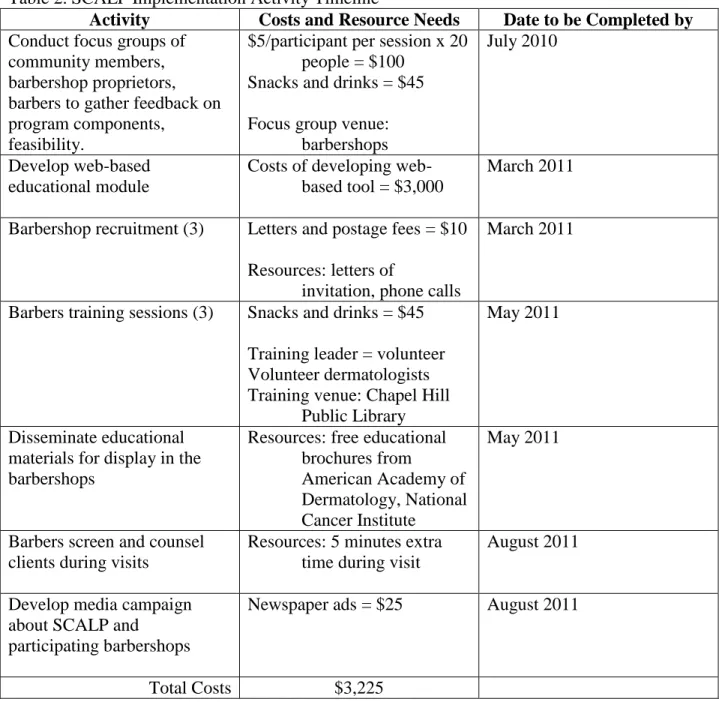
By May 2021, increase 5-year survival from scalp and neck melanomas to 92.1%. Table 2. SCALP Implementation Activity Timeline
Activity Costs and Resource Needs Date to be Completed by
Conduct focus groups of community members, barbershop proprietors, barbers to gather feedback on program components,
feasibility.
$5/participant per session x 20 people = $100
Snacks and drinks = $45 Focus group venue:
barbershops
July 2010
Develop web-based educational module
Costs of developing web-based tool = $3,000
March 2011
Barbershop recruitment (3) Letters and postage fees = $10 Resources: letters of
invitation, phone calls
March 2011
Barbers training sessions (3) Snacks and drinks = $45 Training leader = volunteer Volunteer dermatologists Training venue: Chapel Hill
Public Library
May 2011
Disseminate educational materials for display in the barbershops
Resources: free educational brochures from
American Academy of Dermatology, National Cancer Institute
May 2011
Barbers screen and counsel clients during visits
Resources: 5 minutes extra time during visit
August 2011
Develop media campaign about SCALP and
participating barbershops
Newspaper ads = $25 August 2011
SCALP will aim to have a high level of sustainability (level 4). Once the web-based training module has been developed, barbershops will require minimal resources to implement the program, thus the program will aim to maintain the majority of its features. Training sessions could be coordinated between several barbershops to minimize the costs of finding a venue (although the program would continue to pursue the use of the public library and their computers as a training venue) and dermatologists to assist with the training. One way to encourage
sustainability is to involve the community dermatologists as key stakeholders in the program. As stakeholders, they will be motivated to continue working with barbershops to conduct trainings sessions and to encourage participation of more barbershops in the state.
Involving the media from an early stage is another way to encourage sustainability. If the media profiles SCALP and participating barbershops, the community will be more likely to support the program. Broad-based community support will encourage the recertification of participating barbershops and the initial participation of new barbershops. If the public looks favorably upon SCALP and sees the program as beneficial to their health and wellbeing, they will be more likely to patronize those barbershops participating in SCALP.
Finally, the ultimate method of ensuring SCALP’s sustainability is to lobby for the program to be incorporated into the NC Barber’s licensing process. The SCALP training module and program and implementation plan can be incorporated into the barbers’ curriculum instead of serving as an optional program for barbers to complete after their formal training.
Evaluation Plan
Rationale and Approach to the Evaluation
Rationale
The Skin Cancer Learning Project (SCALP) will need a comprehensive evaluation plan to ensure that it is functioning as effectively and efficiently as possible. The primary reason for an evaluation is to ensure that SCALP is on track to meet the intended goals and objectives, including recruiting barbers to participate and increasing knowledge about skin cancer
prevention among clients in the short-term, and increasing early detection of, and survival from, scalp and neck melanomas in the long-term. An evaluation plan will clarify whether or not the program plan is being implemented effectively to meet these objectives, and in which areas the program can be improved. Dissemination of SCALP across the state of North Carolina is another long-term objective; evaluation of SCALP’s implementation in the pilot barbershops will help to define the program’s readiness for dissemination to other sites and help to improve the program for future use. An evaluation is also essential if the program and its outcomes are to be published or presented in journals or at meetings. Finally, SCALP’s pilot programs will be operating without formal funding, and an evaluation will help to prove the program’s merit when funding is sought for future implementation of the program on a larger scale.
Role of the Evaluator:
As part of the program management team, my role as an evaluator will be that of an internal evaluator. I will be able to engage stakeholders in the evaluation process more readily, as I will have already been working with them throughout the program’s implementation.
than to an outside evaluator whom they may feel intends to be more critical of the program. My evaluation strategy would focus on participatory evaluation, and I would attempt to share control of the evaluation with the stakeholders, including the program staff. My role as an internal evaluator would also involve advocating for the program.
An external evaluator would also be appropriate for this program, because it is difficult for someone closely enmeshed in the program to be entirely objective in an evaluation. The results of an evaluation conducted by an external evaluator may be more credible to potential funding sources, journal editors, and sites in which we wish to disseminate the program since he or she is not invested in the program’s success. It is also usually helpful to have a fresh
viewpoint examining the program; an external evaluator may notice details that are overlooked by the program staff or stakeholders. Essential characteristics for any evaluator include attention to detail, organization, ability to work with stakeholders from many different areas of the
community, respect for program staff and participants, and the ability to analyze data.
Stakeholder Input
An important group of stakeholders in SCALP are the barbers participating in the training and implementation of the program. The barbers will want to know the change in their
are significantly increasing barbers’ knowledge, how many patients are referred to them by SCALP, the outcomes of those referrals, and the change in client behavior as a result of discussion of skin cancer prevention. Finally, the community is a stakeholder group who will want to know how SCALP is affecting early detection and survival from scalp and neck melanomas. All stakeholders will likely complete surveys and participate in focus groups to contribute to the evaluation.
Potential Challenges
The major challenge facing the evaluation plan is SCALP’s lack of funding. As a pilot program, SCALP has not secured funding to implement the program, so it will be a challenge to conduct an evaluation without a budget with which to pay research assistants or data analysts. SCALP has garnered support from a team of interested stakeholders and hopes to conduct this first pilot phase of the program with volunteer support. Another challenge for the evaluation will be to involve all the stakeholders in the process. The stakeholders come from an array of careers and will likely have different schedules; bringing all the stakeholders together at once may not be feasible, thus convenient methods of disseminating information between stakeholder groups will be sought.
Evaluation Design and Methods
Evaluation Design
attitudes about training, the implementation of the program as it occurs in barbershops, the impact of the program on the barbershop workday and business, and the ultimate satisfaction of the barbers, barbershop owners, and clients with SCALP. The pre-experimental design will incorporate pre- and post-test analyses of the same group of participants. The barbers will undergo pre- and post-test analysis of the change in knowledge as a result of the SCALP
training, and the clients will undergo pre- and post-test analysis of their change in awareness and practice of sun-protective behaviors as a result of SCALP’s implementation.
The observational evaluation design is useful for SCALP because it requires minimal resources. SCALP has no funding, and the observational design requires fewer resources because there is no comparison group on which to gather data. The pre-experimental design is also useful because data collected in pre-and post-tests clearly indicate the amount of change that occurs in program participants as a result of the intervention, and the resulting difference can be easily understood by stakeholders, funding agencies, and the community.
A limitation to the use of observational and pre-experimental evaluation designs, also common to many other study designs, is the inability to determine causality between the
outcomes and the intervention.53 However, at this stage in the development of SCALP, while the program is in the pilot stage, our goal is to determine if there are significant relationships
likely to practice these behaviors as a result of the questionnaire instead of as a result of the intervention itself.
Evaluation Methods
The evaluation methods will include methods of collecting both quantitative and qualitative data on SCALP’s implementation and outcomes.
Quantitative Data
Pre- and post-testing: Barbers and groups of clients will undergo pre-and post-testing to document changes in knowledge, awareness, and behaviors as a result of SCALP; this is a primary source of quantitative data.
Epidemiological data: Secondary quantitative data will be collected from sources such as the North Carolina Central Cancer Registry and the North Carolina State Center for Health Statistics to determine diagnosis of melanoma and melanoma mortality rates. Qualitative Data
Observation: This method of evaluation will be employed on several pre-determined days to document the frequency of SCALP implementation with clients in various
barbershops.
Focus groups, surveys, and interviews: Various groups of stakeholders and participants will be interviewed, participate in focus groups, or complete open-ended surveys to evaluate participation, barriers to participation, program satisfaction, and areas needing improvement throughout the evaluation process.
barbershops and SCALP implementation sites, SCALP press releases, SCALP barbers’ referral forms, and medical records from dermatology offices.
Evaluation Planning Tables
Short Term Objective #1:
By May 2011, 90% of barbers at pilot barbershops will have participated in training for SCALP.
Evaluation Question Participant Evaluation Method
By May 2011, how many barbers from pilot barbershops participated in training?
Barbers, training moderator
Survey, document review (training
attendance log) How many barbers declined to participate in
training? Why?
Barbers Survey
Did barbers’ knowledge about detection of skin lesions increase after training?
Barbers Pre-/Post-test analysis How many barbers received a certificate of
completion for the training program?
Barbers Surveys, document review (training completion log) How many barbers attempted but did not
receive a certificate of completion for the training program? Why?
Barbers Surveys
How satisfied were barbers with their ability to detect suspicious lesions on clients’ scalps after completing training?
Barbers Surveys, focus groups
How satisfied were barbers with their ability to discuss sun protective behaviors with clients after completing training?
Barbers Surveys, focus groups
How could recruitment of barbers be improved?
Barbers, barbershop owners
Surveys, focus groups What were the barriers to recruitment? Barbers, barbershop
owners
Surveys, focus groups
Short Term Objective #2:
By August 2011, participating barbers will begin to inspect clients’ scalps and discuss sun-protective behaviors at 90% of all client appointments.
Evaluation Question Participant Evaluation Method
By August 2011, how many clients’ scalps were inspected by barbers each day?