The journal homepage www.jpacr.ub.ac.id
ISSN : 2302 ‐ 4690
19
Construction and Characterization of Coated Wire Oxalate Ion
Selective Electrode Based on Chitosan
Zuri Rismiarti 1, Atikah1, Hermin Sulistyarti11Postgraduate Study, Department of Chemistry, Faculty of Mathematics and Natural Sciences University of Brawijaya, Jl Veteran Malang, East Java, Indonesia
Corresponding email: [email protected]
Received 23 July 2013; Revised 28 October 2013; Accepted 28 November 2013 Published online 9 December 2013 for edition January-April 2014
ABSTRACT
A plasticized PVC (polyvinyl chloride) membrane based coated wire oxalate ion selective electrode has been developed by using chitosan.The results showed the optimum composition of the membrane was chitosan: aliquat 336: PVC: DBP = 4:1:33:62 (% weight). The electrode showed Nernstian response, Nernst factor 29.90 mV/decade of concentration, with improved linear range of 1x10⁻⁵ - 1x10⁻¹ M, with a comparatively lower detection limit of 2.56 x10⁻⁶ M, giving a relatively fast respons of 30 second and reasonable reproducibility. ISE’s performance worked well in pH range of 5-7 and temperature range of 25-50 oC. The lifetime of the electrode was found to be 42 days. Further the electrode was also successfully applied to determine the oxalate content in urine samples.
Key words: ISE, chitosan, membrane, oxalate, urine
INTRODUCTION
Urinary tract stone disease is the third most in the field of urology after urinary tract infections and prostate gland diseases. Urinary stone formation process is influenced by genetic factors and food consumption habits [1]. Approximately 60-80% of the causes of kidney stones in urine are crystals of calcium oxalate. Oxalate ions are able to precipitate as insoluble salts by the presence of calcium and can accumulate in the renal tissue. The measurement of oxalate in urine is very important to diagnose of hereditary kidney stone and hyperoxalauria [2].
Several determination methods of oxalate such as; spectrophotometric, amperometric. The method has high precision and accuracy but require expensive instrumentation, delicate and expert handling of the sample and instrument. Hence potentiometric determination based on ion selective electrodes offer several advantages such as ease of preparation, low cost, simple procedure and easy instrumentation (pH/potentiometer), no sample destruction, fast response. Determination of oxalate using ISE has been developed widely used [2-6]. Oxalate sensors have been developed using a metal-ligand complex as ionophore and PVC as membrane with tube type. In addition, ISE has been developed with coated wire type. The advantages of type coated wire such as no special maintenance required, easily stored without risk of losing the reference solution, and also can be operated in a variety of positions (tube type only in an upright position).
Chitosan is a natural cationic biopolymer that is both high biodegradable and biocompatible and also low toxicity. Chitosan has been success become an anion sensor because at pH < pKa of chitosan (6.3 to 7.2), the -NH2 group was protonated-NH3+ so that
The journal homepage www.jpacr.ub.ac.id
ISSN : 2302 ‐ 4690
20 electrostatic interactions occur with anion [7,8]. The addition aliquat 336 in oxalate sensor to improve the conductivity and ionophores group as the result ion exchange capacity was increased. In the present studies of oxalate sensor has been prepared by chitosan as ionophore PVC as membrane and also aliquat 336 as additive with coated wire type. Characteristics of ISE studied include; sensitivity (Nernst factor), linear concentration range, detection limit), response time, life time. The performance of ISE include; selectivity (the influence of foreign ions), and measurement conditions (pH and temperature effects). Due to the fact that ion-selective membrane electrodes can be reliably used in clinical analysis, oxalate-ion-selective membrane electrodes are proposed for urinary oxalate assay. An oxalate sensor showed improved workable pH range, fast response time and reasonable reproducibility.
EXPERIMENT
Chemicals and instrumentation
Chitosan (DD 65%), dioctylsebakat (DOS) (Sigma Aldrich), dioctylphthalate (DOP) (Sigma Aldrich), dibutylphthalate (DBP) (Sigma Aldrich), Polyvinylchloride (PVC) high molecular weight (60.000) (Sigma Aldrich), tetrahydrofuran (THF) (Sigma Aldrich), Teflon rod (Ø 1 cm), 99.9% platinum wire (Ø 0.5 mm), and jack coaxial cable RG-58, Na2C2O4
(E-Merck), glacial acetic acid (E -(E-Merck), NaH2PO4.H2O (E-Merck), NaCl (E-Merck), K2SO4
(E-Merck), Aliquat 336-Cl (Sigma Aldrich), HNO3 65% (v/v) (E-Merck), alcohol 96 % (v/v)
(E-Merck), distilled water.
The potential were measured using a galvanic cell of the following type: Ag ǀ AgCl ǀ KCl (1M) ǁ sample solution (10-8 – 10-1 M Na2C2O4) ǀ PVC–chitosan membrane ǀ Pt
electrode. Potentiometer (Fisher Accumet Model 955), analytical balance (Adventurer models AR 2130), FT-IR (Shimadzu), digital pH meter with electrode glass (Schoot Gerard), pH meter (Hanna), centrifuge (Fisher Scientific).
Procedure reaction
Preparation of Membrane Electrode
Chitosan was prepared by dissolving 0.500 g of chitosan powder into 20 mL of 3% acetic acid (v/v) and then the mixture was stirred for 24 hours until homogenous. Membrane composed of a mixture of plasticizer (DOP / DOS / DBP), PVC, chitosan solution and aliquat 336-oxalate was dissolved (1:3 (w/v)) and stirred with a magnetic stirrer for 3-4 hours until homogenous.
Construction of ISE
The body of electrode includes platinum wire (diameter 0.5 mm, length of ± 5 cm). The top of Pt wire was connected to RG-58 coaxial cable which was soldered to the jack RG 58 as connector to the potentiometer. The end of the Pt wire was dipped into a mixture of the membrane with a thickness between 0.1-0.2 mm and allowed to stand overnight in the oven at 50 OC. Prior to use the electrode was initially conditioned by soaking it in a 0.2 M of Na2C2O4. The first conditioning time was approximately 12 h, then 15 – 105 min for
successive used.
Characterization of Oxalate ISE
Characterization of oxalate ISE includes of the determination of the Nernstian factor, detection limit, response time, life time, the influence of pH, foreign ion and temperature.
The journal homepage www.jpacr.ub.ac.id
ISSN : 2302 ‐ 4690
21 The parameter was determined by potential of analyte solution. Potential of the analyte solution was determined by measuring the 1x10⁻⁸ - 1x10⁻¹ M of Na2C2O4 pH 5 (phosphate
buffer) at a temperature (26-27 °C) using reference electrodes Ag/AgCl. The electrode immersed to a constant depth in analyte solution and stirred at constant rate of magnetic stirring bar. The potential readings recorded when it became stable. The data were plotted as observed potential vs the logarithm of the oxalate concentration. The Nernst factor was determined from the slope of the resulting curve. Linear concentration range was showed from the straight line. Detection limit was determined by the intersection between the straight line (linear region) and curved lines (non-linear region) of the curve [12]. The same procedure was done to determine the influence of interval of pH, foreign ion, temperature, response time, life time and the determination of oxalate ion in the urine samples.
RESULT AND DISCUSSION
Optimization of Membrane Composition
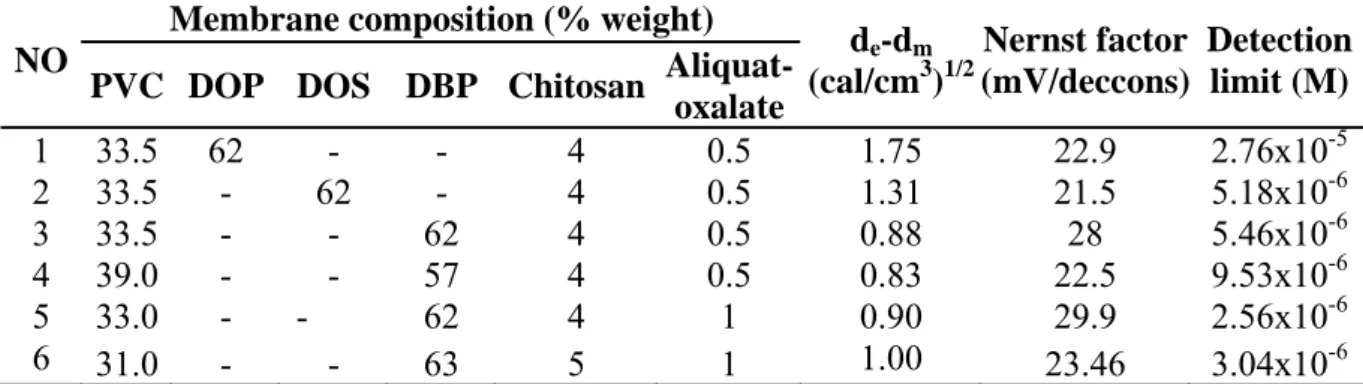
Determination of optimization membrane composition could determine the characteristics of the oxalate ISE include Nernst factor, detection limit. Variations of the composition membrane (% weight) consist of chitosan, PVC, plasticizer, and aliquat-oxalate were showed by Table 1. Plasticizer chain, the value of de-dm, the ratio of PVC:plasticizer; the
ratio of ionophores:additive affect Nernst factor and detection limit.
Tabel 1. Variation of membrane composition. Membrane composition (% weight)
NO
PVC DOP DOS DBP Chitosan Aliquat-oxalate
de-dm (cal/cm3)1/2
Nernst factor (mV/deccons)
Detection limit (M)
1 33.5 62 - - 4 0.5 1.75 22.9 2.76x10⁻⁵
2 33.5 - 62 - 4 0.5 1.31 21.5 5.18x10⁻⁶
3 33.5 - - 62 4 0.5 0.88 28 5.46x10⁻⁶
4 39.0 - - 57 4 0.5 0.83 22.5 9.53x10⁻⁶
5 33.0 - - 62 4 1 0.90 29.9 2.56x10⁻⁶
6 31.0 - - 63 5 1 1.00 23.46 3.04x10⁻⁶
Membrane of 1,2,3 showed the longer chain plasticizer, the more distant from the theoretical Nernst factor (29.6 ± 5 mV/decade of concentration). DBP has good compatibility compared to DOP and DOS. Compatibility decreased with the increasing length of the substituted alkyl esters of plasticizer. DBP able to provide the membrane properties: homogeneity, hydrophobicity, adequate dielectric constant and resulted the ionophore and additives of membrane were dissociation become ions in the membrane-solution interface phase [4]. PVC has excessive amount (membrane 4), the structure of membrane could be rigid or less flexible. This condition affects mobility of oxalate ions in the membrane becomes more difficult. As the resulted, ion exchanger process has been achieved hardly in the membrane-solution interface phase and has small of potential response. The addition of 1% chitosan (membrane 6) decreased sensitivity because formation of intermolecular aggregation chitosan. The increasing concentration of aliquat (membrane 5) has more ammonium sites in the membrane and resulted the ability of anion exchanger was greater so as give optimum sensitivity. Ratio of plasticizer:PVC approached 2:1 and chitosan:aliquat =
The journal homepage www.jpacr.ub.ac.id
ISSN : 2302 ‐ 4690
22 4:1, chitosan:aliquat: PVC: DBP was 4:1:33:62 (% weight) has Nernst factor 29.9 (mV / decade concentration).
Characteristics of The Electrode
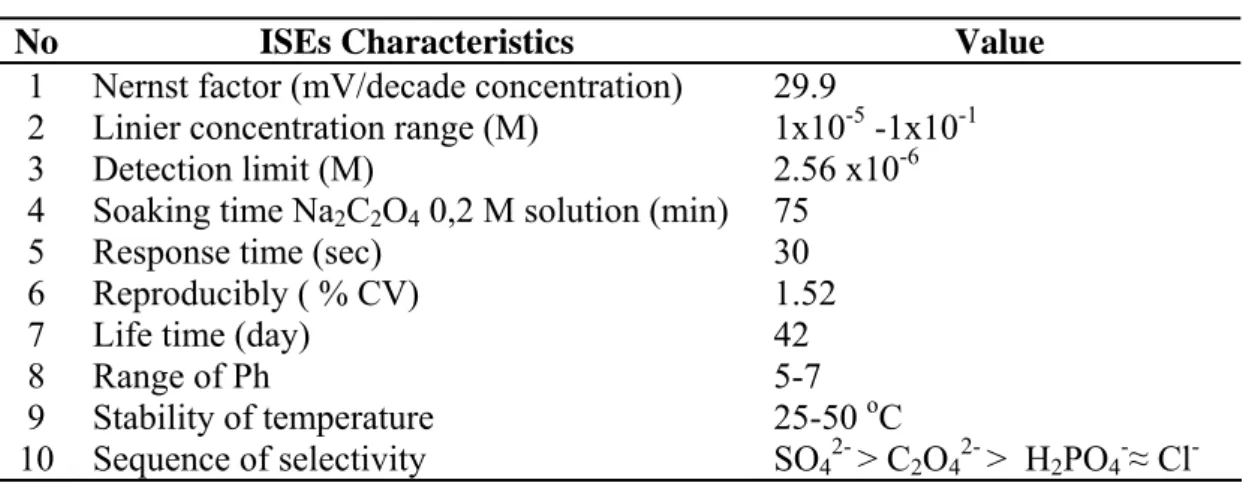
Characteristics of ISE were showed by sensitivity (Nernst factor, linear concentration range, detection limit), response time, life time. The performance of ISE include selectivity (the influence of foreign ions), and the conditions of measurement (the influence of pH and temperature) were presented in Table 2.
Table 2. Characteristics of oxalate ISE based on chitosan
No ISEs Characteristics Value
1 Nernst factor (mV/decade concentration) 29.9
2 Linier concentration range (M) 1x10⁻⁵ -1x10⁻¹
3 Detection limit (M) 2.56 x10⁻⁶
4 Soaking time Na2C2O4 0,2 M solution (min) 75
5 Response time (sec) 30
6 Reproducibly ( % CV) 1.52
7 Life time (day) 42
8 Range of Ph 5-7
9 Stability of temperature 25-50 oC
10 Sequence of selectivity SO42- > C2O42- > H2PO4-≈ Cl
-Soaking optimum electrode in Na2C2O4 solution of 0.2 M was 75 minutes. At this time,
the necessity of water in membrane for dissociation process has been fulfilled. The adequate of water in membrane could help in molecular rearrangement which eases the chain mobility in chitosan [13]. As a resulted, ion exchanger process more easily was reached so as give optimum sensitivity.
Response time is time when a steady-state potential with less than 0.1 mV/min change has been achieved [4] and obtained by the lowest analyte concentrations on linear range curve calibration. As the resulted the oxalate solution of 1x10⁻⁵ M has response time of 30 seconds. This resulted the electrode has good characteristic because the response time with less than 1 second.
Life time
The life time of oxalate ISE based on chitosan has 42 days (Figure 1). This is influenced by the aging process on the membrane resulted swelling in the chitosan and migration of plasticizer. Migration of DBP plasticizer to the membrane surface could increase electrical resistivity of membrane. This condition would confine kinetic of oxalate ion transport to the membrane-analyte surface. Consequently both of homogeneity of membrane and physical stability has been decreased. As the resulted, reduce the sensitivity of ISE showed by the decrease of the Nernstian factor value.
The journal homepage www.jpacr.ub.ac.id
ISSN : 2302 ‐ 4690
23
Figure 1. Life time Effect of pH
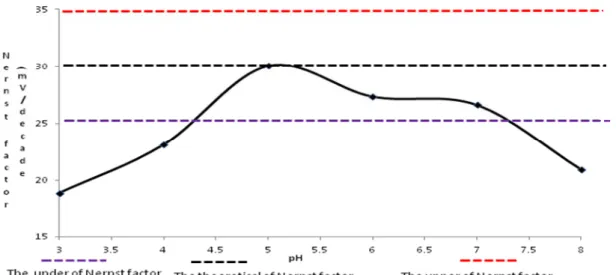
Effect of pH on oxalate ISE based on chitosan was shown in Figure 2. At pH 3 and 4 were distant from range of Nernst factor due to the oxalate ion getting converted to hydro-oxalate ions (HC2O4-) and oxalic acid molecules at pH < 4 [10]. ISE could work well in a pH
range 5-7 with the optimum pH is 5. At alkaline condition, deprotonation chitosan has been occurred [13], NH3+ groups was reduced as a resulted anion exchange capacity was
decreased. At pH > 7, hydroxide ions (OH-) compete and interfere with the oxalate ion activity to bind RR'3N+ aliquat 336. Consequently, the response is not Nernstian at pH 8.
Figure 2. Effect of pH Effect of temperature
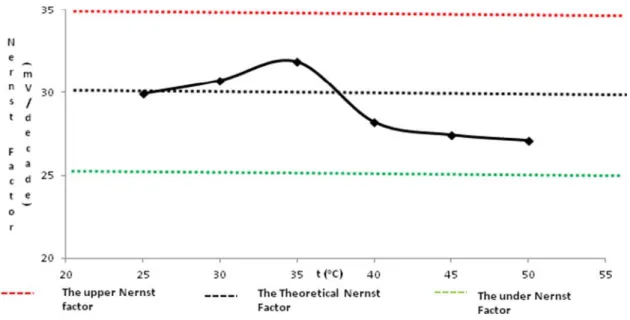
Temperature of 25-50 oC from Na
2C2O2 analyte solution does not interfere the
The journal homepage www.jpacr.ub.ac.id
ISSN : 2302 ‐ 4690
24 (Figure 3). The temperature range 25-35 °C, the higher temperature produced a super Nernstian (Nernst factor: 29.93; 30.73 and 31.86 mV/decade of concentration). This proves that the mobility of the ions in analyte solution could increase with the potential response. At temperature above 35 oC shows Nernst factor can decreased due to the flexibility of ion
exchange membrane is reduced.
Figure 3. Effect of temperature Selectivity
Potentiometric selectivity coefficients can be measured with fixed interference method, which is a mixed solution method [11]. Determination of sensor potential is measured for solution containing varying activity of the primary ion (C2O42-) of 1x10⁻⁵ M to 1x10⁻¹ M and
constant activity of the interfering ion (Cl-, SO42 - and H2PO4-) of 1x10⁻³ M. If the log K i, j ≤
2, the ISE responds to the primary ions more selectively than to the interfering ions.
Table 3. Potentiometric selectivity coefficient values for various interfering anions
Log Ksel p[C2O42- ]
Cl- H2PO42- SO4
2-5 -1.0 -1.0 2.03
4 -2.0 -2.0 1.00
3 -3.0 -3.0 0.00
2 -4.0 -4.0 -1.00
1 -5.0 -5.0 -2.00
Table 3 shows that the performance of ISE respon sulfate ion more selectively than oxalate ion of 1x10⁻⁵-1x10⁻² M whereas oxalate solution of 1x10⁻¹ M did not interfere with the performance of the ISE. Chloride and dihydrogen phosphate ions didn’t interfere with the performance of ISE at oxalate solution of 1x10⁻⁴-1x10⁻¹ M whereas oxalate solution of 1x10⁻⁵
The journal homepage www.jpacr.ub.ac.id
ISSN : 2302 ‐ 4690
25
Application
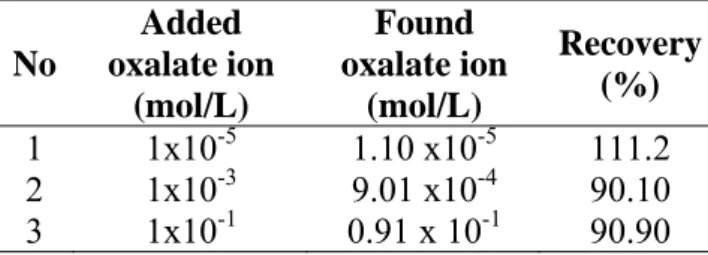
The proposed sensor was used to monitor oxalate ion concentration in urine samples using standard addition method, where known concentration of oxalate ion are added and recovered using the electrode. The results are summarized in Table 4.
Table 4. Determination of oxalate ion in the urine samples using proposed sensor
No
Added oxalate ion
(mol/L)
Found oxalate ion
(mol/L)
Recovery (%)
1 1x10⁻⁵ 1.10 x10⁻⁵ 111.2
2 1x10⁻³ 9.01 x10⁻⁴ 90.10
3 1x10⁻¹ 0.91 x 10⁻¹ 90.90
CONCLUSION
Potentiometric properties towards sensing of oxalate ion are dependent upon the ionophore, plasticizer and additive used in the preparation of the electrode. The membrane exhibits a linear stable response over a wide concentration range with a near Nernstian response of 29.9 mV/decade concentration. The electrode works well in the range of pH 5-7 and temperatures of 25-50 oC. The results of the accuracy test marked the reliability of the ion-selective membrane electrodes used in direct potentiometric assay of urinary oxalate.
REFERENCES
[1] Izhar, M.D., K. Haripurnomo., S. Darmoatmodjo, Berita Kedokteran Masyarakat, 2003,
23(4), 200-209
[2] Ardakani, M.M, F.Iranpoor, M.A. Karimi, dan M.S. Niasari, Bull.Korean Chem.Soc, 2008, 29 (2), 398-404
[3] Rawat, A., C. Sulekh dan S. Anjana, Chin. J. Chem, 2010, 28, 1140—1146
[4] Ardakani, M.M., M. Jalayer , H. Naeimi , A. Heidarnezhad, dan H.R. Zare, Biosens and Bioelectr, 2006, 21, 1156–1162.
[5] Chandra, S., S. Raizada, dan S. Sharma, IOSR J. App.Chem, 2012, 1 (5), 39-48.
[6] Stefan, R.I., I. Draghici, G.E. Baiulesce, Sensors and Actuators B, 2000, 6, 250–252.
[7] Guibal, E., Separation and Purification Technology, 2004, 38, 43-47
[8] Kurniasih, D., Atikah dan H. Sulistyarti, J. Pure App. Chem. Res, 2012, 1 (1), 33‐40 [9] Wiersma, B.J.,Hydrogen Generation During the Corrosion of Carbon Steel in Oxalic
Acid, 2004,Westinghouse Savannah River Company, US
[10] Umezawa, Y., P. Buhlmann, K. Umezawa, K. Tohda, and S. Amemiya, Pure & Appl. Chem, 2000, 72(10), 1852-1854
[11] Wang, J., Analytical Electrochemistry, Third Edition, 2006, John Willey& Sons, Canada
[12] Lee, S.T., F.L. Mi, Y.J. Shen, dan S.S. Shyu, Polymer, 2001, 42, 1879-1892.