ASSESSING SEVERITY OF POSTURAL LOADING IN
FOUR GARI -FRYING METHODS
T. M. SAMUEL1*, J. C. IGBEKA2 AND O. P. KOLAWOLE3
1Dept. of Agricultural Engineering, Olabisi Onabanjo University, Ogun State, Nigeria
2Dept. of Agricultural and Environmental Engineering, University of Ibadan, Nigeria
3PPS, International Institute for Tropical Agriculture (IITA), Ibadan, Nigeria
*Corresponding author: [email protected]
and evaporates rapidly at temperatures above 200C. Some measure of detoxification can
also be achieved by mechanical disintegra-tion (pounding, grating or chipping the tubers).
In cassava processing, about 65-70% of the rural women are actively engaged in physical cultivation of land, planting, harvesting, etc, while women are exclusively responsible for the remaining steps in the food chain, par-ticularly food processing, preparation and distribution (UN, 1994; Ali, 1996). Studies have shown that food processing is a major commercial focus for women in many settle-ments in Nigeria (Asota & Kaul, 1991). Akpabio & Ekpe (2001) analyzed gender role
ABSTRACT
Posture at work is a source of musculoskeletal load. This is in addition to the external task-induced load depending on the task, which must be minimized to ease the work. Four working postures com-mon to gari-frying workers in the southwestern Nigeria namely, sitting beside (SB), sitting in front (SF), alternating sitting and standing (ASS) and standing (S) were investigated to assess severity of loading in each posture. Activities of 16 fryers were videotaped and played back for assessment using Rapid Upper Limb Assessment (RULA) technique. RULA grand score recorded were SB 7.00, S 6.50, SF 6.00 and ASS 5.75. Postural angles were also measured giving SB 36, S 50, SF 79, and ASS 500.
RULA result has been confirmed by postural angle measurement, indicating that ASS has the least severity due to postural loading with the least bending/twisting and flexion of the back during gari-frying task. ASS posture, therefore, is recommended for gari gari-frying in southwestern Nigeria.
KEYWORDS: RULA, gari-frying workers, severity, posture, musculoskeletal disorder
INTRODUCTION
The importance of cassava (Manihot
escu-lenta) in the lives of many Nigerians cannot
be over-emphasized. As food, it comes first among the root and tuber crops despite the respect yam commands as a ceremonial crop. Cassava products include gari, fufu, flour and starch. The leaves are also edible. Cassava is a crop for hunger alleviation and it has great potential for sustainable food security and export promotion. Depending on the processing procedure used, the per-centage of cyanide reduction varies from 70 to 100% (IITA, 1990). The tubers, accord-ing to IITA (opp. cit), are detoxified by hy-drolysis of linamarin and lotuaustarin into hydrogen cyanide (HCN), which is volatile
Sciences, Engineer-ing and Technology © UNAAB 2009
in cassava production in Akwa Ibom state of Nigeria and revealed that female farmers are fully involved in five-task activities and also make greater contribution than male farmers in three of the jointly performed task activities. Igbeka (1993) performed er-gonomic studies on some Nigerian women involved in agricultural processing of cas-sava roots into gari, a common staple food in Nigeria. He faulted the unnatural pos-tures of the operators as well as the uncon-ducive working environment, which gener-ates excessive heat. He then proposed an improved method for reducing fatigue and increasing productivity of the operators.
Gari frying (garification) is about the last
op-eration in gari production and, to a large extent, the determinant of the final product. This involves simultaneous cooking and dehydration, that is, heat treatment of dewa-tered cassava mash, which has been pulver-ized into grains, to produce gelatinpulver-ized and dried grains known as gari (Igbeka, 2003). The Rapid Upper Limb Assessment (RULA) system is designed for assessing the severity of postural loading and is particu-larly applicable to sedentary jobs (McAtamney and Corlett, 1993). The method adopts the concept of OWAS as reported by Guanyan & Peter (1999), using numbers to represent postures with an asso-ciated coding system. The range of move-ment for each upper body part (head, trunk, upper and lower arm, wrist) is divided into sections that are numbered. Number 1 is given to the range of movement or working posture where risk factors causing load on the structures of the body segment are minimal, and higher numbers are given to parts of the movement range with more extreme postures. If an abduction or rota-tion is involved, the scoring is described
beside the diagram (Cornell University, 2000). In addition to posture recordings, RULA also considers the load on the muscu-loskeletal system caused by static or repeti-tive muscle work and force exertion, so that an action list can be produced. This indicates the level of intervention required to reduce the risks of injury due to physical loading on the operator. The method has been tested in a laboratory situation relative to VDU opera-tion (McAtamney and Corlett, 1993). How-ever, further validation may still be needed for the system relative to other occupations. Of all reasons why postures have interested researchers and practitioners, postures as a source of musculoskeletal illnesses, such as low back diseases, have attracted the most attention. Musculoskeletal problems related to repetitive work are also connected to tures (Stellma, 1998). Awkward working pos-tures, repetitive use of body segments, force-ful movements, vibration and long periods of standing are also sources of the physical workload. The physical workload has been recognized as the cause of musculoskeletal injuries in construction workers. Working postures of gari fryers has not been re-searched in Nigeria, especially in the process-ing industry, hence the objective of the paper is to assess postural loading of garification workers in Southwestern Nigeria.
MATERIALS AND METHODS
Four improved traditional garification working postures (ITGWPs) have been identified in the Southwestern Nigeria (Samuel, 2008). They are described as follows:
ITGWP I – sitting beside (SB): A seated fryer (separate from the fireplace) – beside the fireplace, and adopting conventional sit-ting posture.
(involving arms, wrist, neck, trunk and leg) were coded. The posture adopted had been observed whilst undertaking the task prior to selecting the posture(s) for assessment. Therefore, selection was made of the longest held posture and the assessment was made at 30-second interval over the working period. Prof Alan’s worksheet was replicated in excel worksheet to calculate RULA’s grandscore using excel software. However, data were captured from recorded videotape for this analysis. The guideline in Cornell University (2000) was used to determine the RULA grand score. The grand score was then com-pared to the Action Level list in Table 1, which provides a guide for further action. This provides a guide for the control of any risks identified and the action to be taken. Angle of bending of each subject was deter-mined using the same videotape earlier used for RULA. In each case, the extreme bend-ing situation at work was captured and pos-tural angles were determined by using still photographs and the reference point was lumbosacral (L5) (Kumar et al, 2005).
RESULTS AND DISCUSSION
Table 2 shows the results of the analysis of the RULA assessment. From Table 2, the RULA mean scores of all the ITGWPs were between 5 and 7, implying action levels 3 and 4, which respectively implies investigation and changes are required soon and investiga-tion and changes are required immediately according to Table 1. SIF and S postures have RULA mean scores of 6.5 and 6.75 (approximately 7), giving the same action level 4. It does mean that the discomfort level in these working postures in the upper limb was not significantly different from SB with the mean RULA score of 7. However, ASS have score of 6, implying investigation and changes are required soon. Hence ASS fryer – directly facing the fireplace, with
either or both legs fully stretched out. ITGWP III– stand (S): A standing fryer – beside the fireplace, with some movement around the work piece.
ITGWP IV – alternating sitting and stand-ing (ASS): A sit-stand fryer – beside the fireplace and alternating sitting and standing postures, with some movements round the work piece.
Methods for measuring postures have been categorized into three namely, self-reports from workers on workplace exposure to both physical and psychosocial factors, ob-servational methods and direct methods (Guangyan & Peter, 1999). One of such observational methods Rapid Upper Limb Assessment (RULA) is being used in this paper.
Sixteen subjects (four for each posture) were videotaped to capture all movements during work. The workers participating in this research were assigned randomly. For each worker, a 1.5-hour videotape was re-corded. The videotapes were recorded ei-ther in the morning (between 8:00 and 11:00 a.m.) or in the afternoon (between 12:00 and 4:00 p.m.) depending upon the availability of both the jobs being per-formed and the researchers. The two re-cording periods were believed to be repre-sentative since the workers performed the tasks almost all the time. The videotape was not used when the worker was idle due to any unexpected event during the recording period. The weight of the load handled was determined after the completion of the videotaping so that the worker’s task was not disturbed. The videotapes were then played back and the working postures
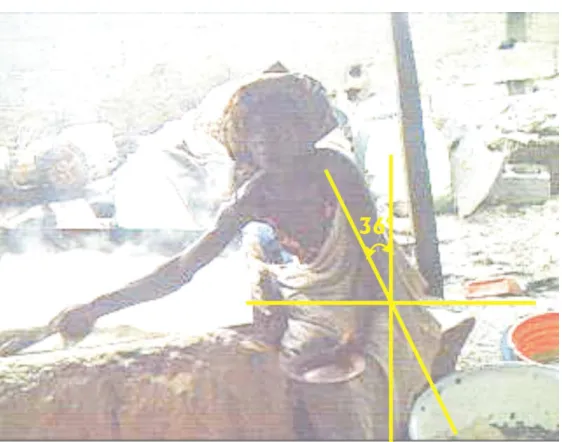
treme bending posture of the workers during
garification operation, that is, at the time the
worker attempted to stir gari mash in the fry pan at the far edges of the pan. The angles recorded were 36, 50,50 and 790,
respec-tively, for SB, S, ASS and SIF. The relatively small angle recorded for SB came as a result of smaller fry pan in use in most locations where SB postures thrive.
The largest angle recorded for SIF was not surprising because the posture really did not fit the worker because the work surface was somehow low and that was the reason the processor had to bend over. The situation was compounded by the large fry pan which was not within the arm reach of the worker, the worker was forced to take this hard pos-ture as seen in Plate 3. In this case, the work surface could have been close to the chest level with the fry pan within arm reach, since only stirring was required with low force in-volved.
had the least risk of musculoskeletal disor-ders.
Though the closeness of the scores does not give distinct classification, especially between S and SIF postures, SB and ASS were clearly indicated respectively as worst and best postures among others with their scores, corroborated by their standard de-viations.
In this analysis, RULA had been used as part of wider analyses to determine risks of musculoskeletal disorders in the subjects. This result requires further analysis, because as its name implies, it is for rapid assess-ment. Hence, further analyses with determi-nation of the bending angles of the subjects stands to give a clearer picture of the analy-sis.
Plates 1 through 4 shows the postural an-gles measured in each of the postures under study. The angles were recorded at the
ex-Table 1: RULA Grand Score and Action Level
RULA Score Action Level Description
1-2 1 Posture is acceptable if it is not maintained or repeated for long periods
3-4 2 Further investigation is needed and changes may be required
5-6 3 Investigation and changes are required soon 7 4 Investigation and changes are required immediately
Table 2: RULA Assessment Results for Four Improved Traditional Garification Working Postures (ITGWP)
SIF 6-7 1 6.5 S 6-7 1 6.75
ITGWP Range STDEV Mean RULA Score
SB 7 0 7
ABSS 5-7 0.817 6
Plate 2: Still Picture Measuring Postural Angle for S Posture
vestigated in southwestern Nigeria. This is revealed by virtue of the low mean RULA grand score and comparatively low bending angle of the subjects who adopted ASS pos-ture. ASS posture is, therefore, recom-mended for adoption in the southwestern Nigeria for garification task.
REFERENCES
Akpabio, A., Ekpe, E.O. 2001. Analysis of Gender Roles in Cassava Production in Akwa- Ibom -State of Nigeria. Proc. of Int.
Symposium for Tropical Root Crops, Africa Branch
(ISTRC-AB) Ibadan. Nigeria. Pp 88-91.
Ali, S.S.1996. Women and food security.
Proceedings of the National Workshop on Strategic Grains Reserve Storage Programme – Nucleus for
The same angle 500 recorded in ASS and S
postures were as a result of measuring the angle at the extreme situation of bending of the worker at work. Since the same size of fry pan was in use in both postures and nei-ther of them was within the arm reach as is supposed, the worker was forced to take this posture as seen in Plates 2 and 3. How-ever, the situation was not as worse as in the case of SIF because the work surface of ASS was at the waist level in consonance with ergonomic guideline.
CONCLUSION
Both RULA analysis and the angle of bend-ing depict that ASS posture has least sever-ity of postural loading among the improved traditional garification working postures
Kumar, R., Chaikumarn, M., Kumar, S.
2005. Physiological, subjective and postural loads in passenger train wagon cleaning us-ing a conventional and redesigned cleanus-ing tool. International Journal of Industrial
Ergonom-ics, 35: 931-38.
Mcatamney, L., Corlett, E.N. 1993.
RULA: a survey method for the investigation of work-related upper limb disorders, Applied
Ergonomics, 24: 91 - 99.
Samuel, T.M. 2008. Effects of Working
Postures on Musculoskeletal disorders among Gari-Frying Workers in Southwestern Nigeria. Unpublished Ph.D. Thesis. Depart-ment of Agricultural and EnvironDepart-mental En-gineering. University of Ibadan. Ibadan. Nigeria
Stellman J.M. 1998. Encyclopedia of
Occu-pational Health and Safety. 4th Ed. Vol. I.
ILO office. Geneva.
United Nations. 1994. Women in a
Chang-ing Global Economy, World Survey on the Role of Women in Development, New York, United Nations, 1995, By United Na-tions Department for Policy Cooperation and Sustainable Development
National Food Security, July. Strategic Grain
Reserve Storage Division of Federal Minis-try of Agriculture, Abuja, 74-75.
Asota, C.N., Kaul, R.N. 1991. Pepper –
mills – A Sample Survey of their types and operational problems, being part of Re-search Findings under the IAR – Ford Foundation Project on Technology for Women, Institute for Agriculture Research, Ahmadu Bello University, Zaria, Nigeria.
Cornell University, 2000. Rapid Upper
Limb Assessment (RULA) Worksheet [email protected]
Guangyan, Li, Peter, B. 1999. Current
techniques for assessing physical exposure to work-related musculoskeletal risks, with emphasis on posture-based methods.
Ergo-nomics, 42(5): 674 - 695.
Igbeka, J.C. 1993. Some Ergonomic
Stud-ies of Nigeria Women Involved in Agric. Processing. Proceedings XXV
CIOSTA-CIGRV Congress. Wageningen. The
Nether-lands. P. 183 – 189.
Igbeka, J.C. 2003. Equipment for
Process-ing Cassava. Personal Communication. IITA 1990. Cassava in Tropical Africa: A
Ref-erence Manual. Int. Institute of Tropical
Agri-culture (IITA), Ibadan Nigeria