ACCESS DEFINED CLOUD BASED MULTIVARIANT
RESPONSE SYSTEM WITH CACHING
G. Janaki
1, M. Menaka21,2
Computer science Department, Kingston engineering college, (India)
ABSTRACT
In the recent trends of computer world, cloud computing is a prominent computing that relies on sharing computing resources rather than having local servers or personal devices to handle applications. Data sharing in form of multi-media is more complicated as it utilizes more traffic in the internet, hence the concept of multimedia streaming has been introduced. In the current technology, a cloud based storage system has been designed to distribute multi variant content (video, audio, doc, and image) with differential service level by utilizing a QOS algorithm. The enhancement is done by the cloud based storage system has been designed to provide multivariate services that serves the request by caching. Caching acts as an staging server in local machine that have temporary copy of the data that has been accessed frequently through LRU and MRU. Privilege setting has been incorporated with the system that manages the accessibility of the data in cloud either publicly or privately. The cache is an area of cloud storage that is used to store content for dissemination.
Keyword-Quality of Service (QOS), Least Recently Used (LRU), Most Recently Used (MRU)
I. INTRODUCTION
Cloud computing is a computing paradigm, where a large pool of systems are connected in private or public networks to provide dynamically scalable infrastructure for application, data and file storage. With the advent of this technology, the cost of computation, application hosting, content storage and delivery is reduced significantly. Security issues in cloud concerns mainly associated with security issue faced by cloud service providers and the service issues faced by customers. In cloud computing, users can outsource their computation and storage to servers (also called clouds) using internet. This frees users from the hassles of maintaining resources on-site. Clouds can provide several types of services like applications (e.g. Google Apps, Microsoft online), infrastructures (e.g., Amazon’s EC2, Eucalyptus, Nimbus) and platforms to help developers write applications (e.g., Amazon’s S3, Windows Azure).Much of the data stored in clouds is highly sensitive, for example, medical records and social networks. Security and privacy are thus very important issues in cloud computing. In one hand, the user should authenticate itself before initiating any transaction and on the other hand, it must be ensured that the cloud does not tamper with the data that is outsourced. When clients access multimedia objects from a content server, the content server must have sufficient disk and network to deliver the objects to the clients. Otherwise, it rejects the requests from the new clients. Thus, the popular content server can easily become the bottleneck in delivering multimedia objects. Therefore, server and network workloads are important concerns in designing multimedia storage systems over the Internet. Multimedia objects, like other traditional data files and Web pages, may betransferred across networks, such as the Internet. In order to provide efficientdelivery of data across the networks, some data can be stored in the middleof the network. When
network insteadof forwarding the request any further. This method to satisfy requests withpreviously accessed data is called caching. Since caching needs to consume a certain amount of storage space, the cache performance is affected by the size of the cache memory.
II. CREDENTIAL EXAMINING UNIT
User authentication process is required by the service provider whenever they use new cloud service.The service provider provides the user’s ID and access permission to the user after the user registration.When the user has been authenticated by the service provider, they can share the information on the cloud. Whenever the user shares the information, the service provider gives suggestion as the user is authenticated person to the server.
III. DATA ACCESS UNIT
The client will send multiple request to the server to check the availability of the service for sharing the information. The sever accepts clients request and sends the response to the client if it is free or the requirement of the client is available. While responding to the client, the server checks the requesting client has authorization or not. To find the needed resources prepare metadata and dynamic statistical data which is needed for next step. Logical, detailed and protocol’s custom verification will be performed in this step. If the check fails or resources are not available, system will refuse to provide services and an error message will be generated to notify the user. The tricky part here is that since different resources are scattered in various places, system may not be able to obtain the resources needed in different environments and conditions. An important indicator here is how to properly handle different situations in order to provide robustness of the system to achieve the goal of fault tolerance.
IV. PERFORMANCE MEASUREMENT
Client can share the any type of information on the cloud services with more security and lower cost.All the accessed data through cloud are stored in the local catch automatically.It is easy to retrieve the data from the local catch not from the main server. Hence accessing time will be reduced.The general benchmark comparison of the system that the security algorithm are been implemented with different domain that been run in cloud platform, the bench mark clearly shows that the SPACK algorithm have less response time and the system can efficiently handle the request and response from the client with a better performance.
STEP 1: User enters the details in the registration forms.
STEP 2: The entered details is fetched as String data type and been identified as an identifier. STEP 3: Through AES Encryption the user details is been encrypted into database.
STEP 4: The user pays to get privilege of High or Low Quality users.
STEP 5: Based on the payment amount the access codes are sent to the registered mail.
STEP 6: The user are made to use access code to enter the server for first time to verify the email. STEP 7: Once verified the multivariate data such as (audio,video) are displayed by search preference. STEP 8: If user have high quality privilege goto step 9 else goto step 10.
STEP 9: The video is displayed in form Most recently used as first then descending to the order.
STEP 11: The high quality user have reduced buffer time of videos where as low quality user don’t have such privileges.
STEP 12: Log out and End the session
.
IV. BANDWITH SPECIFICATION UNIT
HIGH USERS
LOW USERS
1 sec=10 mb
1 sec=5mb
9sec=90mb
4.5=22.5mb
Figure 1: Classification of User Access Time Hqj= Hqj+Uq*((St-Sf)/Sf)
Hqj=10*((2sec-0.2)/0.2) //*high priority =10*((1.8/0.2))
=10*(9) Else
lqj= lqj+Uq*((St-Sf)/Sf)
Lqj=5*(2sec-0.2)/0.2) //* low user =5*(*((1.8/0.2)) //*low priority =5*(9)
Hence these units helps to provide the better efficiency in the result.It helps to serve the low class users in specified steps.
VI. WORKLOAD IDENTIFICATION
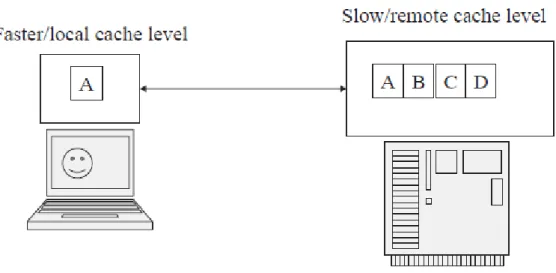
If the storage space is large, more objects can be stored on the cache storage and the probability of finding an object in the cache is thus high. The cache performs better. If the storage space is limited, only a few objects can be stored in the cachestorage, and the probability of finding an object in the cache is low. As a result, the cache performancebecomes low. Therefore, the cache size influences the cache performance. Since caching stores some previously fetched objects on the storage devices,the presence of an object exists on the storage devices significantly affects the efficiency of the caching. When a new object is being accessed, the cacheadmission policy decides whether an accessed object should be stored ontothe cache devices.Since the cache performance increases monotonically with the number ofobjects in the cache, the cache storage space is often full in order to keepthe most number of objects in the cache. When an accessed object needs tobe stored and the cache space is full, the cache replacement policy decideswhich object should be deleted from the cache storage to release space.
Figure 1.1 Memory Caching Is Achieved By Two Copies of Storage Levels
VII. CONCLUSION
Efficient search on encrypted data is also an important concern in clouds. The clouds should not know the query but should be able to return the records that satisfy the query. Accountability of clouds is a very challenging task and involves technical issues and law enforcement. Neither clouds nor users should deny any operations performed or requested. It is important to have log of the transactions performed. Cloud resource management requires complex policies and decisions for multi objective optimization. It is extremely challenging because of the complexity of the system, which makes it impossible to have accurate global state information. Thus the proposed methodology is efficient as when compared to the existing technology.
VIII. FUTURE WORK
There are some future works in the proposed system. Sincesystem stores contents on storages randomly, the content scheduling algorithm could be developed in the future in order to balance the access load on all storages as far as possible and avoid hot-spot storage to a certain extent. Another issue is that whether some storages are ultimately popular and can not even serve high class users properly. The content pieces caching algorithm may be developed in the future in order to solve this issue and improve overall system performance.
REFERENCES
[1] 2011 J. Somorovsky,et al., ―All your clouds belong to us—security analysis of cloud management interfaces,‖ ACM Comput. Commun.Security Conf.
[2] 2011 F. Zhang, et al., ―CloudVisor: retrofitting protection of virtual machines in multi tenant cloud with nested virtualization,‖ Symp. Operating Syst. Principles.
[3] 2012, S. Butt, et al., ―Self service cloud computing,‖ in ACM Comput. Commun Security Conf.
[4] 2012 V. Varadarajan, et al., ―Resource freeing attacks: improve your cloud performance (at your neighbor’s expense),‖ ACM Comput. Commun.Security Conf.
[5] 2012 ―Xen security advisory 19 (CVE 2012 4411)–guest administrator can access QEMU monitor console.‖ Available: http://lists.xen.org/archives/ html/xen announce/2012 09/msg00008.html
[6] 2013 Amazon Inc., ―Amazon elastic compute cloud (Amazon EC2),‖. Available: http://aws.amazon.com/ec2/
[7] 2013, K. Beaty, et al., ―Network level access control management for the cloud,‖ in IEEE Int. Conf. Cloud Eng.
[8] 2013, C. Yu, et al., ―Protecting the security and privacy of the virtual machine through privilege separation,‖ Int. Conf. Comput. Sci. Electron. Eng.
[9] 2013 ―Windows Azure.‖ Available: http://www.windowsazure.com/en us/