Capital: Ankara
Inhabitants: 70.586.256 (2008)
Area:783.562 km²
1. Introduction
Turkey is a parliamentary, multi-party republic located between Asia and Europe. The country has 70,586,256 (2007) inhabitants over a territorial surface area of 780,580 km2. The Grand National Assembly is composed of 550 seats and elections take place every five years. These elections are held by proportional vote, but with a minimum threshold of 10% of the votes at the national level to enjoy representation at the Assembly. The President of the Republic was designated by the National Assembly for seven years until October 2007. Constitutional reforms including the election of the President by direct universal suffrage and the reduction of the President’s term to five years were adopted by referendum in 2007.
Turkey is divided into seven geographical regions (Marmara, Aegean, Mediterranean,
Central Anatolia, Eastern Anatolia, Southeastern Anatolia and Black Sea) with no political or administrative connotations. Since September 2002, it also includes regions divided according to the Europeans NUTS model (12). It is divided into 81 provinces, 3,225 municipalities (2007) and 35,000 villages .
In Turkey, the creation of the first local authorities dates back to the second half of the 19th century. The first municipality was created in 1854 in Istanbul. The special provincial administration (SPA) and the village were created in 1864, but the modern municipality goes back to 1930. The Constitution of 9 July 1961 establishes the principle of decentralisation (Art. 115) and territorial organisation along three levels: special provincial administration, municipality and village (Art. 116). The current Constitution of 7 November 1982 takes these articles up again and defines local authorities as those legal personalities whose deliberative bodies are elected and charged with ensuring the collective local needs of a village, an urban zone (belde) or a province. The creation of metropolitan municipalities in 1984 and the transfer of responsibilities and powers and financial resources the following year mark great steps forward in decentralisation. A new period of reform was observed over the course of the years 2004–2006. New laws were adopted covering municipalities (No.
Republic of Turkey
(Türkiye Cumhuriyeti)
II 5393 of 3 July 2005), metropolitan
municipalities (No. 5216 of 10 July 2004) special provincial administrations (No. 5302 of 22 February 2005), unions of local authorities (No. 5355 of 26 May 2005) and development agencies (regional) (No. 5449 of 25 January 2006).
2. Territorial structure
According to the current administrative distribution, each provincial territory equally and necessarily corresponds to a special provincial administration comparable to the French départements of the 19th century. The central government appoints the Provincial Administrator, who is both representative of the State within the province and the head of the executive body of the province’s local administration. The SPA has a general council, il genel meclisi, elected through direct universal suffrage for five years. It also has an executive committee, il daimi encümeni, composed of elected and appointed councillors. Since 2005, the general council also elects a president. Special provincial administrations have a budget funded by light taxes as well as by transfers coming directly from the State. In relation to the extent of their territories and the diversity of their urban and rural populations, SPAs only enjoy weak administrative and financial autonomy.
The village, which is legally recognised under public law, possesses a deliberative council and a chief, both of which are elected every two years through direct universal suffrage. However, it lacks
financial resources and is completely ill-suited to be able to fulfil its functions as defined by law . The chief has been paid by the central government since 1987 just like a State employee. At present, all technically and socially-based services are ensured by the SPAs and by the decentralised services of the central government.
A municipality is created in all the main towns of provinces and districts and in agglomerations where the population exceeds 5,000 inhabitants. It has two collegiate bodies: a municipal council whose members are elected directly through universal suffrage for five years, and an executive council composed of both elected members and appointed members. The municipal council is the deliberative body of the municipality. The mayor, the executive body of the municipality, is elected directly by the citizens on the first ballot. The majority of Turkey’s population is urban (59.25% in 2000 and 60.3% in 2004). The percentage of the municipal population reached 86.7% in 2005.
The place of local authorities (including the Bank of the Provinces and the management of water, sewage, natural gas and public transportation) in public finances can be summarised as follows: The local authorities ensure the majority of civil public investments: more than 80% and from 1.6% of the GDP .
In Turkey, metropolitan areas enjoy a specific status. The metropolitan municipality was created to resolve the
Table 1: public expenditures (in %) Year Local public expenditure in relation
to total expenditure Local public expenditure in relation to the GDP
2000 12.6 4.73
2001 11.3 5.23
2002 8.8 3.77
2003 10.4 4,08
2004 11.1 3.94
III problems of metropolitan areas by Law No.
3030 of 9 July 1984. This law touches on two levels, with district municipalities (ilçe belediyeleri) at the lower level and large municipalities at the upper level. The large municipality is essentially charged with coordination of the metropolitan level. The new law on the management of large municipalities has strengthened the large municipality’s control over the lower level, to which a new category has been added: that of the first-tier municipality (ilk kademe belediyesi). The upper level’s control bears especially on the budget and on urban planning, while the lower level manages operations such as scheduling specific activities and furnishing services and functions on a daily basis.
3. Local democracy
In Turkey, national political parties achieve better penetration into the local structures of representation. Nevertheless, recent research shows that local issues and the personality of the candidate are just as important for the electorate . Local elections are multi-party elections. In 2004, 20 parties competed with each other for 3,519 mayoral seats. Municipal elections are single ballot elections and the candidate who finishes at the top of the list carries the municipality. The local electoral system is based on the principle of proportional representation. Local elections are held every five years, and contrary to legislative elections, there is no threshold for the percentage of votes required. For the election of the general councils (provincial), each district is a constituency; for the election of mayors and municipal councils, each town or village is a constituency. The lands falling within a metropolitan municipality form the constituency for electing a metropolitan mayor .
The rate of participation in local elections in Turkey is relatively high. In 2004, this was close to 72% for the election of mayors, close to 70% for the mayors of metropolitan municipalities, and more than 75% for the election of provincial councils. On the other hand, the direct democratic procedures prescribed by law are very limited. Citizens are called upon to participate directly in decision-making when a new community is created in a populated area, such as a village, a group of villages, or even through consolidation. The new law on municipalities only provides for one form of democratic participation: town councils. However, certain local authorities organise referendums on local issues by their own initiative. Likewise, as a result of the Law on the Right to Information (Law No. 4982 of 24 October 2003), certain civic initiatives such as ‘Civil society follows the budget’ have been launched .
Although the mahalle cannot legally be classified as a local authority, it can be cited as a traditional and important local institution. Endowed with a chief and council that are elected but have no responsibilities and powers, own resources or legal personality, it corresponds to the districts of a town and can be considered a factor for strengthening participation as long as the chiefs of the mahalle are also charged with representing their mahalle in the town councils.
4. Relations between central and local authorities
There are two central government structures in regard to issues affecting local authorities: the General Directorate of Local Authorities, belonging to the Ministry of the Interior, and the Bank of the Provinces. Created in 1945 (Law No. 4759 of 13 June 1945), the Bank of the Provinces not only provides financial aid to local authorities, but it also offers
IV important technical assistance including
the preparation of geographical maps, land occupation plans, and other projects, as well as the performance of certain public works. It is also charged with allocating funds to local authorities from the revenues received through national taxation.
Local authorities are constitutional entities, and their responsibilities and powers are established by law. The Constitution also provides for the creation of specific forms of management for metropolitan agglomerations, as well as a transfer of resources to local administrations in consideration of their responsibilities, powers and functions. Article 127 of the Constitution endorses an administrative control whose modalities are established by law. However, supervision by the central government was lightened considerably when the recent reforms were passed. The new laws on local authorities have eliminated the Provincial Administrator’s control over the budgets and deliberations of the local councils. Henceforth, the Provincial Administrator will only be able to refer a matter to the administrative court if he/she judges that a deliberation does not conform to the law. The respective laws on local authorities also provide for internal and external mechanisms of control, to include control over legality, financial control and performance evaluation. External controls are carried out by the State Audit Office within the framework of the Law on the Financial Control of the Public Sector No. 5018 of 10 December 2003. The Ministry of the Interior also has power over administrative control, but not over the financing of local authorities. Legislation on local authorities also prescribes the conditions and modalities of impeachment, revocation and dissolution for local elected officials.
In certain cases, conflicts arise between local authorities and certain centralised sectorial institutions. For example, the project to build a third bridge over the Bosporus, which would have formed part of a trans-European motorway as established by the General Directorate of Bridges and Pavement belonging to the Ministry of Land Use and Housing, provoked firm opposition from the metropolitan municipality of Istanbul and its inhabitants. Local authorities can refer issues to the administrative court when there is a conflict of interest. However, the decision of the administrative court can be contested at the State Council.
The Constitution stipulates that local authorities can create unions on the condition that they obtain approval from the Council of Ministers (Law No. 5355 of 26 May 2005). These unions are not local authorities but rather public establishments, and their number is growing. 72% of these unions are created with the aim of providing certain services to villages. Urban unions only made up 5% of the unions of local authorities in 1995. However, from the 1990s onwards, unions arose for protecting the environment and for creating and managing infrastructure . In 2006 there were 915 village unions and 319 irrigation unions . On the other hand, efforts to create a confederation that would encompass the regional unions of the municipalities was stopped by the State Council in 1979 .
5. Local responsibilities and powers The largest share of municipal budgets is allocated for operating expenditure. Investments constitute the second category of expenditure. However, there are no regular statistics that allow the classification of responsibilities and powers in relation to expenditure made. According to a study carried out by the Organisation
V for State Planning on four metropolitan
municipalities (Istanbul, Izmir, Bursa and Kayseri), their priority responsibilities and powers are related to infrastructure and urban planning, followed by the environment, public hygiene and health . As for the SPAs, investments constitute their main expenditure. The responsibilities and powers of the SPAs are relatively limited and essentially rural in nature, since urban zones receive basic urban services from the municipality. For the same reason, the number of staff employed by the SPAs is very limited in relation to the municipalities. However, there are no quantified data on the staff employed by the SPAs. The construction and maintenance of public buildings and notably of educational buildings constitute the primary investment expense for the SPAs. In 2003, 92% of investment expenditure was destined to this sector . The transfer to the municipalities of responsibilities and powers related to urban planning was the main thing at stake in decentralisation activities in 1985. After 20 years of experience, the record is rather negative and municipalities’ practices provoke much debate due to deviances that compromise the public interest. Recent reforms have attempted to respond to this, and the new law on metropolitan municipalities has provided for a superior level of control over lower-level municipalities. The new laws on local authorities have transferred new responsibilities and powers to the local authorities, especially in the field of health, education, and natural and cultural heritage. On the other hand, the distribution of responsibilities and powers among different levels of local authorities in Turkey has never been performed domain by domain. As a result, responsibilities and authorities tend to overlap. Nevertheless, this does not really provoke conflict among the local
authorities, and services are provided by the local authority that can.
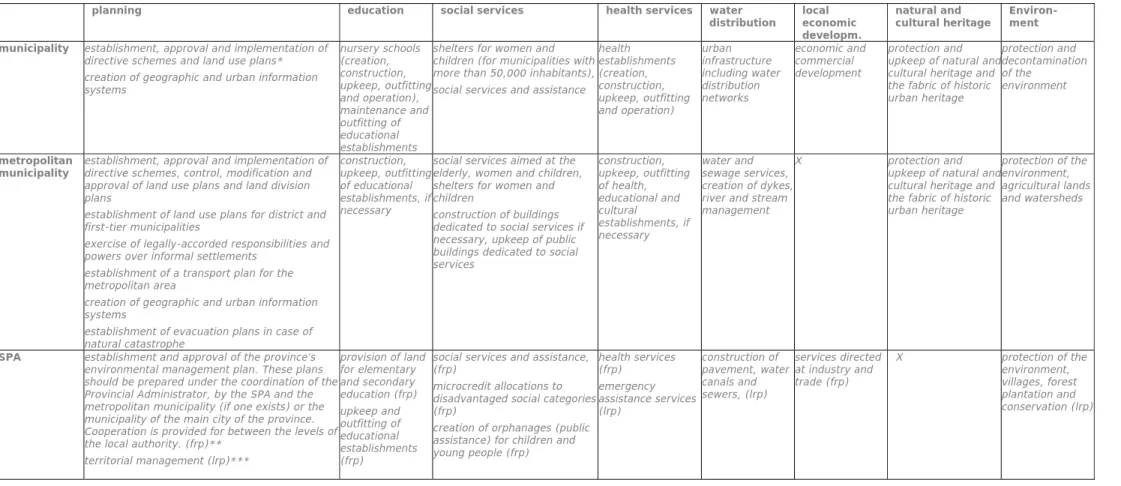
A detailed overview is provided in table 2 (see annex).
6. Financing for local authorities The local authorities in Turkey are not invested with their own fiscal powers. However, the municipalities do collect certain local taxes, notably the tax on landed property. They are also represented in the “appreciation commission”, which is charged with setting the amount upon which this tax is based, and thus are invested with a certain power to set the basis of local property taxes. Local taxes that constitute the own resources of municipalities are the tax on landed property, the tax on entertainment, the tax on communications, the tax on electricity and gas consumption, the tax on fire insurance, the tax on environmental protection and the tax on street cleaning. In 2002, (own) local taxes represented 12.4% of municipal revenue. The SPAs did not have an own local tax. However, one portion is allocated to the SPAs based on the result of the property tax collected by the municipalities. According to some authors , it is therefore more accurate to consider this as a transfer. Besides, it has proven difficult to calculate the SPAs’ own revenues except for tax revenue, for their budgets do not allow for differentiation between revenues allocated by the central government and their local revenues . According to one study, the provinces’ own revenues are approximately 15% .
As for the metropolitan municipalities, they are authorised to retain a certain percentage of taxes collected within their territories by the central authority. The district and first-tier municipalities also transfer a certain percentage of their portions of the product of the national
VI budget to the metropolitan municipalities.
Furthermore, 50% of the taxes on entertainment, as well as 50% of the revenue obtained from car parks, are directed to the metropolitan municipalities. The fees and local rights on different public, sports and cultural installations, and on public announcements, also contribute to metropolitan municipal revenue. However, the statistics available do not allow for a precise analysis of the metropolitan municipalities’ own revenues . The ratio of public municipal expenditure per inhabitant over the total expenditure in the public sector per inhabitant for the year 2002 is at 8% . Article 12 of Law No. 5018 of 10 December 2003 on Public Finances provides for a distinction between the general budget and the specific budget. The budgets of the local authorities form part of the general budget. The specific budget designates the budgets of public establishments attached or linked to a ministry, created by the provision of a specific public service. The local authorities’ other taxes and resources come from participation in public expenditures, fees and products of paid services. They are managed and regulated by the local authorities.
The Law on Municipalities published in 1930 provided for a specific system for municipal staff. However, the necessary legal regulations were never adopted, leaving municipal staff to be subject to the same system used for national public employees. The staff employed in the municipalities amounted to 9.65% of all public employees in 1995. This figure has remained relatively stable throughout the period of the Republic. 32% of municipal staff is employed by metropolitan municipalities . Law No. 657 of 14 July 1965 on Public Employment recommends four different positions: civil servant, employee, contract personnel and temporary personnel. However, the actual
situation has differentiated itself considerably from these legal measures, and four categories of employee have been affirmed: civil servant, contract personnel, permanent employee and temporary employee. In 2002, there existed a total of 263,684 agents, of which only 91,397 were civil servants .
Public administration is a professional vocation in Turkey, and it is well established in the sense that there exist relatively objective norms regarding hiring, promotion and the rights and responsibilities of civil servants . However, it is evident that reform to the public administration system is imperative in order to eliminate certain dysfunctions due mainly to the lack of transparency, corruption and nepotism. The government published Law No. 5176 of 25 May 2004 to create an ethics committee to oversee public employment. Law No. 3628 of 4 May 1990 on Fighting Corruption was modified by Law No. 5020 of 26 December 2003. The Penal Code (Law No. 5237 of 26 September 2004) that entered into law on 1 June 2005 also defined the crimes linked to corruption in the sphere of public employment.
7. Conclusion
Decentralisation is advancing quickly in Turkey. The responsibilities and powers of the local authorities have expanded and supervision by the central government has lightened considerably, especially in view of the reforms carried out over the course of the last three years. However, this supervision has not yet become limited by legal controls. As the middle tier of the local authorities, the SPAs have been allocated new responsibilities and powers, and from now on they will have a president of a general council elected by the council members. However, the Provincial Administrator maintains his/her position at
VII the head of the SPA as the executive body.
As for the villages, even though the quality of their local authority is never put into question, they have been kept in a comatose state with an elected chief and council but no revenue, responsibilities or powers.
Reforms have not noticeably modified financing for local authorities. However, it is best to remain prudent, especially with regard to financing for municipalities. The municipalities are constantly distancing themselves from the traditional organisation of the public sector. They make use of companies and municipal foundations to escape the control of the central government . To be able to fairly evaluate the weight and exact role of local authorities in Turkish political and economic life, it is necessary to take the local authorities’ extra-budgetary financial and economic activities into consideration. In fact, more expansive decentralisation would also require complete transparency and responsibility from the part of the local authorities.
Yeseren ELICIN
Annex
Table 2: The distribution of powers
planning education social services health services water
distribution local economic developm. natural and cultural heritage Environ-ment municipality establishment, approval and implementation of
directive schemes and land use plans* creation of geographic and urban information systems nursery schools (creation, construction, upkeep, outfitting and operation), maintenance and outfitting of educational establishments
shelters for women and children (for municipalities with more than 50,000 inhabitants), social services and assistance
health establishments (creation, construction, upkeep, outfitting and operation) urban infrastructure including water distribution networks economic and commercial development protection and upkeep of natural and cultural heritage and the fabric of historic urban heritage protection and decontamination of the environment metropolitan
municipality establishment, approval and implementation of directive schemes, control, modification and approval of land use plans and land division plans
establishment of land use plans for district and first-tier municipalities
exercise of legally-accorded responsibilities and powers over informal settlements
establishment of a transport plan for the metropolitan area
creation of geographic and urban information systems
establishment of evacuation plans in case of natural catastrophe construction, upkeep, outfitting of educational establishments, if necessary
social services aimed at the elderly, women and children, shelters for women and children
construction of buildings dedicated to social services if necessary, upkeep of public buildings dedicated to social services construction, upkeep, outfitting of health, educational and cultural establishments, if necessary water and sewage services, creation of dykes, river and stream management
X protection and
upkeep of natural and cultural heritage and the fabric of historic urban heritage
protection of the environment, agricultural lands and watersheds
SPA establishment and approval of the province’s
environmental management plan. These plans should be prepared under the coordination of the Provincial Administrator, by the SPA and the metropolitan municipality (if one exists) or the municipality of the main city of the province. Cooperation is provided for between the levels of the local authority. (frp)**
territorial management (lrp)*** provision of land for elementary and secondary education (frp) upkeep and outfitting of educational establishments (frp)
social services and assistance, (frp)
microcredit allocations to disadvantaged social categories (frp)
creation of orphanages (public assistance) for children and young people (frp) health services (frp) emergency assistance services (lrp) construction of pavement, water canals and sewers, (lrp) services directed at industry and trade (frp) X protection of the environment, villages, forest plantation and conservation (lrp)
*Except for first-tier district municipalities, these can only establish land use plans in consideration of directive schemes established by the metropolitan municipality. These land use plans can be controlled and approved by the metropolitan municipality in question.
** (frp): full responsibilities and powers, exercised throughout the province