Available online throug
ISSN 2229 – 5046NUMERICAL INVESTIGATION ON HEAT TRANSFER
THROUGH A POROUS MEDIUM DUE TO SHRINKING SHEET
IN THE PRESENCE OF MHD AND SUCTION
R. KAVITHA*
1AND BALAKRISHNAN RAMASAMY
21Department of Mathematics, SRM University, Chennai - 600089, India.
2Operations Planning, Siemens Gamesa Renewable Power Pvt. Ltd, Chennai - 600119, India.
(Received On: 03-12-18; Revised & Accepted On: 05-03-19)
ABSTRACT
I
n present paper we investigated the effect of MHD convective steady flow and heat transfer through a porous medium over a shrinking sheet with suction using shooting procedure with fourth order Runge-Kutta Method. The velocity, temperature distributions are calculated for different governing parameters. The effect of various non-dimensional parameters like magnetic parameter (M), suction parameter(𝑆), permeable parameter (K) areinvestigated with the aid of graphs.Keywords: MHD, Heat transfer, Porous medium, Steady flow, Shrinking sheet, Suction.
1. INTRODUCTION
The Magnetohydrodynamics flow and heat transfer over a shrinking sheet has many applications such as metal spinning, glass fiber production, wire drawing, paper production and polymer processing and many others. This fluid flow has received attention of many researchers due to its applications. The technique of this flow is mainly used in purification of molten metal from non-metallic inclusion.
Andersson [1] studied the slip effects on boundary layer stagnation-point flow and heat transfer towards a shrinking sheet and later it was extended by Santosh Chaudhary and Pradeep Kumar [10] for viscous, incompressible, electrically conducting fluid near a stagnation point past a shrinking sheet with slip in the presence of a magnetic field. Cortell [5] studied the heat transfer of a fluid flow through a porous medium over a stretching surface.
Wang’s [12] studied the stagnation point flow towards a shrinking sheet. Crane [4] studied a closed form solution for the steady two-dimensional flow of an incompressible viscous fluid caused by the stretching of an elastic sheet. Gupta and Gupta [7] extended the work of Crane by investigating the effect of mass transfer on a stretching sheet with suction or blowing with uniform temperature.
Bhattacharyya and Pop [3] studied MHD boundary layer flow due to an exponentially shrinking sheet. Ahmad et.al [2] investigated MHD flow and heat transfer through a porous medium over a stretching/shrinking surface with suction. Jat and Gopi [8] analyzed steady two-dimensional laminar flow of a viscous incompressible electrically conducting fluid over an exponential stretching sheet in the presence of a uniform transverse magnetic field with viscous dissipation and radiative heat flow is studied. Elbashbeshy [6] furnished numerical findings about flow and heat transfer over an exponentially stretching surface subjected to mass suction. Vyas and Srivastava [11] discussed radiative MHD flow over a non-isothermal stretching sheet in a porous medium. Sajjad and Farooq [9] considered unsteady MHD flow and heat transfer for Newtonian fluids over an exponentially stretching sheet.
The aim of this paper is to study the effect of magnetohydrodynamic steady flow over an shrinking sheet with suction condition through porous medium. The equations with the boundary conditions are then solved numerically by fourth-order Runge-Kutta scheme together with shooting method. The pertinent findings are discussed graphically.
Corresponding Author: R. Kavitha*1,
2. MATHEMATICAL ANALYSIS
Consider steady, two-dimensional laminar flow of viscous fluid through porous medium due to shrinking sheet. The fluid is electrically conducting. Magnetic field 𝐵0 is applied in normal direction to the sheet. A convective heat source with heat flux boundary conditions provides temperature 𝑇𝑤 at the surface. The Cartesian coordinates are used. The x-axis is along the sheet and y-axis is perpendicular to it. The induced magnetic field is neglected. The governing equations of the motion are:
𝜕𝑢 𝜕𝑥+
𝜕𝑣
𝜕𝑦= 0 (1)
𝑢𝜕𝑢𝜕𝑥+𝑣𝜕𝑢𝜕𝑦=𝛾𝜕𝜕𝑦2𝑢2− 𝛾 𝐾0𝑢 −
𝜎𝐵02
𝜌 𝑢 (2)
𝜌𝐶𝑝�𝑢𝜕𝑇𝜕𝑥+𝑣𝜕𝑇𝜕𝑦�=𝑘′ 𝜕 2𝑇
𝜕𝑦2+𝜎𝐵02𝑢2 (3)
In the above system of equations, 𝑢 and 𝑣 represent velocity components in 𝑥 and 𝑦 directions respectively. 𝜇,𝜌,𝜎 and𝛾= (𝜇 𝜌⁄ ) represent respectively the coefficient of viscosity, density, electrical conductivity and kinematic viscosity of the fluid. The constant parameters in the system are: 𝑘′ and 𝐶𝑝 respectively the permeability of porous material and specific heat at constant pressure.
The appropriate boundary conditions are, 𝑢=𝑐𝑥, 𝑣=−𝑣0 at y=0, −𝑘′�𝜕𝑇
𝜕𝑦�=𝑞𝑤=𝐸0𝑥2 at𝑦= 0 (4)
𝑢 →0, 𝑇 →0 as 𝑦 → ∞ (5)
3. SOLUTION OF THE PROBLEM
In this work, similarity technique is used to solve the system of equations (1)-(3) along with the boundary conditions (4) and (5). The similarity transformations are,
𝑢=𝑐𝑥𝑓′(𝜂), 𝑣=−√𝛾𝑐𝑓(𝜂) (6)
𝑇 − 𝑇∞=𝐸𝑜𝑥 2
𝑘′ 𝜃(𝜂) (7)
where𝜂 is similarity variable defined as 𝜂=𝑦�𝑐
𝛾 is dimensionless variable. 𝐸0 is positive constant, 𝑞𝑤is the ratio of
heat transfer.
Introducing the above transformations in equations (1) - (3). The equation (1) is readily satisfied and the equations (2) and (3) becomes:
𝑓′′′+𝑓𝑓′′− 𝑓′2−(𝑀2+1
𝐾)𝑓′= 0, (8)
𝜃′′+𝑃𝑟𝑓𝜃′−2𝑃𝑟𝑓′𝜃 − 𝑀2𝐵𝑟𝑓′2= 0, (9)
where 𝐾=𝑐𝐾0
𝛾 represents the permeability of porous medium, 𝑀2= 𝜎𝐵02
𝜌𝑐 represents the magnetic parameter,
𝑃𝑟=𝜇𝐶𝑝⁄ ′𝜅 represents the Prandtl number and 𝐵𝑟=𝜇𝐶𝑝
𝐾′ 𝑐2𝑥2𝐾′ 𝐸0𝑥2𝐶𝑝�
𝑐
𝛾 denotes the Brinkman number.
The boundary conditions (6) and (7) transform to the following form, 𝑓(0) =𝑆, 𝑓′(0) = ±1, 𝜃′(0) =−1,
𝑓′(∞) = 0, 𝜃(∞) = 0 (10)
Here 𝑓′′ =𝑣 and 𝜃′=𝑧 are the initial guesses which are arbitrarily chosen and an iterative procedure is set to obtain solutions through Runge-Kutta fourth-order method. The computational procedure involved to find the maximum value of η for which f’(0) → 0 and θ(η) → 0 at η → ∞ and find the proper estimates for the unknown quantities f’’ (0) and θ’ (0).
It is not out of place to make remark that the “guesses” were made purely on hit and trial basis and their refinement was interpolated iteratively with the prescribed error tolerance. A grid independence study was also carried out to examine the effect of step size Δη. A step size of Δη = 0.1 was found to be satisfactory for a convergence criterion of 10−6in all cases.
The process is repeated until we obtain the correct results upto the desired accuracy of 10−6 level.
and boundary conditions become,
𝑥(0) =𝑆, 𝑤(0) = 1, 𝑧(0) =−1 at 𝜂= 0 (13) 𝑤(0)→0,𝑦(0)→0 as 𝜂 → ∞ (14)
4. RESULTS AND DISCUSSION
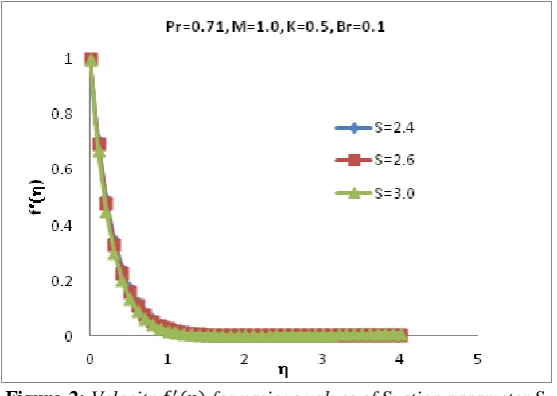
The equations (8) and (9) are solved subject to the boundary conditions (10). The numerical results have been computed by using Mathematica 6.0 software. The effects of the physical parameters namely magnetic parameter 𝑀, suction parameter 𝑆 and permeability parameter 𝐾 have been noticed on velocity and temperature distributions. The results have been presented graphically. The effects of various parameters on the velocity profiles are depicted in figures (1)-(3). The effects of various parameters on the temperature profiles are depicted in figures (4)-(6).
Figure-1: Velocity 𝑓′(𝜂) for various values of Magnetic field M
Figure-2: Velocity 𝑓′(𝜂) for various values of Suction parameter S
Figure-3: Velocity 𝑓′(𝜂) for various values of Permeability parameter K
Figure-4: Temperature profile 𝜃(𝜂) for various values of Magnetic field M
Figures (4) - (6) depict the variation in 𝜃(𝜂) for various values of magnetic parameter𝑀, suction parameter 𝑆 and permeability parameter 𝐾. The Fig-4, Fig-5 and Fig-6 respectively show that the temperature 𝜃(𝜂) decreases with increasing values of magnetic parameter 𝑀, suction parameter 𝑆 and permeability parameter 𝐾.
c
Figure-6: Temperature profile 𝜃(𝜂) for various values of Permeability parameter K
5. CONCLUSION
We have investigated the effect of magnetohydrodynamicconvective steady flow and heat transfer through a porous medium over a shrinking sheet with suction using shooting procedure with fourth order Runge-Kutta Method. The effects of various parameters on the flow and heat transfer are observed from the graphs, and are summarized as follows:
Velocity profile increases as we increase the values of magnetic parameter 𝑀 and permeability parameter𝐾. It is also observed that velocity profile decreases as we increase the values of suction parameter 𝑆.
Temperature profile decreases as we increase the values magnetic parameter𝑀, permeability parameter𝐾 and suction parameter 𝑆.
REFERENCES
1. H.I. Andersson, Slip flow past a stretching surface, Acta Mechanica, 158, 121-125, 2002.
2. F. Ahmad , S. Hussain , A. M. Alanbari and R. S. Alharbi, MHD flow and heat transfer through a porous medium over a stretching/shrinking surface with suction, Sci.int(Lahore), 27(2), 931-935,2015.
3. K. Bhattacharyya and I. Pop, MHD boundary layer flow due to an exponentially shrinking sheet,
magnetohydrodynamics, 47(4), 337--344, 2011.
4. L. J. Crane, Flow past a stretching plate, Zeitschrift fur Angewandte Mathematik und Physik, 21(4), 645--647, 1970.
5. R. Cortell,On a certain boundary value problem arising in shrinking sheet flows, Appl. Math. Comput.,217, 4086--4093, 2010.
6. E. M. A. Elbashbeshy, Heat transfer over an exponentially stretching continuous surface with suction,
Archives of Mechanics, 53, 643-651, 2001.
7. P. S. Gupta and A. S. Gupta, Heat and mass transfer on a stretching sheet with suction or blowing, The Canadian Journal of Chemical Engineering, 55 (6), 744--746, 1977.
8. R.N Jat and Gopi Chand, MHD flow and heat transfer over an exponentially stretching sheet with viscous dissipation and radiation effects, Applied Mathematical Sciences, 7(4), 167-180, 2013.
9. Sajjad Hussain, Farooq Ahmad, Unsteady MHD flow and heat transfer for Newtonian fluids over an exponentially stretching sheet, Sci.Int. (Lahore),27(2), 853-857, 2015.
10. Santosh Chaudhary and Pradeep Kumar, MHD Slip Flow past a Shrinking Sheet, Applied Mathematics, 4, 574-581, 2013.
11. P. Vyas and N. Srivastava, Radiative MHD flow over a non-isothermal stretching sheet in a porous medium,
Applied Mathematical Sciences, 4, 2475–2484, 2010.
12. Wang, C, The three-dimensional flow due to a stretching flat surface, Physics of Fluids, 27, 1915-1917, 1984.
Source of support: Nil, Conflict of interest: None Declared.