Using Tree Adjoining Grammars in the
Systemic Framework*
K a t h l e e n F . M c C o y , K . V i j a y - S h a n k e r , G i j o o Y a n g U n i v e r s i t y of D e l a w a r e
N e w a r k , D E 19716
A b s t r a c t
In this paper we investigate the incorporation of Tree Adjoining Grammars (TAG) into the systemic framework. We show that while systemic grammars have many desirable characteristics as a generation paradigm, they appear to have problems in generating certain kinds of sentences (e.g., those containing discon- tinuity or long-distance dependencies). We argue that these problems can be overcome with an appropriate choice of structural units of realization.
We show that TAG provides appropriate units of structural realization because they localize all depen- dencies and allow the realization of two independent subpieces to be interspersed with each other. We go on to show how TAG can be incorporated without affect- ing the basic tenants of systemic grammar. Finally, we indicate how the incorporation of TAG yields several benefits to the systemic framework.
I n t r o d u c t i o n
As pointed out by many researchers (e.g., [Davey 1978; Mann 1983; Matthiessen & Kasper 1985; Patten 1988; Bateman & Paris 1989]), systemic linguistics offers many advantages to a sentence generation component of a text generation system. Perhaps the strongest as- set of systemics is its view of the generation process as a goal directed enterprise. Its emphasis is on func- tion rather than form [Halliday 1985; Fawcett 1980; Hudson 1971], where the functional distinctions that are required in the grammar manifest themselves in the eventual output form.
While systemic linguists have remained agnostic with respect to certain processing decisions, a computer im- plementation of a systemic grammar requires that ex- plicit decisions be made concerning realization opera- tors and the structures available for manipulation at each point in the processing. The explicit decisions that were made in previous implementations of systemic
*This work is supported in part by Grant #H133ES0015 from the National Institute on Disability and Rehabilita- tion Research. Support was also provided by the Nemours Foundation.
grammar (e.g., [Mann 1983; Mann & Matthiessen 1985; Matthiessen & Kasper 1985]) have proven to be prob- lematic in some respects. In particular, the current implementations have difficulty in generating certain sentences which exhibit discontinuities or long distance dependencies. To date, these can only be handled in a limited fashion, and the solutions provided are not very satisfying.
We argue that Tree Adjoining Grammar (TAG) pro- vides a structural unit that is precisely appropriate for the implementation of a systemic grammar for the gen- eration task. Moreover, we believe our use of TAG for this purpose is completely consistent with the systemic paradigm and helps to overcome the above difficulties. In this paper we first introduce the notion of a sys- temic grammar and the processing paradigm it es- pouses. We indicate problems with current implemen- tations of this paradigm. Next, we introduce the notion of lexicalized Tree Adjoining Grammars, emphasizing their structural domains of locality, and justify that the basic structures of TAG are appropriate structures to be used in an implementation of a systemic grammar. Following this we indicate how a tree adjoining gram- mar can be used as the basis for an implementation of systemic grammar indicating the differences between the approach of current implementations of systemic grammar and that which would result from the incor- poration of TAG. Finally, we indicate potential gains resulting from the incorporation of TAGs and the scope of current work.
G e n e r a t i n g i n S y s t e m i c P a r a d i g m : P r o b l e m s ?
the text as a whole).
A systemic functional grammar consists of networks of grammatical choice alternatives, where individual networks are concerned with one of the metafunctional domains. In generation, these networks are traversed and fragments of grammatical structure are built up and manipulated using a set of realization operators which are associated with the various choice alterna- tives. The correct choice is made by consulting the information concerning the planned utterances. As the choices are made, the associated realization statements in the network are evaluated in order to realize the final structure.
For instance, figure 1 contains a small fragment of a systemic grammar for clauses. The network indicates that a clause may either be simple or complex. If it is simple and full, then the grammatical function process is inserted (indicated by +process). The realization op- eration '% subject process" indicates that the subject should be ordered before the process in the final real- ization.
Systemics deals with communicative function and its eventual surface manifestation at many levels. The basic processing starts with a semantically meaning- ful piece of representation which is decomposed into its component pieces via network traversal. The compo- nent pieces may then be further specified by re-entering the network. Given this rank-based decomposition (or stepwise decomposition), it is not unreasonable to as- sume that 1) decisions at a higher rank are made prior to decisions at a lower rank - that is, the decompo- sition of a particular semantic unit may not be influ- enced by the eventual decomposition of its component pieces, and 2) the structural realizations of the com- ponent pieces of a decomposed unit must be handled independently. These criteria, which we call the inde- pendence criterion, are implicitly followed by current computer implementations of systemic grammar.
Implementing a systemic grammar on computer has forced researchers to be very explicit about certain rep- resentational issues. Such explicitness (coupled with an implicit following of the independence criterion), has enabled the uncovering of certain constructions which appear to be problematic for the systemic framework. For instance, Matthiessen points out that: "There are various structural relationships (e.g., discontinuity...) that do not pose a problem for the informal box diagram representation [used by systemic linguists] but prove to be a problem for explicit realization statements [nec- essary for computer implementations]."[Matthiessen & Kasper 1985, p. 6]. We believe that the same applies to (so called) long distance dependencies.
It can be argued that the problems uncovered by Matthiessen are not due to explicit realization state- ments, but rather result from using explicit realization statements coupled with the implicit assumption that grammatical functions are realized as atomic strings.
We further argue that if the independence criterion is to be followed, the choice of realization operators, the scope of the realization operators, and the choice of appropriate units of realization must be considered to- gether.
Consider, for example, the problems which arise in generating a sentence containing a long distance de- pendency when atomic strings are taken as the struc- tural unit of realization. Consider the sentence: "It was Mary that John thought Bill liked". A natural decom- position would result in the semantic subpieces which correspond to "john thought" and the dependent clause "bill liked mary". The extraction of "mary" will be done subsequent to this decomposition; this extraction should influence the realization of the structural unit for the dependent clause (and should not affect the func- tional decomposition). But notice, if we assume the structural units of realization are atomic strings, we can get "John thought it was Mary that Bill liked" but not our desired utterance "It was Mary that John thought Bill liked" because to do so would necessitate inserting one atomic string ("John thought") within another ("It was Mary that Bill liked").
Two possible ways to get around this problem are: (1) to say that the intended sentence is made up of sev- eral independent but smaller functions (e.g., realized as "john thought", "bill", "liked", "mary"). But this solution goes against the step-wise decomposition into semantically meaningful units. Moreover, this method is not sufficient because we can always consider a sen- tence that requires one more level of embedding which would necessitate a revision of units. (2) not to break up the sentence into the two functional constituents men- tioned, but use some other decomposition. But this is not a correct solution because then one functional de- cision at a lower level (extraction of "mary") influences another which logically precedes the first (decomposi- tion in the clause complex network).
In order to follow the independence criterion (i.e., realization of different independent functions do not in- fluence each other), the structural units being built as the realization of a grammatical function must be ca- pable of localizing all structural dependencies because they must embody all constraints specified with that function. In addition, the chosen structural units must be composable in such a way as to allow the surface string of one unit to be interspersed with the surface string for another (as was required in our example). If this is the case, then it makes sense that these struc- tural units should be taken as the bounding domain for the realization operators. The structures used by TAGs have precisely these qualities and are thus an ap- propriate choice for a structural unit of realization in an implementation of systemic grammar. The struc- tures used in a TAG have an enlarged domain of lo- cality that factor all dependencies (e.g., agreement con- straints, predicate-argument structure, filler-gap depen-
T r a n s i t i v e T r e e G r o u p
S S
NPO ~[+wh] S
NPO~ VP
NP0 VP
V NP1 ~ [
V NP1 ~¢
S
NP1 ~ S
NPO ~ VP
V NP1
I
means that at that node substitution must occur.
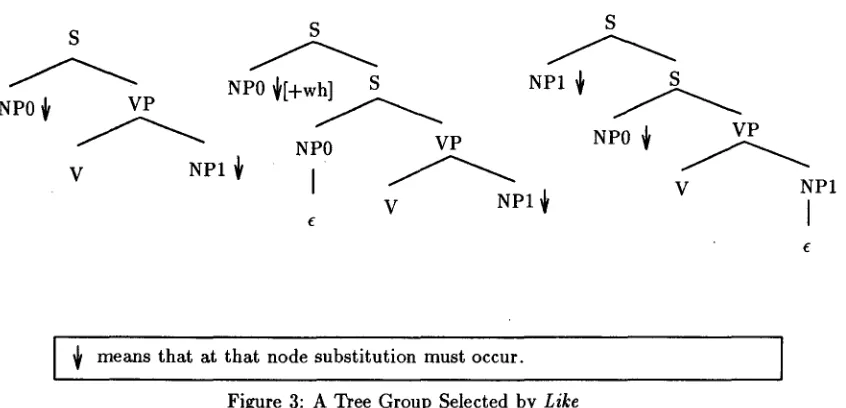
Figure 3: A Tree Group Selected by Like
from one another by syntactic variations (which we shall call transformations). For example, the verb like, which takes a nominal subject and a nominal object, selects the transitive tree group. Some of the members of this tree group axe shown in Figure 3. The figure contains three initial trees, the first corresponds to a declarative sentence, the second to a wh-question on the subject, and the third to an it-cleft construction on the object.
S - T A G s
The processing within a Systemic Tree Adjoining Grammar (S-TAG) is similar to that in systemic gram- mar (e.g., the networks axe traversed and the realization operators associated with the choices taken are evalu- ated). In S-TAG we have already stated that the indi- vidual grammatical functions are realized structurally by elementary trees and that elementary trees provide the bounding scope for application of realization opera- tors. Thus, the "functions" which are inserted into the systemic structure will be associated with elementary trees in the TAG formalism. While the types of realiza- tion operators required by S-TAG will be the same as for general systemic grammars, the individual operators will be tailored to the TAG formalism.
Regions in
S - T A GThe basic processing within a systemic grammar must take into account two dimensions of processing deci- sions:
1. Metafunctional domains. Structures are built in the three metafunctional domains (ideational, interper- sonal, and textual) simultaneously. Certain realiza- tion operators are used to "conflate" the indepen- dently built structures.
2. Processing from one "rank" to another. It is through changes in rank that semantic structures are eventu- ally realized as surface form. The general method- ology is to insert functional units into a structure. Following this, these functional units are refined by re-entering the network at a lower rank. This process continues until a surface structure has been fleshed out.
While the processing in the S-TAG grammar follows the same principles, we differ in some implementation issues to accommodate TAG. One of the major contri- butions of this work is in the processing from one rank to another. In particular, this work makes explicit the bounding domains for the realization operators which are responsible for realizing a given grammatical func- tion. Thus it becomes clear what is available for manip- ulation when a network is entered (and re-entered for specifying a function inserted during the initial network traversals). We employ the notion of a region for this purpose.
In general a region is created to expand a grammat- ical function. Since we have said that elementary trees are appropriate structural units for realizing the func- tions and for the bounding domains for the realization operators, we state that an elementary tree will eventu- ally be associated with every region. The appropriate elementary tree will be chosen after a decision has been made to insert a lexical item. Informally, this lexical item will be the lexical anchor of the elementary tree that will be chosen in the region. For this reason we will call this lexical item the lexical anchor of the re- gion also) The region serves as the bounding domain on the realization operations. All realization operations
1This approach has interesting consequences, such as adopting a head driven generation strategy within the sys-
[image:4.596.100.523.52.256.2]used within a region are applicable on the features of the lexical anchor of the region or the tree selected by this anchor. In the section on "Lexicon and Tree Groups" we will discuss how the features of the anchor, the tree groups selected, and trees selected will be maintained m a region.
Once a lexical anchor is picked, the tree groups asso- ciated with that anchor will be considered. The choices in the network will cause realization operators to be evaluated which will narrow this set of trees to one. This single tree is then said to be associated with the region and will be the structural.realization of the gram- matical function being expanded (whose expansion was the reason for the creation of the region). This filtering will be done by using realization operations that select between tree groups and those that select tree m e m b e r s within tree groups. Such realization operations will be discussed in the section on "Realization O p e r a t o r s " .
Based on the characteristics of the tree associated with a region and directives from the networks be- ing traversed, decisions to expand certain g r a m m a t i - cal functions (previously inserted in the region) will be made. Sub-regions will be created to expand these func- tions and the network will be re-entered to determine the expansion. Notice t h a t this will cause an elementary tree to be associated with each sub-region. These sub- regions must eventually be combined with the super- regions which spawned t h e m using realization opera- tions for adjoining and substitution.
This view of the process is potentially complicated since some of the realization operations to be evaluated in the region m a y not be applied before the set of trees being considered is narrowed down sufficiently. For ex- ample, an operator which selects a particular tree need not be applied until the tree groups have been narrowed to one. If at the point an operator which selects a tree is called for, if the n u m b e r of tree groups has not been reduced to one, it serves no purpose to apply the oper- ation on each tree group. Hence, in such cases, within a region we will maintain a record of realization opera- tions that have to be completed later. These operations will be applied at the appropriate time.
L e x i c o n a n d T r e e G r o u p s
In the lexicon, a lexical item will be associated with a set of tree groups, each of which contains a set of elementary trees. We choose to represent a tree group in the lexicon as a f e a t u r e - s t r u c t u r e / t r e e - g r o u p - n a m e pair. T h e feature-structure includes all of the common features of the trees within the tree groups, the features of the lexical item itself, and its lexical idiosyncrasies, if any. The tree group n a m e can be thought of as a
For example, with the lexical item,
walk,
we will associate the pairs(ft,.a,~s,trans), (fiotra,~,,intrans),
(f, ou,~, noun), trans,
for instance, is the name of the tree group for transitive verbs. All trees in this group share the information t h a t the lexical anchor is a tran- sitive verb. Thus, this information is stored inftrans
along with any other features t h a t are c o m m o n to the trees in the group. The other two pairs represent the fact that
walk
can be used as a intransitive verb as well as a noun.The trees t h a t constitute a tree group are kept to- gether. Some realization operators which will be evalu- ated in a region will refer to certain g r a m m a t i c a l func- tions t h a t are represented as nodes in the tree associ- ated with t h a t region. Hence we will use a m a p p i n g table t h a t maps abstract positions ( g r a m m a t i c a l func- tions) to actual nodes in an elementary tree.
R e a l i z a t i o n O p e r a t o r s
Having set up the notion of a region (and its asso- ciated elementary tree) as the bounding domain over which the realization operators can function, we are now in a position to discuss some of the realization operators t h a t will be used in S-TAG. These opera- tors parallel those found in other systemic g r a m m a r implementations, although they are particular to the use of TAG. According to [Matthiessen & Kasper 1985] the realization operators used in a systemic network can be viewed along three dimensions: (1) Structuring (which defines the structure and its organization within one rank and within one functional domain), (2) R a n k (which "organizes the g r a m m a r into a scale of units: clause- g r o u p / p h r a s e - word - m o r p h e m e " [Matthiessen & Kasper 1985, p. 25]), and (3) Metafunctional lay- ering (which integrates the structures developed within the various metafunctional domains (e.g., interpersonal, ideational, and textual)).
at the given point in the network. 2 As a result many of the structuring operators we introduce are designed to narrow down the trees that could possibly realize a particular function.
I n t r o d u c i n g t h e L e x i c a l A n c h o r : I n s e r t ( L e x - i t e m ) When the lexical anchor is identified in the network, this operation will be used. The purpose of this operation is not only to introduce the lexical an- chor into the region but also to bring the associated set of feature-structure/tree-group-name pairs. Thus the tree group itself is not brought in but is indirectly ac- cessible. A tree is brought into the region only after the narrowing process is completed. The anchor is then inserted into the tree.
F i l t e r i n g T r e e G r o u p s in a R e g i o n We will use one realization operation to choose among the the tree groups being considered in a region. This choice is made on the basis of some features that become known during the traversal of the network and is basically a decision about the functional units the realization must repre- sent. Thus, in some sense it is analogous to the "in- sert" operator in Nigel. For example, the insertion of a particular lexical item, say
walk,
will bring into consid- eration all possible tree groups it can participate in. If it becomes known (in the transitivity network) that the recipient function will have to be realized, then among the various tree groups of the lexical anchor of the re- gion, only the appropriate tree groups (such as those corresponding to transitive verb form) will have to be considered.For current purposes, the realization operation that filters the tree groups will be called
Select-Group
which takes a feature as an argument. In the above example, the network may cause the opera- tion: Select-Group(transitive) to be evaluated. Re- call that the three tree-groups referenced for this lexi- cal item are represented by the pairs:(ftrans,trans),
(fintran,,intrans),
and (fnoun,noun). Since the feature-structuresftran,, fintrans, fnoun are
kept in the lexicon itself rather than with the tree group, these tu- pies will be brought into the region on lexical insertion. If the realization operation Select-Group(transitive) (which is analogous to insert process and recipient in • the Nigel grammar) is evaluated in the region, the feature transitive is unified with the three feature- structuresftrans, fintrans, f.o~,n.
Since this feature is only consistent with the features inftrans,
only the pair(ftrans, trans)
will remain in the region.S e l e c t i n g T r e e s f r o m a T r e e G r o u p The realiza- tion operation used to narrow down the choice of ele- mentary trees within a tree group considered in a region
2Note it is not necessary to bring all of the syntactic structures into the region, rather much of this processing can be done based on the features stored with the lexical anchor.
is called
Select-Tree.
We had described a tree group to correspond to a specific semantic entity with all of its relevant semantic features inserted. The group it- self represents all syntactic realizations of this entity. Therefore the purpose of this operation is to choose among different syntactic forms possible. Its effect is somewhat analogous to that of the "order" operators in Nigel. For example, if during the traversal of the network it is realized that the object is to be topical- ized then the Select-Tree operation will be evaluated. Among the various syntactic variations possible, the tree(s) which realize this thematization will thus be identified.C o m p o s i n g T r e e s Recall that sub-regions are cre- ated to expand grammatical functions. The elementary trees associated with the sub-regions are to be com- posed with the tree associated with the super-region either by substitution or by adjunction. Expansion of a grammatical function is done, in the Nigel grammar, when a function is preselected with a set of features. The preselected features determine where to re-enter the network in order to expand the given function. The resulting realization will replace the original function in the eventual realization of the input. In S-TAG this is accomplished by using the realization operation
Ex-
pand(function, features).
This will cause the creation of a sub-region (which is named by the function). The realization of the function will occur in this sub-region by re-entering the network at a point determined by the preselected feature (as in Nigel).The tree which eventually realizes the function must be composed (by substitution or adjoining) with the tree in the super-region at the node corresponding to the function (as given by the mapping table). The decision to adjoin or substitute is made based on the types of the trees that are picked in the sub- and super- regions.
D i s c u s s i o n
The strongest asset o f systemic grammar is its view of generation as a goal-directed enterprise with emphasis laid on function rather than form. While our work in- volves the incorporation of a syntactic formalism into systemic grammar, we have not departed from the gen- eral approach of systemics view of generation. Sys- temic linguists, however, have not been interested in the details of the mapping between functional choices and the resulting form. In particular, they are not con- cerned with the details of the structural units that are realized. In a computer implementation, a programmer needs to be concerned about the details of the structural units, how they are realized, and how the constraints of systemic grammars are translated as principles of im- plementation. It is in this context that we propose the use of TAG trees as appropriate structural units and examine the processing paradigm (and its logical con-
sequences) that follows from such a choice. Thus, the incorporation of TAG is more than just a simple addi- tion of a syntactic formalism to the systemic framework. We argue that the incorporation of TAGs enriches a sys- temic grammar implementation for the following rea- sons:
First, systemic linguists have stressed the notion of stepwise semantic decomposition as a constraint on any implementation of a systemic grammar. Hence it is not unreasonable to expect the realization of the form to conform to the decomposition of the semantic units. We have called this the independence criterion, indicating that independent decomposed functional units be real- ized independently in any implementation of systemic grammar. We argued that in order to be consistent with this paradigm, we have to choose appropriate struc- tural units as realizations of semantic/functional pieces. These units must capture all necessary structural rela- tionships, and should be the bounding domains for the realization operators that build them. Under these con- ditions, we argued that the structural units should have a "large" enough notion of locality to be able to factor out all structural dependencies. Since the elementary structures of TAGs are "minimally complete" to allow for the factoring of dependencies, we have argued that they are appropriate structures that can be built and manipulated in an implementation of systemic gram- mar. T h e y also form appropriate bounding domains for the realization operators. Our preliminary work on incorporating TAGs in the systemic framework gives us encouragement to believe that this is indeed the case.
Second, in addition to justifying the use of TAG structures for systemics, we can show that we can han- dle the discontinuity (which we did not explicitly dis- cuss for lack of space) and long distance dependency problem which plague other implementations of sys- temic grammars. The key point to make here is that not only are these handled but that generation of utter- ances with discontinuity or long distance dependencies is conceptually no different than generation of utter- ances without any form of discontinuity.
Third, systemic grammar places emphasis on func- tion over form and makes clear that functional distinc- tions in the input manifests themselves in the different available forms. It is clear that our approach brings this aspect of systemics to the fore front. Note that the different trees in a tree group yield various syntactic re- alizations of a single predicate-argument structure. As we step through the network, various choices are made on the basis of the functional content of the planned utterance. These choices will result in choosing one syntactic realization over another.
Finally, what we have suggested calls for putting to- gether two formalisms so that a mainly semantics driven processor (systemics) is able to reap some of the advan- tages of a syntax driven (TAG) approach. Currently a systemic network employs limited mechanism for carry-
ing through the syntactic consequences of the decisions that it makes. Thus one of two things has to happen:
1. the network designer must anticipate all syntactic consequences and explicitly state each of them at the time a decision is made. This is not an ideal solution, especially when the network becomes very large.
2. the system must depend on the environment being consistent in order to carry out the desired conse- quences. In this case the syntactic consequences are strung throughout the network (perhaps p r o m p t e d by different questions that are asked). The envi- ronment must be counted on to answer those ques- tions in a consistent fashion. Even if the informa- tion is straightforwardly captured in the environment (which is unclear), due to lack of the ability to carry out syntactic consequences, it becomes necessary to ask questions of the environment (to make choices) that are redundant. In addition, this arrangement goes against the systemic enterprise in which the en- vironment keeps track of semantic content.
The addition of TAG allows an independent mech- anism (e.g., the T A G processing) to maintain consis- tent syntactic consequences of decisions made. For ex- ample, agreement constraints are precompiled into the tree. Also, for example, given the choice of a particular lexical item - once the trees for that item have been narrowed to one, the tree itself will contain the infor- mation about what functions must be expanded. Thus this information need not be included in the network as well.
We believe that network design will be simpler be- cause the incorporation of TAG makes possible clear demarcation of semantic choices from syntactic conse- quences. Also it allow for the separation of lexical id- iosyncrasies into the lexicon rather than the network.
R e f e r e n c e s
[Bateman ~ Paris 1989] Bateman, J. and Paris, C. 1989. Phrasing a text in terms the user can under- stand. In: Proceedings of the 11th International Joint Conference on Arlificial Intelligence, IJCAI-89, De- troit, Michigan: 1511-1517.
[Davey 1978] Davey, A. 1978. Discourse Production. Edinburgh University Press, Edinburgh.
[Fawcett 1980] Fawcett, R.P. 1980. Cognitive linguis- tics and social interaction. Julius Groos Verlag Hei- delburg and Exter University.
[Halliday 1985] Halliday, M. A. K. 1985. An introduc- tion to functional grammar. Edward Arnold, London England.
[Hudson 1971] Hudson, R.A. 1971. English Complex Sentences: An Introduction to Systemic Grammar. North Holland.
[Joshi 1985] Joshi, Aravind K. 1985. How Much Context-Sensitivity is Necessary for Chracterizing Structural Descriptions : Tree Adjoining Grammar. In: D. Dowry, L. Karttunen, and A. Zwicky, Eds., Natural Language Processing : Theoretical, Compu- tational and Psychological Perspectives. Cambridge University Press, New York.
[Mann 1983] Mann, William C. 1983. A Linguistic Overview of the Nigel: Text Generation Grammar. Technical Report ISI/RS-83-9, ISI/USC.
[Mann & Matthiessen 1985] Mann, W. and Matthiessen, C. 1985. Nigel: A systemic grammar for text generation. In: O. Freedle, Ed., Systemic Perspectives on Discourse. Norwood, NJ.
[Matthiessen & Kasper 1985] Matthiessen, Chris- tian and Kasper, Robert. 1985. Representational Is- sues in Systemic Functional Grammar -and- Systemic Grammar and Functional Unification Grammar. In: 12th International Systemic Workshop, Ann Arbor, Michigan, Also appears as : ISI/USC Technical Note RS-87-179, May 1987.
[Patten 1988] Patten, T. 1988. Systemic Text Gen- eration as Problem Solving. Cambridge University Press, Cambridge.
[Schabes et al. 1988] Schabes, Y., Abille, A., and Joshi, A. 1988. Parsing Strategies with 'Lexicalized' Grammars: Application to Tree Adjoining Gram- mars. In: Proceedings of the 12th International Conference on Computational Linguistics (COLING' 88), Budapest, Hungary.