409
© 2017 by the Serbian Biological Society How to cite this article: Pavlović I, Omar E, Drobac M, Radenković M, Branković S, Kovačević N. Chemical composition and spasmolytic activity of Cymbopogon schoenanthus (L.) Spreng. (Poaceae) essential oil from Sudan. Arch Biol Sci. 2017;69(3):409-15.
Chemical composition and spasmolytic activity of
Cymbopogon schoenanthus
(L.)
Spreng. (Poaceae) essential oil from Sudan
Ivan Pavlović1, Eihab Omar2, Milica Drobac1,*, Mirjana Radenković3, Suzana Branković3 and Nada Kovačević1
1Department of Pharmacognosy, Faculty of Pharmacy, University of Belgrade, Vojvode Stepe 450, 11221 Belgrade, Serbia 2Department of Pharmacognosy, Omdurman Islamic University − Faculty of Pharmacy, P.O. Box #382, Omdurman, Sudan 3Department of Physiology, Faculty of Medicine, University of Niš, Bulevar Dr Zorana Đinđića 81, 18000 Niš, Serbia
*Corresponding author: [email protected]
Received: May 6, 2016; Revised: July 6, 2016; Accepted: July 6, 2016; Published online: November 11, 2016
Abstract: The plants of genus Cymbopogon are well known for their use in traditional medicine and for their high content of essential oils that are widely used as flavoring agents, fragrances, cosmetics, and pharmaceuticals. Essential oils isolated
from the dried stems and inflorescence of cultivated Cymbopogon schoenanthus (L.) Spreng. (Poaceae) collected from
Khartoum state (Sudan) in two periods were studied. The results of chemical analysis of C. schoenanthus revealed that this
plant is rich in essential oil which is a valuable source of the commercially important monoterpene, piperitone (47.7-71.5%).
Other abundant constituents of the oils were intermedeol (6.1-17.3%), δ-2-carene (4.5-10.0%) and elemol (2.7-9.0%). The
essential oil from the inflorescence was tested for spasmolytic activity using three different experimental models: against spontaneous contractions, contractions induced with acetylcholine and contractions induced with potassium chloride. The oil exhibited strong, significant and dose-dependent spasmolytic activity, indicating the possibility for further investigations of this essential oil for its medicinal purposes or application in food industry.
Key words: Cymbopogon schoenanthus; essential oil composition; piperitone; spasmolytic activity.
INTRODUCTION
Essential oils and aromatic plants have been used by many cultures around the world for centuries. Their uses vary between cultures, from religious to healing purposes. Nowadays essential oils have many applica-tions in medicine, pharmacy, cosmetics and the food industry. Interest in aromatic plants and essential oils has increased substantially in the last decades due to their high medicinal and economic value [1].
Cymbopogon Spreng. (Poaceae) is a genus of about
180 species, subspecies, varieties, and subvarieties that inhabit warm and tropical regions of the Old World and Oceania [2]. Species of this genus are well known for their use in traditional medicine as well as for their remarkably high content of essential oils with pleasant aroma and wide usage for flavoring, fragrances, cos-metics, pharmaceuticals and perfumery [3]. Addition-ally, the oils possess numerous biological activities, in-cluding antimicrobial, anticancer, pesticidal, mosquito
repellent, antiinflammatory and hypoglycemic activity [4]. The best-known species of this genus in terms of commercially important essential oils are: C. citratus
Stapf (East Indian lemongrass) and C. flexuosus Stapf (West Indian lemongrass) that produce lemongrass oil, C. martini Stapf (palmarosa oil source), C. nar-dus (L.) Rendle and C. winterianus Jowitt, which give citronella oil [5].
Cymbopogon schoenanthus (L.) Spreng. (camel
Previous studies examining biological activities showed that C. schoenanthus oil exhibits insecticidal [10,11], antitrypanosomal [8], antioxidant and ace-tylcholinesterase activities [9]. In addition, C. citratus
Stapf and C. martinii Stapf., which are traditionally used as antispasmodics, were previously investigated to validate their use in folk medicine. The results have shown that extracts of these plants exhibit strong and significant spasmolytic activity in vitro [12,13].
Bearing in mind the abovementioned uses of C.
schoenanthus, our aim was to investigate the
spas-molytic activity of its inflorescence oil to contribute to the evaluation of the traditional use of this plant. Moreover, a comprehensive analysis of the essential oils from the stems and inflorescence of cultivated C.
schoenanthus collected in two different periods was
carried out in order to assess variability in the chemi-cal composition of the essential oil.
MATERIALS AND METHODS
Chemicals
Alverine (alverine citrate salt), atropine (atropine sulfate salt monohydrate), potassium chloride (KCl), 1,1-diphenyl 2-picryl-hydrazyl (DPPH) and acetyl-choline (ACh, acetylacetyl-choline iodide) were obtained from Sigma Chemical Corp. (USA).
Plant material and essential oil isolation
The aerial parts of C. schoenanthus were collected from the experimental field of the Medicinal & Aro-matic Plants Research Institute (MAPRI), Khartoum, Sudan, in November 2013 and in February 2015 (Table 1). The voucher specimens are deposited at MAPRI, Khartoum, Sudan. The essential oils were isolated from the air-dried and powdered stems and inflorescences by hydrodistillation for 2 h, using a Clevenger-type apparatus.
GC and GC-MS analyses
GC and GC-MS analyses were carried out using an Agilent 6890N Gas Chromatograph equipped with a split/splitless injector (200°C), a HP-5MS capillary
column (30 m x 0.25 mm; film thickness 0.25 μm) and flame ionization detector (FID), and coupled with an Agilent 5975 MS Detector (MSD) operating in the electron impact (EI) mode at 70 eV. The FID and transfer line temperatures were set at 300°C and 250°C, respectively. The carrier gas was He (1.0 mL/ min), and the oven temperature was programmed from 60 to 280°C at a rate of 3°C/min. The injected volume was 1 μl and the split ratio 10:1.
Identification of the compounds was based on a comparison of their retention indices (KI), reten-tion times (RT) and mass spectra with those from the NIST/NBS, Wiley libraries and the literature [14]. The linear KIs were determined in relation to a homo-logues series of n-alkanes (C8-C40) run under the same operating conditions [15]. Relative percentages of compounds were calculated based on the peak areas from the FID data.
Spasmolytic activity
The essential oil from inflorescence of C. schoenanthus
collected in February 2015 (sample CI-2) was tested for spasmolytic activity.
Isolation of ratileum
Six- to eight-week-old Wistar rats (160-200 g) of both sexes were used in this study. All experimental proce-dures with animals where conducted in compliance with Directive 2010/63/EU of the European Parliament and of the Council of Europe from 22September 2010 and approved by Ethical Committee of the University of Niš – Faculty of Medicine. Rats were killed by cervi-cal dislocation and exsanguination. The ileum portions were isolated out, the mesenteries were removed and 2-cm-long preparations were mounted in 10-mL tissue baths containing Tyrode’s solution (NaCl 136.9; KCl 2.68; CaCl2 1.8; MgCl2 1.05; NaHCO3 11.9; NaH2PO4 0.42 and glucose 5.55 mM), maintained at 37ºC and aerated with a mixture of 5% carbon dioxide in oxygen.
Contraction recording
Hungary). The data were recorded and analyzed with a SPEL Advanced ISOSYS Data Acquisition System (Experimetria Ltd, Budapest, Hungary). The segments were suspended under 1-g tension and allowed to equilibrate for 30 min. Under these experimental con-ditions, the segments exhibited spontaneous rhyth-mic contractions. The investigated essential oil (CI-2) (dissolved in 0.5% carboxymethyl cellulose)and the control drugs were added directly to the organ bath in volumes not exceeding 1% of the bath volume [16].
Experimental procedure
The effects of essential oil on spontaneous contrac-tions and contraccontrac-tions induced with ACh and KCl were evaluated as described previously [16]. In the first series of experiments, the spasmolytic effect of at-ropine on spontaneous contractions of isolated ileum was investigated. Then the effect of the essential oil on spontaneous contractions was investigated, and the results are presented as % of maximal effect obtained with atropine. Atropine and essential oil were added to the water bath cumulatively and concentration re-sponse curves were obtained.
In the second series of experiments, the effects of the essential oil on ACh-induced contractions was investigated using a single dose regimen with a con-tact time of 30 s and time cycle of 5 min. Increasing concentrations of ACh were added to the organ bath cumulatively and a concentration-effect curve was generated in the absence and then in the presence of four different concentrations of essential oil (30, 60, 90 and 120 μg/mL), while atropine was used as a control substance.
In the third experimental series, sustained, tonic contraction of isolated rat ileum was induced with 80 mM KCl. Essential oil was then added to the water bath and a concentration-response curve was obtained by the cumulative addition of different concentrations of essential oil at 5 min intervals after the addition of 80 mM KCl. For this experimental model, alverine citrate, an agent known to inhibit the sensitivity of contractile proteins to Ca2+, was used as a control sub-stance. Experiments were also conducted in parallel with controls using the tissue from the same animal and adding an equivalent volume of vehicle (0.5% car-boxymethyl cellulose) instead of essential oil.
Measurements and statistical analysis
Contractions were measured as the area under the curve produced by tissue contraction at 5 min inter-vals just before the addition of the next concentration of the tested sample, and the results were expressed as the percentage of control or maximum induced response for each tissue. Mean and standard error values were calculated for each group of results (n>4 for each set of experiments) and the significance of differences between the means was determined by the Mann-Whitney U-test using SPSS 11.5 software. A probability value of p<0.05 was considered signficant.
RESULTS AND DISCUSSION Chemical analysis of the essential oil
The inflorescence of C. schoenanthus was rich in es-sential oil, yielding 1.9-2.0% (v/w) of oil, whereas the content of essential oil in the stems was 0.2-0.6% (v/w), calculated on a dry weight basis (Table 1). The obtained essential oils were fragrant and yellowish.
The results of GC and GC-MS analyses of the es-sential oils are summarized in Table 2. More than 45 compounds were identified in each oil, representing 98.8-99.4% of the total oils. The oils from stems and inflorescence, as well as the oils originating from dif-ferent periods of plant material collection, were simi-lar in qualitative composition with some quantitative differences. All the investigated essential oils were characterized by a high content of oxygenated monot-erpenes (50.8-75.5%). The dominant compound was piperitone (47.7-71.5%). The other abundant con-stituents were intermedeol (6.1-17.3%), δ-2-carene (4.5-10.0%) and elemol (5.2-9.0%), except in the oil from stems collected in November 2013.
The results of our study are in agreement with previous investigations into C. schoenanthus oils of
Table1. Samples and oil yield of C. schoenanthus essential oils
Sample Collection date Plant part Oil Yield (% v/w)
CS-1
November 2013 stems 0.6
CI-1 inflorescence 2.0
CS-2
February 2015 stems 0.2
Table 2. Chemical composition of essential oils from stem and inflorescence of C. schoenanthus cultivated in Khartoum, Sudan
November 2013 February 2015
Compound KI exp CS-1 (%)Stems InflorescenceCI-1 (%) CS-2 (%)Stems InflorescenceCI-2 (%)
Verbenene 965 0.1 0.2 0.2 0.3
dehydro-1,8-Cineole 992 0.1 tr tr tr
δ-2-Carene 1004 6.3 10.0 4.5 9.7
α-Phellandrene 1006 tr tr tr tr
α-Terpinene 1017 tr tr tr tr
p-Cymene 1024 0.1 tr tr tr
Limonene 1028 1.5 1.9 1.1 1.8
(Z)-β-Ocimene 1036 tr tr tr tr
(E)-β-Ocimene 1049 tr tr tr tr
Fenchone 1087 0.1 tr tr tr
cis-p-Menth-2-en-1-ol 1123 0.8 0.6 tr tr
cis-p-Mentha-2,8-dien-1-ol 1137 tr tr tr tr
trans-p-Menth-2-en-ol 1140 0.6 0.4 tr tr
p-Mentha-1,5-dien-8-ol 1171 0.5 0.4 0.2 0.4
p-Methyl acetophenone 1183 tr tr tr 0.5
p-Cymen-8-ol 1184 0.2 tr tr tr
α-Terpineol 1191 0.9 0.8 0.7 0.8
cis-Piperitol 1199 tr tr tr tr
trans-Piperitol 1210 0.2 tr tr tr
cis-p-Mentha-1(7),8-dien-2-ol 1232 - - 0.3 tr
Carvotanacetone 1248 0.2 0.9 tr
-Piperitone 1253 71.5 47.7 52.9 58.7
(E)-Cinnamaldehyde 1270 0.4 - -
-α-Terpinen-7-al 1288 0.1 tr tr tr
Thymol 1294 tr tr tr tr
β-Elemene 1394 0.2 0.5 0.3 0.2
α-Barbatene 1410 tr tr tr tr
(E)-Caryophyllene 1422 1.1 2.1 0.6 1.1
Isobazzanene 1440 tr tr tr tr
β-Barbatene 1445 0.1 tr tr tr
α-Humulene 1455 0.1 tr tr tr
β-Chamigrene 1480 0.1 0.2 tr tr
α-Selinene 1501 0.2 0.3 0.6 0.2
Valencene 1502 0.3 0.4 0.7 tr
β-Dihydro-agarofuran 1506 - - tr 0.6
α-Chamigrene 1508 0.1 0.1 0.2 0.2
Cuparene 1509 0.5 0.5 0.7 0.5
β-Bazzanene 1523 0.1 tr tr tr
(7)-epi-α-Selinene 1524 0.1 tr 0.2 tr
Kessane 1532 - - tr 0.4
(E)-γ-Bisabolene 1533 0.4 0.9 0.4 0.4
Elemol 1551 2.7 9.0 5.2 5.3
Caryophyllene oxide 1585 0.8 0.3 1.3 0.7
γ-Eudesmol 1633 0.6 1.8 1.6 0.5
Hinesol 1642 tr tr 1.6
-β-Eudesmol 1652 1.1 1.8 3.6 1.3
α-Eudesmol 1655 1.2 2.1 2.7 1.1
different origin. The leaf essential oils of C. schoenan-thus from Benin [8], Burkina Faso [17] and Togo [18] were also dominated by the presence of piperitone (42.0-69.01%), followed by δ-2-carene (8.2-16.9%) and elemol (4.9-6.2%).
The essential oils of C. schoenanthus from Su-dan analyzed in this study differentiate from previ-ously analyzed oils in the presence of sesquiterpene intermedeol (6.1-17.3%), which was not detected in the previously analyzed oils.
A high occurrence of piperitone also characterizes the essential oils of some other Cymbopogon species such as C. parkeri Stapf (80.8%) and C. olivieri (Boiss) Bor (72.8%) from Iran [3] and C. jwarancusa (Jones) Schultz (79.0%) from India [19]. Piperitone is an im-portant raw material for conversion into menthol and thymol [19], which are well known for their medicinal properties and use as flavoring agents.
Spasmolytic activity
Essential oil from the inflorescence of C.
schoenan-thus exhibited strong and concentration-dependent
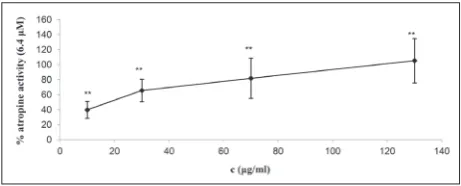
spasmolytic activity. The oil (10-130 μg/mL) centration-dependently inhibited spontaneous con-tractions of isolated rat ileum. The effect was strong and in the concentration of 130 μg/mL comparable (105.23±29.56%) to the maximal relaxant effect of atropine obtained in a concentration of 6.4 μM in a
previous series of experiments. The results are pre-sented in Fig. 1.
Essential oil exhibited a concentration-dependent effect in the second series of experiments where the effect on contractions induced by ACh was investi-gated. The spasmolytic effect of the oil was assessed for four concentrations (30, 60, 90 and 120 μg/mL). In a concentration of 30 μg/mL, the oil exhibited a weak effect (data not shown). At 60 μg/mL, the oil exhibited a strong and significant spasmolytic effect on contractions induced with lower concentrations of ACh (0.01-0.44 μg/mL). The effect on contractions induced with higher concentrations was weaker, in-hibiting the maximal effect of ACh to 77.71±13.85%.
Bulnesol 1672 tr tr 0.5 0.7
α-Bisabolol 1688 tr tr tr tr
Hexadecanoic acid 1962 - - 0.4
-Methyl linoleate 2098 - 0.2 -
-Oleic acid 2144 - 0.7 -
-Identified 99.4 98.2 97.8 98.5
Monoterpene hydrocarbons 8.1 12.1 5.8 11.8
Oxygenated monoterpenes 75.5 50.8 54.1 59.9
Sesquiterpene hydrocarbons 3.3 5.0 3.7 3.2
Oxygenated sesquiterpenes 12.5 29.4 33.8 23.1
Others tr 0.9 0.4 0.5
a KI exp − Relative retention indices calculated against n-alkane on HP-5MS column. b % − Relative area percentage.
c tr − trace (<0.05%).
Table 2. continued
In the concentration of 90 μg/mL, the oil exhibited similar activity at lower concentrations of ACh (0.01-0.44 μg/mL), but the effect on contractions induced with higher concentrations was stronger and signifi-cant, with an inhibition of the maximal effect of ACh to 62.76±21.00%. At 120 μg/mL, the oil exhibited the strongest relaxant activity and completely abolished the contractile effect of ACh (data not shown). The re-sults are shown in Fig. 2. Atropine, used as a reference drug in this model, exhibited stronger activity and in a concentration of 0.14 μM completely inhibited the spasmogenic effect of ACh.
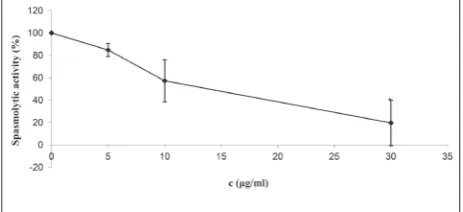
The oil demonstrated the strongest activity against tonic contractions induced with KCl (80 mM). At 30 μg/mL, the oil inhibited the contractile effect of KCl to 19.67±20.26%. The results are presented in Fig. 3.
Piperitone, the main metabolite of the investigated essential oil (58.7%), was previously shown to exhibit spasmolytic activity. Tested in a range of 1-100 μg/mL, piperitone concentration-dependently inhibited con-tractions of isolated rat uterus contracted with KCl (60 mM) with a calculated EC50=10.73±1.27 μg/mL [20]. It was previously shown that limonene, a minor com-ponent of this oil, exhibits spasmolytic activity as well [21]. Relaxant activity was previously demonstrated for β-eudesmol, another minor metabolite of C. sch-oenanthus essential oil (1.3%). This sesquiterpene in-hibited histamine- and barium chloride-induced con-tractions of guinea-pig ileum [22]. Additionally, the essential oil of Perovskia abrotanoides Kar. exhibited a relaxant effect on spontaneous and KCl (80 mM)-induced contractions of isolated rabbit jejunum. The main metabolite of this oil was δ-3-carene [23]. There-fore, δ-2-carene present in C. schoenanthus essential oil (9.7%) might contribute to the demonstrated ac-tivity of the oil. It could be postulated that the strong spasmolytic activity of C. schoenanthus inflorescence essential oil demonstrated in our experiments could be partly due to the presence of piperitone.
CONCLUSION
A high essential oil content and stable composition makes C. schoenanthus from Sudan a valuable source of the commercially important monoterpene, piperi-tone. Significant spasmolytic activity of inflorescence essential oil was observed, emphasizing its beneficial properties, especially for gastrointestinal complaints. Our data represent a good basis for further investiga-tions of this essential oil for its medicinal purposes, as well as for application in the food industry.
Acknowledgments: This research was supported by the Ministry of Education, Science and Technological Development of Republic of Serbia (Grants № 173021 and № III41018).
Authors’ contribution: E.O.: sampling of the plant material and essential oil isolation N.K., M.R., S.B., M.D. and I.P.: conceived and designed the experiments. I.P., E.O., M.D. and S.B.: performed the experiments and analyzed the data. N.K. was the main supervisor of the research project. All authors contributed to manuscript preparation. All authors read and approved the final manuscript.
Conflict of interest disclosure: The authors declare that they have no conflict of interest.
Fig. 2. Concentration-response curves of ACh in the absence (rhombus) and presence of 60 μg/mL (square) and 90 μg/mL (tri-angle) of C. schoenanthus inflorescence essential oil in isolated rat ileum. The values presented on the y-axis represent responses expressed as percentages of the maximum response to ACh. Each point represents means±SEM of seven or more experiments. Stars show statistically significant differences in comparison with the control, the vehicle (Na-CMC)-treated group (*p<0.05, **p<0.01).
Fig. 3. Concentration-related inhibitory effects of C. schoenanthus
REFERENCE
1. Máthé Á. Introduction: Utilization/significance of medicinal and aromatic plants. In: Máthé Á, editor. Medicinal and aro-matic plants of the world: scientific, production, commercial and utilization aspects. Dordrecht: Springer; 2015. p. 1-13. 2. Bertea CM, Maffei ME. The Genus Cymbopogon - Botany,
including anatomy, physiology, biochemistry, and molecular biology. In: Akhila A, editor. Essential oil- bearing grasses, The genus Cymbopogon. Boca Raton: CRC Press; 2010. p. 1-24.
3. Avoseh O, Oyedeji O, Rungqu P, Nkeh-Chungag B, Oyedeji
A. Cymbopogon species; Ethnopharmacology,
phytochem-istry and the pharmacological importance. Molecules. 2015;20:7438-53.
4. Ganjewala D. Cymbopogon essential oils: Chemical composi-tions and bioactivities. Int J Essent Oil Ther. 2009;3:56-65. 5. Akhila A. Chemistry and biogenesis of essential oil from
the genus Cymbopogon. In: Akhila A, editor. Essential oil- bearing Grasses, The genus Cymbopogon. Boca Raton: CRC Press; 2010. p. 84-93.
6. Eltahir AS, AbuEReish BI. Comparative foliar epidermal studies in Cymbopogon citratus and Cymbopogon schoenan-thus in Sudan. J Chem Pharm Res. 2010;2(4):449-55. 7. Ben Othman M, Han J, El Omri A, Ksouri R, Neffati M,
Isoda H. Antistress effects of the ethanolic extract from
Cymbopogon schoenanthus growing wild in Tunisia. Evid
Based Complement Alternat Med. 2013;2013:737401. 8. Khadri A, Serralheiro MLM, Nogueira JMF, Neffati M,
Smiti S, Araujo MEM. Antioxidant and antiacetylcholin-esterase activities of essential oils from Cymbopogon
schoe-nanthus L. Spreng. Determination of chemical
composi-tion by GC-mass spectometry and 13C NMR. Food Chem.
2008;109(3):630-37.
9. Kpoviessi S, Bero J, Agbani P, Gbaguidi F, Kpadonou-Kpoviessi B, Sinsin B, Accrombessi G, Frédérich M, Mou-dachirou M, Quetin-Leclercq J. Chemical composition, cyto-toxicity and in vitro antitrypanosomal and antiplasmodial activity of the essential oils of four Cymbopogon species from Benin. J Ethnopharmacol. 2014;151:652-9.
10. Ketoh GK, Koumaglo HK, Glitho IA, Huignard J. Compara-tive effects of Cymbopogon schoenanthus essential oil and piperitone on Callosobruchus maculatus development. Fito-terapia. 2006;77:506-10.
11. Bossou AD, Mangelinckx S, Yedomonhan H, Boko PM, Akogbeto MC, Kimpe ND, Avlessi F, Sohounhloue DCK. Chemical composition and insecticidal activity of plant
essential oils from Benin against Anopheles gambiae (Giles). Parasit Vectors. 2013;6:337-54.
12. Devi RC, Sim SM, Ismail R. Spasmolytic effect of citral and extracts of Cymbopogon citratus on isolated rabbit ileum. J Smooth Muscle Res. 2011;47:143-56.
13. Janbaz KH, Qayyum A, Saqib F, Imran I, Zia-ul-Haq M, de Feo V. Bronchodilator, vasodilator and spasmolytic activities
of Cymbopogon martinii. J Physiol Pharmacol. 2014;65:859-66.
14. Adams RP. Identification of essential oil components by gas chromatography/mass spectrometry, 4 th ed. Carol Stream, IL: Allured Publishing Corporation; 2007.
15. Van den Dool H, Kratz PD. A generalization of the reten-tion index system including linear temperature programmed gas-liquid partition chromatography. J Chromatogr. 1963;11:463-71.
16. Pavlović I, Petrović S, Radenković M, Milenković M, Cou-ladis M, Branković S, Pavlović Drobac M, Niketić M. Com-position, antimicrobial, antiradical and spasmolytic activity
of Ferula heuffelii Griseb. ex Heuffel (Apiaceae) essential oil.
Food Chem. 2012;130:310-15.
17. Yentéma O, Alioune O, Dorosso SA. Chemical composition and physical characteristics of the essential oil of
Cymbo-pogon schoenanthus (L.) Spreng of Burkina Faso. J Appl Sci.
2007;7(4):503-6.
18. Ketoh GK, Koumaglo HK, Glitho IA. Inhibition of
Callo-sobruchus maculatus (F.) (Coleoptera: Bruchidae)
develop-ment with essential oil extracted from Cymbopogon
schoe-nanthus L. Spreng (Poaceae), and wasp Dinarmus basalis
(Rondani) (Hymenoptera: Pteromalidae). J Stored Prod Res. 2005;41:363-71.
19. Dhar AK, Thappa RK, Atal CK. Variability in yield and com-position of essential oil in Cymbopogon jawarancusa. Planta Med. 1981;41:386-8.
20. Ponce-Monter H, Campos MG, Pérez S, Pérez C, Zavala M, Macías A, Oropeza M, Cárdenas N. Chemical composition and antispasmodic effect of Casimiroa pringlei essential oil on rat uterus. Fitoterapia. 2008;79:446-50.
21. Cardoso Lima T, Mota MM, Barbosa-Filho JM, Viana Dos Santos MR, De Sousa DP. Structural relationships and vaso-relaxant activity of monoterpenes. DARU. 2012;20(1):23. 22. Morita M, Nakanishi H, Morita H, Mihashi S, Itokawa H.
Structures and spasmolytic activities of derivatives from ses-quiterpenes of Alpinia speciosa and Alpinia japonica. Chem Pharm Bull. 1996;44:1603-06.
23. Shah AJ, Gilani AH, Jabeen Q, Nadir M, Rasheed M, Ahmed A, Tareen RB, Ahmad VU. Chemical analysis and calcium channel blocking activity of the essential oil of Perovskia