ISSN: 2501 - 1235 ISSN-L: 2501 - 1235 Available on-line at: www.oapub.org/edu
doi: 10.5281/zenodo.3442452 Volume 5 │ Issue 12 │ 2019
EFFECT OF ISOMETRIC EXERCISES ON PAIN AND DISABILITY
IN PATIENTS WITH CHRONIC NECK PAIN
Mustafa Gulseni Department of Therapy and Rehabilitation,
Vocational School of Health Sciences, Baskent University, Ankara, Turkey
Abstract:
Chronic neck pain (CBA) is one of the musculoskeletal diseases caused by different pathologies. The aim of this study was to evaluate the effect of physical therapy and isometric exercises on pain and disability in individuals diagnosed with CBA. Forty-six patients with the diagnosis of CBA between the ages of 20-65 were included in the study. A treatment program including electrotherapy and exercises was organized. Pain levels and disability status of the patients were evaluated. Paired-t test was used for statistical analysis. P <0.05 was considered statistically significant. No significant difference was found between age, height, weight and BMI (p> 0.05). The cases showed a homogeneous distribution. When the pre- and post-treatment values of the groups were compared, pain and disability scores of the first group were significantly increased, while only the disability scores of the second group were significantly increased (p <0.05). There was no significant difference in pain scores of the second group (p> 0.05). Our study showed that physical therapy and neck isometric exercises and cervical joint opening exercises together with stretching exercises of back extensors were effective in chronic neck pain.
Keywords: disability, physical therapy, chronic neck pain, isometric exercise
1. Introduction
In about 50-85% of people with neck pain, problems can become chronic because the cause is not fully elucidated. People with chronic neck pain present to the clinics with complaints of pain, limitation of movement and function in daily living activities. At the end of clinical examinations, impairments in deep cervical flexor-extensor muscle functions and sense of position, decrease in range of motion of the neck joints, loss of motor and sensation, disability, fear of movement, rest, activity and night pain are observed.
It points out that different beliefs about the nature and future consequences of the problem in chronic pain direct behavior that may lead to misstimulated neuroplastic changes. This suggests that perceptual level and proprioceptive awareness should be examined in chronic pain (1).
In a disorder in the neck region, muscle dysfunctions arise as a result of pain, deterioration of sensory-motor input and the transfer of deep muscles to superficial muscles (2). All these problems may cause asymmetrical, tense, abnormal or large perception of the position and movement of the neck. In order to eliminate problems such as pain, tension, asymmetry, and deterioration of position-movement perception, it is important to evaluate, treat and raise body awareness to a conscious level 3 in general (3).
The first step in approaching the patient with neck pain is to distinguish between acute and chronic pathologies. In acute cases, the control of pain, edema and inflammatory state secondary to damage, protection of damaged structures, transition to early mobilization, reduction of joint burden and exercises are the basic elements of treatment.
When the chronic phase is reached, regaining ROM, gaining muscle strength, endurance and coordination, accelerating the return to normal activity and preventing the recurrence of pathology are the methods to be applied in the treatment. For this purpose, treatment options such as rest and orthosis, medical treatment, physical therapy modalities (hot cold, analgesic applications), injection methods, exercise therapies and surgical methods should be planned according to the patient (4).
Patients should be provided with proper anatomical position to learn the correct posture and exercise habits. In this way, pain, posture disorders, muscular weakness problems in the musculoskeletal systems, functional limitations in daily life, the negative effects of quality of life, fear of movement and psychosocial problems can be solved and painless and regular muscle strength can be contributed to have. Therefore, it is important to evaluate pain and disability in individuals with chronic neck pain and to include awareness development in the treatment program if it is affected.
The aim of this study was to investigate the effect of physical therapy and isometric exercises on pain and disability in patients with chronic neck pain.
2. Method
2.1 Participants
Our study was planned as a prospective randomized controlled study for patients with neck pain who applied to Başkent University School of Medicine, Department of Physical Medicine and Rehabilitation. Written informed consent was obtained from all patients before starting the study. Ethics Committee approval was received from Baskent University Social and Humanities and Art Research Committee (17162298.600-254).
patients who have a home exercise program in addition to Hotpack, TENS and Ultrasound. Only pain and disability questioning of these patient groups taken by physiotherapists in the clinic before and after treatment will be done and the results will be included in our study.
Inclusion criteria:
1) patients between the ages of 20-65,
2) neck pain for more than six months,
3) not received psychiatric treatment,
4) without neurological deficit,
5) ın the last year, exercise and physical therapy modalities have not been
implemented,
6) the reserach will be included in the study in which laboratory examinations are
normal and there are no pathological findings (fracture, dislocation, tumor, infection) in radiological examinations.
Exclusion criteria from the study:
1) surgical intervention from cervical region,
2) trauma,
3) infection of the cervical vertebra,
4) malignancy,
5) inflammatory arthritis,
6) pregnant and psychiatric,
7) presence of cardiac pacemaker,
8) shoulder, neurological or vascular disease,
9) magnetic resonance imaging will be excluded.
Randomization was performed using random-allocation software. The patients were randomly divided into two groups. The first group (n = 23) was treated with hotpack (HP), TENS, ultrasound (US) and neck isometric exercises, and the second group (n = 23) was treated with hotpack (HP), TENS, ultrasound (US) and home exercise programs.
In the first group, five sessions a week, 15 sessions of neck, 20 minutes of hot
pack (HP), 30 minutes of conventional TENS (Enraf NoniusBDelftechpark 39, 2600 AV, Delft, The Netherlands) 60-100 Hz and a 60µsn pulse rate so that patients can feel comfortable 10 minutes ultrasound therapy (Enraf-Nonius-B Delftechpark 39; 1-MHz; 1.5 watt / cm2) was applied to the paravertebral muscles with the current intensity, and 10 repetitive isometric exercises were administered to the neck muscles 3 times a day. Group 2 was shown to have cervical range of motion and stretching exercises of cervical and back extensors as a home program instead of isometric exercise.
2.2 Data Collection Tools
In assessing pain severity; The Visual Analogue Scale (VAS) is a simple method with proven validity and reliability. The visual analog scale (VAS) consists of a level of pain where a person marks the current pain with a vertical line on a plane. The pain the person feels is marked as "0: no pain", "10: I feel very severe pain". Scoring is based on measuring the vertical marking of the participant for the pain he / she has marked on the plane with the ruler. Validity and reliability study of the scale Price et al. Made by (5).
Numerical pain scales allow the patient to express the pain intensity in numbers. "0: no pain at all", "10 or 100: very intolerable, I feel pain" (6).
Northwick Park Neck Pain Questionnaire (NPQ) will be used to evaluate functional status (7). NPQ; developed to determine the level of disability in neck pain, neck pain severity, neck pain and sleep, numbness and tingling in the arms at night, the duration of symptoms and complaints, weight bearing, reading and television watching, working and household chores, social activities and driving 9 is a scale of items. The severity of neck pain, symptoms, duration, and disability in each of the substances mentioned activities are evaluated. Each item consists of 5 items and is scored between 0-4 points. The total score of neck pain consists of 36 points. If patients do not drive, the total score is calculated over 32 points. The total percentage of NPQ is then taken with the formula (neck pain score) / 36 * 100%. If the patient is not driving (neck pain score) / 32 * 100% formula, the total percentage of NPQ is taken. As a result, the percentage range is scored between 0-100. Higher scores indicate greater disability. Its validity and reliability have been demonstrated and the Turkish version is also available (8).
2.3 Statistical Evaluation
SPSS statistical package program version 17.0 (SPSS, Chicago, IL, USA) was used for statistical analysis.
3. Results
Physical characteristics of the cases are presented in Table 1. No significant difference was found between age, height, weight and BMI (p> 0.05). The cases showed a homogeneous distribution.
Table 1: Sociodemographic Characteristics of Patients
1. Group 2. Group
n 23 23
Age 49,39±11,66 47,95 ±14,62
Height (m) 161,82±4,84 163,04±5,9
Weight (kg) 69,56±11,55 65,21±10,1
BMI (kg/m2) 26,55±4,32 24,41±4,65
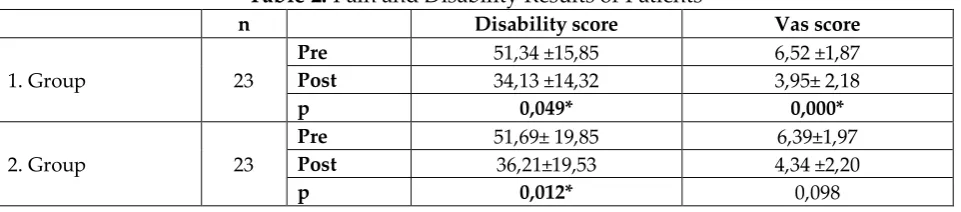
scores of the second group were significantly increased.p <0.05. No significant difference was found in the pain scores of the second group (p> 0.05) (Table 2).
Table 2: Pain and Disability Results of Patients
n Disability score Vas score
1. Group 23
Pre 51,34 ±15,85 6,52 ±1,87
Post 34,13 ±14,32 3,95± 2,18
p 0,049* 0,000*
2. Group 23
Pre 51,69± 19,85 6,39±1,97
Post 36,21±19,53 4,34 ±2,20
p 0,012* 0,098
4. Conclusıon and Dıscussıon
Chronic neck pain has a poor prognosis and is more persistent than low back pain. The main goal of treatment in patients with neck pain is to regain the functional loss of the patient and to minimize degeneration.
Although there are many treatment methods in patients with neck pain, there is no consensus about the efficacy and superiority of treatments (9).
Although conservative methods are the first line of choice for the treatment of neck pain, the most appropriate therapeutic approach is still unknown (10).
There is no mention of a proven effective and clear treatment method in the literatüre (11). Therefore, there is a great need to define an effective form of treatment in the treatment of neck pain. In our study, we investigated the effectiveness of neck isometric exercises in addition to classical physiotherapy.
It has been shown in previous studies that therapeutic exercises in neck pain reduce the level of pain and disability (12).
Exercise therapy increases the strength of the neck muscles. Reduction in neck pain and improvement in neck ROM is aimed to improve the functional status of the patient and decrease the level of disability (13). However, there is no proven and consensus algorithm in the literature about when, in which situations and which type of exercise is recommended in patients with neck pain (14).
treated with neck stabilization exercise and physical therapy agents throughout the study. In addition to physical therapy program, isometric and stretching exercise group showed significant improvement in depression at 1 month after treatment and disability at 3 months after treatment (15). Similar to this study, in our study, there was a statistically significant decrease in VAS values in HP, Tens, US and isometric group and significant improvement in Neck Disability Questionnaire score. In contrast to this study, in our study, the second group was given a home program including cervical range of motion and stretching exercises of cervical and back extensors in addition to HP, Tens, US treatment. There was a statistically significant decrease in VAS values at the end of treatment, but no significant improvement in Neck Disability Questionnaire Form score.
Griffiths et al. ın a study, active neck flexion, extension, lateral flexion and rotation exercises, in addition to the other group, isometric cranioservical flexion exercise and cranioservical flexion exercise performed while sitting in an oblique sitting position. Pain, disability and function were evaluated in the 6th week and 6th month measurements and no significant difference was found between the two groups (16). Similarly, in our study, no statistically significant difference was found between the two groups in terms of neck pain VAS. A statistically significant decrease in VAS was detected in both groups. Unlike this study, no significant difference was found in the disability values of the group that included stretching and normal joint movement exercises.
In conclusion, it is effective to use conventional physical therapy with neck isometric exercises and cervical joint opening exercises together with stretching exercises of back extensors in chronic neck pain. The effectiveness of isometric exercises in the neck region, similar to the traditional exercise program, contributes to the reduction of pain and increase in functions in daily living activities. Our study compares isometric and stretching exercises with the back extensor stretching program in a combined treatment approach. In order to show the difference, a longer period and more studies are needed.
References
1. Coskun M. E. 2006. Boyun Ağrısı ve Tedavisi. Türkiye Klinikleri Journal of
Surgery Medical Sciences.2: 43-47.
2. Haines T., Gross A. R., Burnie S., Goldsmith C. H., Perry L, Graham N. 2009.
Cervical Overview Group (COG). A Cochrane review of patient education for neck pain. The Spine Journal. 9: 859-871.
3. Hadler N. M. 1985. İllness in the workplace: The challenge of musculoskeletal
symptoms. The journal of hand surgery am. 10: 451-456.
4. Sencer S. 1998. Mekanik Bel Ağrılarında Radyolojik Görüntülemenin Yeri.
5. Price D. D., McGrath P. A., Rafii A., Buckingham B.1983. The validation of visual analogue scales as ratio scale measures for chronic and experimental pain. Pain.17(1):45-56.
6. Hawker G. A., Mian S., Kendzerska T., French M. 2011. Measures of adult pain:
Visual Analog Scale for Pain (VAS Pain), Numeric Rating Scale for Pain (NRS Pain), McGill Pain Questionnaire (MPQ), Short-Form McGill Pain Questionnaire (SF-MPQ), Chronic Pain Grade Scale (CPGS), Short Form-36 Bodily Pain Scale (SF-36 BPS), and Measure of Intermittent and Constant Osteoarthritis Pain (ICOAP). Arthritis care & research. 63 Suppl 11:S240-52.
7. Leak A. M., Cooper J., Dyer S., Williams K. A., Turner-Stokes L., Frank A. O.
1994.The Northwick Park Neck Pain Questionnaire devised to measure neck pain and disability. British journal of rheumatology. 33: 469-474.
8. Kose G., Hepguler S., Atamaz F., Oder G. 2007. A comparison of four disability
scales for Turkish patients with neck pain. Journal of Rehabilitation Medicine. 39: 358-362.
9. Hanney W. J., Kolber M. J., Schack-Dugre J., Negrete R., Pabian P. 2010. The
Influence of Education and Exercise on Neck Pain. American Journal of Lifestyle Medicine. 4: 166-175.
10.Moffett J. A. K., Jackson D. A. Richmond S., Hahn S., Coulton S., Farrin A.,
Manca A., Torgerson D. J. 2005. Randomised trial of a brief physiotherapy
intervention compared with usual physiotherapy for neck pain patients: outcomes and patients’ preference. British Medical Journal. 330: 75-81.
11.Ylinen J. 2007. Physical exercises and functional rehabilitation for the
management of chronic neck pain. Europa Medicophysica. 43: 119-132.
12.Willford C. H., Kisner C., Glenn T. M., Sachs L. 1996. The interaction of wearing
multifocal lenses with head posture and pain. Journal of Orthopaedic and Sports Physical Therapy. 23: 194-196.)
13.Magee D. Orthopedic Physical Assessment. Third edition W. B. Saunders
company,1997, Chapter 3. Cervical Spine; 101-147.)
14.Korhonen T., Ketola R., Toivonen R., Luukkonen R., M0 Hakkanen, E.0. 2003.
Viikari-juntura. Work related and individual predictors for incident neck pain among Office employees working with video display units. Journal of Occupational and Environmental Medicine. 60: 475-482.
15.Dusunceli Y., Ozturk C., Atamaz F., Hepguler S., Durmaz B. 2009. Efficacy of
neck stabilization exercises for neck pain: A randomized controlled study. J Rehabil Med. 41(8):626–31.
16.Griffiths C., Dziedzic K., Waterfield J., Sim J. 2009. Effectiveness of specific neck
Creative Commons licensing terms