Reference & User Services Quarterly, vol. 54, no. 3, pp. 30–36
© 2015 American Library Association. All rights reserved.
Permission granted to reproduce for nonprofit, educational use.
This article reports on the current state of health disclaimers, online health resources, and credibility markers provided on pub-lic library websites (N = 105) for those seeking health information. In light of the Affordable Care Act (ACA), these findings have implications for consumer health reference services in public libraries. Ap-proximately half of the public library web-sites in the study sample (n = 52, 49.5%) referred users to the ACA Health Insur-ance Marketplace website (HealthCare. gov). When referring to online consumer health resources, a small number of public library websites identified the authors of online health content (n = 16, 15.2%) or clearly stated the date of publication (n = 8, 7.6%). Further, only 2.8 percent of pub-lic library websites (n = 3) provided impor-tant health disclaimers. As a result, more website credibility markers, such as the content sponsorship and currency of health information, are needed on public library websites to better guide users to reliable online health information. Overall, this study offers practical guidance for library and information professionals for enhanc-ing consumer health reference services and connecting users to health information in the Affordable Care Act landscape.
O
n March 23, 2010, PresidentObama signed the Afford-able Care Act (ACA), ush-ering in new health care re-forms.1 On June 28, 2012, the Supreme Court made a final decision to uphold the new health care law.2 Under the ACA law, US citizens could sign up for a new health plan and coverage during an open enrollment period. American Library Association (ALA) President Barbara Stripling stated, “We expect libraries will receive many inquiries from the public about the Affordable Care Act.”3 As a result, public libraries were propelled into the media spotlight for their role in connecting patrons to information about the Health Insurance Marketplace when open enrollment be-gan on October 1, 2013.
While public libraries in the United States have a long tradition of provid-ing health information to their respec-tive communities,4 the ACA brought attention to the important role public libraries serve in linking communi-ties with health care insurance and timely health information. In fact, pub-lic libraries are often a first point of access for individuals seeking health information.5 Borman and McKenzie further state that libraries are a pre-ferred source for people searching for information related to health issues.6
Deborah H. Charbonneau
Deborah H. Charbonneau, MLS, PhD, ([email protected]) is Assistant Professor, School of Library and Information Science, Wayne State University, Detroit, Michigan.
Health Disclaimers and Website
Credibility Markers
Indeed, the public library is a “highly trusted source of health information.”7
Chobot states that “one of the biggest challenges today’s librarians face is an insatiable consumer demand for health information.”8 As online health resources continue to prolifer-ate, librarians are tasked with sorting through the extensive volume of information and selecting reliable online resources for their communities. Gillaspy and Pranica acknowledge that “librarians working in consumer health will rely more and more heavily on Internet- and technology-based appli-cations for their customers.”9 Noh adds, “The librarian’s role as an evaluator and provider of reliable consumer health in-formation sources has become more important than ever.”10 Consequently, many public libraries assist their communi-ties in locating reliable health information by providing lists of evaluated sources on the library’s website.11 To this end, public library websites serve as a gateway facilitating access to an array of online health resources and assist library patrons in “distinguishing between trustworthy and questionable Internet sites.”12
HEALTH DISCLAIMERS AND CREDIBILITY
MARKERS
ALA President Barbara Stripling comments that libraries “provide the public with balanced, unbiased access to infor-mation.”13 Goldberg also stresses “the neutral provision of information and resources about ACA to those who need it.”14 Hence, drawing the line between interpreting health tion and connecting users with trustworthy health informa-tion is an important principle in the provision of consumer health reference services.
Health disclaimers are one way that libraries can com-municate the scope and limitations of consumer health ref-erence services for their library patrons. While librarians are experts in identifying and providing information, they are “not practicing health professionals who interpret informa-tion and give advice.”15 On the other hand, librarians utilize their expertise to guide, direct, and facilitate access to health information resources.
Gillaspy cautions that librarians should avoid endorsing any treatments or procedures.16 The Medical Library Asso-ciation’s Consumer and Patient Health Information Section (CAPHIS) also reinforces the importance of providing health disclaimers to help differentiate the boundaries between interpreting health information and guiding users to reli-able health sources.17 Specifically, health disclaimers serve an essential role in informing patrons that “libraries do not provide medical advice and do not interpret information for patrons.”18 Yet the extent to which the practice of provid-ing health disclaimers extends into the digital realm and the availability of health disclaimers on public library websites remains unknown.
In addition to providing health disclaimers, website cred-ibility cues are another good practice for strengthening the
provision of consumer health reference services. To help us-ers appraise the quality of online health information, public library websites can regularly incorporate credibility markers, such as the sponsor of the content and the currency of the health information. In fact, research shows that these textual cues are important features that health care consumers use to evaluate the trustworthiness of online health content.19 In the context of the ACA and recent media attention on public libraries, health disclaimers and website credibility markers have important implications for the provision of consumer health reference services.
CONSUMER HEALTH INFORMATION
TRAINING
Despite the growing demand for public libraries to support health information inquiries, numerous studies report that public librarians experience confusion over their role and responsibilities in providing health information.20 Further, a lack of awareness about available consumer health infor-mation resources suggests additional training opportunities are needed for public librarians to build skills for identify-ing reliable health resources.21 When public libraries select health materials, the general public expects that “unreliable and ‘poor’ quality sources will have been sifted out.”22 Thus, the training gaps reported in the extant literature raise im-portant questions about the current state of consumer health resources presented on public library websites.
The published literature includes descriptions of various consumer health training efforts for public librarians.23 A number of consumer health information partnerships be-tween public libraries, academic libraries, hospital libraries, public schools, and health departments are also reported.24 Indeed the role of public librarians in supporting the con-sumer health needs of library patrons has been discussed; however, limited research has focused on public libraries and consumer health reference services in the digital realm. In a relevant study, Ketchum examined the website design and structural elements of thirty-three consumer health–related websites primarily from academic environments.25 This study found that disclaimers and notices for last updates are im-portant website features for consumer health websites in aca-demic settings.26 Yet website design elements and the range of health information resources provided on public library websites remain under explored. Given the current ACA land-scape, an investigation to better understand the practices of providing consumer health information resources on public library websites is both timely and warranted.
RESEARCH QUESTIONS
elements of consumer health websites in academic settings,27 studies that assess the range of health resources collected and organized on public library websites intended for their library website users are lacking. As library users consult public li-braries for assistance in the ACA era, health disclaimers and website credibility markers can be helpful practices for guid-ing users to reliable online health information resources. To date, no study has examined the presence of health disclaim-ers and website credibility markdisclaim-ers on public library websites. To address this question, the present study examined health resources, disclaimers, and credibility markers provided on public library websites with the goal of informing consumer health reference services.
Therefore, the main research questions are as follows:
1. Which online health resources are most frequently fea-tured on public library websites?
2. How many public library websites provide a health disclaimer?
3. Are any credibility markers present on public library websites? If so, how often are various credibility markers included on the public library websites?
For the purposes of this study, several website credibility markers were used to help assess health resources provided on public library websites: authorship/sponsorship of health content, currency of information (i.e., frequency of update), and a health disclaimer. These credibility markers are consis-tent with existing ratings scales used to evaluate the quality of online health information.28 Such credibility markers play an important role in the online environment, and users regard these markers as a “proxy for information quality.”29
RESEARCH DESIGN AND METHOD
As stated above, this research aims to assess the state of health information resources, disclaimers, and credibility markers provided on public library websites. To accomplish this, a total of 105 public library websites were analyzed. The 105 websites represented public libraries in the state of Michi-gan. The state of Michigan website was consulted to identify public library websites available for analysis (see table 1). This strategy has been used successfully in previous research to help identify public libraries for possible inclusion in re-search studies.30 Of the 385 library systems (comprising 660 locations) in the state of Michigan, 105 public libraries had websites available for analysis in March 2014.31 These com-prised the study sample.
DATA COLLECTION PROCESS
In this study, established website credibility markers from the published literature guided the collection and analysis of data. Specifically, the credibility markers used in the present study
included identification of ownership/authorship of health content, currency of health information, dead or broken hy-perlinks, and a disclaimer. These key credibility markers rep-resent the most frequently used criteria for evaluating web-based health information.32 In addition, the Medical Library Association endorses health disclaimer statements when pro-viding health information to library patrons.33 These credibil-ity markers were used to develop a coding sheet instrument to collect data from each of the public library websites in the study sample. The collected data were then analyzed in order to help answer the main research questions regarding health information resources provided on public library websites.
FINDINGS
A total of 105 public library websites were included in the analysis. Health resources prominently featured on public library websites varied in their scope and presentation. The ACA Health Insurance Marketplace website (HealthCare.gov) was the most common online health resource featured on the public library websites (n = 52, 49.5%). This was followed by healthfinder.gov (n = 39, 37.1%) and MedlinePlus.gov (n
= 37, 35.2%). A list of the ten most common online health re-sources provided on the public library websites is provided in the appendix. Out of the ten most popular online health re-sources, five were government-sponsored sites (“.gov” sites), three of the sites consisted of noncommercial organizations (“.org” sites), and the remaining two sites were commercial in nature (“.com” sites). Therefore, one linking pattern was that half of the ten most popular websites for online health content (n = 5) were known, trusted government-sponsored sites (“.gov” sites).
In addition, one resource about the ACA was consis-tently featured, HealthCare.gov. Links to local agencies and community-specific health information were sparse. Only eight public libraries linked to a state or county health de-partment. A few public libraries provided community-specific information, such as African American health information (n
= 1), Asian American health (n = 1), and health information in Spanish (n = 3). Hence, there were more referrals to on-line health content sponsored by the federal government or
Table 1. Public Libraries in Study Sample (by Class)
Library Class Number of Public Libraries
Class 1 6
Class 2 10
Class 3 11
Class 4 21
Class 5 19
Class 6 38
national organizations than health information tailored for specific communities.
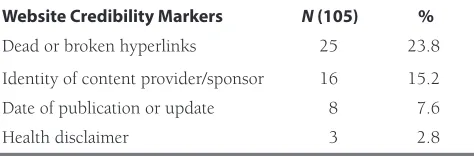
For the most part, links to online health resources were located under website sections labeled either “Health and Wellness” or “Health.” This logical placement on the public library websites facilitated easy access to health information resources. In contrast, health resources organized under sec-tions entitled “helpful links” or simply “links” in several in-stances made health information more challenging to locate. Results from the study also demonstrated a wide range of credibility markers across the public library websites to guide consumers in critically evaluating sources of online health information. As shown in table 2, 23.8 percent (n = 25) of library websites had dead or broken hyperlinks. In ad-dition, only 15.2 percent (n = 16) of the public library web-sites clearly identified authors or sponsors of online health content. Further, 7.6 percent (n = 8) of the public library websites stated the date of publication or last update for the online health content.
Finally, very few public libraries (n = 3, 2.8%) included a health disclaimer on their website. Table 3 provides ex-amples of health disclaimers found on the public library websites in the study sample. In all three instances, the health disclaimer statements were located at the bottom of the library webpage.
This study found common health resources frequently featured across the public library websites. Interestingly, the public library websites often neglected to incorporate common credibility markers known to assist website users in critically evaluating sources of online health information. Only 2.8 percent (n = 3) of public library websites provided a health disclaimer. Given this, several website improvements are recommended for providing referrals to online health information resources. In order to facilitate better access to online health information in the ACA era, a number of areas where improvements could enhance consumer health refer-ence services were identified.
DISCUSSION AND FUTURE RESEARCH
This study was designed to examine the state of health resources provided on public library websites. Given the ACA landscape, the study’s findings have significance for public libraries connecting patrons with health information.
Specifically, several implications arise for consumer health reference services and collection development in public li-braries.
In the state of Michigan, the state library association has not issued guidelines to date for public libraries to respond to community questions about the ACA. At the national level, the Reference and User Services Association (RUSA) of the American Library Association (ALA) provides recommenda-tions for answering medical and legal inquiries but the ACA is not specifically addressed.34 Additional materials, such as collectively building an online guide to frequently asked/ answered questions (FAQs) about the ACA in public librar-ies with relevant resources might be a solid first step to help coordinate public library response to the ACA in Michigan and nationally.
Ongoing discussions are also needed about the role of public libraries in the provision of ACA information. Strate-gies for state library associations to foster more discussion about ACA involvement at local and state levels might in-clude hosting online forums, dedicating programs at the annual state conferences to discussions about the ACA, and soliciting stories similar to the WebJunction initiative at the Online Computer Library Center (OCLC) to better identify how public libraries are responding to ACA-related inqui-ries.35 From this ongoing dialog, the profession at large can begin to identify the range of public library involvement in the ACA and promising practices in supporting community health information needs.
The present study further highlights the need for health disclaimers to be available and prominently displayed on public library websites. Previous research concluded that health disclaimers are important website features in the provision of consumer health information, yet many public library websites neglected to include a health disclaimer.36 One possible reason for the lack of health disclaimers can
Table 2. Frequency of Website Credibility Markers on Public Library Websites
Website Credibility Markers N (105) %
Dead or broken hyperlinks 25 23.8
Identity of content provider/sponsor 16 15.2 Date of publication or update 8 7.6
Health disclaimer 3 2.8
Table 3. Sample Health Disclaimers on Public Library Websites
Sample Health Disclaimers
1. The information provided on this Web site is for general educational purposes only. It is not intended to be used as a substitute for medical advice. Any concerns about your health or the health of your family should be discussed with a qualified health care provider.
2. Health information should always be discussed with your physician. The library and the producers of these web pages are not responsible for the misuse or misapplication of the information provided. These links are for
information only, and should in no way be construed as medical advice.
be gleaned from the professional literature. A number of professional guidelines exist to aid librarians with reference interactions and linking users to electronic information re-sources; however, guidance about online health disclaimers is missing from the discussion.37 Despite the lack of attention to online health disclaimers in these professional guidelines, public librarians report spending significantly more time with health information requests than with other types of reference inquiries.38 Health disclaimers are important for explaining to library website users that referrals to online health sources are provided for informational purposes only, do not imply recommendation or endorsement, and do not substitute for consultation with a health professional. Consulting examples from the Consumer and Patient Health Information Section (CAPHIS) of the Medical Library Association may be helpful for preparing health disclaimers for public library settings.39
The lack of health disclaimers on library websites also suggests public librarians responsible for providing consumer health reference services may benefit from additional training. Previous research has reported that public librarians desire additional training on ethical issues and the availability of quality online health information.40 These findings lend fur-ther support to the idea that additional training opportunities on selecting online content for consumer health reference col-lections would be beneficial for public librarians to meet the growing health information needs of library users. Ongoing training opportunities to help maintain awareness and keep up-to-date on current resources for health insurance mar-ketplace information in light of the ACA might be beneficial. Continuing education opportunities to also grow knowledge about the ACA law requirements and key policy updates may prove fruitful. To further assist in the selection of trustworthy online consumer health information, the Medical Library As-sociation’s Consumer and Patient Health Information Section (CAPHIS) “Top 100 List: Health Websites You Can Trust” is a valuable source for vetted and annotated health websites.41
Further, public libraries can incorporate more website credibility markers to guide patrons to reliable online health information. It has been noted that the Internet plays a prominent role in supporting consumer health information requests.42 However, the present study revealed there are major inconsistencies with regards to the organization and presentation of online health resources. As public libraries continue to support the health information needs of their communities, those responsible for providing access to re-liable and timely health information will increasingly need to address ACA and health-related information inquiries. Whether website development is done internally within the public library or outsourced to third party website develop-ers, these findings may offer practical guidance for consumer health reference services in public libraries.
Many of the public library websites lacked credibility markers to easily guide users to quality online health sources. Even if public libraries refer to health content sponsored by government and noncommercial organizations, the lack of descriptive information about external health resources can
make it challenging for users to evaluate the quality and cur-rency of the online health content.As a result, library web-site users are not provided with adequate cues or credibility markers to make informed decisions about online health information. As library users continue to seek trustworthy online health resources, public library websites can utilize credibility markers more systematically to better guide con-sumers to quality online health information.
To help strengthen website cues for users, library websites should specify the author or sponsor of the health content, date of publication or last update, and provide a brief de-scription of the source, such as any unique features as a way to help users critically evaluate online health content. Public libraries can further empower health care consumers by pro-viding information about established evaluation criteria so that patrons can appraise online health information on their own. For example, useful recommendations for evaluating online health information include guidelines from the Medi-cal Library Association, MedlinePlus, and National Center for Complementary and Alternative Medicine.43
Finally, the Reference and User Services Association (RUSA) of the ALA offers specific recommendations for ad-dressing medical and legal inquiries.44 The existing “Guide-lines for Medical, Legal, and Business Responses” state “li-braries should develop written disclaimers stating a policy on providing specialized information service denoting variations in types and levels of service.”45 While this recommendation is very helpful for the provision of consumer health reference services in general, the RUSA guidelines should be further updated to reflect the digital realities of connecting library users with online health information. More precisely, the guidelines could be further extended to include providing health disclaimers on library websites. A discussion of library involvement in responding to ACA-related reference inqui-ries would also be a nice enhancement as public librainqui-ries are implementing community-based strategies to connect users with relevant health resources.
services, including the identification and selection of quality online health sources.
Although these findings provided insight into the range of health resources, disclaimers, and website credibility markers featured on public library websites, the study sample con-sisted of public libraries in the state of Michigan. The study’s findings begin to illuminate the variety of health resources provided on public library websites, and the findings may have a wider application. Research that continues to examine the range of online health resources being collected and orga-nized on other states’ public library websites would be useful. Future research is also needed to examine how library patrons evaluate and use the health information sources provided on public library websites in the health care decision-making process. Finally, research that explores the role of public li-braries in the provision of health care insurance information in light of the ACA is likely to emerge. Ongoing research that elucidates the role of public libraries in an era of health care reform will be of great interest to many stakeholders, includ-ing those workinclud-ing in public, academic, health, and govern-ment library environgovern-ments.
CONCLUSION
Public libraries support the health information needs of their communities by connecting patrons with online infor-mation regarding the Affordable Care Act (ACA) and other health-related issues. This study was designed to assess the current landscape of resources, credibility markers, and health disclaimers provided on public library websites for those seeking health information. The current ACA land-scape offers tremendous opportunities for public libraries to further demonstrate the important role they play in support-ing the health information needs of their communities. Yet, the lack of credibility cues and health disclaimers found in the study sample suggests that a number of enhancements could strengthen the provision of consumer health reference services. As public libraries continue to select, organize, and provide access to online health resources for their respective communities, library websites can utilize credibility markers to better guide consumers to quality online health informa-tion. Finally, health disclaimers and collection development policies addressing how libraries are evaluating and linking to externally-developed online health resources are critical considerations for the provision of consumer health refer-ence services.
References
1. “Key Features of the Affordable Care Act,” United States Depart-ment of Health and Human Services, accessed June 15, 2014, www .hhs.gov/healthcare/facts/timeline.
2. “Affordable Care Act,” American Library Association, accessed June 15, 2014, www.ala.org/tools/affordable-care-act.
3. Barbara Stripling, “ALA, IMLS Detail Affordable Care Act Resources for Library Staff,” press release, September 2013, accessed
June 15, 2014, www.ala.org/news/press-releases/2013/07/ala-imls -detail-affordable-care-act-resources-library-staff.
4. Mary C. Chobot, “The Challenge of Providing Consumer Health Information Services in Public Libraries,” American Association for the Advancement of Science, accessed June 16, 2014, www .healthlit.org/pdfs/AAASFINAL.pdf; Jenny S. Bossaller, “Evidence, Not Authority: Reconsidering Presentations of Science for Dif-ficult Decisions,” Reference & User Services Quarterly 53, no. 3 (Spring 2014): 232–41.
5. Susan Murray, “Consumer Health Information Services in Public libraries in Canada and the US,” Journal of the Canadian Health Libraries Association 29, no. 4 (2008): 141–43.
6. C. Brandi Borman and Pamela J. McKenzie, “Trying to Help Without Getting in Their Faces Public Library Staff Descriptions of Providing Consumer Health Information,” Reference & User Services Quarterly45, no. 2 (Winter 2005): 133–46.
7. Roma Harris et al., “‘I’m Not Sure if That’s What Their Job Is’: Consumer Health Information and Emerging ‘Healthwork’ Roles in the Public Library,” Reference & User Services Quarterly 49, no. 3 (Spring 2010): 239–52.
8. Chobot, “The Challenge of Providing Consumer Health Informa-tion Services in Public Libraries,” 1.
9. Mary L. Gillaspy and Mary O’Connor Pranica, “Consumer Health Sources” in Introduction to Reference Sources in the Health Sciences, ed. Jeffrey Huber and Susan Swogger (Chicago: Medical Library Association, Neal-Schuman, 2014), 259.
10. Younghee Noh, “The Development and Performance Measure-ments of Educational Programs to Improve Consumer Health Information (CHI) Literacy,” Reference & User Services Quarterly
53, no. 2 (Winter 2013): 140–51.
11. Chobot, “The Challenge of Providing Consumer Health Informa-tion Services in Public Libraries,” 9.
12. Jana C. Allcock, “Helping Public Library Patrons Find Medical Information—The Reference Interview,” Public Library Quarterly
18, no. 3/4 (2000): 21–27.
13. Stripling, “ALA, IMLS Detail Affordable Care Act Resources for Library Staff.”
14. Beverly Goldberg, “Libraries Stress Neutrality as They Prep for Queries on Health Care Law,” American Libraries 44, no. 9/10 (Sep 2013): 13.
15. “The Librarian’s Role in the Provision of Consumer Health Infor-mation and Patient Education,” Medical Library Association Con-sumer and Patient Health Information Section, accessed June 15, 2014, http://caphis.mlanet.org/chis/librarian.html.
16. Mary L. Gillaspy, “Factors Affecting the Provision of Consumer Health Information in Public Libraries: The Last Five Years,”
Library Trends53, no. 3 (Winter 2005): 480–95.
17. “Disclaimers,” Medical Library Association Consumer and Patient Health Information Section, accessed June 15, 2014, http:// caphis.mlanet.org/chis/disclaimers.html.
18. Ibid.
19. Traci Hong, “The Influence of Structural and Message Features on Web Site Credibility,” Journal of the American Society for Information Science & Technology 57 (2006): 114–27.
20. Gail Kouame, Margo Harris, and Susan Murray, “Consumer Health Information from Both Sides of the Reference Desk,”
Library Trends 53, no. 3 (Winter 2005): 464–79.
21. Charles B. Wessel, Jody A. Wozar, and Barbara A. Epstein, “The Role of the Academic Medical Center Library in Training Public Librarians,” Journal of the Medical Library Association 91, no. 3 (2003): 352–60.
22. Harris, et al., “‘I’m Not Sure if That’s What Their Job is,’” 250. 23. Fred B. Wood et al., “Public Library Consumer Health
Informa-tion Pilot Project: Results of a NaInforma-tional Library of Medicine Evalu-ation,” Bulletin of the Medical Library Association 88, no. 4 (October 2000): 314–22.
for the Public: Analysis of Fifty-Three Funded Projects,” Library Trends 53, no. 3 (Winter 2005): 434–52.
25. Andrea M. Ketchum, “Consumer Health Information Websites: A Survey of Design Elements Found in Sites Developed in Academic Environments,” Journal of the Medical Library Association 93, no. 4 (2005): 496–501.
26. Ibid. 27. Ibid.
28. “Assessing the Quality of Internet Health Information,” Agency for Healthcare Research and Quality, accessed June 15, 2014, www .ahrq.gov/research/data/infoqual.html; “HONcode Principles,” Health on the Net, accessed June 15, 2014, www.hon.ch/HON code/Patients/Visitor/visitor.html.
29. C. Nadine Wathen and Jacquelyn Burkell, “Believe It or Not: Fac-tors Influencing Credibility on the Web,” Journal of the American Society for Information Science and Technology 53, no. 2 (2002): 134–44.
30. Deborah H. Charbonneau, “Public Library Websites and Adher-ence to Senior-Friendly Guidelines,” Public Library Quarterly 33, no. 2 (2014): 121–30; John H. Heinrichs, “Required Software Productivity Tool Skills: Public Library Directors’ Perceptions,”
Public Library Quarterly 27, no. 4 (2008): 316–34.
31. Joseph D. Hamlin, “Michigan Public Libraries Data Digest,” accessed June 16, 2014, www.michigan.gov/documents/libraryofmichigan/ 2013_LM_SDC_FY2012_Data_Digest_408234_7.pdf.
32. “Assessing the Quality of Internet Health Information,” Agency for Healthcare Research and Quality, accessed June 15, 2014, www .ahrq.gov/research/data/infoqual.html; “HONcode Principles,” Health on the Net; Wathen and Burkell, “Believe It or Not: Fac-tors Influencing Credibility on the Web,” 139.
33. “The Librarian’s Role in the Provision of Consumer Health Infor-mation and Patient Education.”
34. Reference and User Services Association (RUSA) Reference and Adult Services Division (RASD) Standards and Guideline Com-mittee, “Guidelines for Medical, Legal and Business Responses at General Reference Desks,” American Library Association, accessed June 15, 2014, http://archive.ala.org/rusa/stnd_general_ref_desk .html.
35. “Share Your Story,” Online Computer Library Center (OCLC) WebJunction, accessed August 29, 2014, http://webjunction.org/ share-your-story/news.html.
36. Ketchum, “Consumer Health Information Websites.”
37. Reference and User Services Association (RUSA), Reference Services Section (RSS) Management of Reference Committee, “Guidelines for Behavioral Performance of Reference and Informa-tion Service Providers,” American Library AssociaInforma-tion, accessed
August 30, 2014, www.ala.org/rusa/resources/guidelines/guide linesbehavioral; Reference and User Services Association (RUSA), Machine-Assisted Reference Section (MARS) Management Com-mittee, “Guidelines for the Introduction of Electronic Informa-tion Resources to Users,” American Library AssociaInforma-tion, accessed August 30, 2014, www.ala.org/rusa/resources/guidelines/guide linesintroduction.
38. Borman and McKenzie, “Trying to Help Without Getting in Their Faces Public Library Staff Descriptions of Providing Consumer Health Information,” 133.
39. “Disclaimers.”
40. Catherine Arnott Smith, “The Easier-To-Use Version: Public Librarian Awareness of Consumer Health Resources from the National Library of Medicine,” Journal of Consumer Health on the Internet15, no. 2 (Apr 2011): 149–63; Laura A. Linnan et al., “Public Libraries as a Resource for Promoting Health: Results from the Health for Everyone in Libraries Project (HELP) Librarian Sur-vey,” Health Promotion Practice 5, no. 2 (2004): 182–90; Kouame, Harris, and Murray, “Consumer Health Information from Both Sides of the Reference Desk”; Wessel, Wozar, and Epstein, “The Role of the Academic Medical Center Library in Training Public Librarians.”
41. “Top 100 List: Health Websites You Can Trust,” Medical Library Association Consumer and Patient Health Information Sec-tion, accessed June 15, 2014, http://caphis.mlanet.org/consumer/ index.html.
42. Linnan et al., “Public Libraries as a Resource for Promoting Health.”
43. “Find and Evaluate Health Information on the Web,” Medi-cal Library Association, accessed June 15, 2014, www.mlanet .org/resources/userguide.html; “Evaluating Health Information,” MedlinePlus, accessed June 15, 2014, www.nlm.nih.gov/medline plus/evaluatinghealthinformation.html; “Finding and Evaluat-ing Online Resources on Complementary Health Approaches,” National Center for Complementary and Alternative Medi-cine, accessed June 15, 2014, http://nccam.nih.gov/health/web resources.
44. RUSA RASD Standards and Guideline Committee, “Guidelines for Medical, Legal and Business Responses at General Reference Desks.”
45. Ibid.
46. Allcock, “Helping Public Library Patrons Find Medical Informa-tion.”
47. Wood et al., “Public Library Consumer Health Information Pilot Project”; Ruffin et al., “Access to Electronic Health Information for the Public.”
APPENDIX. TEN MOST POPULAR HEALTH RESOURCES ON PUBLIC LIBRARY WEBSITES (N = 105)
Online Health Resource (URL) Frequency (n/%)
1. Affordable Care Act Health Insurance Marketplace (HealthCare.gov) 52 (49.5)
2. Health Finder (healthfinder.gov) 39 (37.1)
3. MedlinePlus (www.nlm.nih.gov/medlineplus) 37 (35.2) 4. Centers for Disease Control and Prevention (www.cdc.gov) 26 (24.7)
5. Mayo Clinic (www.mayoclinic.org) 25 (23.8)
6. Medicare (www.medicare.gov) 21 (20.0)
7. WebMD (www.webmd.com) 20 (19.0)
8. TeensHealth (Nemours Foundation) (kidshealth.org/teen) 19 (18.1)
9. Merck Manuals (www.merckmanuals.com) 17 (16.2)