P. Vijayasree*
Department of Pharmaceutical Analysis, Vasavi Institute of Pharmaceutical Sciences,
Affiliated to JNTUA, Kadapa-516247, Andhra Pradesh, India. E-mail: [email protected]
Address for correspondence P Vijayasree et al. / JGTPS/5(4)-(2014) 2012-2016
A SIMPLE RP-HPLC METHOD FOR QUANTITATION OF CARBOPROST
TROMETHAMINE IN INJECTION DOSAGE FORM
INTRODUCTION:
Analytical method development, identification, characterization of impurities and method validation play key role in the pharmaceuticals discovery, development and manufacturing. Instrumental method of chemical analysis is an exciting and fascinating part of chemical analysis that interacts with all areas of chemistry and with many other areas of pure and applied sciences.1
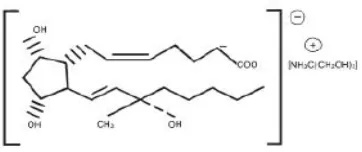
Analytical instruments play a main role in the production and evaluation of new products. This instrumentation provides lower detection limits required to assure safe foods, drugs, water and air. Instrumental methods are widely used by analytical chemists to save time and to obtain increased accuracy. 2 Carboprost is a synthetic 15 methyl analogue of naturally occurring prostaglandin F2α. Carboprost Tromethamine is chemically a salt of (5Z,13E)- (8R,9S,11R,12R,15S )-9,11,15-trihydroxy-15-methylprosta- 5,13-dienoic acid with 2-amino-2-hydroxymethyl-1,3- propanediol. The molecular formula is C25H47O8N and has a molecular weight of 489.64. It is a white to slightly off-white
crystalline powder and is soluble in water. Carboprost available in tromethamine salt form, because tromethamine salt of Carboprost produces a crystalline material and obtained in high purity. It is official in Indian Pharmacopoeia (IP) 3 and United States Pharmacopoeia (USP) 4. The molecular structure is shown in the Figure No.1. Carboprost is an uterine stimulant, used for the control of post partum haemorrhage (PPH) as a part of active management of third stage of labor thereby reduces the maternal mortality and morbidity5. Review literature reveals that several methods were reported using various instrumental techniques like LC separation of carboprost by normal phase 6,7,8, LC-MS method to assess stability and recovery9, GC-MS method in selected ion monitoring mode10, high-performance liquid chromatography with fluorimetric detection 11 and RP-HPLC method in biologic al fluids12 for carboprost estimation. Literature search revealed that no RP-HPLC method was available for determination of Carboprost Tromethamine with faster elution time in pharmaceutical preparations (Injection). Hence an attempt was made to develop and validate a new, simple, precise, accurate and especially time saving method which is suitable for quality control in the pharmaceutical industry.
A new simple, precise, accurate and rapid method was developed for determination of Carboprost Tromethamine from its pharmaceutical dosage form. The separation was carried out on a Waters C18 column (Symmetry -C18, 3.5µm, and 4.6×100mm) in isocratic mode with mobile phase comprising acetate buffer pH 3.7 and methanol (30:70, %v/v) by using Agilent 1100 series HPLC system with Agilent Chemstation software. The flow rate was 1 ml/min and Ultra-Violet detection was carried out at 200 nm. Every part of determination was performed at ambient column temperature. The retention time was 6.827 min for Carboprost Tromethamine. The developed method was validated for parameters like specificity, accuracy, precision, robustness as per International Conference on Harmonization guidelines. Linearity for Carboprost Tromethamine was in the range of 83-249µg/ml and Correlation coefficient was found to be 0.999. The percentage recovery was found to be in the limit of 98.4-99.3 %. Statistical analysis of the results has been carried out revealing high accuracy and good precision. Hence this method can be of use and value for the quality control department of pharmaceutical companies manufacturing these formulations without any interference due its sensitivity, simplicity and selectivity.
Keywords: Carboprost Tromethamine, RP-HPLC, Method development & validation, International Conference on Harmonization.
ABSTRACT
P.
Vijayasree*S. Rubesh Kumar Manasa. K K. C. Gowri devi
S. Charumathi
Department of Pharmaceutical Analysis, Oil Technological Research Institute,
JNTU Anantapur, Ananthapuramu- 515 001,
Andhra Pradesh, India.
Journal of Global Trends in Pharmaceutical Sciences
Journal home page: www.jgtps.com
ISSN: 2230-7346
Figure 1: Molecular structure of Carboprost tromethamine
MATERIALS AND METHODS: Apparatus:
HPLC - Agilent 1100 series (Agilent Technologies Inc.,)
pH meter- CYBER SCAN 510 (Elico)
UV-Visible Spectrophotometer - UV-1700 (Shimadzu)
Digital balance- (Sartorius)
Sonicator- MODEL 2200MH (Shimadzu) Vacuum filter- MF-6126 (Millipore) Materials and Reagents:
All chemicals and reagents used throughout the work were of analytical grade. All other solvents used were of HPLC grade. HPLC grade Milli Q water was used throughout the experiment work. Carboprost Tromethamine working reference standard and formulation were supplied by Astrazeneca Pharma India Limited, Bangalore.
Optimization of method parameters:
The optimum composition of the mobile phase containing acetate buffer pH 3.7 and methanol (30:70, % v/v) was selected because it was found to give a peak for Carboprost Tromethamine with minimum tailing. The flow rate was set to 1 ml/min and UV detection was carried out at 200 nm. The entire determination was performed at ambient column temperature. The separation was carried out on a C18 column (Symmetry -C18, 3.5µm, and 4.6×100mm). Analytical work was performed on an Agilent 1100 series HPLC system. Integration was done using Agilent chemstation software.
Preparation of buffer: 2 ml of glacial acetic acid was dissolved in 1000ml of water. The pH was adjusted to 3.7 using 2% ammonium acetate solution .The buffer was filtered through 0.45µ membrane filter.
Preparation of mobile phase: Mobile phase was prepared by mixing 300 ml of the buffer with 700 ml of methanol (30:70 % v/v). The prepared mobile phase was sonicated for about 5 minutes in a sonicator.
Preparation of Standard Solution:Accurately about 8.3 mg of standard Carboprost Tromethamine was weighed and transferred into 20 ml volumetric flask. The drug was dissolved in purified water with shaking and then the volume made up to the mark with purified water. 4 ml of this solution was diluted to 10 ml with water.
Preparation of Sample Solution: Sample as such was used for analysis.
Analysis of pharmaceutical preparation:
The pharmaceutical preparation (PROSTODIN 125 Injection) containing Carboprost tromethamine 125 µg/ml
was analyzed using this method. Sample as such was assayed & quantified by using conversion factor of 0.752599 for carboprost tromethamine to carboprost. The average of assay result for six estimations is given in Table No.1.
RESULTS AND DISCUSSION: Method Development:
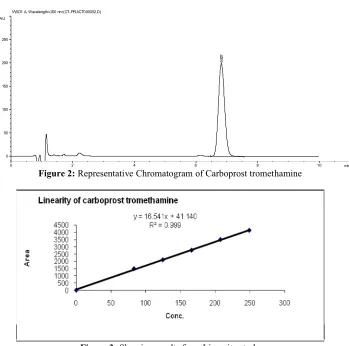
To optimize the RP-HPLC parameters, some important parameters like pH & strength of the buffer solution, percentage of organic modifier, type of stationary phase etc., were tested for a good chromatographic separation. Trails showed that satisfactory separation and good peak symmetry for carboprost tromethamine was obtained with mobile phase composition of acetate buffer pH 3.7 and methanol (30:70 v/v) on a Waters C18 column (Symmetry -C18, 3.5µm, and 4.6×100mm) in isocratic mode at a flow rate of 1 mL/min at ambient temperature. Retention time of the drug obtained under these conditions was 6.827 min. The representative chromatogram of the carboprost tromethamine standard is as shown in Figure No.2. Validation of Proposed method:
The proposed method was validated according to the International Conference on Harmonization (ICH) guidelines13.
Specificity:
The specificity of the proposed HPLC method was proved by its ability to determine the carboprost tromethamine in its formulation confirming that, there was no interference.
Precision:
Precision of the method was investigated through its repeatability and reproducibility. For repeatability standard and sample solutions containing carboprost tromethamine were injected in replicate and analysed by proposed method. For intra-day and inter-day variation of the method, standard solution containing carboprost tromethamine was subjected to the proposed RP-HPLC method of analysis. The precision of the proposed method was calculated in terms of % RSD. % RSD was found to be within limits i.e., <2 which confirms the high degree of precision of the method. Linearity & Range:
Accuracy (Recovery Study):
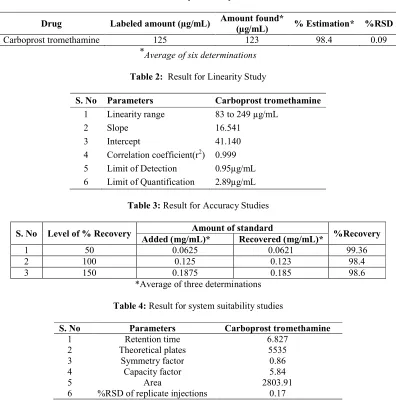
Accuracy was assessed by the recovery studies. The placebo was spiked with the known amount of Carboprost Tromethamine reference standard with three concentrations in the range of 83-249 µg/ml for Carboprost Tromethamine. The concentration of the drug present in the resulting solution was determined by using assay method. The percentage recovery was within the limit of 98.4-99.3 %. Results obtained for Carboprost Tromethamine are summarized in Table No.3.
LOD and LOQ Determination:
In this study LOD & LOQ were determined based on the standard deviation of response and the slope of corresponding curve using following equations 1 & 2
LOD = 3.3 σ/ S ---→ 1 LOQ = 10 σ/ S ---→ 2
Where σ is standard deviation and S is slope of calibration curve. The Limit of Detection (LOD) and Limit of Quantification (LOQ) were found to be 0.95µg/mL and 2.89µg/mL respectively for Carboprost Tromethamine.
Robustness:
Robustness of the method was determined by making slight changes in the chromatographic conditions. It is studied by altering the composition of mobile phase i.e., organic modifier percentage, buffer pH and flow rate by ±0.05 ml/min analyzing six samples from a homogeneous batch.
The changes did not affect the results indicating that the proposed method is robust under these chromatographic conditions.
System suitability testing:
According to USP, system suitability is an integral part of chromatographic methods. System suitability was assessed by injecting Carboprost Tromethamine standard preparation in replicate. System Suitability parameters like Precision of the instrument (%RSD) (n=6), Theoretical plates, Symmetry factor, Capacity factor for the proposed method are reported in Table No.4.
CONCLUSION:
The developed and validated RP-HPLC method for determination of Carboprost Tromethamine reported here is rapid, simple, accurate, sensitive and specific. The method was successfully used for quantitative estimation of Carboprost tromethamine in injection dosage form. The developed method was found to be precise, reproducible, and can be used for routine quality control analysis of carboprost tromethamine in bulk and pharmaceutical formulation.
min
0 2 4 6 8 10
mAU
0 50 100 150 200 250
VWD1 A, Wavelength=200 nm (CT-PRJ\CT000002.D)
6
.8
27
Figure 2:Representative Chromatogram of Carboprost tromethamine
Table 1:Result for Assay of Carboprost tromethamine
Drug Labeled amount (µg/mL) Amount found*(µg/mL) % Estimation* %RSD
Carboprost tromethamine 125 123 98.4 0.09
*Average of six determinations
Table 2: Result for Linearity Study
S. No Parameters Carboprost tromethamine
1 Linearity range 83 to 249 µg/mL
2 Slope 16.541
3 Intercept 41.140
4 Correlation coefficient(r2) 0.999 5 Limit of Detection 0.95µg/mL 6 Limit of Quantification 2.89µg/mL
Table 3: Result for Accuracy Studies
S. No Level of % Recovery Amount of standard %Recovery
Added (mg/mL)* Recovered (mg/mL)*
1 50 0.0625 0.0621 99.36
2 100 0.125 0.123 98.4
3 150 0.1875 0.185 98.6
*Average of three determinations
Table 4: Result for system suitability studies
S. No Parameters Carboprost tromethamine
1 Retention time 6.827
2 Theoretical plates 5535
3 Symmetry factor 0.86
4 Capacity factor 5.84
5 Area 2803.91
6 %RSD of replicate injections 0.17
Acknowledgement
The authors acknowledge sincere gratefulness towardsAstrazeneca Pharma India Limited, Bangalore for providing necessary facilities for completion of this project.
REFERENCES:
1. Skoog DA, Principles of Instrumental Analysis.5th edition, Thomson Brooks/Cole Asia pvt.ltd, Singapore; 2004. pp 4-7.
2. Willard HH, Instrumental methods of Analysis.7th ed, CBS publishers & Distributors, New Delhi; pp 8-10.
3. 3.Indian Pharmacopoeia 2010, volume II, 6th edition, Govt of India , New Delhi: The Controller of publication 2010.
4. U.S.Pharmacopoeia NF 2009 volume II, Twinbrook Pathway Rockwillae: The United State Pharmacopoieal Convention; 2009.
5. KD.Tripathi. Autacoids and Related Drugs: Prostaglandins and Leukotrienes. Essentials of
Medical Pharmacology. Jaypee Brothers Medical Publishers; 6thed: pp. 181.
6. S. G. Hiriyanna, K. Basavaiah, V. Dhayanithi and H. N. Pati., Chiral separation of carboprost isomers by normal phase LC using amylose chiral stationary phase, Chromatographia, 2008, 68(7-8):501-505 .
7. S.M. Plaisted, T.A. Zwier and B.G. Snider., High-performance liquid chromatographic separation of 15-methyl PGF2α methyl ester isomers , Journal of Chromatography A,1983,281:151-157.
8. Leo W. Brown and Bruce E. Carpenter, Comparison of two high-pressure liquid chromatographic assays for carboprost, a synthetic prostaglandin, Journal of Pharmaceutical Sciences, 1980 (69): 1396–1399.
10. Tsukamoto H, Hishinuma T, Mikkaichi T, Nakamura H, Yamazaki T, Tomioka Y, Mizugaki M., Simultaneous quantification of prostaglandins, isoprostane and thromboxane in cell-cultured medium using gas chromatography-mass spectrometry, J. Chromatography. B: Analytical Technologies in the Biomedical and Life Sciences, 2002; 774(2):205-14.
11. Engels W, Kamps MA, Lemmens PJ, van der Vusse GJ, Reneman RS., Determination of prostaglandins and thromboxane in whole blood
by high-performance liquid chromatography with fluorimetric detection, J Chromatogr. , 1988, 427(2):209-18.
12. Terragno A, Rydzik R, Terragno NA., High performance liquid chromatography and UV detection for the separation and quantitation of prostaglandins, Prostaglandins, 1981, 21(1):101-12.
13. The International Conference on Harmonization, Q2 (R1), Validation of Analytical Procedures, Text and Methodology, 2005.
How to cite this article:
P.Vijayasree*, S. Rubesh Kumar, Manasa. K, K. C. Gowri devi, S. Charumathi: A Simple RP-HPLC method for Quantitation of Carboprost Tromethamine in Injection Dosage Form 5(4): 2012-2016. (2014)