Available online throug
ISSN 2229 – 5046
International Journal of Mathematical Archive- 7(12), Dec. – 2016 151
COMPLEMENTARY EQUIVALENCE DOMINATING SETS IN GRAPHS
N. SARADHA*
1, V. SWAMINATHAN
21
Assistant Professor, Department of Mathematics,
S. C. S. V. M. V. University, Enathur, Kanchipuram, Tamil Nadu, India.
2
Coordinator, Ramanujan Research Center in Mathematics,
Saraswathi Narayanan College, Madurai, Tamil Nadu, India.
(Received On: 17-10-16; Revised & Accepted On: 24-11-16)
ABSTRACT
L
et G=(V,E) be a simple finite undirected graph. A subset S of V(G) is called an equivalence set if every componentof the induced sub graph
S
is complete. A graph G is an equivalence graph if every component of G is complete. Asubset S of V(G) is called a complementary equivalence dominating set of G if
V
−
S
is an equivalence set of G andS is a dominating set of G. The minimum cardinality of a c-e-d set of G is denoted by
γ
c−e(
G
). In this paper, several results concerning complementary equivalence domination are derived Also Complementary equivalence irredundanceis defined and relationship between the minimum cardinality of a maximal c-e irredundance set of G and are
found. Further Independence c-e saturation parameter is also introduced.
Keywords: Equivalence domination, Complementary equivalence domination, Complementary equivalence
irredundance.
1. INTRODUCTION
A subset S of V(G) is called an equivalence set if every component of the induced sub graph is complete. A graph
G is an equivalence graph if every component of G is complete. A sub set S of V(G) is called a complementary equivalence dominating set of G if is an equivalence set of G and S is a dominating set of G. The minimum
cardinality of a c-e-d set of G is denoted by . The complementary equivalence number (upper complementary
equivalence number) of G is defined and these parameters are found for standard graphs. Independent complementary equivalence sets are defined and two parameters and are introduced. These are determined for
standard graphs. Several nice results involving c-e-d sets are derived, relationship with other graph parameters are found and inequality chain is established. Complementary equivalence irredundance is defined and relationship between the minimum cardinality of a maximal c-e irredundance set of G and are found. Independence c-e
saturation parameter is also introduced.
2. COMPLEMENTARY EQUIVALENCE DOMINATING SETS IN GRAPHS
Definition 2.1 [3]: Let G = (V, E) be a simple graph. A subset S of V is called an equivalence set of G if the components of are complete.
Definition 2.2: Let G = (V, E) be a simple graph. Then a subset S of V is called a complementary equivalence set if the components of are complete.
Corresponding Author: N. Saradha*
11
Assistant Professor, Department of Mathematics,
S. C. S. V. M. V. University, Enathur, Kanchipuram, Tamil Nadu, India.
) (G
e c−
γ
S
S
V
−
) (G
e c−
γ
)
(
G
i
c−eβ
c−e(
G
)
)
(
G
e c−γ
S
Definition 2.3: The complementary equivalence number of G (upper complimentary equivalence number of G) denoted by c-e(G) (C-E(G)) is defined as
c-e(G) = Min {│S│/S is a minimal c-e set of G}. C-E(G)=Max{│S│/S is a minimal c-e set of G}
Some Standard Results
)
(
1
)
(
C
nn
c
e
C
nE
C
−
=
−
=
−
Definition 2.4: ic-e(G)=Min{│S│/S is a maximal independent c-e set}
β
c−e(
G
)
=
Max
{
S
/S
is
a
maximal
independen
t
c
-
e
set
}
Remark 2.5: A maximal independent c-e set of G is a c-e-dominating set of G.
Proof: Suppose S is a maximal independent c-e set of G. Let . Suppose x is not adjacent with any vertex of S. Then is an independent set of G. Also is an equivalence set of G, since is a
subset of the equivalence set V-S. Therefore, is an independent c-e set of G, a contradiction, since S is a maximal independent c-e set of G. Therefore, S is a dominating set of G.
Some Standard Results
Definition 2.6: Let G = (V, E) be a simple graph. Let S be a subset of V. S is called a complementary equivalence dominating set of G if S is a dominating set of G and V-S is an equivalence set of G and it is abbreviated as c-e-d set of G.
Remark 2.7:
1. c-e-d property is super hereditary.
2. The minimum cardinality of a c-e-d set is called the c-e domination number and it is denoted by .
Characterization of minimal c-e-d set.
Theorem 2.8: Let S be a c-e-d set of G. S is minimal if and only if for any , one of the following holds:
i) .
ii) At least one component of V-S has two or more elements and in each component there exists a vertex which is not adjacent to u.
Proof: Let S be a minimal c-e-d set of G. Let . Then S-{u} is not a dominating set of G. Suppose S-{u} is not a dominating set of G. Then either u is an isolate of G or u has a private neighbour with respect to S in V-S. That is,
)
(
0
)
(
K
nc
e
K
nE
C
−
=
=
−
1
)
(
=
−
−
E
P
n
C
n1
)
(
=
−
−
e
P
n
c
nS
V
x
∈
−
}
{
x
S
∪
V
−
(
S
∪
{
x
})
V −(S∪{x})}
{
x
S
∪
1
)
(
=
−e n
c
K
i
=
−
3
)
(
C
n
i
c e n
=
−
3
)
(
P
n
i
c e n1
)
(
1,=
−e n
c
K
i
0
)
(
=
−e n
c
K
β
=
−
2
)
(
C
nn
e c
β
=
−
2
)
(
P
nn
e c
β
n
K
ne
c−
(
1,)
=
β
)
(
G
e c−γ
S
u
∈
φ
≠
]
,
[
u
S
pn
© 2016, IJMA. All Rights Reserved 153 Suppose S-{u} is a dominating set but its complement is not an equivalence set of G. That is, V-(S-{u}) is not an
equivalence set of G. But V-S is an equivalence set of G. Let T1, T2,...,Tk be the components of . If u is
adjacent with every vertex of a component Ti then
(
V
−
S
)
∪
{
u
}
is an equivalence set of G, acontradiction. Therefore, in each component of , there exists a vertex which is not adjacent with u. Suppose
every component of is singleton. Suppose u is not adjacent with the vertex in each component. Then
is an equivalence set of G, a contradiction. Therefore, at least one component of contains two
or more elements. Therefore, condition (ii) holds.
Conversely, suppose S is a c-e-d set of G and every vertex satisfies one of the two conditions. Suppose u satisfies (i). Then .Therefore, S-{u} is not a dominating set of G. Suppose u satisfies (ii). Then
is not an equivalence set of G. Therefore, S-{u} is not complementary equivalence set of G. Thus if u satisfies (i) or (ii), then S-{u} is not a c-e-d set of G. Therefore, S is 1-minimal c-e-d set of G. Since c-e-d property is super-hereditary, S is a minimal c-e-d set of G.
Definition 2.9: The upper c-e domination number is the maximum cardinality of a minimal c-e-d set.
Some Standard Results
Observation 2.10: For any graph G with out isolates,
γ
c−e(
G
)
≤
α
(
G
)
.Proof: Let S be a maximum independent set of a graph G with out isolates. Then V-S is a dominating set and is also a complementary equivalence set. Therefore, . That is, . That is,
)
(
)
(
G
G
n
−
β
≥
γ
c−e . That is,α
(
G
)
≥
γ
c−e(
G
)
.Definition2.11[15]: A dominating set S of a graph G is a non split dominating set of G if V−S is connected. The minimum cardinality of a non split dominating set of G is denoted by
γ
ns(
G
)
and is called the non split domination number of G.Definition 2.12[12]: A dominating set S of a graph G is called a strong non split dominating set of G if
V
−
S
is complete. The minimum cardinality of a strong non split dominating set of G is denoted byγ
sns(
G
)
and is called the strong non split domination number of G.Observation 2.13: .
Definition 2.14 [13]: A dominating set S of a graph G is called a split dominating set of G if
V
−
S
is disconnected. The minimum cardinality of a split dominating set of G is denoted byγ
s(
G
)
and is called the split domination number of G.Definition 2.15[14]: A dominating set S of a graph G is called a strong split dominating set of G if
V
−
S
is totally disconnected with at least two vertices. The minimum cardinality of a strong split dominating set of G is denoted by)
(
G
ss
γ
and is called the strong split domination number of G.S
V
−
)
1
(
≤
i
≤
k
S
V
−
S
V
−
}
{
)
(
V
−
S
∪
u
V−SS
u
∈
ϕ
≠
]
,
[
u
S
pn
}
{
)
(
V
−
S
∪
u
)
(
G
e c−Γ
1
)
(
=
−e n c
K
γ
=
−
3
)
(
C
nn
e c
γ
=
−
3
)
(
P
nn
e c
γ
1
)
(
1,=
−e n
c
K
γ
)
(
G
S
V
−
≥
γ
c−e n−S ≥γ
c−e(G))
(
)
(
)
(
G
γ
c eG
γ
snsG
Observation 2.16: If then .
Definition 2.17: A dominating set S of a graph G is a complementary strong split dominating set of G if is totally disconnected. The complementary strong split domination number of G is the minimum cardinality of a
complementary strong split dominating set of G.
Definition 2.18: The upper complementary strong split domination number is the maximum cardinality of a minimal complementary strong split dominating set of G.
Definition 2.19: A subset S of V of G is called complementary independent if is totally disconnected. S is also called a covering set of G. The minimum cardinality of S such that V-S is an independent set is called complement maximum independent set or a minimum covering set of G.
Observation 2.20: Let G be an isolate free graph. Suppose S is a subset of V(G) such that V-S is a maximal independent set. Then S is a minimal complementary strong split dominating set.
Proof: Let . Then u is an isolate in . Since u is not an isolate of G, u is adjacent with some vertex of S. Therefore, S is a complementary strong split dominating set. Suppose S is not minimal. Then there exists some
such that S-{u}is a complementary strong split dominating set. Therefore, is totally disconnected set, contradicting the maximality of V-S. Therefore, S is a minimal complementary strong split dominating set.
The following inequality chain is observed.
.
Also if G has no isolates then ,
3. COMPLEMENTARY EQUIVALENCE C-E IRREDUNDANCE IN GRAPHS
Definition 3.1: A subset S of V is called c-e irredundant set if for each , one of the following holds.
i) where
ii) In every component of V-S of order there exists w1 such that w1 is not adjacent to u and there exists w2 such that w2 is adjacent with u.
Definition 3.2: The minimum (maximum) cardinality of a maximum c-e-irredundant set of a graph G is called c-e irredundance number of G (upper c-e-irredundance number of G) and is denoted by .
Some Standard Results
Proposition 3.3: c-e irreddundance is hereditary.
Proof: Let S be a c-e ireredundance set of G and let T be a subset of S. Let
u
∈
T
. Thenu
∈
S
. (Suppose u satisfies the condition that every component of V-S, there exists w such that w is not adjacent to u). Suppose .Then
pn
[
u
,
S
]
=
φ
. Then V-S has a component say X of order ≥2 and u is adjacent with at least one vertex of X andnot adjacent with a vertex of X. Hence
X
∪
{
u
}
is non complete component of V-T. Hence T is c-e irredundent.)
(
)
(
G
snsG
e
c
γ
γ
−<
γ
s(
G
)
≤
γ
c−e(
G
)
≤
γ
ss(
G
)
S
)
(
G
ss c−
γ
) (G ss c− Γ
S
V
−
S
V
u
∈
−
V −SS
u
∈
(
V
−
S
)
∪
{ }
u
)
(
)
(
)
(
)
(
)
(
)
(
)
(
)
(
G
G
G
i
G
G
G
G
IR
G
ir
≤
γ
≤
γ
c−e≤
c−e≤
β
c−e≤
Γ
c−e≤
Γ
≤
)
(
i
i(G)
,
)
(
)
(
G
0G
c-eG
e
c−
≤
α
≤
γ
β
c−e(
G
)
≤
β
0(
G
)
S
u
∈
φ
≠
]
,
[
u
S
pn
pn
[
u
,
S
]
=
N
[
u
]
−
N
[
S
−
{
u
}]
2
≥
))
(
(
)
(
G
IR
G
ir
c−e c−e1
)
(
=
−e n c
K
ir
2
)
(
1,=
−e n
c
K
ir
=
−
3
)
(
C
n
ir
c e n
=
−
3
)
(
P
n
ir
c e nφ
=
© 2016, IJMA. All Rights Reserved 155
Theorem 3.4: Any minimal c-e-d set is a maximal c-e irredundent set.
Proof: Let S be a minimal c-e-d set. Then S is a c-e irredundent set. Suppose S is not a maximal c-e irredundent set. Then there exists such that is a c-e irredundent set.
Case I: Suppose . Therefore, there exists such that v is adjacent only with u with respect to . That is, v is not adjacent with any vertex of S. Therefore, S is not a dominating set, a contradiction. Therefore, S is a maximal c-e -irredundent set.
Case II: Suppose in every component of , there exists w such that w is not adjacent with u. If X1, X2,...,Xr be the components of then u is not adjacent to some vertex in each component of
. That is, V-S is not component wise complete, a contradiction, since S is a c-e-d set. Therefore, S is a maximal c-e irredundent set.
Remark 3.5: .
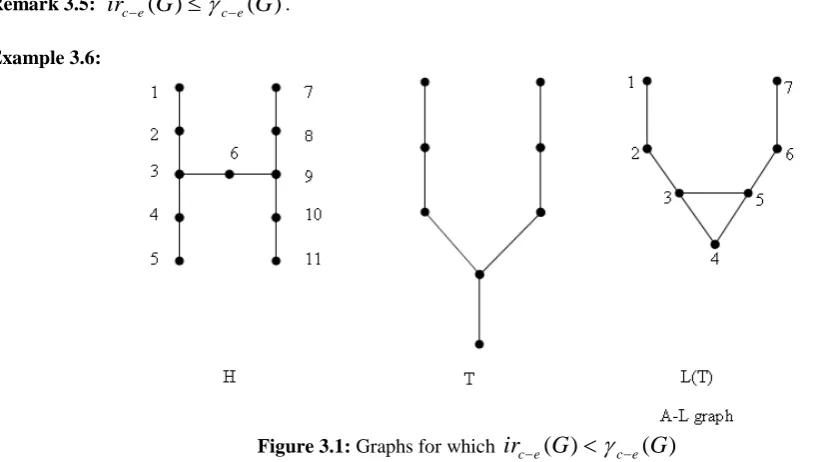
Example 3.6:
Figure 3.1: Graphs for which
For the graph H, S={2,3,8,9} is a c-e irredundent set .
[Because pn(2) =1; pn(3) = 4; pn(8) = 7; pn(9) = 10; V-S = {1,4,5,6,7,10,11} Each component in the induced subgraph of V-S is complete].
S' = {2, 4, 6, 8, 10} is a c-e dominating set. That is, and .
For the A-L graph (L(T)),
and
γ
c−e(
L
(
T
))
=
3
. S = {3, 6} is a c-e irredundant set.S' = {2, 6, 3} is a c-e dominating set.
Theorem 3.7:
Proof: Let irc-e (G)=k. Let S={v1, v2, . . . vk} be an ir c-e set of G. Since S is irredundent,
pn
[
v
i,
S
]
≠
φ
or there exist a component of V-S of order greater than or equal to two and vi is adjacent with a vertex of the component and notadjacent with another vertex of that component. Let S'={u1, u2 . . . ,us} where
u
i∈
pn
[
v
i,
S
]
if vi has a private neighbor and ui is one of the vertices in a component of V-S of order greater than or equal to two adjacent with vi.Lets S"=S ∪ S'. Suppose S" is not a dominating set. Then there exist w ∈ V-S" such that w is not adjacent to ui as well as vi, 1≤ i ≤ k. Therefore, w does not belongs to N [x] for any vertex x in S".
pn
[w,
S
∪
{u}]
≠
φ
. Sincefor any x ∈ S", w is not adjacent with any ui. Therefore, pn[ui, S ∪{w}]≠ .
S
V
u
∈
−
S
∪
{
u
}
φ
≠
∪
{
}]
,
[
u
S
u
pn
v
∈
V
−
(
S
∪
{
u
})
}
{
u
S
∪
})
{
(
S
u
V
−
∪
})
{
(
S
u
V
−
∪
})
{
(
S
u
V
−
∪
)
(
)
(
G
G
ir
c−e≤
γ
c−e)
(
)
(
G
G
ir
c−e<
γ
c−e4
)
(
=
−
H
ir
c e γc−e(H)=52
))
(
(
=
−
L
T
ir
c e1
)
(
2
)
(
)
(
2
/
)
(
<
−≤
−≤
−−
−e
G
ir
c eG
c eG
ir
c eG
c
γ
γ
]
[
x
N
Case I: u i= vi . Then vi is a private neighbor of S. vi is not adjacent with w. Therefore, vi is an isolate of
S
∪
{
w
}
.}
{
w
S
∪
is complementary componentwise complete.Case II: ui ≠vi . ui is not adjacent with w. If ui is a private neighbor of vi then pn[ ui,
S
∪
{
w
}
]≠ .Case III: ui≠vi, and ui is not a private neighbor of vi. Then ui is a vertex in a component of V-S such that vi is adjacent with ui and vi is not adjacent with a vertex of the component. Since is complementary componentwise complete, ui is not a private neighbor of vi but ui is adjacent with vi in a component containing vi having at least two elements.
From case I, case II, case III, S ∪{w} is a c-e irredundent set, contradicting the maximality of S. Therefore, S" is a dominating set. Also S" is a complementary component wise complete. Therefore, S" is a c-e-d set.
Suppose S" is a minimal c-e-d set. Then S" is a maximal c-e irredundent set containing S, a contradiction. Therefore,
. Hence
2
/
1
)
(
2
/
)
(
≤
−−
−e
G
ir
c eG
c
γ
.)
(
2
/
)
(
G
ir
c eG
e
c−
<
−γ
.Therefore,
Theorem 3.8: Let S be a set of G. Then S is dominating set.
Proof: Suppose S is not a dominating set. Then there exists a vertex such that u is not adjacent with any vertex of S. Therefore, is an independent set and complement of is componentwise complete. This contradicts the fact that S is a maximum independent set with complement componentwise complete. Therefore, S is a dominating set. That is, S is a c-e-d set.
Remark 3.9: A
β
0-set of a graph need not be a c-e set.For example, let G = A-L-graph (Figure 3.1). {1, 7, 3} is a maximum independent set. The complement is not componentwise complete.
Definition 3.10:
Independent c-e saturation parameter (I-c-e Saturation parameter)
Let G be an i-c-e excellent graph. Let .Then
i-c-e-s(u)=Maximum{│S│:S is a independent c-e set containing u} i-c-e-s(G)=Minimum{i-c-e-s(u): }
Remark 3.11:
1. Let S be a maximum i-c-e-s(u) set. Then S is a dominating set.
2.
i
c−e(
G
)
≤
i
−
c
−
e
−
s
(
G
)
≤
β
c−e(
G
)
4. RELATIONSHIP BETWEEN OTHER GRAPH PARAMETERS
Proposition 4.1: Given positive integers a,b and c such that , there exists a connected graph G with
c
G
b
G
a
G
)
=
,
c−e(
)
=
and
(
)
=
(
γ
γ
snsγ
.Proof: Let a, b and c be three positive integers such that . Consider Kb. Let be the vertex set of Kb. Add c vertices . Attach each
, as a pendant vertex to some such that each uj has at least one pendant vertex. Join
ua+k with ua+k', . Let G be the resulting graph. Then {u1,u2,u3,...,ua}is a minimum dominating set of G,
is a minimum c-e dominating set of G and is a minimum
sns-dominating set of G.
φ
}
{
w
S
∪
)
(
2
''
)
(
G
S
ir
c eG
e
c−
<
=
−γ
γ
c−e(
G
)
≤
2
ir
c−e(
G
)
−
1
.
1
)
(
2
)
(
)
(
2
/
)
(
<
−≤
−≤
−−
−
G
ir
G
G
ir
G
r
c e c eγ
c e c ee c−
β
S
V
u
∈
−
}
{
u
S
∪
S
∪
{
u
}
)
(
G
V
u
∈
)
(
G
V
u
∈
c
b
a
≤
≤
c
b
a
≤
≤
}
,....,
,...,
,
,
{
u
1u
2u
3u
au
b{
u
1'
,
u
2'
,
u
3'
,...,
u
c'
}
c
i
u
i'
,
1
≤
≤
u
j,
1
≤
j
≤
a
a
b
k
≤
−
≤
1
}
,....,
,...,
,
,
© 2016, IJMA. All Rights Reserved 157 Therefore,
γ
(
G
)
=
a
,
γ
c−e(
G
)
=
b
and
γ
sns(
G
)
=
c
.Remark 4.2: if and only if
γ
c−e(
G
)
≤
n
−
2
.Proof: Let S be a dominating set of G. Then any super set of S containing n-2 vertices is a complementary equivalence dominating set of G. Therefore,
γ
c−e(
G
)
≤
n
−
2
.The converse is also true (since, ).Observation 4.3: If G is a graph without isolates and of order greater than or equal to 4 and if
γ
c−e(
G
)
=
n
−
2
, then G is a triangle free graph.Proof: Let
γ
c−e(
G
)
=
n
−
2
. Since G has no isolates,2
)
(
G
≤
n
γ
. Let S be a dominating set of G. IfV
−
S
contains a triangle say x, y, z , then
S
∪
((
V
−
S
)
−
{
x
,
y
,
z
})
is a complementary equivalence dominating set of G. Therefore,γ
c−e(
G
)
≤
n
−
3
, a contradiction. SupposeS
contains a triangle x, y, z. Since S is a minimumdominating set and since x, y, z are not isolates of
S
, each of them has a private neighbour inV
−
S
. Let}
,
,
{
1
V
x
y
z
S
=
−
. Then S1 is a complementary equivalence dominating set of G. Therefore,γ
c−e(
G
)
≤
n
−
3
, a contradiction. Suppose G has a triangle with one vertex in S and two vertices in V-S (or) two vertices in S and one vertex in V-S.Sub Case I:
x
,
y
,
z
is a triangle in G withx
∈
S
andy
,
z
∈
V
−
S
.If x is an isolate of
S
, then x has private neighbour in V-S. If x is not an isolate ofS
, then there exists vertices in S which are adjacent to x. Therefore,V
−
{
x
,
y
,
z
}
is a complementary equivalence dominating set of G. Therefore,3
)
(
≤
−
−e
G
n
c
γ
, a contradiction.Sub Case II:
x
,
y
∈
S
andz
∈
V
−
S
.Then x and y are not isolates of
S
and henceV
−
{
x
,
y
,
z
}
is complementary equivalence dominating set of G.Therefore,
γ
c−e(
G
)
≤
n
−
3
. Therefore, G has no triangle.Remark 4.4: The converse of the above result is not true.
Consider Km,n . Then
γ
c−e(
K
m,n)
=
min{m,
n}
<
m
+
n
-
2
ifm
,
n
≥
3
. Also Km,n is triangle free.Remark 4.5: Let G be a connected graph of even order. If
2
)
(
G
=
n
γ
, then2
)
(
G
n
e c−
=
γ
.Proof: Since G is connected with
2
)
(
G
=
n
γ
, G is either C4 or H+ where H is connected graph.γ
c−e(
C
4)
=
γ
(
C
4)
and
γ
c−e(
H
+)
=
γ
(
H
+)
. Therefore,2
)
(
)
(
G
G
n
e
c−
=
γ
=
γ
.Remark 4.6: Let G be a complete bipartite graph. Then
γ
c−e(
G
)
=
γ
(
G
)
if and only if G is either a star or2
2
K
K
n++
.Proof: If G is a complete bipartite graph with m,n as the orders of the partition, then
=
=
≥
=
1
n
or
1
m
if
1
2
n
m,
if
2
)
(
G
γ
,γ
c−e(
G
)
=
min{m,
n}
.Therefore,
γ
(
G
)
=
γ
c−e(
G
)
if and only if min{m, n}=2 or min{m, n}=1. That is, G is either a star orK
n+2+
K
2.
2
)
(
G
≤
n
−
γ
2
)
(
)
REFERENCES
1. M.O. Albertson, R.E. Jamison, S.T. Hedetniemi and S.C.Locke, The subchromatic number of a graph, Discrete Math., 74(1989), 33-49.
2. N. Alon, Covering graphs by the minimum number of equivalence relations, Combinatorica 6 (3) (1986), 201-206.
3. S. Arumugam, M.Sundarakannan, Equivalence Dominating Sets in Graphs, Utilitas Mathematica 91(2013) 231-242.
4. A. Blokhuis and T. Kloks, On the equivalence covering number of split graphs, Information Processing Letters, 54(1995), 301-304.
5. P.Duchet, Representations, noyaux en theorie des graphes et hyper graphes, These de Doctoral d'EtatI, Universite Paris VI, 1979.
6. R.D. Dutton and R.C. Brigham, Domination in Claw-Free Graphs, Congr. Numer., 132(1998), 69-75.
7. G.H. Fricke, Teresa, W.Haynes, S.T. Hedetniemi, S.M. Hedetniemi and R.C. Laskar, Excellent trees. preprint. 8. J.Gimbel and C. Hartman, Subcolorings and the subchromatic number of a graph, Discrete Math., 272(2003),
139-154.
9. Harary, Graph Theory, Addison-Wesley/Narosa,1988.
10. T.W. Haynes, S.T. Hedetniemi and Peter J.Slater, Fundamentals of domination in graphs, Marcel Dekker, New York, 1998.
11. T.W. Haynes, S.T. Hedetniemi and Peter J.Slater, Domination in graphs: Advanced Topics, Marcel Dekker, New York, 1998.
12. V.R. Kulli and B. Janakiram, The strong nonsplit domination number of a graph.
13. V.R. Kulli and B.Janakiram, The split domination number of a graph, Graph Theory Notes of New York Academy of sciences xxxii, p.16-19.
14. V.R.Kulli and B.Janakiram, The strong split domination number of a graph, Gulbarga University, Department of Mathematics, Report (1999).
15. V.R. Kulli and B.Janakiram, The nonsplit domination number of a graph, Indian J. pure Appl. Math., 31, p-545-550
16. C.Mynhardt and I. Broere, Generalized colorings of graphs, In Y.Alavi, G.Chartrand, L.Lesniak, D.R. Lick and C.E. Wall, editors, Graph Theory with Applications to Algorithms and Computer Science, Wiley, (1985),583-594.
17. S.P.Subbaiah, Component-wise complete complementary domination, Mathematical and experimental physics, Narosa Publications, 2010, 66-74.
Source of support: Nil, Conflict of interest: None Declared.