1 | P a g e
International Journal of Pharmaceutical
Development & Technology
e ISSN - 2248 - 910X
www.ijpdt.com
Print ISSN - 2248 - 9096FORMULATION AND EVALUATION OF MICROSPHERES FOR
IMMEDIATE AND SUSTAINED RELEASE OF DIFFERENT DRUGS
USING SAME POLYMER
Shivhare UD*, Singare SS, Mathur VB
Sharad Pawar College of Pharmacy, Wanadongri, Hingna Road, Nagpur-441110, M.S., India.
ABSTRACT
Dosage forms that can precisely control the release rates and target drugs to a specific body site have made an enormous impact in the formulation and development of novel drug delivery systems. Microspheres form an important part of such novel drug delivery systems. They have varied applications and are prepared using different polymers. Certain problems regarding the drugs like high first pass metabolism, also the bioavailability of the certain drugs varies due to the instability in acidic environment of stomach. Hence, to resolve such problems the drug should be incorporated in the microspheres for sustained release using a suitable polymer. Natural polymer like chitosan gained great interest in pharmaceutical sector because of its advantages like biodegradability, biocompatibility, non-toxicity, non-immunogenicity and low cost. The current research will be oriented towards the formulation and evaluation of polymeric microspheres of different drugs like atorvastatin calcium and amlodipine and investigate the release profile of such drug using the same polymer chitosan.
Keywords: Atorvastatin calcium, Amlodipine, Chitosan, Sodium alginate, Ionotropic gelation method.
INTRODUCTION
Microspheres can control the delivery of drugs from days to months therefore reducing frequent administrations and improving patient compliance and comfort. Different release profiles with desired release rates can be achieved by selecting polymers with different degradation mechanisms. Use of natural and thus biodegradable polymers to achieve desired release profile is widely accepted practice in pharmaceutical formulation. In this experimental work, cellulose derivatives like Chitosan and Sodium alginate were used to prepare microspheres [1].
Combination of drugs to mitigate different symptoms or aetiologies has been a trend. Its significance is well established and validated through several studies but there may be several consequences regarding the combination of drug in unit dosage form that are undesirable. Different absorption site of each drug is one of the most critical point that plays an important role in the success of the multi drug containing dosage form. In this study an attempt was made to release Atorvastatin and Amlodipine at two different sites via unit dosage form i.e. capsule. Single polymer i.e. Chitosan was used to avoid biocompatibility issue and Sodium alginate to sustain the release of drug [2].
MATERIALS AND METHODS
All the chemicals used were laboratory grade. All the procedures used were validated. Materials: Chitosan (Nitta Gelatin, Cochin, Kerala), Sodium Alginate (Loba Chemicals), Atorvastatin Calcium (Lupin Pharmaceuticals, Pune) and Amlodipin (Zim Laboratories, Nagpur), Calcium Chloride, Tripolyphosphate (TPP), Acetic Acid and Ethyl Alcohol.
Method of preparation of microspheres For sustained release of drug:
Accurately weighed amount of sodium alginate (1%) was dissolved in water by using magnetic stirrer. In another beaker 1% chitosan previously dissolved in acetic acid solution (1%) was mixed with calcium chloride solution in water. Sodium alginate solution was added drop wise using a syringe with flat tip needle into a chitosan-calcium chloride solution. Microspheres formed immediately and were left into the original solution for 24 hr to ensure internal gelification. Then they were filtered, washed with alcohol and dried at room temperature [3-5].
For immediate release of drug
Different concentration of chitosan i.e.0.5% w/v,
2 | P a g e
1% w/v and 1.5% w/v was prepared in 1% v/v acetic acidsolution. Fixed concentration of drug (amlodipine) was dispersed in chitosan solution under continuous stirring until a uniform dispersion was obtained.
Swelling index
The swelling index of the microspheres is an indication of the capacity of the microspheres to absorbed water and swell. For estimating swelling index, the microspheres (50) were weighed initially then suspended in pH 1.2 and 7.4 phosphate buffer. After every 1 h microspheres were removed, surface water trapped with tissue paper and weighed. The increase in weight of microspheres used for calculation of swelling index [6].
es microspher dry of Weight 100 x es microspher wet of Weight index Swelling
Determination of encapsulation efficiency
Accurately weighed microspheres equivalent to 50 mg of the drug was crushed in glass mortar-pestle and the powdered microspheres were suspended in 100 ml of pH 7.4 phosphate buffer. After 24 h, the solution was filtered using Whatmann filter paper. Of this, 1ml of the filtrate was taken and diluted to 10ml. The absorbance was measured at 246 nm for sustained release and at 360 nm for immediate release of drug [7].
content drug l Theoretica 100 x content drug al Experiment (%) efficiency ion Encapsulat
Micromeritic Characterization of Microspheres
The microspheres are characterized by their micromeritic properties such as particle size, angle of repose, bulk density, tapped density, Carr’s index and Hausner’s ratio [8-10].
Particle size analysis
Particle size of microspheres was determined by using an optical microscope under regular polarized light, and the mean particle size was calculated by measuring 100- particles with the help of a calibrated ocular micrometer.
Angle of repose
Angle of repose of different formulations was measured according to fixed funnel standing method.
θ = tan-1
h/r
where, h is height of the heap, d is diameter of the microspheres heap that is formed after making the microspheres flow from the glass funnel.
Bulk and tapped densities
Bulk and tapped densities were measured by using 10 ml of graduated cylinder. The sample poured in cylinder
was tapped for 100 times, then tapped volume was noted down and bulk density and tapped density were calculated.
Mass of microspheres Bulk density =
Bulk volume Mass of microspheres Tapped density =
Tapped volume
Compressibility index or Carr’s Index
Compressibility index or Carr’s Index value of microparticles was computed according to the following equation:
(Tapped density – Bulk density) x 100 Carr (%) =
Tapped density
Hausner ratio
Hausner’s ratio of microparticles was determined by comparing the tapped density to the bulk density using the equation [11]
Tapped density Hausner’s ratio =
Bulk density
In vitro drug release studies
The in vitro drug release studies were performed using Dissolution Apparatus USP using simulated gastric fluid pH 1.2 for twelve hours. An accurately weighed amount of drug loaded mucoadhesive microspheres equivalent to 50 mg of cephalexin, was added to 900 ml of dissolution medium and the release of cephalexin, from mucoadhesive microspheres was investigated at about 100 rpm at temp 37 °C ± 0.5 °C. During dissolution 5 ml aliquot was withdrawn at different time intervals of 1 to 12 h and same was replaced with equal volume of fresh medium. The withdrawn samples were filtered through Whatmann filter paper no.42 and absorbance was measured at 263 nm using UV-Visible Spectrophotometer. Cumulative percent drug released was found out at each time interval and graph was plotted between cumulative % drug released and time in h.
Treatment of drug release data with different kinetic equations
Analysis of drug release from microspheres was performed with a flexible model that can identify the contribution to overall kinetics, mechanism of drug release and the dissolution data obtained for optimized formulation was treated with the different release kinetic equations [12].
RESULTS AND DISCUSSION
3 | P a g e
Microspheres were formed and showed rigidity. Hence, thisapproach was used for further preparation of batches. Various salts were selected as a cross linking agent like calcium chloride, aluminium chloride, ferric chloride and sodium chloride. Out of which, calcium chloride was selected as it formed comparatively spherical and rigid microspheres.
Concentration of 1% w/v, 3% w/v, 5% w/v, 7% w/v and 9% w/v were used, out of which concentration of 3% was selected as it formed comparatively rigid microspheres and no loss of shape was observed during drying. Concentration of 1% w/v, 2% w/v and 3% w/v of both sodium alginate and chitosan were used. Different ratios were selected as per full factorial design. 32 factorial design was used
Microspheres were prepared using ionotropic gelation technique. The concentration of the polymers and the concentration of the cross-linker agent were optimized by trial and error method. Three concentrations of the chitosan 0.5% w/v, 1% w/v and 1.5% w/v were tried which gave the formation of well formed microspheres. At concentrations above 1.5% w/v the viscosity was found to be very high as a result the drop wise extrusion of the polymer solution from the syringe became difficult to control. Thus, 0.5% w/v, 1% w/v and 1.5% w/v solution was chosen for the further studies. Similarly, a number of concentrations of Tripolyphosphate were tried as a cross-linker agent. Out of which 3% w/v and 6% w/v concentration of TPP were selected as it gave the formation of spherical and rigid microspheres.It was observed that all formulations showed comparatively lower swelling index in pH 1.2 buffer than in pH 7.4 phosphate buffer.It was found that the microspheres shrink in acidic pH, this could be well justified due to the fact that, at acidic pH strong interaction occurs between ammonium groups of Chitosan and carboxyl group of Alginate which is due to the formation of intermolecular and intramolecular hydrogen bond (polyelectrolyte complex) between the two polymers. Additionally, a repulsive force within the test microspheres is created due to protonation of primary ammonium group (-NH3+) of Chitosan. But because the force of H-bond is
greater than the repulsive force, the microspheres are kept in a shrunken state in acidic medium.
The increased swelling of microspheres in pH 7.4 phosphate buffer was due to, firstly, the breakage of H-bond, which reduces the interaction between the polyelectrolyte and ionization of carboxylic group of alginate results in swelling of microspheres network with subsequent imbibitions of fluid. Secondly, the ionization of cross linked calcium salt increase and the process of exchange of Ca2+ for sodium start. As Ca2+ ions are replaced by Na+ ions, the dense cross linked structure starts to get loosened and water starts getting absorbed into the microspheres. In case of immediate release, the swelling of chitosan microspheres were increased with increasing chitosan concentration, in acidic pH, the swelling process involves the protonation of ammonium group of chitosan
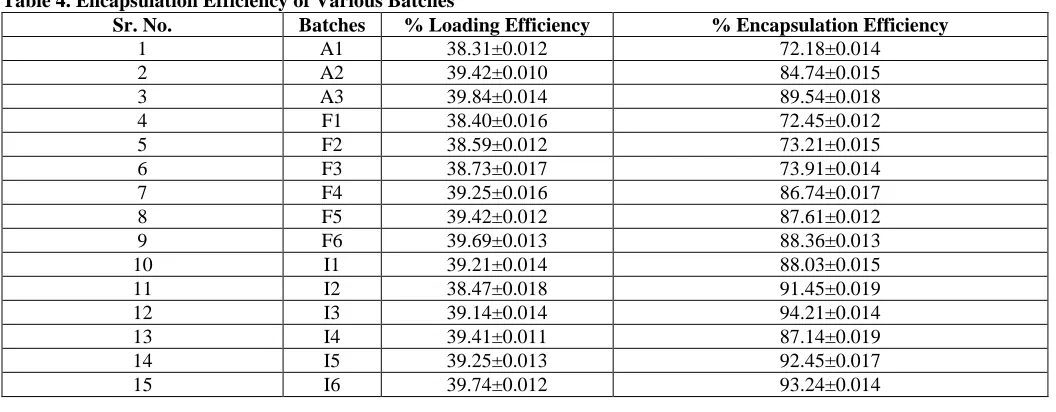
and mechanical relaxation of coiled polymeric chain. Three different concentrations of sodium alginate (1%, 2% and 3%) were used. The higher encapsulation efficiency was observed as the concentration of alginate increased. This is due to the greater availability of active calcium binding sites in the polymeric chains and consequently the greater degree of cross linking. The highest incorporation efficiency (88.36) was achieved with 2 % w/v sodium alginate in combination with 3% chitosan (F6). In case of immediate release entrapment efficiency increases with increasing amount of chitosan.
Good drug loading efficiency was achieved for all the formulation (A1-F6) since Ca++ and NH3+ of Chitosan
compete with each other and react with –COO- of Sodium alginate resulting in more compact structure. Some drug was lost to the external phase during preparation and recovery. The optimized batch F4 showed the loading efficiency of 39.20.
The cumulative percent drug release curve of the drug loaded sodium alginate microspheres showed the drug release from the microspheres decreased as the concentration of sodium alginate increased suggesting that drug release could be controlled by varying the polymers. It can be attributed to increase in the densities of the polymer matrix resulting in larger microspheres and this in turn increase the diffusional path length, which the drug molecules have to traverse during diffusion. Thus in order to control the release chitosan was blended with alginate matrix. The highest drug release about 92.89% was found to be in formulation F4 containing 2% w/v sodium alginate and 1% w/v chitosan and hence was designated as optimized batch.
It can be seen that release rate of Atorvastatin in simulated intestinal fluid (pH 7.4) wasrelatively higher than in simulated gastric fluid (pH 1.2). Low release in acidic medium was due to strong interaction between ammonium groups of Chitosan and carboxyl group of Alginate which is due to the formation of intermolecular and intra molecular hydrogen bond between the two polymers. Additionally, a repulsive force within the microspheres has created due to the protonation of primary ammonium groups (-NH3+) of
Chitosan. But because the force of H-bond is greater than the repulsive force, the microspheres are kept in a shrunken state in acidic medium and the drug is released slowly.
4 | P a g e
Table 1. Formulation of Various Batches for Sustained Release of Drug
Table 2. Formulation of Various Batches for Immediate Release of Drug
Formulation code Drug level(%w/v) Chitosan (%w/v) Tripolyphosphate(%w/v)
I1 1 0.5 3
I2 1 1 3
I3 1 1.5 3
I4 1 0.5 6
I5 1 1 6
I6 1 1.5 6
Table 3. Swelling Index of Various Batches
All values are expressed as mean ± SD (n=3).
Table 4. Encapsulation Efficiency of Various Batches
Formulation code Drug(%w/v) Sodium alginate(%w/v) Chitosan(%w/v) Calcium Chloride(%w/v)
F1 1 1 1 3
F2 1 1 2 3
F3 1 1 3 3
F4 1 2 1 3
F5 1 2 2 3
F6 1 2 3 3
Sr. No. Batch Code Swelling Index
pH 1.2 pH 7.4
1 A1 350.14±0.012 759.25±0.017
2 A2 399.40±0.014 798.24±0.019
3 A3 450.25±0.017 851.54±0.016
4 F1 219.25±0.014 689.41±0.014
5 F2 178.54±0.012 640.88±0.012
6 F3 108.87±0.015 619.87±0.016
7 F4 250.96±0.019 789.79±0.012
8 F5 275.89±0.017 812.74±0.011
9 F6 299.34±0.016 830.77±0.013
10 I1 450.65±0.013 --
11 I2 504.87±0.011 --
12 I3 550.21±0.010 --
13 I4 309.41±0.017 --
14 I5 375.39±0.014 --
15 I6 345.25±0.015 --
Sr. No. Batches % Loading Efficiency % Encapsulation Efficiency
1 A1 38.31±0.012 72.18±0.014
2 A2 39.42±0.010 84.74±0.015
3 A3 39.84±0.014 89.54±0.018
4 F1 38.40±0.016 72.45±0.012
5 F2 38.59±0.012 73.21±0.015
6 F3 38.73±0.017 73.91±0.014
7 F4 39.25±0.016 86.74±0.017
8 F5 39.42±0.012 87.61±0.012
9 F6 39.69±0.013 88.36±0.013
10 I1 39.21±0.014 88.03±0.015
11 I2 38.47±0.018 91.45±0.019
12 I3 39.14±0.014 94.21±0.014
13 I4 39.41±0.011 87.14±0.019
14 I5 39.25±0.013 92.45±0.017
5 | P a g e
Table 5. Micromeritics Characterization of Various Batches
Batches Mean Particle Size Angle of Repose Bulk Density Tapped density Cars Index Hausner Ratio
A1 550.4±0.01 21.95º 0.348±0.01 0.426±0.05 13.188 1.222
A2 610.7±0.02 20.71 º 0.328±0.08 0.401±0.07 12.186 1.213
A3 700.5±0.03 17.83 º 0.333±0.07 0.409±0.08 14.528 1.227
F1 598.3±0.08 18.68 º 0.330±0.09 0.399±0.04 13.250 1.208
F2 625.2±0.07 19.21 º 0.428±0.08 0.485±0.05 11.700 1.132
F3 650.2±0.06 18.10 º 0.450±0.04 0.515±0.06 12.630 1.144
F4 680.4±0.08 17.92 º 0.373±0.06 0.430±0.02 13.559 1.156
F5 700.4±0.04 17.54 º 0.283±0.02 0.314±0.04 10.790 1.121
F6 726.3±0.07 15.42 º 0.333±0.03 0.383±0.07 13.158 1.150
I1 535.2±0.01 22.01o 0.347±0.01 0.398±0.09 13.45 1.154
I2 590.6±0.05 21.45o 0.359±0.07 0.405±0.06 11.280 1.127
I3 621.8±0.09 19.25o 0.318±0.01 0.361±0.04 11.846 1.135
I4 550.2±0.04 21.95o 0.289±0.05 0.339±0.08 14.840 1.174
I5 625.4±0.07 19.22o 0.348±0.09 0.426±0.09 13.188 1.222
I6 660.8±0.08 18.20o 0.328±0.07 0.401±0.01 12.186 1.213
Table 6. Kinetic Treatment of Drug Release Data of Various Batches
Fig 1. Percentage Cumulative drug release (A1-A3, F1-F3)
Fig 2. Percentage Cumulative drug release (F4-F6)
Fig 3. Percentage Cumulative drug release (I1-I6)
Batch code
Kinetic Equation
Zero Order Plot First Order Plot Higuchi Plot Korsemeyer Peppas Plot
R2 R2 R2 R2 Slope
A1 0.9472 0.8451 0.9753 0.9931 0.865
A2 0.9489 0.8459 0.9854 0.9939 0.875
A3 0.9574 0.8574 0.9898 0.9941 0.869
F1 0.9874 0.8613 0.2569 0.9963 0.836
F2 0.9836 0.8717 0.2125 0.9970 0.854
F3 0.9812 0.8841 0.2014 0.9845 0.864
F4 0.9724 0.8782 0.1892 0.9942 0.865
F5 0.9805 0.8679 0.2094 0.9949 0.892
F6 0.9787 0.8694 0.2000 0.9941 0.863
I1 0.5894 0.5850 -1.254 0.8225 0.745
I2 0.5908 0.5872 -1.425 0.8232 0.785
I3 0.5998 0.5874 -1.652 0.8365 0.774
I4 0.9954 0.9989 0.7541 0.8547 0.863
I5 0.9862 0.9972 0.7341 0.9097 0.895
6 | P a g e
Thus, these formulations were capable ofcontrolling drug release and considered as optimized. Release rate was rapid with low percent polymer concentration. Microspheres (A1-A3) containing only sodium alginate released up to 90% of drug within 12 hours. These results suggested that, higher polymer concentration of chitosan formed a highly viscous microspheres network which sustained the drug release.
It was concluded that microspheres containing Chitosan (F1-F6) gave lower drug release than the microspheres containing only sodium Alginate (A1-A3). Since, the presence of chitosan increases the control of the release of drug from the microspheres, as at increasing concentration,(batch F4, F5 and F6 containing 1% w/v, 2% w/v and 3% w/v chitosan respectively ) it can form a network of bonding between the two polymer chains. Hence, at increasing amount of chitosan concentration into the formulation, interaction between the two polymers might have been increased, forming a closer network, which should decreased the diffusion of drug outside the microspheres. The cumulative percentage drug release curve of the drug loaded chitosan microspheres showed increase rate of drug release at lower concentration of chitosan and TPP. The highest drug release about 86.94% was found to be in formulation I2 and hence was designated as optimized batch. Batch I3 showed high swelling index (550.21) as compared to the other batches. Swelling is directly proportional to the drug release. Swelling ability of ionic cross-linked microspheres is depending on the pH value of the swelling medium. Microspheres show high swelling degree at low pH. The higher swelling degree is attributed to the strong protonization of ammonium groups on chitosan, which bring strong electrostatic repulsion among intrachain and interchain of chitosan, resulting in the relaxation of the polymer network. Hence, increased the release rate of drug.
As the concentration of the TPP solution increased, the swelling capacity of the microspheres decreased as per table no. 15 batches I4, I5and I6 shows comparatively low swelling index 309.41, 375.39 and 345.25 as compared to the batches I1, I2 and I3 containing 6% TPP. These support that the more tightly cross linked chitosan matrix does not swell as compared to the loosely cross linked chitosan matrix. At low concentration of TPP, the chitosan network is loose and has high capacity to accommodate more solvent molecule therby inducing chitosan TPP matrix swelling.
CONCLUSION
Microspheres were prepared for sustained and immediate release of drug using a same polymer chitosan by ionotropic gelation method. Microspheres were spherical in shape, having good flow properties and encapsulation efficiency, swelling index, micromeritic study, in- vitro drug release study and stability studies were performed in order to characterize microspheres. In case of sustained release of drug, among the prepared formulations with respect to the entrapment efficiency, swelling studies and in vitro drug release, the alginate-chitosan microspheres prepared by ionotropic gelation using calcium chloride found to be better than ionically cross linked alginate spheres alone. Therefore, dual cross-linked, microspheres are promising carrier for sustained release of drug. In case of immediate release of drug, the Chitosan/TPP crosslinked microspheres of amlodipine were prepared by the ionotropic gelation method. The microspheres showed very high release of drug at pH 1.2. Release was found to be depend upon the various chitosan/TPP ratio.
ACKNOWLEDGEMENTS
Authors wish to thank ZIM Labs, Nagpur for providing amlodipine as a gift sample.
REFERENCES
1. Gonza´lez-Rodrı´guez ML, Holgado MA, Sa´nchez-Lafuente C, Rabasco AM, Fini A. Alginate/chitosan particulate systems for sodium diclofenac release. Int J Pharm, 232, 2002, 225-234.
2. Hoffman AS. Intelligent’ polymers in medicine and biotechnology, macromol. Symp. J Controlled Release, 98, 1995, 645– 64.
3. Kumbar SG, Kulkarni AR and Aminabhavi TM. Cross linked chitosan microspheres for encapsulation of diclofenac sodium: effect of crosslinking agent. J Microencapsul, 19, 2002, 173- 180.
4. Orienti I, Cerchiara T. Influence of different chitosan salts on the release of sodium diclofenac in colon-specific delivery. Int J Pharm, 238, 2002, 51-59.
5. Jain GK et al., Enhanced bioavailability of nano-sized chitosan–atorvastatin conjugate after oral administration to rats. European J Pharm Sci, 44, 2011, 241–249.
6. Chaumeil JC, Chretien C. Indomethacin release from ion-exchange microspheres: impregnation with alginate reduces release rate. J Control Release, 96, 2004, 369– 378.
7. Ibrahim HG, Tashtoush B, Najib NM. A novel approach for the preparation of highly loaded polymeric controlled release dosage forms of diltiazem HCl and diclofenac sodium. European J Pharm Sci, 54, 2002, 75–81.
8. Patil JS, Kamalapur MV, Marapur SC, Kadam DV. Ionotropic Gelation and Polyelectrolyte Complexation: The Novel Techniques To Design Hydrogel Particulate Sustained, Modulated Drug Delivery System: A Review Digest Journal of Nanomaterials and Biostructures, 5, 2010, 241 – 248.
7 | P a g e
10. Wheatly A, Park E, Langer R. Coated Alginate Microspheres: Factors influencing the Controlled Delivery ofMacromolecules, J Appl Poly Sci, 43(11), 1991, 2123-2135.
11. Jameela R, Kumary V, Lal V, Jayakrishna A. Progesterone- LoadedChitosan Microspheres: A Long Acting Biodegradable Controlled delivery System. J Control Release, 52(1), 1998, 17-24.
12. Kawashima Y, Takeuchi H, Yamamoto H. A Gastrointestinal retentive microparticulate system to improve oral drug delivery, New York, Marcel Dekker, Inc., 1996, 505-523.
13. Ramdas M, Dileep KJ, Anitha Y, Willi P, Chandra PS. Alginate encapsulated bioadhesive chitosan microspheres for intestinal drug delivery. J Biomater Appl, 13(4), 1999, 290-296.
14. Poncelet D, Babak V, Dulieu C, Picot A. A physico-chemical approach to production of alginate beads by emulsification-internal ionotropic gelation. Colloids and Surfaces A: Physicochem Eng Aspects, 155, 1999, 171-176.