Available online throug
ISSN 2229 – 5046
RADIATION EFFECT
ON MHD FREE CONVECTIVE FLOW PAST A VERTICAL POROUS PLATE
1
V. SRI HARI BABU*,
2K. JAYARAMI REDDY
1
Research Scholar, Department of Mathematics,
Rayalaseema University, Kurnool, India-518002.
1
Asst. Professor, Usharama College of Engineering & Tech., Telaprolu, (A.P.), India.
2
Professor Department of Mathematics, K L University, Vaddeswaram, India-522502.
Received On: 27-03-17; Revised & Accepted On: 26-06-17)
ABSTRACT
A
n unsteady MHD free convective flow past a vertical porous plate in the presence of radiation has been considered. The fluid is considered to be a gray, absorbing emitting but non – scattering medium and the Rossel and approximation is used to describe the radiative heat flux in the energy equation. The dimensionless governing coupled, nonlinear boundary layer partial differential equations are solved by an efficient finite element method. A parametric study of the physical parameters involved in the problem is considered and a representative set of numerical results is illustrated graphically.Keywords: Radiation, free convective, vertical plate, MHD, skin-friction.
1. INTRODUCTION
Free convection flows past different types of vertical bodies are studied because of their wide applications and hence, it has attracted the attention of numerous investigators and scientists. Literature on unsteady MHD convection heat transfer with or without Hall currents are very extensive due to its technical importance in the scientific community (Elbashbeshy, 1988; Rohsenow, 1998). The radiation effects on MHD flow and heat transfer problems have become more important industrially. At high operating temperature, radiation effect can be quite significant (Sahoo, 2003). Many processes in engineering areas occur at high temperatures and knowledge of radiation heat transfer becomes very important for the design of the pertinent equipment. Nuclear power plants, gas turbines and the various propulsion devices for aircraft, missiles, satellites, and space vehicles are examples of such engineering areas. Heat and mass transfer of a moving vertical plate with suction was studied by Erickson et al, (1966) and (Gupta & Gupta, 1977) with different conditions. Convective heat transfer in an electrically conducting fluid at stretching surface was studied by (Vajravelu & Hadjinicolaou, 1997). Unsteady free convection flow past a vertical porous plate was investigated by (Helmy, 1988). Acharya et al. (2000) have studied free convection and mass transfer flow through a porous medium bounded by vertical infinite surface with constant suction and heat flux (Chen & Char, 1998). But in those studies, they considered the flow to be steady (Danberg & Fansber1976). Coming back to unsteady case, (Young, 2000), investigated unsteady MHD convective heat transfer past a semi-infinite vertical porous moving plate with variable suction. (Chamka, 2004), considered the case taking mass transfer with heat absorption (Sakiadis, 1961). Muthukumaraswamy & Kumar, (2004) investigated heat and mass transfer effect on moving vertical plate in the presence of Thermal Radiation (Carnahan, 1969; Takhar et al., 1996; Singh et al., 2003).
In this paper, we have discussed free convection MHD flow of a viscous incompressible fluid past an infinite vertical porous plate with heat and mass transfer in the presence of radiation. The governing system of partial differential equations and then solved numerically using finite difference method.
Corresponding Author:
1V. Sri Hari Babu*,
2. MATHEMATICAL FORMULATION
Consider the effect of thermal radiation on an unsteady free convective mass flow of a viscous incompressible electrically conducting fluid flow past an accelerating vertical infinite porous flat plate. Choose the Cartesian coordinate system such that x-axis is taken to be along the vertical plate and the y- axis normal to the plate. Since the plate is considered infinite in x- direction, hence all physical quantities will be independent of x-direction. The wall is maintained at constant temperature Tw and concentration Cw higher than the ambient temperature T∞ and concentration C∞respectively. A uniform magnetic field B0 of magnitude is applied normal to the plate. The transverse applied magnetic field and magnetic Reynold’s number are assumed to be very small, so that the induced magnetic field is negligible. The homogeneous chemical reaction is of first order with rate constant between the diffusing species of the fluid is neglected. It is assumed that there is no applied voltage which implies the absence of an electric field. It is assumed that the plate is accelerating with a velocity u=U0 in its own plane for t ≥ 0. The fluid has constant kinematic viscosity and constant thermal conductivity and the Boussinesq’s approximation have been adopted for the flow. The magneto-hydrodynamic unsteady free convective boundary layer equations under the Boussinesq’s approximations are:
0
=
∂
∂
y
v
(1)(
)
(
)
B
u
y
u
v
C
C
g
k
u
T
T
g
y
u
v
t
u
−
o′
′
∂
′
∂
+
′
−
′
+
′
′
−
′
−
′
=
′
∂
′
∂
′
+
′
∂
′
∂
∞ ∞ρ
σ
β
ν
β
* 2 2 2 (2)y
q
C
y
T
C
k
y
T
v
t
T
r pp
∂
′
∂
−
′
∂
′
∂
=
′
∂
′
∂
′
+
′
∂
′
∂
ρ
ρ
1
2 2 (3) 2 2y
C
D
y
C
v
t
C
′
∂
′
∂
=
′
∂
′
∂
′
+
′
∂
′
∂
(4)The boundary conditions of the problem are:
{
∞
→
′
→
′
′
→
′
→
′
=
′
′
=
′
′
=
′
′
−
=
′
=
′
≥
′
′
=
′
=
′
=
′
=
′
≤
′
∞ ∞,
',
0
0
,
,
,
:
0
0
,
0
,
0
,
0
:
0
y
as
C
C
T
T
u
y
at
C
C
T
T
v
v
U
u
t
y
all
for
C
T
v
u
t
w w oO (5)
The radiative heat flux term is simplified by making use of the Rossel and approximation [28] as
y
T
k
q
r′
∂
′
∂
−
=
** 43
4
σ
(6)
Here
σ
*is Stefan- Boltzmann constant andk
* is the mean absorption coefficient. It is assumed that the temperature differences within the flow are sufficient small such thatT
4may be expressed as a linear function of temperature.4 3
4
3
4
∞′
′
−
∞′
≅
′
T
T
T
T
(7)Using (6) and (7) in the last term of Equation (3) we obtain
2 3 * *
3
16
y
T
k
y
q
r′
∂
′
∂
−
=
′
∂
∂
σ
∞(8)
In order to write the governing Equations and the boundary conditions in dimensional following non-dimensional quantities are introduced.
Where ν the kinematics viscosity, k is the thermal diffusivity, β and β* are the volumetric coefficient of expansion for heat and mass transfer respectively, ρ is the fluid density, σ is the electrical conductivity of the fluid, g is the acceleration due to gravity, T is the temperature, U0 is the free stream velocity, µ is the coefficient of viscosity, Cp is the specific heat at constant, qr is the radiative heat flux, M is the magnetic field, R is the radiation parameter, Gr is the Grashof number, Gc is the solutal Grashof number, Pr is the Prandtl number, Sc is the Schmidt number T∞ is the
temperature of the fluid far away from the plate, C is the concentration, C∞ is the concentration of the fluid far away
from the plate, K is the permeability parameter.
Substituting (9) in equations (2), (3) and (4) under boundary conditions (5), we get
( ) ( )
2 2
1
u
u
u
Gr
Gc C
M
u
t
y
y
θ
K
∂
−
∂
=
∂
+
+
−
+
∂
∂
∂
(10)2 2
1
4
1
Pr
3
t
y
R
y
θ
θ
θ
∂
−
∂
=
+
∂
∂
∂
∂
(11)2 2
1
y
C
Sc
y
C
t
C
∂
∂
=
∂
∂
−
∂
∂
(12)
The corresponding boundary conditions are
∞
→
→
→
→
=
=
=
=
y
as
C
u
y
at
C
u
0
,
0
,
0
0
1
,
1
,
1
θ
θ
(13)
3. SOLUTION OF THE PROBLEM
The above set of coupled non-linear partial differential equations subject to the boundary conditions is solved by Finite Element Technique. The fundamental steps comprising the method are as follows.
• Step 1: Discretization of the domain into elements. • Step 2: Derivation of the element equations. • Step 3: Assembly of element equations. • Step 4: Imposition of Boundary Conditions. • Step 5: Solution of the assembled equations.
The problem of radiative heat transfer to unsteady magnetohydromagnetic flow involving heat and mass transfer is addressed in this study. Numerical solutions have been carried out for the non-dimensional Temperature Concentration
C, velocity (u) keeping the other parameters of the problem fixed. Numerical calculations of these results are presented graphically in the figures from (1) to(11). These results show the effect of different parameters on the velocity, temperature distribution and concentration profiles at the wall. To find out the solution of this problem, we have placed an infinite vertical plate in a finite length in the flow. Hence, we solve the entire problem in a finite boundary.
However, in the graphs, the y values vary from 0 to 4 and the velocity, temperature, and concentration tend to zero as y
tends to 4. This is true for any value of y. Thus, we have considered finite length. In the present study we adopted the following default parameter values of finite element method. Gr=1.0, Gc = 1.0, M =1.0, K =1.0, Pr = 0.71, N =1.0,
Sc =0.22. All graphs therefore correspond to these values unless specifically indicated on the appropriate graph.
For various values of the magnetic parameter M, the velocity profiles are plotted in Fig 1. It can be seen that as M
increases an increasing of the fluid temperature. The concentration profiles for different values of Schmidt number is presented figure 10. From the figure, it is seen that the concentration decreases with an increases in Schmidt number.
Fig.1: Velocity profiles for different values Fig.2: Velocity profiles for different values of of magnetic parameter (M) permeability parameter (K).
Fig.3: Velocity profiles for different values of Fig.4: Velocity profiles for different values of Grashof number (Gr). modified Grashof number (Gc).
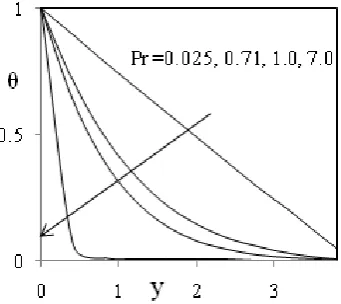
Fig.7: Velocity profiles for different values of Schmidt Fig.8: Temperature profiles for different values of
number (Sc). Prandtl number (Pr).
Fig.9: Temperature profiles for different values of Fig.10: Concentration profiles for different values of radiation parameter (R). Schmidt number (Pr).
Table – 1: Skin – friction results (τ) for the values of
Gr
,
Gc
,
Pr,
Sc
,
M
,
K
,
R
Table – 2: Rate of heat transfer (Nu) values for different values of radiation (R) and Prandtl number (Pr)
R Pr Nu
1.0 0.71 4.4972
1.0 7.00 1.0897 2.0 0.71 4.6087
Table – 3: Rate of mass transfer ( Sh) values for different values of Schmidt number (Sc) and Soret number (So)
Sc So Sh
0.22 1.0 6.9193
0.30 1.0 6.5249
0.22 2.0 7.0338
M K R Gr Gc Pr Sc τ
1.0 1.0 1.0 1.0 1.0 0.71 0.22 3.2954 1.0 1.0 1.0 2.0 1.0 0.71 0.22 4.4918 1.0 1.0 1.0 1.0 2.0 0.71 0.22 5.3946
1.0 1.0 1.0 1.0 1.0 7.00 0.22 2.1650 1.0 1.0 1.0 1.0 1.0 0.71 0.30 3.1168
2.0 1.0 1.0 1.0 1.0 0.71 0.22 2.6004
CONCLUSIONS
We summarize below the following results of physical interest on the velocity, temperature and concentration distributions of the flow field and also on the skin – friction, rate of heat and mass transfer at the wall.
o An increasing the magnetic parameter or Prandtl number or Schmidt number retards the velocity of the flow field at all points.
o The effects of increasing Grashof number or Modified Grashof number or Permeability parameter or Eckert number or Permeability parameter or thermal radiation parameter are to accelerate velocity of the flow field at all points.
o An increasing the Prandtl number decreases temperature of the flow field at all points and increases with increasing of radiation parameter.
o The Schmidt numberdecreases the concentration of the flow field at all points.
o A growing Hartmann number or Prandtl number or Schmidt number decreases the skin – friction while increasing Grashof number or Modified Grashof number or Permeability parameter or radiation parameter increases the skin – friction.
o The rate of heat transfer is decreasing with increasing of Prandtl number and increases with increasing of Thermal radiation parameter.
o The rate of mass transfer is decreasing with increasing of Schmidt number.
REFERENCES
1. Acharya M, Dash GC & Singh LP (2000) Magnetic Field Effects on the Free Convection and Mass Transfer Flow Through Porous Medium with Constant Suction and Constant Heat Flux, Indian J. Pure Appl. Math. 31(1), 1- 18.
2. Carnahan P, Luther HA & Wilkes J O (1969) Applied Numerical Methods, John Wiley & Sons, USA.
3. Chamkha AJ (2004) Unsteady MHD Convective Heat and Mass Transfer Past A Semi-Infinite Vertical Permeable Moving Plate with Heat Absorption, Int. J. Engg. Sci, 42, 217-230.
4. Chen CK & Char MI (1998) Heat transfer of a continuous, stretching surface with suction or blowing, J. Math. Anal. Appl. 135(2), 568–580.
5. Danberg JE & Fansber KS (1976). Non similar solution for the flow in the boundary layer past a stretched wall, Quart. Appl. Math. 34, 305–311.
6. Elbashbeshy, EMA (1998) Heat transfer over a stretching surface with variable surface heat flux, J. Phys. D: Appl. Phys. 31, 1951–1954.
7. Erickson LE, Fan LT & Fox VG (1966) Heat and mass transfer on a moving continuous flat plate with suction or injection, Indust. Eng. Chem. 5, 19–25.
8. Gupta PS & Gupta AS (1977) Heat and mass transfer on a stretching sheet with suction or blowing, Canadian J. Chem. Engrg. 55, 744–746.
9. Helmy KA (1998) MHD Unsteady Free Convection Flow past a Vertical Porous Plate, ZAMM, 78(4), 225- 270.
10. Muthucumaraswamy R & Kumar GS (2004) Heat and Mass Transfer Effects on Moving Vertical Plate in The Presence of Thermal Radiation, Theoret. Appl. Mech, 31(1), 35-46.
11. Rohsenow WM, Hartnett JP, & Cho YI (1998) (eds.), Handbook of Heat Transfer, 3rd ed., McGraw-Hill, New York, 1998.
12. Sahoo PK, Datta N & Biswal S (2003) Magnetohydrodynamic Unsteady Free Convection Flow Past an Infinite Vertical Plate With Constant Suction and Heat Sink, Indian J. Pure Appl. Math., 34(1), 145-155. 13. Sakiadis BC (1961) Boundary layer behaviour on continuous solid surfaces: I. The boundary layer equations
for two-dimensional and axisymmetric flow, AIChE J. 7, 26–28.
14. Singh AK, Singh AK & Singh N P (2003) Heat and Mass Transfer In MHD Flow of a Viscous Fluid Past a Vertical Plate Under Oscillatory Suction Velocity, Indian. J. Pure Appl. Math., 34(3), 429-442.
15. Takhar HS, Gorla RSR, & Soundalgekar VM (1996) Radiation effects on MHD free convection flow of a gas past a semi-infinite vertical plate, Internat. J. Numer. Methods Heat Fluid Flow, 6(2), 77–83.
16. Vajravelu K & Hadjinicolaou, A (1997) Convective heat transfer in an electrically 10.conducting fluid at a stretching surface with uniform free stream, Internat. J. Engrg. Sci. 35, 12-13, 1237–1244.
17. Young JK (2000) Unsteady MHD Convective Heat Transfer Past A Semi-Infinite Vertical Porous Moving Plate with Variable Suction, Int. J. Engg. Sci, 38, 833- 845.
Source of support: Nil, Conflict of interest: None Declared.