SIMPLE CHROMIUM CATALYZED OXIDATIVE SYNTHESIS
OF QUINAZOLINONES AND BENZOXAZINONES FROM
2-AMINOBENZAMIDE AND ANTHRANILIC ACID WITH
ARYLALDEHYDES
Ashwini V. Izankar,
[a]Aniket P. Sarkate,
[a]*Pramod S. Patil,
[b]Arjun L. Khandare,
[c]S. N.
Sinha,
[c]Kshipra S. Karnik,
[a]Yogesh W. More
[d]and Dattatraya N. Pansare
[d]Keywords: quinazolinones; benzoxazinones; chromium trioxide; catalyst; oxidant.
An easy and efficient protocol for oxidative synthesis of quinazolinones and benzoxazinones using novel catalyst fromed in- situ from chromium trioxide has been developed. Here chromium trioxide acts as an oxidant and its reduction products catalyze the coupling reaction. Newly developed method demonstrates a new alternative to existing method which is a cost effective approach to synthesize important moieties like quinazolinones and benzoxazinones from easily available starting materials in good to excellent yields.
* Corresponding Authors
E-Mail: [email protected]
[a] Department of Chemical Technology, Dr. Babasaheb Ambedkar Marathwada University, Aurangabad, 431004 (MS), India
[b] Department of Physics, School of Nanoscience and Technology, Shivaji University, Vidyanagar, Kolhapur-416004, MS, India.
[c] Department of Food Toxicology, Food & Drug Toxicology, Research Center, National Institute of Nutrition, Hyderabad, 500007, Telangana, India.
[d] Department of Chemistry, Deogiri College, Station road, Aurangabad- 431005 (MS), India
INTRODUCTION
Nowadays, various heterocyclic compounds have been found with distinguished pharmacological activities in drug design and development.1 Quinazolinones obtained from natural products form an important skeleton for the synthesis of different therapeutically active drug moieties.2 Its derivatives are important compounds, and have been widely used in hypnotic,3 sedative,4 anticancer,5-6 anticonvulsant7 and anti-inflammatory agents.8 The research interest in the synthesis of 4(3H)-quinazolinone and its derivatives has never faded since the first report of the 4(3H)-quinazolinone.9 Also, 1-benzoxazin-4-one derivatives are important skeletons due to their proven pharmaceutical activity. For example, some of the drugs which contain 4H-3,1-benzoxazin-4-one as the core structure act as HSV-1 protease inhibitor and human chymase inhibitor10 along with anti-proliferative activity.11 Initially, some toxic oxidants like DDQ,12 CuCl2,13 MnO2,14 KMnO4,15 K2S2O816 and PhI(OAc)217 were used which yielded the similar quantity of oxidant-derived waste. The use of chromium trioxide as an oxidsant and a catalyst precursor is a promising strategy in organic synthesis which substitutes many expensive transition metal compounds.18 Especially, the amidation of C(sp3)-H bonds using chromium is very attractive, and it
finds the utility in synthesis of a wide range of N and O- heterocycles.19 Chromium, among transition metals, is particularly attractive in organic synthesis because of its low price.20 Hence, in continuation to our work,21-24 we herein tried to report the synthesis of quinazolinones as well as benzoxazinone derivatives using chromium trioxide as the oxidant and catalyst.
MATERIALS AND METHOD
All chemicals and solvents were used from Sigma-aldrich. Melting points were uncorrected and recorded on Optimelt digital melting point apparatus. IR spectra were recorded on Bruker Alpha E FTIR spectrophotometer. 1H NMR was recorded on Varian 300 MHz spectrometer by using TMS as internal standard. Mass spectra were taken with Micromass-QUATTRO-II of WATER mass spectrometer.
General procedure for the synthesis of compound 3a-3m
A mixture of 2-aminobenzamides 1a (1 mmol), chromium trioxide (20 mol %) and benzaldehyde 2a (1 mmol) was stirred in dichloroethane (5 mL) and heated at 80 °C for 5 h. After completion of reaction, the resulting solution was cooled to room temperature, and the reaction mixture added to the saturated solution of sodium bisulphate stirred for 10-15 min. Then 10 ml of ethyl acetate was added to the mixture and organic layer was separated, concentrated under vacuum and the resulting residue was purified by column chromatography (hexane /ethyl acetate) to afford the desired product. DCE is very cheap solvents as compared to other solvents, hence we used the same.
2-Phenylquinazolin-4(3H)-one (3a)
White solid, mp: 122 °C; 1H NMR (400 MHz, DMSO-d6):
δppm= 7.54 (m, 3H), 7.66-7.94 (m, 4H), 8.10 (d, 2H), 12.11 (1H, NH);13C NMR (100 MHz, DMSO-d6): δppm = 121.3, 125.4, 128.6, 130.1, 134.5, 148.5, 154.4, 164.6. Anal. calcd. for C14H10N2O: C, 75.66; H, 4.54; N, 12.60; Found: C, 75.62; H, 4.5; N, 12.56.
2-(2,4-Dimethoxyphenyl)quinazolin-4(3H)-one (3b)
White solid, mp: 255 °C; 1H NMR (400 MHz, DMSO-d6):
δppm= 3.80 (s, 3H), 6.63-6.74 (m, 3H), 7.54 (m, 3H), 7.66-7.91 (m, 4H), 12.11 (1H, NH); 13C NMR (100 MHz, DMSO-d6): δppm = 55.9, 98.4, 106.5, 117.8, 121.8, 124.9, 126.7, 131.8, 134.5, 146.6, 150.7, 160.0, 163.3. Anal. calcd. forC16H14N2O3: C, 68.07; H, 5.00; N, 9.92; Found: C, 68.11; H, 5.04; N, 9.96.
2-(3-Nitrophenyl)quinazolin-4(3H)-one (3c)
White solid, mp: 147 °C; 1H NMR (400 MHz, DMSO-d6):
δppm= 7.54 (m, 3H), 7.66-7.96 (m, 4H), 8.37-8.72 (d, 2H), 12.11 (1H, NH); 13C NMR (100 MHz, DMSO-d6): δppm = 121.3, 124.0, 126.7, 130.8, 134.5, 147.8, 153.1, 163.8. Anal. calcd. for C14H9N3O3: C, 62.92; H, 3.39; N, 15.72; Found: C, 62.96; H, 3.43; N, 15.76.
2-(4-Methoxyphenyl)quinazolin-4(3H)-one (3d)
White solid, mp: 298 °C; 1H NMR (400 MHz, DMSO-d6):
δppm= 3.78 (s, 3H), 7.54 (m, 3H), 7.66-7.96 (m, 4H), 12.11 (1H, NH); 13C NMR (100 MHz, DMSO-d6): δppm = 55.3, 114.4, 121.3, 126.5, 129.9, 134.5, 148.5, 154.7, 161.3, 164.6. Anal. calcd. forC15H12N2O2: C, 71.42; H, 4.79; N, 11.10; Found: C, 71.38; H, 4.75; N, 11.06.
2-(3-Methoxyphenyl)quinazolin-4(3H)-one (3e)
White solid, mp: 198°C; 1H NMR (400 MHz, DMSO-d6):
δppm= 3.78 (s, 3H), 7.54 (m, 3H), 7.73 (m, 4H), 12.11 (1H,
NH); 13C NMR (100 MHz, DMSO-d6): δppm = 55.3, 114.4, 121.3, 126.5, 129.9, 134.5, 148.5, 154.7, 161.3, 164.6. Anal. calcd. forC15H12N2O2: C, 71.42; H, 4.79; N, 11.10; Found: C, 71.38; H, 4.75; N, 11.06.
2-(4-Nitrophenyl)quinazolin-4(3H)-one (3f)
White solid, mp: 209 °C; 1H NMR (400 MHz, DMSO-d6):
δppm= 7.54 (m, 3H), 7.66-7.94 (m, 4H), 8.25-8.37 (d, 2H), 12.11 (1H, NH); 13C NMR (100 MHz, DMSO-d6): δppm = 121.3, 124.8, 129.2, 134.5, 137.2, 137.2, 149.1, 154.5, 164.6. Anal. calcd. forC14H9N3O3: C, 62.92; H, 3.39; N, 15.72; Found: C, 62.96; H, 3.43; N, 15.76.
4-(4-Oxo-3,4-dihydroquinazolin-2-yl)benzonitrile (3g)
White solid, mp: 297 °C; 1H NMR (400 MHz, DMSO-d6):
δppm= 7.54 (m, 3H), 7.65-7.96 (m, 4H), 8.19 (d, 2H), 12.11 (1H, NH); 13C NMR (100 MHz, DMSO-d6): δppm = 112.2,
118.5, 121.3, 125.4, 128.73, 133.5, 134.5, 148.5, 154.78, 164.6. Anal. calcd. forC15H9N3O: C, 72.87; H, 3.67; N, 16.99; Found: C, 72.83; H, 3.63; N, 16.95.
2-(4-Hydroxyphenyl)quinazolin-4(3H)-one (3h)
White solid, mp: 292 °C;1H NMR (400 MHz, DMSO-d6):
δppm= 6.94 (m, 3H), 7.54 (m, 3H), 7.65-7.96 (m, 4H), 8.13 (d, 2H), 12.11 (1H, NH); 13C NMR (100 MHz, DMSO-d6):
δppm = 116.8, 121.3, 122.8, 126.5, 130.2, 134.5, 148.5,
151.1, 154.8, 164.6. Anal. calcd. forC14H10N2O2: C, 70.58; H, 4.23; N, 11.76; Found: C, 70.62; H, 4.27; N, 11.8.
2-(2,3-Dichlorophenyl)quinazolin-4(3H)-one (3i)
White solid, mp: 299 °C; 1H NMR (400 MHz, DMSO-d6):
δppm= 7.38 (m, 3H), 7.54 (m, 3H), 7.65-7.94 (m, 4H), 12.11 (1H, NH); 13C NMR (100 MHz, DMSO-d6): δppm = 121.8, 124.9, 127.7, 131.0, 132.9, 134.5, 146.9, 149.0, 161.5. Anal. calcd. forC14H8Cl2N2O: C, 57.76; H, 2.77; N, 9.62; Found: C, 57.8; H, 2.81; N, 9.66.
2-(2-Phenyl)quinazolin-4(3H)-one (3j)
White solid, mp: 191°C; 1H NMR (400 MHz, DMSO-d6):
δppm= 7.04-7.45 (m, 3H), 7.54 (m, 3H), 7.65-7.94 (m, 4H), 12.11 (1H, NH); 13C NMR (100 MHz, DMSO-d6): δppm = 116.8, 121.3, 122.8, 126.5, 130.2, 134.5, 148.5, 151.1, 154.8, 164.6. Anal. calcd. forC14H10N2O2: C, 70.58; H, 4.23; N, 11.76; Found: C, 70.62; H, 4.27; N, 11.8.
2-(2,4-Dichlorophenyl)quinazolin-4(3H)-one (3k)
White solid, mp: 297 °C; 1H NMR (400 MHz, DMSO-d6):
δppm= 7.36 (m, 3H), 7.54 (m, 3H), 7.69-7.94 (m, 4H), 12.11 (1H, NH); 13C NMR (100 MHz, DMSO-d6): δppm = 121.8, 124.9, 127.7, 131.0, 132.9, 134.5, 146.9, 149.0, 161.5. Anal. calcd. forC14H8Cl2N2O: C, 57.76; H, 2.77; N, 9.62; Found: C, 57.8; H, 2.81; N, 9.66.
2-(4-Bromophenyl)quinazolin-4(3H)-one (3l)
White solid, mp: 252 °C; 1H NMR (400 MHz, DMSO-d6):
δppm= 7.55 (m, 3H), 7.66-7.96 (m, 4H), 12.11 (1H, NH); 13C NMR (100 MHz, DMSO-d6): δppm = 121.3, 123.9, 126.7, 131.3, 134.5, 148.5, 154.6, 164.6. Anal. calcd. forC14H8Cl2N2O: C, 55.84; H, 3.01; N, 9.30; Found: C, 55.8; H, 2.97; N, 9.26.
2-(3-Ethoxy-4-hydroxyphenyl)quinazolin-4(3H)-one (3m)
White solid, mp: 315 °C; 1H NMR (400 MHz, DMSO-d6):
General procedure for the synthesis of compound 6a-6m
An oven dried three necked round bottom flask was loaded with anthranilic acid (4) (1 mmol), benzaldehyde (5) (1 mmol), chromium trioxide (20 % mol) in dichloroethane (5 mL). Then, the reaction mixture was heated at 80 °C for 16 h. The completion of the reaction was monitored by TLC. After being cooled at room temperature the reaction mixture was poured in the saturated solution of sodium bisulphate stirred for 10-15 min. Then 10 mL of ethyl acetate was added to the mixture and organic layer was separated, concentrated under vacuum and the resulting residue was purified by column chromatography (hexane/ethyl acetate) to afford the desired product.
2-Phenyl-4H-benzo[d][1,3]oxazin-4-one (6a)
White solid, mp: 125°C; 1H NMR (400 MHz, DMSO-d6):
δppm= 7.49 -7.53 (m, 3H), 7.68-7.87 (m, 4H), 8.04-8.28 (d, 2H), 13C NMR (100 MHz, DMSO-d6): δppm = 116.0, 126.2, 131.4, 132.2, 136.8, 147.0, 156.8, 159.2. Anal. calcd. forC14H9NO2: C, 75.33; H, 4.06; N, 6.27; Found: C, 75.37; H, 4.10; N, 6.31.
2-(2-Chlorophenyl)-4H-benzo[d][1,3]oxazin-4-one (6b)
White solid, mp: 139 °C; 1H NMR (400 MHz, DMSO-d6):
δppm= 7.28-7.53 (m, 3H, quinazoline ring), 7.68-7.99 (m, 4H, phenyl ring), 8.04 (d, 1H, quinazoline ring); 13C NMR (100 MHz, DMSO-d6): δppm = 116.5, 128.3, 131.9, 132.8, 136.8, 147.2, 156.4, 159.5. Anal. calcd. forC14H8ClNO2: C, 65.26; H, 3.13; N, 5.44; Found: C, 65.22; H, 3.09; N, 5.40.
2-(3-Chlorophenyl)-4H-benzo[d][1,3]oxazin-4-one (6c)
White solid, mp: 128 °C; 1H NMR (400 MHz, DMSO-d6):
δppm= 7.43-7.69 (m, 5H), 7.87-8.11 (m, 2H), 8.12 (d, 1H); 13C NMR (100 MHz, DMSO-d6): δppm = 116.5, 128.3, 131.9, 132.8, 136.8, 147.2, 156.4, 159.5. 13C NMR (100 MHz, DMSO-d6): δppm = 116.5, 128.3, 131.9, 132.8, 136.8, 147.2, 156.4, 159.5. Anal. calcd. forC14H8ClNO2: C, 65.26; H, 3.13; N, 5.44; Found: C, 65.22; H, 3.09; N, 5.40.
2-(4-Chlorophenyl)-4H-benzo[d][1,3]oxazin-4-one (6d)
White solid, mp: 191°C; 1H NMR (400 MHz, DMSO-d6):
δppm= 7.40-7.41 (m, 3H), 7.69-7.87 (m, 4H), 8.06 (d, 1H); 13C NMR (100 MHz, DMSO-d6): δppm = 116.5, 128.3, 131.9, 132.8, 136.8, 147.2, 156.4, 159.5. Anal. calcd. forC14H8ClNO2: C, 65.26; H, 3.13; N, 5.44; Found: C, 65.30; H, 3.17; N, 5.48.
2-(4-Ethylphenyl)-4H-benzo[d][1,3]oxazin-4-one (6e)
White solid, mp: 98°C; 1H NMR (400 MHz, DMSO-d6):
δppm= 1.21 (t, 3H, CH3), 2.69 (q, 2H, CH2), 7.42 (d, 2H), 7.68-7.87 (m, 3H), 8.03 (d, 2H), 8.17 (d, 1H); 13C NMR (100 MHz, DMSO-d6): δppm = 15.3, 28.6, 116.0, 126.2 128.4, 131.3, 136.8, 147.0, 157.1, 159.2. Anal. calcd. forC16H13NO2: C, 76.48; H, 5.21; N, 5.57; Found: C, 76.44; H, 5.17; N, 5.53.
7-Chloro-2-phenyl-4H-benzo[d][1,3]oxazin-4-one (6f)
White solid, mp: 191 °C; 1H NMR (400 MHz, DMSO-d6):
δppm= 7.17 (d, 1H), 7.49-7.87 (m, 5H), 8.19-8.20 (d, 2H); 13C NMR (100 MHz, DMSO-d6): δppm = 113.8, 124.8, 129.8, 131.4, 132.3, 137.9, 147.3, 157.1, 159.5. Anal. calcd. forC14H8ClNO2: C, 65.26; H, 3.13; N, 5.44; Found: C, 65.30; H, 3.17; N, 5.48.
7-Chloro-2-(3-fluorophenyl)-4H-benzo[d][1,3]oxazin-4-one (6g)
White solid, mp: 121°C; 1H NMR (400 MHz, DMSO-d6):
δppm==7.43 (d, 1H), 7.60-7.87 (m, 4H), 8.04-8.19 (d, 2H); 13C NMR (100 MHz, DMSO-d6): δppm = 113.8, 115.9, 118.8, 126.3, 129.1, 130.6, 132.8, 137.9, 147.3, 155.6, 159.4, 164.4. Anal. calcd. forC14H7ClFNO2: C, 61.00; H, 2.56; N, 5.08; Found: C, 61.04; H, 2.6; N, 5.12.
7-Chloro-2-(4-chlorophenyl)-4H-benzo[d][1,3]oxazin-4-one (6h)
White solid, mp: 141 °C; 1H NMR (400 MHz, DMSO-d6):
δppm=7.41 (d, 1H), 7.70-7.87 (m, 4H), 8.07-8.20 (d, 2H); 13C NMR (100 MHz, DMSO-d6): δppm = 113.8, 124.8, 129.6, 131.7, 138.3, 147.3, 154.5, 159.5. Anal. calcd. forC14H7Cl2NO2: C, 57.56; H, 2.42; N, 4.79; Found: C, 57.60; H, 2.46; N, 4.83.
2-(4-Chlorophenyl)-6-nitro-4H-benzo[d][1,3]oxazin-4-one (6i)
White solid, mp: 185 °C; 1H NMR (400 MHz, DMSO-d6):
δppm=7.41 (d, 1H), 7.93 (m, 4H), 8.04-8.79 (d, 2H); 13C NMR (100 MHz, DMSO-d6): δppm = 118.5, 127.4, 131.0, 131.7, 138.3, 145.8, 150.9, 158.9. Anal. calcd. forC14H7ClN2O4: C, 55.56; H, 2.33; N, 9.26; Found: C, 55.52; H, 2.29; N, 9.22.
2-(4-Methoxyphenyl)-6-nitro-4H-benzo[d][1,3]oxazin-4-one (6j)
White solid, mp: 177°C; 1H NMR (400 MHz, DMSO-d6):
δppm= 3.78 (s, 3H, OCH3), 7.06 (d, 2H), 7.41 (d, 1H), 7.93 (d, 2H), 8.11-8.79 (d, 2H); 13C NMR (100 MHz, DMSO-d6):
δppm = 55.3, 114.2, 118.5, 125.9, 131.0, 145.8, 150.9, 158.9,
163.5. Anal. calcd. forC15H10N2O5: C, 60.41; H, 3.38; N, 9.39; Found: C, 60.37; H, 3.34; N, 9.35.
6-Nitro-2-(4-nitrophenyl)-4H-benzo[d][1,3]oxazin-4-one (6k)
White solid, mp: 185 °C; 1H NMR (400 MHz, DMSO-d6):
δppm= 7.92 (m, 4H), 8.26-8.79 (d, 2H), 13C NMR (100 MHz, DMSO-d6): δppm = 118.5, 124.5, 127.4, 130.6, 131.0, 137.4, 145.8, 150.9, 158.9. Anal. calcd. forC14H7N3O6: C, 53.68; H, 2.25; N, 13.42; Found: C, 53.72; H, 2.29; N, 13.46.
2-(4-Bromophenyl)-6-nitro-4H-benzo[d][1,3]oxazin-4-one (6l)
White solid, mp: 150 °C; 1H NMR (400 MHz, DMSO-d6):
2-(4-Fluorophenyl)-6-nitro-4H-benzo[d][1,3]oxazin-4-one (6m)
White solid, mp: 230 °C; 1H NMR (400 MHz, DMSO-d6):
δppm= 7.34 (d, 1H),7.93 (m, 4H), 8.09-8.79 (d, 2H); 13C NMR (100 MHz, DMSO-d6): δppm = 116.2, 118.5, 127.4, 132.2, 145.8, 150.9, 158.9, 166.8. Anal. calcd. forC14H7FN2O4: C, 58.75; H, 2.47; N, 9.79; Found: C, 58.79; H, 2.51; N, 9.83.
RESULTS AND DISCUSSION
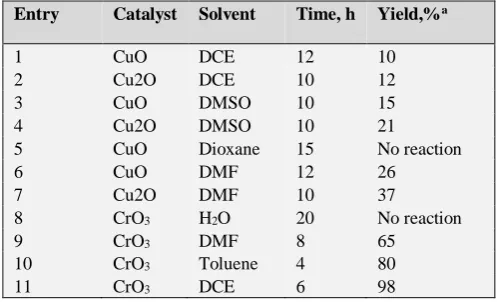
Synthesis of quinazolinones as well as benzoxazinone derivatives using chromium trioxide as the oxidant and catalyst precursor have been performed according to Schemes 1 and 2. The reaction was screened with several copper salts and solvents to enhance the competence of the reactions and the results are summarized in (Table 1).
Scheme 1.
Scheme 2.
Table 1. Optimization of catalyst and solvent on 3a
It was found that reaction works with each of Cu oxides but there was no reaction with copper(II) oxide in dioxane solvent with reaction time of 15 h (Table 1, Entry 5). Also copper(I) oxide in DMF gave good reaction in 10 h but the yield was considerably low i.e. 37 % (Table 1, Entry 7).
Hence taking into consideration the properties of chromium trioxide, we tried our reactions in the same. Initially we took water as the solvent with chromium trioxide but there was no reaction in 20 h (Table 1, Entry 8). Then we tried taking DMF, toluene and DCE, where DCE turned out to be the best solvent among those examined giving 98% yield (Table 1, Entry 1)
Table 2. Derivatives of quinazolinone compounds 3a-3m
Entry R Product Yield (%)
3a
H O
N NH O
90
3b H
O
OCH3 H3CO
N NH O
H3CO OCH3
92
3c
H O
NO2
N NH O
NO2
98
3d H
O
H3CO
N NH O
OCH3
97
Entry Catalyst Solvent Time, h Yield,%a
1 CuO DCE 12 10 2 Cu2O DCE 10 12 3 CuO DMSO 10 15 4 Cu2O DMSO 10 21 5 CuO Dioxane 15 No reaction 6 CuO DMF 12 26 7 Cu2O DMF 10 37 8 CrO3 H2O 20 No reaction 9 CrO3 DMF 8 65 10 CrO3 Toluene 4 80 11 CrO3 DCE 6 98
20 % CrO3
DCE, 80 0
C, 16 h +
4 5 6a-6m
COOH NH2
H O
N O O
DCE, 80oC,3-5h
2 3a-3m
1
+ NH2
O
NH2 N
NH R O CrO3
3e
H O
OCH3
N NH O
OCH3
88
3f H
O
O2N
N NH O
NO2
89
3g H
O
NC
N NH O
CN
80
3h H
O
HO
N NH O
OH
85
3i H
O
Cl Cl
N NH O
Cl Cl
82
3j H
O
OH
N NH O
HO
81
3k H
O
Cl Cl
N NH O
Cl Cl
90
3l H
O
Br
N NH O
Br
94
3m
H O
HO
OC2H5
N NH O
OH OC2H5
88
aIsolated yield
This reaction was screened in a number of different Lewis acid catalysts and solvents for its optimization. Using I2 as a catalyst and DCE as a solvent the obtained yield was 83 % but the reaction time was higher i.e. 16 h (Table 3, Entry 1). Further AlCl3, ZnCl2 and FeCl3 in DCE gave low yield with
different solvents like toluene, acetonitrile and ethanol but did not observe compatible yields (Table 3, Entries 6-8). Hence, we finally decided to carry out the reaction in DCE as the solvent and got the highest yield of 97 % with the abovementioned combination with comparably less reaction time of 12 h than the other trials (Table 3, Entry 9).
Table 3. Optimization of catalyst and solvent on 6a
Entry Catalyst Solvent Time,
h
Yield, %a
1 I2 DCE 16 83
2 AlCl3 DCE 13 54 3 ZnCl2 DCE 14 12 4 SnCl2 DCE 15 No
reaction 5 FeCl3 DCE 12 62 6 CrO3 Toluene 16 55 7 CrO3 Acetonitrile 12 26 8 CrO3 Ethanol 13 46
9 CrO3 DCE 12 97
aIsolated yield
The plausible reaction mechanism of quinazolinone compound is proposed in Fig. 1. Here the aldehyde is reacted with 2-aminobenzamide to give an aminal intermediate. This generated aminal intermediate is oxidized to the corresponding quinazolinone in the presence of [Cr]4+ species. Chromium trioxide plays a very important role in the oxidation of aminal intermediate to quinazolinone. [Cr]6+ quickly converts to [Cr]4+ which forms the most important step in the reaction.
Browsing the literatures related to benzoxazinone synthesis, the following mechanism (Fig. 1) for the oxidative cascade reaction for the synthesis of 2-arylbenzoxazinones using anthranilic acid and benzaldehyde is proposed as an example. First step is the formation of imine 3 from the reaction between anthranilic acid and benzaldehyde catalyzed by chromium trioxide.
Figure 1. Plausible reaction mechanism for quinazolinone and benzoxazinone compounds
The second step involves the activation of imine group to iminium salt 4 by the active constituent CrO3H of chromium trioxide (CrO3). Subsequent cyclization 5 followed by oxidation leads to 2-arylbenzoxazinones 6.
CONCLUSION
The work illustrates a simple and proficient method for the oxidative synthesis of quinazolinones and benzoxazinones using novel chromium trioxide as the oxidant and catalyst precursor. Also the time required for the completion of reaction is reduced to a great extent. The reaction proceeds very clean and no by-products were observed. Moreover the method is cheap and economical since DCE is used as a solvent. The products were obtained in good to excellent yields.
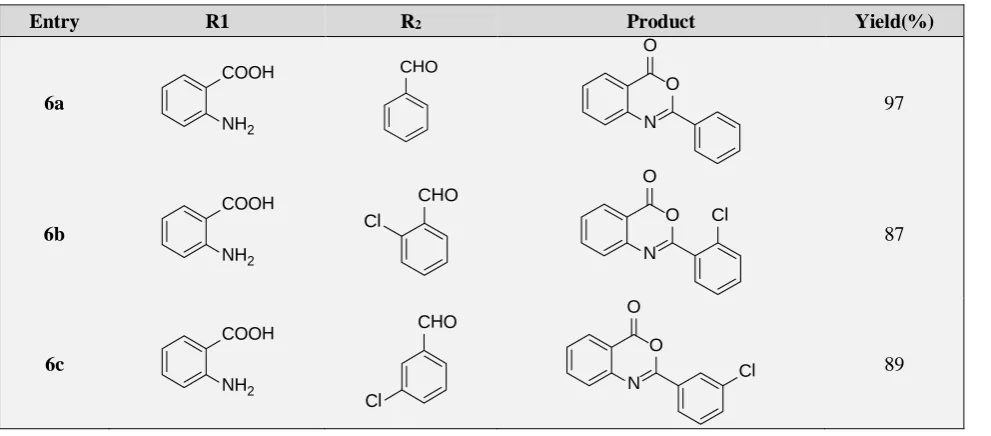
Table 4. Derivatives of benzoxazinone compounds 6a-6m
Entry R1 R2 Product Yield(%)
6a
COOH
NH2
CHO
N O O
97
6b
COOH
NH2
CHO Cl
N O O
Cl
87
6c
COOH
NH2
CHO
Cl
N O O
Cl 89
R1 H
O
+ NH2
O
NH2
NH O
N H R1
[Cr]6+ [Cr]4+
NH O
N R1
Step1
COOH
NH2 +
CHO
[Cr]6+ [Cr]4+
-H+
COOH
N H
Step2
COOH
N H
+CrO3
OH O
N H
X -X=CrO3H
O O
N H
Oxidation
-H+
O O
N
1 2 3
3
4
5 6
Quinazolinone
6d
COOH
NH2
CHO
Cl
N O O
Cl
82
6e
COOH
NH2
CHO
N O O
86
6f
COOH
NH2 Cl
CHO
N O O
Cl 88
6g
COOH
NH2
Cl
CHO
F N
O O
F Cl
83
6h
COOH
NH2
Cl
CHO
Cl
N O O
Cl
Cl
92
6i
COOH
NH2
O2N
CHO
Cl
N O O O2N
Cl
87
6j
COOH
NH2
O2N
CHO
OCH3
N O O O2N
OCH3
86
6k
COOH
NH2 O2N
CHO
NO2
N O O O2N
NO2
89
6l
COOH
NH2
O2N
CHO
Br
N O O O2N
Br
84
6m
COOH
NH2
O2N
CHO
F
N O O O2N
F
ACKNOWLEDGEMENT
The authors are thankful to The Head, Department of Chemical Technology, Dr. Babasaheb Ambedkar Marathwada University, Aurangabad 431 004 (MS), India, for providing the laboratory facility.
REFERENCES
1Shang,Y. H., Fan, L. Y., Li, X. X., Liu, M. X., Y(OTf)3-catalyzed heterocyclic formation viaaerobic oxygenation: An approach to dihydro quinazolinones and quinazolinones, Chin. Chem. Lett., 2015, 26, 1355.
http://dx.doi.org/10.1016%2Fj.cclet.2015.07.026
2Kim, N. Y., Cheon, C. H., Synthesis of quinazolinones from anthranilamides and aldehydes via metal-free aerobic oxidation in DMSO, Tetrahedron Lett., 2014, 55, 2340.
https://doi.org/10.1016/j.tetlet.2014.02.065
3Bie, Z., Li, G., Wang, L., Lv, Y., Niu, J., Gao, S., A facile vanadium-catalyzed aerobic oxidative synthesis of quinazolinones from 2-aminobenzamides with aldehydes or alcohols, Tetrahedron Lett., 2016, 57, 4935.
http://dx.doi.org/10.1016/j.tetlet.2016.09.077
4Mohammed, S., Vishwakarma, R. A., Bharate, S. B., Iodine Catalyzed Oxidative Synthesis of Quinazolin-4(3H)-ones and Pyrazolo[4,3-d]pyrimidin-7(6H)-ones via amination of sp3 C–H Bond, J. Org. Chem., 2015, 80, 6915.
https://doi.org/10.1021/acs.joc.5b00989
5Feng, Y., Li, Y., Cheng, G., Wang, L., Cui, X., Copper-Catalyzed Synthesis of 2-Arylquinazolinones from 2-Arylindoles with Amines or Ammoniums, J. Org. Chem., 2015, 80, 7099.
https://doi.org/10.1021/acs.joc.5b00957
6Cao, S. L., Feng, Y. P., Jiang, Y. Y., Liu, S. Y., Ding, G. Y., Li, R. T., Synthesis and in vitro antitumor activity of 4(3H)-quinazolinone derivatives with dithiocarbamate side chains,
Bioorg. Med. Chem. Lett., 2005, 15, 1915.
https://doi.org/10.1016/j.bmcl.2005.01.083
7Bhandari, S. V., Deshmane, B. J., Dangare, S. C., Gore, S. T., Raparti, V. T., Khachane, C. V., Sarkate, A. P., Anticovulsant activities of some novel 3-[5-substituted 1, 3, 4-thiadiazole-yl]-2-styryl quinazoline-4 (3h)-ones, Pharmacology online, 2008, 2, 604.
8Zhang, Z., Wang, M., Zhang, C., Zhang, Z., Lu, J., Wang, F., The
cascade synthesis of quinazolinones and quinazolines using an α
-MnO2catalyst and tert-butyl hydroperoxide (TBHP) as an oxidant,
Chem. Comm., 2015, 51, 9205.
https://doi.org/10.1039/C5CC02785C
9Shen, C., Man, N. Y. T., Stewart, S., Wu, X. F., Palladium-catalyzed dicarbonylative synthesis of tetracycle quinazolinones, Org. Biomol. Chem., 2015, 13, 4422.
http://dx.doi.org/10.1039/C5OB00368G
10Munusamy, S., Muralidharan, V. P., Iyer, S. K., Direct oxidative cascade cyclisation of 2-aminobenzoic acid and arylaldehydes to aryl 4H-3,1-benzoxazin-4-ones with oxone,
Tetrahedron Lett., 2017, 58, 520.
http://dx.doi.org/10.1016%2Fj.tetlet.2016.12.072
11Pawar, C. D., Sarkate, A. P., Karnik, K. S., Pansare, D. N., Shinde, D. B., Synthesis and antiproliferative evaluation of new (4-substituted-3, 4-dihydro -2H-benzo[b] [1, 4]
oxazin-2-yl)methane substituted sulfonamide derivatives, Eur. J.
Chem., 2017, 8, 384.
https://doi.org/10.5155/eurjchem.8.4.384-390.1635
12Mitobe, Y., Ito, S., Mizutani, T., Nagase, T., Sato, N., Tokita, S., Development of a selective and potent radioactive ligand for histamine H3 receptors: A compound potentially useful for
receptor occupancy studies, Bioorg. Med. Chem. Lett., 2009, 19, 4075. https://doi.org/10.1016/j.bmcl.2009.06.025
13Abdel-Jalil, R. J., Aldoqum, H. M., Ayoub, M.T., Voelter, W., Synthesis and Antitumor Activity of 2-Aryl-7-fluoro-6-(4-methyl-1-piperazinyl)-4(3H)-quinazolinones, Heterocycles,
2005, 65, 2061.https://doi.org/10.3987/COM-05-10387
14Balakumar, C., Lamba, P., Kishore, D. P., Narayana, B. L., Rao, K. V., Rajwinder, K., Rao, A. R., Shireesha, B., Narsaiah, B., Synthesis, anti-inflammatory evaluation and docking studies of some new fluorinated fused quinazolines, Eur. J. Med.
Chem., 2010, 45, 4904.
https://doi.org/10.1016/j.ejmech.2010.07.063
15Kumar, A., Maurya, R.A., Saxena, D., Diversity-oriented synthesis of benzimidazole, benzoxazole, benzothiazole and quinazolin-4(3H)-one libraries via potassium persulfate–
CuSO4-mediated oxidative coupling reactions of aldehydes
in aqueous micelles, Mol. Divers., 2010, 14, 331.
https://doi.org/10.1007/s11030-009-9170-8
16Zhao, K., Du, Y., Cheng, R., Guo, T., Zhang-Negrerie, D., One-Pot Synthesis of Quinazolinones from Anthranilamides and Aldehydes via p-Toluenesulfonic Acid Catalyzed Cyclocondensation and Phenyliodine Diacetate Mediated Oxidative Dehydrogenation, Synthesis, 2013, 45, 2998.
https://dx.doi.org/10.1055/s-0033-1338521
17Zheng, Y., Bian, M., Deng, X. Q., Wang, S. B., Quan, Z. S., Synthesis and Anticonvulsant Activity Evaluation of 5‐Phenyl‐[1,2,4]triazolo[4,3‐c]quinazolin‐3‐amines, Arch. Pharm., 2013, 346, 119.
https://doi.org/10.1002/ardp.201200376
18McDaniel, M.P., Controlling polymer properties with the Phillips chromium catalysts, Ind. Eng. Chem. Res., 1988, 27, 1559.
https://doi.org/10.1021/ie00081a001
19Yin, S. F., Chen, X., Chen, T., Zhou, Y., Ji, F., Iron-catalyzed aerobic oxidative functionalization of sp3 C–H bonds: a versatile strategy for the construction of N-heterocycles, Catal. Sci. Tech.,
2015, 5, 2197. https://doi.org/10.1039/C4CY01618A
20Jones, D. J., Gibson, V. C., Green, S. M., Maddox, P. J., White, A. J. P., Williams, D. J., Discovery and Optimization of New Chromium Catalysts for Ethylene Oligomerization and Polymerization Aided by High-Throughput Screening, J. Am. Chem. Soc., 2005, 127, 11037.
https://doi.org/10.1021/ja0518171
21Sarkate, A. P., Bahekar, S. S., Wadhai, V. M., Ghandge, G. N., Wakte, P. S., Shinde, D. B., Microwave-Assisted Synthesis of Nonsymmetrical Aryl Ethers Using Nitroarenes, Synlett,
2013, 24, 1513. https://dx.doi.org/10.1055/s-0033-1338869
22Bahekar, S. S., Sarkate, A. P., Wadhai, V. M., Wakte, P. S., Shinde, D. B., CuI catalyzed C-S bond formation by using nitroarenes, Catal. Commun., 2013, 41, 123.
https://doi.org/10.1016/j.catcom.2013.07.019
23Shelke, R. N., Pansare, D. N., Khade, M. C., Jadhav, V. N., Pawar, C. D., Deshmukh, S.U., Sarkate, A. P., Gore N. S., Pawar, R. P., Shinde, D. B., Thopate, S. R., Synthesis of 2-((5-benzylidene-4-oxo- 4, 5-dihydrothiazol- 2-yl)-substituted amino acids as anticancer and antimicrobial agents, Eur. Chem. Bull., 2019, 8(2), 63. DOI: 10.17628/ecb.2019.8.63-70
24Kale, I. A., Gore, N. S., Sarkate, A. P., Sakhale, B. K., Khandare, A. L., Sinha, S. N., Karnik, K. S., Pansare, D. N., Peel extract associated oxidative green dakin synthesis of some phenols using aqueous banana extract catalyst, Eur. Chem. Bull.,
2019, 8(5), 160. http://dx.doi.org/10.17628/ecb.2019.8.160-163.
This paper was presented at the “International Symposium on Exploring New Horizons in Chemical Sciences”, January 10– 12, 2019, Aurangabad, India (ENHCS–2019).