THE IMPACT OF ISOLATION ON THE ATTENTIONAL BOOST EFFECT
Samuel Adam Smith
A thesis submitted to the faculty at the University of North Carolina at Chapel Hill in partial fulfillment of the requirements for the degree of Master of Arts in the Department of Psychology
and Neuroscience (Cognitive Psychology).
Chapel Hill 2016
iii ABSTRACT
Samuel Adam Smith: The Impact of Isolation on the Attentional Boost Effect (Under the direction of Neil W. Mulligan)
The typical pattern of results in divided attention experiments is that subjects in a full attention (FA) condition perform markedly better on tests of memory than subjects in a divided attention (DA) condition which forces subjects to split their attention between studying to-be-remembered stimuli and completing some peripheral task. Nevertheless, recent research has revealed an exception wherein stimuli presented concurrently with targets in a detection task are better remembered than stimuli which co-occur with distractors. Research on this phenomenon – the Attentional Boost Effect (ABE) – has demonstrated that the ABE is reduced or eliminated for words made distinct by their word frequency or orthographic properties – forms of secondary
iv
TABLE OF CONTENTS
LIST OF FIGURES………..…. vi
LIST OF TABLES………...…………. vii
LIST OF ABBREVIATIONS………...………….…. viii
INTRODUCTION……….…. 1
The Attentional Boost Effect……….. 2
Distinctiveness Effects………... 5
Differences Between Distinctiveness Effects………..……... 8
Degree of Isolation……… 11
The Current Study……….… 12
EXPERIMENT ONE………...…. 16
Methods………. 17
Participants……… 17
Design………..…. 17
Materials………...…… 17
Procedure……….…. 19
Results………...… 20
v
EXPERIMENT TWO………..…. 26
Methods………. 27
Participants………...……. 27
Design………..…. 27
Materials………..…. 27
Procedure………..… 29
Results………..…. 32
Discussion………. 34
GENERAL DISCUSSION………...… 36
FIGURES……….………. 46
TABLES………...… 48
vi
LIST OF FIGURES
Figure 1 – Full Attention results of Experiment One………..…. 46
Figure 2 – Divided Attention results of Experiment One………. 46
Figure 3 – Full Attention results of Experiment Two………..…. 47
vii
LIST OF TABLES
Table 1 – Experiment One (Perceptual Isolation): Proportion of
Hits and False Alarm Rates………..………. 48 Table 2 – Experiment Two (Conceptual Isolation): Proportion of
viii
LIST OF ABBREVIATIONS
1
INTRODUCTION
Effects of divided attention on subsequent memory performance have been extensively documented in a wide range of experimental settings. A common method of studying this tendency employs the dual-task paradigm, which contrasts a full attention condition with a divided attention (or dual task) condition. In the divided attention (DA) condition, a subject encodes material (usually in anticipation of a later memory test) while also carrying out a concurrent task. For example, the participant might read a series of words (the study materials) while simultaneously monitoring a sequence of tones, categorizing each (e.g., with a key press) as either high or low. In the full-attention (FA) condition, the sole task is memory encoding of the study materials. In the example above, this condition would consist of reading the words and trying to remember them for later, but without carrying out the tone-monitoring task. The typical pattern of results in such experiments is that subjects in the FA condition perform markedly better on the memory test than subjects in a DA condition (for review, see Mulligan, 2008). Such findings are generally explained as the result of placing additional constraints on the availability of one’s limited pool of attentional resources, thereby reducing one’s capacity to effectively encode information. The notion that distraction reduces memory performance is an intuitive concept, and applies to performance on tasks associated with several subdomains of memory.
However, this tendency is not without exception. In a recent series of studies, Swallow and Jiang (2010) presented subjects with a sequence of visual scenes, each of which was
2
disregard the squares. In contrast, subjects in the DA condition not only studied the scenes, but were also instructed to monitor the color of the squares, responding to the infrequent white squares (i.e., targets) by pressing the spacebar, and making no response to the more frequent black squares (i.e., distractors). Curiously, an assessment of recognition memory performance for the images studied in the DA condition – but not the FA condition – revealed that scenes from trials containing the white (target) squares were better remembered than images on the distractor trials. Furthermore, this memory enhancement for DA-target trials resulted in performance which was equivalent to subjects in the FA condition, effectively eliminating the usual negative effect of distraction on memory encoding. This finding was starkly contrasted with the performance on DA-distractor trials, which revealed the normal pattern of reduced recognition accuracy relative to the FA subjects. The authors interpreted the improved memory for DA-target relative to DA-distractor trials as evidence that responding to target items in the distractor task facilitated attentional processing of the stimuli in the concurrent encoding task, thereby boosting subsequent memory retrieval. As such, this phenomenon was labeled the Attentional Boost Effect (ABE).
The Attentional Boost Effect
Since Swallow and Jiang’s (2010) initial paper, the ABE has been the subject of an increasing number of studies due to several properties exhibited by the effect. First, the ABE is applicable to a variety of stimulus types; although the initial demonstration of the ABE was found with pictures, it has since been generalized to verbal stimuli presented either visually or aurally, with memory enhancements occurring both within and between these modalities
3
individually via the chosen modality while a monitoring stimulus (typically a green or red circle) co-occurs with the onset of the verbal stimulus. Participants try to remember the words and, in the DA condition, also monitor the circle for the appearance of a target (e.g., a red circle). Memory is later assessed with an old/new recognition test, and the results mirror those of the original experiments (i.e., better recognition memory for words from target trials relative to distractor trials in the DA condition, but not the FA condition). Second, the ABE is not confined to explicit long-term memory, with enhancements demonstrated in implicit long-term memory (Spataro, Mulligan, & Rossi-Arnaud, 2013) and visual short-term memory (Lin et al., 2010; Makovski, Swallow, & Jiang, 2011) as well. Third, the ABE is not contingent on a motoric response to the target items. The effect can be elicited when subjects respond to all items except
the target stimuli, and when subjects simply count the number of targets without producing an overt response (Swallow & Jiang, 2012). A final consideration is the finding that under certain conditions the ABE not only improves memory for target items relative to distractor items, but actually results in better performance on target trials for DA subjects than those in the
corresponding FA group. This “absolute ABE” has been found to occur both in implicit (Spataro, Mulligan, & Rossi-Arnaud, 2013) and explicit (Mulligan & Spataro, 2015) assessments of
memory. In other words, there are particular experimental conditions under which the ABE has been demonstrated to elevate memory for DA-target items to a point that actually surpasses the performance of undistracted participants.
4
lower frequency of targets than distractors, this account suggests that to-be-remembered stimuli paired with low-frequency targets were inherently distinct from other items in the list, thereby prompting improved memory performance at test. Although intuitive, a closer examination of the results discourages this interpretation. If the mere presence of a perceptually distinct feature on target trials is sufficient to enhance memory performance, then one would also expect improved memory for target items in the FA condition (since the stimuli were identical between the conditions); however, target and distractor trials had comparable levels of recognition
performance in the FA condition (Spataro et al., 2013; Swallow & Jiang, 2010). Likewise, when rare distractor items are added to the set of observed stimuli, memory for these perceptually infrequent items is not enhanced, suggesting that some recognition of items as being targets is necessary for the effect to occur (Swallow & Jiang, 2012). Finally, if target and distractor trials are made equally frequent, memory enhancement on target trials still occurs, lending further support to the notion that the ABE is not reliant upon the low frequency of perceptually distinct targets in the distractor task (Swallow & Jiang, 2012). Other competing explanations for the ABE – such as attentional cuing or perceptual grouping accounts (Swallow & Jiang, 2011) – have likewise been discredited, supporting the notion that the ABE is not simply a manifestation of another cognitive phenomenon.
5
attentional allocation to these items during encoding (Maddox & Estes, 1997; Malmberg & Nelson, 2003; Mandler, 1980), the researchers suggested that the ABE might not improve performance on these items as strongly as it would for high-frequency (i.e., common) words. Indeed, upon assessment of subjects’ recognition memory, results indicated a robust ABE for high-frequency words, but a drastically reduced – and in most cases non-significant – effect for low-frequency words. A similar trend was found in relation to distinctive orthography, where the ABE was found to enhance recognition for orthographically common words, but not for
orthographically distinct words (Spataro, Mulligan, & Rossi-Arnaud, 2014). These findings support the notion that the advantageous properties of the ABE only apply to items which do not intrinsically elicit heightened attentional allocation. In other words, the ABE’s relative boost in memory performance appears to be redundant with other manipulations that enhance encoding as a result of increased attentional arousal. This redundancy suggests the possibility of an upper limit for memory enhancement from phenomena that operate by orienting attention to particular stimuli.
Distinctiveness effects
The aforementioned studies provide a glimpse into how the manipulation of
distinctiveness for items in a memory task intersects with the ABE. However, it is important to note that distinctiveness effects take on different forms, and consequently fall into different categories. One of the principle subdivisions of distinctiveness is between primary
6
illustrate this concept, imagine you are studying a series of words under the category of “Body Parts”. If you are presented with a word sequence such as “Arm, Leg, Pen, Foot…”, the word
“Pen” would be characterized by primary distinctiveness (because it is not inherently
uncommon, but it does not fit within the established category of the words in this setting). In contrast, imagine the similar list “Arm, Leg, Uvula, Foot…” – in this instance, the word “Uvula”
would be considered to have secondary distinctiveness (the word falls into the appropriate contextual category, but is less likely to be encountered in most settings). As shown in this example, distinctiveness caused by low word frequency or orthographic rarity fall under the umbrella of secondary distinctiveness effects, which rely upon extra-experimental knowledge to determine the likelihood of encountering a given stimulus. As such, it is unclear whether
manipulations of word frequency or orthographic distinctiveness in the ABE paradigm would produce results representative of all distinctiveness effects, or only secondary distinctiveness effects.
One of the key differences between primary and secondary distinctiveness is the origin of the information necessary to appraise a stimulus as distinctive. In the case of primary
distinctiveness, the ability to recognize certain characteristics as being distinctive relies upon the establishment of associative similarities between stimuli observed within the immediate context of a given task (Hunt, 1995; Hunt & Lamb, 2001). Once the general dimension(s) of
commonality has been established for a set of stimuli, items with primary distinctiveness are recognized as deviating from this dimension, typically resulting in an enhancement of
subsequent memory for the incongruent item.1 This contrasts with secondary distinctiveness,
1
7
which does not rely on a subject recognizing commonality among the items in the current
context, but rather relies on preexisting knowledge about the absolute likelihood of encountering an item regardless of context. As such, secondary distinctiveness cannot be experimentally manipulated (because researchers cannot control what environmental stimuli are encountered by subjects prior to an experiment), whereas primary distinctiveness can be directly established by the researcher within the course of a study.
In studies of primary distinctiveness, the preferred experimental design is typically some form of the isolation paradigm. Often attributed to Hedwig von Restorff (von Restorff, 1933; but see Wallace, 1965, pp. 411-412), the isolation paradigm features a list of stimuli which
predominantly display some common featural characteristic, with one item not sharing this property (e.g., a letter placed in a sequence of numbers) – this contextually atypical stimulus is referred to as the “isolate”. Of the variety of manipulations available for the study of primary distinctiveness in this manner, two of the most commonly implemented strategies rely upon variations of either the perceptual or conceptual properties of the stimuli. A perceptual manipulation of distinctiveness is an instance in which an isolate contains a physical feature which is notably aberrant from the items which surround it. Within the modality of vision this distinction can take several forms (see Cimbalo, 1978), such as a difference in color (Bireta, Surprenant, & Neath, 2008; Huang & Wille, 1979; Kishiyama & Yonelinas, 2003), text size (Bornstein, Neely, & LeCompte, 1995; Kelley & Nairne, 2001; Otten & Donchin, 2000; Vitali et al., 2006), letter case (Brandimonte & Passolunghi, 1994; Wallace, 1982), or spatial information (Guérard, Neath, Surprenant, & Tremblay, 2010; Oker, Versace, & Ortiz, 2009; but see also Nosofsky & Zaki, 2003). For instance, in a series of words printed in black, a word appearing in
8
red would be perceptually distinctive along the dimension of color. In contrast, conceptual distinctiveness does not rely upon a physical manipulation of study items, but rather on
categorical incongruence of semantic content with respect to other stimuli (Geraci & Manzano, 2010; Geraci, McDaniel, Manzano, & Roediger, 2009; Hunt & Lamb, 2001). An example of this might be embedding the name of a piece of furniture (say, table) in a list otherwise composed of types of fish, such as trout, herring, shark, salmon, etc. (Geraci & Rajaram, 2004).
Differences between distinctiveness effects
Although distinctiveness generally enhances memory performance for isolated items, there are some differences in the effects produced by manipulations of primary vs. secondary distinctiveness. For instance, a study by Hunt & Mitchell (1982) compared memory performance for words which were distinctive due to either their orthography (secondary distinctiveness) or their conceptual incongruence with other items in a list (primary distinctiveness). Both
manipulations resulted in improved memory for the distinctive items, but a closer inspection of the results suggests differences in the processes which underlie this enhancement. Subjects were more aware of the presence of conceptual isolation than of orthographic distinctiveness. Also, conceptually isolated words were clustered together more tightly during recall than orthographic isolates. These results lead the authors to conclude that conceptual isolation induces relational processing between items, whereas orthographic isolation induces item-specific processing. Word frequency manipulations are also characterized by idiosyncratic properties of
distinctiveness – specifically, it is generally the case that low-frequency words are better
9
produced by the word frequency effect is dependent not only on how stimuli are manipulated, but also on how the study is designed.
Differences can also arise when comparing perceptual and conceptual distinctiveness. Such dissimilarities may include a difference in interference of categorical information (Konkle et al., 2010), or a facilitation of prospective remembering that varies depending on whether a stimulus is perceptually or conceptually distinct (Brandimonte & Passolunghi, 1994). Perceptual and conceptual distinctiveness have also produced mixed results in tests of recognition memory. A few experiments have failed to produce isolation effects in recognition for perceptually distinctive stimuli (e.g., McLaughlin, 1968; van Dam et al., 1974), leading some researchers to believe that recognition memory enhancement may only occur for conceptual (i.e., semantic) manipulations of distinctiveness (see Schmidt, 1991). However, a closer inspection of these studies suggests that this finding may not be a result of substantive differences between these manipulations, but could instead be a result of ceiling effects in recognition memory
performance in these experiments. Indeed, several other studies have found perceptual distinctiveness effects to occur in recognition (e.g., Kishiyama & Yonelinas, 2003; Rajaram, 1998; Wallace, 1982), suggesting that the impact of perceptual isolation is not limited to memory tests assessing recall. Whether this inconsistency is viewed as a true theoretical discrepancy or as a methodological oversight, this disparity in the literature highlights the fact that the behavioral outcomes of distinctiveness effects may be differentially sensitive to the specific experimental manipulations used to isolate stimuli.
10
font color and category membership, respectively) had different attentional requirements. To examine this possibility, these manipulations were assessed in the context of a divided attention paradigm, in which subjects either engaged in an irrelevant task (counting backwards) during encoding, or did not. Although a perceptual isolation effect was produced when attention was divided in this task, the categorical isolates were not remembered any better than categorical non-isolates. In other words, when attention was split between the two tasks, no conceptual isolation effect occurred. Bireta and Mazzei (2016) interpreted these results as evidence that
perceptual isolation effects are largely automatic and thereby undiminished when attention is divided, whereas conceptual isolation effects require a greater deal of attentional allocation in order to occur, and therefore would not be present under conditions in which processing resources are scarce. In light of these findings, the authors concluded that it is unwise to generalize what cognitive processes are necessary in order for different forms of primary distinctiveness to provide an enhancement of memory – in this case, task requirements that elicited a greater burden on attentional resources eliminated one form of isolation effect while leaving another unaffected.
In addition to behavioral differences among distinctiveness effects, there are also differences in patterns of neural activation. One consistent difference is revealed through
11
activity was observed between perceptual and conceptual isolation. Additionally, fMRI evidence suggests that while certain brain regions (i.e., the right inferior prefrontal and bilateral posterior fusiform cortices) are similarly activated for several forms of primary distinctiveness,
manipulations of perceptual and conceptual isolation also prompt activation of distinct neural regions (Strange, Henson, Friston, & Dolan, 2000). Although these particular findings may appear unsurprising due to the variety of qualitative differences between perceptual and semantic properties of stimuli, patterns of neural activation may also be sensitive to specific manipulations
within a given stimulus attribute. Otten and Donchin (2000) found that altering different aspects of perceptual distinctiveness can yield variations in ERPs based upon the specific manner in which the physical properties of the stimulus were distinguished from surrounding items in a list (e.g., isolation based on distinctive word size versus the presence or absence of a box frame surrounding the word). In short, it is clear that the general similarity in behavioral results across several forms of distinctiveness (i.e., the tendency for enhanced memory of distinctive items) does not imply identical patterns of neural activation for each subtype of distinctiveness. As such, one should not assume that results of a study featuring one form of distinctiveness will necessarily indicate how another manipulation of distinctiveness will interact with stimuli in the context of a given experimental paradigm.
Degree of isolation
Not only are there variations in the effects that can be observed between different types of distinctiveness, but differences in results can arise within a given classification as well.
12
the isolation effect is sensitive to a variety of manipulations which impact the degree of isolation for stimuli characterized by primary distinctiveness. Such manipulations include altering the number of isolated items in a study list (as the number of isolates increases, the size of the isolation effect tends to decrease, Kelley & Nairne, 2001; Newman & Jennette, 1975; Steil & Hynum, 1970), or increasing the dissimilarity of isolates relative to the rest of the items in the list (e.g., an isolate presented at four times the normal font size will be retrieved more effectively than an isolate presented at only twice the normal size, Gumenik & Levitt, 1968). The degree of isolation for distinctive items is also impacted by the number of dimensions in which an isolate is incongruent with non-isolates (Erickson, 1963; Huang & Hynum, 1970; see also Hunt &
Mitchell, 1982). For instance, consider perceptual isolation effects – an isolate featuring an uncommon color or size will be better remembered than other words in the list, but an isolate which is simultaneously atypical in both its color and size will be remembered better than it would if only one of these perceptual components was distinctive. These findings are important to consider, as they highlight how the strength of the isolation effect’s impact on memory can vary depending on the experimental paradigm employed in a given study.
The Current Study
13
study was designed to investigate whether the ABE is similarly eliminated for items with primary as opposed to secondary distinctiveness. Alternatively stated, this study investigates whether manipulations of primary distinctiveness are similarly redundant with the ABE, or if isolation effects and the ABE independently enhance memory. Additionally, because perceptual and conceptual isolation can produce differences in memory performance (e.g., Bireta & Mazzei, 2016), both forms of primary distinctiveness were examined. Specifically, Experiment One examined perceptual isolation using variation in font size, and Experiment Two utilized
conceptual isolation caused by categorical incongruence with surrounding items. For the sake of consistency with previous research, the study materials of both experiments were visually
presented words. Finally, each experiment included a FA group in order to assess how the impact of primary distinctiveness on memory retrieval might vary when subjects are not required to simultaneously engage in the monitoring task.
Based on prior research, several results were expected from these experiments. First, an isolation effect was expected in the FA condition, such that isolates are better remembered than non-isolates. This prediction was based on the similarity in experimental design between the FA condition and the standard isolation paradigm. Likewise, an isolation effect was also expected for distractor trials in the DA condition, as these trials were functionally equivalent to those experienced in the FA condition. Additionally, an ABE was anticipated for non-isolated items in the DA condition, and was expected to result in enhanced memory for target non-isolates relative to distractor non-isolates. In contrast, no ABE was expected to occur in the FA condition.
14
reduction or absence of the ABE for isolates would be expected in the DA condition. Such a scenario would be consistent with the results prompted by manipulations of secondary
distinctiveness in the ABE (Mulligan et al., 2014; Spataro et al., 2014). In contrast, if the ABE and isolation effect are not redundant, then we would expect these effects to accumulate,
resulting in superior memory performance for items which are both targets and isolates. In such a scenario, a similar ABE effect would be expected for both isolates and non-isolates. In this case, it may even be possible that these additive effects result in memory for isolated targets that not only meets, but surpasses the memory performance of the FA condition. Such a finding would reveal the presence of an absolute ABE similar to what has been found with certain variations of the ABE paradigm (Mulligan & Spataro, 2015; Spataro et al., 2013).
Although additive memory effects were not observed for prior manipulations of secondary distinctiveness in the ABE paradigm, it is unknown whether this same pattern will hold for primary distinctiveness. Consider how the act of altering degrees of isolation –
15
16
EXPERIMENT ONE
The purpose of the first experiment was to determine whether perceptual isolation is redundant with the ABE. In other words, this study was intended to establish whether the
attentional boost manipulation produces similar enhancements for both perceptually isolated and non-isolated items, or if the increased level of encoding in target trials is redundant with the enhanced processing that occurs with perceptual distinctiveness. This experiment was modeled on the design of Mulligan, Spataro, and Picklesimer (2014). During the study phase, subjects in the DA condition were instructed to read a series of words aloud while simultaneously
monitoring a small circle appearing below each word. The infrequent target trials featured a red circle (to which subjects responded by pressing the spacebar), and the more frequent distractor trials contained a green circle (which did not require a response). Since the circles varied in color, the perceptual isolation was achieved by manipulating the size of the study items, such that isolated words were presented at twice the font size of the other words in the study list. This specific perceptual manipulation has successfully produced an isolation effect in prior research (Kelley & Nairne, 2001; see also Vitali et al., 2006). A FA condition was also included in this study. Subjects assigned to the FA condition observed the same study materials as those in the DA condition, but did not engage in the monitoring task. Inclusion of the FA condition allowed for a direct comparison of DA and FA performance on Target-Isolate items, which was
17 Experiment One – Methods
Participants
Forty-eight subjects were recruited from the Introductory Psychology subject pool at the University of North Carolina at Chapel Hill, and were divided evenly between the DA condition and FA condition. Subjects were native speakers of English and had normal or corrected-to-normal vision. Compensation for time spent by the subjects took the form of partial fulfillment of the required laboratory research component of their Introductory Psychology course (0.5 credit hours per subject).
Design
This study consisted of three variables of interest. The attention condition (DA vs. FA) was manipulated between subjects via random assignment to each condition. ABE trial type (target [red circle] vs. distractor [green circle]) and isolation (isolate [large font] vs. non-isolate [small font]) were manipulated within subjects.
Materials
18
Distractor-Non-isolate). These critical items were counterbalanced in such a way that eight versions of the study materials were created, so that across lists each critical item appeared equally often in the old and new conditions, and when old, equally often in each of the four critical stimulus combinations.
19 Procedure
20
smaller font) so that the spacing between target items varied from block to block. The subjects in the FA condition were provided with the exact same stimuli; however, these participants were instructed to ignore the circles, and told that their only task was to read words aloud and remember them for a later memory test.
A distractor task followed the study phase. Subjects were given a sheet of arithmetic problems and were instructed to complete as many of the problems as possible in 5 minutes. After 5 minutes, the experimenter collected the sheet from the subject regardless of the degree of completion.
Finally, recognition memory was assessed. Each critical word was presented individually on the computer screen, and subjects were instructed to indicate whether the test item was old (by pressing the O key) or new (by pressing the N key). All words – regardless of whether they were initially studied as isolates or not – were presented in the center of the screen in a uniform size and font (Times New Roman, 44 point font size). The test was self-paced, and subjects were encouraged to be as accurate as possible. After each response, a blank screen occurred for
200ms, followed by the subsequent test word. Each experimental session lasted approximately 20 minutes (including informed consent and debriefing).
Experiment One – Results
Before analyzing the data from the recognition memory test, the responses to the critical items in the study phase were examined to ensure that subjects in the DA condition were
21
for these items as it would for targets to which the subjects made a response. As observed in previous experiments on the ABE, performance on this task was essentially perfect (99.7% hit rate for target trials, 0% false alarm rate for distractor trials), with only one target item missed among all DA subjects. The item in question was a Target-Isolate and was removed from subsequent analyses.
Average hit rates and false alarm rates for each type of item on the recognition test were compiled (see Table 1). Accuracy on the recognition memory phase was assessed with corrected hit rates, wherein the false-alarm rate was subtracted from the hit rate for each subject. Analyses based on d’ produced the same results with any minor differences noted below. A preliminary analysis submitted the corrected hits to a 3-way ANOVA using attention condition (DA vs. FA) as a between subjects factor and ABE trial type (targets vs. distractors) and isolation (isolates vs. non-isolates) as within subjects factors.
A significant main effect of trial type was obtained, such that targets were better
remembered than distractors, F(1, 46) = 7.462, MSE = 0.024, p = 0.009. Similarly, a main effect was found for isolation (isolates vs. isolates), with isolates being recognized better than non-isolates, F(1, 46) = 19.539, MSE = 0.02, p < 0.001. However, both main effects were qualified by interactions. Specifically, the interaction between ABE trial type and attention was
significant, F(1, 46) = 4.131, MSE = 0.024, p = 0.048, and the interaction of isolation and attention was marginally significant, F(1, 46) = 3.90, MSE = 0.020, p = 0.054. In addition, the 3-way interaction was also significant, F(1, 46) = 4.602, MSE = 0.019, p = 0.037. No other effects of this initial analysis were significant (Fs < 1).1
22
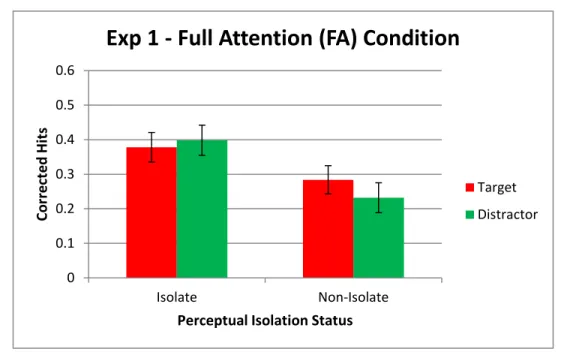
In order to follow up on the interactions, the corrected hits from the DA and FA conditions were submitted to separate 2x2 ANOVAs using the within-subjects factors of ABE trial type (target vs. distractor) and isolation (isolate vs. non-isolate). In the FA condition (Figure 1), isolates were better recognized than non-isolates, F(1, 23) = 14.225, MSE = 0.029, p = 0.001. As expected, there was no main effect of ABE trial type – targets and distractors were
remembered equally well, indicating no ABE in the FA condition, F(1, 23) = 0.29, MSE = 0.02,
p = 0.595. Finally, there was no significant interaction between isolation and ABE trial type, F(1, 23) = 1.494, MSE = 0.021, p = 0.234.
In the DA condition (Figure 2), the results indicated that an isolation effect was present for these subjects as well, F(1, 23) = 5.316, MSE = 0.011, p = 0.03. Additionally, an ABE was present in this condition, with a significant boost in recognition performance (10.64%) for target items relative to distractors, F(1, 23) = 9.796, MSE = 0.028, p = 0.005. The interaction was marginally significant, F(1, 23) = 3.405, MSE = 0.017, p = 0.078, indicating a trend for a larger ABE for the isolates than non-isolates.
In order to determine whether the observed ABE was a relative boost in memory for DA target items (i.e., matching FA performance) or an absolute boost (i.e., exceeding FA
performance), a 2x2 ANOVA with attention condition (FA or DA) and isolation (isolate or non-isolate) as its factors was conducted for the corrected hits on target items. Because the ABE does not impact distractor items, only target items were assessed in this first analysis. First, it is worth mentioning that the isolation effect found in previous analyses was still significant in this
23
interaction between isolation and attention, demonstrating that the advantage of isolates over non-isolates was similar for DA and FA target items, F(1, 46) = 0.008, MSE = 0.018, p = 0.929. The evidence here suggests the presence of a relative ABE, characterized by DA-target
performance reaching (but not significantly surpassing) FA-target performance.
A similar analysis was conducted on the distractor items to ensure no peculiarities arose as a result of the current study’s manipulation of the ABE paradigm. There was a main effect of isolation (F(1, 46) = 8.135, MSE = 0.02, p = 0.006), but no main effect of attention condition (F(1, 46) = 0.13, MSE = 0.062, p = 0.721). The final result of this analysis was somewhat unexpected – a significant interaction between isolation and attention was present for distractor items, F(1, 46) = 8.054, MSE = 0.02, p = 0.007. This interaction was driven by the fact that there was a robust isolation effect for FA-distractors (t(23) = 3.244, p = 0.004), but not amongst DA-distractors (t(23) = 0.015, p = 0.988). In fact, although previous analysis had shown a significant isolation effect for the DA condition, upon closer inspection it is clear that this was entirely due to performance on the target items – no isolation effect whatsoever was produced amongst the DA-distractor items.
Experiment One – Discussion
24
and DA conditions, indicating that the isolation paradigm and ABE paradigm can be blended together in such a way that both effects can be individually produced. This is noteworthy considering that in this experiment both the isolation effect and ABE were dependent upon processing of information that was perceptually distinct, and provides further evidence for the notion that the ABE cannot be reduced to an effect of perceptual distinctiveness alone (i.e., the infrequency of red targets), but instead requires the subject to actively attend and respond to the target items in a series of stimuli.
Considering the current results in light of previous research on the ABE and (secondary) distinctiveness (Mulligan et al., 2014; Spataro et al., 2014), it appears that the current study’s manipulation of primary distinctiveness via perceptual isolation yielded some critically different outcomes. Earlier studies produced a reduction or elimination of the ABE for stimuli marked by secondary distinctiveness (specifically, words with low-frequency or atypical orthographic features). However, in Experiment One the ABE was no smaller for perceptual isolates than it was for non-isolates – in fact, the boost was numerically (though not significantly) larger for isolated items. In other words, it seems as though the ABE and isolation effect both uniquely contributed to enhancements in memory performance. This suggests that these two effects are not redundant with one another; some fundamental difference in the cognitive mechanisms underlying each effect must exist. The exact nature of possible differences in cognitive
mechanisms between primary distinctiveness and the ABE will be explored later in the General Discussion section, after both manipulations of primary distinctiveness have been assessed.
25
up to the level observed in the FA condition. While this outcome for the target items is typical of the ABE paradigm, the results of the distractor items were actually somewhat surprising. An isolation effect was initially expected amongst the DA-distractor items given that these items are functionally identical to trials in the FA condition – a word presented on a screen with no
accompanying motoric response for the colored circle located below. Despite the robust isolation effect for items in the FA condition, there was no trace of a benefit for isolates over non-isolates among DA-distractor items. The reason for this pattern of results is unclear, but perhaps this trend arose due to perceived differences in the degree of isolation for stimuli in the DA
26
EXPERIMENT TWO
The previous experiment revealed that the ABE could co-occur with the isolation effect, such that a benefit of an item’s status as a “target” was not limited to non-isolates, but existed amongst isolates as well. This finding brings into question the idea that distinctiveness effects (in the general, all-encompassing sense of the term) are unable to improve memory for items which already enjoy the mnemonic benefit of being paired with a target stimulus within the ABE paradigm. More directly, this first experiment provides initial evidence which suggests that primary distinctiveness effects may interact with the ABE in a way that is fundamentally dissimilar from secondary distinctiveness effects.
However, at this point it is still premature to suggest that all primary distinctiveness effects are immune to the redundancy observed with manipulations of secondary distinctiveness. In particular, previous research on primary distinctiveness has uncovered differences between
perceptual isolation (as in Experiment One) or conceptual (i.e., categorical) isolation (see Bireta & Mazzei, 2016).Consequently, a more complete investigation of the interaction between
primary distinctiveness and the ABE requires the inclusion of an experiment using conceptual isolation. With this in mind, Experiment Two was designed to be similar to Experiment One, but instead used conceptual rather than perceptual isolation. Specifically, words in the study list were isolated with respect to category membership rather than physical appearance (for example, the word river embedded in a list composed predominantly of animal names like lion, cow, dog, cat,
27 Experiment Two – Methods
Participants
Forty-eight undergraduates from the University of North Carolina at Chapel Hill
participated in this experiment. The inclusion/exclusion criteria and compensation were identical to Experiment One, and subjects were once more divided evenly between DA and FA conditions.
Design
Attention condition (DA vs. FA) and ABE trial type (target vs. distractor) were manipulated as in Experiment One. The isolation variable was again manipulated within subjects, but in this experiment was based upon the category membership of a given word
relative to the conceptual theme of a given list (isolate [categorically incongruent] vs. non-isolate [categorically congruent]).
Materials
28
exemplar for the categories of “Color” and “Fruit”, and was therefore not included in the study items.
Three words from each category were designated as critical items, and were assigned as either a categorical isolate, a categorical non-isolate, or as a new (i.e., unstudied) word presented during the recognition memory test. The critical items were counterbalanced over subjects such that all critical words fell into each of these designations for separate versions of the study list. For instance, in the category “A Unit of Time”, the three critical words selected were day, second,
and year, and each of these items appeared equally often as isolates, non-isolates, and new words. Additional counterbalancing took place between targets and distractors; to illustrate, if
day was a target-isolate in one subject’s study list, it would appear as a distractor-isolate in another subject’s list. From this process, a total of six counterbalance conditions were created.
A practice phase was again created in order to acclimatize subjects to the format of the study phase. This phase consisted of three blocks of categorical words, along with three isolates selected from unrelated categories. Importantly, these six categories were unique to the practice phase and did not overlap with the categories chosen for any other portion of the experiment. As with Experiment One, the practice phase was identical for all counterbalance conditions.
The study phase consisted of 16 blocks of categorically grouped words, with each block varying in length from eight to ten words to make the duration of any given categorical sequence less predictable. In total, each study list was 144 words long. To reduce the predictability of the isolate locations, the conceptual isolates were placed in either the 4th, 5th, or 6th serial position within each block.1 The critical non-isolate always appeared either two positions before or after a given isolate (but never earlier than the 3rd serial position). As a result of this organization,
1 If the isolates were placed any earlier, there might have been some risk of unintentionally inducing an
29
targets and critical distractors were likewise located two positions away from one another in each block.
Memory performance was once again assessed by an old/new recognition test. Old items were the set of 32 critical words presented during the study phase (again, 8 each for Target-Isolate, Target-Non-isolate, Distractor-Target-Isolate, and Distractor-Non-isolate combinations). Of the 32 new words not presented in the study phase, half (16) of these were the critical words selected to be new items for a given counterbalance condition. As such, these items were
category-congruent new items – even though these new words were not studied earlier, their categories
were. The incorporation of category-congruent new words in the recognition test was necessary to ensure that the subjects could not simply reject unstudied items based on their memory of the categories presented in the study phase. The other half of the new words, the
category-incongruent new items, was selected from 16 categories (one word from each) that were not used in the study or practice phases of the experiment. In total, the recognition test consisted of 64 items, with equal numbers of old and new words.
Procedure
30
stood out from the study word trials. This pattern of blocked separation of categories also took place during the practice phase to familiarize subjects with the structure of the study lists. Although this structure is unlike the typical ABE procedure, previous studies on conceptual isolation effects have made effective use of pauses between study lists (Geraci & Rajaram, 2004; Geraci & Manzano, 2010) and category labelling (Singer, Fazaluddin, & Andrew, 2011) in order to ensure that the inherent categorical structure of each study block is readily apparent to the subjects.
31
By making the separation between study blocks noticeable to subjects, a concern arose for the target monitoring task. If subjects know that there are a series of finite lists, and each block contains only one target, it is possible that after responding to the target item that subjects would no longer continue to monitor for red circles for the remainder of the block. As a result, distractor trials occurring after the target might be studied under conditions where attention is not truly divided between the two tasks. In order to reduce the likelihood of this occurring,
Experiment Two incorporated the use of faux-targets. Faux-targets were physically identical to the genuine target trials, but memory performance for faux-targets was not assessed. For half of the blocks in the study phase (and 2/3 of the blocks in the practice phase), a faux-target appeared as the final trial for the category. Because subjects were unaware of which blocks would contain the final extra target and did not know the exact length of a given block, the inclusion of faux-targets was intended to ensure that participants would actively engage in the target monitoring task for all of the items. It is unlikely that this inclusion of extra “targets” hampered the ABE considering that the effect has been produced under conditions where the target to distractor ratio is as low as 1:1 (Swallow & Jiang, 2012).
The final alteration was a minor increase in the time allotment for each study word trial. Whereas Experiment One presented each word for a total duration of 1,000ms, Experiment Two increased the duration to 1,200ms. This was to account for an increase in the character length of certain words – whereas word length was confined to 5-6 letters in the first experiment, a wider range was necessary for Experiment Two in order to utilize the pre-established category norms (which contained words of varying lengths). By marginally increasing the trial duration, the slightly longer reading time of certain words was better accommodated.2 Furthermore, it was expected that a trial duration of 1,200ms would still be short enough to produce the ABE, as the
32
effect does not seem to dissipate until trial length begins to approach ~4,000ms (Mulligan & Spataro, 2015).
Experiment Two – Results
As in Experiment One, responses to the critical study phase items were once again assessed to ensure that subjects in the DA condition accurately completed the go/no-go target monitoring task. While no target items were missed in this instance, there were three false-alarms where subjects pressed the spacebar to a distractor (i.e., green circle) item.3Although overall accuracy for responses to the critical items remained quite high (100% hit rate, 0.8% false alarm rate), the presence of false-alarms on this task is rare within the ABE paradigm, and therefore merits acknowledgment. Notably, the entirety of critical item false-alarms were for items designated as Distractor-Isolates – in this case, a categorically incongruent word paired with a green circle. Perhaps the subjects conflated the rarity of the isolate with the response that was intended for the rare target items (although if this were the case, it is unclear why a similar pattern failed to arise in Experiment One). At any rate, these false-alarms were removed to ensure that whatever mental process accompanied the errors did not impact the subsequent analysis of the recognition phase.
As in the previous experiment, mean hit rates and false alarm values for each critical stimulus type were compiled (see Table 2). Corrected hit rates were again used to assess recognition accuracy (analyses using d’ produced the same results with one minor exception noted below). As in Experiment 1, a preliminary analysis submitted the corrected hits to a 3-way ANOVA using attention condition (DA vs. FA), ABE trial type (targets vs. distractors) and
33
isolation (isolates vs. non-isolates) as factors. The main effects followed the same pattern as in Experiment One, with significant effects of ABE trial type (F(1, 46) = 9.795, MSE = 0.017, p = 0.003) and isolation (F(1, 46) = 13.215, MSE = 0.019, p = 0.001), but no main effect of attention (F(1, 46) = 0.135, MSE = 0.077, p = 0.715). Similarly, a significant interaction was once again obtained between ABE trial type and attention, F(1, 46) = 4.657, MSE = 0.017, p = 0.036. No other effects were significant (Fs < 1).
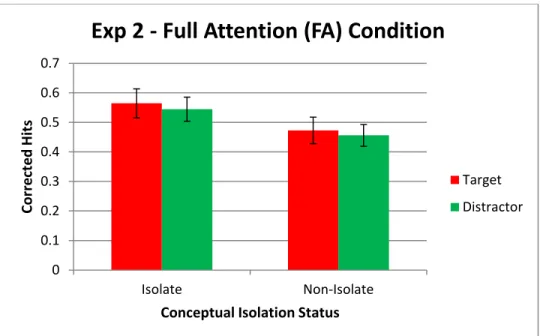
As in Experiment One, the corrected hits from the DA and FA conditions were once again submitted to separate 2x2 ANOVAs with the within-subjects factors of ABE trial type and isolation in order to further explore the nature of the interaction of ABE trial type and attention revealed in the initial analysis. The analysis of the FA condition (Figure 3) once again revealed a significant isolation effect, with an average 9.0% better recognition of isolates relative to non-isolates, F(1, 23) = 8.501, MSE = 0.023, p = 0.008, and no ABE, F(1, 23) = 0.42, MSE = 0.019, p
= 0.524 (nor interaction, F < 1). In the DA condition (Figure 4), an isolation effect of 5.65% was observed, F(1, 23) = 4.755, MSE = 0.016, p = 0.04.4 A significant ABE was found in this condition, with target items being 9.98% more likely to be recognized than distractor items, F(1, 23) = 15.978, MSE = 0.015, p = 0.001. Again the interaction was not significant, with the ABE advantage being roughly equivalent for isolates and non-isolates, F(1, 23) = 0.578, MSE = 0.018,
p = 0.455.
Similarly, DA-target and FA-target items were again compared to determine if the observed ABE was characterized by an absolute or a relative boost in memory performance. Once again, a significant isolation effect was observed for target items, F(1, 46) = 4.669, MSE = 0.021, p = 0.036. As before, no main effect of attention was found, F(1, 46) = 1.5, MSE = 0.049,
34
p = 0.227, nor was the interaction of isolation and attention significant, F(1, 46) = 0.915, MSE = 0.021, p = 0.344. Therefore, as in the prior experiment, the analysis suggests the presence of a relative ABE, wherein DA-target performance meets, but does not significantly surpass, FA-target performance.
Finally, the distractor items were analyzed in order to determine whether an isolation effect only occurred for the FA-distractors (as in Experiment One), or if a benefit of isolation was likewise found amongst DA-distractors. The main effect results were identical to the earlier study, with a main effect of isolation (F(1, 46) = 8.547, MSE = 0.019, p = 0.005), but no main effect of attention (F(1, 46) = 0.365, MSE = 0.045, p = 0.549). However, unlike the previous experiment, no interaction between isolation and attention was found: a similar isolation effect was produced for distractors in both the FA and DA groups, F(1, 46) = 0.036, MSE = 0.019, p = 0.85.
Experiment Two – Discussion
The pattern of results obtained here is largely consistent with what was found in Experiment One. Once again, the ABE was obtained in the DA condition, but not the FA condition. Not only does this finding replicate a defining characteristic of the ABE, but this outcome confirms that the modifications made to the standard paradigm for the purposes of this experiment (i.e., block separation, faux-targets, and trial duration) did not disrupt the normal effect. Additionally, a conceptual isolation effect was produced for both the FA and DA conditions. In other words, dividing a subject’s attention between two tasks did not prevent an isolation effect, thus demonstrating that the benefit of primary distinctiveness in the ABE
35
can occur for conceptual isolation as well. As such, these results may suggest a reassessment of the notion that dividing attention precludes the conceptual isolation effect (as suggested by Birtea & Mazzei, 2016; but see General Discussion below).
36
GENERAL DISCUSSION
The current study revealed that manipulations of primary distinctiveness via the isolation effect were able to operate within the ABE paradigm in such a way that both effects were
capable of enhancing memory for stimuli. More importantly, in both experiments the effects of isolation and ABE were found to be independent of one another, resulting in an additive advantage for study trials featuring the characteristic traits of both effects simultaneously. This finding lies in stark contrast with what was observed in previous research on the intersection of secondary distinctiveness effects and the ABE. In these earlier studies, the manipulation of secondary distinctiveness interacted with the ABE such that more distinctive items (i.e., low-frequency words or orthographically distinct words) were not subject to the ABE advantage, whereas the ABE was robust amongst less distinctive items. In contrast, the current study
revealed no such dependency between these variables for primary distinctiveness – the ABE was equally robust for both distinctive (i.e., isolated) and non-distinctive items. Furthermore, the current experiments demonstrated that the additive benefit of isolation and the ABE occurred regardless of whether perceptual or conceptual isolation was employed, suggesting that these findings are generally representative of the relationship between the ABE manipulation and primary distinctiveness. The results of this study are therefore inconsistent with the notion that stimuli designated as targets within the ABE paradigm are unable to receive additional
mnemonic benefits if made distinctive, and asserts that primary distinctiveness interacts with the ABE in a manner fundamentally dissimilar from the previously studied manipulations of
37
Why might this be the case? To explain the results, one should consider the underlying cognitive mechanisms of these effects. If the cognitive processing invoked by two phenomena is redundant, then it should be unsurprising that the effects cannot jointly impact memory. If, however, the processing mechanisms vary, then both effects should be able to independently influence the memory for study items. The current body of research suggests that the ABE is driven by early-phase encoding processes, wherein heightened attention for items co-occurring with targets enhances early aspects of encoding such as initial perception and comprehension of a stimulus (Mulligan & Spataro, 2015). Notably, the improvement in early-phase encoding processes afforded by the ABE is not limited to the perceptual aspects of a stimulus, but seems to enhance memory for the abstract, amodal properties of stimuli (Mulligan, Smith, & Spataro, 2016; Mulligan, Spataro, & Picklesimer, 2014).
This enhancement in early-phase encoding for target items in the ABE paradigm closely parallels the mechanism believed to be responsible for secondary distinctiveness effects.
38
Likewise, orthographic distinctiveness – another secondary distinctiveness effect – is also thought to recruit additional attentional resources during encoding relative to orthographically common words (see Hunt & Elliot, 1980). As such, divided attention during encoding has been found to disrupt the orthographic distinctiveness effect (Geraci & Rajaram, 2002), suggesting that the availability of attentional resources at encoding facilitates the effect. Furthermore, the orthographic distinctiveness effect can occur after very brief (250ms) presentation times, and does not become more robust with increased study durations (Gounden & Nicolas, 2012), which supports the idea that specifically early-phase encoding is driving the effect. Therefore, it is perhaps unsurprising that the orthographic distinctiveness effect has also been found to be redundant with the ABE (Spataro, Mulligan, & Rossi-Arnaud, 2014). In short, the previous literature illustrates that secondary distinctiveness effects are already subject to heightened levels of attention during the early stages of encoding, and therefore do not confer any additional improvement for memory beyond what is already afforded by the ABE.
39
which were homogeneous with the exception of a single isolate (e.g., a number embedded within a list of letters, or vice versa) which was placed near the beginning of a given list. As such, subjects studied isolates before any dimension of similarity between the non-isolated study items could have possibly been established. Therefore, the recognition of an item’s isolation status could only have taken place after being exposed to the isolate (i.e., after a dimension of similarity is made apparent between the other items). Consequently, enhanced memory for isolates in these studies cannot be explained by increased salience during initial encoding, as the isolates were presented before subjects were given any contextual information that would have revealed isolates as distinct from other items in the list (Hunt, 1995).
This variation on the standard isolation paradigm is known as the early-isolation effect (as opposed to the more commonly utilized late-isolation effect, in which isolates are presented later in the list, presumably after the dimension of similarity between non-isolates is apparent to the participant).1 Modern research on the early-isolation effect provides additional support for the proposition that salience is not required to produce mnemonic benefits of isolation.
Dunlosky, Hunt, and Clark (2000) assessed salience for isolated items during encoding by
measuring judgments-of-learning (JOLs) immediately after viewing each item in a study list. The salience of early-isolates was judged as being comparable to nearby non-isolates (i.e., similar JOLs). Moreover, early-isolates were, unsurprisingly, rated as less salient than late-isolates. However, despite this measured difference in salience, actual memory for isolates was equivalently improved regardless of whether isolation occurred early or later in the list. The comparable size of early- and late-isolation effects further supports the notion that salience during encoding is not a necessary component of the isolation effect, suggesting that some other cognitive mechanism must be responsible for the effect. This finding is instructive in interpreting
40
the results of the current study: if salience for an isolate is not required during initial encoding, this suggests that early-phase encoding is likewise unnecessary for the isolation effect to occur. If so, this reveals a fundamental contrast between the cognitive processes underlying primary distinctiveness and the early-phase encoding mechanism thought to drive both the ABE and secondary distinctiveness effects.
Of course, the idea that early-isolation effects may be produced without being initially salient during isolate encoding does not preclude the possibility that isolates can be salient. Indeed, in studies of the more frequently utilized late-isolation effect (including the current study), it is likely the case that the uniqueness of isolates during initial encoding is salient to subjects due to their appearance after the general dimension of similarity between study items has been established. It is worth noting that the literature on early-isolation effects does not suggest that isolates are never salient (and potentially recruit heightened attention due to this salience) – rather, it suggests that isolates are not required to be salient in order to enhance memory.
So what mechanism is required for isolation effects to occur? There is evidence
41
isolation effects should not overlap with the enhancement caused by effects which increase early-phase encoding (namely, the ABE).
Despite the plausibility of this account, there is still debate concerning the mechanism underlying the isolation effect, with many researchers still pointing to salience as a necessary precursor to whatever additional processing isolates receive. For example, Geraci & Manzano (2010) found evidence suggesting that salience is required for isolation effects to take place, regardless of whether isolates were placed early or later in the study list. However, these findings are not necessarily inconsistent with the current study, as the authors noted that the salience necessary to produce isolation effects arises over the course of the study phase, and is not temporally bound to the point at which the isolate was presented. In other words, salience is not seen as being restricted to encoding at the specific moment the isolate is observed, but rather unfolds throughout the study list. As such, this account is still compatible with the current results, as it would suggest that the benefit of salience in the isolation effect is not confined to early-phase encoding of a specific item (as ABE and secondary distinctiveness effects are thought to be). Clearly further research will be necessary to decisively establish the separability of cognitive mechanisms required for primary and secondary distinctiveness. Nevertheless, it seems safe for now to suggest that the processes underlying primary distinctiveness are not redundant with the ABE, thereby allowing these effects to jointly enhance memory for stimuli in a way that secondary distinctiveness could not achieve in the context of the ABE paradigm.
On the surface, the current study’s successful production of both perceptual and conceptual isolation effects within the ABE paradigm seems to conflict with the findings of Bireta and Mazzei (2016), who found that conceptual, but not perceptual, isolation was
42
Mazzei’s (2016) results, there were several methodological differences between these studies worth noting. First, the current study manipulated attention between subjects, whereas Bireta and Mazzei (2016) manipulated this variable within subjects. This was achieved by presenting several shorter lists of study items to subjects, and varying the instructions for each list (causing attention to be divided for some sets of words and not for others). The memory test also varied between these two studies, with Bireta and Mazzei (2016) utilizing free recall, which some earlier studies suggested may be more hospitable to revealing perceptual isolation effects than recognition assessments like those used in the current study (see Schmidt, 1991; but see also Kishiyama & Yonelinas, 2003; Rajaram, 1998). Bireta and Mazzei (2016) also did not include a separate distractor phase between study and test, making it difficult to determine whether the performance during retrieval represented the establishment of a long-term memory trace, or if the results were impacted by continued rehearsal of items in working memory. However, despite these variations in methodology, it is admittedly unclear exactly how these differences would produce divergent results between the two studies.
Perhaps a more promising explanation for the differences between the current results and Bireta and Mazzei (2016) concerns how attention was divided in these two studies. Whereas the current study used the standard ABE monitoring task to divide attention, Bireta and Mazzei (2016) used a self-paced backward counting task. Although they did not measure performance on this distraction task (making it difficult to assess whether attention was divided equally for all study items), the results clearly indicated an overall effect of divided attention between the FA and DA groups, with the typical finding of FA performance surpassing DA performance. In contrast, the current study produced no effect of attention among distractor items2 in either
43
experiment. It is possible that the distractor task used in Bireta and Mazzei’s (2016) experiments imposed a greater burden on attention than the standard ABE monitoring task. If so, this may have more strongly disrupted the encoding processes throughout the study episode, thereby producing the typical dual-task costs to memory performance when attention is divided. Moreover, this increased attentional burden may have been able to disrupt the relational processing needed to enhance memory traces for conceptual isolates at retrieval. However, the relational processing for perceptual isolates could be more automatic, leaving the perceptual isolation effect relatively unharmed when subjects are exposed to the same attentional burdens which eliminated conceptual isolation. Considering the previously mentioned sensitivity of distinctiveness effects to variations in study design, the noted methodological differences between the current study and Bireta and Mazzei (2016) make a direct comparison of these two studies difficult to interpret. However, at the very least, the current study demonstrates one particular set of circumstances under which both perceptual and conceptual isolation can be produced within a dual-task paradigm (albeit the notably atypical ABE paradigm).
The current study reveals several contributions relevant to the extant literature for both the ABE and distinctiveness effects. First, these experiments reveal new methodological
variations which successfully produce the ABE. Previous studies demonstrated that the ABE was resilient to several alterations in study design, including differences in stimulus type (pictorial vs. verbal), modality (written vs. audible words), memory assessment (implicit vs. explicit), target to distractor ratio, and several other variations (see Introduction). The design of the current study revealed additional modifications which were successfully integrated into the standard paradigm, and therefore expand upon these previous findings. Specifically, Experiment Two showed that
44
the set of verbal study items could be split up into several separate lists (rather than the more standard long single list of stimuli) and still produce the ABE.3 Additionally, both experiments successfully incorporated a separate memory-enhancing manipulation (i.e., the isolation
manipulation) into the ABE paradigm without disrupting the memory boosting properties of either phenomenon. These findings add to the growing body of evidence pointing toward the robustness and versatility of the ABE despite variations of the standard paradigm.
Perhaps more interesting are the theoretical implications of the current study. To start, these experiments provide even further evidence that the ABE cannot be simply explained as a variation of the isolation effect – if this were the case, then it seems unlikely that the
incorporation of isolates in the study would separably enhance memory. Furthermore, in light of these findings, it is clear that the previous studies incorporating secondary distinctiveness into the ABE paradigm are not representative of how all forms of distinctiveness may interact with the ABE. Unfortunately, in many studies it is a fairly common practice to interpret the results produced from one manipulation of distinctiveness as being representative of how all
manipulations of distinctiveness should operate in a given scenario. The current study provides an example of how this assumption can be faulty, and suggests caution when attempting to extrapolate the results of one distinctiveness manipulation as being representative of distinctiveness effects in general. More precisely, these results provide evidence that the mechanisms underlying secondary distinctiveness effects may not mirror those necessary for primary distinctiveness, despite the fact that in many cases the general behavioral outcome (namely, improved memory for distinctive items) seems comparable. As such, it may be
3
This is similar in some ways to Experiment 1 of Swallow & Jiang (2012), except that they used pictorial stimuli (faces), and subjects were given breaks between each list to provide feedback on performance in the target
45
worthwhile to consider how other variants of distinctiveness may interact within the ABE paradigm. To this end, future research might consider effects such as emotional distinctiveness, which sometimes produces paradoxical effects on memory and has consequently been
categorized outside the umbrella of primary and secondary distinctiveness effects (Schmidt, 1991).
In closing, the present results provide an updated perspective on earlier studies of distinctiveness effects in the ABE paradigm by revealing that not all manipulations of
distinctiveness may interact with the ABE in a similar manner. This study demonstrated that the ABE phenomenon can bolster retrieval for items which are already subject to a separate
memory-enhancing effect (i.e., the isolation effect), resulting in a combined improvement of memory performance rather than a redundancy of the two effects (as was found in studies
utilizing secondary distinctiveness). In so doing, the current study also provides indirect evidence that different cognitive mechanisms are likely in use for primary and secondary distinctiveness, which is consistent with retrieval-based theoretical accounts of the isolation effect as well as the early-phase encoding account of the ABE. Finally, this study expands our knowledge of