BIOPHYSICS
AND
COMPUTATIONAL
BIOLOGY
Experimental evaluation of the generalized vibrational
theory of G protein-coupled receptor activation
Ross D. Hoehna, David E. Nicholsb,1, John D. McCorvyb, Hartmut Nevenc, and Sabre Kaisa,d,1
aDepartment of Chemistry, Purdue University, West Lafayette, IN 47907;bDepartment of Pharmacology, University of North Carolina, Chapel Hill, NC 27514; cGoogle Los Angeles, Venice, CA 90291; anddSanta Fe Institute, Santa Fe, NM 87501
Edited by Leslie B. Vosshall, The Rockefeller University, New York, NY, and approved April 14, 2017 (received for review November 6, 2016)
Recently, an alternative theory concerning the method by which olfactory proteins are activated has garnered attention. This the-ory proposes that the activation of olfactthe-ory G protein-coupled receptors occurs by an inelastic electron tunneling mechanism that is mediated through the presence of an agonist with an appropriate vibrational state to accept the inelastic portion of the tunneling electron’s energy. In a recent series of papers, some suggestive theoretical evidence has been offered that this the-ory may be applied to nonolfactthe-ory G protein-coupled recep-tors (GPCRs), including those associated with the central ner-vous system (CNS). [Chee HK, June OS (2013)Genomics Inform 11(4):282–288; Chee HK, et al. (2015)FEBS Lett 589(4):548–552; Oh SJ (2012)Genomics Inform10(2):128–132]. Herein, we test the viability of this idea, both by receptor affinity and receptor acti-vation measured by calcium flux. This test was performed using a pair of well-characterized agonists for members of the 5-HT2 class of serotonin receptors, 2,5-dimethoxy-4-iodoamphetamine (DOI) andN,N-dimethyllysergamide (DAM-57), and their respec-tive deuterated isotopologues. No evidence was found that selec-tive deuteration affected either the binding affinity or the acti-vation by the selected ligands for the examined members of the 5-HT2receptor class.
protein|mechanism of action|pharmacology|quantum biology| electron tunneling
O
lfaction—and other chemo-sensitive sensory processes—is an important information-gathering technique for organ-isms of many clades and kingdoms. Specifically, human olfaction is known to occur by activation of olfactory receptors (ORs)— a subclass of G protein-coupled receptors (GPCRs)—located within the nasal epithelium and mediating responses within the olfactory bulb, where it is encoded and conveys information to the amygdala, the orbitofrontal cortex, and the hippocampus (1, 2). The discovery and the cloning of ORs led to the joint 2004 Nobel Prize in Physiology and Medicine to Richard Axel and Linda Buck. (3) GPCRs are 7-helical transmembrane pro-teins, facilitating communication from extracellular ligand sig-nals to the cellular interior through activation of (interior) G proteins, while maintaining the integrity of the membrane (4). GPCRs are activated by an appropriate agonist moving into the protein’s orthosteric binding site, resulting in a conformational change within the helical bundle. This structural change leads to altered conformations of the intracellular loops that couple to appropriate signaling molecules within the cell, e.g., G proteins. A recent series of papers has experimentally determined acti-vated/inactivated states through isotopic-tagged receptors with NMR spectroscopy (5–7). An additional work used molecular dynamics to provide structural insights into how the agonist may assist the interchange between conformations through several proposed peptide sidechain pathways by examining the struc-tures of the activated and inactivated µ-opioid receptor (8). Additionally, photon-induced conformational changes in light-sensitive proteins have also been observed (9, 10).Recently, an iteration of the vibrational theory of olfaction (VTO)—suggested and advocated by Luca Turin (11, 12)—
has arisen and has gained both supporters (13–16) and detrac-tors (17, 18); the novelty of this incarnation of the VTO is ascribable to its nonthermal- and nonphoton-based mechanism. Turin’s theory is a contemporary reincarnation of the more clas-sical theory proposed by Dyson (19), Wright (20), and Wright and Serenius (21), where the activation of the olfactory recep-tor is performed—or sensitive to—the molecular vibrations of the olfactant. Dyson suggested that the molecular vibrations of the agonist were exactly responsible for the activation of the protein. These vibrations were entirely thermally excited, as no mechanism for photoexcitation is available within the body. The modern incarnation of this theory suggests that the OR behaves as an electron-tunneling (ET) junction. Hypothet-ically, this electron transfer instigates the conformation change of the olfactory GPCR, leading to the intracellular signal cas-cade. This theory both is contentious and lacks direct at-receptor evidence. Several of the proposed tests for this theory, includ-ing odor mixinclud-ing, have been addressed to disprove this theory through controlled sensory tests (13, 15). Additionally, more modern examinations of this theory with both humans and insect subjects have provided mixed and controversial results. (14, 16–18, 22–24).
There have been several tests of the previous iterations of the VTO, including odor blending (25, 26) and isotope exchange (20, 27–30); each of these methods—odor blending (11, 18) and iso-tope exchange (11, 31)—has been used to evaluate the modern VTO. Initial justifications of the VTO correlated characteristics of the vibrational spectra with olfactory perception (12), contin-ued within ORs (32), and expanded into non-OR GPCRs (33– 36). Isotope exchange—which provides the ability to alter the vibrations of a molecule while maintaining its chemistry—may manifest itself as an alteration of either the intensity or the qual-ity of the scent. Isotope exchange tests of the VTO focused on
1
H→2
H exchange, although13C exchange has been suggested
Significance
Herein, we test the present iteration of the vibrational theory of protein activation by comparing predictions obtained from Turin’s vibrational theory for the activation of olfactory tors measuring affinity and activation at a nonolfactory recep-tor family of G protein-coupled receprecep-tors. This was done at the CNS serotonin receptor family h5-HT2 and with both the 2,5-dimethoxy-4-iodoamphetamine andN,N-dimethyllysergamide agonists. Invalidation was performed through a comparative analysis of agonist behavior between isotopologues.
Author contributions: R.D.H., D.E.N., H.N., and S.K. designed research; R.D.H., D.E.N., and J.D.M. performed research; R.D.H., D.E.N., J.D.M., H.N., and S.K. analyzed data; and R.D.H., D.E.N., and S.K. wrote the paper.
The authors declare no conflict of interest.
This article is a PNAS Direct Submission.
1To whom correspondence may be addressed. Email: [email protected] or drdave@ purdue.edu.
N
N H H CH3
H O
N aCH
3 bCH
3
I
OCH3 OCH3
CH3 H17 H16
H18
NH2
A
B
Fig. 1. (A) Structure of the (R)-DOI molecule. In blue text, the atomic indexes for some specific sidechain hydrogen atoms initially considered for deuteration are shown. Additional sites considered for deuteration are the hydrogens of the two methoxy groups. (B) Structure of the DAM-57 molecule. In blue text, each methyl amide carbon where deuteration exchange was undertaken is denoted as either carbon “a” or “b.”
(37). Unfortunately, measuring either quality or intensity changes by sensory studies has presented itself as inconclusive and difficult to quantify.
Recently, several recent studies—both in vitro and in vivo— have been conducted at a more physiological level. Block et al. (17) studied the activation of several ORs (importantly, OR5AN1 and MOR244-3) by both muscone and cyclopen-tadecanone; neither receptor displayed a significant differen-tial response to isotopologues of the musk odorants, suggest-ing failure of the VTO at mammalian ORs. However, criticism of this work has arisen on grounds of lacking the in situ envi-ronment (odorant binding proteins, cofactors, etc.) and possibly being too specific with respect to the repertoire of examined ORs (23, 24, 38, 39). Supporting previous behavioral studies (14, 16), Drimyl et al. (23) and Paoli et al. (24) studied direct electro-physical responses induced by odorant detection at the antennae and glomeral lobe of severalDrosophilaspecies andApis mel-lifera, respectively. These findings show unique spatial–temporal responses with respect to families of isotopologues. Two things should be further noted with respect to these in situ insect stud-ies: (i) Despite attempts at compensation, these results may not be entirely independent of perireceptor effects (including trans-port, enzymes, and extracellular vestibule). (ii) Insect ORs are ionotropic receptors (IRs) and not GPCRs; each class of recep-tors (GPCRs vs. IRs) shows specific evolutionary benefits (broad responsiveness vs. speed of detection and processing) (40, 41).
Herein, we exploit the fact that ORs are a subclass of the broader GPCR family with highly conserved sequences and structural motifs. The nonexceptionalism of ORs within the broader class of GPCRs was previously discussed within the con-text of the VTO (18) and is highlighted by Barwich (42), who asserts ORs are a model system for the GPCRs within neuro-biology. Furthermore, ORs maintain up to 40% genetic similar-ity with rhodopsin (43). Additionally, ORs appear within areas of mammalian corpus that have no olfactory capacity (44–55). We therefore hypothesize that due to functional and morpholog-ical similarities, if ORs are activated through an ET mechanism, other GPCRs share the same fundamental mechanism. Examina-tion of another (better characterized) GPCR subclass may pro-vide insight into the possibility of the proposed ET mechanism. The serotonin 5-HT2 receptor class, notably a primary target
for hallucinogenic compounds, was selected as the main test for the contemporary VTO. (R)-2,5-dimethoxy-4-iodoamphetamine (R-DOI) is a well-characterized agonist for the serotonin 5-HT2A
receptor used as a standard ligand for studying the pharmacol-ogy of 5-HT2A receptors and is widely used as a radioligand
to measure expression and affinity of ligands at 5-HT2A
recep-tors, particularly in brain tissues. (R)-DOI is reported to have psychedelic effects somewhat similar to those of lysergic acid diethylamide (LSD) (56). A quintessential hallucinogenic ligand for the 5-HT2Areceptor is LSD; a highly related (non-Schedule
1) molecule is generated by substituting the diethyl amide with a dimethyl amide, creatingN,N-dimethyllysergamide (DAM-57). DAM-57 is an assumed serotonergic psychedelic with limited hallucinogenic capacity and very mild autonomic stimulation in humans at dosages of∼100µg (57).
The organization of this paper is as follows:Theoretical Pre-dictionsgives a brief explanation of the theoretical predictions for (R)-DOI at members of the 5-HT2serotonin receptor class
according to Turin’s theory, while making direct reference to a previous work concerning similar predictions for DAM-57;
Experimental Procedures briefly introduces methods of experi-mental analysis for determining affinity;Results and Discussion
provides a discussion of the experimental results and a compar-ison with theoretical predictions; and finally, inConclusion we provide concluding remarks.
Theoretical Predictions
Turin—within the contemporary VTO—hypothesized that the active site of the GPCR [specifically an OR, although later works considered generalizing this hypothesis (18, 36, 58)] acts as an ET junction (11). According to the theory, an electron emerges from a donation site—likely a metal atom acting as a cofac-tor (11, 31), redox chemistry (59), or peptide sidechain (11, 60) capable of oxidation—and traverses the active site to an accep-tor site, which is likely a specific motif or residue sidechain. As the electron traverses the active site, it may undertake several paths: (i) elastic tunneling, where no energy is lost or gained by the electron; (ii) inelastic tunneling (IET), where the electron may donate or accept a quantum of energy during transfer; and (iii) subsequently higher ordered inelastic processes (61–63). The hypothesized presence of a possible metal cofactor site—acting to assist either in binding or in a later activation step—at ORs, GPCRs, and non-GPCR chemokine receptors is supported by altered behavioral response (64–66), physiological response (66– 68), theory (69, 70), and in vitro observations (70–79).
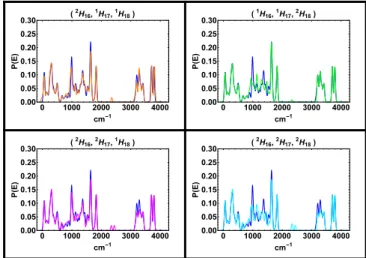
Fig. 2. Plots of the tunneling probability as a function of energy, P(E), for various deuterated analogues of the DOI molecule. (Top Left) In orange, 2H16deuterated DOI; (
Top Right) in green2H18 deuterated DOI; ( Bottom Left) in magenta,2H16and2H17deuterated DOI; and (Bottom Right) in cyan, 2H16,2H17, and2H18deuterated DOI. In all plots, blue is the all-protium DOI
BIOPHYSICS
AND
COMPUTATIONAL
BIOLOGY
Fig. 3. Plots of the tunneling probability as a function of energy, P(E), for various deuterated analogues of the (R)-DOI molecule with respect to the deuteration of one or both aromatic methoxy groups. Note that the dou-ble deuteration depletes the possidou-ble active peaks at 1,600–1,800 cm−1by roughly 50%, indicating that this experiment could be carried out with a detectable effect.
Within the hypothesized protein-based ET junction, the donor and acceptor energies are offset by a quantum of energy,∆E. If an electron attempts to undergo an elastic tunneling process, it has no available acceptor site. However, if the electron is capa-ble of losing a specific quantum of energy (to an internal mode of a bound ligand) such thatEacceptor−Edonor= ∆E, the trans-fer can be undertaken, activating the protein. Thus, a molecule must both fit into the active site with the correct orientation and have a vibrational mode capable of assisting in an IET process to activate the protein. Working within Turin’s hypothesis, several theoretical expansions have been undertaken to account for spe-cific considerations of the system, including charge transfer rates (60, 80), receptor effects (80–82), and chiral effects (83).
Block et al. (17) gave several criticisms of current modeling approaches to the VTO; these criticisms include inappropriate reorganization energies, not considering dynamic fluctuations on the system, excluding possible protein electron couplings during ET, and an unreliable electron delivery mechanism. Recently, Reese et al. (81) addressed several of these concerns, showing that the binding effects of the receptor have a nonzero—all but negligible—effect on the ligand, that dynamic fluctuations have a very small effect on the transfer, and that the reorganization energy (λ) for an OR can conform toλ1kcal/mol. Concerns of electron density leaking into the environment were previously addressed through coupling a vibrational bath with the electron transfer (80), and such studies have shown that environmental-induced dissipation could enhance the vibrational signaling (82). Evaluating the reliability of the electron delivery mechanism cannot be addressed until the complete structure of the OR is known and models account for all cofactors including the pos-sible effects of perireceptor molecular species, as there is evi-dence that NADPH and other oxidative processes are impor-tant in GPCR activation (59). Furthermore, future theoretical investigations should include the fundamental electron–dipole interaction—placing emphasis on the orientation of each vibrat-ing dipole—described by Lambe and Jaklevic (61), Kirtley et al. (62), and Phillips and Adkins (63), among others. This interac-tion potential permits Raman modes to assist transfer and was recently used by Bittner et al. (84).
We—in the context of Turin’s VTO—previously conducted a theoretical study of several ligands belonging to the family of
serotonin receptor agonists. Within this previous study, tunnel-ing spectra were generated and a stunnel-ingle common peak among all of the agonists was determined; the IET probability den-sity displayed behavior scaling with the efficacies of the ago-nists at the 5HT2A receptor (36). Herein, we test the validity
of this vibrational theory of protein activation by examining the assumed active peak—as determined in the above-discussed pre-vious work (36)—at roughly 1,500–1,650 cm−1; this energy range is also in agreement with a characteristic infrared peak for his-tidine receptors as determined by Chee and June (33), Chee et al. (34), and Oh (35). We have calculated the effects on the tunneling probability of several deuterium variants for a pair of well-characterized 5-HT2Aagonists: (R)-DOI and DAM-57. The
structure of (R)-DOI can be found in Fig. 1A, hereafter referred to as structure1; note that the locations of the candidate deu-terium exchanges are highlighted for ease of discussion. Simi-larly, the structure of DAM-57, with its deuterium exchanges can be found in Fig. 1Band is hereafter referred to as structure2. We have used the computational methods discussed within our previous work (36), as first described by Turin (11, 12).
Several deuteration schemes of structure1were considered to determine the scheme capable of maximizing the possible vari-ation in efficacy at the receptor to a high enough degree that it is unlikely to be solely attributable to the pedestrian kinetic iso-tope effects. By deuterating the ethyl sidechain of DOI we found that no such deuterium analogue would present sufficient change in the agonist efficacy. The effects of deuteration on the tunnel-ing spectrum can be seen in Fig. 2. Within each plot in Fig. 2, the blue curve denotes the natural abundance compound and is given as a comparison. As can be seen in Fig. 2, no deuteration scheme of the alkyl sidechain produces a large effect on the tun-neling spectra in the target energy region. The alteration in the tunneling probability, and thus the tunneling current, associated with these schemes is a decrease of roughly 10%. Although this is a substantial difference in terms of efficacy, anything smaller than 10% may not be convincing, as it could be attributable to the normal causes of kinetic isotope effects. Additionally, alter-ation of isotopes changes the vibralter-ations, possibly highlighting a kinetic isotope effect that may be 8–10% itself (85, 86), leading to a further disregard of these findings.
Experimental Procedures
In Fig. 3 we have plotted the probability distribution function (PDF) for the IET during the subsequent deuteration of one (d3), and then both (d6) methoxy groups on the aromatic ring of DOI. Within Fig. 3, Pro-protium DOI is shown in blue, d3in orange, and d6in green. Notably, d6results in an∼50% depletion in the assumed active peak. Such a difference should be experimentally evident; additionally this effect would be larger than a typi-cal kinetitypi-cally derived isotope effect (85, 86). Reducing the tunneling prob-ability would result in a much lower probprob-ability of an electron completing a tunneling transfer assisted by vibrational modes within this energy range. This depletion of the associated tunneling probability in a specific energy region is attributable to two interrelated effects: (i) Isotope exchange results in shifting of energy quanta of a specific vibrational mode. (ii) Alteration of coupling between a vibrational mode (oscillating dipole) and an elec-tron is dependent on the size of the dipole (displacement), and the relative
Table 1. Binding affinities of (R)-DOI and its hexadeutero isotopologue at cloned human receptors
Ligand h5-HT2ApKi (Ki)* h5-HT2BpKi (Ki) h5-HT2CpKi (Ki)
R-DOI HCl 8.19±0.09 8.71±0.07 7.96±0.06
(6.45) (1.95) (10.96)
R-d6-DOI HCl 8.02±0.07 8.65±0.07 7.99±0.06
(9.52) (2.24) (10.23)
Values were determined by PDSP;n= 2 full displacement curves except for 5-HT2A, where (R)-DOIn= 6 and (R)-d6-DOIn= 7.
Table 2. Comparison of (R)-DOI and DAM-57 and their hexadeutero isotopologues for activation of 5-HT2A/2B/2Cmeasuring Gq-mediated calcium flux, as illustrated in Fig. 4
Gq calcium flux
5-HT2A 5-HT2B 5-HT2C
EC50, nM Emax EC50, nM Emax EC50, nM Emax
Ligands (pEC50±SEM) % 5-HT (pEC50±SEM) % 5-HT (pEC50±SEM) % 5-HT
5-HT 0.83 100 1.29 100 0.25 100
(9.08±0.02) (9.01±0.12) (9.62±0.10)
(R)-DOI 0.58 95±4 4.80 94±1 2.19 101±2
(9.25±0.08) (8.43±0.12) (8.70±0.14)
(R)-d6-DOI 0.63 96±4 4.40 91±1 2.23 100±3 (9.22±0.10) (8.45±0.10) (8.70±0.15)
DAM-57 1.54 98±1 13.6 73±2 57.5 81±6
(8.82±0.06) (7.87±0.04) (7.24±0.02)
d6-DAM-57 1.51 98±1 12.6 74±1 49.2 83±6
(8.84±0.07) (7.91±0.05) (7.31±0.02)
Calcium flux data were acquired with human 5-HT2A, 5-HT2B, and 5-HT2CINI-expressing tetracycline-inducible HEK cells. Estimates of EC50and Emaxrepresent the average and SE of the mean (SEM) from three
independent experiments performed in triplicate. Emaxis defined as percentage of 5-HT maximum response.
magnitude of an IET PDF peak associated with a mode is dependent on the mass of an atom. This depletion of electron transfer should result in fewer successful activations of the protein than the natural abundance compound. It is for these reasons that the deuteration schemes involving exchange of all six of the methoxy hydrogens of DOI and the methyl chains on the amide of DAM-57 were selected as candidates.
d6-(R)-DOI was prepared by an asymmetric synthesis, as shown inFig. S1. NMR, mass spectral, and melting-point data were consistent with a pre-viously published synthesis of the protio compound (87). d6-DAM-57 was prepared by a standard route (Fig. S2), using either dimethylamine or d6-dimethylamine. First, DOI and d6-DOI were submitted to the National Insti-tute of Mental Health (NIMH)-sponsored Psychoactive Drug Screening Pro-gram (PDSP) (88) to determine their binding affinities at the human 5-HT2A receptor and then all compounds were tested at 5-HT2A, 5-HT2B, and 5-HT2C receptors, measuring Gq-mediated calcium flux. A complete discussion of the synthetic routes for all molecules, as well as a discussion of the biologi-cal assays, is given inSupporting Information.
Results and Discussion
Herein, we operate under the following null hypothesis: A vibration-sensitive mechanism is shared between all members of the GPCR class of proteins, possibly due to conserved topo-graphical structures even without conservation of sequence iden-tities, implying that general topographical structures of the GPCRs are essential in performing their biological task (89). Fol-lowing this logic, it seems reasonable that the family of GPCRs likely shares a common fundamental activation mechanism. Fur-thermore, forms of both the lock-and-key and the glove-and-hand models exist in olfactory research, admitting acceptance of common aspects. Due to the likelihood of a common fun-damental activation mechanism, findings at CNS GPCRs will have implications at mammalian ORs. We have used a series of well-characterized GPCRs (explicitly h5-HT2A, h5-HT2B, and
h5-HT2C) with two established ligands: (R)-DOI and DAM-57.
IET spectra were generated for both molecules, using meth-ods prescribed by Turin in previous works (11, 12). Within a previous work (36), we examined the IET spectrum of several agonists and determined a consistently shared peak between the agonist’s spectra, the area of this shared spectral aspect roughly scaled with the agonist’s efficacy. This peak was consistent with the works of Chee and June (33), Chee et al. (34), and Oh (35), who attempted to generate a novel pharmacophore tool based on shared vibrational peaks. From the candidate deuter-ation schemes discussed above, we sought the greatest possible alteration in efficacy at the previously suggested activation peak to focus our experimental effort (36).
Both (R)-DOI and (R)-d6-DOI were synthesized and were
assayed for binding affinity (Table 1). All four compounds were assayed for functional activity, using calcium flux assays (Fig. 4 and Table 2) at the 5-HT2A, 5-HT2B, and 5-HT2C receptors.
Neither (R)-d6-DOI nor d6-DAM-57 presented significant
alter-ations in either binding or potency and efficacy (as noted by EC50
and Emax, respectively) compared with the protium versions. The
endogenous agonist 5-HT was included in the calcium flux assays for comparison.
The process of protein agonism/antagonism involves, at min-imum, two steps: binding of the ligand to the active site of the protein and the activation of the protein. It should be noted that these actions may happen in concert as proposed in the hand-in-glove/multiconformation (5–8) models or as two individual steps (11, 60, 67, 80, 90). In Table 1, we present the results of bind-ing displacement assays comparbind-ing the relative bindbind-ing affinity of both (R)-DOI and (R)-d6-DOI at several serotonin GPCRs.
Alteration in the binding kinetics, as defined by pKi, shows no sig-nificant difference between the protonated and deuterated vari-ants; explicitly, any difference found in the power-scaled equilib-rium constant exists within the standard errors of the number, and therefore no claim of a difference can be made with confidence. The kinetic isotope effect may also affect the binding kinetics of the G protein and thus could appear independently of ligand-binding effects but would be apparent in activation studies.
BIOPHYSICS
AND
COMPUTATIONAL
BIOLOGY
Activation analysis was conducted through a series of exper-iments at human tetracycline-inducible HEK cells expressing all members of the h5-HT2 receptor subclass. Receptor
acti-vation was determined by calcium flux assay, dependent on Gαq dissociation. The experiment was performed in triplicate (n = 3) to achieve relevant statistics. Results of the Gαq flux can be found in both Fig. 4 and Table 2 for five species. It is clear from Fig. 4 that DOI is a near full agonist at all three 5-HT2receptors examined in this assay, whereas DAM-57
shows partial agonist activity at 5-HT2B and 5-HT2Creceptors.
Additionally—and more prescient—there is no significant differ-ence in calcium flux between either pair of parent–isotopologue compounds at any of the 5-HT2 receptors. This conclusion is
illustrated in Table 2, which gives both the EC50 and the
per-centage of Emax. The power-scaled pEC50, which estimates
dif-ferences in potency between each pair of parent–isotopologue compounds, is within the SE and likewise for the percentage of maximum response (where 100% is taken to be the response to the endogenous 5-HT ligand). Therefore, no significant ligand-binding or activation (due to either ligand–receptor or ligand– receptor-G protein interactions) effects were found.
Herein, we found no exceptional dependency on isotopic exchange for the activity of either (R)-DOI or DAM-57. These findings do not argue for the irrelevancy of isotopic exchange, but do relegate the majority of this concern to binding. Isotope effects on the binding of a ligand with a protein have been exam-ined extensively (85, 86) and were the subject of a recent paper on the H2 histamine receptor (58). Whereas Krˇzan et al. (58) detected small alterations in the binding of ligand to receptor due to isotope exchange and conclude with possibly relevant com-ments concerning the VTO, we considered both the affinity and the functional activity. By considering both aspects, we are able to draw conclusions regarding the activation of the protein— addressing the VTO directly—while retaining knowledge of pos-sible binding effects. As this work was to evaluate the depen-dency of activation on vibrational modes of ligands in GPCRs within the CNS through an IET-esque mechanism, we state that
we found no evidence suggestive of the plausibility of said theory. We believe that the findings within this paper argue very strongly against the VTO. Furthermore, this places our work in agree-ment with the transition state theories (recent works: refs. 5–8). Physiochemical properties of the ligand—other than vibrational quanta—are likely involved in the activation of both ORs—as suggested for Drosophilareceptors by Saberi and Seyed-allaei (91)—and GPCRs in general.
Conclusion
Herein, we attempted to examine the viability of a contentious theory of protein activation—originally proposed for ORs—with a series of serotonin receptors widely expressed in the CNS: h5-HT2A, h5-HT2B, and h5-HT2C. We have tested two
well-characterized ligands—and specific isotopologues—at the 5-HT receptor family: (R)-DOI and DAM-57. Our calculations of the tunneling probability—based on Turin’s theory—predicted as much as a 50% loss of potency for both (R)-d6-DOI and
d6-DAM-57, compared with their protium counterparts. The
minor deviations in the binding between (R)-DOI and (R)-d6
-DOI were within the SE and therefore cannot be assumed to be of any significance, as were the changes in receptor function mea-sured by calcium flux. Similarly, no deviation in the potency or efficacy was detected for d6-DAM-57. As all values were within
the SE, we can only conclude that alteration of the hydrogen iso-topes at (R)-DOI and DAM-57 agonists has no significant effect on the activity at the series of 5-HT receptors studied herein. Clearly, our results are not consistent with predictions made under the VTO acting within nonolfactory GPCRs. This calls into question the viability of the IET mechanism within non-OR GPCRs, while additionally making it more difficult to argue in favor of the VTO without invoking exceptionalism of ORs within the GPCR class of proteins.
ACKNOWLEDGMENTS.The authors gratefully acknowledge assistance with the NMR and MS analyses by Jarod Waybright. The authors acknowledge support from the National Institute of Mental Health-sponsored Psychoac-tive Drug Screening Program.
1. Kesner RP, Hunsaker MR, Ziegler W (2011) The role of the dorsal and ventral hip-pocampus in olfactory working memory.Neurobiol Learn Mem96:361–366. 2. Rolls ET (2000) The orbitofrontal cortex and reward.Cereb cortex10:284–294. 3. Buck L, Axel R (1991) A novel multigene family may encode odorant receptors: A
molecular basis for odor recognition.Cell65:175–187.
4. Jastrzebska B, Debinski A, Filipek S, Palczewski K (2011) Role of membrane integrity on G protein-coupled receptors: Rhodopsin stability and function.Prog Lipid Res
50:267–277.
5. Manglik A, et al. (2015) Structural insights into the dynamic process ofβ2-adrenergic receptor signaling.Cell161:1101–1111.
6. Sounier R, et al. (2015) Propagation of conformational changes duringµ-opioid receptor activation.Nature524:375–378.
7. Nygaard R, et al. (2013) The dynamic process ofβ2-adrenergic receptor activation.
Cell152:532–542.
8. Huang W, et al. (2015) Structural insights intoµ-opioid receptor activation.Nature
524:315–321.
9. Pande K, et al. (2016) Femtosecond structural dynamics drives the trans/cis isomeriza-tion in photoactive yellow protein.Science352:725–729.
10. Nango E, et al. (2016) A three-dimensional movie of structural changes in bacteri-orhodopsin.Science354:1552–1557.
11. Turin L (1996) A spectroscopic mechanism for primary olfactory reception.Chem Senses21:773–791.
12. Turin L (2002) A method for the calculation of odor character from molecular struc-ture.J Theor Biol216:367–385.
13. Haffenden L, Yaylayan V, Fortin J (2001) Investigation of vibrational theory of olfac-tion with variously labelled benzaldehydes.Food Chem73:67–72.
14. Franco MI, Turin L, Mershin A, Skoulakis EMC (2011) Molecular vibration-sensing component inDrosophila melanogasterolfaction.Proc Natl Acad Sci USA108:3797– 3802.
15. Gane S, et al. (2013) Molecular vibration-sensing component in human olfaction.PLoS One8:1–7.
16. Gronenberg W, et al. (2014) Honeybees (Apis mellifera) learn to discriminate the smell of organic compounds from their respective deuterated isotopomers.Proc Biol Sci
281:20133089.
17. Block E, et al. (2015) Implausibility of the vibrational theory of olfaction.Proc Natl Acad Sci USA112:E2766–E2774.
18. Keller A, Vosshall LB (2004) A psychophysical test of the vibration theory of olfaction.
Nat Neurosci7:337–338.
19. Dyson GM (1928) Some aspects of the vibration theory of odor.Perfum Essent Oil Rec
19:456–459.
20. Wright RH (1954) Odour and molecular vibration. I. Quantum and thermodynamic considerations.J Appl Chem4:611–615.
21. Wright RH, Serenius RSE (1954) Odour and molecular vibration. II. Raman spectra of substances with the nitrobenzene odour.J Appl Chem4:615–621.
22. Kim J, Matsuyama S, Suzuki T (2004) Deuterated analogues of 4,8-dimethyldecanal, the aggregation pheromone ofTribolium castaneum: Synthesis and pheromonal activity.J Labelled Compd Radiopharm47:921–934.
23. Drimyli E, Gaitanidis A, Maniati K, Turin L, Skoulakis EMC (2016) Differential electro-physiological responses to odorant isotopologues in drosophilid antennae.eNeuro
3:015215.
24. Paoli M, et al. (2016) Differential odour coding of isotopomers in the honeybee brain.
Sci Rep6:21893.
25. Wright R (1977) Odor and molecular vibration: Neural coding of olfactory informa-tion.J Theor Biol64:473–502.
26. Wright RH (1983) Molecular vibration and odour blending.Chem Senses8:103–106. 27. Doolittle RE, Beroza M, Keiser I, Schneider EL (1968) Deuteration of the melon fly
attractant, cue-lure, and its effect on olfactory response and infra-red absorption.J Insect Physiol14:1697–1712.
28. Blum MS, Doolittle RE, Beroza M (1971) Alarm pheromones: Utilization in evaluation of olfactory theories.J Insect Physiol17:2351–2361.
29. Barker RJ, Berdel RL, Waller GD (1973) The molecular basis for scent discrimina-tion: Response to nitrobenzene-d5of honey bees (Apis mellifera L.) conditioned with nitrobenzene.Experientia29:418–419.
30. Wright RH (1975) Odor and molecular vibration: Response to nitrobenzene-d5of honey bees (Apis mellifera L.) conditioned with nitrobenzene.Experientia31:530. 31. Turin L, Yoshii F (2003) Structure–odor relations: A modern perspective.Handbook of
Olfaction and Gustation, ed Doty RL (CRC, Oxford), 2nd Ed, pp 457–515.
32. Maia ER, Magalh ˜aes DRB, Lerner DA, Berthomieu D, Bernassau JM (2014) Quantum calculation for musk molecules infrared spectra towards the understanding of odor.
Adv Chem2014:1–13.
34. Chee HK, Yang JS, Joung JG, Zhang BT, Oh SJ (2015) Characteristic molecular vibra-tions of adenosine receptor ligands.FEBS Lett589:548–552.
35. Oh SJ (2012) Characteristics in molecular vibrational frequency patterns between ago-nists and antagoago-nists of histamine receptors.Genomics Inform10:128–132. 36. Hoehn RD, Nichols D, Hartmut N, Sabre K (2015) Neuroreceptor activation by
vibration-assisted tunneling.Sci Rep5:9990.
37. Klika KD (2013) The potential of13C isotopomers as a test for the vibrational theory of olfactory sense recognition.ISRN Org Chem2013:515810.
38. Turin L, Gane S, Georganakis D, Maniati K, Skoulakis EMC (2015) Plausibility of the vibrational theory of olfaction.Proc Natl Acad Sci USA112:E3154.
39. Block E, Jang S, Matsunami H, Batista VS, Zhuang H (2015) Reply to turin et al.: Vibra-tional theory of olfaction is implausible.Proc Natl Acad Sci USA112:E3155. 40. Kaupp UB (2010) Olfactory signalling in vertebrates and insects: Differences and
com-monalities.Nat Rev Neurosci11:188–200.
41. Pellegrino M, Nakagawa T (2009) Smelling the difference: Controversial ideas in insect olfaction.J Exp Biol212:1973–1979.
42. Barwich AS (2016) What is so special about smell? Olfaction as a model system in neurobiology.Postgrad Med J92:27–33.
43. Crasto CJ (2009) Computational biology of olfactory receptors.Curr Bioinform4:8–15. 44. Abaffy T (2015) Human olfactory receptors expression and their role in non-olfactory
tissues a mini-review.J Pharmacogenomics Pharmacoproteomics6:152.
45. Kang N, Koo J (2012) Olfactory receptors in non-chemosensory tissues.BMB Rep
45:612–622.
46. Feldmesser E, et al. (2006) Widespread ectopic expression of olfactory receptor genes.
BMC Genomics7:121–121.
47. Vanderhaeghen P, Schurmans S, Vassart G, Parmentier M (1993) Olfactory receptors are displayed on dog mature sperm cells.J Cell Biol123:1441–1452.
48. Flegel C, et al. (2016) Characterization of the olfactory receptors expressed in human spermatozoa.Front Mol Biosci2:73.
49. Malki A, et al. (2015) Class I odorant receptors, TAS1R and TAS2R taste receptors, are markers for subpopulations of circulating leukocytes.J Leukoc Biol97:533–545. 50. Gaudin JC, Breuils L, Haertl ´e T (2006) Mouse orthologs of human olfactory-like
recep-tors expressed in the tongue.Gene381:42–48.
51. Blache P, Gros L, Salazar G, Bataille D (1998) Cloning and tissue distribution of a new rat olfactory receptor-like (OL2).Biochem Biophys Res Commun242:669–672. 52. Weber M, Pehl U, Breer H, Strotmann J (2002) Olfactory receptor expressed in ganglia
of the autonomic nervous system.J Neurosci Res68:176–184.
53. Pluznick JL, et al. (2009) Functional expression of the olfactory signaling system in the kidney.Proc Natl Acad Sci USA106:2059–2064.
54. Goto T, Salpekar A, Monk M (2001) Expression of a testis-specific member of the olfac-tory receptor gene family in human primordial germ cells.Mol Hum Reprod7:553– 558.
55. Drutel G, et al. (1995) Cloning of OL1, a putative olfactory receptor and its expression in the developing rat heart.Recept Channels3:33–40.
56. Shulgin A, Shulgin A (1991)PIHKAL: A Chemical Love Story(Transform Press, Berkeley, CA).
57. Shulgin A, Shulgin A (1997)TIHKAL: The Continuation(Transform Press, Berkeley, CA). 58. Kr ˇzan M, et al. (2016) The quantum nature of drug-receptor interactions: Deuteration
changes binding affinities for histamine receptor ligands.PLoS One11:1–16. 59. Ushio-Fukai M (2009) Vascular signaling through G protein coupled receptors - new
concepts.Curr Opin Nephrol Hypertens18:153–159.
60. Brookes JC, Hartoutsiou F, Horsfield AP, Stoneham AM (2007) Could humans recognize odor by phonon assisted tunneling?Phys Rev Lett98:038101.
61. Lambe J, Jaklevic RC (1968) Molecular vibration spectra by inelastic electron tunnel-ing.Phys Rev165:821–832.
62. Kirtley J, Scalapino DJ, Hansma PK (1976) Theory of vibrational mode intensities in inelastic electron tunneling spectroscopy.Phys Rev B14:3177–3184.
63. Phillips WA, Adkins CJ (1985) A theory for the intensities of inelastic electron-tunnelling spectra.Philos Mag B52:739–750.
64. Frazier JL, Heitz JR (1975) Inhibition of olfaction in the mothHeliothis virescensby the sulfhydryl reagent fluorescein mercuric acetate.Chem Senses1:271–281. 65. Jia H, et al. (2016) Enhancement of odor-induced activity in the canine brain by zinc
nanoparticles: A functional MRI study in fully unrestrained conscious dogs.Chem Senses41:53–67.
66. Moore CH, et al. (2012) Olfactory responses to explosives associated odorants are enhanced by zinc nanoparticles.Talanta88:730–733.
67. Wang J, Luthey-Schulten ZA, Suslick KS (2003) Is the olfactory receptor a metallopro-tein?Proc Natl Acad Sci USA100:3035–3039.
68. Viswaprakash N, et al. (2009) Enhancement of odorant-induced responses in olfactory receptor neurons by zinc nanoparticles.Chem Senses34:547–557.
69. Vodyanoy V (2010) Zinc nanoparticles interact with olfactory receptor neurons.
BioMetals23:1097–1103.
70. Hu C, Chan SI, Sawyer EB, Yu Y, Wang J (2014) Metalloprotein design using genetic code expansion.Chem Soc Rev43:6498–6510.
71. Seebungkert B, Lynch JW (2001) A common inhibitory binding site for zinc and odor-ants at the voltage-gated K+channel of rat olfactory receptor neurons.Eur J Neu-rosci14:353–362.
72. Kinouchi K, Standifer KM, Pasternak GW (1990) Modulation ofµ1,µ2, andδopioid binding by divalent cations.Biochem Pharmacol40:382–384.
73. Standifer KM, Clark JA, Pasternak GW (1993) Modulation ofµ1 opioid binding by magnesium: Evidence for multiple receptor conformations.J Pharm Exp Ther
266:106–113.
74. Holst B, Elling CE, Schwartz TW (2002) Metal ion-mediated agonism and agonist enhancement in melanocortin MC1 and MC4 receptors.J Biol Chem277:47662– 47670.
75. Li S, et al. (2016) Smelling sulfur: Copper and silver regulate the response of human odorant receptor OR2T11 to low-molecular-weight thiols.J Am Chem Soc138:13281– 13288.
76. Block E (2017) Fifty years of smelling sulfur: From the chemistry of garlic to the molec-ular basis for olfaction.Phosphorus Sulfur Silicon Relat Elem192:141–144. 77. Duan X, et al. (2012) Crucial role of copper in detection of metal-coordinating
odor-ants.Proc Natl Acad Sci USA109:3492–3497.
78. Gerlach LO, et al. (2003) Metal ion enhanced binding of AMD3100 to Asp262 in the CXCR4 receptor.Biochemistry42:710–717.
79. Rodr´ıguez FI, et al. (1999) A copper cofactor for the ethylene receptor ETR1 from
Arabidopsis.Science283:996–998.
80. Solov’yov IA, Chang PY, Schulten K (2012) Vibrationally assisted electron transfer mechanism of olfaction: Myth or reality?Phys Chem Chem Phys14:13861–13871. 81. Reese A, List NH, Kongsted J, Solov’yov IA (2016) How far does a receptor influence
vibrational properties of an odorant?PLoS One11:1–21.
82. Checi ´nska A, Pollock FA, Heaney L, Nazir A (2015) Dissipation enhanced vibrational sensing in an olfactory molecular switch.J Chem Phys142:025102.
83. Tirandaz A, Taher Ghahramani F, Shafiee A (2015) Dissipative vibrational model for chiral recognition in olfaction.Phys Rev E92:032724.
84. Bittner ER, Madalan A, Czader A, Roman G (2012) Quantum origins of molecular recognition and olfaction in Drosophila.J Chem Phys137:22A551.
85. Rakowski K, Paneth P (1996) Isotope effects on binding.J Mol Struct378:35–43. 86. ´Swiderek K, Paneth P (2013) Binding isotope effects.Chem Rev113:7851–7879. 87. Mathis CA, Hoffman AJ, Nichols DE, Shulgin AT (1988) Synthesis of high specific
activ-ity 125I- and 123I-labelled enantiomers of 2,5-dimethoxy-4-iodophenylisopropylamine (DOI).J Labelled Comp Radiopharm25:1255–1265.
88. Besnard J, et al. (2012) Automated design of ligands to polypharmacological profiles.
Nature492:215–220.
89. Zhang Z, Wu J, Yu J, Xiao J (2012) A brief review on the evolution of GPCR: Conserva-tion and diversificaConserva-tion.Open J Genet2:11–17.
90. Brookes JC, Horsfield AP, Stoneham AM (2012) The swipe card model of odorant recognition.Sensors12:15709–15749.
91. Saberi M, Seyed-allaei H (2016) Odorant receptors of Drosophila are sensitive to the molecular volume of odorants.Sci Rep6:25103.
92. Curphey TJ (1979) Trifluoroacetylation of amino acids and peptides by ethyl trifluo-roacetate.J Org Chem44:2805–2807.
93. Chambers JJ, Kurrasch-Orbaugh DM, Parker MA, Nichols DE (2001) Enantiospecific synthesis and pharmacological evaluation of a series of super-potent, conformation-ally restricted 5-HT2A/2Creceptor agonists.J Med Chem44:1003–1010.