THE COMMITTEE TO ABOLISH HELL:
STRATEGIC CULTURE, OODA LOOPS, AND DECISION-MAKING BY THE U.S. NATIONAL SECURITY COUNCIL DURING THE BOSNIAN WAR
Justin Bingham Pullen
A thesis submitted to the faculty at the University of North Carolina at Chapel Hill in partial fulfillment of the requirements for the degree of Master of the Arts in the Transatlantic Masters Program in the
Department of Political Science.
Chapel Hill 2014
Approved by:
Robert Jenkins
Milada Vachudova
iii ABSTRACT
Justin Pullen: The Committee to Abolish Hell:
Strategic Culture, OODA Loops, and Decision-Making by the U.S. National Security Council During the Bosnian War
(Under the direction of Robert Jenkins)
How are important policy decisions made? There are multiple heuristics that have been
employed by political scientists, but few of them make use of contemporary control theory heuristics to
analyze decision cycles at the national level. However, the difficulty of applying control theory is that it
tends to promote rationalistic models that often do not take into account cultural and emotional factors
that may strongly shape the actual decision. To bridge these gaps, this thesis seeks to examine the
Observe-Orient-Decide-Act (OODA) loop postulated by John Boyd as a decision-making model and
integrate it with strategic culture theory, which provides a means of understanding the non-rational
influences that shape decisions. The United States National Security Council’s decision to deploy ground
iv
TABLE OF CONTENTS
CHAPTER 1 - INTRODUCTION ... 1
Questions to a Quiet Room ... 1
A Brief Overview of the War in Bosnia... 1
Defining the Problem ... 2
Approach Overview ... 4
CHAPTER 2 – THEORETICAL APPROACHES ... 5
Understanding What is Happening in the World ... 5
The OODA Loop ... 5
Fighter Pilot Philosophy – A Brief History of the Thinking of John Boyd ... 6
What is the OODA loop and What Does it Mean? ... 7
Critiques of the OODA loop ... 11
Concerns About the Use of the OODA loop... 13
Strategic Culture ... 14
A Historical Approach of National Ways of War ... 14
The Emergence of Strategic Culture in Political Science Studies ... 15
Johnston’s “Three Generations” Taxonomy ... 17
Problems and Outliers ... 19
Toward “Grand Strategic Culture”? ... 20
Nesting Strategic Culture within the OODA loop ... 22
v
CHAPTER 3 – BOSNIA CASE STUDY ... 28
Challenges and International Climate ... 28
Focal Point: The National Security Council ... 30
Policy Evolution During the Clinton Administration ... 31
Key Figures from the Principals Committee ... 35
External Constraints ... 42
UNPROFOR and the European Powers... 42
Constraints from Russia ... 44
Opposition from the Serbs ... 44
Congress as a Peer Actor ... 46
CHAPTER 4 - CONCLUSION ... 48
Endgame Realized... 48
Assessing the OODA loop’s Effectiveness ... 50
Assessing Strategic Culture’s Effectiveness ... 53
Understanding the Right Questions to Ask ... 56
1
CHAPTER 1 – INTRODUCTION
Questions to a Quiet Room
It was clear almost immediately after the Serbs invaded the UN safe area at Srebrenica beginning
on 6 July 1995 that something dramatically significant had happened, but the full import of the events
would not become clear for several days, when satellite photos revealed that mass graves had been dug
for thousands of men and boys killed during the raid. As news began to spread, senior members of the
White House foreign policy team met to discuss what should be done. Referring to a front-page story in
the Washington Post, Vice President Al Gore mentioned to the assembled group that his 21 year-old daughter had read about a woman who had been raped by Serb soldiers, and her shame and pain had led
the Bosniak woman to hang herself. Gore’s daughter, the same age as that refugee hanging from a tree in
Bosnia, asked her father why the United States wasn’t doing anything about the conflict. “My daughter is
surprised the world is allowing this to happen . . . I am too,” Gore observed (Daalder 2000: 73). When
Gore related this story to the President and his assembled national security staff, “everyone around the
room was very, very quiet” (Turque 2000: 301). In that moment, Gore had no answer for his daughter,
and the President and his National Security Council had no answer for the world about what to do in
Bosnia.
A Brief Overview of the War in Bosnia
The Clinton Administration had come to power in January of 1993 with bold ambitions, both at
home and abroad. Bosnia was a particularly knotty problem. Yugoslavia had held together as a state for
over a decade since the death of Josef Tito, but by 1991 the government was coming unraveled. There
were difficulties and conflict in every region of the former Yugoslavia, but nowhere more so than in
2
and religiously heterogeneous mixture of Orthodox Serbs, Catholic Croatians, and Muslim Bosniaks.
Further complicating the problem was that in many parts of Bosnia the groups were not geographically
separated, but often lived in close proximity. As tensions erupted into war, the UN Security Council
decided to impose a blanket arms embargo—a decision that would strongly benefit the Serbs, who were
able to obtain weapons left over from the remnants of the Yugoslavian Army (JNA) or directly transferred
from the rump Yugoslav state dominated by Serbia. Better armed and equipped than the Croatians or
Bosniaks, the Bosnian Serbs were able to make significant gains in territory, gains that they attempted to
secure by evicting, imprisoning or killing non-Serbs in the areas they held. The war’s cost was most
acutely observed in the Bosnian capital of Sarajevo, which was located along an ethnic faultline between
Bosniaks and Serbs. The Serbs surrounded the city, effectively placing it under siege.
In response to this metastasizing conflict, the international community sought to make peace.
The UN Security Council approved the deployment of approximately 9,000 troops in February 1993 in a
mission that would be known as the United Nations Protection Force (UNPROFOR). Lightly armed and
severely restricted in the use of force, UNPROFOR was primarily focused on protecting the distribution
of humanitarian relief supplies to the beleaguered citizens of the area and providing support to diplomatic
initiatives to forge a peace plan. These initiatives proceeded almost entirely absent the involvement of the
United States, which under the Bush Administration was content to leave the problem to the Europeans to
solve.
Defining the Problem
As a candidate for President, Bill Clinton had seized on the Bush Administration’s inaction in
Bosnia, and had used the campaign to propose that more should be done to address the crisis there. So
why did it take two and a half years for the Clinton Administration to finally act decisively? They were
unequivocally aware of the problem from the day they took office, and Srebrenica was far from the first
3
Administration—they were hardly the only group seeking a solution for Bosnia, but no one seemed to
know what to do.
Government decisionmaking is a tricky topic, because in many cases the means of deciding is
baked into intricate policy paradigms that subdue problems by digesting them with the inhuman enzymes
of bureaucratic process. Many political science models ignore the decision process altogether, and simply
look at the gestalt movement of government as indicative of broader influences. Granular analysis of
individual decisions is “inside the black box,” and may ultimately be inconsequential vacillation in the
grander arc of destiny.
However, this perspective bears no relation to the situation that actually confronts policymakers
with difficult choices to make about intractable situations like the one in Bosnia. Is there any means to
understand how decisionmakers make sense of problems? If such a means exists, it may provide clues
not only about why they made the decisions that they did, but also hint at a systemized approach that may
suggest how decisions can more fully take into account the enormous variety of factors that shape
outcomes.
For this reason, Bosnia is an excellent case study. The resolution of the conflict ultimately
involved all the major powers of Europe plus the United States and Russia, and yet the fate of the former
Yugoslav states were not seen as a central interest of any of these powers. The conflict also had an
unusual tripartite nature—unlike the other parts of Yugoslavia, Bosnia had no clear ethnic majority, but
was split between Orthodox Serbs, Catholic Croats, and Muslim Bosniaks. Their dispersal across Bosnia
was not cleanly segmented—in many areas they intermixed, and not all areas where one group held a
majority were contiguous with other areas controlled by that same group. In other words, there was no
simple way to partition Bosnia into ethnically homogenous regions. This meant that the best way forward
was not obvious—at least, not short of condoning ethnic cleansing and the creation of vast numbers of
4 Approach Overview
So how did the Clinton Administration ultimately figure out what to do? What happened in the
nearly three years between Clinton’s inauguration in January 1993 and the signing of the Dayton Accords
in December 1995? When faced with a complicated but important problem, what did the decision process
look like? To answer these questions, two analytical tools will be brought to bear. The first is a concept
called the Observe-Orient-Decide-Act (OODA) loop. While still contested, the OODA loop has
developed considerable influence in military circles as a powerful tool to gain advantage in difficult
conflict environments. The second is a body of theory on a concept called strategic culture. Because
decisions are not made by ultra-rational machines, but humans who operate in history and culture,
strategic culture theory has emerged as a means of understanding the broader context in which decisions
are made.
This thesis will look particularly at one of the most difficult decisions American policymakers
had to confront—whether to deploy ground troops in Bosnia. Following the signing of the Dayton
Agreement, the United States would ultimately deploy thousands of troops as a part of the
Implementation Force (IFOR) and its successor, the Stabilization Force (SFOR). The core of individuals
that formulated the answer to this question were all members of the National Security Council (NSC), and
their approach would, after many dead ends and endless meetings, develop a solution that was both
practical and politically tenable. Confronted with what Secretary of State Warren Christopher called “a
problem from hell,” their debates within the Administration and negotiation with outside elements (both
domestic and international) would position them as a committee desperately resolved to abolish the hell
5
CHAPTER 2 – THEORETICAL APPROACHES
The OODA LOOP
Understanding What is Happening in the World
In the complex realm of global policy, decisionmakers and political scientists must first grapple
with the same challenge: to understand what is happening in the world. But how is this accomplished?
The question is particularly important because if correctly analyzed, it will suggest how political scientists
might best create work that will improve the ability of those decisionmakers to effectively comprehend
the difficult problems, and consequently act to address them.
There are a variety of different decision models that have been posited, but it is impossible to
ignore the enormous influence of John Boyd’s Orient-Observe-Decide-Act (OODA) Loop on military
doctrine and key policymakers in the security arena, both in the United States and elsewhere. The
concept is embedded in the doctrine of every American military service and reportedly had a decisive
effect on the strategy employed during the first Gulf War (Hasik 2013, Coram 2002), though the practical
impact of the OODA loop in terms of specific decisions is still under debate (Mets 2004, Young 2012). If
the OODA loop is a flawed method of understanding how decisions are made, it is an error that needs to
be corrected immediately. If the concept is limited in its applicability, those limitations need to identified.
However, if the concept proves sound for military decisions in the security realm, might it also provide
useful insights for other governmental organizations—foreign ministries, interagency working groups,
national command architectures, and so on? If it works everywhere, it should be used everywhere. If it
6
Fighter Pilot Philosophy – A Brief History of the Thinking of John Boyd
It is perhaps telling that most discussions of the OODA loop include a section on the life and
personality of its originator, John Boyd. Totally aside from its theoretical rigor or practical utility, the
idea’s popularity is in many ways an enduring testament to Boyd’s impact as a warfighter whose pursuit
of a sort of grand unified theory of war was undaunted by the size and inertia of the Pentagon
bureaucracy. Boyd’s iconoclasm still retains a degree of romance especially for military officers weary of
conventional thinking, and so in that regard his approach is important not only as a theory but as an
attitude, an emotional heuristic that prizes aggressiveness, adaptability, decisiveness, and the ability to
maintain a rapid tempo (Coram 2002, Hasik 2013).
Boyd initially came to fame in the Air Force during the late 1950s as an instructor at the Fighter
Weapons School, where he successfully defended a bold claim that he could win an engagement with any
other fighter pilot in 40 seconds or less (Coram 2002). Building on his experience there and as a pilot
during the Korean War, he authored Aerial Attack Study (a guide to tactical engagements for fighter pilots), which, while influential on its target audience, was merely a precursor of the massive impact he
was soon to have. Famously, Boyd “stole” over a million dollars’ worth of computer time from the Air
Force to research aircraft performance in order to co-create Energy-Maneuverability (E-M) Theory, an
empirically grounded aeronautical conceptualization that continues to have an immense impact on how
engagements are flown and how fighter aircraft are designed to this day (Coram 2002).
One of the important concepts in E-M theory is the notion of “fast transients”—in essence, the
ability of pilots to quickly maneuver in ways that allow them to go from being the hunted to being the
hunter. Fast transients are to a certain extent dependent on the capabilities of the equipment being used
(i.e. the aircraft), and consequently Boyd’s early work was focused on quantifying the aircraft
7
advantage of this understanding.1 However, one of Boyd’s key insights was that fighter engagements are
not contests won simply on the technical merits of the aircraft in play—they are complex events packed
with decisions made by pilots, and those decisions often materially determine the outcome of the
engagement. This was validated by Boyd’s experience in the Korean War—the F-86 Sabre, which he
flew, was clearly an inferior aircraft to the MiG-15s flown by the Communists according to his own E-M
Theory, yet by the official tally by the end of the war was that Sabre pilots shot down ten MiGs for every
one of their own brought down. The official line on this was that the ratio was due to better American
training, but as Boyd developed E-M Theory, he suspected that this didn’t adequately capture what was
going on. What Boyd realized was that fast transients are not just about an aircraft’s ability to maneuver
rapidly; they’re also about the pilot’s ability to conceptually process events as they unfold and to make
decisions about what to do next (Coram 2002). But what if this concept applies to more than just fighter
engagements?
What is the OODA Loop and What Does it Mean?
It is important to understand that while fast transients often entail acting quickly, it’s not merely a
question of speed, but tempo. It is not enough to make decisions quickly; a rapid tempo implies that they are consciously executed in support of a coherent heuristic. It is the difference between noise and music.
Decision-making entities—be they individuals, groups, or vast organizations—do not merely make single
decisions in a vacuum; they make multiple decisions in a time-constrained environment. Some decisions
are made quickly and some slowly, but because each decision exists in a broader stream of multiple
actions (many of which, as path-dependency theorists note, are interdependent and shaped by their
sequential nature [see especially Hay and Wincott 1998, pg. 955]), individual or collective
1 Boyd’s equation demonstrated that the specific energy of an aircraft is equal to thrust minus drag divided by
8
decisionmakers have a “pace” that profoundly affects the actor’s2 ability to react and adapt. The
conditions that influence decisions are constantly changing, so there is therefore a continual process of
information gathering and reevaluation. Yet because decisions and the actions that put those decisions
into effect do not take a negligible amount of time to implement, it is possible that the action taken is
based on outdated information, especially in highly bureaucratic decisionmaking environments.
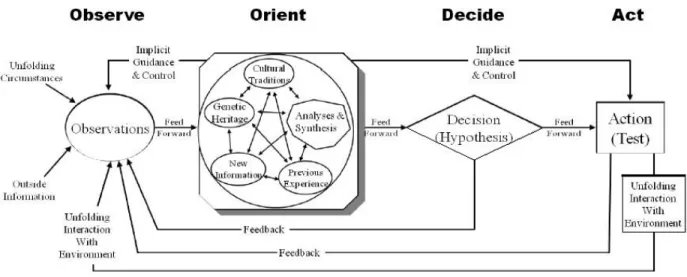
To describe this process, Boyd created a four step model called the OODA loop (Fig. 1).
Stripped down to the most basic terms, the OODA loop describes how an actor gathers information about
what is happening, makes sense of it, decides what action should be taken, and then executes that action.
Because the actor receives feedback about the consequences of its actions and often has new decisions to
make, the process is dynamic and responsive, so it would be incorrect to understand it as an unbroken
cycle that returns to where it started. While decisions and actions may be discrete, observation and
orientation are continuous.
Figure 1: The OODA Loop (Coram 2002, 344)
The OODA loop implies that several things are happening whenever actors are confronted with a
decision. The “observe” step is a reaction to the first question any actor must ask: what is happening? On
a basic level, there is a need for raw data, perhaps indicated in a political crisis by intelligence or news
2 For the sake of coherency, “actor” will be used here as a term for state, non-state, and sub-state elements with the
9
reports of a destabilizing event. Note that the observation phase may begin long before the specific
sequence of events that circumscribe a specified action, though it is debatable how to separate “unfolding
circumstances” from “previous experience.” If a World War II general studied the Franco-Prussian War
as a cadet, does that knowledge count as “previous experience” or is it part of a long chain of unfolding
circumstances, or is it outside information? Boyd’s material does not make fully make clear the impact
and appropriate classification of experience, which will consequently merit further attention and
potentially refinement in this paper’s application of the OODA loop.
The “orient” step (which occurs while the actor continues to observe and receive new
information) hangs on a more profound question: what do these observations mean? For the purposes of
this thesis, the orient step is the most critical of the four, because it bears the weight of an actor’s
assumptions, biases, and emotional considerations, all of which is manifested in the decision phase. If an
actor makes an irrational decision, it is fundamentally because during the orient phase the actor accepted
emotional or otherwise non-rational inputs about the significance and impact of the events at hand.
The “decide” phase also grapples with a question: what should be done? In Boyd’s model it is
the least complicated part of the theory, perhaps in part because of its origins in the cockpit of fighter
pilots making split-second decisions. But it is also potentially shaped by Boyd’s admiration for
blitzkrieg-style tactics and daring raids that maximize speed and shock. These are not the methods of
timorous men wracked by indecision, but are rather the tools of confident, authoritative leaders.
Essentially, Boyd creates the model for military commanders, and he assumes unity of command
unfettered by any kind of interagency or negotiation process. But unity of command does not always
exist, and the impact of that problem is one of the questions that this thesis will seek to address.
The “act” phase, unlike the others, does not come with a question, although implicit in the model
is the assumption that actors will consider whether their intended action has translated into actual action,
which is in of itself a set of observations that create a feedback loop that perpetuate the OODA process,
potentially requiring a new set of actions. Additionally, the “act” phase in Boyd’s model suffers from
10
actions, when in reality those actions may be enormously complex and time-consuming to implement,
even assuming there are no new observations or countervailing decisions. Boyd is clear that commanders
should act quickly, but there is little acknowledgement that “quickly” is an extremely relative term.
One of the three most significant authors to produce book-length examinations of Boyd’s work,3
Dutch fighter pilot Frans Osinga (2007),4 cautions that it is facile to understand the OODA loop merely as
an imperative to loop as fast as possible, a notion further supported by Boyd acolyte Chet Richards
(2012), who observes that it is overly reductive to depict the actual behavior of organizations in conflict
as clean, uninterrupted cycles, and further argues that this was not Boyd’s intent in the first place.
Richards further acknowledges that there is a tension between making quick decisions and making
decisions that are sufficiently well-considered that they will not require revisiting at a later time. As the
theory has achieved increasing attention (particularly in military circles, but occasionally in a business
context), advocates of Boyd’s work have been careful to warn against simplistic interpretations that
reduce the OODA loop to a “plug and play” formula. Hasik (2013) draws attention to David Fadok’s
comparison of Boyd to John Warden, another famed airpower strategist. Fadok’s 1994 paper points out
that Warden is Jominian, which is to say that he pursues orthopraxy—how to act in war, with a focus on
developing particular methods that hold true regardless of the particular circumstances of the conflict at
hand. Boyd, on the other hand, is a Clauswitzian, pursuing instead orthodoxy: “how to think about war,”
but eschewing formulaic prescriptions (Hasik 2013: 584).
Frustratingly, Boyd never formally published anything on the OODA loop, and even his
unpublished work is extremely limited. Dissemination of his ideas was primarily through a brief titled
“Patterns of Conflict” that never seemed to settle into a final incarnation and eventually ballooned into a
193-slide behemoth that took six hours to present (Coram 2002). However, those slides reveal—if not a
3
The other two are Robert Coram’s 2002 biography of Boyd and Grant T. Hammond’s The Mind of War: John
Boyd and American Security (2001). See Hasik (2013) for a brief examination of the current literature on Boyd’s work.
4 As of early 2014, Osinga is a Commodore (equivalent to a brigadier general) in the Dutch Royal Air Force and is a
11
full exegesis of Boyd’s thinking—a window on the scope of the OODA loop’s potential for application.
Far more than just a tool to understand individual decisions in a tactical engagement, the OODA loop is a
philosophical approach that seeks to illuminate the whole of warfare, and perhaps even the whole of
conflict or competition-based interaction in the realm of human endeavor.
Critiques of the OODA Loop
Despite the fact that Boyd died in 1997, his theories still receive considerable attention. For
example, the U.S. Marine Corps inaugurated an annual “Boyd and Beyond Symposium” in 2010, and
military publications like Airpower History and Armed Forces Journal still regularly feature articles on his work (McIntosh 2011, Maccuish 2011, Hasik 2013). However, many of these works seek only to
discover how Boyd’s work might be applied, rather than evaluating whether the OODA loop model itself
actually holds up.5 As James Hasik (2014: 583) points out, Boyd’s work is “advocated more than tested.”
Consequently, this has left the theory vulnerable to some significant methodological critiques. Hasik’s
analysis of Boyd’s work provides a particularly adroit deconstruction of the OODA loop under the harsh
light of rigorous methodological analysis. Based on a careful study of Boyd’s available work
(particularly “Patterns of Conflict”), Hasik outlines six problems with the OODA loop model: 1) Boyd’s
basic epistemology builds on reasoning by analogy, which is suspect; 2) a tendency to generalize that
tactical truisms apply to grand strategy; 3) poor methodology in Boyd’s analysis of historical examples,
including omitted variable bias, selection bias, and an unwillingness to engage with counterexamples; 4) a
lack of originality, given the existence of earlier, similarly-structured decision models; 5) a lack of
published material for scholars to engage with; and 6) questionable applicability to modern strategic
challenges like nuclear warfare policy.
Hasik’s critiques are not all of equal import for scholars seeking to understand if the OODA loop
is useful for contemporaneous analysis. The lack of published material is not so much a failing as it is an
5 In addition to the work of Hasik discussed here, David Mets (2004) provides some useful criticism of the Boyd
12
invitation to modern thinkers to build on and refine the OODA loop with their own published material.
Similarly, questions of how the OODA loop was derived through extrapolation of tactical principles,
potentially cherry-picked historical examples, and questions of applicability simply indicates that the idea
is ripe for further examination and testing in multiple scenarios. The potential lack of originality is
pertinent within the context of academic attribution, but of limited relevance to the theory’s empirical
validity. Hasik points out that Boyd’s OODA loop was long preceded by Shewhart’s 1939
“Plan-Do-Check-Act” model, and also cites Lawson’s “Sense-Process-Compose-Decide-Act” and Wohl’s
“Stimulus-Hypothesis-Option-Response” models (both published in 1981) as precursors to Boyd’s work,
though this seems at odds with the fact that Boyd was briefing versions of “Patterns of Conflict”
(including the OODA loop) as early as 1976.
These are problems that would be grave if Boyd was an academic facing peer review but can be
dismissed as water under the bridge for scholars looking to see if the theory can be effectively tested and
applied. However, a more serious concern deals with potential structural flaws in the OODA loop.
Scholars of control theory point out that the OODA loop does not explicitly model the interaction
between friendly OODA loops and those of an opposing entity, since both are often making decisions
simultaneously. It also has no means to model the interaction of the separate OODA loops of actors who
are cooperating with one another, no recognition of structured planning and decision-making processes
that might distort the loop, and no accounting for the fact that actors have the capacity to learn—and
potentially, to forget (Grant and Kooter 2005).
Interestingly, for both Hasik and Grant & Kooter, these problems are reasons why Boyd should
be studied more, not less. In fact, Hasik proposes that “Boyd’s theories should be taught in any strategic
studies programme, business school, or war college, though perhaps not in the doctrinaire way Boyd
would want” (2013: 595). He acknowledges that while Boyd developed his concepts inductively, that
does not mean Boyd was wrong, merely that his ideas are unproven and in need of additional examination
13
loop at work specifically in the case of the U.S. government’s reaction to the crisis in Bosnia, and attempt
to determine if it is a suitable model for application.
Concerns About the Use of the OODA Loop
There is a practical reason to be concerned about suggesting the use of the OODA loop outside of
a military or business context. Both military organizations and businesses are fundamentally competitive,
and justifiably concerned with “winning.” Boyd was a fighter by profession and by temperament, so his
exposition on the OODA loop is fundamentally oriented towards showing the practitioner how to gain an
advantage over an opponent. But what about interactions where winning is not the point? A foreign
ministry could point out that while they are responsible for promoting the interests of their home country,
this is achieved by cooperation more than competition. Using the OODA loop as a framing device for
bureaucratic organizations that are (in theory) not designed to “win” or “lose” anything might be a grave
error. Alexander Wendt (1995: 73) suggests that social structures are defined by “shared understandings,
expectations, or knowledge,” so by that logic the very act of introducing the OODA loop might create a
shared expectation of competition where none existed before, perhaps to the detriment of the system as a
whole.
Admittedly, concern should be taken seriously. However, there are several reasons why that
concern is not an impediment to continuing to use the OODA loop as an analytical framework. The first
reason is that the OODA loop is hardly a secret—and indeed, is part and parcel of foundational mission
command doctrine for the military (Young 2012)—so it is not as if further discussion of the idea will
open a Pandora’s Box of Machiavellian scheming in previously benign institutions. Introducing the idea
of operational tempo and decision cycles will not plunge innocent government agencies into Original Sin.
The second reason is that the OODA loop has already been identified to lack structures for cooperation,
collaboration, and other multi-agent interactions, so applying the OODA loop in a full-spectrum context
14
OODA loop is that while it provides the tools for aggressive action, its framing of how decisions are
made does not inherently require bellicosity.
Strategic Culture
A Historical Approach to National Ways of War
Unlike the OODA loop, the concept of strategic culture has received a fair degree of attention in
the academic community, especially among scholars who specialize in security studies. But as Lawrence
Sondhaus points out,6 the idea has gained traction not only as a political science concept but as an area of
study for historians, in part because the debate about strategic culture is intertwined with the idea of
“national ways of war” popularized by B.H. Liddell Hart in his eponymous 1932 book The British Way in Warfare (Sondhaus 2006). Hart’s book spawned a long-running discussion about culturally-determined approaches to war, and proved particularly fruitful because it not only allows for but demands unique
analysis of each state, which subsequent military historians have dutifully tackled. Russell Weigley’s The American Way of War has been particularly influential, as has Victor Davis Hanson’s The Western Way of War, but in addition to multiple new perspectives on the British way of war, scholars have written on ways of war for Germany, South Africa, Russia, India, the Arab states, and Europe as a whole (Sondhaus
2006, Williams 2005). Yet this modern strain of scholarship is hardly the first time that scholars have
turned to cultural explanations to analyze how states deal with conflict; Keith Krause (1998) points out
that there are examples of perspectives that use culture as an explicatory agent as early as 1716, as found
in François de Callières’ book The Art of Diplomacy. Cultural study is an inherently broad and multidisciplinary field, and consequently its impact often predates the formalization of the academic
disciplines that now attempt to dissect or apply it.
6
15
The Emergence of Strategic Culture in Political Science Studies
But the term “strategic culture” as a specific analytical concept (in contrast to the more nebulous
“national way of war”) can be traced specifically to the work of Jack Snyder, a political scientist whose
work with the RAND Corporation in the late 1970s and early 1980s on Soviet military policy introduced
the term and provided an initial definition: “the sum total of ideas, conditioned emotional responses, and
patterns of habitual behavior that members of a national strategic community have acquired through
instruction or imitation and share with each other with regard to nuclear strategy” (Snyder 1977, pg. 8).
Snyder’s key insight was that the rationalist models of human behavior (particularly the then-ascendant
concept of realism) failed to explain the fact that Soviet policies often did not align with those of a
generic rational actor, and needed to take into account cultural influences. Not only were Soviet leaders
not “culture-free, preconception-free game theorists,” but it was “presumptuous to speculate about Soviet
leaders’ attitudes toward limited nuclear conflict when those attitudes are doubtless far from fully
formed—and, in fact, can never be fully formed until the moment of decision has arrived” (Snyder 1977,
pg. 4). His approach stands in stark contrast to the rationalist notion of actors as “calculating machines
who always know what they want and are never uncertain” (Risse 2005), particularly the neorealist
paradigm that “assumes states are functionally undifferentiated units that seek to optimize their utility”
(Johnston 1995).
When Jack Snyder coined the term “strategic culture,” he was just 26 years old and relatively
unknown, but when Colin S. Gray expanded on Snyder’s ideas in his 1981 essay “National Style in
Strategy” that the idea began to generate academic traction and accumulate legitimacy as nascent subfield
within political science (Sondhaus 2006, Toje 2008). Gray posited that while the USSR had a strategic
culture, so too did the United States, and that understanding this culture could be used to explain the past
decisions of American policymakers and potentially predict decisions that had yet to be made.7 Gray’s
involvement with strategic culture theory would prove particularly significant because following the
7 In his book Modern Strategy [1999] Gray would later retreat from the idea that strategic culture theory could
16
election of Ronald Reagan to the presidency, Gray was selected to serve on the President’s General
Advisory Committee on Arms Control and Disarmament. In that capacity he argued that the Soviets’
strategic culture did not include some of the most important American assumptions (most importantly,
that “no one can win a nuclear war”) which justified abandoning détente in favor of pursuing the Strategic
Defense Initiative (SDI, better known as “Star Wars) (Snyder 1977, Gray 1981, Johnston 1995, Sondhaus
2006).
Snyder was notably unhappy with this use of his idea, confirming N.T. Wright’s observation that
“when you invent a phrase, you quickly discover that phrases are like young adult children. They go away
from home, get into stray company, and bring home undesirable acquaintances” (Dunn and Wright 2007:
2). Snyder instead argued that strategic culture should be interpreted far more narrowly, and must not be
conflated with “political culture or national culture in general.” Instead, strategic culture describes “a
distinctive approach to strategy [that] becomes integrated in training, institutions, and force posture” and
takes on “a life of its own, distinct from the social interests that helped give rise to it” (Sondhaus 2006: 4;
quotes from Snyder’s article which is the first chapter in Jacobson 1990).
Despite their disagreement, both Snyder (1977, Jacobson 1990) and Gray (1981) acknowledge a
substantial debt to Kenneth Booth’s (1973) work in Strategy and Ethnocentrism, which does not directly discuss strategic culture as such but laid the groundwork for the dialogue by identifying and critiquing the
pervasiveness of ethnocentric heuristics in strategic thought (Jacobson 1990; see both Snyder article and
Booth’s book). In particular, Booth finds strategic culture important as an approach that helps to make
sense of a country’s decisions “on its own terms,” to counter the tendency to analyze a state’s foreign and
domestic policy separately, to comprehend decisions that seem to be irrational, to better utilize history as
a means to understand “the motivations, self-image, and behavioral patterns of others,” and in both
17 Johnston’s “Three Generations” Taxonomy
When he reviewed strategic culture literature in 1995, Alastair Iain Johnston identified three
“generations” of theorists on the topic. Snyder, Gray, and Booth are all a part of the first generation,
along with David Jones, Carnes Lord, and Richard Pipes.8 Initially, “strategic culture” was used almost
entirely for analyzing issues concerning the possible use of nuclear weapons, and consequently the
majority of the early literature reflects the imperative for (largely American) Western thinkers to develop
effective paradigms that provided insights on how the Soviets made decisions. Johnson critiques this
generation as “mechanically deterministic” and argues that the definitions used by Gray and Jones in
particular are so all-encompassing that “there is little conceptual space for a non-strategic culture
explanation of strategic choice” (1995: 37). If strategic culture is omnipresent, how can it be tested for
theoretical validity? According to Johnston, another flaw common to the first generation of thinkers was
that they failed to account for instrumentality: the idea that strategic culture could be utilized by “the
strategic hegemony” to justify particular decisions while pursuing an operational strategy that supports
their true interests (1995: 39).
Johnston claimed that the second generation of strategic thinkers (including Bradley S. Klein and
Robin Luckham) address instrumentality by theorizing that strategic culture provides a legitimate cover
behind which decisionmakers covertly pursue what best supports their desires. Klein’s perspective is
shaped by “critical Marxism” (in particular that of Antonio Gramsci) and colored with a strong streak of
realism,9 and consequently his analysis consistently returns to calculations of how governments
accumulate power, legitimacy and influence both domestically and within the international system. The
state (and the elites that control it) must maintain legitimacy for their actions at home in order for their
domestic sovereignty to remain unchallenged, and strategic culture is a standard by which to determine
8
Johnston (1995: 32) points out that while Gray was advising the Arms Control and Disarmament Agency, Pipes was on Reagan’s National Security Council and also served as an outside advisor to the director of the CIA when George Bush held the office.
9 These two would seem to be somewhat contradictory. Klein is a realist in his focus on power, but rejects some of
18
what legitimacy means within the state’s historical context. But because some of these norms arise in an
international context, it is natural for elites at the state level to seek international legitimacy and
ultimately a world hegemony that mirrors their domestic sovereignty (Klein 1988).
The problem with second generation theorists, according to Johnston, is that they decouple
strategic culture from behavior, which makes it unclear what sort of effects we should actually expect
strategic culture to have. Is it just a smokescreen that does not alter outcomes? Also, if elites all over the
world are using this sort of instrumentality, what kind of differences can we expect from one state to
another? Asle Toje (2008: 17) also points out that by positing unspoken interests behind the overt
“declaratory doctrine,” scholars may be tempted to find implicit support for whatever theory they wish to
confirm.
To address the shortcomings of the previous generations—particularly their lack of theoretical
rigor--Johnston suggested that the third generation of strategic culture theorists (which, in addition to
Johnston himself, include Jeffrey Legro and Elizabeth Kier) has sought to address the problem by treating
strategic culture (but not behavior) as an independent variable (Johnston 1995, Morgan 2003). This
allows for a more scientific analysis of the effect of culture (and potentially permits an analyst to
empirically compare culture with other factors), but raises the question of how culture and behavior can
realistically be separated. Colin Gray has been particularly active in rebutting Johnston’s concept,
pointing out that “a definition driven by the needs of theory-building rather than by the nature of the
subject is unusually likely to lead scholars astray.” Furthermore, he adds, “From the perspective of
methodological rigour it is hard to fault him. The problem is that one cannot understand strategic
behaviour by that method, be it ever so rigorous. Strategic culture is not only ‘out there’, it is also within
us; we, our institutions, and our behaviour are in the context.” (Gray 1999: 132-3). However, the
complexity of this context also prompted Gray to retreat from his assessment that strategic culture could
be used to predict future decisions, because while strategic culture influences decisions, it is not
19
“The idea of strategic culture does not imply that there is a simple one-to-one relationship between culturally traceable preferences and actual operational choices. The claim, rather, is that culture shapes the process of strategy-making, and influences the execution of strategy, no matter how close actual choice may be to some abstract or idealized cultural preference” (Gray 1999: 135).
Problems and Outliers
Though Johnston’s theories about the proper meaning and application of strategic culture remain
contested, almost all scholars have (implicitly or explicitly) accepted his three generation taxonomy of the
field, and it has emerged as the dominant way to summarize the ongoing debate over strategic culture
(Gray 1999, Williams 2005, Morgan 2003, Sondhaus 2006, Meyer 2006). This description of the debate
is useful as an orientation tool, but it does not actually provide an accurate picture of the panoply of
thinking on strategic culture. On one hand, it groups scholars together (like Snyder and Gray) who
explicitly disagree on fundamental issues; on the other it identifies new “generations” (in the case of the
second generation comprised of only two people) while the previous generations are still writing and
developing theories. It also encourages the exclusion of ideas that do not fit neatly within its heuristic,
whether they are historians like Geoffrey Parker, or social scientists working on similar ideas, like James
March and Johan Olsen’s logic of appropriateness or the “social ontologies” of Colin Hay and Daniel
Wincott’s approach towards historical institutionalism (1998).
It’s also important to point out that while not all the literature relevant to the strategic culture
debate is labelled “strategic culture” (or even “culture”), nor is everything labelled “strategic culture” is
engaged with the dialogue that Snyder, Gray, and Johnson are taking part in. For example, in 2001 Paul
Cornish and Geoffrey Edwards asked if there were the beginnings of a “European Strategic Culture,” but
their definition of strategic culture (“the institutional confidence and processes to manage and deploy
military force as part of the accepted range of legitimate and effective policy instruments;” pg. 587) bears
no resemblance to any other definition of the term. Clearly, their definition is constructed solely to
address the European Union’s coherence as an actor in a military context, and has limited utility in
20
In light of the ongoing debate, what is the current status of “strategic culture” as a coherent idea?
Can strategic culture be said to be a subdiscipline of cultural studies, or is it a theory within security
studies that applies cultural considerations? And (perhaps most importantly), is there agreement on what
“strategic culture” means? Due to its origination as a means of analyzing nuclear deterrence doctrine and
policy, strategic culture has remained situated in the realm of security studies, and consequently most
definitions of strategic culture make some reference to war or the use of force. This is significant because
it influences the tools various authors reach for when seeking to understand decisions. Do they reason
from history, or create empirical models? While strategic culture theorists make use of cultural and
sociological scholarship to deepen their understanding of security organizations, they would be more
accurately described as strategic thinkers who consider culture than as cultural theorists who wonder
about strategy. In this sense, at least, Snyder, Gray, Johnston, and their colleagues have carved out a
broadly coherent subdiscipline. (Therefore, that group is what is being referred to with the term “strategic
culture theorists.”) But perhaps it is unsurprising that there is no generally agreed-upon definition of
strategic culture, and it seems unlikely that one will emerge, largely due to disagreement over scope and
matters like the separability of behavior from culture. The discussion of strategic culture is defined less
by a common vision and more by a stream of dialogue on how best to understand “ways of war” and the
assumptions that underlie them.
Toward “Grand Strategic Culture”?
Thus far, strategic culture literature has focused almost entirely on the matter of states using
force, which is generally appropriate given the Clausewitzian definition of strategy: “the use of
engagements for the object of war” (Clausewitz 1976: 128). But the example of Bosnia suggests that this
use of strategic culture is too narrow, because most organizations at the top level of government (most of
which are intimately involved in decisions to go to war and, once launched, how to prosecute that war)
have a multitude of functions in peace as well. Does strategic culture emerge spontaneously once war
21
would be absurd to think so. Even in situations where military force is the preeminent option under
consideration, it is never the only one available to the men and women steering the ship of state. So while
it might be possible to speak of a strategic culture purely in the context of war for military officers
operating in a purely “high intensity conflict” situation (i.e. with no direction to conduct peacekeeping,
stability, or humanitarian operations), it rarely happens that the mission is so clearly limited. It is possible
to contemplate Air Force or Naval officers tasked with executing kinetic strikes in support of the
objectives of the national command (e.g. by flying strategic bombers or crewing submarines equipped
with ballistic missiles) as executors of pure strategy in the Clauswitizan sense, but the vast majority of
agencies and bodies in government have a far broader remit than merely orchestrating engagements in
support of war. Boyd speaks of using schwerpunkt (focus of the main effort) as a means to harmonize the actions of disparate echelons (and presumably, peer organizations only distantly connected hierarchically,
like subordinate elements of the State Department cooperating with the military), but what if the focus of
the main effort is not inherently tied to the use of force? The example of Bosnia is instructive because it
demonstrates that even though the use of force was an important issue in the broader policy debate, not
even the Department of Defense could limit itself to thinking about how force might be used. Indeed, one
of the most important questions was how the military forces could support the goals of American grand
strategy while minimizing the need to use force. While the deeper objectives of American policy in the Bosnia situation have been subject to intense debate, the stated policy aims can unequivocally be reduced
to one word: peace. To the extent that force was used, it was (ironically) designed to ultimately
perpetuate peace (Clinton 2004, Holbrooke 1999, Lake 2000).
So if strategy is properly considered to be a consideration endemic to war, we can use grand
strategy as the concept that encapsulates the broader aims of the state, and how policymakers seek to
promote the state’s interests on the global stage. Whether these interests are self-aggrandizing or in
support of Machiavellian power stratagems (as the realists might suggest) or could be genuinely idealistic
notions (as liberals might suggest) is, for the moment, irrelevant. The point is that governments and
22
do not lay aside their culture when determining which approach to use. If strategic culture shapes
decisions on the use of force, it is necessarily merely a part of a larger grand strategic culture, for which
force is only one option in a much broader menu of options.
So why not abandon the notion of strategic culture entirely, and speak only of a cultural approach
to politics? There are several reasons for this. The first is that there is a legitimate need for the cultural
approach to be used to be tailored to the organization it seeks to describe, which means that the theorist
can either attempt to run the culture studies through the wash until it has shrunk to fit the organizational
psychology specific to organizations that play a role in grand strategy, or strategic culture literature can be
“stretched” to encompass a community that has broader considerations than just force. Especially for
questions related to security (not merely national security, but also international and human security), the
actors are the same as they are in a classical strategic culture debate over (for example) the use of nuclear
weapons. If nuclear deterrence was a product of a strategic culture that flowed from “geopolitical,
historical, and other unique influences,” were not those same influences present in the same people who
were making decisions about every other aspect of policy? (Gray 1981: 22) Strategic culture theory is
already designed to look at a specific group of people with specific powers operating in a specific
historical and social context. Why abandon the work that has been so far completed. In this particular
case, it is easier to scale up than to scale down.
Nesting Strategic Culture within the OODA Loop
Even if strategic culture and the OODA loop are useful tools in understanding how governments
make decisions, can they be used together as part of an integrated whole? The answer is rather simple:
strategic culture provides the means to improve the OODA loop’s description of orientation. Boyd’s
model seems odd in certain respects—for example, how does “genetic heritage” affect orientation? In
others, it overlaps neatly with strategic culture descriptions, particularly in its use of cultural traditions
and previous experience as descriptors. This suggests that strategic literature can be used as a means to
23
decisions. Boyd was clear that orientation was the most important stage of the OODA loop, but the
complexity of national-level decisions demands accommodation. Because strategic culture is specifically
designed to look at policy at that level, its use as an orientation tool allows OODA to better accommodate
the demands of strategic thinking.
Model Validation
The next challenge is to determine, independent of our case study, what conditions and evidence
will be required to validate the integrated OODA/Strategic Culture model. Validation is particularly
challenging because the OODA loop was derived inductively, and strategic culture is similarly unresolved
as to whether culture can be treated as a testable variable, perhaps by bottling it up and using it to titrate a
culture-free security environment. Both have also depended on reasoning from history, another process
that necessarily draws more from analysis than deduction.
So to validate these theories, the first question that needs to be asked against what alternative they
are being tested. One of the initial givens is that a decision is, in fact, being made, so the test will have
the flexibility to identify a decision made by the actor in the case study and reverse-engineer how it was
decided. But for a given decision, if the OODA/Strategic Culture model did fail, what does failure look
like? One technique would be to find a competing model for decisionmaking, and determine which
works better. In the case of strategic culture, empirical testing is difficult because there is no null-culture
example, which presents an attribution problem: how can we know to what extent a decision was shaped
by culture vice some other factor?
The OODA loop has a different fundamental challenge: though there are a variety of different
models, most of them are similar enough that much of the basic architecture has substantial overlap. In
1988 Mayik and Rubin conducted a review of 15 different models of command and control (though they
did not include OODA), and concluded that while no two models are exactly the same, they can generally
be mapped onto one another. Grant and Kooter (2005) used this methodology to directly compare
24
OODA but did not discover any dissonance so fundamental as to render any model incompatible with the
others. Their analysis suggests that a comparative analysis of variant decision models will not provide
sufficient uniqueness to be particularly helpful.
The flow of the debate over strategic culture also suggests a methodological danger identified by
French sociologist Pierre Bourdieu and elaborated upon by philosopher James K. A. Smith: that of
conceptual projection. In Morgan’s (2003: 7) overview of strategic culture literature, he notes that second
generation theorists like Kier and Largo favor “process-oriented relationships” (i.e. interactions that tend
to be driven by bureaucratic or organizational forms) whereas Johnson and others of the third generation
use “value-driven linkage” (i.e. hierarchical and peer relationships with quantifiable cultural merit
variables) which can be modeled with empirical data. But are the relationships between principle actors
in a decision actually process-oriented? Is it realistic to expect that the key figures in the Bosnia crisis
actually perceived their interactions in terms of “value driven linkages”? There is good reason to suspect
otherwise. Richard Holbrooke, for one, provides a list of the major people involved in the American-led
peace negotiations that culminated with the Dayton Accords, but—tellingly—he titles this list “Cast of
Characters,” as though they were roles in a play (Holbrooke 1999: 377). Holbrooke’s co-chair at Dayton,
Carl Bildt, does the same in his memoir (1998: ix). Similarly, Strobe Talbott (2002) is unequivocal that
Bill Clinton’s personal relationship with Boris Yeltsin was the gravitational center of American policy
towards Russia during the Clinton administration, and that policy and process were merely tools to
facilitate agreements negotiated in the context of this relationship. Elizabeth Drew notes that National
Security Advisor Tony Lake’s perspective on Bosnia was explicitly shaped by non-process, non-rational
experiences. She observes: “Tony Lake had been deeply affected by his Vietnam experience. He
admitted to being ‘emotional’ about Bosnia and believed that emotion had a proper role in the formulation
25
allow your emotions to cloud your judgment. But you can sure hate it when you turn on the television
and see the carnage” (Drew 1994: 143).10
These anecdotes about perspective do not prove, per se, that relationships are never
process-oriented or shaped by value-driven linkages. Sometimes individuals or groups operate in accordance with
forces or tendencies that they do not fully understand. However, the discrepancy does flag a potential
problem. As James K.A. Smith (2013: 77) notes, “interpretations of practice too often smuggle in
assumptions that effectively construe practitioners as thinkers, constituting the world of practice in the
image of the scientist.” Smith’s point is further supported by research on decision-making by Wohl
(1981) and Klein (1998), who point out that decision-making is often not fully rational and that in
“naturalistic decision-making” (NDM), experts make decisions in ways that depend more on problem
recognition in terms of previous experience to make intuitive decisions, rather than to work through
process-driven models (Grant and Kooter 2005). Again, this does not invalidate strategic culture
literature or the merit of empirical data to support deduction. But the circumspect political scientist must
recognize the limits of deductive reasoning in attempting to quantify and rationalize a process that is from
the perspective of the practitioner heavily shaped by inductive analysis.
Perhaps the optimal balance between inductive and deductive analysis will be better revealed
through specific enumeration of the testing process used to validate the hybrid OODA loop/Strategic
Culture model. The first task is to identify the decision under consideration. An alternate approach
would be to first pick a decision-making actor, and follow them through time as they are confronted with
inputs and must determine what decisions will be made. However, “reverse-engineering” a decision
will—for purposes of validating the model—ensure that the specific question actually culminates in a
decision and has sufficient evidence to test the model’s validity at each stage. Once the model has been
validated it can then be tested in cases where issues were posed, discussed, and potentially abandoned
10 From the context of the passage, it appears this quote is from a personal interview Drew conducted with Lake “in
26
without action. Inaction is, of course, a type of decision, but it is often more difficult to trace what
specific factor precipitated the inaction.
The next task is to identify the specific actor whose OODA loop and strategic culture are to be
examined. Because policy decisions are made in complex environments with multiple actors from
multiple states, rather than attempting to map every possible actor, a single actor (either an individual or
an organization) can be identified, and then peer, superior, and subordinate actors who shape the decision
can be identified through study of the chosen actor’s decision process. Admittedly, this may not
necessarily identify every single actor involved in shaping the outcome for that particular issue.
However, that is in some ways a benefit, because it will exclude actors who failed to influence the
decision process of the actor under consideration. It helps reduce the number of OODA loops and
strategic cultures to be compared to the ones that actually interacted.
Once the actor under consideration has been identified, the inputs (in OODA terminology,
“observations”) need to be identified. In essence, how does this particular actor receive information about
what is going on? Consideration of this question raises a potential flaw in the OODA model: what about
observations that are rejected as worthless or incorrect? What about observations that are incorrect, but
are accepted as true? Broadly speaking, false-positive observations fit with Grant and Kooter’s concern
about OODA’s failure to incorporate “learning.” If a decisionmaker is confronted with inputs from a
person who is known to be a liar, the liar’s statements are still observed. Not only that, but the liar’s
statements may still influence the decision that is ultimately made, but not because they are accepted as true. This process of rejection or interpretation needs to be integrated in the orientation step of the model.
The next step is to identify external guidance or boundaries imposed on the actor by other actors,
particularly inputs that will distort or change the decision cycle. These may be included as observations,
but they may also serve as orientating factors that frame the policy debate or the interaction with other
actors. Examples of these influencers include guidance from superior actors (in hierarchical
organizations), resources available, peer OODA loops, and both collaboration and opposition from
27
ministry or policymaker). It is also possible to consider time and space to be constraints, although
Kantian epistemology would classify those as the medium in which decisions are being made, rather than
as resources to be expended (Durant 2005, Kant 1990).
Once constraining or shaping circumstances are identified, the actor’s means of receiving inputs
and developing orientation should be clarified—in essence, how is the sausage made? Ivo Daadler (2000:
3) describes what this looks like in Washington: “on the corridors of power where memos are written and
read; meetings are convened; deals are cut; decisions are made and ignored; bureaucratic games are
played; and egos are confirmed and broken.” Policy is traced historically by artifacts—memos, published
doctrine, speeches, email, and so on—but the making of that policy often plays out in a far larger theater
that includes personal conversations, diplomatic engagements where minimal notes are taken, and so on.
Furthermore, the specific instruments are themselves shaped by the progress of technology, the leadership
style of key figures, and the strategic culture of the actor. So the specific media for policy debate must be
28
CHAPTER 3 – BOSNIA CASE STUDY
Challenges and International Climate
Of the decisions faced by the Clinton Administration regarding Bosnia, the choice to deploy
ground troops as a part of the NATO element that would come to be known as the Implementation Force
(IFOR) and later Stabilization Force (SFOR) was perhaps one of the most critical. The decision was
controversial for several reasons, not in the least because the Administration had been badly stung by its
experience in Somalia. The Clinton Administration had inherited the mission from the Bush
Administration, which had decided to conduct a humanitarian intervention in the light of near-apocalyptic
famine conditions, and sent a multi-service task force with over 10,000 troops to distribute food and other
aid. However, soon after taking power the Clinton Administration discovered that the task was not as
simple as simply handing out food, because local warlords were attempting to use the food as an
instrument of power in local clan conflicts. In October of 1993 the United States deployed a Task Force
of Rangers and Special Operations Aviation to kill or capture one of the warlords, Mohamed Farah Adid,
but the mission went badly wrong, and images of dead Rangers being dragged through the streets of
Mogadishu made an indelible impression on both Congress and the American public. These events
would haunt Bosnia discussions.
The comparatively low-risk use of airpower to bomb Bosnian Serb military elements was far
more politically feasible, but created difficulties abroad. In particular, the British, French, Canadians,
Dutch and Spaniards had troops already on the ground as a part of the United Nations Protection Force
(UNPROFOR) in Bosnia, and they feared that increased NATO airstrikes would result in reprisals against
their troops. (Andreatta 1997, Daalder 2000, Holbrooke 1999). This fear prompted the introduction of a
cumbersome “dual-key” process whereby both NATO and the UN had to approve the release of any
29
engaged with hostile elements waiting for long periods of time while the appropriate approvals were
obtained (Holbrooke 1999, Daalder 2000). Recognizing the constraints under which both UNPROFOR
and NATO were operating, the Bosnian Serb forces were able to continue to operate with relative
impunity. Clearly, the situation was untenable, but UNPROFOR and aggressive NATO airstrikes could
not co-exist unless American troops were on the ground.
The situation was grave both for the Bosnians of all backgrounds, given the rising toll of war, but
it was also emblematic of the existential challenges faced by NATO, which was struggling to define its
purpose in light of the collapse of the Warsaw Pact and the dissolution of the Soviet Union. Critics were
already asking if NATO was still needed; a failure to act coherently and potently might provide proof that
absent the chilling clarity of the Cold War NATO was unfocused, irresolute and irrelevant.
Yet despite these obstacles NATO ultimately did act, and it was American willingness to lead
both in the air and on the ground that proved crucial. But how did this decision come about? More
precisely, how did the situation change in such a way that allowed American policymakers both the
understanding of the problem and the understanding of the options available to them to pursue that
choice? The war was already underway when the Clinton Administration took office in January of 1993,
yet it took nearly three years to reach a peace agreement. During that time, over 45,000 people were
killed as a result of the war, and many more were wounded, raped or displaced.11 Whatever the cause, the
delay in reaching a solution was incredibly costly in human terms. Was the impediment a failure to fully
comprehend the situation? Bureaucratic friction within the decisionmaking process? A simple lack of
resolve? Could they have acted sooner—possibly curtailing the number killed in the ethnic conflict—or
were there conditions that had to change for the ultimate policy approach to become possible?
11 Casualty figures come from the Bosnian Book of the Dead, a by-name database project compiled by the Research
30
All these questions are undergirded with a significant assumption: the policy decisions made by
the Clinton Administration had a material effect on the resolution of the Bosnian conflict. Is that
assumption reasonable? It is clear that the Clinton Administration was far from the only body able to
influence the conflict, given the involvement of NATO, the UN, and the residents of Bosnia and the rest
of former Yugoslavia, but from a decision analysis standpoint, the Clinton Administration clearly thought
it had a significant role to play in resolving or ameliorating the conflict, and policy is a catchall term that
describes the product of their deliberations.
Focal Point: The National Security Council
To understand how the Clinton Administration worked out what to do about Bosnia, this thesis
will focus on one particular body within the American government: the National Security Council (NSC).
The NSC is a particularly fruitful target for examination because of their role at the center of the policy
process, where the positions and concerns of multiple Cabinet-level agencies are debated, analyzed, and
ultimately presented for the President’s consideration. Established by the National Security Act of 1947,
the NSC is essentially a forum for those top-level appointees, though it also has a staff of its own advisors
and experts (White House 2014). However, unlike the Department of Defense (which can deploy troops)
or the State Department (which can send diplomats), the NSC is fundamentally a coordinating substrate
rather than a body that takes direct action to implement the policy decisions that it coordinates.
However, there are several complications with using the OODA loop and strategic culture to
analyze the NSC’s role in the crisis. The first is rather basic: can we actually attribute the decision to
employ American ground troops in Bosnia under NATO to the NSC? Can we meaningfully attribute that
decision to any actor at all within the US government? The President would seem an obvious candidate,
but his authority to deploy troops is constrained by the War Powers Act, which limits overseas
deployments to 90 days without Congressional consent. Yet while Congress has the ability to declare war
(which they did not, in the case of Bosnia), authorize funding, and conduct oversight hearings, command