Database Design Concepts
Thomas M Connolly, Mark Stansfield and Evelyn McLellan School of Computing, University of Paisley, Scotland
[email protected]
,Abstract: The study of database systems is typically core in undergraduate and postgraduate programmes related to computer science and information systems. However, one component of this curriculum that many learners have diffi-culty with is database analysis and design, an area that is critical to the development of modern information systems. This paper proposes a set of principles for the design of a games-based learning environment to help the learner develop the skills necessary to understand and perform database analysis and design effectively. The paper also presents some preliminary results on the use of this environment.
Keywords: Collaborative learning; innovative teaching and learning technologies for web-based education; e-pedagogy; design and development of online courseware.
1. Introduction
The database is now the underlying framework of the information system and has fundamentally changed the way many organizations and indi-viduals work. This is reflected within tertiary edu-cation where databases form a core area of study in undergraduate and postgraduate programmes related to computer science and information sys-tems, and typically at least an elective on other data-intensive programmes (ACM/IEEE, 2001; EUCIP, 2003). The core studies are commonly based on the relational data model, SQL (the de
facto language for relational DBMSs), data
model-ling and relational database design. This curricu-lum supports industry needs where the relational DBMS is the dominant data-processing software currently in use, with estimated new licence sales of between US$6 billion and US$10 billion per year (Connolly and Begg, 2004).
With more than 30 years since Codd proposed the relational data model in his seminal paper, the core relational theory is a mature and established area in relation to other parts of the computing curriculum. However, one component of this cur-riculum that many learners have difficulty with is database analysis and design. For the purposes of this paper we use the term ‘database analysis and design’ to encompass requirements analysis, conceptual database design (including ER model-ling), logical database design (including mapping to the relational model and validating the model using normalization) and physical database de-sign (Connolly and Begg, 2004).
In this paper, we explore a range of teaching techniques that supplement traditional teaching methods with more non-traditional methods based on interactive visualization and computer games to help overcome these difficulties and help the learner develop the skills necessary to understand
and perform database analysis and design effec-tively.
1.1 Problems with teaching database analysis and design
Mohtashami and Scher (2000) note that peda-gogical strategies for teaching database analysis and design traditionally follow a similar modality to that of other technical programmes in computing science or information systems. A significant amount of technical knowledge must be imparted with the lecturer becoming a ‘sage on stage’ and the students passive listeners. While students tend to cope well with basic concepts and practi-cal components of the curriculum, one area that many students find difficult is the abstract and complex domain of database analysis and design. A comparable problem has been identified with object-oriented analysis and design, which is also highly abstract (e.g. Yazici et al., 2001). This is borne out by a recent European survey that found that the primary skill that organizations considered to be lacking in both new IT graduate recruits and current IT staff was database design (database tuning and database administration were second and third, respectively) (Connolly and Laiho, 2004).
To undertake database analysis and design effec-tively for an even moderately complex system, a student requires (among others) the skills to:
work in a project team and apply appropriate fact-finding techniques to elicit requirements from the client (both ‘soft’, people-oriented skills);
conceptualise a design from a set of require-ments (‘soft’, analytical skills),
map a conceptual design to a logical/physical design (‘hard’, technical skills);
reflect and review intermediate designs, par-ticularly where information complexity is pre-sent (a combination of ‘soft’ and ‘hard’ skills). Students often have considerable difficulty com-prehending implementation-independent issues and analysing problems where there is no single, simple, well-known or correct solution. They have difficulty handling the ambiguity and vagueness that can arise during database analysis. Students can also display an inability to translate classroom examples to other domains with analogous sce-narios, betraying a lack of analytical problem-solving skills. For the students these problems can lead to confusion, a lack of self-confidence and a lack of motivation to continue.
In this paper we explore the use of interactive visualization and computer games to provide a web-based collaborative learning environment to supplement traditional methods of teaching data-base analysis and design. We have chosen to examine such an environment for several rea-sons:
The younger generation have grown up in a technologically sophisticated environment populated by home computers, the Internet, graphic-rich movies, multi-player Internet gam-ing, Nintendo GameBoysTM, XBoxesTM, DVD players, mobile phones, interactive television and iPodsTM, which has led to changes in their experiences, attitudes and expectations (e.g. Prensky, 2001; Kolb et al., 2001). This sug-gests that we should investigate and exploit those aspects of the technologies the modern learner has been exposed to, such as com-puter games, with a view to identifying those aspects that might be transferable in
peda-gogical terms, into teaching (Connolly et al.,
2004).
There is empirical evidence that games can be an effective tool for enhancing learning and understanding of complex subject matter (Ricci et al., 1996; Cordova and Lepper, 1996).
Educationalists are interested in the intensity of involvement between instructional strate-gies, motivational processes and learning out-comes. It would be highly desirable to harness the appropriate properties of computer games that enhance learning and improve student performance.
This paper is structured into four further sections. The next section discusses the pedagogical basis for developing a problem-based learning environ-ment based on visualization and computer games to teach database analysis and design, leading in the section thereafter to a set of principles for the design of the proposed learning environment. The penultimate section discusses the on-going de-sign of this environment. The final section
pro-vides some concluding remarks and directions for future research.
2. Previous Research
In this section we examine previous research re-lated to the use of computer games in education, covering motivation and flow; constructivism as a pedagogical approach to learning and the appro-priateness of problem-based learning for our pur-poses.
2.1 Motivation
Motivation is a key concept in many theories of learning. Katzeff (2000) stresses motivation is a critical factor for instructional design and for learn-ing to occur the learner must be motivated to learn. Malone and Lepper (1987) present a theo-retical framework of intrinsic motivation in the de-sign of educational computer games. They postu-late that intrinsic motivation is created by four in-dividual factors: challenge, fantasy, curiosity and control and three interpersonal factors: coopera-tion, competition and recognition. Interestingly many of these factors also describe what makes a good game, irrespective of its educational quali-ties.
Prensky (2001) defines the key characteristics of (simulation) games as: rules, goals and objec-tives, outcomes and feedback, conflict (and/or competition, challenge, opposition), interaction, and representation of story. While intrinsic motiva-tion is highly desirable, many of the activities in which learners engage in is directly influenced by extrinsic rather than intrinsic motivation (Csik-szentmihalyi and Nakamura (1989). Unfortunately evidence suggests that extrinsic motivators may lead to merely short-range activity while actually reducing long-range interest in a topic while with intrinsic motivators learners tend to persist longer, work harder, actively apply strategies and retain key information more consistently. Thus, extrinsic motivators must be supported by intrinsic motiva-tors, otherwise the result is likely to be a reduction in the very behaviour we want to promote. One of the most serious problems that research has pointed out during the past two decades is that extrinsic motivation when used alone is likely to have precisely the opposite impact that we want it to have on learner achievement (Lepper amd Ho-dell, 1989).
In determining what makes a particular situation or activity intrinsically motivating to an individual, the Csikszentmihalyi’s (1990) concept of flow is often mentioned . The conditions likely to induce the state of flow are challenge, control, perform-ance criteria and feedback (Connolly et al., 2004).
2.2 Constructivism and learning envi-ronments
2.2.1 Constructivist and sociocultural theory While traditional education was guided by the paradigm of didactic instruction there is now an emphasis on constructivism as a philosophical, epistemological and pedagogical approach. Con-structivism focuses on knowledge construction, not knowledge reproduction (Collins, 1991). Vy-gotsky’s sociocultural theory of learning empha-sises that human intelligence originates in our culture. Individual cognitive gain occurs first in interaction with other people and in the next phase within the individual (Forman and McPhail, 1993).
According to Gance (2002) the main pedagogical components commonly associated with these models are:
A cognitively engaged learner who actively seeks to explore her environment for new in-formation.
A pedagogy that often includes a hands-on, dialogic interaction with the learning environ-ment. For example, actually designing a data-base is preferred to simply being told how to design a database.
A pedagogy that often requires a learning con-text that creates a problem-solving situation that is realistic.
An environment that typically includes a social component often interpreted as interaction with other learners and with mentors in the context of learning.
2.2.2 Problem-based learning
Many researchers have expressed their hope that constructivism will lead to better educational soft-ware and better learning (e.g. Brown et al., 1989; Jonassen, 1994). They emphasise the need for open-ended exploratory authentic learning envi-ronments in which learners can develop person-ally meaningful and transferable knowledge and understanding. The problem-based learning (PBL) model encompasses the principles of constructiv-ism. With PBL the teacher (facilitator) is available for consultation and plays a significant role in modelling the metacognitive thinking associated with the problem-solving process. This reflects a
cognitive apprenticeship environment (Collins et
al., 1990) with coaching and scaffolding (e.g. of-fering hints, reminders and feedback) provided to support the learner in developing metacognitive skills. As these skills develop, the scaffolding is gradually removed. The intention is to force learn-ers to assume as much of the task on their own,
as soon as possible. The cognitive apprenticeship model also advocates:
modelling, which involves an expert (the
teacher) performing a task so that the learner can observe and build a conceptual model of the processes required to accomplish it;
articulation (either verbal as mentioned above
or written);
reflection, to enable learners “to compare their
own problem-solving processes with those of an expert, another learner, and ultimately, an internal cognitive model of expertise” (Collins et al., 1990);
exploration, to push learners into a mode of
problem-solving on their own.
Savery and Duffy (1995) comment that PBL should stimulate, and therefore engage the learner in, the problem-solving behaviour that the practicing professional would employ. The PBL approach is now used across a range of subject disciplines.
A similar concept to articulation that has been cited as an important element of simulation games
is debriefing (Lederman and Kato, 1995). Games
and simulations differ in that simulations include elements of the real world whereas games are “separate from the real world”. Debriefing is an essential element of any simulation game be-cause it links what has been experienced during the simulation with learning. Debriefing provides the opportunity for learners to consolidate their experience and assess the value of the knowl-edge they have obtained in terms of its theoretical and practical application to situations that exist in reality.
3. Guiding Principles For The Online
Games-Based Learning Environment
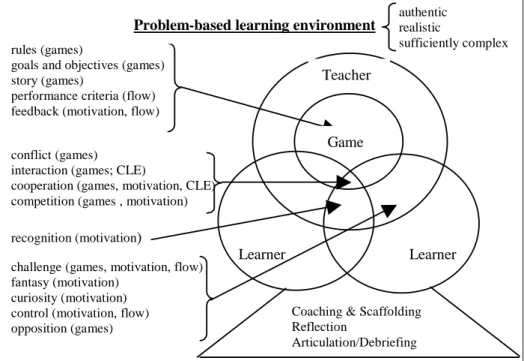
We illustrate the influences for the online games-based collaborative learning environment that we are developing to teach database analysis and design based on the above research in Figure 1, depicting the relationships between the game, the teacher, learners and the environment. In addi-tion, we put forward our own principles for the learning environment as follows:
1. Start with an authentic problem grounded in professional practice. This problem should be both realistic and sufficiently complex to de-velop analytical and problem-solving skills. 2. Encourage learners to take responsibility
(ownership) for learning and to be aware of the knowledge construction process.
3. Allow learners to develop their own process to reach a solution.
4. Provide learners with the opportunity to ex-perience and appreciate other perspectives (this may come about as part of the next prin-ciple).
5. Provide opportunities for interaction and col-laboration, either learner, learner-teacher or learner-system.
6. Ensure that the learning environment moti-vates, engages and challenges the learner. 7. Provide feedback mechanisms to enable
learners to be fully aware of their progress. 8. Provide support mechanisms for learners
us-ing coachus-ing and scaffoldus-ing.
9. Be flexible to support different learning styles. 10. Provide opportunities for reflection,
self-evaluation, articulation and debriefing. 11. Provide an integrated assessment.
While many examples of collaborative learning are in the more traditional face-to-face mode, there is evidence that supports the view that col-laboration that is many-to-many, time and place independent, and distributed can have its advan-tages (e.g. Warschauer, 1997). As we discuss shortly, early results from a prototype of the learn-ing environment that we have developed are en-couraging and show enhanced performance across the student cohorts.
4. Designing the learning environment
Video case studies have been used for several years within computing-related undergraduate and postgraduate modules in the School of Computing at the University of Paisley. The videos were de-veloped by the School to provide students with real-world organizational problem scenarios such as organizational change within a library, a marina and a veterinary practice through which they could develop and apply a range of different skills and concepts. Although the use of the videos was found to be engaging, their main drawback was that students could not interact with the characters and scenarios presented to them, they could only view them in a sequential, linear and passive fashion. In addition, for several years the School has been developing online learning materials for various undergraduate and postgraduate mod-ules/programmes as well as interactive visualiza-tions that enhance these materials. In particular, material has been developed for the undergradu-ate ‘Introduction to Database Systems’ and the postgraduate ‘Fundamentals of Database Sys-tems’ modules.
.
challenge (games, motivation, flow) fantasy (motivation)
curiosity (motivation) control (motivation, flow) opposition (games) conflict (games) interaction (games; CLE)
cooperation (games, motivation, CLE) competition (games , motivation) rules (games)
goals and objectives (games) story (games)
performance criteria (flow) feedback (motivation, flow)
recognition (motivation)
authentic realistic
sufficiently complex
Teacher
Game
Learner Learner
Coaching & Scaffolding Reflection
Articulation/Debriefing
Problem-based learning environment
Figure 1: Influences for the online games-based learning environment To develop the students’ learning experience
fur-ther in these two modules, it was decided to de-velop an educational simulation game around the video case studies and use the interactive visuali-zations and online learning materials as a form of
digital scaffolding in an attempt to increase
stu-dent interactivity and engagement with the
prob-lem scenarios being presented. For example, stu-dents would be able to interact with the characters by asking different types of preset questions, which would influence the outcome of the problem situation. The simulation game provides the op-portunity for students to learn and apply a range of relevant skills and techniques relating to
data-base analysis and design within a more interac-tive, engaging and stimulating environment more akin to the real-world setting that students may find themselves in industry.
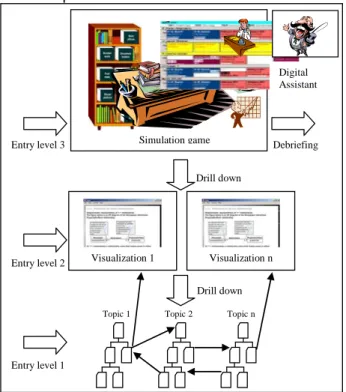
The simulation game is part of a wider learning environment as shown in Figure 2. The following three main components form the learning envi-ronment:
The online learning units/topics (entry level 1) introduce the concepts to be explored; these units are structured in a hierarchical manner allowing students to ‘drill down’ to obtain fur-ther details. Topics are hyperlinked to allow non-sequential browsing.
The visualizations (entry level 2) enhance learning by providing animated walkthroughs of specific examples (e.g. construction of an ER diagram or the process of normalization).
The simulation game (entry level 3) provides a real-world simulated environment within which to apply skills and techniques.
The simulation game is part of a natural evolution of the learning environment in which all three ele-ments work together. This means that students working through the simulation game can pause at appropriate points and ‘drill down’ via the Digital Assistant to the interactive visualizations or to in-dividual topics.
Debriefing
Entry level 2 Entry level 3
Entry level 1
Drill down
Drill down Simulation game
Topic 1 Topic 2 Topic n
Digital Assistant
Visualization n Visualization 1
Figure 2: The learning environment.
5. Preliminary results
At present, levels 1 and 2 of the environment have been developed and initial findings are positive. We have three cohorts of students taking the Fundamentals of Database Systems module: a
full-time face-to-face cohort consisting of 920 stu-dents, a part-time face-to-face cohort consisting of 177 students and a fully online part-time cohort (no face-to-face contact) consisting of 14 stu-dents. Using the experimental design criteria iden-tified by Joy and Garcia (2000), the prior knowl-edge and ability of the students in the three co-horts were similar, the instructor effects were minimal and the time on task was the same for each cohort. In the interests of impartiality, exams were blind marked and because of large class sizes, courseworks were marked by a number of staff with no prior knowledge of the students. Only the online students were given access to the games-based learning environment. To determine whether there was any observable difference be-tween the three cohorts, we used the University’s grading system. Figure 3 shows the module per-centage by module and mode of attendance. A Chi-squared test using the crosstab frequencies was performed. This test can be seen in one of two ways: it is either a test for independence be-tween mode of attendance and grade or that each mode of attendance gives the same profile across grades. In Figure 3 the percentage in each grade is shown with the corresponding result for the test. It is noted that a highly significant result is de-tected.
A B1 B2 C D E χ2 test full-time 24.4 22.3 20.7 16.0 9.0 7.7 part-time 31.5 22.8 16.8 14.1 4.0 10.7
online 26.7 33.3 6.7 26.7 0.0 6.7 p<0.001
Figure 3: Chi-squared test for independence of mode of attendance and grade
As reported in some other studies (e.g. Carr, 2000; Ditton et al., 2002) an online delivery can have high dropout rates. An analysis of dropout rates showed that the face-to-face students had a 13% dropout rate whereas the online students had a 7% dropout rate (representing one student who dropped out). We also examined both stu-dent and faculty perceptions the online environ-ment. Both groups provided extremely positive comments, although on the negative side faculty were concerned that the development costs of the online environment were high and that, while co-hort sizes were small workload wouild be similar, scalability would be an issue and larger online cohort sizes would require a significantly higher workload than teaching a comparable number of face-to-face students.
6. Summary and future directions
This paper has discussed some of the pedagogi-cal issues underpinning the development of a constructivist learning environment using problem-based learning and a simulation game and
inter-active visualizations to help teach database analysis and design.
Future work will include completion of the devel-opment of level 3 of this environment and evalua-tion of the appropriateness of this environment for different groups of students (undergraduate and postgraduate, full-time and part-time). The evalua-tion will include both quantitative and qualitative measures to examine the effectiveness of the en-vironment, looking not just at any perceived grade improvements but also at any perceived levels of improved satisfaction from student and instructor perspectives (Joy and Garcia, 2000; Hiltz et al., 2000). The current aim is for the game to maintain a journal of student interaction that will aid this
evaluation and provide a source of information for further reflection. Additional work will be neces-sary to consider the applicability of this environ-ment to online students, particularly the collabora-tion element of the activities.
Acknowledgements
The authors would like to thank the following peo-ple from the University of Paisley for their contri-butions in discussing ideas relating to this paper - Evelyn McLellan (School of Computing), Judith Ramsay (School of Social Science) and Ewan MacArthur (School of Engineering and Science), as well as John Sutherland (Moray House School of Education) Edinburgh University.
References
ACM/IEEE, ACM/IEEE Computing Curricula, Dec. 15 2001. http://www.computer.org/education/cc2001/ (23 July 2004). Brown, J.S., Collins, A. & Duguid, P. (1989) “Situated cognition and the culture of learning”, Educational Researcher,
Jan-Feb, pp32-42.
Carr, S. (2000). As distance education comes of age, the challenge in keeping students. Chronicle of Higher Education, 46(13), A39–A41. Available at: http:/chronicle.com/free/v46/i23/23a00101.htm (last access date 11 November 2004). Collins, A., Brown, J.S. & Newman, S.E. (1990) “Cognitive apprenticeship: Teaching the crafts of reading, writing, and
mathematics”, in Knowing, learning, and instruction: Essays in honor of Robert Glaser, L.B. Resnick ed., Hillsdale, N.J: Lawrence Erlbaum.
Collins, A. (1991) “The role of computer technology in restructuring schools”, Phi Delta Kappan, 73, pp28-36. Connolly, T.M & Begg, C.E. (2004) Database systems: a practical approach to design, implementation, and
manage-ment, 4th ed, London: Addison Wesley.
Connolly, T.M. & Laiho, M. (2004) Database technology professional European survey analysis, http://www.dbtechnet.org (23 July 2004).
Connolly, T.M., McLellan, E., Stansfield, M.H., Ramsay, J. & Sutherland, J. (2004) “Applying computer games concepts to teaching database analysis and design”, Proc. International Conference on Computer Games, AI, Design and Education, Reading. UK, November 2004. pp352-359.
Cordova, D.I. & Lepper, M.R. (1996) “Intrinsic motivation and the process of learning: beneficial effects of contextualiza-tion, personalizacontextualiza-tion, and choice”, Journal of Educational Psychology, 88, pp715-730.
Csikszentmihalyi. M. & Nakamura, J. (1989) “The dynamics of intrinsic motivation: a study of adolescents”, in Research on motivation in education, R. Ames & C. Ames, eds. vol. 3, San Diego. CA: Academic Press.
Csikszentmihalyi, M. (1990) Flow: the psychology of optimal experience, New York: Harper and Row.
Dutton, J., Dutton, M., and Perry, J. (2002). How do online students differ from lecture students? Journal of Asynchro-nous Learning Networks, 6(1), pp1–20.
EUCIP, EUCIP (European Certification of Informatics Professionals) Core Syllabus. March 2003,
http://www.eucip.com/DownloadFiles/Core_Syllabus_March_2003.pdf (23 July 2004).
Forman, E. & McPhail, J. (1993) “Vygotskian perspectives on children’s collaborative problem-solving activities”, in Con-texts for learning. Sociocultural dynamics in children’s development, E.A. Forman, N. Minick & C. Addison Stone, eds, Oxford: Oxford University Press.
Gance, S. (2002) “Are constructivism and computer-based learning environments incompatible?” Journal of the Associa-tion for History and Computing, V(1), May.
Hiltz, S.R., Coppola, N., Rotter, N. & Turoff, M. (2000) “Measuring the importance of collaborative learning for the effec-tiveness of ALN: a multi-measure, multi-method approach”, Journal of Asynchronous Learning Networks, 4(2), pp103-123.
Jonassen, D.H. (1994) “Thinking technology: Toward a constructivist design model”, Educational Technology, 34(3), pp34-37.
Joy, E.H. & Garcia, F.E. (2000) “Measuring learning effectiveness: a new look at no-significant-difference findings”, Jour-nal of Asynchronous Learning Networks, 4(1), pp33-39.
Katzeff, C. (2000) “The design of interactive media for learners in an organizational setting – the state of the art” , Proc. NordiCHI 2000, Stockholm, Oct. 23-25 2000.
Kolb, B., Gibb, R. & Gonzalez, C.L.R. (2001) “Cortical injury and neuroplasticity during brain development”, In Toward a theory of Neuroplasticity, C.A. Shaw & J.C. McEchern, eds. New York: Taylor and Francis.
Lepper, M.R. & Hodell, M. (1989) “Intrinsic motivation in the classroom”, in Research on motivation in education, R. Ames & C. Ames, eds., vol. 3, San Diego. CA: Academic Press.
Malone, T.W. & Lepper, M.R. (1987) “Making learning fun: a taxonomy of intrinsic motivations for learning”, in Aptitude, learning and instruction, Volume 3: Conative and affective process analysis, Hillsdale, N.J: Lawrence Erlbaum, pp223-253).
Mohtashami, M & Scher, J.M. (2000) “Application of Bloom’s cognitive domain taxonomy to database design”, Proc. of ISECON (Information Systems Educators Conference), Philadelphia, Nov. 9-12,2000.
Prensky, M. (2001) Digital game based learning, McGraw-Hill.
Ricci, K., Salas, E. & Cannon-Bowers, J.A. (1996) “Do computer-based games facilitate knowledge acquisition and re-tention?” Military Psychology, 8(4), pp295-307.
Savery, J.R. & Duffy, T.M. (1995) “Problem based learning: An instructional model and its constructivist framework”, Educational Technology, 35, pp31-38.
Savery, J.R. & Duffy, T.M. (1995) “Problem based learning: An instructional model and its constructivist framework”, Educational Technology, 35, pp 31-38.
Lederman, L.C & Kato, F. (1995) “Debriefing the debriefing process”, in Simulation and gaming across disciplines and cultures: ISAGA at a watershed, D. Crookall and K. Arai, eds. Thousand Oaks. CA: Sage.
Warschauer, M. (1997) “Computer-mediated collaborative learning: theory and practice”, Modern Language Journal, 81(3), pp470-481.
Yazici, S., Boyle, T. & Khan, T. (2001) “Towards a multimedia learning environment for object oriented design”, Proc. 2nd Annual Conference of the LTSN Centre for Information and Computer Sciences,London, Aug. 28-30 2001.