31
3. SYSTEMS CHANGE MODELS and ‘COPMI’ CONSULTATION THEMES
Building on the Chapter 1 introduction to systems change theory and Chapter 2 national and jurisdictional information, this section of the report introduces the strategic goal and evolutionary change theoretical frameworks for systems change in more detail. In addition, key themes arising from the analysis of findings from the interviews and focus groups in the States/territories and nationally regarding systems change will be introduced, with further discussion relating to enablers and barriers for each of the themes being outlined in successive chapters.
3.1 Strategic change approaches
Strategic change approaches were introduced in Chapter 1 of this report, with models presented regarding Systems Theory and Organisational Development models. These models reflect change as intentional and strategic and sometimes infrequent, with change generally occurring within the single organisation or group. Clear goals, measurement and feedback are involved and linking individual people with the directions of the organisation. Change processes are about goal achievement and may be people-focused, including training and working alongside individuals and teams to get them involved. Measurement and feedback about goal achievement and encouraging participation are the roles of leaders in these change approaches.
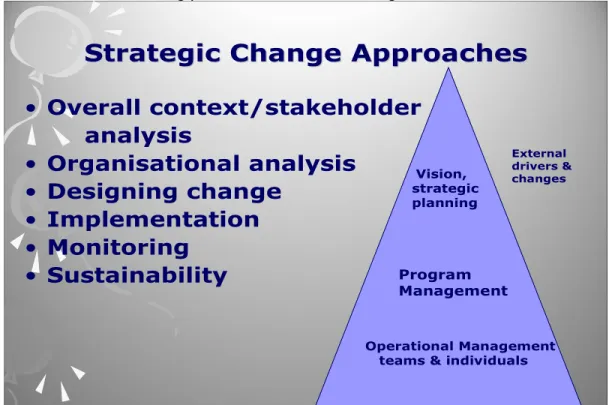
Figure 1 shows further detail about some processes and aspects involved in establishing the strategic approach within a particular organisation, which in broad terms involves three layers: leaders having a vision and doing some strategic planning; establishing a project management team for implementing change and then operationalisation and involving all relevant teams and individuals. As shown, processes for achieving a strategic approach include initially examining the overall context both within and external to the organisation, identifying all the stakeholders and considering the various perspectives. A detailed organizational analysis examination of the particular organisation, its purpose and processes and achievements and the gaps is the next step. Designing a change including considering staffing needs, training, evaluation processes and involving others and getting their support and ideas is also involved, leading to implementation of the change. The final steps are about monitoring the change and collecting data about success and then building processes so that the change becomes sustainable.
Strategic Change
Strategic Change
Approaches
Approaches
•
Overall context/stakeholder
analysis
•
Organisational analysis
•
Designing change
•
Implementation
•
Monitoring
•
Sustainability
Vision, strategic planning Program Management Operational Management teams & individualsExternal drivers & changes
__________________________________________________________________________
32
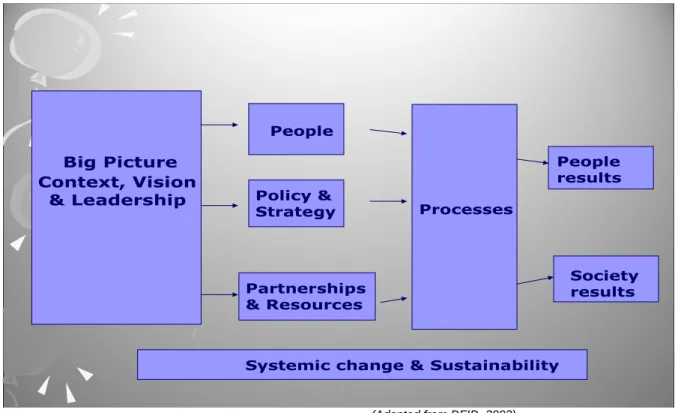
Therefore, as shown in Figure 2, in establishing strategic change in a sustainable manner when health and other social improvement areas are the focus, there needs to be a big picture context, leadership and vision. The involvement of people, policies and strategies and partnerships and resources then occurs and processes to implement the change, followed by evaluation processes to look at the outcomes for people and society (DFID, 2003).Processes
Big Picture Context, Vision
& Leadership
Systemic change & Sustainability Policy & Strategy People results Society results People Partnerships & Resources
(Adapted from DFID, 2003)
Figure 2: Sustainable systems change enablers within a strategic change approach
3.2 Evolutionary change approaches
The evolutionary change approach was briefly outlined in Chapter 1 in regard to involving interaction across organisations and the environment and change being consistent and cumulative rather than intentional and infrequent as occurs within the strategic approach. Complexity Theory and Social Worlds or constructive conflict models were previously presented. In the evolutionary approach, multiple approaches and letting directions arise gradually over time or working through conflicting ideas and creating new directions are the change processes involved. The leader’s role becomes one of working with others and interpreting the emerging change and taking a strategic view of all the different agendas underway.
Figure 3 provides a representation of the evolutionary change process within a health care context (Plsek, 2003). A key difference from the previously-outlined strategic approach is that the change is recognised as happening within a wider two-way context, with those other influences and knowledge having an impact. Secondly rather than being top down, the generation of new ideas can come from anyone and may simply evolve in the course of routine work for a few people and then become more widely adopted across the organisation and across other organisations.
33
Emergent Change Approach (Rogers 1995)
(Rogers, 1995, cited in Plsek, 2003)
Figure 3: Evolutionary change in health care
In terms of ‘copmi’ change processes, both strategic and evolutionary approaches have some relevance and a purpose for this research is to learn more about the enablers and barriers for change and the degree to which strategic or evolutionary approaches are important.
Considering the strategic and evolutionary approaches as having some relevance to this research means focusing on:
the importance of relationships and leadership
need for relevant structures, processes and patterns
changing ‘how people think’ (mental models), leading to adoption and other innovations
considering what causes attraction to new ideas for different groups of people
understanding that adaptation and change are constant
the importance of encouraging experimentation, ongoing ideas and seeking evidence
understanding that ongoing small-scale evolutionary and ‘informal’ change can have a strong impact long term
recognising systems are embedded within other systems and co-evolve
(adapted from Plsek, 2003)
3.3 Change management and sustainability maturity models
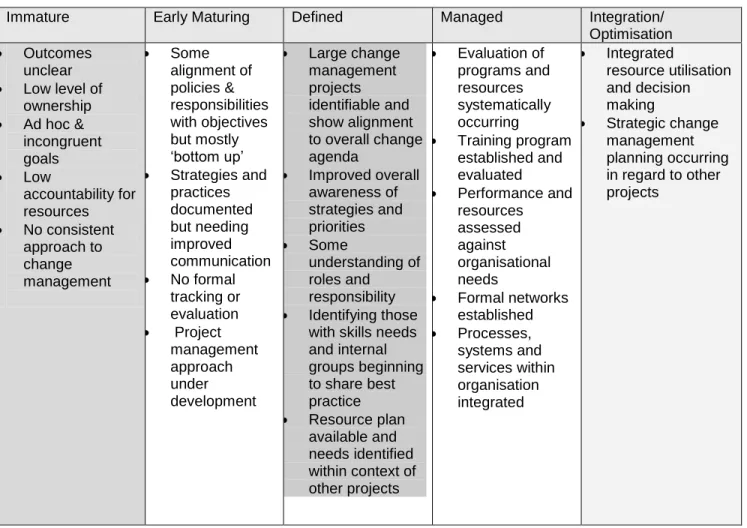
Change management and sustainability maturity models are being developed in the corporate world and have some relevance to this work. Maturity models are useful in identifying the indicators for various levels of capability. One change management model linked to sustainability has various elements of Outcomes; Resourcing and Evaluation; Policy and Strategy; Capacity and Capability Management and Project and Programme Management. The characteristics for each of these elements can be described across various levels of development in terms of sustainability. While there are various labels which can be used, these can be outlined from Immature to Early Maturing, Defined, Managed and Integration/Optimisation (Cambridgeshire County Council, undated; CSR Quest, 2007).
__________________________________________________________________________
34
As shown in Table 2, the model shows progressively more alignment between various parts of an organization over various stages in terms of clarity of outcomes, consistency of policies and responsibilities to objectives, and resources and training, as well as evaluation:Table 2: Change management maturity matrix
Immature Early Maturing Defined Managed Integration/
Optimisation Outcomes unclear Low level of ownership Ad hoc & incongruent goals Low accountability for resources No consistent approach to change management Some alignment of policies & responsibilities with objectives but mostly ‘bottom up’ Strategies and practices documented but needing improved communication No formal tracking or evaluation Project management approach under development Large change management projects identifiable and show alignment to overall change agenda Improved overall awareness of strategies and priorities Some understanding of roles and responsibility Identifying those
with skills needs and internal groups beginning to share best practice Resource plan available and needs identified within context of other projects Evaluation of programs and resources systematically occurring Training program established and evaluated Performance and resources assessed against organisational needs Formal networks established Processes, systems and services within organisation integrated Integrated resource utilisation and decision making Strategic change management planning occurring in regard to other projects
(Adapted from Cambridgeshire County Council, undated; CSR Quest, 2007)
Health studies reviews examining sustainability across six domains showed enablers and barriers as follows (Sibthorpe et al., 2005):
Political: including local, state/territory and national political contexts, with individual champions occurring locally and nationally and with good links established with regional health planning and with alignment to national policy directions;
Institutional: between institutions and within institutions connections involving good relationships and structures (e.g. Linkage group, Memorandum of Understanding), with processes supporting this including flexibility in implementation to account for local conditions and good information (formal/informal and national/local, training tools);
Financial: dependent on general funding and specific funding, with good general funding facilitating sustainability;
Economic: time and workload issues with no specific incentives for incorporating into routine general practice;
Client: issues about resilience of client base with sustainability enhanced if people sought care and there was acceptance of the provider role or service was embedded in patient community and there were few out of pocket costs for patients; and
35
Workforce: staffing, skills and motivation aspects.
3.4 ‘Copmi’ research systems change key enablers introduction The key themes in terms of supporting systems change identified are:
Big Picture Context and Leadership
Policy and Strategy
People, Culture and Management
Structures, Systems and Processes
Resources
As shown in Figure 4, each of these aspects incorporates various sub-themes. A coding system has been used to identify the frequency of responses. Some of these sub-themes were frequently raised by research participants, as indicated by the sign +++. Sub-themes which were sometimes raised have been indicated using ++. Sub-themes rarely raised are shown using +.
. COPMI change enablers Vision Executive leadership Project/program Operational Resources •national/state/area/specialist level coordinator positions++ •recurrent funding & longevity of key personnel++
•funding for activities++ •interconnected resources++
Big Picture Context & Leadership
•legal & policy interconnected contexts+++ •critical incidents++
•high level influential champions & national contexts++
•historical/social issues & timing++
People, Culture & Management
•champions at all levels+++ •formal & informal alliances++
•bottom up and top down influencing++ •leadership commitment & reculturing++ •professional learning++
Structures, Systems, Processes
•nat/state/area/team network alignment & local flexibility++
•protocols & systematic data collection+ •documented minutes & dissemination++ •clear structures, roles & responsibilities++ •evaluation processes+
Policy & Strategy
•high level x-sector agreements+ •strategic implementation plans++ •national, jurisdictional & regional alignment++
__________________________________________________________________________
36
Figure 4: ‘COPMI’ research change enabler themes
3.5 ‘Copmi’ research key barriers introduction
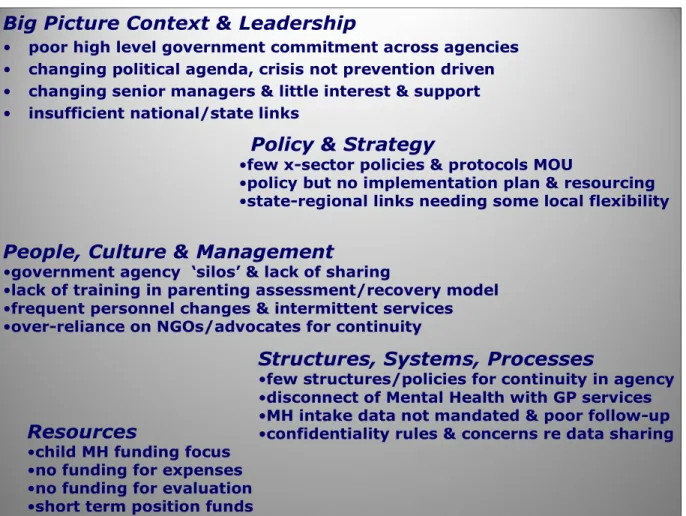
Barriers, as indicated in Figure 5 in relation to Big Picture Context and Leadership; Policy and Strategy; Structures, Systems, Processes; People, Culture and Management; and Resources will also be presented. Detailed discussion of each of these themes including enablers and barriers will occur in chapter 4 to 8. Quotations are provided from various government and non-government representatives, also consumers and carers in states and territories and nationally, thereby capturing the voice of stakeholders, although without specific identification of individuals, organisations or jurisdictions.
Big Picture Context & Leadership
• poor high level government commitment across agencies
• changing political agenda, crisis not prevention driven
• changing senior managers & little interest & support
• insufficient national/state links
People, Culture & Management
•government agency ‘silos’ & lack of sharing
•lack of training in parenting assessment/recovery model
•frequent personnel changes & intermittent services
•over-reliance on NGOs/advocates for continuity
Structures, Systems, Processes
•few structures/policies for continuity in agency
•disconnect of Mental Health with GP services
•MH intake data not mandated & poor follow-up
•confidentiality rules & concerns re data sharing
Resources
•child MH funding focus
•no funding for expenses
•no funding for evaluation
•short term position funds
Policy & Strategy
•few x-sector policies & protocols MOU
•policy but no implementation plan & resourcing
•state-regional links needing some local flexibility