(will be inserted by the editor)
A Cost-Benefit Analysis of Using Cloud Computing to
Extend the Capacity of Clusters
Marcos Dias de Assun¸c˜ao · Alexandre di Costanzo · Rajkumar Buyya
Received: 06/11/2009 / Accepted:
Abstract In this paper, we investigate the benefits that organisations can reap by using “Cloud Comput-ing” providers to augment the computing capacity of their local infrastructure. We evaluate the cost of seven scheduling strategies used by an organisation that op-erates a cluster managed by virtual machine technology and seeks to utilise resources from a remote Infrastruc-ture as a Service (IaaS) provider to reduce the response time of its user requests. Requests for virtual machines are submitted to the organisation’s cluster, but addi-tional virtual machines are instantiated in the remote provider and added to the local cluster when there are insufficient resources to serve the users’ requests. Na¨ıve scheduling strategies can have a great impact on the amount paid by the organisation for using the remote resources, potentially increasing the overall cost with the use of IaaS. Therefore, in this work we investi-gate seven scheduling strategies that consider the use of resources from the “Cloud”, to understand how these strategies achieve a balance between performance and usage cost, and how much they improve the requests’ response times.
This work is partially supported by research grants from the Australian Research Council (ARC) and Australian Department of Innovation, Industry, Science and Research (DIISR). Marcos’ PhD research was partially supported by National ICT Australia. Marcos Dias de Assun¸c˜ao
INRIA RESO/LIP ´
Ecole Normale Sup´erieure de Lyon
46, all´ee d’Italie - 69364 Lyon Cedex 07 - France E-mail: [email protected] Alexandre di Costanzo and Rajkumar Buyya The University of Melbourne
Melbourne, VIC, Australia
E-mail:{adc,raj}@csse.unimelb.edu.au
Keywords Cloud computing · load sharing · job scheduling·backfilling
1 Introduction
Managing and supplying computational resources to user applications is one of the main challenges for the high performance computing community. To manage resources existing solutions rely on a job abstraction for resource control, where users submit their applications as batch jobs to a resource management system respon-sible for job scheduling and resource allocation. This us-age model has served the requirements of a large num-ber of users and the execution of numerous scientific ap-plications. However, this usage model requires the user to know very well the environment on which the ap-plication will execute. In addition, users can sometimes require administrative privileges over the resources to customise the execution environment by updating li-braries and software required, which is not always pos-sible using the job model.
The maturity and increasing availability of virtual machine technologies has enabled another form of re-source control based on the abstraction of containers. A virtual machine can be leased and used as a con-tainer for deploying applications [28]. Under this sce-nario, users lease a number of virtual machines with the operating system of their choice; these virtual machines are further customised to provide the software stack quired to execute user applications. This form of re-source control has allowed leasing abstractions that en-able a number of usage models, including that of batch job scheduling [33].
The creation of customised virtual machine environ-ments atop a physical infrastructure has enabled
an-other model recently known as “Cloud Computing” [2, 38]. Based on the economies of scale and recent Web and network technologies, commercial resource providers, such as Amazon Inc., aim to offer resources to users in a pay-as-you-go manner. These Cloud providers, also known as Infrastructure as a Service (IaaS) providers, allow users to set up and customise execution envi-ronments according to their application needs. Previ-ous work has demonstrated how Cloud providers can be used to supply resources to scientific communities. Deelmanet al.[9] demonstrated the cost of using Cloud providers to supply the needs for resources of data in-tensive applications. Palankar et al. [27] have shown that Grid computing users can benefit from mixing Cloud and Grid infrastructure by performing costly data operations on the Grid resources while utilising the data availability provided by the Clouds.
In this work, we investigate whether an organisation operating its local cluster can benefit from using Cloud providers to improve the performance of its users’ re-quests. We evaluate seven scheduling strategies suitable for a local cluster that is managed by virtual machine based technology to improve its Service Level Agree-ments (SLAs) with users. These strategies aim to utilise remote resources from the Cloud to augment the capac-ity of the local cluster. However, as the use of Cloud resources incurs a cost, the problem is to find the price at which this performance improvement is achieved. We aim to explore the trade-off between performance im-provement and cost.
We have implemented a system that relies on virtu-alisation technology for enabling users to request virtual machines from both the local cluster and the Cloud to run applications. In this work, we evaluate via simula-tion seven strategies for improving scheduling perfor-mance through the use of a Cloud provider. In sum-mary, the contributions of this work are to:
– Describe a system that enables an organisation to augment its computing infrastructure by allocating resources from a Cloud provider.
– Provide various scheduling strategies that aim to minimise the cost of utilising resources from the Cloud provider.
– Evaluate the proposed strategies, considering differ-ent performance metrics; namely average weighted response time, job slowdown, number of deadline violations, number of jobs rejected, and the money spent for using the Cloud.
The rest of this paper is organised as follows. In Sec-tion 2 we provide the background on virtual machines, Cloud computing, and scheduling. Then, we present the seven scheduling strategies for redirecting requests from
the cluster to the Cloud in Section 3. Section 4 de-scribes the system design. Next, Section 5 shows the considered experimental scenario and reports the per-formance evaluation of the investigated strategies. Re-lated work is discussed in Section 6 whereas conclusions are presented in Section 7.
2 Background and Context
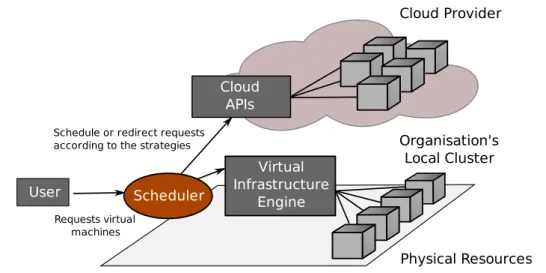
This work considers the case where an organisation manages a local cluster of computers through virtual machine technology to supply its users with resources required by their applications. The scenario, depicted in Figure 1, can also represent a centre that provides com-puting resources to scientific applications or a commer-cial organisation that provisions resources to its busi-ness applications. The organisation wants to provision resources for its user applications in a way that guar-antees acceptable response time.
The resources of the local cluster are managed by a Virtual Infrastructure Engine (VIE) such as Open Nebula [14] and Eucalyptus [26]. The VIE can start, pause, resume, and stop Virtual Machines (VMs) on the physical resources offered by the cluster. The scheduling decisions at the cluster are performed by theScheduler, which leases the site’s virtual machines to the users. The scheduler also manages the deployment of VMs on a Cloud Provider according to provisioning strategies, which are detailed in the next section.
2.1 Virtualisation Technologies
The increasing availability of VM technologies has en-abled the creation of customised environments on top of physical infrastructures. The use of VMs in distributed systems brings several benefits such as: (i) server con-solidation, allowing workloads of several under-utilised servers to be placed in fewer machines; (ii) the abil-ity to create VMs to run legacy code without interfer-ing in other applications’ APIs; (iii) improved security through the creation of sandboxes for running applica-tions with questionable reliability; (iv) dynamic provi-sion of VMs to services, allowing resources to be allo-cated to applications on the fly; and (v) performance isolation, thus allowing a provider to offer some levels of guarantees and better quality of service to customers’ applications.
Existing systems based on virtual machines can man-age a cluster of computers by enabling users to create virtual workspaces [21] or virtual clusters [14, 6, 15] atop the actual physical infrastructure. These systems can
Cloud Provider Physical Resources Organisation's Local Cluster User Cloud APIs Virtual Infrastructure Engine Scheduler
Schedule or redirect requests according to the strategies
Requests virtual machines
Fig. 1 The resource provisioning scenario.
bind resources to virtual clusters or workspaces accord-ing to the demands of user applications. They also pro-vide an interface through which the user can allocate virtual machines and configure them with the operating system and software of choice. These resource managers allow the user to create customised virtual clusters us-ing shares of the physical machines available at the site. Virtualisation technology minimises some security concerns inherent to the sharing of resources among multiple computing sites. Therefore, we utilise virtual-isation software in our system design, described in Sec-tion 4, because existing cluster resource managers rely-ing on virtual machines can provide the buildrely-ing blocks, such as availability information, required for the cre-ation of virtual execution environments. The crecre-ation of execution environments comprising multiple computing sites is our long-term goal. In addition, relying on vir-tual machines eases deploying execution environments on multiple computing sites as the user application can have better control over software installed on the re-sources allocated from the sites without compromising the operation of the hosts’ operating systems.
2.2 Infrastructure as a Service
Virtualisation technologies have also facilitated the re-alisation of new models such as as Cloud Computing or IaaS. The main idea is to supply users with on-demand access to computing or storage resources and charge fees for their usage. In these models, users pay only for the resources they utilise. A key provider of this type of on-demand infrastructure is Amazon Inc. with its Elastic Compute Cloud (EC2) [1]. EC2 allows users to deploy VMs on Amazon’s infrastructure, which is composed of several data centres located around the world. To use Amazon’s infrastructure, users deploy instances of
pre-submitted VM images or upload their own VM im-ages to EC2. The EC2 service utilises the Amazon Sim-ple Storage Service (S3), which aims at providing users with a globally accessible storage system. S3 stores the users’ VM images and, as EC2, applies fees based on the size of the data and the storage time.
2.3 Scheduling and Redirection Strategies
The strategies investigated in this work define how the scheduler performs the scheduling of leases and when it borrows resources from the Cloud. The scheduler is divided into two sub-scheduler modules, one managing the scheduling of requests at the local cluster, hereafter also termed theSite Scheduler, and another managing the scheduling on the Cloud resources, termed as the
Cloud scheduler. We term a strategy or algorithm used to schedule the leases as ascheduling strategy, and the algorithm that defines when the scheduler borrows re-sources from the Cloud and which requests are redi-rected to the Cloud resources as aredirection strategy. A combination of scheduling and redirection strategies is astrategy set. As discussed later in Section 3, a redi-rection strategy can be invoked at different times (e.g.
a job arrival or completion) in different strategy sets.
2.4 Types of User Requests
In addition to the type of virtual machine required and configuration details, a request r is a tuple containing at least < n, rt, d >, where n specifies the number of virtual machines required;rtis the ready time, before which the request is not ready for execution; andd is the deadline for request completion. These parameters are sufficient to specify a wide range of virtual machine
requests. As demonstrated latter in Section 5, by mak-ing rt larger than the submission time, the user can specify deadline constrained requests that require ad-vance reservation of virtual machines.
The users of the infrastructure run different appli-cations with different computing requirements. Some applications need resources at particular times to meet application deadlines, whereas other applications are not strict about the time when they are given resources to execute as long as they are granted the resources required. The first category of applications is termed asdeadline-constrained whereas the second category is termed asbest-effort.
For the purposes of this work, users are to be ser-viced by virtual machines hosted by an individual com-puting site; thus the same user request cannot receive resources from both the Cloud provider and the organ-isation’s cluster. Applications that rely heavily on mes-sage passing interfaces are generally sensitive to net-work delays and, despite advances in virtualisation tech-nology [36], may not benefit heavily from using resources from multiple computing sites. In practice, the execu-tion of these applicaexecu-tions is generally confined to an individual computer cluster.
We will relax this assumption in future work as applications may present different communication de-mands. Some applications are composed of tasks that consist of multiple executions of the same program with different input parameters. These applications are often called bag-of-tasks and the tasks generally do not re-quire communication between them; which makes these applications good candidates for utilising resources from multiple sites.
3 Evaluated Strategy Sets
As described in Section 2, a strategy set consists of strategies for scheduling requests at the site and the Cloud, and a redirection strategy that specifies which requests are redirected to the Cloud.
As scheduling strategies we use conservative [25], aggressive [22], and selective backfilling [34]. With con-servative backfilling, each request is scheduled (i.e. it is granted a reservation) when it arrives in the system, and requests are allowed to jump ahead in the queue if they do not delay the execution of other requests. In ag-gressive backfilling, only the request at the head of the waiting queue – calledthe pivot – is granted a reserva-tion. Other requests are allowed to move ahead in the queue if they do not delay the pivot. Selective back-filling grants reservations to requests that have waited long enough in the queue. Under selective backfilling
a request is granted a reservation if its expected slow-down exceeds a threshold. The expected slowslow-down of a request r is also called eXpansion Factor (XFactor) and is given by Equation 1.
XF actor= (wait time+run time)/run time (1)
In fact, we use the Selective-Differential-Adaptive scheme proposed by Srinivasan et al. [34], which lets the XFactor threshold be the average slowdown of pre-viously completed requests.
The following strategy sets are used for scheduling requests that arrive at the organisation’s cluster:
Na¨ıve: both local Site and Cloud schedulers use conservative backfilling to schedule the requests. The redirection algorithm is executed at the arrival of each job at the site. If the site scheduler cannot start a request immediately, the redirection algorithm checks whether the request can be started immediately using Cloud resources. If the request can start on the Cloud resources, then it is redirected to the Cloud, otherwise it is placed in the site’s waiting queue.
Shortest Queue: jobs at the site’s cluster are sched-uled in a First-Come-First-Served (FCFS) manner with aggressive backfilling [22]. The redirection algorithm ex-ecutes as each job arrives or completes, and computes the ratio of virtual machines required by requests cur-rently waiting in the queue to the number of processors available, similar to the work of England and Weissman [12]. If the Cloud’s ratio is smaller than the cluster’s, the redirection algorithm iterates the list of waiting re-quests and redirects rere-quests until both ratios are sim-ilar.
Weighted Queue: this strategy is an extension of the Shortest Queue strategy. As each job arrives or com-pletes, the scheduler computes the number of virtual machines required by waiting requests on the cluster and how many virtual machines are in execution on the Cloud. The site scheduler then computes the number of VMs that can be started on the Cloud,num vms, as the minimum between the number of VMs demanded by the site’s requests and the Cloud’s VM limit, and redi-rects requests to the Cloud untilnum vmsis reached.
Selective: the local site uses the selective back-filling scheme described earlier. As each job arrives or completes, the scheduler checks which requests can be started, then starts them. Using the same approach based on queue ratios used in the Shortest Queue strat-egy, the scheduler then computes the ratios for the clus-ter and the Cloud. If the ratios are different, the algo-rithm iterates the list of waiting requests and checks their XFactors. For each waiting request, if the expan-sion factor exceeds the threshold, the algorithm checks
the potential start time for the request at both the Cloud and the site. The algorithm finally makes a reser-vation at the place that provides the earliest start time. We also investigate strategies to schedule deadline constrained requests using resources from the site and the Cloud provider. The additional deadline-aware strat-egy sets are:
Conservative:both local site and Cloud schedule requests using conservative backfilling. As each request arrives, the scheduler checks if the site can meet the request’s deadline. If the deadline cannot be met, the scheduler checks the availability on the Cloud. If the Cloud can meet the request’s deadline, then the request is scheduled on the Cloud resources. If the request dead-line cannot be met, the scheduler schedules the request on the local site if it provides a better start time than the Cloud. Otherwise, the request is redirected to the Cloud.
Aggressive:both local site and Cloud use aggres-sive backfilling to schedule requests. Similarly to the work of Singh et al. [32], as each request arrives the scheduler builds a tentative schedule for currently wait-ing requests. Uswait-ing aggressive backfillwait-ing for buildwait-ing the tentative schedule, the scheduler sorts the requests applying an Earliest Deadline First scheme and checks whether the acceptance of the arriving request would break any request deadline. If there are no potential deadline violations, the request is scheduled locally; oth-erwise, a tentative schedule is built for Cloud resources. If the request does not break deadlines of requests sched-uled to use the Cloud, the request is served with re-sources from the Cloud provider. If the request dead-line cannot be met, the scheduler schedules the request using the local site’s resources if they provide a bet-ter start time than the Cloud. Otherwise the request is served by resources from the Cloud.
Conservative with Reservation Support:both local site and Cloud schedule requests using conserva-tive backfilling with support for advance reservation of resources. As each request arrives, the scheduler checks whether it is a best-effort or reservation request. In the first case, the request is placed in the local site. Other-wise, for an advance reservation request the scheduler first checks if the site can provide the resources dur-ing the required time-frame. If there are not resources available during the requested time-frame, the sched-uler checks the resource availability on the Cloud. The request is then scheduled on the Cloud if it can pro-vide the resources required; otherwise the reservation request is rejected.
Although as of writting of this paper some Cloud providers do not support advance reservation, that does not impact our system because reservations are
man-aged by an entity (i.e. Gateway) that uses the Cloud API to start and stop virtual machines when reserva-tions commence or finish. The assumption of this work is that the Cloud will provide the resources required when reservations are enforced.
4 System Design
In this section, we describe briefly the design of the InterGrid Gateway (IGG), which is analogous to the scheduler and uses a VIE to enforce virtual machine leases granted to users. The names of the components derive from our previous work on the interconnection of computational Grids [8]. A complete description of the implementation and an evaluation of the system is available elsewhere [10].
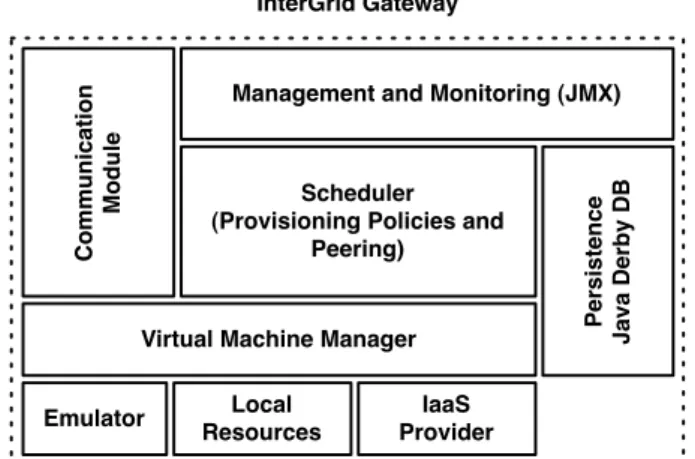
IGGs can have peering relationships that define un-der which circumstances they borrow resources from one another (i.e. redirection strategies). These peer-ing relationships specify when an IGG seeks to use re-sources from another IGG and how the IGG evaluates a request for resources from another IGG. The IGG has been implemented in Java, and a layered view of its components is presented in Figure 2.
Communication
Module
Management and Monitoring (JMX)
Scheduler (Provisioning Policies and
Peering)
Persistence
Java Derby DB
Virtual Machine Manager
Emulator Local
Resources
IaaS Provider InterGrid Gateway
Fig. 2 Main components of the IGG.
The central component of the IGG is theScheduler; in charge of serving users’ requests, handling reserva-tions, and managing start and stop of virtual machines when jobs are scheduled. The scheduler maintains the resource availability information and interacts with the Virtual Machine Manager (VM Manager) for creating, starting or stopping virtual machines to fulfil the re-quirements of the scheduled requests.
The IGG does not share physical resources directly, but relies on virtualisation technology to abstract them. The VM Manager controls the deployment of virtual
machines for the IGG. The types of virtual machines available for the IGG are described asVirtual Machine Templates, which are analogous to computers’ config-urations. A VM template describes a type of VM and contains information such as the number of processors or cores assigned to the VM, the amount of memory, the kernel used to boot the operating system, the disk im-age, and the price of using a VM of this type over one hour. All available templates are stored in the IGG’s repository. At present, users willing to request VMs, need to specify the templates they want to use from the repository. In addition, IGGs need to agree on the templates in order to allow one IGG to borrow VMs from another. In this work, we consider that the Cloud provider has a matching template for each template available at the organisation’s cluster.
The VM Manager deploys VMs on physical resources when requested by the IGG. The scheduling strategies that define when and which VMs are started or shut down are implemented as part of the IGG’s scheduler. The VM Manager relies on a VIE for deploying and managing VMs; the current implementation uses Open Nebula as a VIE for virtualising a physical cluster in-frastructure. In addition, the VM Manager is able to control VMs hosted by a Cloud provider such as Ama-zon EC2 [1].
TheCommunication Moduleis responsible for mes-sage passing. This module receives mesmes-sages from other entities and delivers them to the components registered as listeners. Message-passing makes gateways loosely coupled and allows for more failure-tolerant commu-nication protocols.
5 Performance Evaluation
This section describes the scenario considered for per-formance evaluation, the perper-formance metrics, and ex-perimental results.
5.1 Experimental Scenario
The evaluation of the strategies is performed by using a discrete-event simulator [5]. We use simulation because it enables us to perform repeatable experiments, and the cost incurred by performing experiments on real in-frastructure would be prohibitively expensive. To store the information about resources available for running virtual machines, the scheduler uses a data structure based on a red-black tree [7] whose nodes contain the list of resources available at the start or completion of leases. The tree is augmented by a double-linked list
connecting the sibling nodes; this list eases the inter-action for finding alternative time slots when handling advance reservations or looking for potential start times for requests. This data structure is based on the idea of availability profile used in some implementations of conservative backfilling [25].
For the experiments that do not involve advance reservations, we model the San Diego Super Computer (SDSC) Blue Horizon machine because job traces col-lected from this supercomputer are publicly available1
and have been studied previously [23]. The Blue Hori-zon machine comprises 144 nodes. The experiments with advance reservations model the infrastructure of the Lyon site of Grid’50002. This site has 135 nodes and
the requests submitted to it resemble requests for vir-tual machines; users reserve resources and deploy sys-tem images containing the customised operating syssys-tem and required applications. To model the workload we use traces collected from this site containing one year of request submissions.
The limit of virtual machines that the site can host is the same as the number of nodes. In addition, in this work the maximum number of virtual machines that can be in execution by the Cloud provider at a particu-lar time is the same as the maximum in the local cluster. We plan to relax this assumption in future work.
To compute the cost of using resources from the Cloud provider, we use the amounts charged by Ama-zon to run basic virtual machines at EC2 (i.e. as of writing of this paper the rate was US$0.10 per vir-tual machine/hour). The experiments consider only the amount charged to run VMs, but in practice Amazon charges for the usage of other resources such as net-work and storage. Other usage fees are not considered in this work because they depend on the applications’ communication and data requirements.
The operating system running on a virtual machine takes from a few seconds to some minutes to boot, but Amazon commences charging users when the VM pro-cess starts. The experiments therefore consider that the booting time is already included into the request’s du-ration. In addition, the experiments consider full-hours of utilisation; if a request uses a VM for 30 minutes for example, the cost of one hour is considered.
5.2 Performance Metrics
Some metrics related to requests’ response times in-clude the bounded job slowdown (bound=10 seconds), hereafter referred only as job slowdown [13] and the
1 http://www.cs.huji.ac.il/labs/parallel/workload/ 2 http://www.grid5000.fr/
Average Weighted Response Time (AWRT) [16]. The AWRT measures how long on average users wait to have their requests completed. A short AWRT indicates that on average users do not wait long for their requests to complete. AW RT = X j∈τk pj·mj·(ctj−stj) X j∈τk pj·mj (2)
The AWRT is given by Equation 2, wheremj is the
number of virtual machines required by request j, pj
is the execution time of the request, ctj is the time of
completion of the request andstjis its submission time.
The resource consumption (pj·mj) of each requestjis
used as the weight.
In order to compute the benefits of using one strat-egy over another, we also compute the cost ratio be-tween AWRT and the amount spent in running virtual machines on the Cloud. In addition, we measure the number of deadline violations and request rejections when we evaluate scenarios where some requests are deadline constrained. More information about the ra-tios is provided along with respective experiments.
5.3 Experimental Results
The first experiment evaluates the performance improve-ment of different strategy sets by running virtual ma-chines on the Cloud provider and the cost of such im-provement in each case. This experiment uses a metric termed asperformance cost. The performance cost of a strategystis given by Equation 3.
perf. costst=
Amount spent
AW RTbase−AW RTst
∗AW RTst (3)
whereAmount spent is the amount spent running vir-tual machines on the Cloud provider,AW RTbaseis the
AWRT achieved by a base strategy that schedules re-quests using only the site’s resources and AW RTst is
the AWRT reached by the strategy st when Cloud re-sources are also utilised. This metric aims to quantify the improvement achieved in AWRT and its cost; the smaller the performance improvement cost, the better the strategy performs. In the experiments described in this section, the base strategy is FCFS with aggressive backfilling.
For this experiment, the site’s workloads have been generated using Lublin and Feitelson’s model [23], here
referred to as Lublin99. Lublin99 has been configured to generate two-month-long workloads of type-less re-quests (i.e. no distinction is made between batch and interactive requests); the maximum number of CPUs used by the generated requests is set to the number of nodes in the cluster. This experiment evaluates the performance cost under different types of workloads. In order to generate different workloads, we modify three parameters of Lublin99’s model, one at a time. First, we change the mean number of virtual machines re-quired by a request (specified inlog2) tolog2m−umed
where m is the maximum number of virtual machines allowed in system. We varyumed from 1.5 to 3.5. The larger the value ofumed, the smaller the requests be-come in terms of numbers of VMs required and con-sequently result in lighter loads. The second parame-ter changed in the experiments affects the inparame-ter-arrival time of requests at rush hours. The inter-arrival rate of jobs is modified by setting the β of the gamma dis-tribution (hereafter termedbarr), which we vary from 0.45 to 0.55. As the values forbarr increase, the inter-arrival time of requests also increases. The last param-eter impacts on the request duration by changing the proportion of the first gamma in the hyper-gamma dis-tribution used to compute the requests runtimes. The proportionpof the first gamma in Lublin99’s model is given byp=pa∗nodes+pb. We vary the paremeterpb from 0.5 to 1.0. The larger the value ofpb, the smaller the duration of the requests.
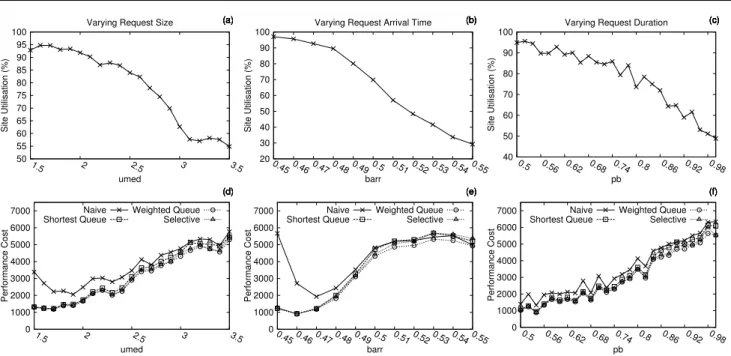
The results of this experiment are shown in Figure 3. Each data point is the average of 5 simulation rounds. Graphs (a), (b) and (c) show the site’s utilisation un-der aggressive backfilling scheduling when the Cloud resources are not used. These graphs illustrate the ef-fect of the parameter changes on the load. Graphs (d), (e) and (f) show the performance cost when we vary: the number of VMs required by a request, the inter-arrival interval and the request’s duration, respectively. The higher values obtained by the na¨ıve strategy show that more money is spent to achieve an improvement in AWRT, especially under heavy loads, as shown in graph (d). From graphs (a) and (d), we also observe that the performance cost of using the Cloud is linear with the decrease in number of VMs of requests except for the na¨ıve strategy, which is very expensive for small requests. Under lighter loads, all strategies tend to yield the same ratio of cost and performance. With small inter-arrival periods, all strategies have similar perfor-mance, except the na¨ıve strategy. The na¨ıve strategy again provides a high performance cost, as shown in graph (e). With the variation of request arrival time, the experiments show a limit of the performance cost close to US$5,500. The cost increases until this limit
0 1000 2000 3000 4000 5000 6000 7000 1.5 2 2.5 3 3.5 Performance Cost umed (d) (e) (f) (a) (b) (c) Naive Shortest Queue Weighted Queue Selective 50 55 60 65 70 75 80 85 90 95 100 1.5 2 2.5 3 3.5 Site Utilisation (%) umed Varying Request Size
(d) (e) (f) (a) (b) (c) 0 1000 2000 3000 4000 5000 6000 7000 0.45 0.46 0.47 0.48 0.49 0.5 0.51 0.52 0.53 0.54 0.55 Performance Cost barr (d) (e) (f) (a) (b) (c) Naive Shortest Queue Weighted Queue Selective 20 30 40 50 60 70 80 90 100 0.45 0.46 0.47 0.48 0.49 0.5 0.51 0.52 0.53 0.54 0.55 Site Utilisation (%) barr Varying Request Arrival Time
(d) (e) (f) (a) (b) (c) 0 1000 2000 3000 4000 5000 6000 7000 0.5 0.56 0.62 0.68 0.74 0.8 0.86 0.92 0.98 Performance Cost pb (d) (e) (f) (a) (b) (c) Naive Shortest Queue Weighted Queue Selective 40 50 60 70 80 90 100 0.5 0.56 0.62 0.68 0.74 0.8 0.86 0.92 0.98 Site Utilisation (%) pb Varying Request Duration
(d) (e) (f)
(a) (b) (c)
Fig. 3 The top three graphs show the site’s utilisation using the base aggressive backfilling strategy without Cloud resources; the bottom three graphs show the performance cost under different workloads. Higher values ofumedresult in requests requiring a larger number of VMs. The larger the value ofbarr, the greater the inter-arrival time of requests at rush hours. The time duration of the requests decrease as the value ofpbincreases. Each data point is the average of 5 simulation rounds.
and then decreases, due to the increase of the request inter-arrival time. More time between requests allows using less resources, which makes it more costly to rely on the Cloud to improve the request response time. For smaller inter-arrival time values, there is an important difference in cost of performance for the na¨ıve strat-egy in comparison to other strategies. In the last part of the experiment, graphs (c) and (f), all strategies re-turn similar performance cost for the same request du-ration variation. The performance cost is inversely pro-portional to the cluster usage.
The second experiment evaluates the site using re-sources from the Cloud to meet service level agreements with consumers. In this experiment the requests have deadlines and we measure the cost of reducing deadline violations, or requests completing after their deadlines. The cost of reducing deadlines using a strategy st is given by Equation 4.
non−violation costst=
Amount spentst
violbase−violst
(4)
whereAmount spentst is the amount spent with Cloud
resources, violbase is the number of violations using a
base strategy andviolst is the number of violations
un-der the evaluated strategy. The base policy is aggressive backfilling sorting the jobs for scheduling and backfill-ing in an Earliest Deadline First manner.
This experiment uses real job traces collected from the SDSC Blue Horizon machine to model the workload
of the site’s cluster. As the job trace spans a period of two years, we divide it into intervals of two months each. For each experiment, we perform 5 simulation rounds using a different workload for each round. As the deadline information is not available in the trace, we use a Bernoulli distribution to select from the trace the requests that should have deadlines. In this way, a request read from the job trace file has a probability of being deadline constrained. The experiments consider different numbers of deadline constrained requests.
To generate the request deadlines we use a tech-nique described by Islam et al. [20], which provides a feasible schedule for the jobs. To obtain the deadlines, we perform the experiments by scheduling requests on the site’s cluster without the Cloud using aggressive backfilling. After that, the deadlinedj of a jobj is
cal-culated using Equation 5:
dj=
(
stj+ (taj∗sf), if [stj+ (taj∗sf)]< ctj
ctj, otherwise
(5)
where stj is the request j’s submission time,ctj is its
completion time,taj if the request’s turn around time
(i.e. the difference between the request’s completion and submission times) and sf is a stringency factor that indicates how urgent the deadlines are. Ifsf = 1, then the request’s deadline is the completion under the
aggressive backfilling scenario. We evaluate the strate-gies with different stringency factors (i.e.0.9, 1.3 and 1.7 termed tight, normal and relaxed deadline scenarios respectively).
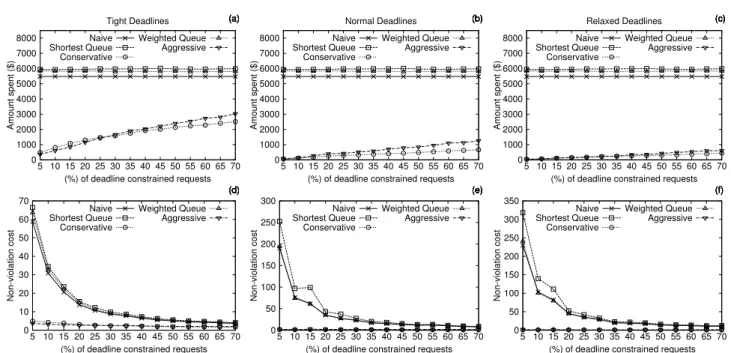
The results of this experiment are depicted in Fig-ure 4. The top graphs show the amount spent using re-sources from the Cloud provider to reduce the number of deadline violations. The Conservative and the Ag-gressive deadline strategies spend smaller amounts than the remaining strategies because they are designed to consider deadlines. Other strategies, except the na¨ıve, sort the requests according to deadlines; however, take into account other performance aspects such as min-imising response time when redirecting requests to be scheduled on the Cloud. With a small proportion of deadline constrained requests with tight deadlines, the aggressive strategy had a smaller cost that the con-servative strategy. With normal deadlines and a large number of deadline constrained requests, the aggressive strategy spends more than the conservative strategy.
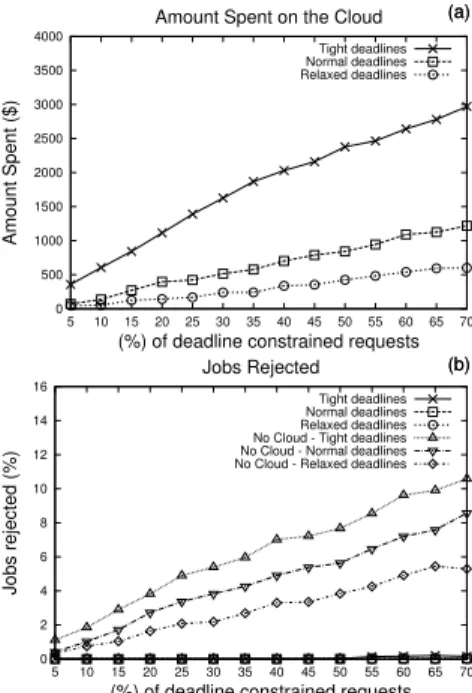
We decided to evaluate the aggressive deadline strat-egy further in a scenario considering only the site’s re-sources and a case considering the site and the Cloud. If the deadline of a request cannot be met, the request is rejected. This experiment evaluates how much the or-ganisation would need to spend to decrease the number of jobs rejected. The results are summarised in Figure 5.
0 2 4 6 8 10 12 14 16 5 10 15 20 25 30 35 40 45 50 55 60 65 70 Jobs rejected (%)
(%) of deadline constrained requests Jobs Rejected (b)
(a)
Tight deadlines Normal deadlines Relaxed deadlines No Cloud - Tight deadlines No Cloud - Normal deadlines No Cloud - Relaxed deadlines 0 500 1000 1500 2000 2500 3000 3500 4000 5 10 15 20 25 30 35 40 45 50 55 60 65 70 Amount Spent ($)
(%) of deadline constrained requests Amount Spent on the Cloud
(b) (a)
Tight deadlines Normal deadlines Relaxed deadlines
Fig. 5 (a) amount spent using resources from the Cloud
provider; (b) the decrease of requests rejected. Each data point is the average of 5 simulation rounds.
Figure 5 (a) shows the amount spent on the Cloud and (b) depicts the percentage of jobs rejected when the Cloud is used and not used. An amount of US$3,000 is spent on the Cloud to keep the number of jobs rejected close to zero under a case where 70% of the requests have deadlines. With normal deadlines, the strategy did not spend more than US$1,500 in any quantity of dead-line constrained requests.
Again using traces from the SDSC Blue Horizon, this experiment evaluates the amount of money spent using the Cloud infrastructure under different schedul-ing strategies, and compares the improvement of the strategies to a scenario where requests were scheduled using only the site’s resources with aggressive back-filling. Table 1 summarises the results. All the strate-gies perform similarly in terms of AWRT improvement. However, the proposed strategy set based on selective backfilling yields a better ratio of slowdown improve-ment to amount of money spent for using Cloud re-sources.
The experimental results show that the cost of in-creasing the performance of application scheduling is higher under a scenario where the site’s cluster is un-derutilised. However, the cost-benefit of using a na¨ıve scheduling strategy can be smaller than using other ap-proaches as a large cost is incurred under scenarios of high system utilisation. In addition, request backfilling and redirection based on the expansion factors (i.e. se-lective backfilling) have shown a good ratio of slowdown improvement to amount of money spent for using Cloud resources.
5.4 Advance Reservations
The experiments discussed in this section measure the cost of handling additional load by using the Cloud to increase the support for reservation of resources. Thereby, we measure the cost of redirecting reserva-tion requests to a Cloud provider and the cost of wast-ing Cloud resources if the redirected requests fail. As described beforehand, the experiments use a trace col-lected from a Grid’5000 site containing one year of re-quest submissions. We split the trace into two-month-long periods, and we use a different part for each sim-ulation round. All values reported by the experiments are averages of 5 simulation rounds.
The original request trace contains reservation and best-effort requests. Best-effort requests do not require reservation of resources and their start times are de-termined by the scheduler; the scheduler places then in the queue and starts their execution at the earliest time when enough resources are available; a best-effort
0 10 20 30 40 50 60 70 5 10 15 20 25 30 35 40 45 50 55 60 65 70 Non-violation cost
(%) of deadline constrained requests
(d) (e) (f) (a) (b) (c) Naive Shortest Queue Conservative Weighted Queue Aggressive 0 50 100 150 200 250 300 5 10 15 20 25 30 35 40 45 50 55 60 65 70 Non-violation cost
(%) of deadline constrained requests
(d) (e) (f) (a) (b) (c) Naive Shortest Queue Conservative Weighted Queue Aggressive 0 50 100 150 200 250 300 350 5 10 15 20 25 30 35 40 45 50 55 60 65 70 Non-violation cost
(%) of deadline constrained requests
(d) (e) (f) (a) (b) (c) Naive Shortest Queue Conservative Weighted Queue Aggressive 0 1000 2000 3000 4000 5000 6000 7000 8000 5 10 15 20 25 30 35 40 45 50 55 60 65 70 Amount spent ($)
(%) of deadline constrained requests Tight Deadlines (d) (e) (f) (a) (b) (c) Naive Shortest Queue Conservative Weighted Queue Aggressive 0 1000 2000 3000 4000 5000 6000 7000 8000 5 10 15 20 25 30 35 40 45 50 55 60 65 70 Amount spent ($)
(%) of deadline constrained requests Normal Deadlines (d) (e) (f) (a) (b) (c) Naive Shortest Queue Conservative Weighted Queue Aggressive 0 1000 2000 3000 4000 5000 6000 7000 8000 5 10 15 20 25 30 35 40 45 50 55 60 65 70 Amount spent ($)
(%) of deadline constrained requests Relaxed Deadlines (d) (e) (f) (a) (b) (c) Naive Shortest Queue Conservative Weighted Queue Aggressive
Fig. 4 The top graphs show the amount spent using resources from the Cloud provider; the bottom graphs show the cost of decreasing deadline violations under different numbers of deadline constrained requests and different types of deadlines. Each data point is the average of 5 simulation rounds.
Table 1 Performance of the strategies using workload traces (averages of 5 simulation rounds).
Metric description Na¨ıve Shortest Queue Weighted Queue Selective
Amount spent with VM instances ($) 5478.54 5927.08 5855.04 4880.16
Number of VM instances/Hours 54785.40 59270.80 58550.40 48801.60
Average weighted response time (improvement) 15036.77 15065.47 15435.11 14632.34
Overall Job slowdown (improvement) 38.29 37.65 38.42 39.70
request can be preempted to make room for a reserva-tion. Whilst we maintain the ratio of reservation and best-effort requests in the experiments, we do not con-sider preemption of requests; once the schedule of a best-effort request is determined, it is not preempted to give room for a reservation.
To measure the cost of increasing the support for ad-vance reservations, we select randomly from the trace the requests that correspond to the additional load. That is, all the original requests are submitted, along with requests randomly selected from the same trace (i.e. additional load). The percentage of requests se-lected is the additional load and varies from 0 to 100%. Furthermore, the trace contains requests whose execu-tions have failed due to factors such as incorrect con-figuration of system images and problems with the de-ployed application. When these requests are redirected to a Cloud provider and the required virtual machines are started, but not fully utilised because the applica-tion has failed, the allocaapplica-tion corresponds to a wastage of resources from the organisation’s perspective. Al-though we do not have details about the reasons why these applications have failed in the original execution,
we attempt to measure the money spent (or wasted) to allocate resources from the Cloud to serve these appli-cations.
Table 2 summarises the results. The first line shows the amount of money spent using resources from the Cloud under various additional load configurations. The second and the third lines show respectively the num-ber of requests redirected to the Cloud and their corre-sponding load percentages compared to the overall load generated. The last line shows the amount of money (in US$) spent with requests whose executions have failed. One can observe that all the additional load injected is redirected to the Cloud provider and that the amount spent on the Cloud grows proportionaly to the load redirected. Furthermore, around 60% to 70% of the money spent by using resources from the Cloud were spent on requests whose executions have failed. As dis-cussed beforehand, it is difficult to argue that all these failures reported in the original log have roots on de-ployment issues; and that is probably not the case. In addition, one can advocate that a commercial provider would offer minimum quality of service and resource availability guarantees that could minimise the number
Table 2 Cost of increasing the support for reservations (averages of 5 simulation rounds).
Additional Load 0% 10% 20% 30% 40% 50% 60% 70% 80% 90% 100%
Amount spent on the Cloud ($) 77 754 1778 3034 3926 5073 6079 6931 8736 9595 10460
Number of requests redirected 114 1032 1748 2939 4254 5795 7018 9375 11595 14535 16701
Load redirected (%) 0.52 5.20 11.58 19.47 23.31 29.78 32.86 35.68 45.11 48.27 52.15
Amount wasted with failures ($) 49 567 1355 2379 3044 3927 4693 5175 6653 7187 7778
of failures. However, it is important to notice that the results demonstrate that if a commercial Cloud provider is used to extend the capacity of a local infrastructure, deployment of applications and load redirection have to be planned carefully to avoid wastage of resources and consequently waste of money.
6 Related Work
Lease abstractions relying on virtual machine technol-ogy have been proposed [33, 21, 19]. Sotomayoret al.[33] explored a lease abstraction to handle the scheduling of a combination of best-effort jobs and advance reserva-tions. Keahey et al. [21] demonstrated how to create customised execution environments for a Grid commu-nity via Globus Virtual Workspaces. Shirako provides a system of brokers that enable the leasing of various types of resources including virtual machines [19]. In addition, the number of migrations required when the broker and a site scheduler use conflicting policies has been investigated [17]. We evaluate the cost of extend-ing the capacity of an organisation’s cluster for improv-ing the response time of user requests.
The applicability of Amazon services for Grid com-puting has been demonstrated in existing work. Palankar
et al.[27] evaluated the use of Amazon S3 for Science Grids with data-intensive applications and concluded that Amazon S3 can be used for some of the operations required by data-intensive Grid applications. Although Grid applications can benefit from using Amazon ser-vices, such as improving data availability, Palankar et al. highlighted that a balance between the benefits of Amazon services and the cost of using Amazon’s in-frastructure should be taken into account. This balance involves performing expensive operations that generate large amounts of temporary data at the Grid infras-tructure. Deelmanet al.[9] evaluated the cost of using Amazon EC2 and S3 services to serve the resource re-quirements of a scientific application.
Existing work has shown how to enable virtual clus-ters that span multiple physical computer clusclus-ters [11, 30, 31]. Emenekeret al. [11] evaluated the overhead of creating virtual clusters using Xen [4] and the Moab scheduler. VioCluster [30] is a system in which a
bro-ker responsible for managing a virtual domain (i.e. a virtual cluster) can borrow resources from another bro-ker. Brokers have borrowing and lending policies that define when machines are requested from other brokers and when they are returned, respectively. The resources borrowed by one broker from another are used to run User Mode Linux virtual machines.
Systems for virtualising a physical infrastructure are also available. Montero et al. [24] investigated the de-ployment of custom execution environments using Open Nebula. They investigated the overhead of two distinct models for starting virtual machines and adding them to an execution environment. Montero et al. [29] also used GridWay to deploy virtual machines on a Globus Grid; jobs are encapsulated as virtual machines. They evaluated several strategies such as using one virtual machine execution per job, pausing the virtual machine between job executions, and reusing the virtual machine for multiple job executions. Monteroet al.showed that the overhead of starting a virtual machine is small for the application evaluated. We use Open Nebula in the real system implementation of our architecture.
Singh et al. [32] proposed an adaptive pricing for advance reservations where the price of a reservation depends on how many jobs it delays. Aggressive back-filling is used to build a tentative schedule and test how many jobs are delayed. We use a similar approach for request admission control in one of our deadline-aware strategies and for deciding on the redirection of requests to the Cloud provider.
Market based resource allocation mechanisms for large-scale distributed systems have been investigated [39]. In this work, we do not explore a market-based mechanism as we rely on utilising resources from a Cloud provider that has cost structures in place. We focus on evaluating the trade-offs between improvement of scheduling user applications and cost of resource utili-sation. Specifically, we aim to evaluate the cost of per-formance improvements.
Several load sharing mechanisms have been investi-gated in the distributed systems realm. Iosupet al.[18] proposed a matchmaking mechanism for enabling re-source sharing across computational Grids. Wang and Morris [37] investigated different strategies for load shar-ing across computers in a local area network. Suranaet
al.[35] addressed the load balancing in DHT-based P2P networks. Balazinska et al. [3] proposed a mechanism for migrating stream processing operators in a feder-ated system. We evaluate the benefits and the cost of adding resources from a Cloud provider to an organisa-tion’s infrastructure.
7 Conclusions
This paper evaluated the cost of improving the schedul-ing performance of virtual machine requests by allocat-ing additional resources from a Cloud computallocat-ing in-frastructure. We considered the case of an organisation that operates its computing infrastructure, but wants to allocate additional resources from a Cloud infras-tructure. The experiments evaluated the cost of im-proving the performance under different strategies for scheduling requests on the organisation’s cluster and the Cloud provider. Na¨ıve scheduling strategies can re-sult in a higher cost under heavy load conditions. Ex-perimental results showed that the cost of increasing the performance of application scheduling is higher un-der a scenario where the site’s cluster is unun-der-utilised. In addition, request backfilling and redirection based on the expansion factors (i.e.selective backfilling) showed a good ratio of slowdown improvement to the money spent for using Cloud resources.
In future work, we would like to study the perfor-mance of different types of applications, such as bag-of-tasks or SPMD running on the local cluster, on the Cloud provider, and both at the same time. In addi-tion, we are currently working on an adaptive strategy that aims to optimise scheduling performance consider-ing the user’s budget. For a given budget amount, the scheduler would find the best strategy to fulfil the user’s request.
8 Acknowledgments
We would like to thank Sungjin Choi, Suraj Pandey, Carlos Varela, and Marco Netto for their feedback on a preliminary version of this work. We carried out some experiments using traces collected from the Grid’5000 platform, an initiative from the French Ministry of Re-search through the ACI GRID incentive action, IN-RIA, CNRS, RENATER and other contributing part-ners (http://www.grid5000.fr).
References
1. Amazon Inc. Amazon Elastic Compute Cloud (Amazon
EC2). http://aws.amazon.com/ec2.
2. M. Armbrust, A. Fox, R. Griffith, A. D. Joseph, R. H. Katz, A. Konwinski, G. Lee, D. A. Patterson, A. Rabkin, I. Stoica, and M. Zaharia. Above the clouds: A Berkeley view of Cloud computing. Technical report UCB/EECS-2009-28, Electrical Engineering and Computer Sciences, University of California at Berkeley, Berkeley, USA, February 2009.
3. M. Balazinska, H. Balakrishnan, and M. Stonebraker. Contract-based load management in federated distributed systems. In 1st Symposium on Networked Systems Design
and Implementation (NSDI), pages 197–210, San Francisco,
USA, March 2004. USENIX Association.
4. P. Barham, B. Dragovic, K. Fraser, S. Hand, T. Harris, A. Ho, R. Neugebauer, I. Pratt, and A. Warfield. Xen and the art of virtualization. In 19th ACM Symposium on Operating
Systems Principles (SOSP ’03), pages 164–177, New York,
NY, USA, 2003. ACM Press.
5. R. Buyya and M. Murshed. GridSim: a toolkit for the model-ing and simulation of distributed resource management and scheduling for Grid computing.Concurrency and
Computa-tion: Practice and Experience (CPE), 14(13–15):1175–1220,
November-December 2002.
6. J. S. Chase, D. E. Irwin, L. E. Grit, J. D. Moore, and S. E. Sprenkle. Dynamic virtual clusters in a Grid site manager. In
12th IEEE International Symposium on High Performance
Distributed Computing (HPDC 2003), page 90, Washington,
DC, USA, 2003. IEEE Computer Society.
7. T. H. Cormen, C. E. Leiserson, R. L. Rivest, and C. Stein.
Introduction to Algorithms. MIT Press / McGraw-Hill,
Cam-bridge, Massachusetts, 2nd edition, 2001.
8. M. D. de Assun¸c˜ao, R. Buyya, and S. Venugopal. InterGrid: A case for internetworking islands of Grids.Concurrency and
Computation: Practice and Experience (CCPE), 20(8):997–
1024, June 2008.
9. E. Deelman, G. Singh, M. Livny, B. Berriman, and J. Good. The cost of doing science on the Cloud: The montage ex-ample. In2008 ACM/IEEE Conference on Supercomputing
(SC 2008), pages 1–12, Piscataway, NJ, USA, 2008. IEEE
Press.
10. A. di Costanzo, M. D. de Assun¸c˜ao, and R. Buyya. Harness-ing cloud technologies for a virtualized distributed comput-ing infrastructure. IEEE Internet Computing, 13(5):24–33, 2009.
11. W. Emeneker, D. Jackson, J. Butikofer, and D. Stanzione. Dynamic virtual clustering with Xen and Moab. In Fron-tiers of High Performance Computing and Networking
with ISPA 2006, volume 4331 of LNCS, pages 440–451,
Berlin/Heidelberg, November 2006. Springer.
12. D. England and J. B. Weissman. Costs and benefits of load sharing in the computational Grid. In10th International Workshop on Job Scheduling Strategies for Parallel
Process-ing (JSSPP ’04), volume 3277 ofLNCS, pages 160–175, New
York, USA, 2004. Springer Berling Heidelberg.
13. D. G. Feitelson, L. Rudolph, U. Schwiegelshohn, K. C. Sev-cik, and P. Wong. Theory and practice in parallel job
schedul-ing. In Job Scheduling Strategies for Parallel Processing
(IPPS ’97), pages 1–34, London, UK, 1997. Springer-Verlag.
14. J. Font´an, T. V´azquez, L. Gonzalez, R. S. Montero, and I. M. Llorente. OpenNEbula: The open source virtual machine manager for cluster computing. In Open Source Grid and
Cluster Software Conference – Book of Abstracts, San
Fran-cisco, USA, May 2008.
15. I. Foster, T. Freeman, K. Keahey, D. Scheftner, B. So-tomayor, and X. Zhang. Virtual clusters for Grid commu-nities. In 6th IEEE International Symposium on Cluster
Computing and the Grid (CCGRID 2006), pages 513–520,
16. C. Grimme, J. Lepping, and A. Papaspyrou. Prospects of collaboration between compute providers by means of job interchange. InJob Scheduling Strategies for Parallel
Pro-cessing, volume 4942 ofLecture Notes in Computer Science,
pages 132–151, Berlin / Heidelberg, April 2008. Springer. 17. L. Grit, D. Inwin, A. Yumerefendi, and J. Chase. Virtual
machine hosting for networked clusters: Building the foun-dations for ‘autonomic’ orchestration. In1st International Workshop on Virtualization Technology in Distributed
Com-puting (VTDC 2006), Tampa, Florida, November 2006.
18. A. Iosup, D. H. J. Epema, T. Tannenbaum, M. Farrellee, and M. Livny. Inter-operating Grids through delegated match-making. In2007 ACM/IEEE Conference on
Supercomput-ing (SC 2007), pages 1–12, New York, USA, November 2007.
ACM Press.
19. D. Irwin, J. Chase, L. Grit, A. Yumerefendi, D. Becker, and K. G. Yocum. Sharing networked resources with brokered leases. InUSENIX Annual Technical Conference, pages 199– 212, Berkeley, USA, June 2006. USENIX Association. 20. M. Islam, P. Balaji, P. Sadayappan, and D. K. Panda. QoPS:
A QoS based scheme for parallel job scheduling. In9th Inter-national Workshop on Job Scheduling Strategies for Parallel
Processing (JSSPP ’03), volume 2862 ofLNCS, pages 252–
268, Seattle, WA, USA, 2003. Springer.
21. K. Keahey, I. Foster, T. Freeman, and X. Zhang. Virtual workspaces: Achieving quality of service and quality of life in the Grids.Scientific Programming, 13(4):265–275, 2006.
22. D. A. Lifka. The ANL/IBM SP scheduling system. In
Workshop on Job Scheduling Strategies for Parallel
Process-ing (IPPS’95), pages 295–303, London, UK, 1995.
Springer-Verlag.
23. U. Lublin and D. G. Feitelson. The workload on parallel supercomputers: Modeling the characteristics of rigid jobs.
Journal of Parallel and Distributed Computing, 63(11):1105–
1122, 2003.
24. R. S. Montero, E. Huedo, and I. M. Llorente. Dynamic deployment of custom execution environments in Grids.
In 2nd International Conference on Advanced
Engineer-ing ComputEngineer-ing and Applications in Sciences (ADVCOMP ’08), pages 33–38, Valencia, Spain, September/October 2008. IEEE Computer Society.
25. A. W. Mu’alem and D. G. Feitelson. Utilization, predictabil-ity, workloads, and user runtime estimates in scheduling the IBM SP2 with backfilling. IEEE Transactions on Parallel
and Distributed Systems, 12(6):529–543, 2001.
26. D. Nurmi, R. Wolski, C. Crzegorczyk, G. Obertelli, S. So-man, L. Youseff, and D. Zagorodnov. Eucalyptus: a techni-cal report on an elastic utility computing architecture linking your programs to useful systems. Technical Report 2008-10, Department of Computer Science, University of California, Santa Barbara, California, USA, 2008.
27. M. R. Palankar, A. Iamnitchi, M. Ripeanu, and S. Garfinkel. Amazon S3 for science Grids: a viable solution? In Inter-national Workshop on Data-aware Distributed Computing
(DADC’08) in conjunction with HPDC 2008, pages 55–64,
New York, NY, USA, 2008. ACM.
28. L. Ramakrishnan, D. Irwin, L. Grit, A. Yumerefendi, A. Iamnitchi, and J. Chase. Toward a doctrine of contain-ment: Grid hosting with adaptive resource control. In2006
ACM/IEEE Conference on Supercomputing (SC 2006), page
101, New York, NY, USA, 2006. ACM Press.
29. A. Rubio-Montero, E. Huedo, R. Montero, and I. Llorente. Management of virtual machines on globus Grids using Grid-Way. InIEEE International Parallel and Distributed
Pro-cessing Symposium (IPDPS 2007), pages 1–7, Long Beach,
USA, March 2007. IEEE Computer Society.
30. P. Ruth, P. McGachey, and D. Xu. VioCluster: Virtualization for dynamic computational domain. In IEEE International
on Cluster Computing (Cluster 2005), pages 1–10,
Burling-ton, USA, September 2005. IEEE.
31. A. Shoykhet, J. Lange, and P. Dinda. Virtuoso: A system for virtual machine marketplaces. Technical Report NWU-CS-04-39, Electrical Engineering and Computer Science Depart-ment, Northwestern University, Evanston/Chicago, IL, July 2004.
32. G. Singh, C. Kesselman, and E. Deelman. Adaptive pric-ing for resource reservations in shared environments. In8th IEEE/ACM International Conference on Grid Computing
(Grid 2007), pages 74–80, Austin, USA, September 2007.
ACM/IEEE.
33. B. Sotomayor, K. Keahey, and I. Foster. Combining batch execution and leasing using virtual machines. In17th Inter-national Symposium on High performance Distributed
Com-puting (HPDC 2008), pages 87–96, New York, NY, USA,
2008. ACM.
34. S. Srinivasan, R. Kettimuthu, V. Subramani, and P. Sa-dayappan. Selective reservation strategies for backfill job scheduling. In8th International Workshop on Job Scheduling
Strategies for Parallel Processing (JSSPP ’02), volume 2537
of LNCS, pages 55–71, London, UK, 2002. Springer Berlin Heidelberg.
35. S. Surana, B. Godfrey, K. Lakshminarayanan, R. Karp, and I. Stoica. Load balancing in dynamic structured peer-to-peer systems. Performance Evaluation, 63(3):217–240, 2006. 36. M. Tatezono, N. Maruyama, and S. Matsuoka. Making
wide-area, multi-site MPI feasible using Xen VM. InWorkshop on Frontiers of High Performance Computing and Networking
(held with ISPA 2006), volume 4331 of LNCS, pages 387–
396, Berlin/Heidelberg, 2006. Springer.
37. Y.-T. Wang and R. J. T. Morris. Load sharing in distributed systems. IEEE Transactions on Computers, C-34(3):204– 217, March 1985.
38. A. Weiss. Computing in the Clouds.netWorker, 11(4):16–25, December 2007.
39. R. Wolski, J. S. Plank, J. Brevik, and T. Bryan. Analyzing market-based resource allocation strategies for the computa-tional Grid.The International Journal of High Performance