The Turtles Project: Design and Implementation of Nested Virtualization
Muli Ben-Yehuda
†Michael D. Day
‡Zvi Dubitzky
†Michael Factor
†Nadav Har’El
† [email protected] [email protected] [email protected] [email protected] [email protected]Abel Gordon
†Anthony Liguori
‡Orit Wasserman
†Ben-Ami Yassour
†[email protected] [email protected] [email protected] [email protected] †
IBM Research – Haifa
‡IBM Linux Technology Center
Abstract
In classical machine virtualization, a hypervisor runs multiple operating systems simultaneously, each on its own virtual machine. Innested virtualization, a hypervi-sor can run multiple other hypervihypervi-sors with their associ-ated virtual machines. As operating systems gain hyper-visor functionality—Microsoft Windows 7 already runs Windows XP in a virtual machine—nested virtualization will become necessary in hypervisors that wish to host them. We present the design, implementation, analysis, and evaluation of high-performance nested virtualization on Intel x86-based systems. The Turtles project, which is part of the Linux/KVM hypervisor, runs multiple
un-modifiedhypervisors (e.g., KVM and VMware) and
op-erating systems (e.g., Linux and Windows). Despite the lack of architectural support for nested virtualization in the x86 architecture, it can achieve performance that is within 6-8% of single-level (non-nested) virtualization for common workloads, throughmulti-dimensional pag-ing for MMU virtualization and multi-level device
as-signmentfor I/O virtualization.
The scientist gave a superior smile before re-plying, “What is the tortoise standing on?” “You’re very clever, young man, very clever”, said the old lady. “But it’s turtles all the way
down!”1
1
Introduction
Commodity operating systems increasingly make use of virtualization capabilities in the hardware on which they run. Microsoft’s newest operating system, Win-dows 7, supports a backward compatible WinWin-dows XP mode by running the XP operating system as a virtual machine. Linux has built-in hypervisor functionality
1http://en.wikipedia.org/wiki/Turtles all the way down
via the KVM [29] hypervisor. As commodity operat-ing systems gain virtualization functionality, nested vir-tualization will be required to run those operating sys-tems/hypervisors themselves as virtual machines.
Nested virtualization has many other potential uses. Platforms with hypervisors embedded in firmware [1,20] need to support any workload and specifically other hy-pervisors as guest virtual machines. An Infrastructure-as-a-Service (IaaS) provider could give a user the ability to run a user-controlled hypervisor as a virtual machine. This way the cloud user could manage his own virtual machines directly with his favorite hypervisor of choice, and the cloud provider could attract users who would like to run their own hypervisors. Nested virtualization could also enable the live migration [14] of hypervisors and their guest virtual machines as a single entity for any reason, such as load balancing or disaster recovery. It also enables new approaches to computer security, such as honeypots capable of running hypervisor-level root-kits [43], hypervisor-level rootkit protection [39,44], and hypervisor-level intrusion detection [18, 25]—for both hypervisors and operating systems. Finally, it could also be used for testing, demonstrating, benchmarking and debugging hypervisors and virtualization setups.
The anticipated inclusion of nested virtualization in x86 operating systems and hypervisors raises many in-teresting questions, but chief amongst them is its runtime performance cost. Can it be made efficient enough that the overhead doesn’t matter? We show that despite the lack of architectural support for nested virtualization in the x86 architecture, efficient nested x86 virtualization— with as little as 6-8% overhead—is feasible even when running unmodified binary-only hypervisors executing non-trivial workloads.
Because of the lack of architectural support for nested virtualization, an x86 guest hypervisor cannot use the hardware virtualization support directly to run its own guests. Fundamentally, our approach for nested virtual-izationmultiplexesmultiple levels of virtualization
(mul-tiple hypervisors) on the single level of architectural sup-port available. We address each of the following ar-eas: CPU (e.g., instruction-set) virtualization, memory (MMU) virtualization, and I/O virtualization.
x86 virtualization follows the “trap and emulate” model [21,22,36]. Since every trap by a guest hypervisor or operating system results in a trap to the lowest (most privileged) hypervisor, our approach for CPU virtualiza-tion works by having the lowest hypervisor inspect the trap andforwardit to the hypervisors above it for emula-tion. We implement a number of optimizations to make world switches between different levels of the virtualiza-tion stack more efficient. For efficient memory virtual-ization, we developedmulti-dimensional paging, which
collapsesthe different memory translation tables into the
one or two tables provided by the MMU [13]. For effi-cient I/O virtualization, webypassmultiple levels of hy-pervisor I/O stacks to provide nested guests with direct assignment of I/O devices [11, 31, 37, 52, 53] via
multi-level device assignment.
Our main contributions in this work are:
• The design and implementation of nested virtual-ization for Intel x86-based systems. This imple-mentation can run unmodified hypervisors such as KVM and VMware as guest hypervisors, and can run multiple operating systems such as Linux and Windows as nested virtual machines. Using multi-dimensional paging and multi-level device assign-ment, it can run common workloads with overhead as low as6-8%of single-level virtualization.
• The first evaluation and analysis of nested x86 virtu-alization performance, identifying the main causes of the virtualization overhead, and classifying them into guest hypervisor issues and limitations in the architectural virtualization support. We also sug-gest architectural and software-only changes which could reduce the overhead of nested x86 virtualiza-tion even further.
2
Related Work
Nested virtualization was first mentioned and theoreti-cally analyzed by Popek and Goldberg [21, 22, 36]. Bel-paire and Hsu extended this analysis and created a formal model [10]. Lauer and Wyeth [30] removed the need for a central supervisor and based nested virtualization on the ability to create nested virtual memories. Their im-plementation required hardware mechanisms and corre-sponding software support, which bear little resemblance to today’s x86 architecture and operating systems.
Belpaire and Hsu also presented an alternative ap-proach for nested virtualization [9]. In contrast to today’s
x86 architecture which has a single level of architectural support for virtualization, they proposed a hardware ar-chitecture with multiple virtualization levels.
The IBM z/VM hypervisor [35] included the first prac-tical implementation of nested virtualization, by making use of multiple levels of architectural support. Nested virtualization was also implemented by Ford et al. in a microkernel setting [16] by modifying the software stack at all levels. Their goal was to enhance OS modularity, flexibility, and extensibility, rather than run unmodified hypervisors and their guests.
During the last decade software virtualization tech-nologies for x86 systems rapidly emerged and were widely adopted by the market, causing both AMD and Intel to add virtualization extensions to their x86 plat-forms (AMD SVM [4] and Intel VMX [48]). KVM [29] was the first x86 hypervisor to support nested virtualiza-tion. Concurrent with this work, Alexander Graf and Jo-erg Roedel implemented nested support for AMD pro-cessors in KVM [23]. Despite the differences between VMX and SVM—VMX takes approximately twice as many lines of code to implement—nested SVM shares many of the same underlying principles as the Turtles project. Multi-dimensional paging was also added to nested SVM based on our work, but multi-level device assignment is not implemented.
There was also a recent effort to incorporate nested virtualization into the Xen hypervisor [24], which again appears to share many of the same underlying principles as our work. It is, however, at an early stage: it can only run a single nested guest on a single CPU, does not have multi-dimensional paging or multi-level device assign-ment, and no performance results have been published.
Blue Pill [43] is a root-kit based on hardware virtual-ization extensions. It is loaded during boot time by in-fecting the disk master boot record. It emulates VMX in order to remain functional and avoid detection when a hypervisor is installed in the system. Blue Pill’s nested virtualization support is minimal since it only needs to remain undetectable [17]. In contrast, a hypervisor with nested virtualization support must efficiently multiplex the hardware across multiple levels of virtualization deal-ing with all of CPU, MMU, and I/O issues. Unfortu-nately, according to its creators, Blue Pill’s nested VMX implementation can not be published.
ScaleMP vSMP is a commercial product which aggre-gates multiple x86 systems into a single SMP virtual ma-chine. ScaleMP recently announced a new “VM on VM” feature which allows running a hypervisor on top of their underlying hypervisor. No details have been published on the implementation.
Berghmans demonstrates another approach to nested x86 virtualization, where a software-only hypervisor is run on a hardware-assisted hypervisor [12]. In contrast,
our approach allows both hypervisors to take advantage of the virtualization hardware, leading to a more efficient implementation.
3
Turtles: Design and Implementation
The IBM Turtles nested virtualization project imple-ments nested virtualization for Intel’s virtualization tech-nology based on the KVM [29] hypervisor. It can host multiple guest hypervisors simultaneously, each with its own multiple nested guest operating systems. We have tested it with unmodified KVM and VMware Server as guest hypervisors, and unmodified Linux and Windows as nested guest virtual machines. Since we treat nested hypervisors and virtual machines as unmodified black boxes, the Turtles project should also run any other x86 hypervisor and operating system.
The Turtles project is fairly mature: it has been tested running multiple hypervisors simultaneously, supports SMP, and takes advantage of two-dimensional page table hardware where available in order to implement nested MMU virtualization via multi-dimensional paging. It also makes use of multi-level device assignment for effi-cient nested I/O virtualization.
3.1
Theory of Operation
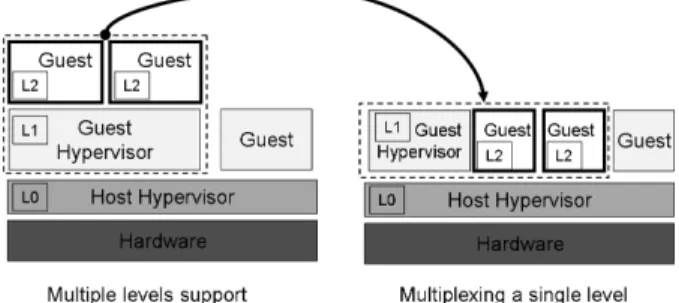
There are two possible models for nested virtualization, which differ in the amount of support provided by the underlying architecture. In the first model, multi-level
architectural support for nested virtualization, each
hy-pervisor handles all traps caused by sensitive instructions of any guest hypervisor running directly on top of it. This model is implemented for example in the IBM System z architecture [35].
The second model,single-level architectural support
for nested virtualization, has only a single hypervisor
mode, and a trap at any nesting level is handled by this hypervisor. As illustrated in Figure 1, regardless of the level in which a trap occurred, execution returns to the level 0 trap handler. Therefore, any trap occurring at any level from1. . . ncauses execution to drop to level 0. This limited model is implemented by both Intel and AMD in their respective x86 virtualization extensions, VMX [48] and SVM [4].
Since the Intel x86 architecture is a single-level vir-tualization architecture, only a single hypervisor can use the processor’s VMX instructions to run its guests. For unmodified guest hypervisors to use VMX instruc-tions, this single bare-metal hypervisor, which we call L0, needs to emulate VMX. This emulation of VMX can
work recursively. Given that L0provides a faithful
em-ulation of the VMX hardware any time there is a trap on VMX instructions, the guest running on L1will not
Figure 1: Nested traps with single-level architectural support for virtualization
know it is not running directly on the hardware. Build-ing on this infrastructure, the guest at L1 is itself able
use the same techniques to emulate the VMX hardware to an L2 hypervisor which can then run its L3 guests.
More generally, given that the guest at Ln−1provides a
faithful emulation of VMX to guests at Ln, a guest at Ln
can use the exact same techniques to emulate VMX for a guest at Ln+1. We thus limit our discussion below to L0,
L1, and L2.
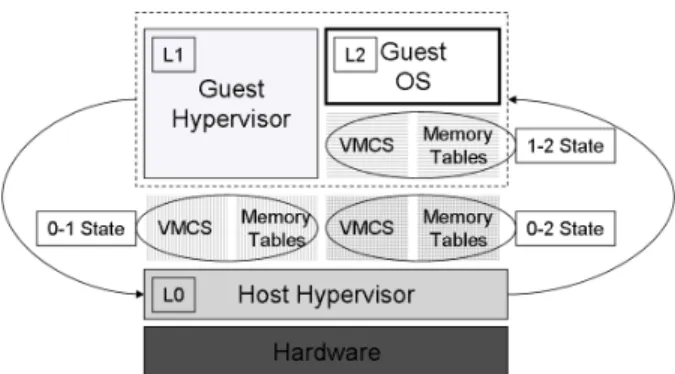
Fundamentally, our approach for nested virtualization works by multiplexing multiple levels of virtualization (multiple hypervisors) on the single level of architectural support for virtualization, as can be seen in Figure 2. Traps areforwardedby L0between the different levels.
Figure 2: Multiplexing multiple levels of virtualization on a single hardware-provided level of support
When L1wishes to run a virtual machine, it launches it
via the standard architectural mechanism. This causes a trap, since L1is not running in the highest privilege level
(as is L0). To run the virtual machine, L1supplies a
spec-ification of the virtual machine to be launched, which includes properties such as its initial instruction pointer and its page table root. This specification must be trans-lated by L0 into a specification that can be used to run
L2 directly on the bare metal, e.g., by converting
mem-ory addresses from L1’s physical address space to L0’s
physical address space. Thus L0 multiplexesthe
hard-ware between L1and L2, both of which end up running
as L0virtual machines.
When any hypervisor or virtual machine causes a trap, the L0 trap handler is called. The trap handler then
de-cides whether that trap should be handled by L0 (e.g.,
because the trapping context was L1) or whether to
for-ward it to the responsible hypervisor (e.g., because the trap occurred in L2and should be handled by L1). In the
latter case, L0forwards the trap to L1for handling.
When there arenlevels of nesting guests, but the hard-ware supports less thannlevels of MMU or DMA trans-lation tables, thenlevels need to be compressed onto the levels available in hardware, as described in Sections 3.3 and 3.4.
3.2
CPU: Nested VMX Virtualization
Virtualizing the x86 platform used to be complex and slow [40, 41, 49]. The hypervisor was forced to re-sort to on-the-fly binary translation of privileged instruc-tions [3], slow machine emulation [8], or changes to guest operating systems at the source code level [6] or during compilation [32].
In due time Intel and AMD incorporated hardware virtualization extensions in their CPUs. These exten-sions introduced two new modes of operation:root mode
andguest mode, enabling the CPU to differentiate
be-tween running a virtual machine (guest mode) and run-ning the hypervisor (root mode). Both Intel and AMD also added special in-memory virtual machine control structures (VMCS and VMCB, respectively) which con-tain environment specifications for virtual machines and the hypervisor.
The VMX instruction set and theVMCSlayout are ex-plained in detail in [27]. Data stored in theVMCScan be divided into three groups. Guest state holds virtualized CPU registers (e.g., control registers or segment regis-ters) which are automatically loaded by the CPU when switching from root mode to guest mode on VMEntry. Host state is used by the CPU to restore register val-ues when switching back from gval-uest mode to root mode on VMExit. Control data is used by the hypervisor to inject events such as exceptions or interrupts into vir-tual machines and to specify which events should cause a VMExit; it is also used by the CPU to specify the VMExit reason to the hypervisor.
In nested virtualization, the hypervisor running in root mode (L0) runs other hypervisors (L1) in guest mode.
L1hypervisors have the illusion they are running in root
mode. Their virtual machines (L2) also run in guest
mode.
As can be seen in Figure 3, L0is responsible for
mul-tiplexing the hardware between L1 and L2. The CPU
runs L1usingVMCS0→1environment specification.
Re-spectively, VMCS0→2 is used to run L2. Both of these
environment specifications are maintained by L0. In
ad-dition, L1 creates VMCS1→2 within its own virtualized
environment. Although VMCS1→2 is never loaded into
the processor, L0uses it to emulate a VMX enabled CPU
for L1.
Figure 3: Extending VMX for nested virtualization
3.2.1 VMX Trap and Emulate
VMX instructions can only execute successfully in root mode. In the nested case, L1uses VMX instructions in
guest mode to load and launch L2guests, which causes
VMExits. This enables L0, running in root mode, to trap
and emulate the VMX instructions executed by L1.
In general, when L0 emulates VMX instructions, it
updates VMCS structures according to the update pro-cess described in the next section. Then, L0 resumes
L1, as though the instructions were executed directly by
the CPU. Most of the VMX instructions executed by L1
cause, first, a VMExit from L1to L0, and then a
VMEn-try from L0to L1.
For the instructions used to run a new VM,
vmresume and vmlaunch, the process is different, since L0 needs to emulate a VMEntry from L1 to L2.
Therefore, any execution of these instructions by L1
cause, first, a VMExit from L1to L0, and then, a
VMEn-try from L0to L2.
3.2.2 VMCS Shadowing
L0 prepares a VMCS (VMCS0→1) to run L1, exactly in
the same way a hypervisor executes a guest with a single level of virtualization. From the hardware’s perspective, the processor is running a single hypervisor (L0) in root
mode and a guest (L1) in guest mode. L1 is not aware
that it is running in guest mode and uses VMX instruc-tions to create the specificainstruc-tions for its own guest, L2.
L1 defines L2’s environment by creating a VMCS
(VMCS1→2) which contains L2’s environment from L1’s
perspective. For example, the VMCS1→2 GUEST-CR3
field points to the page tables that L1 prepared for L2.
L0 cannot use VMCS1→2 to execute L2 directly, since
VMCS1→2is not valid in L0’s environment and L0
VMCS1→2 to construct a new VMCS (VMCS0→2) that
holds L2’s environment from L0’s perspective.
L0 must consider all the specifications defined
in VMCS1→2 and also the specifications defined in
VMCS0→1to createVMCS0→2. The host state defined in
VMCS0→2must contain the values required by the CPU
to correctly switch back from L2 to L0. In addition,
VMCS1→2host state must be copied toVMCS0→1guest
state. Thus, when L0emulates a switch between L2 to
L1, the processor loads the correct L1specifications.
The guest state stored in VMCS1→2 does not require
any special handling in general, and most fields can be copied directly to the guest state ofVMCS0→2.
The control data ofVMCS1→2andVMCS0→1must be
merged to correctly emulate the processor behavior. For example, consider the case where L1specifies to trap an
eventEAinVMCS1→2 but L0 does not trap such event
for L1(i.e., a trap is not specified inVMCS0→1). To
for-ward the eventEAto L1, L0needs to specify the
corre-sponding trap inVMCS0→2. In addition, the field used by
L1to inject events to L2needs to be merged, as well as
the fields used by the processor to specify the exit cause. For the sake of brevity, we omit some details on how specificVMCSfields are merged. For the complete de-tails, the interested reader is encouraged to refer to the KVM source code [29].
3.2.3 VMEntry and VMExit Emulation
In nested environments, switches from L1to L2and back
must be emulated. When L2 is running and a VMExit
occurs there are two possible handling paths, depending on whether the VMExit must be handled only by L0or
must be forwarded to L1.
When the event causing the VMExit is related to L0
only, L0handles the event and resumes L2. This kind of
event can be an external interrupt, a non-maskable inter-rupt (NMI) or any trappable event specified inVMCS0→2
that was not specified inVMCS1→2. From L1’s
perspec-tive this event does not exist because it was generated outside the scope of L1’s virtualized environment. By
analogy to the non-nested scenario, an event occurred at the hardware level, the CPU transparently handled it, and the hypervisor continued running as before.
The second handling path is caused by events related to L1 (e.g., trappable events specified in VMCS1→2).
In this case L0 forwards the event to L1 by copying
VMCS0→2fields updated by the processor toVMCS1→2
and resuming L1. The hypervisor running in L1believes
there was a VMExit directly from L2to L1. The L1
hy-pervisor handles the event and later on resumes L2 by
executingvmresumeorvmlaunch, both of which will be emulated by L0.
3.3
MMU: Multi-dimensional Paging
In addition to virtualizing the CPU, a hypervisor also needs to virtualize the MMU: A guest OS builds a guest page table which translates guest virtual addresses to guest physical addresses. These must be translated again into host physical addresses. With nested virtualization, a third layer of address translation is needed.
These translations can be done entirely in software, or assisted by hardware. However, as we explain be-low, current hardware supports only one or two
dimen-sions (levels) of translation, not the three needed for
nested virtualization. In this section we present a new technique, multi-dimensional paging, for multiplexing the three needed translation tables onto the two avail-able in hardware. In Section 4.1.2 we demonstrate the importance of this technique, showing that more na¨ıve approaches (surveyed below) cause at least a three-fold slowdown of some useful workloads.
When no hardware support for memory manage-ment virtualization was available, a technique known as shadow page tables [15] was used. A guest creates a guest page table, which translates guest virtual addresses to guest physical addresses. Based on this table, the hy-pervisor creates a new page table, the shadow page ta-ble, which translates guest virtual addresses directly to the corresponding host physical address [3, 6]. The hy-pervisor then runs the guest using this shadow page table instead of the guest’s page table. The hypervisor has to trap all guest paging changes, including page fault excep-tions, the INVLPG instruction, context switches (which cause the use of a different page table) and all the guest updates to the page table.
To improve virtualization performance, x86 architec-tures recently addedtwo-dimensional page tables[13]— a second translation table in the hardware MMU. When translating a guest virtual address, the processor first uses the regular guest page table to translate it to a guest phys-ical address. It then uses the second table, called EPT by Intel (and NPT by AMD), to translate the guest physi-cal address to a host physiphysi-cal address. When an entry is missing in the EPT table, the processor generates an EPT violation exception. The hypervisor is responsible for maintaining the EPT table and its cache (which can be flushed with INVEPT), and for handling EPT viola-tions, while guest page faults can be handled entirely by the guest.
The hypervisor, depending on the processors capabil-ities, decides whether to use shadow page tables or two-dimensional page tables to virtualize the MMU. In nested environments, both hypervisors, L0 and L1, determine
independently the preferred mechanism. Thus, L0 and
L1 hypervisors can use the same or a different MMU
differ-ent nested MMU virtualization models.
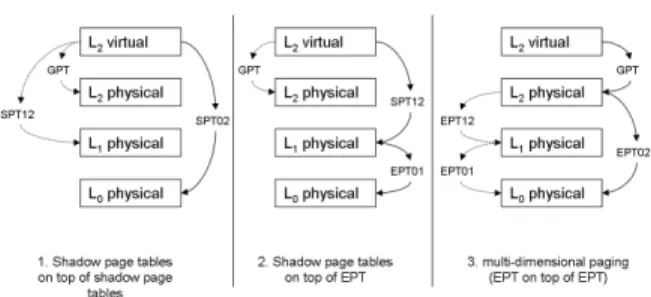
Figure 4: MMU alternatives for nested virtualization Shadow-on-shadow is used when the processor does not support two-dimensional page tables, and is the least efficient method. Initially, L0creates a shadow page
ta-ble to run L1 (SPT0→1). L1, in turn, creates a shadow
page table to run L2 (SPT1→2). L0 cannot useSPT1→2
to run L2 because this table translates L2 guest virtual
addresses to L1 host physical addresses. Therefore, L0
compresses SPT0→1 and SPT1→2 into a single shadow
page table, SPT0→2. This new table translates directly
from L2guest virtual addresses to L0host physical
ad-dresses. Specifically, for each guest virtual address in SPT1→2, L0 creates an entry inSPT0→2with the
corre-sponding L0host physical address.
Shadow-on-EPT is the most straightforward approach to use when the processor supports EPT. L0uses the EPT
hardware, but L1 cannot use it, so it resorts to shadow
page tables. L1usesSPT1→2to run L2. L0configures
the MMU to useSPT1→2as the first translation table and
EPT0→1as the second translation table. In this way, the
processor first translates from L2guest virtual address to
L1host physical address using SPT1→2, and then
trans-lates from the L1 host physical address to the L0 host
physical address using theEPT0→1.
Though the Shadow-on-EPT approach uses the EPT hardware, it still has a noticeable overhead due to page faults and page table modifications in L2. These must
be handled in L1, to maintain the shadow page
ta-ble. Each of these faults and writes cause VMExits and must be forwarded from L0 to L1 for handling. In
other words, Shadow-on-EPT is slow for the exactly the same reasons that Shadow itself was slow for single-level virtualization—but it is even slower because nested exits are slower than non-nested exits.
In multi-dimensional page tables, as in
two-dimensional page tables, each level creates its own sepa-rate translation table. For L1to create an EPT table, L0
exposes EPT capabilities to L1, even though the
hard-ware only provides a single EPT table.
Since only one EPT table is available in hardware, the two EPT tables should becompressedinto one: Let us assume that L0runs L1usingEPT0→1, and that L1
cre-ates an additional table, EPT1→2, to run L2, because L0
exposed a virtualized EPT capability to L1. The L0
hy-pervisor could then compressEPT0→1andEPT1→2 into
a singleEPT0→2 table as shown in Figure 4. Then L0
could run L2 using EPT0→2, which translates directly
from the L2guest physical address to the L0host
physi-cal address, reducing the number of page fault exits and improving nested virtualization performance. In Sec-tion 4.1.2 we demonstrate more than a three-fold speedup of some useful workloads with multi-dimensional page tables, compared to shadow-on-EPT.
The L0hypervisor launches L2with an emptyEPT0→2
table, building the table on-the-fly, on L2EPT-violation
exits. These happen when a translation for a guest phys-ical address is missing in the EPT table. If there is no translation in EPT1→2 for the faulting address, L0 first
lets L1handle the exit and updateEPT1→2. L0can now
create an entry in EPT0→2 that translates the L2 guest
physical address directly to the L0host physical address:
EPT1→2is used to translate the L2physical address to a
L1physical address, andEPT0→1translates that into the
desired L0physical address.
To maintain correctness ofEPT0→2, the L0hypervisor
needs to know of any changes that L1makes toEPT1→2.
L0sets the memory area ofEPT1→2as read-only, thereby
causing a trap when L1tries to update it. L0will then
up-dateEPT0→2according to the changed entries inEPT1→2.
L0also needs to trap all L1INVEPT instructions, and
in-validate the EPT cache accordingly.
By usinghuge pages[34] to back guest memory, L0
can create smaller and faster EPT tables. Finally, to further improve performance, L0 also allows L1to use
VPIDs. With this feature, the CPU tags each transla-tion in the TLB with a numeric virtual-processor id, eliminating the need for TLB flushes on every VMEn-try and VMExit. Since each hypervisor is free to choose these VPIDs arbitrarily, they might collide and therefore L0 needs to map the VPIDs that L1 uses into valid L0
VPIDs.
3.4
I/O: Multi-level Device Assignment
I/O is the third major challenge in server virtualization. There are three approaches commonly used to provide I/O services to a guest virtual machine. Either the hyper-visoremulatesa known device and the guest uses an un-modified driver to interact with it [47], or apara-virtual
driveris installed in the guest [6, 42], or the host assigns
a real device to the guest which then controls the device directly [11, 31, 37, 52, 53]. Device assignment generally provides the best performance [33, 38, 53], since it mini-mizes the number of I/O-related world switches between the virtual machine and its hypervisor, and although it complicates live migration, device assignment and live
migration can peacefully coexist [26, 28, 54].
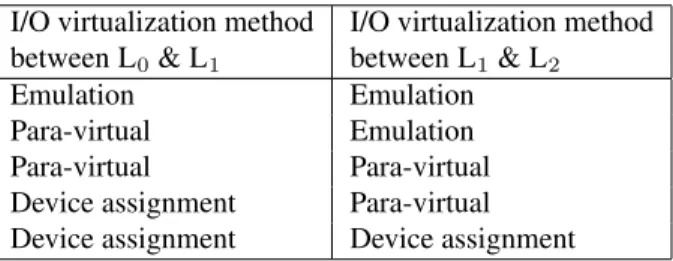
These three basic I/O approaches for a single-level guest imply nine possible combinations in the two-level nested guest case. Of the nine potential combinations we evaluated the more interesting cases, presented in Ta-ble 1. Implementing the first four alternatives is straight-forward. We describe the last option, which we call
multi-level device assignment, below. Multi-level
de-vice assignment lets the L2 guest access a device
di-rectly, bypassing both hypervisors. This direct device access requires dealing with DMA, interrupts, MMIO, and PIOs [53].
I/O virtualization method I/O virtualization method between L0& L1 between L1& L2
Emulation Emulation Para-virtual Emulation Para-virtual Para-virtual Device assignment Para-virtual Device assignment Device assignment
Table 1: I/O combinations for a nested guest Device DMA in virtualized environments is compli-cated, because guest drivers use guest physical addresses, while memory access in the device is done with host physical addresses. The common solution to the DMA problem is an IOMMU [2, 11], a hardware component which resides between the device and main memory. It uses a translation table prepared by the hypervisor to translate the guest physical addresses to host physical addresses. IOMMUs currently available, however, only support a single level of address translation. Again, we need to compress two levels of translation tables onto the one level available in hardware.
For modified guests this can be done using a paravir-tual IOMMU: the code in L1 which sets a mapping on
the IOMMU from L2 to L1 addresses is replaced by a
hypercall to L0. L0changes the L1address in that
map-ping to the respective L0address, and puts the resulting
mapping (from L2to L0addresses) in the IOMMU.
A better approach, one which can run unmodified guests, is for L0to emulate an IOMMU for L1[5]. L1
believes that it is running on a machine with an IOMMU, and sets up mappings from L2to L1addresses on it. L0
intercepts these mappings, remaps the L1 addresses to
L0 addresses, and builds the L2-to-L0 map on the real
IOMMU.
In current x86 architecture, interrupts always cause a guest exit to L0, which proceeds to forward the interrupt
to L1. L1 will then inject it into L2. The EOI (end of
interrupt) will also cause a guest exit. In Section 4.1.1 we discuss the slowdown caused by these interrupt-related exits, and propose ways to avoid it.
Memory-mapped I/O (MMIO) and Port I/O (PIO) for a nested guest work the same way they work for a single-level guest, without incurring exits on the critical I/O path [53].
3.5
Micro Optimizations
There are two main places where a guest of a nested hy-pervisor is slower than the same guest running on a bare-metal hypervisor. First, the transitions between L1and
L2 are slower than the transitions between L0 and L1.
Second, the exit handling code running in the L1
hyper-visor is slower than the same code running in L0. In this
section we discuss these two issues, and propose opti-mizations that improve performance. Since we assume that both L1and L2are unmodified, these optimizations
require modifying L0only. We evaluate these
optimiza-tions in the evaluation section.
3.5.1 Optimizing transitions between L1and L2
As explained in Section 3.2.3, transitions between L1
and L2 involve an exit to L0 and then an entry. In
L0, most of the time is spent merging theVMCS’s. We
optimize this merging code to only copy data between VMCS’s if the relevant values were modified. Keeping track of which values were modified has an intrinsic cost, so one must carefully balance full copying versus partial copying and tracking. We observed empirically that for common workloads and hypervisors, partial copying has a lower overhead.
VMCS merging could be further optimized by copy-ing multipleVMCSfields at once. However, according to Intel’s specifications, reads or writes to the VMCS area must be performed using vmread and vmwrite in-structions, which operate on a single field. We empiri-cally noted that under certain conditions one could ac-cessVMCSdata directly without ill side-effects, bypass-ingvmreadandvmwriteand copying multiple fields at once with large memory copies. However, this opti-mization does not strictly adhere to the VMX specifica-tions, and thus might not work on processors other than the ones we have tested.
In the evaluation section, we show that this opti-mization gives a significant performance boost in micro-benchmarks. However, it did not noticeably improve the other, more typical, workloads that we have evaluated.
3.5.2 Optimizing exit handling in L1
The exit-handling code in the hypervisor is slower when run in L1 than the same code running in L0. The main
cause of this slowdown are additional exits caused by privileged instructions in the exit-handling code.
In Intel VMX, the privileged instructionsvmreadand
vmwriteare used by the hypervisor to read and mod-ify the guest and host specification. As can be seen in Section 4.3, these cause L1to exit multiple times while
it handles a single L2exit.
In contrast, in AMD SVM, guest and host specifica-tions can be read or written to directly using ordinary memory loads and stores. The clear advantage of that model is that L0 does not intervene while L1 modifies
L2specifications. Removing the need to trap and
emu-late special instructions reduces the number of exits and improves nested virtualization performance.
One thing L0 can do to avoid trapping on every
vmreadandvmwriteis binary translation [3] of prob-lematic vmreadandvmwrite instructions in the L1
instruction stream, by trapping the first time such an in-struction is called and then rewriting it to branch to a non-trapping memory load or store. To evaluate the po-tential performance benefit of this approach, we tested a modified L1that directly reads and writesVMCS1→2in
memory, instead of usingvmreadandvmwrite. The performance of this setup, which we call DRW(direct read and write) is described in the evaluation section.
4
Evaluation
We start the evaluation and analysis of nested virtual-ization with macro benchmarks that represent real-life workloads. Next, we evaluate the contribution of multi-level device assignment and multi-dimensional paging to nested virtualization performance. Most of our experi-ments are executed with KVM as the L1 guest
hyper-visor. In Section 4.2 we present results with VMware Server as the L1guest hypervisor.
We then continue the evaluation with a synthetic, worst-case micro benchmark running on L2 which
causes guest exits in a loop. We use this synthetic, worst-case benchmark to understand and analyze the overhead and the handling flow of a single L2exit.
Our setup consisted of an IBM x3650 machine booted with a single Intel Xeon 2.9GHz core and with 3GB of memory. The host OS was Ubuntu 9.04 with a kernel that is based on the KVM git tree version kvm-87, with our nested virtualization support added. For both L1and
L2guests we used an Ubuntu Jaunty guest with a kernel
that is based on the KVM git tree, version kvm-87. L1
was configured with 2GB of memory and L2was
config-ured with 1GB of memory. For the I/O experiments we used a Broadcom NetXtreme 1Gb/s NIC connected via crossover-cable to an e1000e NIC on another machine.
4.1
Macro Workloads
kernbench is a general purpose compilation-type benchmark that compiles the Linux kernel multiple times. The compilation process is, by nature, CPU- and memory-intensive, and it also generates disk I/O to load the compiled files into the guest’s page cache.
SPECjbb is an industry-standard benchmark de-signed to measure the server-side performance of Java run-time environments. It emulates a three-tier system and is primarily CPU-intensive.
We executedkernbenchandSPECjbbin four se-tups: host, single-level guest, nested guest, and nested guest optimized with direct read and write (DRW) as de-scribed in Section 3.5.2. The optimizations dede-scribed in Section 3.5.1 did not make a significant difference to these benchmarks, and are thus omitted from the results. We used KVM as both L0and L1hypervisor with
multi-dimensional paging. The results are depicted in Table 2. Kernbench
Host Guest Nested NestedDRW
Run time 324.3 355 406.3 391.5 STD dev. 1.5 10 6.7 3.1 % overhead vs. host - 9.5 25.3 20.7 % overhead vs. guest - - 14.5 10.3 %CPU 93 97 99 99 SPECjbb
Host Guest Nested NestedDRW
Score 90493 83599 77065 78347 STD dev. 1104 1230 1716 566 % degradati-on vs. host - 7.6 14.8 13.4 % degradati-on vs. guest - - 7.8 6.3 %CPU 100 100 100 100
Table 2:kernbenchandSPECjbbresults We compared the impact of running the workloads in a nested guest with running the same workload in a single-level guest, i.e., the overhead added by the additional level of virtualization. Forkernbench, the overhead of nested virtualization is 14.5%, while for SPECjbb the score is degraded by 7.82%. When we discount the Intel-specificvmread andvmwrite overhead in L1,
the overhead is 10.3% and 6.3% respectively.
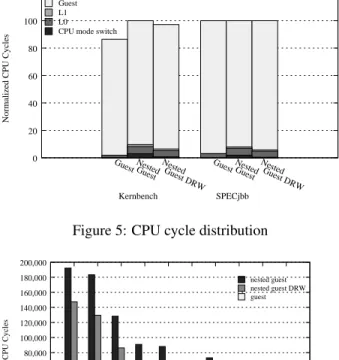
To analyze the sources of overhead, we examine the time distribution between the different levels. Figure 5 shows the time spent in each level. It is interesting to compare the time spent in the hypervisor in the single-level case with the time spent in L1in the nested guest
case, since both hypervisors are expected to do the same work. The times are indeed similar, although the L1
hy-pervisor takes more cycles due to cache pollution and TLB flushes, as we show in Section 4.3. The signifi-cant part of the virtualization overhead in the nested case comes from the time spent in L0and the increased
num-ber of exits.
For SPECjbb, the total number of cycles across all levels is the same for all setups. This is because
SPECjbbexecuted for the same pre-set amount of time in both cases and the difference was in the benchmark score.
Efficiently virtualizing a hypervisor is hard. Nested virtualization creates a new kind of workload for the L0
hypervisor which did not exist before: running another hypervisor (L1) as a guest. As can be seen in Figure 5,
forkernbenchL0takes only 2.28% of the overall
cy-cles in the single-level guest case, but takes 5.17% of the overall cycles for the nested-guest case. In other words, L0has to work more than twice as hard when running a
nested guest.
Not all exits of L2incur the same overhead, as each
type of exit requires different handling in L0and L1. In
Figure 6, we show the total number of cycles required to handle each exit type. For the single level guest we measured the number of cycles between VMExit and the consequent VMEntry. For the nested guest we measured the number of cycles spent between L2VMExit and the
consequent L2VMEntry.
There is a large variance between the handling times of different types of exits. The cost of each exit comes primarily from the number of privileged instructions per-formed by L1, each of which causes an exit to L0. For
ex-ample, when L1handles a PIO exit of L2, it generates on
average 31 additional exits, whereas in thecpuidcase discussed later in Section 4.3 only 13 exits are required. Discounting traps due to vmread andvmwrite, the average number of exits was reduced to 14 for PIO and to 2 forcpuid.
Another source of overhead is heavy-weight exits. The external interrupt exit handler takes approximately 64K cycles when executed by L0. The PIO exit handler takes
approximately 12K cycles when executed by L0.
How-ever, when those handlers are executed by L1, they take
much longer: approximately 192K cycles and 183K cy-cles, respectively. Discounting traps due to vmread
andvmwrite, they take approximately 148K cycles and 130K cycles, respectively. This difference in execution times between L0and L1is due to two reasons: first, the
handlers execute privileged instructions causing exits to L0. Second, the handlers run for a long time compared
with other handlers and therefore more external events such as external interrupts occur during their run-time.
Guest L1 L0 CPU mode switch
0 20 40 60 80 100 Guest Nested
Guest Nested Guest DRW Guest NestedGuest Nested Guest DRW
Normalized CPU Cycles
Kernbench SPECjbb
Figure 5: CPU cycle distribution
nested guest nested guest DRW guest 0 20,000 40,000 60,000 80,000 100,000 120,000 140,000 160,000 180,000 200,000
External interruptPIO Read MSRCR accessAPIC accessExceptionWrite MSRPending interruptCpuid EPT violation
CPU Cycles
Figure 6: Cycle costs of handling different types of exits
4.1.1 I/O Intensive Workloads
To examine the performance of a nested guest in the case of I/O intensive workloads we usednetperf, a TCP streaming application that attempts to maximize the amount of data sent over a single TCP connection. We measured the performance on the sender side, with the default settings ofnetperf(16,384 byte messages).
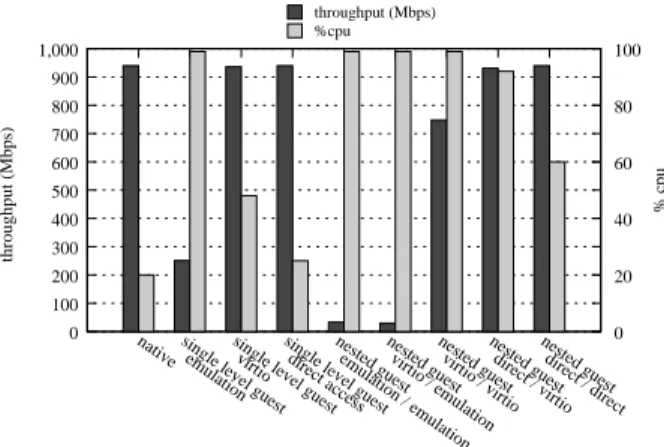
Figure 7 shows the results for running thenetperf
TCP stream test on the host, in a single-level guest, and in a nested guest, using the five I/O virtualization combina-tions described in Section 3.4. We used KVM’s default emulated NIC (RTL-8139), virtio [42] for a paravirtual NIC, and a 1 Gb/s Broadcom NetXtreme II with device assignment. All tests used a single CPU core.
On bare-metal, netperf easily achieved line rate (940 Mb/s) with 20% CPU utilization.
Emulation gives a much lower throughput, with full CPU utilization: On a single-level guest we get 25% of the line rate. On the nested guest the throughput is even lower and the overhead is dominated by the cost of device emulation between L1 and L2. Each L2 exit is
trapped by L0and forwarded to L1. For each L2exit, L1
then executes multiple privileged instructions, incurring multiple exits back to L0. In this way the overhead for
throughput (Mbps) %cpu 0 100 200 300 400 500 600 700 800 900 1,000
native single level guest
emulationsingle level guest virtio single level guest direct accessnested guest emulation / emulationnested guest virtio / emulationnested guest virtio / virtionested guest direct / virtionested guest direct / direct
0 20 40 60 80 100 throughput (Mbps) % cpu
Figure 7: Performance ofnetperfin various setups
each L2exit is multiplied.
The para-virtual virtio NIC performs better than emu-lation since it reduces the number of exits. Using virtio all the way up to L2gives 75% of line rate with a
satu-rated CPU, better but still considerably below bare-metal performance.
Multi-level device assignment achieved the best per-formance, with line rate at 60% CPU utilization (Fig-ure 7, direct/direct). Using device assignment between L0and L1and virtio between L1and L2enables the L2
guest to saturate the 1Gb link with 92% CPU utilization (Figure 7,direct/virtio).
While multi-level device assignment outperformed the other methods, its measured performance is still subop-timal because 60% of the CPU is used for running a workload that only takes 20% on bare-metal. Unfortu-nately on current x86 architecture, interrupts cannot be assigned to guests, so both the interrupt itself and its EOI cause exits. The more interrupts the device generates, the more exits, and therefore the higher the virtualiza-tion overhead—which is more pronounced in the nested case. We hypothesize that these interrupt-related exits are the biggest source of the remaining overhead, so had the architecture given us a way to avoid these exits—by assigning interrupts directly to guests rather than having each interrupt go through both hypervisors—netperf
performance on L2would be close to that of bare-metal.
To test this hypothesis we reduced the number of in-terrupts, by modifying standardbnx2network driver to work without any interrupts, i.e., continuously poll the device for pending events
Figure 8 compares some of the I/O virtualization com-binations with this polling driver. Again, multi-level de-vice assignment is the best option and, as we hypothe-sized, this time L2 performance is close to bare-metal.
With netperf’s default 16,384 byte messages, the throughput is often capped by the 1 Gb/s line rate, so we
100 200 300 400 500 600 700 800 900 1000 16 32 64 128 256 512 Throughput (Mbps)
Message size (netperf -m) L0 (bare metal) L2 (direct/direct) L2 (direct/virtio)
Figure 8: Performance ofnetperfwith interrupt-less network driver
ran netperf with smaller messages. As we can see in the figure, for 64-byte messages, for example, on L0(bare
metal) a throughput of 900 Mb/s is achieved, while on L2with multi-level device assignment, we get 837 Mb/s,
a mere 7% slowdown. The runner-up method, virtio on direct, was not nearly as successful, and achieved just 469 Mb/s, 50% below bare-metal performance. CPU utilization was 100% in all cases since a polling driver consumes all available CPU cycles.
4.1.2 Impact of Multi-dimensional Paging
To evaluate multi-dimensional paging, we compared each of the macro benchmarks described in the previ-ous sections with and without multi-dimensional paging. For each benchmark we configured L0 to run L1 with
EPT support. We then compared the case where L1uses
shadow page tables to run L2(“Shadow-on-EPT”) with
the case of L1using EPT to run L2(“multi-dimensional
paging”). Shadow on EPT Multi−dimensional paging 0.0 0.5 1.0 1.5 2.0 2.5 3.0 3.5
kernbench specjbb netperf
Improvement ratio
Figure 9: Impact of multi-dimensional paging Figure 9 shows the results. The overhead between the two cases is mostly due to the number of page-fault exits. When shadow paging is used, each page fault of the L2
pag-ing is used, only an access to a guest physical page that is not mapped in the EPT table will cause an EPT violation exit. Therefore the impact of multi-dimensional paging depends on the number of guest page faults, which is a property of the workload. The improvement is startling in benchmarks such askernbenchwith a high number of page faults, and is less pronounced in workloads that do not incur many page faults.
4.2
VMware Server as a Guest Hypervisor
We also evaluated VMware as the L1hypervisor to
ana-lyze how a different guest hypervisor affects nested vir-tualization performance. We used the hosted version, VMWare Server v2.0.1, build 156745 x86-64, on top of Ubuntu based on kernel 2.6.28-11. We intentionally did not install VMware tools for the L2 guest, thereby
in-creasing nested virtualization overhead. Due to similar results obtained for VMware and KVM as the nested hy-pervisor, we show onlykernbenchandSPECjbb re-sults below.
Benchmark % overhead vs. single-level guest
kernbench 14.98
SPECjbb 8.85
Table 3: VMware Server as a guest hypervisor Examining L1 exits, we noticed VMware Server
uses VMX initialization instructions (vmon, vmoff,
vmptrld, vmclear) several times during L2
execu-tion. Conversely, KVM uses them only once. This dissimilitude derives mainly from the approach used by VMware to interact with the host Linux kernel. Each time the monitor module takes control of the CPU, it en-ables VMX. Then, before it releases control to the Linux kernel, VMX is disabled. Furthermore, during this tran-sition many non-VMX privileged instructions are exe-cuted by L1, increasing L0intervention.
Although all these initialization instructions are emu-lated by L0, transitions from the VMware monitor
mod-ule to the Linux kernel are less frequent for Kernbench and SPECjbb. The VMware monitor module typically handles multiple L2exits before switching to the Linux
kernel. As a result, this behavior only slightly affected the nested virtualization performance.
4.3
Micro Benchmark Analysis
To analyze the cycle-costs of handling a single L2 exit,
we ran a micro benchmark in L2 that does nothing
ex-cept generate exits by callingcpuidin a loop. The vir-tualization overhead for running an L2guest is the ratio
between the effective work done by the L2guest and the
overhead of handling guest exits in L0and L1. Based on
this definition, thiscpuidmicro benchmark is a worst case workload, since L2 does virtually nothing except
generate exits. We note thatcpuidcannot in the gen-eral case be handled by L0 directly, as L1 may wish to
modify the values returned to L2.
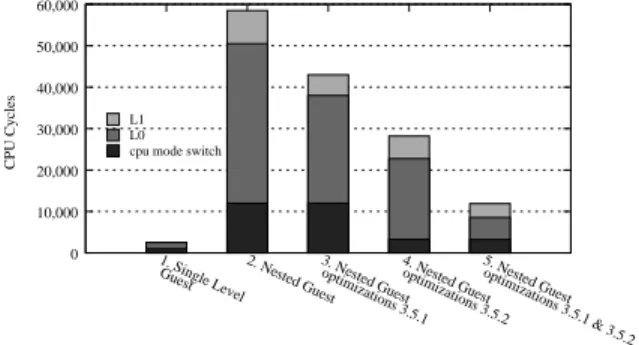
Figure 10 shows the number of CPU cycles required to execute a singlecpuidinstruction. We ran thecpuid
instruction4∗106times and calculated the average
num-ber of cycles per iteration. We repeated the test for the following setups: 1. native, 2. runningcpuidin a single level guest, and 3. runningcpuidin a nested guest with and without the optimizations described in Section 3.5. For each execution, we present the distribution of the cy-cles between the levels: L0, L1, L2. CPU mode switch
stands for the number of cycles spent by the CPU when performing a VMEntry or a VMExit. On bare metal
cpuidtakes about 100 cycles, while in a virtual ma-chine it takes about 2,600 cycles (Figure 10,column 1), about 1,000 of which is due to the CPU mode switch-ing. When run in a nested virtual machine it takes about 58,000 cycles (Figure 10,column 2).
L1 L0 cpu mode switch
0 10,000 20,000 30,000 40,000 50,000 60,000 1. Single Level
Guest 2. Nested Guest3. Nested Guestoptimizations 3.5.14. Nested Guestoptimizations 3.5.25. Nested Guestoptimizations 3.5.1 & 3.5.2
CPU Cycles
Figure 10: CPU cycle distribution forcpuid
To understand the cost of handling a nested guest exit compared to the cost of handling the same exit for a single-level guest, we analyzed the flow of handling
cpuid:
1. L2executes acpuidinstruction
2. CPU traps and switches to root mode L0
3. L0switches state from running L2to running L1
4. CPU switches to guest mode L1
5. L1modifiesVMCS1→2
repeat n times:
(a) L1accessesVMCS1→2
(b) CPU traps and switches to root mode L0
(c) L0emulatesVMCS1→2access and resumes L1
(d) CPU switches to guest mode L1
7. L1executes a resume of L2
8. CPU traps and switches to root mode L0
9. L0switches state from running L1to running L2
10. CPU switches to guest mode L2
In general, step 5 can be repeated multiple times. Each iteration consists of a single VMExit from L1 to L0.
The total number of exits depends on the specific im-plementation of the L1 hypervisor. A nesting-friendly
hypervisor will keep privileged instructions to a mini-mum. In any case, the L1hypervisor must interact with
VMCS1→2, as described in Section 3.2.2. In the case of
cpuid, in step 5, L1 reads 7 fields ofVMCS1→2, and
writes 4 fields toVMCS1→2, which ends up as 11
VMEx-its from L1 to L0. Overall, for a single L2 cpuidexit
there are 13 CPU mode switches from guest mode to root mode and 13 CPU mode switches from root mode to guest mode, specifically in steps: 2, 4, 5b, 5d, 8, 10.
The number of cycles the CPU spends in a single switch to guest mode plus the number of cycles to switch back to root mode, is approximately 1,000. The total CPU switching cost is therefore around 13,000 cycles.
The other two expensive steps are 3 and 9. As de-scribed in Section 3.5, these switches can be optimized. Indeed as we show in Figure 10,column 3, using various optimizations we can reduce the virtualization overhead by 25%, and by 80% when using non-trappingvmread
andvmwriteinstructions.
By avoiding traps on vmreadand vmwrite(
Fig-ure 10, columns 4 and 5), we removed the exits caused
byVMCS1→2accesses and the correspondingVMCS
ac-cess emulation, step 5. This optimization reduced the switching cost by 84.6%, from 13,000 to 2,000.
While it might still be possible to optimize steps 3 and 9 further, it is clear that the exits of L1 while
han-dling a single exit of L2, and specificallyVMCSaccesses,
are a major source of overhead. Architectural support for both faster world switches andVMCSupdates without ex-its will reduce the overhead.
Examining Figure 10, it seems that handlingcpuid
in L1 is more expensive than handling cpuidin L0.
Specifically, in column 3, the nested hypervisor L1
spends around 5,000 cycles to handlecpuid, while in column 1 the same hypervisor running on bare metal only spends 1500 cycles to handle the same exit (note that these numbers do not include the mode switches). The code running in L1and in L0is identical; the
differ-ence in cycle count is due to cache pollution. Running thecpuidhandling code incurs on average 5 L2 cache misses and 2 TLB misses when run in L0, whereas
run-ning the exact same code in L1incurs on average 400 L2
cache misses and 19 TLB misses.
5
Discussion
In nested environments we introduce a new type of work-load not found in single-level virtualization: the hypervi-sor as a guest. Traditionally, x86 hypervihypervi-sors were de-signed and implemented assuming they will be running directly on bare metal. When they are executed on top of another hypervisor this assumption no longer holds and the guest hypervisor behavior becomes a key factor.
With a nested L1hypervisor, the cost of a single L2
exit depends on the number of exits caused by L1
dur-ing the L2 exit handling. A nesting-friendly L1
hyper-visor should minimize this critical chain to achieve bet-ter performance, for example by limiting the use of trap-causing instructions in the critical path.
Another alternative for reducing this critical chain is to virtualize the guest hypervisor, similar to OS para-virtualization [6, 50, 51]. While this approach could re-duce L0 intervention when L1 virtualizes the L2
envi-ronment, the work being done by L0 to virtualize the
L1 environment will still persist. How much this
tech-nique can help depends on the workload and on the spe-cific approach used. Taking as a concrete example the conversion ofvmreads andvmwrites to non-trapping load/stores, para-virtualization could reduce the over-head forkernbenchfrom 14.5% to 10.3%.
5.1
Architectural Overhead
Part of the overhead introduced with nested virtualization is due to the architectural design choices of x86 hardware virtualization extensions.
Virtualization API: Two performance sensitive areas
in x86 virtualization are memory management and I/O virtualization. With multi-dimensional paging we com-pressed three MMU translation tables onto the two avail-able in hardware; multi-level device assignment does the same for IOMMU translation tables. Architectural support for multiple levels of MMU and DMA transla-tion tables—as many tables as there are levels of nested hypervisors—will immediately improve MMU and I/O virtualization.
Architectural support for delivering interrupts directly from the hardware to the L2guest will remove L0
inter-vention on interrupt delivery and completion, interven-tion which, as we explained in Secinterven-tion 4.1.1, hurts nested performance. Such architectural support will also help single-level I/O virtualization performance [33].
VMX features such as MSR bitmaps, I/O bitmaps, and CR masks/shadows [48] proved to be effective in reduc-ing exit overhead. Any architectural feature that reduces single-level exit overhead also shortens the nested critical path. Such features, however, also add implementation complexity, since to exploit them in nested environments
they must be properly emulated by L0hypervisors.
Removing the (Intel-specific) need to trap on every
vmreadandvmwriteinstruction will give an imme-diate performance boost, as we showed in Section 3.5.2.
Same Core Constraint: The x86 trap-and-emulate
implementation dictates that the guest and hypervisor share each core, since traps are always handled on the core where they occurred. Due to this constraint, when the hypervisor handles an exit the guest is temporarily stopped on that core. In a nested environment, the L1
guest hypervisor will also be interrupted, increasing the total interruption time of the L2guest. Gavrilovska, et
al., presented techniques for exploiting additional cores to handle guest exits [19]. According to the authors, for a single level of virtualization, they measured 41% aver-age improvements in call latency for null calls, cpuid and page table updates. These techniques could be adapted for nested environments in order to remove L0
interven-tions and also reduce privileged instrucinterven-tions call laten-cies, decreasing the total interruption time of a nested guest.
Cache Pollution: Each time the processor switches
between the guest and the host context on a single core, the effectiveness of its caches is reduced. This phe-nomenon is magnified in nested environments, due to the increased number of switches. As was seen in Sec-tion 4.3, even after discounting L0 intervention, the L1
hypervisor still took more cycles to handle an L2 exit
than it took to handle the same exit for the single-level scenario, due to cache pollution. Dedicating cores to guests could reduce cache pollution [7, 45, 46] and in-crease performance.
6
Conclusions and Future Work
Efficient nested x86 virtualization is feasible, despite the challenges stemming from the lack of architectural support for nested virtualization. Enabling efficient nested virtualization on the x86 platform through multi-dimensional paging and multi-level device assignment opens exciting avenues for exploration in such diverse areas as security, clouds, and architectural research.
We are continuing to investigate architectural and software-based methods to improve the performance of nested virtualization, while simultaneously exploring ways of building computer systems that have nested vir-tualization built-in.
Last, but not least, while the Turtles project is fairly mature, we expect that the additional public exposure stemming from its open source release will help enhance its stability and functionality. We look forward to see-ing in what interestsee-ing directions the research and open source communities will take it.
Acknowledgments
The authors would like to thank Alexander Graf and Jo-erg Roedel, whose KVM patches for nested SVM in-spired parts of this work. The authors would also like to thank Ryan Harper, Nadav Amit, and our shepherd Robert English for insightful comments and discussions.
References
[1] Phoenix Hyperspace. http://www.hyperspace.com/.
[2] ABRAMSON, D., JACKSON, J., MUTHRASANALLUR, S., NEIGER, G., REGNIER, G., SANKARAN, R., SCHOINAS, I., UHLIG, R., VEMBU, B., ANDWIEGERT, J. Intel virtualiza-tion technology for directed I/O.Intel Technology Journal 10, 03 (August 2006), 179–192.
[3] ADAMS, K.,ANDAGESEN, O. A comparison of software and hardware techniques for x86 virtualization. SIGOPS Oper. Syst. Rev. 40, 5 (December 2006), 2–13.
[4] AMD. Secure virtual machine architecture reference manual. [5] AMIT, N., BEN-YEHUDA, M.,ANDYASSOUR, B.-A. IOMMU:
Strategies for mitigating the IOTLB bottleneck. InWIOSCA ’10: Sixth Annual Workshop on the Interaction between Operating Systems and Computer Architecture.
[6] BARHAM, P., DRAGOVIC, B., FRASER, K., HAND, S., HARRIS, T., HO, A., NEUGEBAUER, R., PRATT, I., AND
WARFIELD, A. Xen and the art of virtualization. InSOSP ’03: Symposium on Operating Systems Principles(2003).
[7] BAUMANN, A., BARHAM, P., DAGAND, P. E., HARRIS, T., ISAACS, R., PETER, S., ROSCOE, T., SCHUPBACH¨ , A.,AND
SINGHANIA, A. The multikernel: a new os architecture for scal-able multicore systems. InSOSP ’09: 22nd ACM SIGOPS Sym-posium on Operating systems principles, pp. 29–44.
[8] BELLARD, F. QEMU, a fast and portable dynamic translator. In
USENIX Annual Technical Conference(2005), p. 41.
[9] BELPAIRE, G.,ANDHSU, N.-T. Hardware architecture for re-cursive virtual machines. InACM ’75: 1975 annual ACM con-ference, pp. 14–18.
[10] BELPAIRE, G., ANDHSU, N.-T. Formal properties of recur-sive virtual machine architectures. SIGOPS Oper. Syst. Rev. 9, 5 (1975), 89–96.
[11] BEN-YEHUDA, M., MASON, J., XENIDIS, J., KRIEGER, O.,
VANDOORN, L., NAKAJIMA, J., MALLICK, A.,ANDWAHLIG, E. Utilizing IOMMUs for virtualization in Linux and Xen. In
OLS ’06: The 2006 Ottawa Linux Symposium, pp. 71–86. [12] BERGHMANS, O. Nesting virtual machines in virtualization test
frameworks. Master’s thesis, University of Antwerp, May 2010. [13] BHARGAVA, R., SEREBRIN, B., SPADINI, F.,AND MANNE,
S. Accelerating two-dimensional page walks for virtualized sys-tems. InASPLOS ’08: 13th intl. conference on architectural sup-port for programming languages and operating systems(2008). [14] CLARK, C., FRASER, K., HAND, S., HANSEN, J. G., JUL, E.,
LIMPACH, C., PRATT, I.,ANDWARFIELD, A. Live migration of virtual machines. InNSDI ’05: Second Symposium on Networked Systems Design & Implementation(2005), pp. 273–286. [15] DEVINE, S. W., BUGNION, E.,ANDROSENBLUM, M.
Virtu-alization system including a virtual machine monitor for a com-puter with a segmented architecture. US #6397242, May 2002. [16] FORD, B., HIBLER, M., LEPREAU, J., TULLMANN, P., BACK,
G.,ANDCLAWSON, S. Microkernels meet recursive virtual ma-chines. InOSDI ’96: Second USENIX symposium on Operating systems design and implementation(1996), pp. 137–151.
[17] GARFINKEL, T., ADAMS, K., WARFIELD, A.,ANDFRANKLIN, J. Compatibility is not transparency: VMM detection myths and realities. InHOTOS’07: 11th USENIX workshop on Hot topics in operating systems(2007), pp. 1–6.
[18] GARFINKEL, T.,ANDROSENBLUM, M. A virtual machine in-trospection based architecture for intrusion detection. InNetwork & Distributed Systems Security Symposium(2003), pp. 191–206. [19] GAVRILOVSKA, A., KUMNAR, S., RAJ, H., SCHWAN, K., GUPTA, V., NATHUJI, R., NIRANJAN, R., RANADIVE, A.,AND
SARAIYA, P. High-performance hypervisor architectures: Virtu-alization in hpc systems. InHPCVIRT ’07: 1st Workshop on System-level Virtualization for High Performance Computing. [20] GEBHARDT, C., ANDDALTON, C. Lala: a late launch
appli-cation. InSTC ’09: 2009 ACM workshop on Scalable trusted computing(2009), pp. 1–8.
[21] GOLDBERG, R. P. Architecture of virtual machines. In Proceed-ings of the workshop on virtual computer systems(New York, NY, USA, 1973), ACM, pp. 74–112.
[22] GOLDBERG, R. P. Survey of virtual machine research. IEEE Computer Magazine(June 1974), 34–45.
[23] GRAF, A., AND ROEDEL, J. Nesting the virtualized world. Linux Plumbers Conference, Sep. 2009.
[24] HE, Q. Nested virtualization on xen. Xen Summit Asia 2009. [25] HUANG, J.-C., MONCHIERO, M.,ANDTURNER, Y. Ally:
Os-transparent packet inspection using sequestered cores. InWIOV ’10: The Second Workshop on I/O Virtualization.
[26] HUANG, W., LIU, J., KOOP, M., ABALI, B.,ANDPANDA, D. Nomad: migrating OS-bypass networks in virtual machines. In
VEE ’07: 3rd international conference on Virtual execution envi-ronments(2007), pp. 158–168.
[27] INTEL CORPORATION. Intel 64 and IA-32 Architectures Soft-ware Developers Manual. 2009.
[28] KADAV, A.,ANDSWIFT, M. M. Live migration of direct-access devices. InFirst Workshop on I/O Virtualization (WIOV ’08). [29] KIVITY, A., KAMAY, Y., LAOR, D., LUBLIN, U., AND
LIGUORI, A. KVM: the linux virtual machine monitor. In Ot-tawa Linux Symposium(July 2007), pp. 225–230.
[30] LAUER, H. C.,ANDWYETH, D. A recursive virtual machine architecture. InWorkshop on virtual computer systems(1973), pp. 113–116.
[31] LEVASSEUR, J., UHLIG, V., STOESS, J.,ANDG ¨OTZ, S. Un-modified device driver reuse and improved system dependability via virtual machines. InOSDI ’04: 6th conference on Symposium on Opearting Systems Design & Implementation(2004), p. 2. [32] LEVASSEUR, J., UHLIG, V., YANG, Y., CHAPMAN, M.,
CHUBB, P., LESLIE, B.,ANDHEISER, G. Pre-virtualization: Soft layering for virtual machines. InACSAC ’08: 13th Asia-Pacific Computer Systems Architecture Conference, pp. 1–9. [33] LIU, J. Evaluating standard-based self-virtualizing devices: A
performance study on 10 GbE NICs with SR-IOV support. In
IPDPS ’10: IEEE International Parallel and Distributed Pro-cessing Symposium(2010).
[34] NAVARRO, J., IYER, S., DRUSCHEL, P.,ANDCOX, A. Prac-tical, transparent operating system support for superpages. In
OSDI ’02: 5th symposium on Operating systems design and im-plementation(2002), pp. 89–104.
[35] OSISEK, D. L., JACKSON, K. M.,ANDGUM, P. H. Esa/390 interpretive-execution architecture, foundation for vm/esa. IBM Systems Journal 30, 1 (1991).
[36] POPEK, G. J.,ANDGOLDBERG, R. P. Formal requirements for virtualizable third generation architectures.Commun. ACM 17, 7 (July 1974), 412–421.
[37] RAJ, H.,ANDSCHWAN, K. High performance and scalable I/O virtualization via self-virtualized devices. InHPDC ’07: Pro-ceedings of the 16th international symposium on High perfor-mance distributed computing(2007), pp. 179–188.
[38] RAM, K. K., SANTOS, J. R., TURNER, Y., COX, A. L.,AND
RIXNER, S. Achieving 10Gbps using safe and transparent net-work interface virtualization. InVEE ’09: The 2009 ACM SIG-PLAN/SIGOPS International Conference on Virtual Execution Environments(March 2009).
[39] RILEY, R., JIANG, X., AND XU, D. Guest-transparent pre-vention of kernel rootkits with vmm-based memory shadowing. InRecent Advances in Intrusion Detection, vol. 5230 ofLecture Notes in Computer Science. 2008, ch. 1, pp. 1–20.
[40] ROBIN, J. S.,ANDIRVINE, C. E. Analysis of the intel pen-tium’s ability to support a secure virtual machine monitor. In9th conference on USENIX Security Symposium(2000), p. 10. [41] ROSENBLUM, M. Vmware’s virtual platform: A virtual machine
monitor for commodity pcs. InHot Chips 11(1999).
[42] RUSSELL, R. virtio: towards a de-facto standard for virtual I/O devices.SIGOPS Oper. Syst. Rev. 42, 5 (2008), 95–103. [43] RUTKOWSKA, J. Subverting vista kernel for fun and profit.
Blackhat, Aug. 2006.
[44] SESHADRI, A., LUK, M., QU, N.,ANDPERRIG, A. Secvisor: a tiny hypervisor to provide lifetime kernel code integrity for com-modity oses. InSOSP ’07: 21st ACM SIGOPS symposium on Operating systems principles(2007), pp. 335–350.
[45] SHALEV, L., BOROVIK, E., SATRAN, J.,ANDBEN-YEHUDA, M. Isostack—highly efficient network processing on dedicated cores. InUSENIX ATC ’10: The 2010 USENIX Annual Technical Conference(2010).
[46] SHALEV, L., MAKHERVAKS, V., MACHULSKY, Z., BIRAN, G., SATRAN, J., BEN-YEHUDA, M.,ANDSHIMONY, I. Loosely coupled tcp acceleration architecture. InHOTI ’06: Proceedings of the 14th IEEE Symposium on High-Performance Interconnects
(Washington, DC, USA, 2006), IEEE Computer Society, pp. 3–8. [47] SUGERMAN, J., VENKITACHALAM, G.,ANDLIM, B.-H. Virtu-alizing I/O devices on VMware workstation’s hosted virtual ma-chine monitor. InUSENIX Annual Technical Conference(2001). [48] UHLIG, R., NEIGER, G., RODGERS, D., SANTONI, A. L., MARTINS, F. C. M., ANDERSON, A. V., BENNETT, S. M., KAGI, A., LEUNG, F. H.,ANDSMITH, L. Intel virtualization technology.Computer 38, 5 (2005), 48–56.
[49] WALDSPURGER, C. A. Memory resource management in VMware ESX server. InOSDI ’02: 5th Symposium on Operating System Design and Implementation.
[50] WHITAKER, A., SHAW, M.,ANDGRIBBLE, S. D. Denali: a scalable isolation kernel. InEW ’10: 10th ACM SIGOPS Euro-pean workshop(2002), pp. 10–15.
[51] WHITAKER, A., SHAW, M.,ANDGRIBBLE, S. D. Scale and performance in the denali isolation kernel. SIGOPS Oper. Syst. Rev. 36, SI (2002), 195–209.
[52] WILLMANN, P., SHAFER, J., CARR, D., MENON, A., RIXNER, S., COX, A. L.,ANDZWAENEPOEL, W. Concurrent direct net-work access for virtual machine monitors. InHigh Performance Computer Architecture, 2007. HPCA 2007. IEEE 13th Interna-tional Symposium on(2007), pp. 306–317.
[53] YASSOUR, B.-A., BEN-YEHUDA, M.,ANDWASSERMAN, O. Direct device assignment for untrusted fully-virtualized virtual machines. Tech. rep., IBM Research Report H-0263, 2008. [54] ZHAI, E., CUMMINGS, G. D.,ANDDONG, Y. Live migration
with pass-through device for Linux VM. InOLS ’08: The 2008 Ottawa Linux Symposium(July 2008), pp. 261–268.