Development Of Antirigging Voting System Using Biometrics Based
On Adharcard Numbering
1M.Venkata Rao,2Venugopal Rao Ravula,3Pavani Pala
1Assistant professor,2,3(B.Tech students) in Dept of Electronic and Communication Engineering
Amrita sai Institute of science and technology,Bathinapadu,Aandhra Pradesh,INDIA
Abstract: Now a days voting process is exercised
by using EVM(Electronic voting machine). In this paper we present and use implementation is to implement the development of anti rigging voting system using fingerprint.The purpose of the project and implementation is to provide a secured and reliable environment to the customers is to electing thecandidatesby using the intelligentelectronic voting machineby providing a unique identity to every user using the FINGER PRINT identification technology. Here in this project and implementation we are going provide the at most security since it is taking the FINGER PRINTS as the authentication for EVM. Intelligent EVM is an Embedded based project and implementation. It involves microcontroller and interfaces. Intelligent EVM has been specially designed to collect, record, store, count and display cent percent accurately. It has got two units control unit and ballot unit. It has “DISPLAY” section that will display the number of votes to respective candidate at the end of the poll.
Keywords- FINGERPRINTMODULE,EEPROM
,MAX232
I. Introduction
In present days, computer becomes a main part of human beings for storing information. This information is up to some extent is a secured one. For example the details of employees and student etc... The authority person may only change the details. For this protection we are going to provide a PASSWORD for the PCs. This is secure up to some extent only because there may be a chance of revealing the password or some times the authorized person may forgot the password. So we have to provide security for PCs with a unique and simple to remember identification. One of such identification is the FINGER PRINT.Fingerprint Scanner is a device for computer Security featuring superior performance, accuracy, durability based on unique NITGEN Fingerprint Biometric Technology. Fingerprint Scanner can be plugged into a computer
of password that is vulnerable to fraud and is hard to remember.
II.Issues Of Existing Voting System
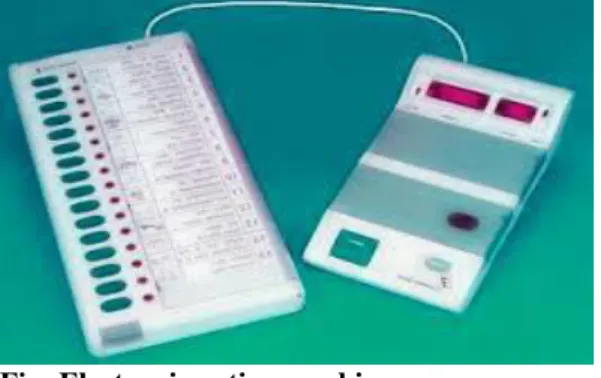
Elections are a defining feature of democratic government, but all too frequently, we take the actual mechanics of the election for granted. We speak at length of such issues as who is allowed to vote, how campaigns are conducted, and how they are financed, but no one gives priority to the understanding of the actual voting process. Electronic Voting Machines ("EVM"), Idea mooted by the Chief Election Commissioner in 1977. The EVMs were devised and designed by Election Commission of India in collaboration with Bharat Electronics Limited (BEL), Bangalore and Electronics Corporation of India Limited (ECIL), Hyderabad. The EVMs are now manufactured by the above two undertakings. An EVM consists of two units, i) Control Unit, ii) Balloting Unit. The two units are joined by a five-meter cable. The Control Unit is with the Presiding Officer or a Polling Officer and the Balloting Unit is placed inside the voting compartment.
Fig: Electronic voting machine
There are two types of problems with EVM which is currently in use :
2. Illegal Voting (Rigging) - The very commonly known problem, Rigging which is faced in every electoral procedure. One candidate, casts the votes of all the members or few amount of members in the electoral list illegally. This results in the loss of votes for the other candidates participating and also increases the number votes to the candidate who performs this action. This can be done externally at the time of voting.
III.Bioemtric System (Fingerprint Recognition)
The analysis of fingerprints for matching purposes generally requires the comparison of several features of the print pattern. These include patterns, which are aggregate characteristics of ridges, and minutia points, which are unique features found within the patterns.[1]It is also necessary to know the structure and properties of human skin in order to successfully employ some of the imaging technologies.
Patterns
The three basic patterns of fingerprint ridges are the arch, loop, and whorl:
arch: The ridges enter from one side of the finger, rise in the center forming an arc, and then exit the other side of the finger.
loop: The ridges enter from one side of a finger, form a curve, and then exit on that same side.
whorl: Ridges form circularly around a central point on the finger.
Scientists have found that family members often share the same general fingerprint patterns, leading to the belief that these patterns are.
Fig:The arch pattern Fig:The loop pattern.
I. Architecture of the system
The block diagram of anti rigging voting system is as follows
II. MODULES USED
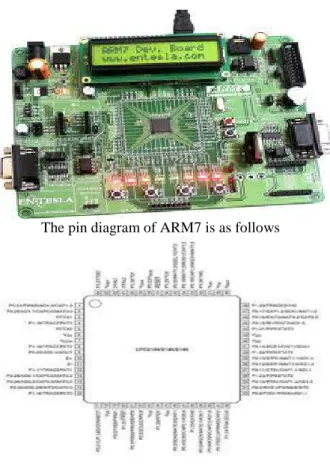
Microcontroller Used
The most widely used ARM7 designs implement the ARMv4T architecture, but some implement ARMv3 or ARMv5TEJ. All these designs use a Von Neumann architecture, thus the few versions comprising a cache do not separate data and instruction caches.Some ARM7 cores are obsolete. One historically significant model, the ARM7DI[1]is notable for having introduced JTAG based on-chip debugging; the preceding ARM6 cores did not support it. The "D" represented a JTAG TAP for debugging; the "I" denoted an ICEBreaker debug module supporting hardware breakpoints and watchpoints, and letting the system be stalled for debugging. Subsequent cores included and enhanced this support.It is a versatile processor designed for mobile devices and other low power electronics. This processor architecture is capable of up to 130 MIPS on a typical0.13 µm process. TheARM7TDMI processor core implements ARM architecture v4T. The processor supports both 32-bit and 16-bit instructions via the ARM and Thumb instruction sets.
Mic
ro
Co
ntr
olle
r
Power
Supply
Fin
ger
Pri
nt
Mo
dul
e
MAX
232
LCD
Display
EEPRO
M
Keypad
The pin diagram of ARM7 is as follows
A. Fingerprint Module R305
R305 Fingerprint Module is a serial fingerprint scanner which can be directly
connected to the PC’s com port. R305 Fingerprint
Sensor can easily be connected to any controller via MAX232 IC. This Fingerprint scanner is capable of storing and comparing the fingerprint and accordingly giving the desired output.Fingerprint processing includes two parts: fingerprint enrollment and fingerprint matching (the matching can be 1:1 or 1: N). When enrolling, user needs to enter the finger two times. The system will process the two time finger images, generate a template of the finger based on processing results and store the template. When matching, user enters the finger through optical sensor and system will generate a template of the finger and compare it with templates of the finger library. matching finger. In both circumstances, system will return the matching result, success or failure.
Features:
Basic Power: 8-12v AC/DC
Interface: RS232.
Matching Mode: 1:1 and 1:N Baud rate: 9600–115200. Default: 57600.
Image Acquire Time: <0.5sec
Fig: Finger print module B. LCD DISPLAY
A liquid crystal display is a special thin flat panel that can let light go through it, or can block the light. (Unlike an LED it does not produce its own light). The panel is made up of several blocks, and each block can be in any shape. Each block is filled with liquid crystals that can be made clear or solid, by changing the electric current to that block. Liquid crystal displays are often abbreviated LCDs.Liquid crystal displays are often used in battery-powered devices, such as digital watches, because they use very little electricity. They are also used for flat screenTV's. Many LCDs work well by themselves when there is other light around (like in a lit room, or outside in daylight). For smartphones, computer monitor, TV's and some other purposes, a back-light is built into the product.
Fig: L c d display
C. KEYPAD
and a key is pressed, one of the columns will have 0 since the key pressed provides the path to ground.
D. MAX232
The MAX220–MAX249 family of line drivers/receivers is intended for all EIA/TIA-232E and V.28/V.24 communications interfaces, particularly applications where ±12V is not available.These parts are especially useful in battery-powered systems, since their low-power shutdown mode reduces power dissipation to less than 5µW. The MAX225, MAX233, MAX235, and MAX245/MAX246/MAX247 use no external components and are recommended for applications where printed circuit board space is critical.
E. POWER SUPPLY
Power Supply - Power supply unit consists of the following units:
1. Step down transformer 2. Rectifier unit
3. Input filter 4. Regulator unit 5. Output filter
III. FUTURE SCOPE
1. This system can be implemented in a few years, with recent development in technology, a fingerprint scanner is neither too expensive nor too complicated to use on daily basis.
2.Memory of finger print module can be expanded .We can use a 1mb flash memory finger print module for increasing the capacity.
Unique Identification Numbers (Aadhar cards) have already been introduced in India that contains an
individual‘s fingerprints and iris scan. Soon every
Indian citizen can have a similar identity card and all the government will have all the necessary information required to bring such a system in play.
IV. CONCLUSION
Thus the advent of this biometric voting system would enable hosting of fair elections in India. This will preclude the illegal practices like rigging. The citizens can be sure that they alone can choose their leaders, thus exercising their right in the democracy.
REFERENCES
[1.] Schurmann, C.; IT Univ. of Copenhagen,
Copenhagen, Denmark . ―Electronic Elections:
Trust Through Engineering‖, First international
workshop Requirements Engineering for e-Voting Systems (RE-VOTE), 2009.
[2.] .Introducing Electoral voting, IDEA-international institute for democracy and Electoral Assistance, policy paper, Dec 2011.
[3]. Firas Hazzaa, Seifedine Kadry, New System of E-voting Using Fingerprint, International Journal of Emerging Technology and Advanced Engineering, 2 (2012) 355-363.
[4.] K. Memon, Dileep Kumar, S. Usman, Next Generation A secure E-Voting System Based On Biometric Fingerprint Method, International Conference on Information and Intelligent Computing (IPCSIT). (2011).
Authors:
M.Venkata Rao, M.Tech, He is
currently working as Assistant professor in Department of Electronic and Communication Engineering at Amrita sai Institute of science and technology, Bathinapadu, He expert in this areas Artificial Immune System ,Conditional Monitoring and Instrumentation ,Circuits and Devices, Communication and Information Processing, Electrical Engineering Communications, Electromagnetic and Microwave, Measurement and Testing, Nanoscience and Nanotechnology, Devices and Systems all current trends and techniques in Electronic and Communication Engineering.
Venugopal Rao Ravula, is a
student of Amrita sai Institute of science and technology, Bathinapadu. Presently he is pursuing his B.Tech [Electronic and Communication Engineering] from this college and Affiliated to JNT University Kakinada in this year 2015. His area of interest includes Embedded System Artificial Intelligence, Neural Network, Distributed Computing Signal Processing, Microprocessor, all current trends and techniques in Electronic and Communication Engineering.
Pavani Pala, is a student of