28
RESEARCH ON THE EVOLUTION OF MAIN YIELD COMPONENTS OF
MAIZE HYBRIDS GROWN IN DIFFERENT CLIMATIC CONDITIONS ON
LUVOSOIL FROM SIMNIC AREA
BORLEANU IOANA CLAUDIA1, PARASCHIVU MIRELA1, TUȚĂ CLAUDIA ELENA1
1 Agricultural Research and Development Station Simnic
Key words: maize,hybrid, yield,climatic condition,sowing density,yield component
ABSTRACT
Environmental factors strongly influence the yields of cultivated crops. In maize, drought is one of the major factors limiting biomass and seed production. Five maize hybrids sowed in three different planting densities have been evaluated for their response to water stress conditions comparatively with well-watered conditions. Several yield components were measured: grain yield, ears/plant, ear weight, thousand kernel weight. Under water stress conditions it terms of planting densities grain yield, ears/plant, relative yield weren’t significantly affected, while ear weight and thousand kernels weight were
significantly lower for 50000 pl/ha and 60000 pl/ha comparatively with the control.Relative
yield was a stable character with mean values close to one planting density to another. Among all studied characters under normal water conditions only grain yield, ears number/plant and thousand kernels weight were significantly affected by planting density.
INTRODUCTION
29
MATERIAL AND METHODS
During three years (2009-2011) six maize hybrids grown on three planting density (40000pl/ha, 50000pl/ha and 60000pl/ha) have been tested in different climatic conditions in order to evaluate their yielding capacity and main yield components. The material was represented by six maize hybrids (F 475, Kamelias, Danubian, KWS 2376, Rapsodia, Kitty) tested using a split plot design with two factors (Factor A – planting density, Factor B – maize hybrid) in three replications. The size of each plot was 25 m2
. Plots were fertilized at sowing time with 200 kg/ha complex fertilizer NPK 20-20-0 basal applied and 150 kg/ha ammonium nitrate top-dressed during vegetation period. Weeds were controlled in each experimental year using herbicides. For the experiment F 475 and 40000 plants/ha were considered as the control. Grain yield, ears/plant, ear weight, relative yield and thousand kernels weight were determined for each plot and replication. For statistic interpretation was used analyze of variance.
RESULTS AND DISCUSSION
30
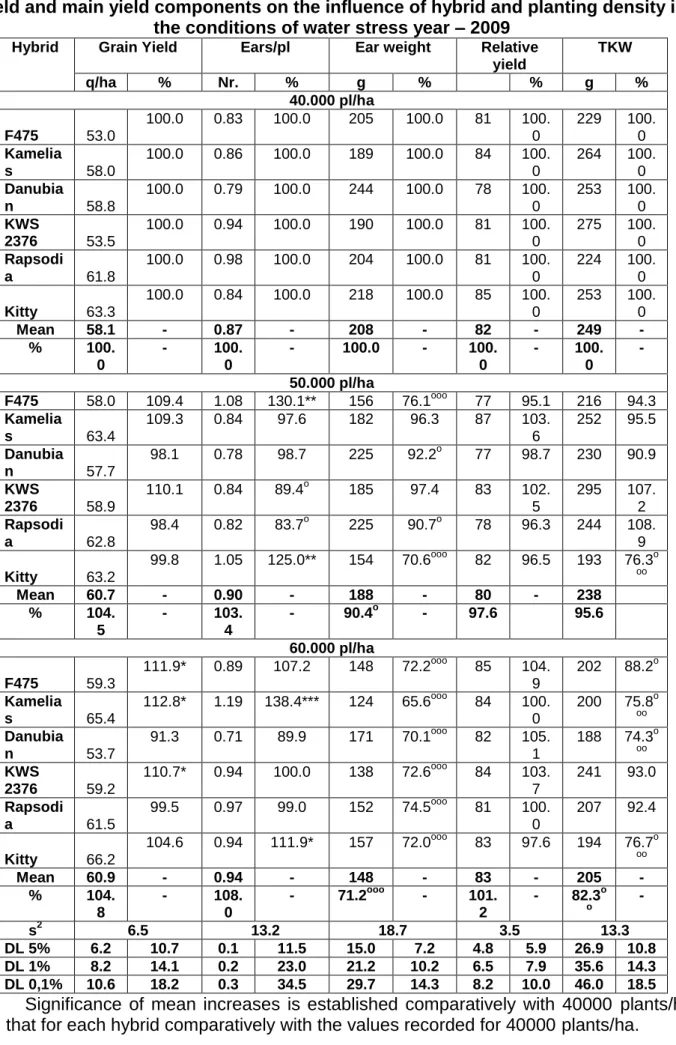
Table 1
Yield and main yield components on the influence of hybrid and planting density in the conditions of water stress year – 2009
Hybrid Grain Yield Ears/pl Ear weight Relative
yield
TKW
q/ha % Nr. % g % % g %
40.000 pl/ha
F475 53.0
100.0 0.83 100.0 205 100.0 81 100.
0
229 100.
0
Kamelia
s 58.0
100.0 0.86 100.0 189 100.0 84 100.
0
264 100.
0
Danubia
n 58.8
100.0 0.79 100.0 244 100.0 78 100.
0
253 100.
0
KWS
2376 53.5
100.0 0.94 100.0 190 100.0 81 100.
0
275 100.
0
Rapsodi
a 61.8
100.0 0.98 100.0 204 100.0 81 100.
0
224 100.
0
Kitty 63.3
100.0 0.84 100.0 218 100.0 85 100.
0
253 100.
0
Mean 58.1 - 0.87 - 208 - 82 - 249 -
% 100.
0
- 100.
0
- 100.0 - 100.
0
- 100.
0
-
50.000 pl/ha
F475 58.0 109.4 1.08 130.1** 156 76.1ooo 77 95.1 216 94.3
Kamelia
s 63.4
109.3 0.84 97.6 182 96.3 87 103.
6
252 95.5
Danubia
n 57.7
98.1 0.78 98.7 225 92.2o 77 98.7 230 90.9
KWS
2376 58.9
110.1 0.84 89.4o 185 97.4 83 102.
5
295 107.
2
Rapsodi
a 62.8
98.4 0.82 83.7o 225 90.7o 78 96.3 244 108.
9
Kitty 63.2
99.8 1.05 125.0** 154 70.6ooo 82 96.5 193 76.3o
oo
Mean 60.7 - 0.90 - 188 - 80 - 238
% 104.
5
- 103.
4
- 90.4o - 97.6 95.6
60.000 pl/ha
F475 59.3
111.9* 0.89 107.2 148 72.2ooo 85 104.
9
202 88.2o
Kamelia
s 65.4
112.8* 1.19 138.4*** 124 65.6ooo 84 100.
0
200 75.8o
oo
Danubia
n 53.7
91.3 0.71 89.9 171 70.1ooo 82 105.
1
188 74.3o
oo
KWS
2376 59.2
110.7* 0.94 100.0 138 72.6ooo 84 103.
7
241 93.0
Rapsodi
a 61.5
99.5 0.97 99.0 152 74.5ooo 81 100.
0
207 92.4
Kitty 66.2
104.6 0.94 111.9* 157 72.0ooo 83 97.6 194 76.7o
oo
Mean 60.9 - 0.94 - 148 - 83 - 205 -
% 104.
8
- 108.
0
- 71.2ooo - 101.
2
- 82.3o
o -
s2 6.5 13.2 18.7 3.5 13.3
DL 5% 6.2 10.7 0.1 11.5 15.0 7.2 4.8 5.9 26.9 10.8
DL 1% 8.2 14.1 0.2 23.0 21.2 10.2 6.5 7.9 35.6 14.3
DL 0,1% 10.6 18.2 0.3 34.5 29.7 14.3 8.2 10.0 46.0 18.5
31
Table 2
Yield and main yield components on the influence of hybrid and planting density in the conditions of normal rainfall regime (2010-2011)
Hybrid Grain Yield Ears/pl Ear weight Relative
yield
TKW
q/ha % Nr. % g % % g %
40.000 pl/ha
F475 66.3
100.0 1.45 100.0 124 100.0 86 100.
0 362
100. 0
Kamelias 65.9
100.0 1.56 100.0 112 100.0 88 100.
0 327
100. 0
Danubian 63.3
100.0 1.36 100.0 131 100.0 86 100.
0 287
100. 0
KWS 2376 64.4
100.0 1.62 100.0 103 100.0 85 100.
0 326
100. 0
Rapsodia 64.2
100.0 1.35 100.0 136 100.0 83 100.
0 312
100. 0
Kitty 75.1
100.0 1.46 100.0 141 100.0 86 100.
0 298
100. 0
Mean 66.5 - 1.47 - 125 - 86 - 318 -
% 100.
0
- 100.0 - 100.0 - 100.
0
- 100.
0
-
50.000 pl/ha
F475 75.7
114.2** 1.34 92.4 124 100.0 87 101.
2 296
81.8o oo
Kamelias 74.6
113.2** 1.42 91.0 117 104.5 85 96.6
330 100.
9
Danubian 68.8 108.7 1.24 91.2 133 101.5 85 98.8 282 98.3
KWS 2376 72.1
112.0* 1.51 93.2 106 102.9 87 102.
4 332
101. 8
Rapsodia 74.0
115.3** 1.26 93.3 142 104.4 87 104.
8* 303
97.1
Kitty 78.0
103.9 1.34 91.8 129 91.5 87 101.
1 272
91.2o oo
Mean 73.9 1.35 125 86 303
% 111.
1*
91.8o 100.0 100.
0
95.3
60.000 pl/ha
F475 75.7
107.2 1.34 92.4 104 83.9o 86 100.
0 277
76.5o oo
Kamelias 74.6
97.4 1.12 71.8 111 99.1 86 97.7
279
85.3o oo
Danubian 68.8
94.8 1.22 89.7 97 74.0ooo 84 97.7
250
87.1o oo
KWS 2376 72.1 111.8* 1.37 84.6 98 95.1 84 98.8 318 97.5
Rapsodia 74.0
109.7 1.04 77.0 131 96.3 84 101.
2 292
93.6o
Kitty 78.0
97.5 1.33 91.1 113 80.1ooo 88 102.
3 273
91.6o o
Mean 73.9 1.24 109 85 282
% 111.
1*
84.4oo 87.2o 98.8 88.7o
oo
s2 7.4 10.7 12.3 1.7 9.3
DL 5% 6.6 9.9 0.1 6.8 14.2 11.4 4.0 4.7 15.2 4.8
DL 1% 8.7 13.1 0.2 13.6 18.7 15.0 5.7 6.6 21.6 6.8
DL 0,1% 11.3 17.0 0.3 20.4 23.1 18.5 7.6 8.8 27.2 8.6
32
It was observed that grain yield increased significantly for most tested hybrids at a density of 50000 pl/ha, while at planting density of 60000 pl/ha only KWS 2376 recorded a significantly grain yield increase. Generally, ears number/plant was significantly affected by planting density for both 50000 pl/ha and 60000 pl/ha comparatively with the control. Ears weight was another yield component affected by planning density, recording decreases comparatively with the control at a density of 60000 pl/ha. Thousand kernels weight decreased as planting density increased, the most affected hybrids were F475 and Kitty.
The most affected characters due to water stress were number of ears/plant and thousand kernels weight. Relative yield was a stable character with mean values close to one planting density to another.
CONCLUSIONS
Generally, yield and yield components were affected by water stress for all tested hybrids comparatively with the values recorded in well-watered year. Under water stress conditions it terms of planting densities grain yield, ears/plant, relative yield weren’t significantly affected, while ear weight was significantly and very significantly lower for 50000 pl/ha and 60000 pl/ha comparatively with the control. Among all studied characters under normal water conditions only grain yield, ears number/plant and thousand kernels weight were significantly affected by planting density.
BIBLIOGRAPHY
Betrán F.J., Beck D., Bänziger M., Edmeades G.O. 2003. Genetic analysis of inbred and
hybrid grain yield under stress and nonstress environments in tropical maize. Crop Science 43, p.807-817.
Beck J., Betrán F.J., Bänziger M., Edmeades G.O., Ribant J.M., Willcox M., Vasal S.K., Ortega A. 1997. Progress in developing drought and low soil nitrogen tolerance in maize. In: Proceedings of the Annual Corn and Sorghum Research Conference, 51, Chicago. Illionis, 11-12 December 1996. Washington D.C., American Seed Trade.
Dow E.W., Daynard T.B., Muldoon J.F., Major D.J., Thurtell G.W. 1984. Resitance to drought and density stress in Canadian and European maize (Zea mais L.)hybrids. Canadian Journal Plant Science 64, p.575-585.
Duvick D.N.1992. Genetic contributions to advances in yield of U.S. maize. Maydica 37,
p.69-79.
Edmeades G.O., Bolaños J., Lafitte, H.R. 1992. Progres in breeding for drought
tolerance in maize. In: D. Wilkinson (Ed.) Proc. 47th Ann. Corn and Sorghum Ind. Res. Conf. 1992. Asta Washinghton, p.93-111.
Edmeades G.O., Bänziger M., Beck D.L., Chapman S.C., Cortes M. 1997. Introductory
paper – Drought and low-N testing networks: Past, present and future. In: Edmeades G.O.,
Bänziger M., Mickelson, H.R., Peña-Valdivia C.B. (eds). Developing Drought and Low-N
Tolerance Maize. Prodeedings of a Symposium March 25-29, 1996, CIMMYT, El Batan, Mexico, Mexico D.F., CIMMYT.
Heisey P.W., Edemeades G.O., 1998 – Maize production in drought-stressed
environments: technical options and research resource allocation. World maize facts and trensds, 1997/1998, p: 1-36.
Ilicevici S. 1980. Capacitatea de producție a unor hibrizi de porumb în condițiile zonei de
la S.C.A. Șimnic. Analele I.C.C.P.T. Fundulea, XLV.
Ilicevici S., Radu A. 1986. Efectul secetei asupra producției de porumb. Lucrări științifice,
33
LaRovere R., Kostandini G., Abdoulaye T., Dixon J., Mwangi W., Guo Z., Banziger M.
2010. Potential impact of investments in Drought Tolerant Maize in Africa Nairobi, Kenya, CIMMYT.
Paraschivu M., Mirela Paraschivu, Gabriela Paunescu, 2008. The Behaviour of winter
wheat set to Pyrenophora tritici repentis attack in different fertilizing treatments to ARDS Șimnic area. The 4th Edition of Scientific Conference with International Participation ,,Durable Agriculture - Agriculture of Future,, 28th-29th Nov.2008/Craiova/Romania, The Anales of the University of Craiova, vol. XXXVIII/B, p. 369-378, ISSN 1841-8317.
Paraschivu M., Mirela Paraschivu, Gabriela Păunescu. 2009. The Influence of sowing
time and climatically conditions on the Black Point symptom to ARDS Șimnic area.The 5th edition of Scientific Conference with International Participation ,,Durable Agriculture-Agriculture of Future,, 20th -21th Nov. 2009/Craiova/Romania/Anales of the University of Craiova, vol. XXXIX/A, p.222-226, ISSN 1841-8317.
Paraschivu Mirela, Paraschivu M., Păunescu Gabriela. 2009. The Influence of sowing
time and climatically conditions on the Fusarium species attack to A.R.D.S. Șimnic area. The 5th edition of Scientific Conference with International Participation ,,Durable Agriculture-Agriculture of Future,, 20th -21th Nov. 2009/Craiova/Romania/Anales of the University of Craiova, vol. XXXIX/A, p.227-231, ISSN 1841-8317
Paraschivu Mirela, Partal Elena, Paraschivu M. 2010. The influence of sowing time to the evolution of Pyrenophora tritici-repentis to a set of winter wheat varieties in ARDS Simnic area. The 6th edition of Scientific Conference with International Participation ,,Durable Agriculture-Agriculture of Future,, and the 22nd edition of National Mycology Symposium, 19th -21th Nov. 2010/Craiova/Romania, Anales of the University of Craiova,vol.XL/1 2010, p.142-147. ISSN1841-8317
Păunescu Gabriela, Boghici Ofelia. 2008. Performance of several wheat cultivars under
contrasting conditions of water stress in central part of Oltenia. Romanian Agricultural Research, 25, p.13-18.
Rotaru A., Păunescu Gabriela, Tuță Claudia, Oncică Fraga. 2010. Quality parameters
and yield elements correlation at romanian and foreign winter wheat varieties cultivated in different technological conditions on luvic soil at ARDS Simnic, vol. 40 (1): 193-199.
Tuță Claudia, Paraschivu Mirela, Păunescu Gabriel. 2010. The influence of different treatments to wheat baking quality in ARDS Simnic area conditions. The 6th edition of Scientific Conference with International Participation ,,Durable Agriculture-Agriculture of Future,, and the 22nd edition of National Mycology Symposium, 19th -21th Nov. 2010 /Craiova/Romania, Anales of the University of Craiova, vol. XL/1 2010, p.239-242, ISSN 1841-8317.
Urechean Viorica, Borleanu Ioana Claudia, Bonea Dorina, Paraschivu Mirela. 2010.
The influence of climatically conditions to maize yielding capacity in Oltenia area. Anales of the University of Craiova Vol.XXXX. ISSN 2066 – 950x.
Urechean Viorica, Bonea Dorina, Borleanu Ioana Claudia, 2011. The influence of climate on maize production in the centre of Oltenia. Maize Genetics Cooperation, Newsletter, No. 84. Division of Plant Sciences University of Missouri. Columbia, Missouri, 14- 15, ISSN 1090-4573.
Vasal, S.K., Cordova, H.S., Beck D.L., Edmeades G.O.1997. Choices among breeding
procedures and strategies for developing stress tolerant maize germplasm. In: Edmeades
G.O., Bänziger M., Mickelson, H.R., Peña-Valdivia C.B. (eds). Developing Drought and