174
RESEARCH ON THE SOIL OF SUITABILITY
RECAS GROWING CENTER
CASIANA MIHUŢ1*
, OKROS A.1, ANIȘOARA DUMA-COPCEA1, STROIA M.S.1, LAȚO I.1
1University of Agricultural Sciences and Veterinary Medicine of Banat Timişoara.
Faculty of Agriculture, C. Aradului, no. 119., code 300645 *e-mail: [email protected]
Key words: production capacity, favorability, suitability, evaluation notes, potentially productive
ABSTRACT
Viticulture is a branch of agriculture with a high intensity level, vines involves energy consumption, it can not develop without energy or low intake of it. Increased production
WINE will take place in future energy crisis and raw materials (Ţărău D., Luca M., 2002, et
Țărău D., Borza I., Dumitru M., Ciobanu C., 2007) .
Objectives aimed especially following: identification and characterization of soil types and subtypes, calculating evaluation notes, determining suitability and land classification in classes of favorability. Recas vineyard soils Center, formed by the complex interaction of factors of which the most important pedogenetic are topography, water, rock parent, climate, vegetation and man. Thus the perimeter Recas are two areas where soils are well differentiated, a result of different climatic conditions.
INTRODUCTION
Recas wine center is situated in the west of Romania, about the center of Timis county, on the lower Bega River, with a wide opening for Plain Timis south and north guarded by a shield consisting of the last hills Lipovei Hills.
MATERIALS AND METHODS
To establish the suitability of soils in Central Recas wine, soil profiles were dug for each soil type and subtype were taken soil samples were then processed and the following analyzes were performed, the following methods:
- Determination of soil reaction (pH) by potentiometric method with pH-sensitive glass electrode, at a ratio soil: water 1:2,5;
- Determination of hydrolytic acidity (Ah) single extraction with 1N sodium acetate at pH 8.3, at a ratio soil: solution 1:2,5;
- Determination of total exchange acidity (Sh) at pH = 8.3 by leaching soil to exhaustion with a 1N solution of potassium acetate buffer at pH = 8.3;
- Determination of acid extractable exchange in solutions of neutral salts, netamponate (Al3 +, H +) by Coleman method: extraction by percolation to exhaustion with 1N KCl;
- Determining cation exchange capacity and exchangeable sodium after Bower method, by saturating the soil with 1N Na Na acetate at pH = 8.2;
-Determiningsoluble salts in the aqueous extract at a ratio soil: water 1:5 to 1:20; - Determination of humus - soil organic matter oxidation with dichromate in sulfuric acid medium K and excess oxidant dosage Mohr salt as Schollenberger method;
- Determination of alkaline earth carbonates gazovolumetrică method (Scheibler method);
175
hydrochloric acid and separation by the method Kacinscki fractions by sieving and pipetting; determining bulk density: with metal cylinders, the natural structure (DA);
- Determinination soil density pycnometer, in distilled water (D); moisture determination: by drying in an oven at 105°C (EU); By calculation, we have determined the following:
- Total porosity: PT = (1 - DA / D) x100 (%); - Porosity of aeration: Pa = PT-CcxDA - Supply of humus (t / ha) = ΣHUMxHxDA - Index of nitrogen (IN) IN = (HUMxVAh) / 100;
- The degree of compaction Gt = (PTmn-PT) / PTmn x100.
RESULTS AND DISCUSSION
Eutric Cambosols. Regarding suitability Eutric Cambisols Center Recas wine for various agricultural uses and horticultural crops, the situation is presented in Table 1.
Table 1 Crops and agricultural uses placed in Group A of favorability
or very favorable I
Cultures Points Class of
favorability
PS 100
Very favorable I
FN 90
AR 81
As shown in table 1, in the favorability - I very favorable with a score between 81-100 points located are pastures, meadows and arable land, which shows that we have pastures and meadows of high quality and therefore obtain high yields.
Table 2 Agricultural and horticultural crops and uses placed in Group B of favorability
Very favorable or II
Cultures Points Class of
favorability
MR 65
Very favorable II
PN 65
TR 80
In the table 2 is presented Eutric Cambisols suitability for growing apple, plum and clover which obtained a mark of evaluation lies between 61 and 80 points which places them in the favorability - very favorable II. On these soils can be obtained close to maximum potential production of production of these crops and horticulture.
176
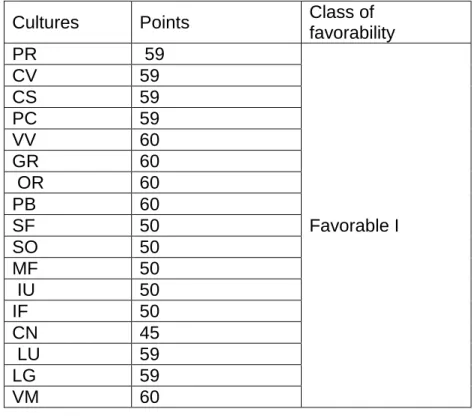
Table 3 Agricultural and horticultural crops and uses falling in Group C of favorability
or Favorable I
Cultures Points Class of
favorability
PR 59
Favorable I
CV 59
CS 59
PC 59
VV 60
GR 60
OR 60
PB 60
SF 50
SO 50
MF 50
IU 50
IF 50
CN 45
LU 59
LG 59
VM 60
2. Haplic Luvisols
In table 4 can be seen that only arable land is in the favorability - very friendly with a touch of evaluation I located between 81 and 100 points, which shows good suitability for large crops.
Table 4 Crops and agricultural uses placed in Group A of favorability or very favorable
Cultures Points Class of favorability
AR 90 Very favorable I
Table 5
Crops and agricultural uses placed in Group B of favorability or very favorable II
Cultures Points Class of
favorability
PS 80
Very favorable II
FN 80
177
Agricultural and horticultural crops and uses placed in Group C of favorability or Favorable I
Cultures Points Class of
favorability
MR 55
Favorable I
PR 55
PN 55
CV 55
CS 55
PC 55
GR 60
OR 60
PB 60
SF 55
SO 55
IF 45
CN 45
TR 55
LG 55
In the table 6 is observed that most crops and horticulture, are in the favorability - I favor, with a note of evaluation between 41 and 60 points, which limits the capacity of these crops, especially apple, plum, wheat, barley, soy alternatives taking into account the replacement of other crops that are suited to these types of soil and cultivation on other soil types.
Table 7 that in the favorability - favorable II, with a note of good standing located between 21 and 40 points, is the vine for wine and table which determines the production of low production, but since the land is in a hilly area, the best way to achieve maximum production of this class of favorability is to use these two cultures. Table 7 presents the situation less favorable crop sunflower, potato and alfalfa. It is recommended that these crops to be grown on other land which is suitable to be cultivated.
Table 7 Agricultural and horticultural crops and uses falling in Group D of favorability
or Favorable II
Cultures Points Class of
favorability
VV 40
Favorable II
VM 40
FS 40
CT 30
MF 30
LU 40
178
Table 8 Crops and agricultural uses placed in Group B of favorability or very favorable II
Cultures Points Class of
favorability
AR 70 Very favorable II
Table 9 Crops and agricultural uses placed in Group C of favorability or Favorable I
Cultures Points Class of
favorability
PS 46 Favorable I
Table 10 Crops and agricultural uses placed in Group D of favorability or Favorable II
Culturi Puncte Clasa de
favorabilitate
FN 21-40 Favorable II
Table 11 Agricultural and horticultural crops and uses falling in Group E of favorability or
less favorable
Cultures Points Class of favorability
MR 17
Less favorable
PR 18
PN 18
CV 15
CS 15
PC 14
VV 12
VM 12
GR 19
OR 19
PB 19
FS 18
CT 10
SF 10
SO 5
MF 4
IU 2
IN 6
CN 3
LU 5
TR 5
LG 11
179
of 46 making the most of areas to be occupied by them.
Table 11 situation is observed which is most cultures, including the species tree and vine and wine, they got low grades of evaluation with an average of 8.5 points, placing the area of favorability - less favorable.
CONCLUSIONS
Most crops are favorable area I just pastures and hayfields is very favorable zone II, and II is the favorable plants whose water requirement is reduced and due to excessive humidity and high rainfall plants are not optimal development.
Although typically a large volume edaphic fertility potential of these soils is low. When taken in culture and fertilized soils shows an enrichment of cations basics. Soils under grasslands have a higher content in humus, nitrogen and phosphorus but organic nitrogen mineralization capacity is low.
Agricultural use as arable land is constrained cups increased Lift temporarily poor because of their compactness or submitted.
To improve a number of interventions are necessary agrotechnical and agrochemical: the moldboard plowing to alleviate temporary excess humidity, calcareous amendments correct reaction conditions, organic fertilizers to increase reserves of humus and fertilizers.
State nutrient supply is poor and existing reserves are mobilized difficult because air-fluid system losses and poor microbiological activities.
BIBLIOGRAPHY
Ţărău D., Luca M., 2002 - Waxwork of Banat villages in terms of soil, Ed Marineasa Timisoara.
Țărău D., Borza I., Dumitru M., Ciobanu C., 2007 - Characteristics of environmental conditions and soil fertility restoration in western Romania. Ed EUROBITE, Timisoara, 2007.
*** 1998 - Atlas Romania, Institute of Geography, Bucharest, 1998.
*** 1987 - Methodology Elaboration Soil Studies, vol I, II, III, ASAS-ICPA, Bucharest, 1987.