6
„Reflections on Teaching and Learning in an Online Master Program - A Case Study“ presents the Master of Distance Education (MDE) program jointly offered by the University of Maryland University College and Carl von Ossietzky University of Oldenburg. The MDE was launched in January 2000 and is offered completely online. Faculty from three continents and more than 500 students from 12 different countries joined the MDE community within its first three years.
The mission of the MDE is to qualify present and future managers of distance education. Given that distance education - and e-learning - have expanded so rapidly in the past few years in both public and private education, as well as in the training sectors, the program educates the multitude of new managers and future leaders necessary in this field. These managers need to be qualified as leaders, since they will be required to be active advocates for distance education and training in their organizations and need to manage significant change processes that affect the entire organization.
The Distance Learning Community of Practice Award Committee of the University Continuing Education Association (UCEA) in the U.S. selected the MDE as the winner of the Program of Excellence award in 2003.
Studien und Berichte der Arbeitsstelle Fernstudienforschung der Carl von Ossietzky Universität Oldenburg
Band
6
HKS 43 - Schwarz Termin: 10.April 2003 - Auflage: 350 Exemplare
Bernath / Rubin (Eds.): Reflections on T
eaching and Learning
Ulrich Bernath and Eugene Rubin (Eds.)
Reflections on Teaching
and Learning
in an Online Master Programm
A Case Study
Studien und Berichte der Arbeitsstelle Fernstudienforschung
der Carl von Ossietzky Universität Oldenburg
Volume 6
Ulrich Bernath and Eugene Rubin (Eds.)
Reflections on Teaching and Learning
in an Online Master Program
A Case Study
Bibliotheks- und Informationssystem der Universität Oldenburg 2003
Studien und Berichte der Arbeitsstelle Fernstudienforschung der Carl von Ossietzky Universität Oldenburg
Herausgeber:
Dr. Ulrich Bernath
Prof. Dr. Friedrich W. Busch
Prof. Dr. Detlef Garz
Prof. Dr. Anke Hanft
Prof. Dr. Wolf-Dieter Scholz
Reprint, November 2004
© Carl von Ossietzky University of Oldenburg, Center for Distance Education
Publisher: Bibliotheks- und Informationssystem der
Carl von Ossietzky Universität Oldenburg (BIS) – Verlag –
Tel. +049 441 798-2261 Telefax: + 049 441 798-4040 e-mail: [email protected]
Contents
Series Editors' Foreword... 5
Volume Editors' Foreword... 7
Ulrich Bernath & Eugene Rubin The Online Master of Distance Education (MDE): Its History and Realization... 9
Otto Peters Moderating a Virtual Seminar - Reflections on First Practical Experiences ... 51
Thomas Hülsmann Texts That Talk Back - Asynchronous Conferencing: A Possible Form of Academic Discourse? ... 75
Michael F. Beaudoin Learning or Lurking? Tracking the ‘Invisible’ Online Student ... 121
Börje Holmberg Computer Support of Distance Education, Particularly Online Teaching and Learning... 131
Jane E. Brindley, Olaf Zawacki & Judy Roberts Support Services for Online Faculty: The Provider and the User Perspectives ... 137
Thomas Hülsmann Costs Without Camouflage...167
Christine Walti Experiencing a New Paradigm - Elements, Aspects, and Structure of Selected Courses in the MDE Program... 227
Brian F. Fox Experiences, Observations, and Applications: A Student's Personal Account of the MDE Program ... 245
Linda J. Smith Assessing Student Needs in an Online Graduate Program ... 255
Susanne Offenbartl Distance Learning: Learning on Demand and Just in Time...267
List of Contributors ...279
Name Index...283
List of Acronyms ...285
Series Editors' Foreword
The Arbeitsstelle Fernstudienforschung (ASF) is a joint unit of the Center for Distance Education and the School of Education at Carl von Ossietzky University of Oldenburg. It supports research and development in distance education. More specifically, the joint venture was set up to reflect upon the activities undertaken by the Center for Distance Education in the light of relevant international research in distance education and to facilitate the development of programs and courses within the university as well as in a national and international context.
In fulfilling its mission one of the outcomes of the ASF was the creation of the ASF Series in order to publish studies and reports reflecting upon the practices undertaken by the Center for Distance Education. The first publication in 2000 assembled contributions on a university networked program for professional development in dialysis of around 900 nurses, which was one of the larger and remarkably successful projects coordinated by the Center for Distance Education.
In Spring 2000 the online Master of Distance Education (MDE) program - jointly offered by the University of Maryland University College (UMUC) and Carl von Ossietzky University of Oldenburg - was implemented. The realization of this program endowed the ASF Series with a new perspective, namely to provide a series of volumes that directly support specific courses in the program, as well as contributing to the overall scholarship in the field of distance education.
Holmberg and Peters, repeatedly awarded for their life-long contributions in the field of distance education authored volume 4 & 5 of the ASF Series, which became readings in the MDE's Foundations of Distance Education course. Currently in preparation are four volumes by Rumble, Beaudoin, Brindley, and Hülsmann that are also designed to serve as readings for students in other MDE program courses.
Volume 6 of the ASF Series - in hand - follows the original goal of the series. It reflects upon the undertakings of the Center for Distance Education. The MDE has become the center's largest endeavor in recent times with more than 500 students joining the program since its inception.
The editors of the ASF Series are grateful to the faculty, staff, and students of the MDE program, who followed the MDE program directors' and the editors' invitation to present a multi-facetted case study with "Reflections on Teaching and Learning in an Online Master Program". We like to express our special gratitude to Christine Walti and Franziska Vondrlik for their tremendous editorial assistance before handing this volume over to the University press.
It is our hope that the many involved in this program as well as the professional community are stimulated by the extraordinary efforts invested in volume number six of our series and enjoy the profusion of reflections.
Volume Editors' Foreword
The Master of Distance Education program was launched in January 2000 by the degree granting University of Maryland University College (UMUC) in partnership with Carl von Ossietzky University of Oldenburg, which contributes two of the six integrated certificates in the distance education program. The Master's and certificate degree programs are completely accessible online. There were only a few similar programs existing at the time and much of the curriculum needed to be developed as there was no "standard“ program to follow. We felt the program to be both innovative and experimental. On these grounds we were challenged to reflect on what we were to do and at the same time set the standards for a graduate program in distance education.
The publication of this 6th volume of the ASF Series was a particularly challenging one for a number of reasons. It was our intention to do more than merely describe a graduate university program in distance education and, at that, one which is entirely online. We not only want to share the curriculum with our colleagues, but also the process, the critical reflections and indeed the emotional impact of developing and participating in such a project. It was - and still is - an evolving experience and one that we feel others could learn and benefit from. In order to achieve the different levels and goals to which we aspired necessarily meant including the many players involved - the program directors, the faculty and visiting experts, and the students - who all approach the program from different backgrounds, experiences, intentions, and perspectives. Collecting the various aspects and practices of program development for online teaching and learning provides us - those involved - and the distance education community with an extraordinarily rich picture and in this sense we call this work a case study.
The themes include institutional politics, program management, detailed cost analysis, student and faculty support, reflections on online and distance learners and learning behaviors, digital learning spaces, technologies, communication, facilitation, cooperation, and collaboration. Thus, we can also regard our work to be a handbook on issues that necessarily arise and need to be taken into consideration when planning and developing an online program. The multiple perspectives from the thirteen authors from Canada, Germany, Sweden, and the U.S. give each chapter a distinct feel, convey individual world views and often slightly different ways of looking at the same events within a larger framework. The detailed index invites readers to approach the volume from their own perspectives and interests.
We do not present our program as the correct way to do things... it was our way - based on the circumstances and the context along an existing timeline. However, what is unique about this publication is that the practice which has evolved has been extensively deliberated and is rooted in theoretical underpinnings and purposeful research supported by these experiences. It is a program designed and taught by reflective practitioners, who are willing and able to share these insights with their colleagues, students, and with a larger community, and they flow back into the program.
The volume is divided into three parts. In the first part the program directors from the partnering institutions (Bernath and Rubin) describe the historical origins of the Master of Distance Education, outline the basic structure of the program and discuss the organizational and managerial issues that need to be dealt with in the development and early pilot phases of such an endeavor. This sets the stage for the second part where
MDE faculty, visiting experts, and staff (Beaudoin, Brindley, Holmberg, Hülsmann, Peters, Roberts, Zawacki) review the program from various aspects and their experiences. The third part of the volume, the students' perspective (Fox, Offenbartl, Smith, Walti) gives voice to those who are the target audience of the program's efforts to convey and create new knowledge.
The combination of reflective practice and experiencing theory leads to a strengthening of both areas, with the added value of providing substantive knowledge to the community at large.
The more than 500 students who have joined the program since its inception, the array of international faculty and visiting experts, the experiencing of collaborative and differing approaches to a number of issues as well as the possibilities and challenges encountered in the online environment - these are all components in the work accomplished here. With "Reflections on Teaching and Learning in an Online Master Program - A Case Study" we invite the readers to join us in the discussion.
We are very much obliged to all who contributed to this volume. Ulrich Bernath & Eugene Rubin
U
LRICHB
ERNATH&
E
UGENER
UBINThe Online Master of Distance Education (MDE):
Its History and Realization
1. The Virtual Seminar for Professional Development in Distance Education ... 10
1.1. The Curriculum of the Virtual Seminar ... 11
1.2. Experiences from the Virtual Seminar ... 12
1.3. Conclusions from the Virtual Seminar ... 17
2. The Transition from the Virtual Seminar to the MDE Program... 17
2.1. The Planning of the Master of Distance Education (MDE) Program... 17
2.2. Significant Changes to the Proposed Program... 18
2.3. The Formalization of the Partnership ... 19
2.4. Course Development... 19
3. The Realization of the Online Master of Distance Education (MDE) Program... 19
3.1. Description of the MDE Program... 20
3.1.1. Program Curriculum (as of Fall 2002)... 20
3.1.2. Graduate Certificate Programs (as of Fall 2002) ... 24
3.2. Preliminary Program Outcomes ... 26
3.2.1. The MDE Students... 26
3.2.2. Program Growth and Capacity ... 26
3.2.3. Student Intentions... 28
3.2.4. Extending Access ... 29
3.2.5. The International MDE Faculty ... 29
3.2.6. Contributions to Research and Scholarship... 31
3.2.7. Student Satisfaction... 32
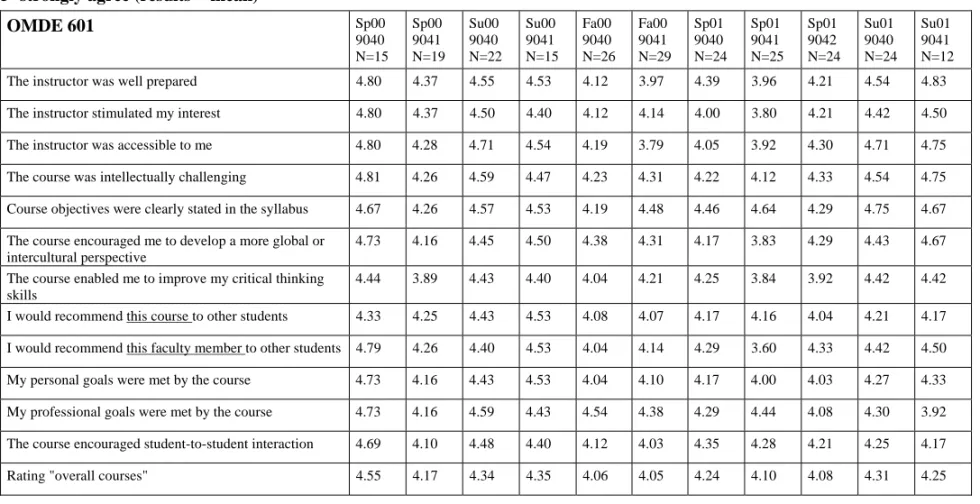
3.2.7.1. The Course Evaluation of OMDE as an Example ...32
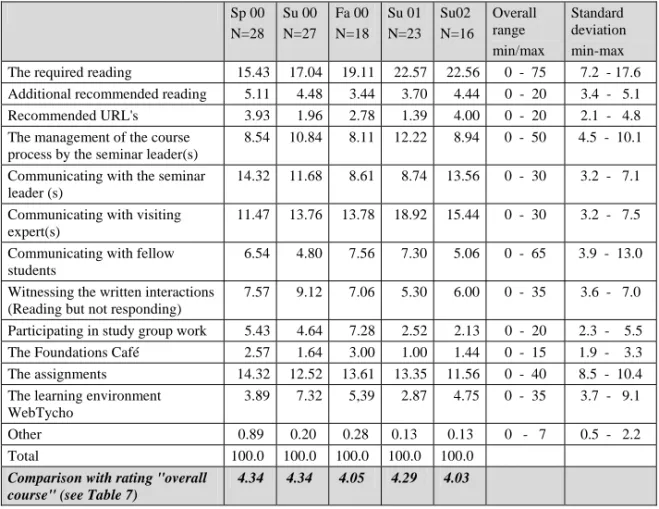
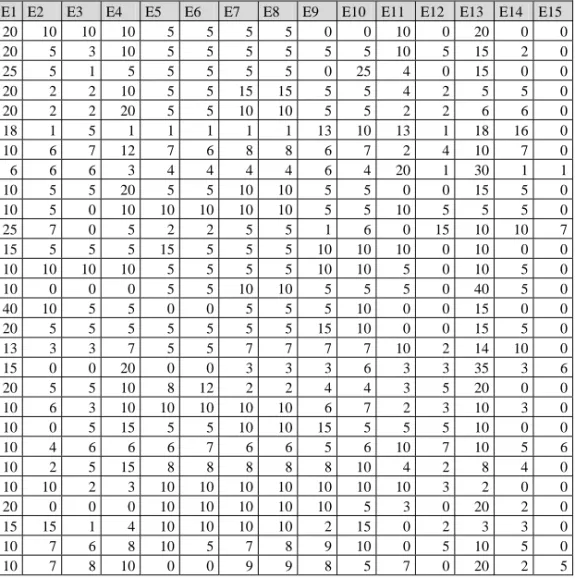
3.2.7.2. The 100-Points Questionnaire ... 35
3.2.7.3. Students Comments... 40
3.2.8. Learning Outcomes ... 41
3.2.9. Related Outreach Activities ... 42
3.2.10. Cost Effectiveness ... 43
4. Conclusion ... 43
References... 44
U
LRICHB
ERNATH&
E
UGENER
UBINThe Online Master of Distance Education (MDE):
Its History and Realization
The development of the Master of Distance Education (MDE) program began in 1995, when Ulrich Bernath, Director of the Center for Distance Education at Carl von Ossietzky University of Oldenburg/Germany, and Eugene Rubin, at that time Director of the Office for Instructional Design at the University of Maryland University College/USA conceptualized a virtual seminar for professional development in distance education to address what they perceived as two critical needs:
The need for faculty and administrator training programs in which new distance education faculty and administrators can develop a broader perspective of the general foundations of distance education and can learn critical knowledge and skills in the field.
The need for a global perspective among distance education faculty and administrators so that they can benefit from the knowledge of how other institutions approach distance education and solve problems, particularly in cross-cultural contexts. (cf. Bernath, 1996; Rubin, 1997)
Given that need for professional development and training in distance education, the authors submitted a proposal in 1995 to participate in the "Global Distance Learning Initiative" of the International Council for Open and Distance Education (ICDE), which, in collaboration with the AT&T Foundation, offered a series of grants for research and exploration in the area of distance education. They were awarded a grant for 1996/97 to develop and test the "Virtual Seminar for University Faculty and Administrators 'Professional Development in Distance Education'".
1. The Virtual Seminar for Professional Development in Distance Education
The Virtual Seminar was offered in 1997 as a successful experiment, and in 1998 two further Virtual Seminars were run on a self-supporting basis. The three Virtual Seminars attracted 127 faculty and distance education administrators from 24 different countries. The teaching faculty as well as most of the participants, experienced for the first time a virtual seminar, organized as an asynchronous communication process in an online learning environment.
Formal and informal evaluations of the Virtual Seminars took place externally as well as internally. During the course of the Virtual Seminars evaluation reports and experiences were published in various articles (cf. Fritsch, 1997; Bernath, 1998; Bernath & Rubin, 1998a, 1998b, 1999, and 2001). A final report and documentation of the first Virtual Seminar has also been published (cf. Bernath & Rubin (Eds.). 1999) and reviewed (cf. Beaudoin, 1999). It contains all of the components of the project’s Website including a complete transcript of all the seminar discussions and participant projects, as well as the formal evaluations of the project and the web server statistics.
The Online Master of Distance Education (MDE): Its History and Realization
Much of what is described below about the Virtual Seminar can be found in the mentioned publications. Our experiences were subsequently shown to be important and represent the values and methodology of our successive efforts. The experiences with and reflections on the Virtual Seminar helped to shape the future pedagogy of the Master of Distance Education program.
1.1. The Curriculum of the Virtual Seminar
The curriculum of the Virtual Seminars was conceived as a mix of both theory and practice. The concept of "theory" was a broad one, which encompassed the foundations of distance education (its history and formal educational theories), a broad conceptual look at national, cultural and institutional structures, and an overview of the effect of technology on the field. These were broad categories of discussion, and represented an attempt to get new distance educators as well as program directors in distance education to appreciate how distance education had evolved and to identify the important influences and issues of the present.
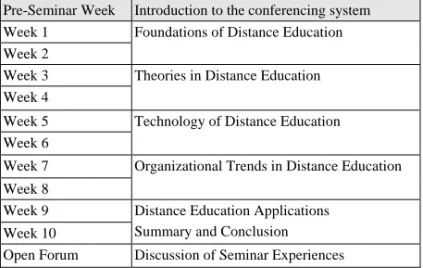
The idea was to ask top experts within the field of distance education to act as an expert mentor in each of the four areas of "theory" (see the syllabus outline below). Our four experts were Börje Holmberg for the Foundations, Otto Peters for the Theories, Tony Bates for the Technology, and Gary Miller for the Institutional Modelsand Organizational Trends in Distance Education modules. It was assumed that participating faculty and administrators would need a strong reason for their continuing involvement in the Virtual Seminar and that the presence of these top "name" experts would act not only as a direct source of information and opinion within each topic area, but also be a "motivator". We learned that the involvement of our distinguished experts in the discussions (with their readings and their live participation) were the key ingredients which had the most relevance in achieving the goals of both the students and the organizers of the Virtual Seminar.
Table 1: The Syllabus Outline of the Virtual Seminar in Fall 1998
Pre-Seminar Week Introduction to the conferencing system Week 1
Week 2
Foundations of Distance Education Week 3
Week 4
Theories in Distance Education Week 5
Week 6
Technology of Distance Education Week 7
Week 8
Organizational Trends in Distance Education Week 9
Week 10
Distance Education Applications Summary and Conclusion Open Forum Discussion of Seminar Experiences
The Online Master of Distance Education (MDE): Its History and Realization
1.2. Experiences from the Virtual Seminar
The most striking experiences bear noting:
Team-teaching across time-zones
The online learning environment and the asynchronous mode of communication in the Virtual Seminar allowed the two seminar leaders to team-teach across time zones. The seminar leaders planned and executed the seminar from their respective home universities across the Atlantic. This, in fact, turned out to be one of the hidden objectives of the seminar; to test whether this kind of Internet collaboration was feasible.
Knowledge-building communities
The Virtual Seminars featured a "visiting expert" model, a unique opportunity to interact with distinguished scholars and practitioners such as Börje Holmberg, Otto Peters, Gary Miller, and Tony Bates for live interaction with the participants during an assigned period of time within the syllabus of the Virtual Seminar.
Otto Peters observed that these seminars appeared to be virtual knowledge-building communities (cf. Peters, 1998). While this is not a new concept in the literature on computer-mediated communication (cf. Scardamalia & Bereiter, 1994), Peters’ observation summed up quite well the experience of most of the participants involved in the seminars (cf. Otto Peters in this volume).
Each seminar was a community in which the participants met, talked, agreed, sometimes strongly disagreed, sympathized, empathized, and formed relationships (several of which have lasted beyond the end of the seminars). And like other types of communities, each seminar was different from the others. Each had its own “feel”, its own pace, group dynamics, and its own emphasis on content matters. It was clear that the individual personalities of the participants and their backgrounds played a role in how the community functioned.
Thus, the Seminar's design was one of a meeting of peers and not one of a relationship between students and teacher. The seminar leaders were well aware that they were dealing with qualified professionals, who were actively employed in academia, business, and/or government.
The cross-cultural dialogue
Another goal of the Virtual Seminar was to enable a cross-cultural sharing of experiences, ideas, and opinions from participants from all over the world. This was deemed to be a potential positive outcome because a) distance education occurred in some manner in almost all countries of the world and in a number of ways, while using a wide variety and different levels of technology; b) distance education was increasingly becoming a world-wide enterprise in that courses could be delivered almost anywhere in the world; and c) the cultural and regional bias that each participant brought to the discussion would result in a broader and deeper learning.
With participants from 24 countries of origin, the three seminar experiences indirectly supported the above supposition that the cross-cultural aspects of the seminar would result in positive outcomes. By being globally accessible via the Internet, the content and interaction allowed participants to differentiate and generalize across cultural borders and among the diverse practices within the field of distance education. It gave depth to the learning and forced the participants to think beyond their own cultural and
The Online Master of Distance Education (MDE): Its History and Realization
environmental constraints. Not only were a broad variety of opinions expressed, but these often prompted discussions that reflected a more comprehensive analysis and understanding of critical issues. This was particularly true of the technology related discussions, where participants from nations that were not highly technology enabled often came up with innovative and useful solutions to problems that did not occur to participants from high technology countries.
New interpretations of "activity" in a virtual seminar
In many respects the communication processes in the Virtual Seminars appeared to be new and unknown for most of the participants at that time. From various points of view the "activity" of participants in a virtual seminar became a matter of research.
The notion of "witness learning" (Fritsch, 1997) was introduced to interpret positive evaluation results of participants with low or no visible activity levels, which then led to further studies on the "invisible learner" (cf. Beaudoin in this volume) in order to better understand invisible activities that remain "behind the screen".
Helmut Fritsch, the formal evaluator for the first Virtual Seminar, looked at both the on-screen participation in the seminar as well as the questionnaire data from the participants. What struck him most was the discrepancy between measurable, visible participation (appearing on the screen with postings during the discussions) and the self reporting of many of the participants that they were “active”, only they did not “say” anything. In other words, many of the participants reported that they regularly read the discussion (sometimes every day), but for a variety of reasons chose not to actively submit a written contribution. It was clear that if one only considered the written contributions, the participation rate appeared to be only about 50% (and even then, not at all times). Yet, it also seemed clear that many whom we regarded as functional drop-outs were not. At the end of the seminar these non-contributors reported that they had learned considerably from the seminar. Fritsch (1997) coined the term "witness learning" to indicate that these “passive” participants were in fact active learners, and that they reported to have learned from witnessing the interactions among the "active" participants, leaders, and experts.
The notion of the "ripple effect", coined by Bernath, (cf. Bernath & Rubin, 2001) was introduced to better understand a specific characteristic of asynchronous communication, in which postings to the discussions in computer conferences seemed much like throwing a stone into the water (the incoming messages) and creating ripples that expand outward in each recipients head (pondering on the content of the message). In asynchronous seminar discussions one can "work" on the answer to be given. This pondering allows one to react whenever one feels ready and while doing so, to go in-depth and raise new ideas and notions in the seminar. Furthermore, the written contributions to the discussions remain and have effects on later discussions. The asynchronous computer conference to a certain extent appeared to be a renaissance of the written word in communication.
The volume of interaction
All participants of the three Virtual Seminars experienced the sheer volume of the interaction in the Virtual Seminars as formidable. Participation data were quite deceptive. The first seminar's data showed that the average length of a comment posted by a participant to the discussions during the weeks with a "visiting expert" was 187 words (with a range of 76 to 477 words), which fills half of a typical single spaced typewritten
The Online Master of Distance Education (MDE): Its History and Realization
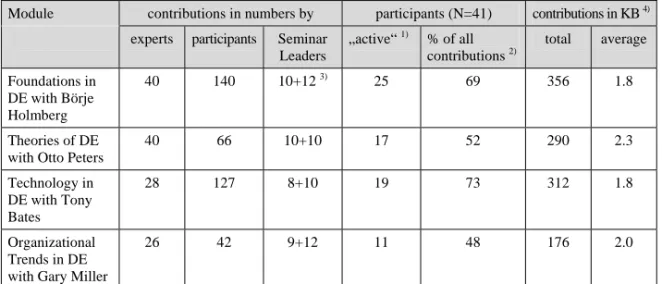
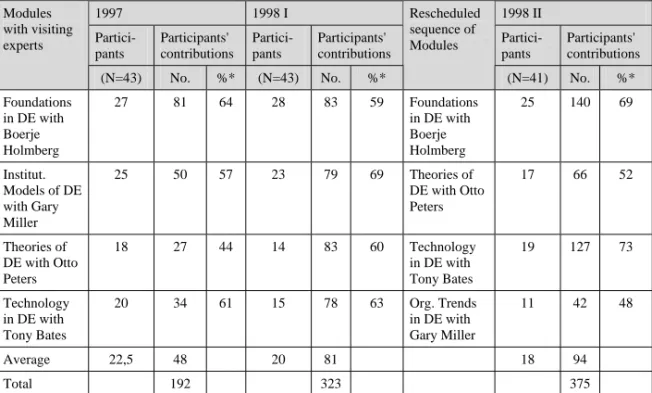
page of about 350 words. Each participant contributed an average of only one comment in each of the ten weeks. Yet this modest amount of postings, when multiplied by 43 participants, resulted in over 66,000 words in ten weeks and an equivalent of more than 160 typewritten pages. The empirical data clearly show that online activity can be overwhelming to both the teacher and the student (see Table 2, 3, and 4). Consequently, all participants in an asynchronous Virtual Seminar need to develop new ways and means to manage such an unknown flow and volume of written communication.
Our data suggested that 40+ participants may be too high for the type of virtual seminar with its emphasis on teacher-student and student-student interaction. Our concerns about work and information overload in computer-mediated learning and teaching were very much in line with earlier findings compiled in Harasim, Hiltz, Teles & Turoff (1995).
Table 2: Numbers of Words Contributed to the First Virtual Seminar (Jan – March 1997)
Words Bernath/Rubin (as a team) 10,765
Bernath 8,472 Rubin 9,483 Total Visiting Experts 26,937
Total Leaders and Visiting Experts 61,178 Total Participants 66,324 Total for the Seminar 127,502
Table 3: Participation Patterns in the Virtual Seminar No 3 (Sep - Nov 1998)
Module contributions in numbers by participants (N=41) contributions in KB 4)
experts participants Seminar Leaders „active“ 1) % of all contributions 2) total average Foundations in DE with Börje Holmberg 40 140 10+12 3) 25 69 356 1.8 Theories of DE with Otto Peters
40 66 10+10 17 52 290 2.3 Technology in DE with Tony Bates 28 127 8+10 19 73 312 1.8 Organizational Trends in DE with Gary Miller
26 42 9+12 11 48 176 2.0
1) "Active" participants here are defined as those who participate in the online discussion and appear "on screen."
2) The % of contributions is the participants' portion of all contributions posted in each respective Module. 3) The Seminar Leaders contributed as moderators (first number) and individually asdiscussants(second number).
The Online Master of Distance Education (MDE): Its History and Realization
Table 4: Comparison of Participant's Participation Patterns in Three Virtual Seminars with Invited Experts
1997 1998 I 1998 II Partici- pants Participants' contributions Partici- pants Participants' contributions Partici- pants Participants' contributions Modules with visiting experts (N=43) No. %* (N=43) No. %* Rescheduled sequence of Modules (N=41) No. %* Foundations in DE with Boerje Holmberg 27 81 64 28 83 59 Foundations in DE with Boerje Holmberg 25 140 69 Institut. Models of DE with Gary Miller 25 50 57 23 79 69 Theories of DE with Otto Peters 17 66 52 Theories of DE with Otto Peters 18 27 44 14 83 60 Technology in DE with Tony Bates 19 127 73 Technology in DE with Tony Bates 20 34 61 15 78 63 Org. Trends in DE with Gary Miller 11 42 48 Average 22,5 48 20 81 18 94 Total 192 323 375
* The % of contributions is the participants' portion of all contributions posted in each respective Module.
The impact of the new technology
The web-based conferencing system selected was HyperNews, which is a Unix-based "threaded" system. The web-based seminars were positive examples of the environment for which the participants were being trained (see the following screen shots from the Virtual Seminars in Fall 1998 and Spring 1997). This software was chosen because it was easily accessible through a web browser on a minimally configured system. Nevertheless, a few participants with slow connections faced technical problems.
The Online Master of Distance Education (MDE): Its History and Realization
1.3. Conclusions from the Virtual Seminar
Our conclusions from the Virtual Seminar experience became crucial for the development of the Master of Distance Education. In essence we learned, that:
A virtual seminar involves reading and writing and this demands much of a participant's time. The written contributions in the asynchronous discussion process differ from the synchronous and flighty chat, and are fundamentally different from a conventional seminar. Engaging in a virtual seminar and using computer conferencing is a much more reflective process than face-to-face interaction (as already mentioned with respect to the "ripple effect"). One's thoughts are typed, reread, edited and/or added to and even spell-checked. After carefully inspecting what has been written, the work is then submitted for others to read. These written words are recorded and thus persist. They can be read and reread by others long after the end of the seminar.
The discussion process in the Virtual Seminar needs direction and moderation to make the best use of the opportunities offered by media and technology. In particular, it is essential to get as many activities as possible to the "surface of the screen". There is also an emotional component to the seminar as well. Participants are not only positively or negatively affected in the discussions, but also reported the establishment of varying degrees of personal relationships with fellow participants. In our opinion this emotional component was critical to the success of the seminar. The positive results of the Virtual Seminar likely correlate with the interest of the participants in their own growth of knowledge and acquisition of skills. Clearly the relevance of the content is related to the participant's persistence as well as their attitude, and our data indicated a positive affect and a continuing involvement of the participants in the process of the seminar. It is also worthwhile mentioning that the seminar experience has proven to be applicable in other contexts. We learned this e. g from participants who used HyperNews for their own teaching and from others who applied their own seminar experiences to other situations in the online learning environment.
One of the most important outcomes of the Virtual Seminar was the joint decision by the two seminar leaders and their respective institutions, the University of Maryland University College (UMUC) and Carl von Ossietzky University of Oldenburg, to pursue the design, development and delivery of a Master of Distance Education degree. The decision came directly from the original intent to develop a means to train faculty and administrators in the area of distance education in the light of the new technologies, the emerging market and growing importance of distance education worldwide.
2. The Transition from the Virtual Seminar to the MDE Program 2.1. The Planning of the Master of Distance Education (MDE) Program
The Virtual Seminar had been a collaborative endeavor of two individuals with the agreement of their respective institutions. To expand this concept both realized that they needed to more directly involve each institution. As a result of the authors' extensive collaboration on the curriculum and the structure of a possible program, an outline of a full graduate program was developed, and a proposal was made by the end of 1998 to both institutions for an online Masters program in distance education. It was originally
The Online Master of Distance Education (MDE): Its History and Realization
designed to begin within one year and the full development was scheduled to take five years. The UMUC Executive accepted the proposal and took the lead for the establishment of the Master's program, and we were asked to start the program within six months. UMUC was in a unique position to capitalize on both its international reputation as a distance education institution and its resident expertise in this discipline. Further, UMUC's ability to serve students worldwide through a well established distance education infrastructure placed it in a strong competitive position with other similar programs.
The proposal for the Master of Distance Education was submitted to the Maryland Higher Education Commission (MHEC) in March 1999 (cf. MHEC Proposal, 1999). This was a requirement for all new degree proposals in the State of Maryland. The program was consistent with UMUC's mission to provide higher education opportunities to adult, part-time students. Excerpts from the MHEC proposal can be found in the appendix to this article. It gives the reader detailed information regarding market analyses, potential needs, related programs at the time, and the program's planned goals. In parallel to UMUC's request for approval of the Master of Distance Education program by the State of Maryland, Oldenburg University submitted a grant proposal to its respective State of Lower Saxony in Germany to receive funds for the development and testing of four courses aimed at constituting a Foundations of Distance Education certificate program as an integral part of UMUC's Master of Distance Education program.
2.2. Significant Changes to the Proposed Program
The excerpts in the appendix give the reader a sense of the issues that were put forth for the program and reflect the environment at the beginning of the program's planning. However, as in all projects, things changed as time progressed. Some of these changes are significant and the notable ones are listed below:
While the proposal was formally approved by MHEC, and UMUC formally committed itself to the program by announcing its start by the Spring of 2000, the program began without a significant investment in staff (only the program directors from the partnering institutions). Despite the fact that Oldenburg University received some funds that were approved by the State of Lower Saxony for a limited period of time (from September 1999 to December 2000), the program was from the beginning under pressure to generate revenue to justify staffing. Once the commitment was made to offer the program, there was also a commitment to provide courses in a timely manner so students could complete the program in the shortest amount of time. As a result, it was proposed that the original developmental schedule (5 years) be compressed into 2½ years to generate faster program growth.
All students are required to take the Foundations of Distance Education course as their first course in the program. This course was conceived with a gate-keeping function, determining the number of students that could be enrolled in the program. Thus, the capacity of this course dictated how many students entered the program. Originally, based on the experience with the Virtual Seminar and related to the concept of visiting experts, a maximum of 25 students per term was viewed as the starting capacity of the program. However, given the pressure for revenue, the capacity of the Foundations
The Online Master of Distance Education (MDE): Its History and Realization
visiting expert model. This occurred before the program had actually started. Within one year, the capacity of the Foundations course was raised to 75 per term. The grant to Oldenburg University by the state government of Lower Saxony facilitated the acceleration of the developmental schedule.
2.3. The Formalization of the Partnership
The Virtual Seminar was based on a cooperation between directors of their institutions acting within their respective areas of responsibilities. Once the planning of the MDE was well underway, the relationship between the institutions needed to be addressed. Knowing that institutional agreements are often difficult and complicated, it was felt that a successful collaboration needed to be straight forward and built on a feeling of trust and in a win-win environment. Since the personal working relationship already existed as a result of the Virtual Seminar, a simple yet fair set of terms needed to be negotiated. It was agreed that UMUC would be the degree-granting institution with Oldenburg as a partner contributing a certificate and courses within this degree. Furthermore UMUC would be responsible for all of the student administration as well as for the learning management system and the web-based delivery system. Each institution would develop its respective courses and hire and manage its faculty. It was further agreed that course and faculty development would be a shared responsibility.
2.4. Course Development
The content and design of the Virtual Seminar was the basis for the initial Foundations
course in the Master’s program. The syllabus and teaching methods of this first course are directly based on those of the Virtual Seminar. The Virtual Seminar was an ideal model for a broad look at distance education and would serve as an effective introduction to the field for beginning graduate students. We planned to continue the team-teaching model and use a somewhat modified visiting expert guided structure. For us, the Program Directors and former seminar leaders, this was the logical outcome of the Virtual Seminar. However, the Virtual Seminar needed additional development in order to make it appropriate for inclusion in a graduate program. It was necessary to add assessments and to expand the content to fit a 15-week term. Furthermore the program served a broader constituency, including professionals who were involved in distance education enterprises within the educational, business, government, and not-for profit sectors.
3. The Realization of the Online Master of Distance Education (MDE) Program
In September 1999 the online Master of Distance Education (MDE) program was officially launched, and in January 2000 the program started with the first Foundations of Distance Education course. The complete degree program and associated certificates are offered entirely online via WebTycho, UMUC’s web-based platform for course delivery. It was agreed that the pace of development would proceed according to the needs of the initial students. Since the program was aimed at a working adult population it was assumed that most students would not take more than two courses per term. This is based on UMUC's experience in other graduate programs.
The Online Master of Distance Education (MDE): Its History and Realization
3.1. Description of the MDE Program
The mission of the Master of Distance Education is to qualify present and future managers of distance education. Given that distance education - and e-learning - have expanded so rapidly in the past few years in both public and private education, as well as in the training sectors, the program educates the multitude of new managers and future leaders necessary in this field. These managers need to be qualified as leaders, since they will be required to be active advocates for distance education and training in their organizations and need to manage significant change processes that affect the entire organization.
3.1.1. Program Curriculum (as of Fall 2002)
The 36-credit MDE program consists of seven core courses and four elective courses, and the additional requirement of a final integrative project. The MDE curriculum is intentionally structured to provide students with both breadth and depth in this field of study. When UMUC and Oldenburg first joined to design the program curriculum, it was decided that an appropriate balance between the pedagogical, technological and economic aspects of distance education, and the broader theoretical, historical, and social views of this field should be sought. Thus, the program curriculum seeks to position the evolving role of distance education within a larger societal framework. Whereas many similar graduate-level programs may focus more narrowly on instructional design and development, educational technology, or administrative and management issues, the MDE takes a more multidisciplinary approach by integrating each of these subject areas. Indeed, as the program has matured, it has moved closer to a focus on leadership, which requires such a multidisciplinary approach.
MDE courses are structured as graduate-level seminars in which students and faculty are immersed in the literature, research, and scholarship from major contributors in the field of distance education. Students are challenged to critically analyze the concepts and issues they encounter in their readings and to apply their own professional experiences in the class discussions. Several other MDE courses have also incorporated the "visiting experts" model, designed to bring distance education scholars into the classroom and facilitate individual modules or short-term series of discussions.
Syllabi for the MDE courses, which are all three credits, have already been developed and are available at the MDE homepage: http://www.umuc.edu/programs/grad/mde/. Additional courses are still under development.
The seven required core courses are:
Foundations of Distance Education (OMDE 601)
The goals of the course are to provide the student with: a foundation of knowledge, skills, and attitudes that are required by a competent practitioner of distance education. Students explore the critical concepts and issues identified in the distance education literature and critically examine the history and theories of the field. The course was developed by Ulrich Bernath (Germany) and Eugene Rubin (U.S.) in collaboration with Börje Holmberg (Sweden) and Otto Peters (Germany). This course must be taken in the first term the student is enrolled in the program. It is taught in multiple sections by a team of faculty with Michael Beaudoin (U.S.), Ulrich Bernath, Thomas Hülsmann (Germany), Christine Walti (Germany/U.S.) and visiting experts Börje Holmberg (Germany/ Sweden), Otto Peters (Germany), and Michael Moore (U.S.).
The Online Master of Distance Education (MDE): Its History and Realization
Distance Education Systems (OMDE 602)
Distance education functions within the organizational structure of educational institutions, businesses, non-profit organizations and government will be examined. Students analyze operational, logistic, and regulatory systems within distance education and training organizations. A range of theories pertaining to systems in general, systems in education, systems needs in distance education, and systems approaches to organizational development are introduced. This course was developed by Eugene Rubin, and is presently taught by Inez Giles (U.S.).
Technology in Distance Education (OMDE 603)
This course explores the role of technology in the design, development, and delivery of distance education. Students critically examine the relationship between technology and the goals of the educational/training organization. Various uses of technology are explored in the areas of course development, asynchronous and synchronous distance course delivery, and management/administration. The relationship of information technology and distance education is explored, and special emphasis is placed on computer-based technologies. This course was developed by Judy Roberts (Canada).
The Management of Distance Education 1: Cost Analysis (OMDE 606)
The course places the economics of distance education in the larger context of economics of education. A variety of methodological approaches (including cost/benefit and cost/ effectiveness analysis) are applied to the distance education context. A variety of costing techniques and economic models are explored and applied to different institutional forms and levels of distance education. This course was developed by Thomas Hülsmann. It is taught by Thomas Hülsmann with visiting experts Greville Rumble (U.K.) and Tony Bates (Canada). The title of this course was changed in Spring 2003. Before that it was
OMDE 606 Economics of Distance Education.
The Management of Distance Education 2: Leadership in D. E. (OMDE 604)
This course introduces the student to the organization, management, and administration of distance education systems. Specific issues include roles (both traditional and unique), leadership, human resource management, employee relations, the role of information technology, student support services, faculty/staff development, inter-institutional collaboration, funding, delivery systems, and policy. Both the education and business environments are explored in this course, and students gain an understanding and skills that allow them to function effectively in either type of organization. This course was developed by Eugene Rubin and Jim Gelatt (U.S.). It will be taught by Jim Gelatt and Merrily Stover (U.S.) as of Spring 2003.
Instructional Design and Course Development in Distance Education (OMDE 607)
This course examines the process of instructional design and development in a distance education and training context. Students critically evaluate the relationship between instructional design and technology. Various models of instructional and course development are considered (e.g., large vs. small scale course development, centralized vs. decentralized course development, individual faculty/author vs. team course development). Students apply the instructional development process by developing a small instructional unit. Special emphasis is given to web-based instructional design and delivery. This course was developed by Eugene Rubin and Inez Giles (U.S.). It is now taught by Som Naidu (Australia).
The Online Master of Distance Education (MDE): Its History and Realization
Student Support in Distance Education and Training (OMDE 608)
This course focuses on planning and management of learner support and interaction within modern distance education and training systems. Included are all types of tutorial and instructional assistance (mentoring, tutoring, teaching), advising and counseling services, library, and administrative services (admissions, registration, prior learning assistance, credit coordination, help desk). In this context, students explore topics such as learner retention, the role of evaluation and applied research, serving learners with special needs, and practitioners’ professional development, and develop an understanding of contextual factors that determine the choice of particular learner support models. In the final course unit, students work in teams to custom design learner support services for an educational or training provider. The course was developed by Jane Brindley (Canada) and Alan Tait (UK) and is taught by Jane Brindley and Christine Walti. This course was OMDE624 until the 2002 Spring term. Students choose four of the following elective courses:
Issues in the Delivery of Library Services to Distance Students (OMDE 611)
An overview of the design and delivery of library services and education to distance education students is provided. The course reviews the types of distance technologies used and how the library can be integrated into the delivery of courses in a variety of formats. In addition, this course covers methods for developing and evaluating library instructional materials, primarily in web-based formats, to teach distance education students library research skills. This course was developed by Ilene Frank (U.S.).
Intellectual Property and Copyright (OMDE 614)
This course will provide an overview of intellectual property issues that impact digital distance education. As both creators and users of copyrighted information, educators are affected by the rules surrounding ownership and use of information. Most distance educators are not aware of the implications of copyright law and digital delivery of materials and make preventable mistakes. This course will provide educators with a general framework for addressing issues such as ownership of electronic course materials, determining whether a work is in the public domain, proper use of copyrighted works at a distance and licensing mechanisms and processes. Prevention of plagiarism in the digital environment will also be addressed. Finally, participants will discuss whether recent legislation that has amended the Copyright Act of 1976 achieves the goal of advancing knowledge and learning. This course was developed by Kim Bonner (U.S.).
Learning and Training with Multimedia (OMDE 620)
This course focuses on the design and evaluation of multimedia learning and teaching environments in higher education settings as well as corporate training contexts. Multimedia is broadly defined as learning from verbal and visual material. Students are introduced to principles of multimedia design based on cognitive theories and constructivist approaches to learning. Pedagogical aspects of technological innovations in distance education, promises and pitfalls of multimedia learning, media selection, and computer-supported collaborative work (CSCW) will also be addressed. Students explore the characteristics, possibilities and limits of various multimedia products, develop criteria for their evaluation and design their own concept for a multimedia project. The course was taught (up to Spring 2003) by Joachim Hasebrook (Germany) as OMDE 605 and was redesigned by Hilko Donker and Olaf Zawacki (Germany), and will be taught by both beginning in Spring 2003.
The Online Master of Distance Education (MDE): Its History and Realization
Training at a Distance (OMDE 621)
This course examines the role of distance training in business, non-profit, and government organizations. Students explore a wide variety of issues, problems, and solutions in the areas of: web-based training, the economics of distance training, distance technology in the business organization, synchronous vs. asynchronous interactive tools, collaborative and problem solving tools, authoring tools, insourcing vs. outsourcing, and the role of multimedia in distance training. Specific emphasis is given to the concept of the Corporate Virtual University and its design and operation. This course was developed by Greg Kearsley (U.S.).
The Business of Distance Education (OMDE 622)
Distance Education/Training is emerging within a highly competitive environment. Not only does the manager need to know about cost effectiveness issues, but he/she also is often responsible for such issues as marketing (local, national, and, increasingly, world-wide), insourcing vs. outsourcing, balancing the strong entrepreneurial focus of distance education within more traditional service-based organizations, and whether the distance education unit should be integrated or self-supporting. The course includes emphasis on the development of business and marketing plans and the use of common business analysis tools. In addition, students explore the rapidly expanding role of private and publicly traded education companies that are marketing new distance education products and services to the consumer market. This course was developed by Eugene Rubin.
Web-Based Learning and Teaching and The Virtual University (OMDE 623)
The Virtual University is a new concept that has recently evolved as a result of the emergence of the World Wide Web as a means of delivering higher education. This course covers the brief history, definitions, and implementations of the concept of the Virtual University in both higher education, government and business. The rapidly evolving literature of web-based learning is explored, with special emphasis placed on web-based pedagogy and course design. In addition, the impact of web-based technologies is discussed. The student begins developing web-based learning environments and uses web-based communication tools. This course was developed by Yolanda Gayol (U.S./ Mexico).
National and International Policies for Distance Education in Developing Countries (OMDE 625)
This course is an exercise in stocktaking. It will examine the purposes for which distance education has been used and the audiences reached. It will analyze the roles played by international agencies including bilateral and multilateral funding agencies, the UN family, regional bodies, and specialist agencies. The goal of the course is to develop and use typologies in order to examine the advantages and disadvantages of a range of organizational models for distance education at various educational levels, relating to audience, educational purpose, and choice of technologies. This course was developed by Thomas Hülsmann in collaboration with Hilary Perraton (UK).
Technologies for Distance Education in Developing Countries (OMDE 626)
This course is explorative in character. It examines the range of educational technologies that assist institutions in reaching various off-campus audiences (from print, through broadcasting to satellite links and computer-based systems). The course will examine the use of computers in school for (a) information science and computer studies (b)
The Online Master of Distance Education (MDE): Its History and Realization
application to the general curriculum (c) access to internet (d) school linking. It will give an assessment of current and planned ventures including emerging rich-country policies and institutions, the changing role of the private sector, the role of conventional universities in relation to e-learning and the new international players (e.g. African Virtual University). The course was developed by Thomas Hülsmann.
Advanced Technology in DE 1: Synchronous Learning Systems (OMDE 631)
This is an advanced course that builds upon OMDE 603 Technology in Distance Education. The course focuses on synchronous (real time) technologies that are used for DE such as satellite broadcasting, cable channels (CATV), telephony, wireless technology (WAP), web-based technologies such as push, pull, compression, and streaming. Also, students will be introduced to synchronous tools such as MOOs, MUDs, ICQ, text and audio chat, 2D-3D, application sharing, and white board. Students critically examine instructional-led learning environments and audio and video systems such as: interactive TV, site-based videoconference, and desktop videoconference. Technical details regarding standards-based technologies, telecommunications technologies, and computer technologies are also examined so students will be able to effectively manage the implementation of these tools. This course was developed by Gila Kurtz (Israel).
Advanced Technology in DE 2: Asynchronous Learning Systems (OMDE 632)
This is an advanced course that builds upon OMDE 603 Technology in Distance Education. The course focuses specifically on asynchronous (non-real time) technologies such as computer-mediated communication (computer conferencing), e-mail, listservs, archived streaming audio and video, etc. Technical details are covered relating to telecommunications technologies, video technologies, and computer technologies to ensure that the students can effectively manage the technical implementation of these tools. This course was developed by Robert Sapp (U.S.).
The required capstone course is:
The Distance Education Portfolio and Project (OMDE 690)
Each Master's student will work towards the development of a personal Portfolio. The goal of the portfolio is to demonstrate the student's qualifications gained in the field and to provide evidence of their competencies and skills in a variety of disciplines/roles. The goal is that this Portfolio would end up being a passport to the professional world. The Distance Education Project should come from the student's experiences within the MDE program. The 690 project is designed to be an "inclusive" activity and should reflect the student's sophistication in and knowledge of the field and asks the student create an outcome that is worthy of a professional in the field. It can take many forms, including (but not limited to) a paper, a organizational case study, a course or other types of projects. This course is taught by Eugene Rubin, Michael Beaudoin, and Ulrich Bernath.
3.1.2. Graduate Certificate Programs (as of Fall 2002)
One of the unique features of UMUC’s MDE program is that students can pursue one or more graduate certificates in distance education in addition to the master’s degree. These programs are ideal for students who want to gain expertise in a particular content area related to distance education but may not want to commit to the entire degree program. Students may also choose to earn certificates en route to the degree program and can apply the appropriate credits in their entirety:
The Online Master of Distance Education (MDE): Its History and Realization
Foundations of Distance Education Certificate
OMDE 601 Foundations of Distance Education
OMDE 606 The Management of Distance Education 1: Cost Analysis
OMDE 608 Student Support in Distance Education and Training
OMDE 620 Learning and Training with Multimedia
Distance Education and Technology Certificate
Required Courses
OMDE 601 Foundations of Distance Education
OMDE 603 Technology in Distance Education Elective Courses (choose two)
OMDE 620 Learning and Training with Multimedia
OMDE 623 Web-Based Learning and Teaching and the Virtual University
OMDE 631 Advanced Technology in Distance Education I: Synchronous Systems
OMDE 632 Advanced Technology in Distance Education II: Asynchronous Systems
Library Services in Distance Education Certificate
Required Courses
OMDE 601 Foundations of Distance Education
OMDE 603 Technology in Distance Education
OMDE 611 Issues in the Delivery of Library Services to Distance Students Elective Courses
Students may choose one course from among the elective courses in the Master of Distance Education program.
Teaching at a Distance Certificate
Required Courses
OMDE 601 Foundations of Distance Education
OMDE 603 Technology in Distance Education
OMDE 607 Instructional Design and Course Development in Distance Education
OMDE 623 Web-Based Learning and Teaching and the Virtual University
Training at a Distance Certificate
Required Courses
OMDE 601 Foundations of Distance Education
OMDE 621 Training at a Distance
OMDE 622 The Business of Distance Education Elective Courses
Students may choose one course from among the elective courses in the Master of Distance Education program.
Distance Education in Developing Countries Certificate
OMDE 601 Foundations of Distance Education
OMDE 606 The Management of Distance Education 1: Cost Analysis
OMDE 625 National and International Policies for Distance Education in Developing Countries
The Online Master of Distance Education (MDE): Its History and Realization
3.2. Preliminary Program Outcomes 3.2.1. The MDE Students
The total number of students that successfully completed the Foundations of Distance Education course is 408 as of Summer 2002. These students came from 12 different countries and 37 U.S. states and territories, and U.S. military posted overseas; 43% were from the state of Maryland, 57% reside outside of Maryland. There are some students in the program that take only specific courses, but they have not been included in these figures.
A total of approximately 1,500 course enrollments in 18 courses occurred between Spring 2000 and Summer 2002. The first certificates were awarded in April, 2001 and the first Master graduates completed the program in December, 2001. As of Summer 2002, there were four Master graduates and 63 Certificate recipients. An additional eight Master graduates and 28 Certificates are scheduled to be awarded in December 2002.
The students come from a very diverse set of backgrounds. Almost all of them are presently working (usually full-time). Their present employment includes higher education, corporations (often in a training capacity), government and non-profit organizations (again, often in a training capacity), and military, with a small minority from the K-12 education sector. This range corresponds very closely with the proposed target populations at which the program was originally aimed. This, however, poses some problems while at the same time it fulfills our expectations. Given that UMUC and Oldenburg have limited funds with which to market this individual program, it has proved to be difficult to focus marketing efforts in a particular area due to this wide variety of students' backgrounds. Our initial data gathered from a questionnaire administered in the OMDE 601 class indicates that students learn about the program from a number of sources. However two appear to be the most common: by searching the internet, and from a present student. We are therefore presently concentrating our efforts on these two marketing avenues.
Initially we had difficulty predicting the degree of national and international participation in the program. However, since UMUC is a Maryland state institution, it was likely that we would attract a large number of Maryland residents. We were surprised at the national character of the MDE student body, but have been rather disappointed at the low number of international (other than the U.S.) students. Many of the non-U.S. residents are, in fact, Americans living abroad. This is probably due to several factors: 1) The program is delivered exclusively in English. 2) The tuition costs of UMUC are fairly high for non-Maryland residents. 3) Many European institutions charge little or no tuition for graduate study and thus, the MDE does not appear to be economically attractive to students from those countries. 4) There has not been any significant investment in marketing the program. While there have been some initiatives to make the program known, these have been primarily personal initiatives of the program directors, rather than their institutions.
3.2.2. Program Growth and Capacity
While the program has grown at a reasonably rapid rate and the response to the program has exceeded our initial business plan estimates, so have the resources required to support that growth. Within two years both Oldenburg and UMUC have had to add additional human resources.
The Online Master of Distance Education (MDE): Its History and Realization
Table 5: The UMUC/UNI OL Model of Collaboration (as of Fall 2002) Academic Resources UMUC
UMUC UNI OL
Central Administration (services to the MDE, selected):
Graduate School School of Education and the Center for Distance Education
Information Technology Department with WebTycho working group and helpline 24/7
Student Services,
Registry (student records)
Library Services with copyright clearance
Department of Marketing and Communication Program Chair Program Director 2 full-time faculty 8 adjunct faculty 1 part-time secretary 1 part-time DE Coordinator Academic Chair Executive Director 2 full-time faculty 8 adjunct faculty 1 part-time staff
1 part-time "faculty support" person
Table 5 shows that each institution has added both full-time and adjunct faculty as well as management staff beyond the initial Program Chair/Executive Director. Thus, the initial increase in program capacity resulted in more required support, which in turn needs more students (more revenue) to finance that support. The program is now aiming at a steady state capacity of about 400 active course-taking students, that will result in enough revenue to support the necessary resources at each institution. An increase beyond that may result in the need for additional support resources, which will again, in turn, result in the need to recruit further students toward a new revised steady state. The capacity of the program can be viewed from several perspectives. One can control capacity by creating a gate-keeping function in the first course. This is the existing strategy for the program. By limiting the number of students in this course (presently 75 each for the Fall and Spring terms and 50 for the Summer terms – or a total of 200 new students per year) we believe that we can systematically control the growth of the program. This will allow well organized course development and revision, recruitment of faculty, and effective use of new emerging technologies. The capacity of the Foundation course is an issue because this course is based on the original model of the Virtual Seminar and requires a more intensive use of human resources than most of the other courses. To date, it has relied on the use of world-renown experts, whose published works are the basis for many of the readings in the course. While this is a more expensive model than most of the other UMUC programs, it is the hallmark of the MDE program and is clearly an aspect of the educational experience that is recognized by both students and external distance education professionals.
Revenue is related to course capacity. The current maximum capacity of MDE courses is approximately 25-30 students per course. Presently, approximately 15 courses per term are offered. This number is a best estimate of the number and variety of courses that are necessary for the present students to be able to achieve their program completion plans in a timely manner. The Foundations course has a capacity of 75 per term. The goal is to fill the remaining 14 courses (assuming only one section of 30 students each). Therefore, the maximum revenue per term possible is based on 30 x 14 = 495 enrollments plus the 75
Foundations enrollments equals 570 enrollments. Present experience shows that students take approximately 1.4 courses per term. This means that approximately 410 students need to be actively taking courses each term in order to achieve 570 enrollments. Since there are presently 400+ students that have successfully completed the Foundations
The Online Master of Distance Education (MDE): Its History and Realization
course, this would mean that almost all of these students would need to be actively taking courses. This, in fact, is not true. A number of the students who have completed the Foundations course are only pursuing a Certificate, and have already completed the courses required for that goal. And others decide for various reasons, not to take a course in a particular term. Our initial data shows that the number of enrollments has been considerably below 400. We are thus offering some courses at below capacity. As more students complete the Foundations course, the number of active program course takers will increase, but as time progresses, the number of program completers (both certificate and degree) will rise. At some point, all other variables being equal, a steady state will be achieved. Students exiting the program (for whatever reasons) will theoretically equal the students entering the program. (A survey investigating the "stop-out" and/or "drop-out" issue in the MDE program is currently being conducted). It is our hope that the present capacity of the Foundations course (200 per year) will indeed eventually result in each course reaching full capacity. If there is additional demand, we would then offer additional sections of each course. Planning for further program growth would then occur when the demand for additional places in the Foundation course exceeds 75 per term.
3.2.3. Student Intentions
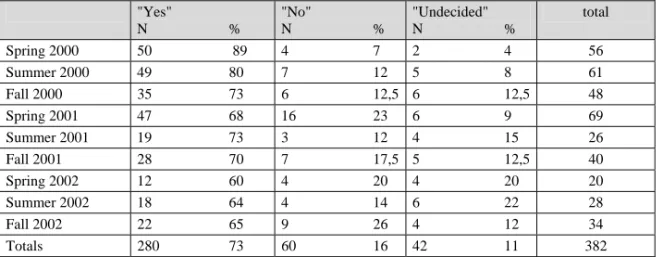
Immediately after the start of the entry Foundations of Distance Education course students were asked: "Do you plan to participate in the MDE program towards graduation with a Masters degree?" to express their initial intentions in a questionnaire. The results of all administered questionnaires from Spring 2000 through Fall 2002 are compiled in the following table:
Table 6: Results of all MDE Program Questionnaires From Spring 2000 Through Fall 2002 "Yes" N % "No" N % "Undecided" N % total Spring 2000 50 89 4 7 2 4 56 Summer 2000 49 80 7 12 5 8 61 Fall 2000 35 73 6 12,5 6 12,5 48 Spring 2001 47 68 16 23 6 9 69 Summer 2001 19 73 3 12 4 15 26 Fall 2001 28 70 7 17,5 5 12,5 40 Spring 2002 12 60 4 20 4 20 20 Summer 2002 18 64 4 14 6 22 28 Fall 2002 22 65 9 26 4 12 34 Totals 280 73 60 16 42 11 382
The compiled data are available from 382 students who filled out the questionnaire. Taking into account that 1) in Spring 2002 one section of the OMDE 601 course did not receive the questionnaire, and 2) there are withdrawals (predominantly) in the first weeks, we can estimate that these 382 students represent more than 80 % of all OMDE 601
Foundations of Distance Education course students.
On average 73 % of the students in OMDE 601, whom we regard as our beginners in the program, plan to graduate with the Master's degree. Only 16 % are not aiming for the Master's degree; some of them focus on certificates within the program. A fraction of the 16 % are studying the Foundations course without an explicit interest in any