JOURNAL OF LANGUAGE AND LINGUISTIC STUDIES
ISSN: 1305-578XJournal of Language and Linguistic Studies, 15(3), 1188-1203; 2019
Causality related to coreferential and reciprocal structures in Ewe
Phillips Kofi Atsu Larnyo a , Nathaniel Glover-Meni b
a Department of Speech, Language and Hearing Sciences, School of Allied Science, University of Health and Allied Sciences, PMB 31, Ho, Volta Region, Ghana
b Department of General and Liberal Studies, School of Basic and Biomedical Sciences, University of Health and Allied Sciences, PMB 31, Ho, Volta Region, Ghana
APA Citation:
Larnyo, P.K.A., & Glover-Meni, N. (2019). Causality related to coreferential and reciprocal structures in Ewe. Journal of Language and Linguistic Studies, 15(3), 1188-1203. Doi: 10.17263/jlls.631561
Submission Date: 03 /07/2019 Acceptance Date: 07 /09/2019
Abstract
This paper examines how causality is related to coreferential and reciprocal structures, looking at how they are conceived and expressed in Ewe. It deals with one particular type of causative constructions, namely the periphrastic causative construction, where the CAUSER is coreferential with the CAUSEE. This is the case where the CAUSER and the CAUSEE refer to one and the same person. For a more adequate description of this causative phenomenon in Ewe, two types of linguistic data are employed in this paper: textual and introspective. The textual data are composed of didactic materials which include popular story books and descriptions of folklore, customs and traditions, pseudo-literary plays and narratives published by the Bureau of Ghana Languages. All instances of the causative situation were extracted, with a careful consideration of the surrounding contexts so as to allow for a correct interpretation in the analyses (as context is often crucial for a correct semantic analysis and interpretation of causative forms). This paper identifies that just as English and other languages do, it is possible to express threefold coreferentiality in Ewe; where the causer is coreferential with the causee and the patient. It can also be identified that only verbs that can take the same semantic participant types as both subject and object can be reflexivized and reciprocalized; else, prototypical semantically-transitive verbs can be reflexivized only metaphorically.
© 2019 JLLS and the Authors - Published by JLLS.
Keywords: Co-reference; Ewe; semantically-transitive verb; reflexivize; reciprocal
1.
Introduction
For an adequate description of the phenomenon, two types of linguistic data are employed in this paper: textual and introspective. The textual data are composed of didactic materials which include popular story books and descriptions of folklore, customs and traditions, as well as pseudo-literary plays and narratives published by the Bureau of Ghana Languages. All instances of the causation situation were extracted, with a careful consideration of the surrounding contexts so as to allow for a correct interpretation in the analyses (as context is often crucial for a correct semantic analysis and interpretation of causative forms). This view is corroborated by Escure (2008), cited in Kouwenberg and Singler (2008), who notes that “consideration of data without context has the dangerous potential of producing “an impoverished caricature of the language, bearing no explanation of its actual use” (Klein-Andreu, 1983).
In the examples from published sources, the titles of the works plus the pages are indicated. Throughout this work, the first line represents the Ewe data, the second line represents the interlinear glosses of each morpheme, and finally, the third line denotes the ‘literal’ translation of the text.
Dixon (2000) professes a causative construction as a structure that “… involves the specification of an additional argument, a causer, onto a basic clause. A causer refers to someone or something (which can be an event or state, any physical object, situation, or phenomenon) that initiates or controls the activity that produces an effect” (my emphases). Causative constructions are therefore grammatical mechanisms/strategies that are employed by speakers of languages all over world to express the phenomenon of causation.
The guiding idea of the argument in this paper is that “like ‘regular’ causative constructions, coreferential causative constructions express a process in which a CAUSER changes or influences a CAUSEE, which thereby produces an EFFECT. The only difference between the ‘regular’ and coreferential causation is that in the latter, the CAUSER and the CAUSEE are not two different entities, but two parts of a single entity” that can be considered autonomous (Gilquin, 2007).
Shibatani (2001) acknowledges the indispensability of causative constructions when he affirms that, “for one thing, no grammatical description can be complete without a discussion of causative constructions, because every human language seems to possess various means of expressing the notion of causation, and this prevalence, in turn, indicates the fundamental nature of this cognitive category” (my emphasis).
Lakoff and Johnson (1980), as cited in Gilquin (2010), contemplate causatives as a “basic human concept”, through which individuals “organize their physical and cultural realities” and Baron (1974) also confirms “the importance of causation to the underlying structure of human language”. The fundamental importance of causation in our daily lives and activities can thus not be overestimated. Salmon (1997) proffers that “the concept of causality pervades our thinking about ourselves, about our environment, and about the entire universe we live in.” This assertion is true because cause and effect remain the fundamental and underlying forces of our very existence since nothing happens in a vacuum but as a result of one causal factor or the other.
As Bishop (1992) elaborates, “causality presupposes two conditions: the dependency of the effect event on the causing event and the required sharing of certain referential points, such as time, space, and agency.”
The causative phenomenon generally embodies a linguistic expression which: represents a complex macro-situation, consisting of two micro-situations or component events:
(i) the causing event in which the causer does or initiates something in order to bring about a different event (i.e. the caused event or effect), and
(ii) the caused event or effect in which the causee carries out an action or undergoes a change of condition or state as a result of the causer’s action” or influence (Song, 2001), cited in Bugaeva (2012), also see Shibatani (1976); Comrie (1989, 1983).
The following demonstration of the causative situation, adapted from Comrie (1983) below, is illustrative enough to kick-start the discussions on causative constructions.
(1). a. ‘But the bus fails to turn up; as a result, I am late for the meeting’.
In this simple example, the bus’ failure to turn up functions as the cause, and my being late for the meeting functions as its effect. These two micro-situations thus combine together to give a single complex macro-situation, the causative situation. The macro-situation can thus be expressed by combining the two clauses together.
b. ‘The bus’ failure to come caused me to be late for the meeting.’ c. ‘The bus didn’t come, so I was late for the meeting.’
d. ‘I was late for the meeting because the bus didn’t come’ (Comrie, 1983).
The basic notions that should be clear from the illustration above in view of causality are presented below:
a. The cause and effect in the causal continuum must be adjoining or contiguous spatio-temporally i.e. in space and time. This principle “postulates that cause and effect must be in spatial contact or connected by a chain of intermediate things (entities) in contact” in a given time frame (Born 1949).
b. The cause must necessarily “be prior to or precede, or at least be simultaneous with, the effect” (Born 1949). Kenny (2004), reiterates that in order “for X to cause Y, X must precede Y in time. Such time precedence means that a causal relationship is essentially asymmetric” (emphases mine). This can be interpreted to mean that the causal relationship or energy flow (in the causal nexus) between cause and effect cannot be interchangeable or reversible.
c. There should be a continual interaction or union between the cause and the effect.
Kenny further notes that, “implicit in a causal vocabulary is an active, dynamic process that inherently must take place over time” (Kenny, 2004).
To Gilquin (2010), an action chain “symbolizes a transfer of energy from the CAUSER to the CAUSEE and from the CAUSEE to the PATIENT, if any.” He adds that “the realization of the action chain at the linguistic level explains the existence of different causative structures”.
A causal chain can therefore be considered as “a sequence of linearly ordered events” (Heise, 1975) as in Figure (1.).
The figure above reflects a transmission of energy from an entity (human being, animal, concrete object, abstract concept, etc.) to one or several other linearly configured entities. The “head” of the action chain, which corresponds to the energy source, transmits the energy, through contact or ‘some other influence’, to a second entity. The latter is set in motion and transmits the energy it has received from the head to another entity, which itself comes into contact with yet another entity to which it transmits the energy, and so on and so forth until the energy reaches the “tail”, which finally consumes or absorbs the energy and does not transmit it further (Gilquin, 2010; see also Langacker, 1991 and Ungerer & Schmid 2006).
The typical event encoded by transitive causal constructions can be summarized in the following characterization provided by Langacker (1991) cited in Stefanowitsch (2001).
FORM: [SUBJ V OBJ]
a. There are two participants, X and Y
b. X and Y are in the same location in time and space
c. X and Y are individuated entities (different from each other and different from the setting of the event)
d. X has a higher capacity than Y (i.e. a higher potential for releasing energy) e. X consciously and volitionally instigates an interaction between X and Y f. This interaction is unidirectional, and involves X moving toward Y
g. At the point of this interaction is a (punctual) physical contact between X and Y h. This contact changes the state of Y (see also Croft, 1990).
1.1.
Theoretical background
The theoretical framework that underprops this current study is the “Cognitive Linguistics Theory”. Evans et al., (2006:1) explain that “it is a modern school of linguistic thought and practice that is concerned (primarily) with (investigating) the relationship between human language, the mind and socio-physical experience” (emphasis mine). “It is an approach that has adopted a common set of core commitments and guiding principles, which have led to a diverse range of complementary, overlapping (and sometimes competing) theories” (Evans et al., 2006:2). Historically, Evans & Green, (2006:742) reiterate that “the cognitive approach to grammar originally grew out of a reaction against the generative approach and defined itself against that tradition”.
Robinson and Ellis (2008:3) further note that “it is an approach to the study of language, informed by both linguistics and psychology. It describes how language interfaces with cognition, and how it (cognition) adapts in the course of language usage.”
A similar observation is made by Croft and Cruse (2004:2), when they explain aptly that, in cognitive linguistics “the organization and retrieval of linguistic knowledge is not significantly different from the organization and retrieval of other knowledge of the mind, and the cognitive abilities that we apply to speaking and understanding language are not significantly different from those applied to other cognitive tasks, such as visual perception, reasoning or motor activity”.
Regarding the appropriateness of cognitive linguistics as a framework within which language in general and causation in particular could be organized and analyzed, Kemmer and Verhagen (1994:117) state this view even more forcefully when they argue that:
causation, which must be based in some fundamental mode or modes of chunking and
organizing perceived reality that allows humans to interact successfully with their
physical and social environment. We assume that language is a good source of evidence
for discovering at least some of the conceptual structures associated with causation.”
The theory of ‘Force dynamics’ and its offshoots - “psychodynamics” and “sociodynamics”, propounded by Leonard Talmy were applied in the analysis and interpretation of some of the data. Force dynamics thus emerges as a fundamental notional system that structures conceptual material pertaining to force interaction in a common way across a linguistic range: the physical, psychological, social, inferential, discourse, and mental-model domains of reference and conception (Talmy, 2000).
“The idea that causal knowledge is an essential feature for our understanding of the world is very old—it traces back to the time of ancient Greece”, Federica (2009) adduces.
2.
Coreferential causative constructions
This section which is the core of the discussion of the paper, deals with one particular type of causative constructions, namely the periphrastic causative construction, where the CAUSER is coreferential with the CAUSEE. This is the case where the CAUSER and the CAUSEE refer to one and the same person. In this case, the antecedent causer is co-indexed with the causee, and they both represent the same entity. Reflexivization is a syntactic process by which languages signpost the interaction between supposedly two coreferential NPs contained in the same sentence structure.
Saha (1987), cited in Saah (1989), defines a reflexive as “a linguistic device such as a word, particle, or an affix used to convey a grammaticalized notion of animate or non-animate entities interacting with themselves.”
The following proposition by Li (1999) aptly captures the arguments above thus: E1 as a single-member chain receives the c-role Cause if it is in Scaus. Consider for instance:
(2). [The teacher beat [the pupili so mercilessly that he could not lift [himselfi up (cause) (affectee)
Then c-roles are assigned according to the characterization above. Since the teacher is the most prominent argument (=E1) and is a constituent in the matrix CP (=Scaus), it receives Cause; the pupil is the next prominent argument and forms a chain with himself, which is an argument in the embedded CP (=Sres). Thus, the pupil acquires Affectee (Li, 1999).
According to Gilquin (2007), “like ‘regular’ causative constructions, coreferential causative constructions express a process in which a CAUSER changes or influences a CAUSEE, which thereby produces an EFFECT. The only difference between the ‘regular’ and coreferential causation is that the CAUSER and the CAUSEE are not two different entities, but two parts of a single entity” that can be considered autonomous.
Lee (2001: 110), cited in Gilquin (2007: 4-5), refers to the two parts of the human mind involved in the causation process as the ‘Subject and the Self’, and describes this division as follows:
This notion of coreferentiality in causation is illustrated in the ensuing Ewe examples. (3). a. Kofii da yi-a de abi e-ɖokuii ŋu
Kofi throw machete-DET fix wound 3SG-self body ‘Kofi swung the machete and hurt himself’
This reflexive causative clause can be represented in a tree diagram below:
b. Agbadzanyii wↄ e-ɖokuii movitↄ be ŋuti-fa-fa na va
Agbadzanyi make 3SG-self fool that body-cold-RED FUT come
‘Agbadzanyi made himself (caused himself to become) a fool in order to engender peace’
c. Ne ei-zi ei-ɖokui dzi gale dↄ-a wↄ-wↄ dzi la,
If 3SG-force 3SG-self top continue work-DET work-RED top CFM, ei-le nu gblẽ-m le eyai ŋutↄ ɖokuii ŋu
3SG-COP thing spoil-PROG COP 3SG own self body
‘If he persists and continues working, he is causing harm to himself’ (Nunyamↄ 6: 68)
In the examples above, the coreference reading is possible because the causer is the same as the individual that is being affected by his own action. The antecedents and the pronouns are thus coindexed. The causative actions described here go back to affect the performers; thus semantically making the subject and the object to refer to the same person. In Ewe, the reflexive marker agrees only in person and number but there are no gender restrictions.
(4). Amuzui blu abe dzata-tsu ene eye wòi-hlẽ ei-ɖokui Amuzu roared like lion-male like and 3SG-sprinkle 3SG-self gladzaa abe abosam ene
big like devil like
In example (4), the pronouns (wò and e ‘he’) can be construed as coreferential with the antecedent, (the proper noun, Amuzu) that c-commands them in its governing category as indexed in the example.
True to what Gilquin (2007) observes in English, it is possible for a causative construction in Ewe to express threefold coreferentiality, with the CAUSER being coreferential with the CAUSEE and the PATIENT. Consider the following examples.
(5). Mei-lé ɖokuinyei nyuie be nye me de abi
1SG-hold 1SG-self well that 1SG NEG fix wound ɖokuinyei ŋu o.
1SG-self body NEG
‘I restrained myself well that I did not get hurt’
Here, the causer, (me ‘I’) is coreferential with the causee (ɖokuinye ‘myself’) as well as the patient (ɖokuinye ‘myself’) in the CP.
(6). a. Kofitsei na Senaj de abi e-ɖokuij ŋu
Kofitse make Sena mark wound 3SG-self body
‘Kofitse made Sena hurt herself’ (i.e. Cause Sena to hurt herself [Sena]) b. *Kofitsei na Senaj de abi e-ɖokuii ŋu
Kofitse make Sena mark wound 3SG-self body ‘*Kofitse made Sena hurt Kofitse herself’
It can be observed from the example (6a) that the causee, Sena, is the same entity that is hurting herself (a co-referential construction). Kofitse serves only as the ‘instigator’ of ‘the hurting act’. Also, the causee and affectee arguments both occur as direct objects of the ‘instigator’, Kofitse. Are both Sena and eɖokui from the example above objects of the causative clause? The causal chain above could be considered as an indirect one since the causee, Sena, also acts as the causer, (under some circumstance or influence or, manipulation of a sort of Kofitse, whether volitionally or otherwise) hence acting as an intervening cause. The reading of (6b) is contrary to this assertion since it is illogical and semantically (cognitively) inconceivable due to the indexes assigned to the arguments which cannot be cross-referenced. Here, Kofitse is not the entity that hurt himself but rather Sena and so must not have the same index as eɖokui, which explains the ungrammaticality of example (6b).
Following Gilquin (2007), I propose that, to count as a coreferential causative construction in Ewe, not all the participants need necessarily be expressed. In (7a and b) below, though the CAUSEE is not mentioned, it can clearly as construed coreferential with the CAUSER.
(7) a. Me-do ŋuse nu do le dodokpↄ-a me bↄbↄe 1SG-plant strength thing come out-PREP exam-DET in easily ‘I got myself to study so hard that I came out of the exam successfully’ b. M-a-ʋli vevie be agbe-mavↄ na su asi-nye 1SG-FUT-struggle hard that life-everlasting should fill hand-POSS ‘I will strive (myself) hard to attain eternal life’
Illustrating coreferential causation, (7a and b) depict a causal situation where the causee is abbreviated (not explicitly expressed in a morphologically marked reflexive form) but can be construed as unambiguously coreferential with the causer. In their reflexive reading, it would mean ‘I got/will get myself to work/strive hard in order to achieve a set goal’.
mía ᶑokuiwo / míawo ŋutↄ “ourselves” mia ᶑokuiwo / miawo ŋutↄ “yourselves” wó ᶑokuiwo / wóawo ŋutↄ “themselves” míanↄewo / wónↄewo “each other/one another” For example:
(8). a. Ðevi-a-wo de abi wó-nↄe-wo ŋu Child-DET-PL fix wound PL-self-PL body ‘The children wounded/hurt one another’
b. Kpovitↄ la kple gamenↄla la vu-vu wonↄewo ƒe awu-wo Police DET and prisoner DET tear-REDUP each other POSS dress-PL ‘The police and the prisoner tore each other’s clothes (into shreds)’
Here, although the causers (Ðevi-a-wo; Kpovitↄ and gamenↄla) are by their actions bringing about a change of state of one another and each other respectively, they are at the same time at the receiving end of one another/each other’s actions and so are the patients (causees) as well.
Gilquin (2007:430-435) makes an interesting observation that force dynamics need not concern a physical phenomenon, as the interaction can also be of a more symbolic nature. This idea has been explored by Talmy (2000) with the notions of “sociodynamics” and “psychodynamics”. In the former case, the interaction involves social forces. In (9), “he” has a tendency towards rest, but “she” exerts pressure on him to force him towards motion – and is successful in doing so, since the resultant state is one of motion i.e, attending the meeting.
(9). She persuaded him to come to the meeting (Gilquin, 2007 (7)).
The same causative situation expressed in (9) pertains to (10) where the “sukuviawo” have a higher tendency towards rest (i.e. not completing the task) but the “nufiala” exerts some influence of a sort (maybe a gift or threat or simply words of encouragement) to energize them to complete the (difficult) task which otherwise they might not have been able to complete.
(10). Nufiala la do ŋuse suku-vi-a-wo wo-wu dↄ-a nu Teacher DET plant strength school-child-DET-PL 3PL-complete work-DET end ‘The teacher encouraged the students to complete the task on time’
Here, the physical contact between two objects with a transmission of energy is extended to “one sentient entity’s production of stimuli, including communication that is perceived by another sentient entity and interpreted as reason for volitionally performing a particular action” (Gilquin 2007:438). In the case of psychodynamics, the participants are not two distinct entities, but two parts of a single psyche. Thus, in a sentence such as (11a and b), the subjects are presented as divided selves, with one part wanting to yawn or slap the thief and the other not wanting to.
(11) a. I refrained (myself) from yawning (Gilquin, 2007 (8)).
b. Kpovitↄ la ɖu eɖokui dzi be me ƒo to-me na fiafitↄ-la o Police DET eat 3SG-self top that NEG beat ear-inside give thief-DET NEG ‘The policeman restrained himself so much that he did not slap the thief’
(12). Me de abi ɖokui-nye ŋu 1SG put wound self-1SG body ‘I hurt myself’
Here, though not volitionally, the causer is certainly not in control and does not have the capacity to prevent the event from occurring. This causation scenario is not entirely the same as what pertains in the examples below:
(13). a. E-gblẽi e-ɖokuii ɖi dↄ wu-ii wòi-ɖi
3SG-leave 3SG-self down hunger kill-3SG 3SG-bury ku abe ŋↄli ene
slim like ghost like
‘He starved himself so that he emaciated like a skeleton’ b. Atsu do dzi-ku na-m gake me-ɖu-ɖokui-nye dzi Atsu plant heart-death give-1SG but 1SG-eat-self-1SG top be nye me ƒo nu o
that 1SG NEG beat mouth NEG
‘Atsu annoyed me (caused me to be annoyed) but I restrained myself and did not talk’ To use Talmy’s (20000) description, (13a and b) ‘involve a physical force interaction to behaviour within the psyche and between psyches. That is, it largely physicalizes the psychosocial domain of reference, where even though one part of the psyche has the tendency to prevent or facilitate (cause) an event (effect), it does not.’
Talmy (2000:468) concludes, “the conceptualizations in language of physical and mental force interaction can correspond closely to the commonsense concepts of physical and psychological properties in our mental-model domain.”
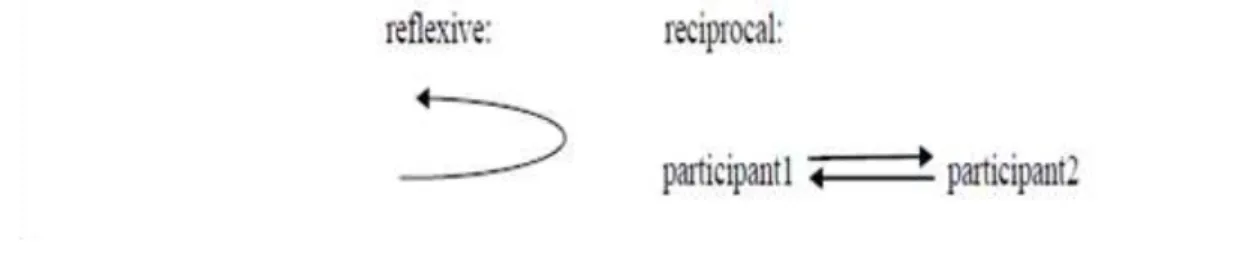
In brief, the reflexive causative can be presented diagrammatically as a loop since the action is reflected back to the causer, while the reciprocal can be seen as a bidirectional (or even multidimensional) causative activity affecting both participants, the causer and the causee at the same time. This is schematized below:
Fig. 2. Reflexive and reciprocal relations adapted from Croft (2012 (34)).
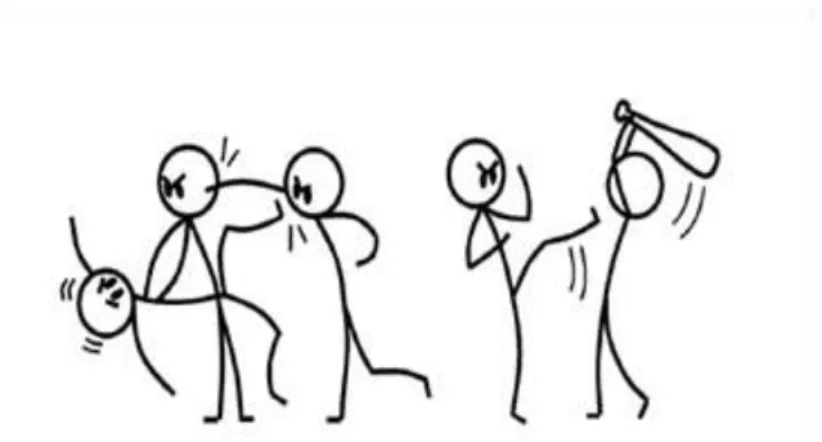
Regarding reciprocal causative events, Evans et al. (2007) cited in Croft (2012) suggest that the mixed one-/two-/(-multiple participant) construal of reciprocal events is due to the joint character of the event: that is, in addition to X acting on Y and Y acting on X, X and Y are acting jointly, as exemplified by
Fig. 3: Reciprocal causation adapted from Sabato and Winter (2005:209).
Croft (2012) notes that “reflexive and reciprocal relations represent mental events in which the two directions of transmission of force are different event types. In reciprocal events, the two directions of transmission of force are the same event type, and in reflexives there is only one event and hence one event type” (p. 233-4).
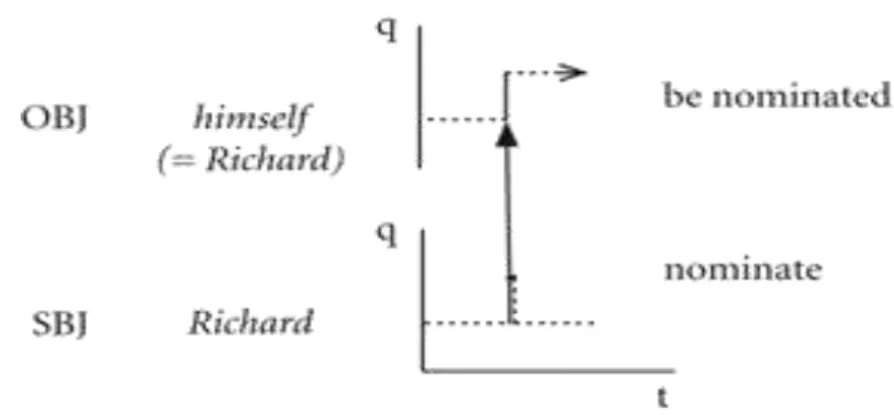
He illustrates thus, in a reflexive relation such as “He nominated himself”, a participant acts on him: he is simultaneously initiator and endpoint. However, in a reciprocal relation such as:
(15) a. “They congratulated each other” (Croft, 2012) b. Rodney kple Nana lↄ wonↄewo
Rodney CONJ Nana love each other ‘Rodney and Nana love each other’
Each participant according to Croft, “plays the role of initiator and end point for the same event type (She congratulates him and He congratulates her)”.
As stated by Croft (2012), ‘reciprocal events are unlike reflexive event types in that each participant in a reciprocal event acts on another participant, not on themselves. They are like reflexive events in the sense that each participant partakes in the event in two roles, and moreover each participant participates in the event in the same two roles’. This is clearly demonstrated in examples (15a and b).
Croft (2012) again reiterates that, “these constructions are “unary” even if they are realized with two distinct argument phrases. As a group, they all participate in the reciprocal event as a whole as initiators and as endpoints. Hence, they are not unlike the participant(s) in a reflexive event. It appears that reflexive forms may be diachronically extended to reciprocal events and reciprocal forms may be extended to reflexive events”.
(16). Richard nominated himself (Croft, 2012 (35))
Fig. 4. An overt reflexive diagram adapted from Croft (2012). b. Agamahi ƒo fi de e-ɖokuii
Agamah beat curse fix 3SG-self ‘Agamah cursed himself’
In (16a and b), the coreference relation between initiator and endpoint is expressed by the special reflexive Object pronoun form, himself and eɖokui (such forms are called reflexive markers by Kemmer (1993) cited in Croft (2012).
It is important to add here that only verbs that can take the same semantic participant types as both subject and object can be reflexivized and reciprocalized.
Consider these ungrammatical illustrations: (17). a. *Senyo gbã eɖokui
Senyo break 3SG-self b. *Kofi tù e-ɖokui Kofi grind 3SG-self
Judging from this obvious ungrammaticality of the above constructions, many of these prototypical semantically-transitive verbs can be reflexivized only metaphorically (Givón, 2001), for instance:
(18). a. Ama ɖuna e-ɖokui le eme ŋutↄ Ama eat-HAB 3Sg-self COP inside very ‘Ama worries herself too much’
b. Fo Atsu tu e-ɖokui ɖe dzi to suku dede me Fo Atsu build 3SG-self on top through school attend-RED inside ‘Fo Atsu built himself up through education’
The same argument holds for reciprocals. For example: (19). *Senyo kple Sika dↄ alↄ wónↄewo
Senyo and Sika sleep sleep each other
In example (19), two predicate arguments are required for the event to be reciprocalized but it has only one thus resulting in an obvious ungrammaticality.
3.
Conclusions
prominence of verbs in the structuring and profiling of events. As indicated by Croft (2012) that “verbs never occur outside of an argument structure construction, and an argument structure construction never occurs without a verb. A verb’s meaning involves a force-dynamic potential which allows it to occur in multiple argument structure constructions; a verb occurring in a particular argument structure construction represents a specific force-dynamic construal of that event.”
It can also be identified that only verbs that can take the same semantic participant types as both subject and object can be reflexivized and reciprocalized; else, prototypical semantically-transitive verbs can be reflexivized only metaphorically. It thus, indicates, that verbs play a crucial role in how events in general and causative constructions in particular are structured.
References
Anonymous Author. (1975; 1976). Nunyamↄ 2A, 2B, 4 and 6. Accra: Bureau of Ghana Languages in Association/ FEP International Private Limited.
Baron, N. S. (1974). The Structure of English Causatives. Lingua, Vol. 33, pp. 299-342.
Bishop, N. (1992). A Typology of Causatives, Pragmatically Speaking. In B. A. Donald & M. R. William (Eds.), Language in Context: Essays for Robert E. Longacre. Arlington: The Summer Institute of Linguistics, Inc. / University of Texas.
Born, M. (1949). Natural Philosophy of Cause and Chance. Oxford: The Clarendon Press.
Bugaeva, A. (2015). Causative constructions in Ainu: A typological perspective with remarks on the diachrony. STUF-Language Typology and Universals, 68(4), 439-484.
Bugaeva, A. (2012). Causative Constructions in Ainu: A Typological Perspective with Remarks on Diachrony. In L. K. Leonid & I, Serzants (Eds.) (forthcoming). Transitivity and Voice in Indo-European and Beyond: A Diachronic Typological Perspective. Philadelphia: John Benjamins. Available at: <www.waseda.jp/wias/eng/achievement/dp/data/dp2011006.pdf.> Date accessed (22 January, 2012).
Comrie, B. (1989). Language Universals and Linguistic Typology: Syntax and Morphology (2nd ed.).
Oxford: Blackwell Publishers.
Comrie, B. (Ed.). (1983). Causative Constructions. Language Universals and Linguistic Typology: Syntax and Morphology. Oxford: Basil Blackwell Publishers Ltd.
Croft, W. (1990). Possible Verbs and the Structure of Events. In S. Tsohatsidis (Ed.), Meanings and Prototypes, pp. 48-73. New York: Routledge.
Croft, W. (2012). Verbs: Aspect and Causal Structure. Oxford: Oxford University Press.
Croft, W. & Cruse, D. A. (2004). Cognitive Linguistics. Cambridge: Cambridge University Press. Dakubu, M. E. K. (2017). Sub-classifying the languages of the Lower Volta Valley: Towards
redefining Kwa. STUF – Language Typology and Universals, 70 (2): pp. 283-301.
Dixon, R. W. M. (2000). A Typology of Causatives: Form, Syntax and Meaning. In R. W. M. Dixon & A. Y. Aikhenvald (Eds.), Changing Valency: Case Studies in Transitivity. Cambridge: Cambridge University Press.
Escure, G. (2008). Pidgins/Creoles and Discourse. In K. Silvia & S. J. Victor (Eds.), The Handbook of Pidgin and Creole Studies (pp. 567-92). Malden, MA: Blackwell Publishing Ltd.
Evans V., Bergen K., & Zinken J. (2006).
The Cognitive Enterprise: An Overview. In: The
Cognitive Linguistics Reader
. Equinox Publishing Company.
Evans, N., Alice, G., & Rachel, N. (2007). Valency Mismatches and the Coding of Reciprocity in Australian Languages. Linguistic Typology, 11, pp. 97-541.
Federica, R. (2009).
Causality and Causal Modelling in Social Sciences: Measuring Variations
.
Belgium: Springer Science and Business Media BV.
Gilquin, G. (2007). Causing Oneself to do Something: The Psychodynamics of Causative Constructions. In E. M. Bermudez & L. R. Miyares (Eds.), Linguistics in the Twenty First Century (pp. 37-46.). Cambridge: Cambridge Scholars Press.
Gilquin, G. (2010). Corpus, Cognition and Causative Constructions. Philadelphia: John Benjamins Publishing Company.
Givón, T. (2001). Syntax: An Introduction, Vol. 2. Philadelphia: John Benjamins Publishing Company.
Heise, D. R. (1975). Causal Analysis. New York: John Wiley and Sons, Inc.
Kamlah, A. (1991). The Causal Relation as the Most Fundamental Fact of the World. Comments on Hans Reichenbach's Paper: The Space Problem in the New Quantum Mechanics. Erkenntnis, 35, 49-60.
Kemmer, S., & Verhagen, A. (1994). The Grammar of Causatives and the Conceptual Structure of Events. In: Cognitive Linguistics, 5(2), pp. 115-156.
Kemmer, S. (1993). The Middle Voice. (Typological Studies in Language, 23). Amsterdam: John Benjamins.
Kenny, D. A. (2004). Correlation and Causality. Storrs: Connecticut.
Klein-Andreu, F. (1983). Grammar in Style: Adjective Placement in Spanish. In K. A. Flora (Ed.), Discourse Perspectives on Syntax (pp. 143-79). New York: Academic Press.
Kouwenberg, S., & Singler, J. V. (Eds.). (2008). The Handbook of Pidgin and Creole Studies. United Kingdom: Blackwell Publishing Ltd.
Lakoff, G., & Johnson, M. (1980). Metaphors We Live By. Chicago: University of Chicago Press. Langacker, R. W. (1991a). Foundations of Cognitive Grammar. Descriptive Application, Vol. 2.
Stanford: Stanford University Press.
Lee, D. (2001). Cognitive Linguistics. An Introduction. Oxford: Oxford University Press.
Li, Y. (1999). Cross-Componential Causativity. Natural Language & Linguistic Theory, 17(3), pp. 445-497.
Meyer, P. G. (2000). The Relevance of Causality. In C. K. Elizabeth & K. Bernd (Eds.), Topics in English Linguistics 33: Cause, Condition, Concession, Contrast: Cognitive Discourse Perspectives. New York: Mouton de Gruyter.
Saah, K. (1989). Reflexivization in Akan. Journal of West African Languages, Vol. 19(2), pp. 15-28. Sabato, S., & Winter, Y. (2005). Against Partitioned Readings of Reciprocals. In D. Paul & F. Michael
(Eds.), Proceedings of the Fifteenth Amsterdam Colloquium. Amsterdam: ILLC/Department of Philosophy, University of Amsterdam.
Saha, P. K. (1987). Reflexivization in American English. Journal of American Speech, 62(3), pp. 211-234.
Salmon, W. C. (1997). Causality and Explanation. Pennsylvania: University of Pittsburgh.
Shibatani, M. (1976). The Grammar of Causative Constructions: A Conspectus. In S. Masayoshi (Ed.), The Grammar Causative Constructions (Syntax Semantics, 6). New York: Academic Press.
Shibatani, M. (2001). Some Basic Issues in the Grammar of Causation. In S. Masayoshi, (Ed.). The Grammar of Causation and Interpersonal Manipulation: Typological Studies in Language, 48. Philadelphia: John Benjamins Publishing Company.
Song, J. J. (2001). Causatives and Causation: A Universal-typological Perspective. London: Longman. Stefanowitsch, A. (2001). Constructing Causation: A Construction Grammar Approach to Analytic
Causatives. Ph. D Thesis. Ann Arbor: Bell & Howell Information and Learning Company.
Talmy, L. (2000). Toward a Cognitive Semantics: Concept Structuring Systems, Vol. 1. Cambridge: MIT Press.
Ungerer, F., & Schmid, H. J. (2006). An Introduction to Cognitive Linguistics. (2nd ed.). Harlow: Pearson
Education.
Appendix
List of abbreviations
1SG “First Person Singular Pronoun” 3PL “Third Person Plural Pronoun” 3SG “Third Person Singular Pronoun” CFM “Clause Final Marker”
CONJ “Conjunction” COP “Copula”
CP “Complementizer Phrase” DET “Determiner”
FOC “Focus Marker”
FUT “Future Aspect Marker” HAB “Habitual Aspect Marker” LOC “Locative”
MOD “Modal Auxiliary” NEG “Negative Particle”
PL “Plural Marker”
POSS “Possessive Marker” PREP “Preposition”
Ewe'de eşgöndergesel ve işteş yapılarla ilgili nedensellik
Öz
Bu makale, Ewe'de eşgöndergesel ve işteş yapılarla ile ilgili nedenselliği, nasıl tasarlandığını ve ifade edildiğini incelemektedir. Bu malake belirli bir ettirgen yapı türü olan, ettirenin sebep olan etmen ile eşgöndergesel ilişki içinde olduğu dolaylı ettirgen yapı ile ilgilidir. Ettiren ve sebep olan etmenin aynı kişiyi kastettiği durum budur. Ewe'deki bu nedensel fenomenin daha yeterli bir açıklaması için, bu çalışmada, metinsel ve içsel olmak üzere iki tür dilsel veri kullanılmıştır. Metinsel veriler, popüler hikaye kitapları ve folklorun tanımları, gelenek ve görenekleri, sözde edebi eserleri ve Gana Dilleri Bürosu tarafından yayınlanan anlatıları içeren didaktik materyallerden oluşmaktadır. Ettirgen yapının tüm örnekleri, analizlerde doğru bir yorumlamaya izin verecek şekilde çevreleyen bağlamların dikkatlice göz önünde bulundurulmasıyla çıkarılmıştır. Bu yazı, tıpkı İngilizce ve diğer dillerin yaptığı gibi, Ewe'de üç kat eşgönderimliliği ifade etmenin mümkün olduğunu; burada ettiren, sebep olan etmen ve etkilenen ile eşgöndergesel ilişki içinde olduğunu göstermektedir. Sadece hem konu hem de nesne ile aynı anlamsal katılımcı türlerini alabilen fiillerin refleksleştirilip karşılıklılaştırılabildiği de belirlenebilir; başka, prototipik anlamsal geçişli fiiller sadece mecazi olarak yeniden yansıtılabilir.
Anahtar sözcükler: eşgönderge; Ewe; anlamsal geçişli fiil; dönüşlü; karşılıklı
AUTHOR BIODATA
PHILLIPS KOFI ATSU LARNYO: is a university Lecturer, a language specialist and media commentator. He lectures in the Department of Speech, Language, and Hearing Sciences, in the School of Allied Health Sciences of the University of Health and Allied Sciences, Ho.
EDUCATIONAL BACKGROUND
He had his M.Phil degree in Linguistics at the University of Ghana, Legon. His thesis is in the area of Cognitive/Psycholinguistics. Before then, he obtained his Bachelor’s Degree in French and Linguistics (Combined Major) also at the University of Ghana, Legon. He is also a product of the Université d’Abomey Calavi, Republic of Benin, where he obtained a Diplôme Universitaire d’Études en Langue Française (DUEF).
WORK EXPERIENCE
As a language and communication expert, he has taught French and English Languages as well as Linguistics related courses at various levels prominent among which are: Ghana Military Academy and Training School, Teshie; Data-Link University College, Tema/Ho; Centre of Distance Education, University of Cape Coast, Ho Campus; Institute for Education Development and Extension, University of Education, Winneba, Ho Campus. He currently serves with the Department of Speech, Language, and Hearing Sciences, where he teaches various Language and Cognition and Neurogenic related courses in Speech, Language and Hearing Disorders. RESEARCH INTEREST
His research interests include: Cognition and Language, Communication Disorders, Rehabilitation and Integration across the Lifespan, Health and Behavioural Change Communication. He enjoys community services targeted at interventions for adolescents with educational challenges.