AN ECOLOGICAL MODEL OF SES AND YOUTH HOPELESSNESS: THE
INTERVENING ROLES OF NEIGHBORHOOD CONTEXT AND FAMILY PROCESSES
Michelle Gonzalez
A thesis submitted to the faculty of the University of North Carolina at Chapel Hill in partial fulfillment of the requirements for the degree of Doctor of Philosophy in the Department of
Psychology (Clinical)
Chapel Hill 2012
Approved by:
ABSTRACT
MICHELLE GONZALEZ: An Ecological Model of SES and Youth Hopelessness: The Intervening Roles of Neighborhood Context and Family Processes
(Under the direction of Deborah J. Jones, Ph.D.)
Although prior work demonstrates a link between low socioeconomic status (SES) and youth hopelessness, less is known about the mechanisms by which hopelessness is
transmitted. This study examined an ecological model of SES and youth hopelessness via a series of intervening processes at both the neighborhood (i.e., crime and sense of community) and family levels (i.e., maternal hopelessness and compromised positive parenting) in a sample of 193 African American single mother-youth (11-16 year old) dyads. Path analyses revealed that families from lower SES backgrounds were more likely to live in
neighborhoods with more crime and less sense of community. Lower levels of sense of community, in particular, were associated with higher levels of maternal hopelessness, which in turn, was associated with compromised positive parenting. Lastly, mothers who engaged in less positive parenting practices had adolescents who reported higher levels of
ACKNOWLEDGEMENTS
Funding for this project was provided by the Ethnicity, Culture and Health Outcomes Program, a Junior Faculty Development Grant, a University Research Council Grant, the UNC Center for AIDS Research (CFAR; 9P30 AI050410), and the Centers for Disease Control and Prevention (K01 PS000795). Additional support was provided by a National Institute of Child Health and Human Development Grant (RO1HD064723).
I would like to thank the families of the African American Families and Children Together (AAFACT) study for their contributions. In addition, I would like to thank the members of my committee for their valuable time and feedback.
TABLE OF CONTENT
LIST OF TABLES ...v
LIST OF FIGURES ...vi
LIST OF ABBREVIATIONS ...vii
INTRODUCTION ...1
METHODS ...8
RESULTS ...14
DISCUSSION ...17
APPENDICES ...23
LIST OF TABLES Table
1. Demographic and descriptive characteristics of the sample (n = 193) ...29 2. Bivariate correlations among SES, neighborhood context, maternal
LIST OF FIGURES
FIGURES
1. Pattern of relationships among study variables for the proposed
LIST OF ABBREVIATIONS Abbreviations
Introduction
More than a quarter (28%) of African American adolescents between 9th and 12th grade report having felt sad or hopeless almost everyday for two or more weeks in a row in the past 12 months (CDC, 2010). Although hopelessness appears to occur among African Americans at a rate similar to the national average (28.6%) for youth in the United States (U.S.) more generally, this cursory review of prevalence rates fails to address a critical research question: What predicts hopelessness among African American youth in particular? This question remains only tangentially addressed in the literature in spite of some data to suggest hopelessness may be a particularly important marker of adjustment among African American youth (e.g., Gonzalez, Jones, Kincaid, & Cuellar, 2012; Kessler et al., 1994; Weissman, Bruce, Leaf, Florio, & Holzer, 1991). Thus, this study aims to establish a better understanding of the correlates of hopelessness among African American youth, which is critical to facilitate earlier identification and prevention of hopelessness in this group. Hopelessness in African American Youth from Single Mother Homes: An Ecological Model
Hopelessness may be defined as an expectation for failure or lack of positive beliefs about future orientations (e.g., Beck, Weissman, Lester, & Trexler, 1974; Joiner & Wagner,
1995; Kazdin, French, Unis, Esveldt-Dawson, & Sherick, 1983). Therefore, underlying hopelessness is the ability to conceptualize and believe in the future. Nurmi and colleagues
planning for the future that may be particularly taxed during the developmental period of adolescence, making it more difficult for youth to deal with stressors, including family financial stress (e.g., Ebata, Petersen, & Conger, 1990; Elkind, 1975; Garmezy & Masten, 1986).
Rates of hopelessness among African American youth in particular (28%) are comparable to national averages for hopelessness among youth in the U.S. (28.6%) more generally (CDC, 2010). Yet, some work suggests that more attention to hopelessness among African American youth, in particular, may be critical to earlier identification and prevention of the psychological correlates of hopelessness in this group, which include not only
internalizing problems, but externalizing problems as well (Drummond, Bolland, & Harris, 2011; Gonzalez et al., 2012; Kashani, Suarez, Allan, & Reid, 1997). First, some work suggests that it may be more culturally acceptable for African American youth to endorse a sense of hopelessness, rather than the broader spectrum of internalizing and depressive symptoms (e.g., sadness, crying) (Kessler et al., 1994; Weissman et al., 1991). In addition to hopelessness as a marker or precursor of internalizing symptoms, more recent work suggests that hopelessness may also be a correlate of externalizing problems among African American youth, who are overrepresented in statistics on delinquency and conduct problems nationally (Gonzalez et al., 2012; Office of Juvenile Justice and Delinquency Prevention, 2011;
amendable to intervention, the present study aimed to better elucidate the potential mechanisms by which hopelessness, in particular, is transmitted in this group.
In order to understand the mechanisms that influence hopelessness among African American youth, an ecological perspective may be most informative. According to
Ecological Systems Theory (Bronfenbrenner, 1986; Cummings, Davies, Campbell, 2000), the development of children is nested within three systems, microsystem (i.e., family, peers, classroom), exosystem (i.e., school, neighborhood, mass media), and macrosystem (i.e., culture, society, economic), which interact to influence child development. Thus, the child is a product of interrelated contextual factors, including family SES.
SES & Hopelessness among African American Youth
Although a wealthy nation, the U.S. is comprised of a relatively high portion of low SES families relative to other developed countries. In fact, the most recent census for which data are available revealed that 42 percent of children in the U.S. were living in low-income families (i.e., not more than 200 percent above the federal poverty threshold) (Chau, Thampi, & Wight, 2010). Moreover, African American (67%) youth are more likely to be raised in low-income families in the U.S. than White (29%) youth (Annie E. Casey Foundation, 2011; U.S. Census Data, 2009). Several economic, social, and institutional factors may account for the overrepresentation of African American youth residing in low-income homes in the U.S.; however, one major factor that has received attention from both policy makers and
psychologists is the rise in the number of single-mother homes, particularly in the African American community.
headed by single mothers (Annie E. Casey Foundation, 2011; U.S. Census Data, 2009). Single mother families are posited to be overrepresented among the low SES in the U.S. for a range of reasons, including, but not limited to the following: lower wages for women, lower educational attainment, and lower rates of child support and father involvement (e.g., Bartfeld & Meyer, 1994; Danziger & Danziger, 1993; McLoyd, 1998). In turn, African American youth from single mother homes have been the focus of increased research attention regarding the effects of low-income families on child and adolescent adjustment (e.g., Brody & Flor, 1997; Jones, Forehand, Brody, & Armistead, 2003; McLoyd, Jayaratne, Ceballo, & Borquez, 1994). Such work has shown that low family income negatively influences an adolescent’s ability to think about the future (e.g., Lamm, Schmidt, &
Trommsdorff, 1976; Nurmi 1987; Trommdorff, Lamm, & Schmidt, 1979), stunting or even inhibiting this developmental process and exacerbating the vulnerability for feelings of hopelessness (Bolland et al., 2007). However, several separate, but interrelated, lines of research suggest that family SES may be operating indirectly through other contextual variables, including neighborhood and family contexts, rather than directly.
Neighborhood context will be discussed here first.
SES, Neighborhood Context, & African American Youth Hopelessness.
Not surprisingly, family income dictates the types of neighborhoods in which youth reside, with lower income neighborhoods characterized by greater physical and social disorder (e.g., Bolland, Lian, & Formichella, 2005; Ross & Mirowsky, 1999; Ross,
study aimed to examine two particular neighborhood characteristics posited to be particularly relevant to the development of youth hopelessness: neighborhood crime and sense of
community.
Sense of community can be defined as feelings of belongingness, trust, and socioemotional ties with other community members (e.g., Chavis, Hogge, McMillan, & Wandersman, 1986; Martinez, Black, Starr, 2002; McMillan & Chavis, 1986). Sense of community in adolescents from low-income neighborhoods may be compromised, because they are more likely to witness or be victims of crime and violence (i.e., assault, illegal drug activity, prostitution), which may generate fear and, ultimately, lead to social withdrawal and lower connectedness to neighborhoods (Bolland et al., 2005). In turn, exposure to
neighborhood crime, which tends to plague many low-income neighborhoods, has been associated with increased feelings of hopelessness in youth from low-income backgrounds (e.g., Bolland et al., 2005; DuRant, Getts, Cadenhead, Emans, & Woods, 1995).
Accordingly, Ross et al. (2000) assert that neighborhood crime “raises levels of fear at the same time that it reduces the perceptions that one is in control of one’s life, creating a sense that one is powerless to escape a bad situation” (p. 594). Yet, what is less well understood is whether there are more proximal family factors that may further account for the links
between neighborhood context and youth hopelessness, factors that may be more amenable to psychosocial intervention than family SES or the neighborhoods in which youth reside. Two family process variables that will be examined in this study in particular are maternal hopelessness and positive parenting.
According to the Family Economic Stress Model, chronic economic disadvantage leads daily struggles that contribute to economic pressure (e.g., worrying about making ends meet, difficulty in dealing with stressful economic conditions), which in turn affect parental mental health, subsequent parenting behavior, and, in turn, have deleterious effects on youth development (Conger et al., 1992).
Gutman and colleagues (2005) extended the Family Economic Stress Model by further highlighting the unique environmental stressors faced by African American families living in lower income communities in particular. That is, Gutman et al. (2005) revealed that economic hardship, which is characteristic of many low SES families, influenced
psychological distress through neighborhood stress. Neighborhood crime may not only create stress for mothers but, consistent with a Social Stress Framework (Pearlin, Menaghan,
Lieberman, & Mullan, 1981), may also lead to lower levels of sense of community as parents in the community may be likely to witness or be victims of violence, which may generate fear and, ultimately, lead to social withdrawal and lower connectedness to neighborhoods (Bolland et al., 2005).
In turn, lower levels of sense of community may exacerbate maternal hopelessness, as has been suggested by prior theory and research (Lincoln, Chatters, & Taylor, 1995; Pearlin, et al., 1981) and compromise maternal parenting behavior. Although the authors is unaware of prior studies that have examined the link between maternal hopelessness, in particular, and parenting, the present study draws upon the literature of depression and parenting to
to display more irritable affect, engage in more angry and hostile behavior, and employ lax/undercontrol disciplinary practices (e.g., Hops et al., 1987; Goodman, Adamson, Riniti, & Cole, 1994; Dumas, Gibson, & Albin, 1989). Generalizing these findings, the present study theorized that hopelessness may be overwhelming to mothers, which could influence their cognitions or diminish their cognitive availability to engage in warm and supportive interactions with their children, as well as decrease the immediate attention to monitoring practices that are key for positive parenting. As a result, children may negatively perceive these less optimal parenting practices as cold, harsh, or indifference, hindering the parent-child relationship and, in turn, exacerbating youth hopelessness.
Study Aims & Hypotheses
Of note, each of the aforementioned literatures, although related, has evolved
relatively independently. Accordingly, the aim of the current study is to integrate and extend prior research and theory by examining a series of mechanisms posited to explain the link between SES and youth hopelessness in African American youth from single mother homes. It was predicted that family socioeconomic status would be indirectly linked with youth hopelessness via the intervening roles of neighborhood context (sense of community, crime), maternal hopelessness, and compromises in maternal positive parenting (See Figure 1). More specifically, it was expected that youth from lower SES families would reside in
It is important to consider here the role of adolescent age and gender in youth
hopelessness. With regard to the role of age on youth hopelessness, a couple of studies have found an association between age and hopelessness, such that older youth were more likely to report higher levels of hopelessness (e.g., Stoddard, Henly, Sieving, & Bolland, 2011; Duke, Borowsky, Pettingell, & McMorris, 2009). These findings may be explained by the literature on the developmental trajectory of hopelessness that suggests that higher levels of cognitive ability and maturity are needed to conceptualize feelings of hopelessness (Nurmi et al., 1991). However, in the data that were utilized for the current investigation, age was not associated with youth hopelessness. This may be partially explained by statistical
implications associated with restriction of range. Specifically, adolescents in the current sample ranged from 11 to 16 years of age, whereas studies that found an association between age and youth hopelessness had a relatively wider age range (i.e., 10-19 year-olds).
Findings from prior research regarding the relationship between gender and hopelessness is mixed. The Youth Risk Behavior Survey conducted by the CDC (2010) found significant gender differences, such that African American girls reported higher levels of hopelessness than their male counterparts. In contrast, other studies have found that males reported significantly higher levels of hopelessness (e.g., Bolland et al., 2007; Stoddard et al., 2011). Additionally, there have been studies that found no significant gender differences on youth hopelessness (e.g., DuRant et al., 1994, 1995; Gonzalez et al., 2012), as was the case with the current sample. Given that neither age nor gender was associated with youth
hopelessness in the current sample, they were not included in the proposed statistical model. Method
Data for the current study was obtained from the African American Families and Children Together (AAFACT) Project, a study of African American youth from single mother homes. African American single mother-headed families (N = 194 dyads) with an 11- to 16-year-old adolescent were recruited from counties across central North Carolina. Recruitment was conducted through community agencies (e.g., health departments, YMCAs, churches), public events (e.g., health fairs), local advertisements (e.g., university-wide informational emails, bus displays, brochures), and snowball sampling. The Behavioral Institutional Review Board approved all study procedures.
Participants
African American mother-youth dyads (N = 193) who participated in the AAFACT investigation and who had complete data on all relevant demographic and major study variables were the focus of these analyses. The mean age for participating youth (n = 193) was 13 years (SD = 1.45) and approximately half (56%) were girls. On average, mothers (n = 193) were 38 (SD = 7.19) years of age approximately half (52%) completed some
college/vocational school after high school/GED; the majority (83.5%) were employed; and household incomes were an average of $29,733/year (SD = $17,457). The average household size for participating families was 3 (SD = 1.25). According to the U.S. Census (2006), which defines low-income as not more than 200 percent above the poverty threshold, 60% of families in the current study were low SES.
Procedure
informed consent was obtained from the mother for her and the adolescent’s participation, and the adolescent gave assent. In order to maximize confidentiality and reduce the potential for biased responses, data from each family member was separately collected on laptop computers using Audio Computer-Assisted Self-Interviewing (ACASI) software, and
participants’ answers were linked to an assigned number rather than to any form of identity. Respondents listened through earphones to pre-recorded questions and personally recorded their answers via the computer mouse and keyboard. This approach helped reduce the
potential for interviewer influence, minimized the error that could have resulted from varying literacy levels in the sample, and maximized confidentiality. Each data collection session assessed a variety of psychosocial variables and took approximately 60 to 90 minutes for mother-child dyads to complete. For the current study, mother-report of neighborhood context, mother-report of parenting practices, mother-report of hopelessness, and youth-report of hopelessness were utilized. Mother-child dyads were compensated a total of $25 for their participation.
Measures
Demographic information. Mothers completed a demographic measure that included
questions about themselves (e.g., maternal age, education), their adolescents (e.g., child age), and their families (e.g., household income). Youth also reported demographic information (e.g., gender, age).
Socioeconomic Status. Several measures of SES were considered for the current
Occupation codes were based on the 1970 U.S. census. In the Hollingshead (1975) system, an SES score is computed in the following manner. An education score (1 through 7, with 1 equal to less than a eight-grade education and 7 equal to graduate training) and an occupation score (1 through 9, with 1 equal to farm laborers/menial service workers and 9 equal to higher executives, proprietors of large businesses, and major professionals) is assigned for each parent based on information provided by them. Education and occupation scores are then weighted to obtain a single score for each parent (range 8 to 66) that reflects one of five social strata (1 through 5, with 1 a reference to unskilled laborers/ menial service workers and 5 a reference to executive/proprietors/major professionals). The Hollingshead (1975) four-factor index of SES has been one of the most frequently used measures of SES
(Edwards-Hewitt & Gray, 1995) and is considered a valuable measure in numerous studies (e.g., Felton, Naylor, & Wood, 1990; Barratt, Roach, & Leavitt, 1996; Cuffe, Waller, Cuccaro, Pumariega, & Garrison, 1995).
Perceived Neighborhood Context. Although census data affords an objective index of
neighborhood disadvantage (Leventhal & Brooks-Gunn, 2000; Raudenbush & Sampson, 1999), it fails to take into account the variability within African American neighborhoods, particularly family members’ own perceptions and experiences of the communities in which they reside (Leventhal & Brooks-Gunn, 2000; 2003; Sampson, Raudenbush, & Earls, 1997). Thus, subjective indices of neighborhood context were examined.
The Perceived Neighborhood Scale (PNS) is a 34-item theoretically-derived self-report measure that assesses four important dimensions of neighborhood that have
socioemotional ties with other community members and (b) perceived crime, which includes the risk and actual occurrence of criminal activities in the neighborhood. Mothers’ responses were scored on a five-point Likert-type scale. The item responses of the sense of community subscale and the perceived crime subscale were coded so that higher scores indicate greater degree of sense of community and higher levels of perceived crime. Prior research using the PNS with a sample of African American mothers documented the applicability of the factor structure, provided evidence for the scale’s concurrent and convergent validity, and showed good reliability estimates (Martinez, 2000; Martinez et al., 2002). For the current study, the coefficient alpha for the sense of community subscale was .86 and includes questions like, “People trust each other in my neighborhood.” The coefficient alpha for the perceived crime subscale was .93 and includes questions such as, “It is safe for my child to play outside.”
Maternal Hopelessness. Mother hopelessness was assessed using the Beck
Compromised Parenting. Maternal parenting was assessed by combining the mother
version of the Interaction Behavior Questionnaire as a measure of warmth/support and the Parental Monitoring Measure as a measure of monitoring/control, two typically examined domains in the parenting literature (Foster et al., 2007; Jones et al., 2008; McKee, Jones, Forehand, & Cuellar, in press). These measures were standardized and averaged.
The Interactive Behavior Questionnaire (IBQ; Prinz, Foster, Kent, & O'Leary, 1979) assesses warmth and support in the mother-child relationship. Mothers completed the short form of the IBQ, which is comprised of the 20 true/false items with the highest phi
coefficients and the highest item-to-total correlations with the original 75 items of the IBQ. The short form correlates .96 with the longer version. Sample items, which may be endorsed as True or False, include: “For the most part, he or she likes to talk to you,” and “This child usually listens to what you have to tell him or her.” Scores can range from 0 to 20. For the present study, items were reverse coded, such that higher scores indicated higher levels of compromised parenting (i.e., low warmth and support). In addition to being discussed as a measure of warmth in the child-parent relationship or of relationship quality, the IBQ has also been discussed in previous research as measuring parent-child interaction and
communication-conflict behavior/ positive communication (Wade, Wolfe, Brown, & Pestian, 2005; Steele, Nesbitt-Daly, Daniel, & Forehand, 2005; Klein, Forehand, Armistead, 1997). Prinz and colleagues (1979) and Robin and Weiss (1980) have reported adequate internal consistency and discriminant validity. The alpha coefficient for the current sample was .87 for the mother report.
activities, and relationships. The items are rated on a 5-point scale ranging from “Not at All” (0) to “Always” (4). This measure has demonstrated acceptable reliability data and good test-retest correlations (e.g., Stattin & Kerr, 2000). Higher scores suggest less maternal
monitoring (i.e., higher levels of compromised parenting). For the current sample, the alpha coefficient for the mother-report version of the measure was .88.
Youth Hopelessness. Hopelessness, the outcome variable of interest, was assessed
using the Hopelessness Scale for Children (HSC; Kazdin, Rodgas, & Colbus, 1986), a 17-item, true-false revision of the Beck Hopelessness Scale for adults; scores may range from 0 to 17 (BHS; Beck et al., 1974). A sample item from the HSC is “I might as well give up because I can’t make things better for myself.” Kazdin et al. (1986) found the HSC to correlate positively with depression (r = .58) and negatively with self-esteem (r = -.61) and social skills (r = - .39). Adequate internal consistency has been reported with clinical
samples of children and young adolescents (e.g., 5 to 13 years old; alpha = .96; Kazdin et al., 1986), as well as older adolescents, including a study in which African American youth were included in the sample (e.g., 13 to 15 years old; alpha = .84; Spirito, Williams, Stark, & Hart, 1988); however, the alpha has been lower among community samples (e.g., alpha = .69; Spirito et al., 1988). In order to improve the alpha in our sample, we deleted items 1 (“I want to grow up, because I think things will be better”), 6 (“Some day, I will be good at doing the things that I really care about”), and 11 (“When I grow up, I think I will be happier than I am now”) in the total hopelessness score. Of note, all three of these items have been highlighted in past research as functioning differently for youth in community than clinical samples (Spirito et al., 1988). The resulting alpha for this 14-item scale was 0.72.
Preliminary analyses
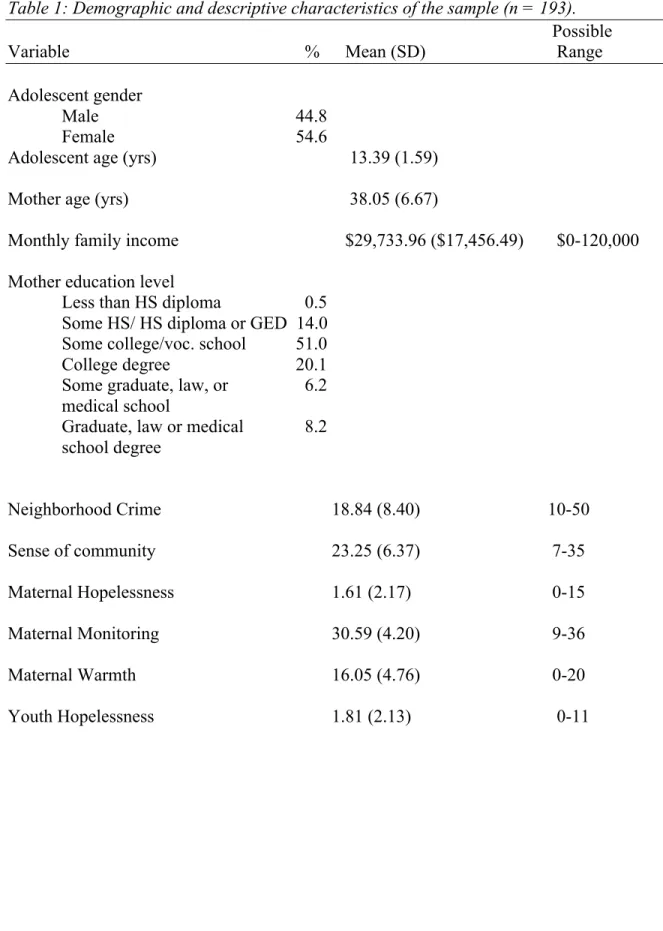
Descriptive statistics for demographic and primary study variables are presented in Table 1. The only demographic variable associated with youth hopelessness was maternal age (r = -.20, p < .01); therefore, maternal age was statistically controlled in the respective path analyses with youth hopelessness as the outcome. The proposed pattern of associations was initially examined using bivariate analyses. As evidenced by the pattern of correlations in Table 2, SES was significantly associated with perceived neighborhood crime (r = -.27, p = .01), sense of community (r = .20, p = .01), and maternal hopelessness (r = -.24, p = .01), such that youth from low SES families were more likely to live in neighborhoods
characterized by more crime and less sense of community as reported by their mothers, who also endorsed higher levels of hopelessness. Additionally, perceived neighborhood crime and sense of community were associated with youth hopelessness (r = .20, p = .01, r = -.25, p = .01) in the directions hypothesized. Youth living in neighborhoods with higher levels of crime and lower levels of sense of community reported greater feelings of hopelessness. Finally, maternal hopelessness was positively correlated with maternal compromised
parenting (r = .33, p = .001), which was in turn, positively associated with child hopelessness (r = .17, p = .05).
Model Testing Procedures
Path analysis was employed to test the proposed indirect (family SES, neighborhood context, maternal hopelessness, and compromised positive parenting) and direct
(neighborhood) effects of the study variables on youth hopelessness. Path analysis, an
appropriate technique for evaluating direct and indirect effects, because it allows for the simultaneous modeling of multiple regression relationships.
Primary Analyses
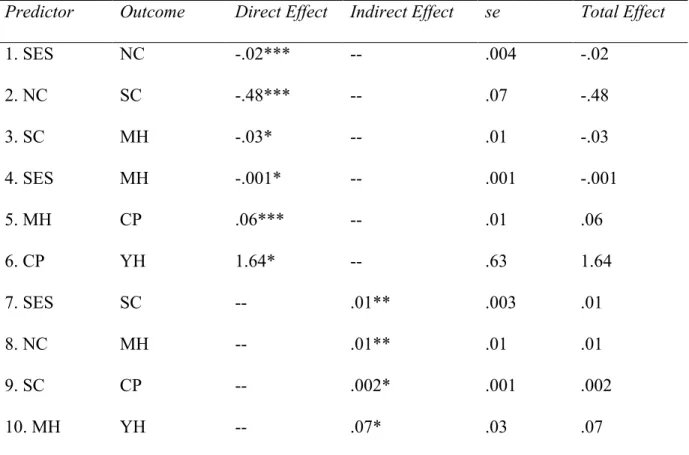
The first set of analyses examined the direct effects among the primary study variables in the path model in order to later identify and test potential indirect effects on youth hopelessness (See Figure 1). Results indicated that SES was associated with perceived neighborhood crime (β = -.02, p < .001) and maternal hopelessness (β = -.001, p < .05). In turn, maternal hopelessness predicted compromised parenting (β = .06, p < .001), which subsequently predicted youth hopelessness (β = 1.64, p < .05) after controlling for maternal age. Informing the process in which the study variables may be operating, neighborhood crime was associated with sense of community (β = -.48, p < .001), which also predicted maternal hopelessness (β = -.03, p < .01).
Advances in the examination of intervening variables no longer requires an
association between the independent and dependent variable (i.e., “direct effect”) in order to test the role of an intervening variable (i.e., “indirect effect”) (see Hayes, 2009, for a review). Accordingly, the proposed indirect effects of SES on youth hopelessness via neighborhood context, maternal hopelessness, and positive parenting were examined utilizing bootstrapping methods for assessing indirect effects (e.g., Hayes, 2009; Preacher & Hayes, 2004).
bootstrap-estimated standard errors of the indirect effects are calculated from the probability of the distribution from all of the resampled estimates. A 95% confidence interval that does not include 0 was considered the criterion for significance.
Turning now to the findings (see Table 3), path analyses identified neighborhood crime as an intervening variable for SES and sense of community (95% CI range .003 to .013). Mothers categorized as lower SES reported residing in neighborhoods with higher levels of crime, which was then associated with sense of community. In addition, neighborhood crime was indirectly associated with maternal hopelessness via sense of community (95% CI range .001 to .025). In other words, mothers who reported living in riskier neighborhoods also reported lower levels of sense of community, which, in turn, was associated with higher levels of hopelessness. Although sense of community was not
indirectly associated with youth hopelessness, it was indirectly associated with compromised parenting (95% CI range .001 to .003). That is, sense of community operated through
maternal hopelessness to influence compromises in positive parenting. Finally, path analyses revealed a significant intervening role for compromised parenting in the association between maternal hopelessness and youth hopelessness (95% CI range .02 to .18). Mothers who reported more feelings of hopelessness engaged in more comprised parenting behaviors, which, in turn, was associated with greater youth-reported feelings of hopelessness.
Discussion
neighborhoods with more crime and, in turn, less sense of community. Lower levels of sense of community, in particular, was associated with higher levels of maternal hopelessness, which in turn, was associated with compromised positive parenting. Finally, mothers who engaged in less positive parenting practices had adolescents who reported higher levels of hopelessness.
Building upon prior literature (e.g., Duncan, 1991; Jargowsky, 1994; Zigler, 1994), SES was negatively associated with neighborhood crime. Indeed, family SES dictates the types of neighborhoods in which youth reside, with lower income neighborhoods
characterized by greater physical and social disorder (e.g., Bolland et al., 2005; Ross & Mirowsky, 1999; Ross et al., 2000). As expected given prior work (e.g., Brodsky, O’Campo, & Aronson, 1999; Perkins & Taylor, 1996; Riger, LeBailley, & Gordon, 1981), SES was not directly associated with lower levels of sense of community; rather, SES was indirectly associated with sense of community through neighborhood crime. These findings suggest that being from a low SES family, in and of itself, may not inhibit the ability for African American single mothers to form connections with their communities. Instead, low SES families are more likely to reside in more dangerous neighborhoods in which they are more likely to witness or be victims of violence, which may generate fear and, ultimately, lead to social withdrawal and lower connectedness to neighborhoods (Bolland et al., 2005).
the Social Stress framework (Pearlin et al., 1981) and suggests in risky neighborhoods, high instances of crime may inhibit a sense of community from developing among neighborhood residents, depriving individuals of the support that may ameliorate feelings of hopelessness associated with financial hardships that are often perennial for lower SES families.
including low SES and neighborhood risk (Brody et al., 2001). In turn, these mothers may be less willing or able to engage in positive parenting behaviors.
Finally, maternal hopelessness operated through compromises in positive parenting to shape youth hopelessness. That is, mothers who endorsed more feelings of hopelessness also reported engaging in more compromised parenting practices (i.e., low warmth/support and monitoring), which in turn was associated with increased feelings of hopelessness among youth. Indeed, the literature has widely supported an association between parenting practices and child adjustment. Specifically, research has found an association between the lack of positive parenting behaviors (low warmth/support and low monitoring/control) and various child outcomes, including both internalizing and externalizing problems (Baumrind, 1989; Grolnick & Ryan, 1989; Lamborn, Mounts, Steinberg, & Dornbusch, 1991). Futhermore, these findings are supported by the Family Economic Stress Model, which suggests that parental psychological distress can diminish or disrupt effective parenting practices leading to deleterious effects on developmental trajectories of children and adolescents (Conger et al., 1992).
Of course, the findings of the current study must be considered in light of the
limitations. First, the cross-sectional nature of this study prohibits the opportunity to establish the direction of causality and/or potential bidirectionality of relationships (e.g., youth
distress. Third, although we do not necessarily consider this a limitation, caution is warranted in generalizing results from this study to other racial/ethnic groups or two parent families. Future work could examine SES, neighborhood context, maternal hopelessness,
compromised parenting, and youth hopelessness in the context of other racial groups and 2 parent families, which could reveal potential moderators (i.e. two parent homes vs. single parent homes) and differences among groups.
The clinical implications of this study afford some direction to researchers regarding which factors (i.e., parenting and maternal hopelessness) to target in intervention
programming in order to ameliorate or prevent feelings of hopelessness in low-income African American children from single mother homes. Much of the literature on
hopelessness, including this study, has focused on contextual factors (i.e., neighborhood crime) that are beyond the control of the child. However, by identifying variables amenable to intervention (i.e., maternal hopelessness, positive parenting), researchers can target those mechanisms to reduce feelings of hopelessness and improve children’s outlook on their futures. In fact, future studies could examine whether targeting parenting, maternal hopelessness, and even sense of community or social support would predict feelings of hopefulness in low-income children and adolescents.
Appendix A
Perceived Neighborhood Scale (Mother-Report)
Now we would like you to think about the neighborhood you live in. You will hear some general statements about neighborhoods. Please tell us how each statement fits the way you feel about your neighborhood.
Social Embeddedness Subscale
Choose: 1 = Very Unlikely 2 = Unlikely 3 = Not Sure 4 = Likely 5 = Very likely
1. How likely is it that you could ask a neighbor to loan you a few dollars or have some food?
2. How likely is it that a neighbor could ask you to borrow a few dollars or have some food?
3. How likely is it that you could get help from a neighbor? For example, to watch your place while you are away, or to take care of your child when you are sick
4. How likely is it that you could help a neighbor? For example, to watch their place while they are away, or take care of their child if they are sick?
5. How often do you greet your neighbors when you see them?
6. How often do you casually visit with neighbors either by going over to their homes, or by them coming to your home?
7. How often do you go to neighborhood activities, such as church fairs, community meetings, sport events, etc?
8. How often do you exchange or share childcare with a neighbor? 9. How often do you talk to neighbors who are parents?
Sense of Community Subscale
Choose: 1 = Strongly Disagree 2 = Disagree 3 = Not Sure 4 = Agree 5 = Strongly Agree
10. There are people I can rely on among my neighbors 11. People trust each other in my neighborhood
12. I feel I belong in my neighborhood
13. I care about what my neighbors think about my actions, such as how I dress, how I treat my child, etc
14. I feel close to some of my neighbors
Satisfaction with Neighborhood Subscale
Choose: 1 = Strongly Disagree 2 = Disagree 3 = Not Sure 4 = Agree 5 = Strongly Agree
17. My neighborhood is a good place to live
18. My neighborhood has been getting worse recently
19. I have good access to public transportation in my neighborhood 20. The buildings and yards in my neighborhoods are really run down 21. I would love to move out of my neighborhood if I could
22. I have easy access to a telephone. For example, I own a phone, there is a pay phone close by, or a neighbor has a phone.
23. There is a good place for children to play in my neighborhood, such as a playground. 24. My neighborhood is a good place to raise a family
Neighborhood Crime Subscale
Choose: 1 = Strongly Disagree 2 = Disagree 3 = Not Sure 4 = Agree 5 = Strongly Agree
25. It is safe for my child to play outside
26. There are trouble makers hanging around in my neighborhood 27. There is public drinking in my neighborhood
28. There is open drug use or dealing in my neighborhood 29. It is safe to walk alone in my neighborhood at night
30. Some friends and relatives don’t visit me at home because they don’t feel safe 31. People are scared of being robbed in my neighborhood
Appendix B
Beck Hopelessness Scale (Mother-Report)
The following questions are about attitudes. If a statement describes your attitude over the past week, including today, you would say the statement is true. If a statement does not describe your attitude, you would say the statement is false. Be sure to listen to each statement carefully.
1. I look forward to the future with hope and enthusiasm
2. I might as well give up because there is nothing I can do to make things better for myself
3. Whenever things are going badly, I am helped by knowing that they cannot stay that way forever
4. I can’t imagine what my life will be like in 10 years 5. I have enough time to accomplish the things I want to do 6. In the future I expect to succeed in what concerns me most 7. My future seems dark to me
8. I happen to be particularly lucky, and I expect to get more of the good things in life than the average person
9. I just can’t get the breaks and there’s no reason I will in the future 10. All I can see ahead of me is unpleasantness rather than pleasantness 11. My past experiences have prepared me well for the future
12. I don’t expect to get what I really want
13. When I look ahead to the future, I expect that I will be happier than I am now 14. Things just don’t work out the way I want them to
15. I have great faith in the future
16. I never get what I want, so it’s foolish to want anything 17. It is very unlikely that I will get any satisfaction in the future 18. The future seems vague and uncertain to me
19. I can look forward to more good times than bad
Appendix C
Maternal Warmth/Support (Mother-Report)
Think back over the last several weeks at home. Please tell us if you believe that the statement is mostly true or mostly false about you and the child participating in this study. Your answers will not be shown to your child, coparent, or anyone else in your family. Choose: 0 = True 1 = False
1. The child is easy to get along with
2. The child is well behaved in your discussions with him or her
3. The child is receptive to criticism or listens when you correct him or her 4. For the most part he or she likes to talk to you
5. You and he or she never seem to agree
6. This child usually listens to what you tell him or her
7. At least three times a week, you and he or she get angry with each other 8. He or she says that you have no consideration or respect for his or her feelings 9. You and this compromise or reach an agreement during arguments
10. This child often doesn’t do what you ask
11. The talks that you and he or she have are frustrating 12. This child often seems angry with you
13. He or she acts impatient with you
14. In general, you don’t think that you and he or she get along very well 15. This child almost never understands your side of an argument
16. This child and you have big arguments over little things 17. He or she is defensive and often doesn’t listen to what you say 18. He or she thinks your opinions or ideas don’t count
19. You and he or she argue a lot about rules
Appendix D
Maternal Monitoring (Mother-Report)
The next several items will ask you how much you know about the activities of the child participating in this study.
Choose: 0 = Not at All 1 = Rarely 2 = Some of the time 3 = Most of the time 4 = Always
How often do you know:
1. What your child does during his or her free time?
2. Who this child has as friends during his or her free time? 3. What type of homework this child has?
4. What this child spends his or her money on?
5. When this child has an exam or assignment due at school? 6. How this child does on different subjects in school? 7. Where this child goes when out at night with friends? 8. What this child does and where he or she goes after school?
9. In the past month, how often have you had no idea where this child was at night?
Appendix E
Hopelessness Scale for Children (Adolescent-Report)
The following statements are about how some kids feel about their lives. Your answers let us know about how kids feel about things. We’d like you to tell us if the statement is true or false for you. If the statement is how you feel, you would say it is like you, or true; if the statement is not how you feel, you would say it is not like you, or false. There are no right or wrong answers; just tell us if the statement is like you or not.
1. I want to grow up because I think things will be better
2. I might as well give up because I can’t make things better for myself 3. When things are going badly, I know they won’t be as bad all the time 4. I can imagine what my life will be like when I grow up
5. I have enough time to finish the things I really want to do 6. Some day I will be good at the things that I really care about 7. I will get more of the good things in life than most other kids
8. I don’t have good luck and there’s no reason to think I will when I grow up 9. All I can see ahead of me are bad things, not good things
10. I don’t think I will get what I really want
11. When I grow up I think I will be happier than I am now 12. Things just won’t work out the way I want them to 13. I never get what I want to it’s dumb to want anything 14. I don’t think I will have any real fun when I grow up 15. Tomorrow seems unclear and confusing to me 16. I will have more good times than bad times
Table 1: Demographic and descriptive characteristics of the sample (n = 193). Possible
Variable % Mean (SD) Range
Adolescent gender
Male 44.8
Female 54.6
Adolescent age (yrs) 13.39 (1.59)
Mother age (yrs) 38.05 (6.67)
Monthly family income $29,733.96 ($17,456.49) $0-120,000 Mother education level
Less than HS diploma 0.5 Some HS/ HS diploma or GED 14.0 Some college/voc. school 51.0 College degree 20.1 Some graduate, law, or 6.2 medical school
Graduate, law or medical 8.2 school degree
Neighborhood Crime 18.84 (8.40) 10-50
Sense of community 23.25 (6.37) 7-35
Maternal Hopelessness 1.61 (2.17) 0-15
Maternal Monitoring 30.59 (4.20) 9-36
Maternal Warmth 16.05 (4.76) 0-20
Table 2: Bivariate correlations among SES, neighborhood context, maternal hopelessness, compromised parenting and youth hopelessness
Variable 1 2 3 4 5 6
1. SES -- -.27** .20** -.24** -.25** .17* 2. Neighborhood crime -- -- -.46** .17* .15* .20** 3. Sense of community -- -- -- -.26** -.21** -.25** 4. Maternal hopelessness -- -- -- -- .33** .18* 5. Compromised parenting -- -- -- -- -- .17* 6. Youth hopelessness
Table 3: Direct and Indirect Effects of Path Analyses
Predictor Outcome Direct Effect Indirect Effect se Total Effect
1. SES NC -.02*** -- .004 -.02
2. NC SC -.48*** -- .07 -.48
3. SC MH -.03* -- .01 -.03
4. SES MH -.001* -- .001 -.001
5. MH CP .06*** -- .01 .06
6. CP YH 1.64* -- .63 1.64
7. SES SC -- .01** .003 .01
8. NC MH -- .01** .01 .01
9. SC CP -- .002* .001 .002
10. MH YH -- .07* .03 .07
Figure
Figure 1. Pattern of relationships among study variables for the proposed ecological model of youth hopelessness
Family SES
Maternal
Hopelessn
Sense of Communit
y Neighborh ood Crime
Mother Positive parenting
Youth Hopelessn
References
Annie E. Casey Foundation (2011). Kids count data book. America’s children, America’s challenge: Promoting Opportunity for the next generation. Retrieved from
http://datacenter.kidscount.org/DataBook/2011/Default.aspx
Barratt, M. S., Roach, M. A., & Leavitt, L. A. (1996). The impact of low risk prematurity on maternal behavior and toddler outcomes. International Journal of Behavioral
Development, 19(3), 581-602. doi:10.1080/016502596385703
Bartfeld, J., & Meyer, D. (1994) Are they really deadbeat dads? The relationship between ability to pay, enforcement, and compliance in nonmartial child support
cases. Social Service Review, 68(2), 219-235.
Baumrind, D. (1989). The permanence of change and the impermanence of stability. Human Development, 32, 187-195. doi:10.1159/000276467
Beck, A. T. & Steer, R. A. (1993). Manual for the Beck Hopelessness Scale. San Antonio, TX: Psychological Corporation.
Beck, A.T., Weissman, A., Lester, D., & Trexler, L. (1974). The Measurement of pessimism: The hopelessness scale. Journal of Consulting and Clinical Psychology, 42(6), 861-865. doi: 10.1037/h0037562
Bolland, J.M., Bryant, C. M., Lian, B.E., McCallum, D. M., Vazsonyi, A.T., & Barth, J. (2007). Development and risk behavior among African American, Caucasian, and Mixed-race adolescents living in high poverty inner-city neighborhoods. American Journal of Community Psychology, 40(3), 230-249. doi: 10.1007/s10464-007-9132-1
Bolland, J.M., Lian, B.E., & Formichella, C.M. (2005). The origins of hopelessness among inner-city African-American adolescents. American Journal of Community
Psychology, 36(3/4), 293-305. doi:10.1007/s10464-005-8627-x
Brodsky A, O’Campo P, & Aronson R. (1999). PSOC in community context: Multi-level correlates of a measure of psychological sense of community in low-income, urban neighborhoods. Journal of Community Psychology, 27(6), 659-679. doi:
10.1002/(SICI)1520-6629(199911)27:6
Brody, G. H., & Flor, D. L. (1997). Maternal psychological functioning, family processes, and child adjustment in rural, single-parent, African American families.
Developmental Psychology, 33(6), 1000-1011. doi: 10.1037/0012-1649.33.6.1000
Bronfenbrenner, U. (1986). Ecology of the family as a context for human development: Research perspectives. Developmental Psychology, 22(6), 723-742.
doi:10.1037/0012-1649.22.6.723
Burton, L., Price-Spratlen, T., & Spencer, M. (1997). On ways of thinking about measuring neighborhoods: Implications for studying context and development among minority children. In J. Brooks-Gunn, G. Duncan, & L. Aber (Eds.), Neighborhood poverty: Context and consequences for children (pp. 132–144). New York: Russell Sage. Center for Disease Control and Prevention (CDC). (2010, June). CDC surveillance
summaries: Youth Risk Behavior Survey. Morbidity and Mortality Weekly Report, 59, 1-142.
Chau, M., Thampi, K., Wight, V.R. (2010). Fact sheet: Basic facts about low-income
children, 2009 children under age 18. Retrieved from National Center for Children in Poverty website: http://www.nccp.org/publications/pdf/text_975.pdf
Chavis, D., Hogge, J., McMillan, D., & Wandersman, A. (1986). Sense of community through Brunswik’s lens: A first look. Journal of Community Psychology, 14(1), 24– 40. doi: 10.1002/1520-6629(198601)14:1<24::AID-JCOP2290140104>3.0.CO;2-P Chung, H. L., & Steinberg, L. (2006). Relations between neighborhood factors, parenting
behaviors, peer deviance, and delinquency among serious juvenile offenders. Developmental Psychology, 42(2), 319-331. doi:10.1037/0012-1649.42.2.319
Conger, R.D., Conger, K. J., Elder, G.H., Lorenz, F.O., Simons, R.L., & Whitbeck, L.B. (1992). A family process model of economic hardship and adjustment of early adolescent boys. Child Development, 63(3/4), 526-541. doi:10.2307/1131344 Coulton, C., Korbin, J., & Su, M. (1996). Measuring neighborhood context for young
children in an urban area. American Journal of Community Psychology, 24(1), 5–32. doi: 10.1007/BF02511881
Cuffe, S. P., Waller, J. L., Cuccaro, M. L., Pumariega, A. J., & Garrison, C. Z. (1995). Race and gender differences in the treatment of psychiatric disorders in young adolescents. Journal of the American Academy of Child and Adolescent Psychiatry, 34(11), 1536-1543. doi:10.1097/00004583-199511000-00021
Cummings, E. M., Davies, P. T., & Campbell, S. B. (2000). Developmental psychopathology and family process: Theory, research, and clinical implications. New York, NY: GuilfordPublications, Inc.
Danziger, S., & Danziger, S. (1993) Child poverty and public policy: Toward a
mediating effect of hopelessness on the code of the street thesis. Deviant Behavior, 32(3), 191-223. doi: 10.1080/01639621003748746
Duke, N.N., Borowsky, I.W., Pettingell, S.L., & McMorris, B.J. (2009). Examining youth hopelessness as an independent risk correlate for adolescent delinquency and violence. Maternal Child Health Journal, 15(1), 97-97. doi: 10.1007/s10995-009-0550-6.
Dumas, J. E., Gibson, J. A., & Albin, J. B. (1989). Behavioral correlates of maternal
depressive symptomatology in conduct-disorder children. Journal of Consulting and Clinical Psychology, 57(4), 516-521. doi: 10.1037/0022-006X.57.4.516
Duncan, G. (1991). The economic environment of childhood. In A. Huston (Ed.), Children in poverty: Child development and public policy (pp. 23-50). New York: Cambridge University Press.
DuRant, R.H., Getts, A., Cadenhead, C., Eman, S.J., Woods, E.R. (1995). Exposure to violence and victimization and depression, hopelessness, and purpose in life among adolescents living in and around public housing. Developmental and Behavioral Pediatrics, 16(4), 233-237. doi:10.1097/00004703-199508000-00004
Ebata, A. T., Petersen, A. C., & Conger, R. D. (1990). The development of psychopathology
in adolescence. In J. E. Rolf and A. S. Masten (Eds.), Risk and protective factors in
the developmentof psychopathology (pp. 308-333). New York: Cambridge University Press.
Edwards-Hewitt, T., & Gray, J. J. (1995). Comparison of measures of socioeconomic status between ethnic groups. Psychological Reports, 77, 699-702. doi:10.2466/pr0.1995.7 7.2.699
Elkind, D. (1975). Recent research on cognitive development in adolescence. In S. E. Dragastin G. Elder, Jr. (Eds.), Adolescence in the life cycle. New York: Wiley.
Felton, R. H., Naylor, C. E., &Wood, F. B. (1990). Neuropsychological profile of adult dyslexics. Brain and Language, 39(4), 485-497. doi:10.1016/0093-934X(90)90157-C Foster, S.A., Jones, D.J., Olson, A., Forehand, R., Gaffney, C., Zens, M.S., & Bau, J.J.
(2007). Family socialization of adolescent self reported cigarette use: The roles of parents’ history of regular smoking and parenting style. Journal of Pediatric Psychology, 32(4), 481-493. doi:10.1093/jpepsy/jsl030
Garmezy, N., & Masten, A. S. (1986). Stress, competence and resilience: Common frontiers for therapist and psychopathologist. Behavior Therapy, 17(5), 500-521. doi:
adjustment in African American youth from single mother homes: The mediating role of hopelessness. Cultural Diversity and Ethnic Minority Psychology, 18(2), 109-117. doi: 10.1037/a0026846
Goodman, S. H., Adamson, L. B., Riniti, J., & Cole, S. (1994). Mothers' expressed attitudes: Associations with maternal depression and children's self-esteem and
psychopathology. Journal of the American Academy of Child and Adolescent Psychiatry, 33(9), 1265-1274. doi:10.1097/00004583-199411000-00007
Goodman, S. H., & Gotlib, I. H. (1999). Risk for psychopathology in the children of depressed mothers: A developmental model for understanding mechanisms of transmission. Psychological Review, 106(3), 458-490. doi:10.1037/0033-295X.106.3.458
Grolnick, W., & Ryan, R. (1989). Parent styles associated with children’s self-regulation and competence in school. Journal of Educational Psychology, 81(2), 143-154. doi:10.10 37/0022-0663.81.2.143
Gutman, L.M., McLoyd, V.C., & Tokoyawa, T. (2005). Financial strain, neighborhood stress, parenting behaviors, and adolescent adjustment in urban African American families. Journal of Research on Adolescence, 15(4), 425-449. doi: 10.1111/j.1532-7795.2005.00106.x
Hayes, A. F. (2009). Beyond Baron and Kenny: Statistical mediation analysis in the new millennium. Communication Monographs, 76(4), 408-420. doi:10.1080/0363775 0903310360
Hollingshead, A. B. (1975). Four factor index of social status. Unpublished manuscript, Yale University, New Haven, CT.
Hops, H., Biglan, A., Sherman, L., Arthur, J., Friedman, L., & Osteen, V. (1987). Home observations of family interactions of depressed women. Journal of Consulting and Clinical Psychology, 55(3), 341-346. doi: 10.1037/0022-006X.55.3.341
Jargowsky, P, (1994). Ghetto poverty among Blacks in the 1980s. Journal of Policy Analysis and Management, 13(2), 288-310. doi: 10.2307/3325015
Joiner, T.E., & Wagner, K.D. (1995). Attributional style and depression in children and adolescents: A meta-analytic review. Clinical Psychology Review, 15(8), 777-798. doi: 10.1016/j.bbr.2011.03.031
Jones, D.J., Forehand, R., Rakow, A., Colletti, C., McKee., L., & Zalot., A. (2008). The specificity of maternal parenting behavior and child adjustment difficulties: A study of inner-city African American families. Journal of Family Psychology, 22(2), 181-192. doi:10.1037/0893-3200.22.2.181
Jones, D. J., Zalot, A. A., Foster, S. E., Sterrett, E., & Chester, C. (2007). A review of childrearing in African American single mother families: The relevance of a coparenting framework. Journal Of Child And Family Studies, 16(5), 671-683. doi:10.1007/s10826-006-9115-0
Kashani, J. H., Suarez, L., Allan, W. D., Reid, J. C. (1997). Hopelessness in inpatient youth: A closer look at behavior, emotional expression, and social support. Journal of the American Academy of Child and Adolescent Psychiatry, 36(11), 1625-1631. doi: 10.1016/S0890-8567(09)66575-8
Kazdin, A.E., French, N.H., Unis, A.S., Esveldt-Dawson, K., & Sherick, R. B. (1983). Hopelessness, Depression, and suicidal intent among psychiatrically disturbed inpatient children. Journal of Counseling and Clinical Psychology, 54(4), 504-510. doi:10.1016/0272-7358(95)00046-1
Kazdin, A. E., Rodgas, A., & Colbus, D. (1986). The Hopelessness Scale for Children: Psychometric characteristics and concurrent validity. Journal of Consulting and Clinical Psychology, 54(2), 241-245. doi: 10.1037/0022-006X.54.2.241.
Kessler, R. C., McGonagle, K. A., Zhao, S., Nelson, C. B., Hughes, M., Eshleman, S.,…
Kendler, K. S. (1994). Lifetime and 12-month prevalence of DSM III-R psychiatric
disorders in the United States: Results from the National Comorbidity Survey.
Archives of General Psychiatry, 51(1), 8-19.
doi:10.1001/archpsyc.1994.03950010008002
Klein, K., Forehand, R., Armistead, L., & Long, P. (1997). Delinquency during the transition to early adulthood: Family and parenting predictors from early adolescence.
Adolescence, 32(125), 61-80.
Lamborn, S., Mounts, N., Steinberg, L., & Dornbusch, S. (1991). Patterns of competence and adjustment among adolescents from authoritative, authoritarian, indulgent, and
neglectful families. Child Development, 62(5), 1049-1065. doi:10.2307/1131151
Lamm, H., Schmidt, R.W., & Trommsdorff, G. (1976). Sex and social class as determinants
of future orientation in adolescents. Journal of Personality and Social Psychology,
34(3), 317-326. doi:10.1037//0022-3514.34.3.317
Leventhal, T., & Brooks-Gunn, J. (2003). Children and youth in neighborhood contexts. Current Directions in Psychological Science, 12(1), 27-31. doi:10.1111/1467-8721.01216
Lincoln, K.D., Chatters, L.M., & Taylor, R.J. (2005). Social support, traumatic events, and
depressive symptoms among African Americans. Journal of Marriage and Family,
67(3), 754-766. doi:10.1111/j.1741-3737.2005.00167.x
Martinez, M. L. (2000). Neighborhood context and the development of African American children. New York, NY: Garland Publishing, Inc.
Martinez, M., L., Black, M., & Starr, R. H. (2002). Factorial structure of the Perceived Neighborhood Scale (PNS): A test of longitudinal invariance. Journal of Community Psychology, 30(1), 23-43. doi:10.1002/jcop.1048
McKee, L., Jones, D.J., Forehand, R., & Cuellar, J. (in press). Assessment of parenting style, parenting relationships, and other parent variables in child assessment. To appear in Oxford Handbook of Psychological Assessment of Children and Adolescents. New York: Oxford.
McLoyd, V. C. (1998) Socioeconomic disadvantage and child development. American Psychologist, 53(2), 185-204. doi:10.1037//0003-066X.53.2.185
McLoyd, V. C., Cauce, A., Takeuchi, D., & Wilson, L. (2000). Marital processes and
parental socialization in families of color: A decade review of research. Journal Of
Marriage And The Family, 62(4), 1070-1093. doi:10.1111/j.1741-3737.2000.01070.x
McLoyd, V. C., Jayaratne, T.B., Ceballo, R., & Borquez, J. (1994). Unemployment and work interruption among African American single mothers: Effects on parenting and
adolescent socioemotional functioning. Child Development, 65(2), 562-589.
doi:10.111/j.1467-8624.1994.tb00769.x
McMillan, D., & Chavis, D. (1986). Sense of community: A definition and theory. Journal of Community Psychology, 14(1), 6–23. doi: 10.1002/1520-6629(198601)14:1<6::AID-JCOP2290140103>3.0.CO;2-I
Murry, V., Bynum, M. S., Brody, G. H., Willert, A., & Stephens, D. (2001). African American single mothers and children in context: A review of studies on risk and resilience. Clinical Child And Family Psychology Review, 4(2), 133-155. doi:10. 1023/A:1011381114782
Muthen, L.K., & Muthen, B.O. (2008). MPlus User’s Guide: 5th Edition. Los Angeles, CA: Muthen & Muthen.
of adolescents’ future orientation: A developmental task interpretation. Adolescence, 22(88), 977-991.
Nurmi, J.E. (1991). How do adolescents see their future? A review of the development of future orientation and planning. Developmental Review, 11(4), 1-59. doi:
10.1016/0273-2297(91)90002-6
Nurmi, J.E., Poole, M. E., & Seginer, R. (1995). Tracks and transitions: A comparison of adolescents future-oriented goals, explorations, and commitments in Australia, Israel, and Finland. International Journal of Psychology, 30(3), 355-375. doi: 10.1080/0020 7599508246575
Office of Juvenile Justice and Delinquency Prevent (OJJDP). (2011). Law enforcement and juvenile crime: Juvenile arrest rate trends. Statistical Debriefing Book. Retrieved from http://www.ojjdp.gov/ojstatbb/crime/JAR_Display.asp?ID=qa05260
Pearlin, L.I., Menaghan, E.G., Lieberman, M.A., & Mullan, J.T. (1981). The family process. Journal of Health and Social Behavior, 22, 337-356.
Perkins, D.D., & Taylor, R.B. (1996). Ecological assessment of community disorder: Their relationship to fear of crime and theoretical implications. American Journal of Community Psychology, 24(1), 63–107. doi: 10.1007/BF02511883
Peterson, C. (2000). The future of optimism. American Psychologist, 55(1), 44-55. doi: 10.1037/0003-066X.55.1.5
Pinderhughes, E., & Le, H. (2008). Introduction to excavating culture. Applied Developmental Science, 12(4), 161-162 doi:10.1080/10888690802387765
Preacher, K.J., & Hayes, A.F. (2004). SPSS and SAS procedures for estimating indirect effects in simple mediation models. Behavior Research, Methods, Instruments, and Computers, 36(4), 717-731. doi:10.3758/BF03206553
Prinz, R., Foster, S., Kent, R., & O’ Leary, K. (1979). Multivariate assessment of conflict in distressed and non-distressed mother-adolescent dyads. Journal of Applied Behavior Analysis, 12, 691-700.
Raudenbush, S. W., & Sampson, R. J. (1999). Econometrics: Toward a science of assessing ecological settings with application to the systematic social observation of
neighborhoods. In M. E. Sobel & M. P. Becker (Eds.), Sociological methodology, Vol. 29 (pp. 1-41). Washington, DC: American Sociological Association.
Robin, A., & Weiss, J. (1980). Criterion-related validity of behavioural and self-report measures of problem-solving communication skills in distressed and non distressed parent--adolescent dyads. Behavioural Assessment, 2, 339-352.
Ross, C. E., & Mirowsky, J. (1999). Disorder and decay: The concept and measurement of perceived neighborhood disorder. Urban Affairs Review, 34(3), 412–432.
doi:10.1177/10780879922184004
Ross, C. E., Reynolds, J. R., & Geis, K. J. (2000). The contingent meaning of neighborhood stability for residents’ psychological well-being. American Sociological Review, 65, 581–597.
Sampson, R. J., Raudenbush, S. W., & Earls, F. (1997). Neighborhoods and violent crime: A multilevel study of collective efficacy. Science, 277(5328), 918-924. doi:10.1126/ science.277.5328.918
Spirito, A., Williams, C. A., Stark, L. J., & Hart, K. J. (1988). The Hopelessness Scale for Children: Psychometric properties with normal and emotionally disturbed
adolescents. Journal of Abnormal Child Psychology, 16(4), 445-458. doi: 10.1007/BF00914174
Stattin, H., & Kerr, M. (2000). Parental monitoring: A reinterpretation. Child Development, 71(4), 1072-1085. doi: 10.1111/1467-8624.00210
Steele, R.C., Nesbitt-Daly, J.S., Daniel, R.S., & Forehand, R. (2005). Factor structure of the Parenting Scale in a low-income African American sample. Journal of Child and Family Studies, 14(5), 535–549. doi: 10.1007/s10826-005-7187-x
Stoddard, S.A., Henly, S.J., Sieving, R., & Bolland, J.M. (2011). Social connections, trajectories of hopelessness, and serious violence in impoverished urban youth. Journal of Youth Adolescence, 40(3), 278-295. doi: 10.1007/s10964-010-9580-z
Tolan, P. H., Gorman-Smith, D., & Henry, D. B. (2003). The developmental ecology of urban males' youth violence. Developmental Psychology, 39(2), 274-291. doi:10. 1037/0012-1649.39.2.274
Trommdorff, G., Lamm, H., & Schmidt, R.W. (1979). A longitudinal study of adolescents’ future orientation (time perspective). Journal of youth and Adolescence, 8, 132-147. Wade, S. L., Wolfe, C., Brown, T. M., & Pestian, J. P. (2005). Putting the pieces together:
preliminary efficacy of a web-based family intervention for children with traumatic brain injury. Journal of Pediatric Psychology, 30(5), 437-442. doi: 10.1093/jpepsy/ jsi067
Weissman, M. M., Bruce, M. L., Leaf, P. J., Florio, L. P., & Holzer, C. (1991). Affective
TheEpidemiologic Catchment Area study (pp. 53-80). New York: Free Press. U.S. Census Bureau. (2009). America’s Families and Living Arrangements. [Dataset].
Available from http://www.census.gov/population/www/socdemo/hh-fam/cps2009.html
U.S. Department of Health and Human Services (2008). Fact sheet: Juvenile delinquency. Retrieved from aspe.hhs.gov/hsp/08/boys/FactSheets/jd/report.pdf