Original Research Article
Correlation of clinical and laboratory parameters of acute
glomerulonephritis in children
Chandra Sekhar Kondapalli
1, Kalyan Chakravarthy Gondi
1*, Faisal Mohammed
2INTRODUCTION
Acute glomerulonephritis is an inflammatory process affecting primarily the glomerulus with infiltration and proliferation of acute inflammatory cells. These are principally mononuclear cells and neutrophils in post-infectious glomerulonephritis. Inflammation is immunologically mediated with immune deposits in the
glomerulus. Onset of symptoms is usually acute.1 It is
essentially a disease of childhood that accounts for approximately 90% of renal disorders in children. The group A β hemolytic streptococcus (GAS) is a common infective agent in children that causes the widest range of clinical disease in humans of any bacterium. Post-streptococcal glomerulonephritis (PSGN) is still prevalent in the developing countries.2
1Department ofPediatrics Katuri Medical College and Hospital, Guntur, Andhra Pradesh, India 2Department of Pediatrics, Rainbow Hospitals, Bengaluru, Karnataka, India
Received: 04 December 2018
Accepted: 25 December 2018
*Correspondence:
Dr. Kalyan Chakravarthy Gondi, E-mail: [email protected]
Copyright: © the author(s), publisher and licensee Medip Academy. This is an open-access article distributed under the terms of the Creative Commons Attribution Non-Commercial License, which permits unrestricted non-commercial use, distribution, and reproduction in any medium, provided the original work is properly cited.
ABSTRACT
Background: The present study was conducted to study the clinical and laboratory parameters of acute glomerulonephritis in children admitted in the department of Pediatrics, Katuri Medical College and Hospital, Guntur.
Methods: A prospective study was done at Katuri Medical College and Hospital in all children who are clinically diagnosed edema, oliguria, Cola coloured urine and hypertension. Children presenting with Oliguria, Oedema, Haematuria, Hypertension, Pharyngitis or skin lesions were included, both genders male and female. 50 cases of post-streptococcal glomerulonephritis were evaluated by taking detailed history, thorough clinical examination and appropriate investigation were done for establishment of diagnosis. Lab investigations, CUE, RFT, ASO titres, Serum Complement were done. All the statistical analysis was performed by using EPI INFO 3.5-1. The results were expressed as percentages. Test of significance was done by chi square test. P<0.05 was considered significant.
Results: 4156 cases were admitted, out of which 50 cases were having acute glomerulonephritis comprising of 1.2%. The incidence of glomerulonephritis was more from July to December. The sex ratio from male to female is 1.17:1. The incidence of glomerulonephritis was more in children coming from low socio-economic families. Signs wise analysis of glomerulonephritis, it was observed that puffiness of face, edema feet and hypertension were the common features. Incidence of hyper tension were more in male children than female children. The incidence of edema and proteinuria are the commonest clinical presentation. The comparison between incidence of oliguria and blood urea is statistically significant. 1/4th of patients of oliguria are associated with increase serum creatinine level.
Conclusions: Acute glomerulonephritis is completely a preventable and completely curable disease if proper precaution is like personal hygiene is observed. Proper knowledge of pathophysiology of glomerulonephritis is important for proper management, institution on appropriate treatment and careful follow up of cases are the corner stones for successful outcome of patients.
Keywords: AGN clinical and labs, AGN in children, Correlation of AGN
Burden of APSGN in underdeveloped countries is 9.3 cases per 100,000 population.3 Acute glomerulonephritis
syndrome consists of sudden onset of edema, hematuria, hypertension, oliguria and varying degree of proteinuria. 4-6 It may follow infection with a variety of bacteria,
viruses and parasites or can be a part of systemic disease (or) as a primary glomerular disease.7 Infection can be
that of respiratory tract in the form of pharyngitis, otitis media or skin infections like pyoderma, impetigo or infected scabies.8 Acute glomerulonephritis is regarded as
a primary disease of kidney. Cardiovascular disturbances form a conspicuous part of the clinical picture. The main cardiovascular change being cardiac failure due to secondary hypertension, which is often seen in infants and children. In acute glomerulonephritis, myocardial function is not commonly depressed. Myocardial failure may occur secondary to arterial hypertension, severe electrolyte disturbances, aggravated by anemia. In some cases, cardiac failure has been present in the absence of significant hypertension. The changes can be attributed to concomitant viral infection which presents as myocarditis. The histologic findings probably are due to edema with no significant cellular destruction (or inflammatory changes in the myocardium). Since acute nephritis and rheumatic fever are both related to post-streptococcal sensitization, it is possible that rheumatic myocarditis may occur in association with nephritis, but this is a very rare occurrence. Cardiac failure, whether due to hypertension (or) carditis, the heart is deprived of its contractile activities with reduction of the effective cardiac output. As a compensatory mechanism, the heart adapts by increasing the rate of contraction resulting in tachycardia.9
The aim and objectives of the present study are to study the clinical and laboratory parameters of acute glomerulonephritis in children admitted in the department of Pediatrics, Katuri Medical College and Hospital, Guntur; to investigate clinical presentation of acute glomerulonephritis and to investigate clinical and laboratory correlation of acute glomerulonephritis.
METHODS
It was a prospective study carried out at Department of Pediatrics, Katuri Medical College and Hospital, Guntur. The study population included the hospitalized children of Katuri Medical College, Guntur; in children who are clinically diagnosed edema, oliguria, cola colored urine and hypertension.
Inclusion criteria
Children presenting with
• Oliguria,
• Edema,
• Hematuria
• Hypertension, pharyngitis or skin lesions
• Both genders male and female.
Exclusion criteria
Children presenting with
• Nephrotic syndrome
• Chronic kidney disease.
Laboratory investigation included CBP, complete urine examination, FT, ASO titres, serum complement. The sample size for the fifty patients were identified for the study.
Description of Maneuver
This is a hospital-based study carried out in the ward of the Katuri Medical College, Guntur. The children satisfying the inclusion criteria were registered. Children having conditions enlisted in the exclusion criteria were carefully excluded. A detailed history enlisting the presenting complaints, history of present illness, past history, family history, nutritional history and treatment history were noted.
A thorough general examination was done followed by systemic examination and the findings recorded in a proforma which follows:
• Selection of cases will be done according to inclusion criteria of acute glomerulonephritis i.e., oliguria, oedema, haematuria, associated with hypertension, pharyngitis or skin lesions.
• Hypertension is considered to be present when as an average systolic blood pressure (SBP) and/or diastolic BP that is ≥95th percentile for age, sex, and height on ≥3 occasions.
• Microscopic haematuria was indicated by presence of more than 5 RBC per HPF (high power field) in freshly voided 10 ml of urine.
• Hypertensive encephalopathy (generalized or posterior reversible encephalopathy syndrome) is suggested by the presence of headache, vomiting, temperature elevation, visual disturbances, ataxia, and depressed level of consciousness, CT abnormalities, and seizures.
Statistical analysis
All the statistical analysis was performed by using EPI INFO 3.5-1. The results were expressed as percentages. Test of significance was done by chi square test. P<0.05 was considered significant.
RESULTS
take remedial measures for prevention of disease. 50 cases of post-streptococcal glomerulonephritis were evaluated by taking detailed history; thorough clinical examination and appropriate investigation were done for establishment of diagnosis during a period of 2 years. Present study is a hospital-based study included the patients admitted in the Department of Pediatrics during the above period. The incidence in the present study may not reflect the true incidence of disease because it is a hospital-based study. 4156 cases were admitted in the department of pediatrics out of which 50 cases were having acute glomerulonephritis comprising of 1.2%. Analysis of seasonal incidence of glomerulonephritis:12 cases were reported from January to June and 38 cases were reported from July to December comprising of 24% and 76% respectively. The incidence of glomerulonephritis was more from July to December.
Table 1: Age and sex incidence.
Age Male Female Total Percentage
Up to 3 years 1 0 1 2 4 to 6 years 9 6 15 30 7 to 9 years 8 13 21 42 10 to 12 years 9 4 13 26
27 23 50 100
Sex and age wise analysis of the 50 cases, 1 case below 3 years was reported in male child. There was equal distribution of cases in male children between 3-6 years, 7-9years and 10-12 years comprising of 9,8,9 cases respectively. In females, age wise distribution of cases as follows 3-6years, 7-9 years and 10-12years comprising of 6,13 and 4 respectively. More number of cases in females were observed in the age 7-9 years comprising of 13 cases. Analysis of the sex wise incidence of glomerulonephritis was 27 cases in male children and 23 cases in female children. There is slight increase in incidence of glomerulonephritis in male children than females comprising of 27(54%) and 23(46%) respectively. The sex ratio from male to female is 1.17:1 (Table1).
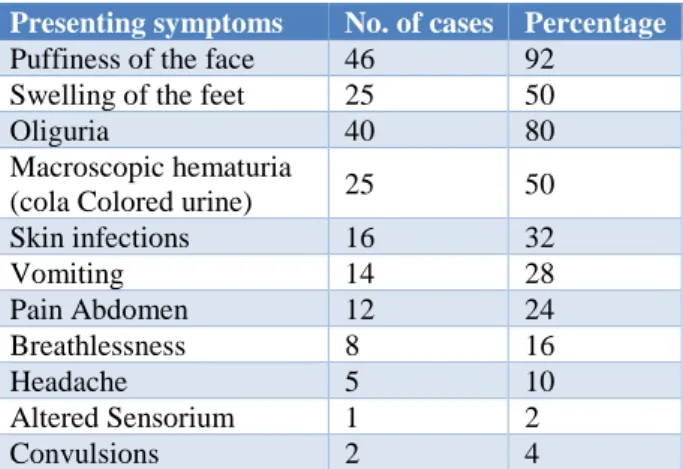
Table 2: Presenting symptoms.
Presenting symptoms No. of cases Percentage
Puffiness of the face 46 92 Swelling of the feet 25 50
Oliguria 40 80
Macroscopic hematuria
(cola Colored urine) 25 50 Skin infections 16 32
Vomiting 14 28
Pain Abdomen 12 24
Breathlessness 8 16
Headache 5 10
Altered Sensorium 1 2
Convulsions 2 4
Incidence of glomerulonephritis by the socio-economic status: it was observed that 48 cases reported in children from low socio-economic families. Only 2 cases were reported in children high socio-economic status. It is quite obvious that the incidence of glomerulonephritis was more in children coming from low socio-economic families. Incidence wise clinical features of glomerulonephritis were analysed and observed that the common features in present analysis were puffiness of face, oliguria, cola coloured urine, swelling of feet, skin infection, vomiting, pain abdomen and breathlessness comprising of 46(92%), 40(80%), 25(50%), 25(50%), 16(32%), 14(28%), 12(24%) and 8(16%) respectively. Severe life-threatening complications like CNS involvement were seen in two cases (Table 2).
Table 3: Clinical findings.
Clinical findings No. of cases Percentage
Edema face 46 92
Hypertension 40 80
Edema feet 35 70
Ascites 4 8
Congestive cardiac
failure 3 6
Hepatomegaly 3 6
Hypertensive
encephalopathy 2 4
Signs wise analysis of glomerulonephritis, it was observed that puffiness of face, edema feet and hypertension were the common features comprising of 46(92%), 40(80%) and 35(70%) respectively. But other important features like ascites, cardiac failure, hepatomegaly and hypertensive encephalopathy were observed in 4, 3, 3 and 2 respectively (Table 3).
Table 4: Blood pressure.
Male Female
Mild hypertension 13 7 Moderate hypertension 9 7 Severe hypertension 3 1
Total 25 15
From the sex wise analysis of hypertension, it was observed that the incidence of hyper tension was more in male children than female children comprising of 25(50%) and 15(30%) respectively (Table 4).
Laboratory investigations
Table 5: Urine examination.
Laboratory entity No. of cases Percentage
1 + proteinuria 17 34 2 + proteinuria 16 32 3 + proteinuria 3 6
Hematuria 48 96
Biochemical analysis
Evaluation of blood urea showed less than 40mg/dl was seen in 29 cases and above 40mg/dl was seen in 21 cases (Table 6).
Table 6: Blood urea.
Value No. of cases Percentage
20-40mg 29 58
40-80mg 20 40
80-100mg 1 2
Estimation of serum creatinine showed that 40 cases had less than 1mg and 10 cases showed more than 1mg. It showed that the kidney function is preserved in majority of cases (Table 7).
Table 7: Serum creatinine.
Values No. of cases Percentage
<1mg 40 80
1-2mg 9 18
2-4mg 1 2
Serum electrolytes
Abnormal serum sodium levels were observed in 6 cases with serum sodium level less than 130mEq/L, whereas above 145mEq/L was seen in 2 cases (Table 8).
Table 8: Serum sodium.
Values No. of cases Percentage
<130mg/l 6 12
130-145mg/l 42 84
>145mg/l 2 4
On estimation of potassium levels in the blood, it was observed that two cases were having potassium less than 3mEq/L and 6 cases were having potassium level more than 5.5mEq/L and the remaining 42 cases are having potassium levels in normal range (Table 9).
Table 9: Serum potassium.
Values No. of cases Percentage
<3meq/l 2 4
3-5.5meq/l 42 84
>5.5meq/l 6 12
Table 10: Serum cholesterol.
Values No. of cases Percentage
<200mg/dl 47 94
>200mg/dl 3 6
Serum cholesterol level was also estimated to rule out atypical nephrotic syndrome. It was observed that 47 cases out 50 were having cholesterol level less than 200mg/dl and only 3 cases were having cholesterol above 200mg/dl (Table 10). Estimation of serum proteins in the blood showed that the protein level was normal in all the cases, as there was no massive proteinuria observed in the present analysis.
ASO titers was estimated in all the 50 cases of glomerulonephritis showed that 33 cases had elevated ASO titres level indicating that the glomerulonephritis might be due post-streptococcal infection comprising of 66%. It was negative in 17 cases comprising of 34%.
Normal values of ASO titers
• 2-4 years: 160 Todd units
• 5-9 years: 240 Todd units
• 10-12 years: 320 Todd units
Radiological changes
Evaluation of heart and lungs by x-ray revealed cardiomegaly in 3 cases, pleural effusion in 2 two cases and pneumonitis (Table 11).
Table 11: Chest X-ray.
X-ray finding No. of cases Percentage
Normal cardiac size with
prominent lung vasculature 44 88
Cardiomegaly 3 6
Pleural effusion 2 4
Pneumonitis 1 2
Evaluation of complements in the blood showed that the level was low in 45 cases and normal in 5 cases comprising of 90% and 10% respectively.
Table 12: U/s abdomen findings.
U/s. finding No. of cases Percentage
Normal study 6 12
Bulky kidneys with
decreased echotexture 28 56 Increased echotexture 14 28 Pleural effusion with
ascites 2 4
antibody with complement deposition in the glomeruli which is mainly responsible for glomerulonephritis. Ultrasound examination of the abdomen revealed that bulky kidneys were observed in 42 cases, increases echogenicity in 14 cases and pleural effusion and ascites in 2 cases. It showed that majority of cases of glomerulonephritis had abnormality of in kidney architecture (Table 12).
Table 13: Correlation of edema and proteinuria.
Present Absent p-value
Edema 46 (92%) 4 (8%)
0.02 Proteinuria 36 (72%) 14 (28%)
The incidence of edema and proteinuria are the commonest clinical presentation in the present study comprising of 46(92%) and 36(72%). All the patients of proteinuria are associated with edema. So, the clinical correlation is statically significant with a P value of 0.02 (Table 13).
Table 14: Correlation of oliguria and blood urea.
Present Absent p-value
Oliguria 40 (80%) 10 (20%)
0.03 Blood urea 21 (42%) 18 (36%)
The incidence of oliguria and blood urea was 40(80%) and 21(42%). Nearly half of patients of oliguria are associated with increased blood urea level. So, the comparison between incidence of oliguria and blood urea is statistically significant with P value of 0.03 (Table 14).
Table 15: Correlation of oliguria and serum creatinine.
Present Absent p-value
Oliguria 40 (80%) 10 (20%)
0.02 Serum creatinine 10 (20%) 18 (36%)
The incidence of oliguria and serum creatinine was 40(80%) and 10(20%). From the above analysis it was observed that 1/4th of patients of oliguria are associated with increase serum creatinine level. This is statically significant with P value of 0.02 (Table 15).
DISCUSSION
A total number of 50 patients with glomerulonephritis admitted in the department of Pediatrics, Katuri medical college Guntur were studied over a period of 2 years. The incidence in the present study may not reflect the true incidence in the general population as it was done in the patients admitted in the department.
In order to know the true incidence a large-scale study is require over a period of time by using standard protocol.
Incidence of disease
4156 cases were admitted in the department of pediatrics over a period of two years out of which 50 cases were found to have renal problem particularly glomerulonephritis comprising of 1.2%
All the 50 cases admitted in the department of Pediatrics so were arranged month wise to know the seasonal influence in causing glomerulonephritis. The general trend is that the glomerulonephritis caused by sore throat is mainly seen in winter and rainy months and skin infection caused by group A β hemolytic streptococci is seen mainly in summer season. The present study observed that the majority cases were admitted between July to December comprising of 76%. Only 12 cases were reported from January to June comprising of 24%. Manhas et al, reported that the maximum number of cases were seen between August to December.10 Port harcourt
et al, and Mcgil ugwu et al, reported clustering of cases between October to January.11,12 The present study was in
correlation with the studies of above authors reported from various part of the country. So, it is concluded that most of cases of acute glomerulonephritis occur in rainy and winter seasons.
Socioeconomic group
Of the analysis 50 cases of glomerulonephritis 96% of cases were from the low socio-economic families. Similar findings were observed by Calabar et al, where the reported incidence was 82%.13 So, the incidence of
glomerulonephritis is more common in children of low socio-economic back ground because of repeated sore throat and skin infection.
Sex distribution
The male preponderance was observed in the present study where the sex ratio from male to female was 1.17:1. Similar sex incidence was reported by all authors like with minor variation Calabar et al, Kumar et al, Enugu et al, Dodge et al.13-16 There is slight preponderance was
observed in male children by all authors including the present study.
Age distribution
Age wise distribution of the cases by other authors and the present study so, it was observed that maximum number of cases were seen between 5-10years comprising 70% and a smaller number of cases were reported below 5 years and above 10 years comprising of 4% and 26% respectively. When the present study compared with the study of other authors from various areas like Yadav et al.17 It was observed similar findings
observation of other authors including present study that glomerulonephritis common between 5 to 10 years of age.
Clinical presentation
Of the analysis 50 cases clinically, it was observed that edema, oliguria, hypertension and cola colored urine were the main features in order of incidence comprising of 92%, 80%, 80% and 50% respectively. These were the main features observed by other authors from various places like Yadav et al, Singh M et al, Berriox et al, Ocheke et al, Shah et al.17-21
The incidence of edema by all authors including the present study was the commonest presentation of above 80% in the present study (92%) which is in concordance with Yadav et al (85.1%), Singh M et al (93%), Berriox et al (100%), Ocheke et al (84.6%), Shas et al (85%).17-21
The incidence of oliguria in the present study of 80% of cases was observed by many authors except by few authors like Yadav et al (41.5%), and Shas et al (22%) where they reported incidence was less.17,21
In the present study hypertension was noted in 80% of cases which was comparable with study of other authors like in, Yadav et al (86.2%), Berriox et al (97%), Ocheke et al (92.3%), Shah et al (86%), Poonking et al (83%).17,19-22 But less incidence was noted by the authors
like Manhas et al (69%), Mcgil et al (55%), and Meherban singh et al (49%).10,12,18
Cola coloured urine which was the fourth most common finding was observed in 50% of cases in the present study was in comprising with study of Meherban singh et al (56%).18 Higher incidence of cola coloured urine was
observed by other authors like Manhas et al, (90%) Mcgil et al,(90%), Kumar et al, (92%), Yadav et al (96%), Berriox et al (90%), Ocheke et al (76%), Shas et al (96%).10,12,14,17,19-21
Clinical findings
The proportion of sore throat in the present study was 60% and Similar incidence was noted Ibadin et al (53.8%) but less incidence was noted by other authors like Mcgil et al (25%), Calabar et al (14.7%) yadav et al (25.5%), shas et al21(25.5%).12.13,17,21
The percentage of skin infection in present study was 32% which was more than the observation of Mcgil et al (19%), Calabar et al (22.1%), yadav et al (19.1%), shah et al (19.1%). but it is less than the incidence observed by Ibadin et al (46.2%).12,13,17,21,23
Lab investigations
Evaluation of proteinuria in the present study observed that the incidence was 86% which was in comparison
study by other authors like Mcgil et al (100%), Calabar et al (100%), Kumar et al (100%), Yadav et al (73.3%), Meherban et al (93%), Shah et al (98%), Becquet et al (98%).12-14,17,18,21,24
The incidence of hematuria in the present study was 98% which was comparable with the study of other authors like Mcgil et al12(90%), Calabar et al(58.8%), Kumar et al (100%), Meherban et al (96%) Shah et al (96%), Becquet et al (100%), but the incidence observed by Yadav et al (41.5%) was less.12-14,17,18,21,24
Evaluation of kidney function by estimating blood urea and serum creatinine in the present study was 46% and 20% respectively. The incidence of blood urea in the present study was in correlation with the study of Yadav et al (42.6%) and Shah et al (47.8%).17,21 But the
incidence was higher than the incidence reported by Calabar et al (17.6%), Kumar et al (20%).13,14
The incidence of serum creatinine in the present study was 20% and comparable with the studies of Calabar et al (13.7%) and Kumar et al (26%) but higher incidence was noted by Yadav et al (43.6%) and Shas et al (43.6%).13,14,17,21
Estimation of ASO titers in the present study observed the incidence of 66% which indicates the development of glomerulonephritis by group A β hemolytic streptococci mainly involving tonsils, which was in correlation with studies of Kumar et al (76%), Becquet et al (76.3%) and Derakhshan et al (84%) and it was higher than that of results observed by Mcgil et al (30%)and shah et al (34%).12,14, 21,24,25
Evaluation of electrolytes disturbances mainly sodium and potassium in the present study revealed that hyponatremia and hyperkalemia noted 12% and 14% respectively. The incidence of hyponatremia in the present study was higher than study observed by Shas et al (4.2%) but it was less than Mcgil et al (40%).12,21
The proportion of hyperkalemia in the present study was 14% which was less than that of Mcgil et al (40%), but is more than that of Shas et al (10.6%).12,21
Hypernatremia in the present was observed only in 4% of cases was less than the study observed by Shah et al (12.7%). (17.6%), Kumar et al (20%).14,21
Complements
Evaluation of the complement is very important because it will be deposited in the glomeruli along with antigen antibody causing glomerulonephritis.
So, in the present study low complements level were noted in 90% of patients which was comparable to the study observed by Berriox et al 95%.19 Forty-five
of complement. This is in concordance with that of which showed decreased complement C3 in 95% of cases. Out of these 45 children, only 31 children underwent repeat serum complement levels after 2 months (8 weeks). 29 children (96%) had the normal complement levels. Two cases still had decreased levels of complement which on renal biopsy showed membranoproliferative glomerulonephritis type - II, one child is suffering with systemic lupus erythematosus in whom Antinuclear antibodies are positive.
Radiological appearance of the chest
The heart and lungs are mainly affected in glomerulonephritis due to hypertension and retention of sodium and water manifesting as hypertensive heart failure and pleural effusion. In the present study cardiomegaly, pleural effusion and pneumonitis was observed 6%, 4%, and 2% respectively even though the 50% patients had hypertension and 98% edema. In majority of patients there were no secondary effects of glomerulonephritis in the form of normal chest x ray. The present was in correlation with study of with reported incidence was Mcgil et al (10%).12
U/s. abdomen
Ultra sound evaluation of kidneys revealed that transient bulky kidneys were observed in 56% of the cases.
Complication
After the evaluation of 50 cases of glomerulonephritis in the present study 8% of cases having CCF and 4% of cases having hypertensive encephalopathy observed as posterior reversible encephalopathy syndrome (PRES). The incidence of CCF in the present study was in correlation with studies of others. The incidence of hypertensive encephalopathy was similar to the studies of Calabar et al (4.4%) and Singh M et al (5%) and lower than the studies observed by Mcgil et al (15%), Yadav et al (10.6%), Ocheke et al (41%), shah et al (10%).12,13,17,18,20,21
The percent of seizures observed in the present study was 4% which was comparable to studies of Calabar et al (4.4%) and Becquet et al (4%) and the incidence was lower observed by Mcgil et al (15%).12,13,24 There is very
good recovery for acute glomerulonephritis. Spontaneous recovery occurs in most instances, children with normal blood pressure, urine output of more than 400ml can be managed at home. Bed rest is beneficial in those with edema and hypertension. Urine output, oral intake and weight should be recorded every day. Sodium intake is restricted in all cases with edema and hypertension. All foods rich in potassium need to be restricted till the urinary output is more than 400ml per day. If we manage the crisis, the outcome will be good in case of acute glomerulonephritis.
CONCLUSION
Majority of the cases were admitted in the months July to December where the incidence of throat infection is more caused by group A β haemolytic streptococci. Skin infection is also a major factor for causing glomerulonephritis. There is a female predominance of glomerulonephritis in the ratio of female to male is 1.6:1 between 7 to 9 years and male predominance between 10 to 12 years. More number of cases were reported in the age group of 5 to 10 years. The incidence of glomerulonephritis was observed more in children of low socio-economic background. Almost all patients presented with insidious onset of edema, puffiness of the face and pedal edema. Cola coloured urine (Macroscopic haematuria) was seen in 50% of cases. Microscopic haematuria was seen in all most all cases. (98%). Majority of the children had proteinuria (from trace to ++) with only 6% of children having 3+ proteinuria. ASO titers were increased in 66% of cases. Majority of children had hypocomplementemia (C3) at the time of admission and have reached the normal levels of complement (C3) after 2 months (8 weeks). There was no much disturbance of electrolytes in the present study. Only few cases were having electrolyte disturbance like hyponatremia, hypernatremia and hyperkalaemia. There is disproportionate rise of blood urea and serum creatinine where the incidence of increased of blood urea was more than the incidence increased of serum creatinine. The serum protein levels are normal in majority of the children with negligible incidence of proteinuria ranging from 1+ to 3+. Comparison of Clinical and Laboratory features coupled with Statistical analysis was done in the present study which yielded significance for the following features like: edema and proteinuria; oliguria and blood urea; oliguria and serum creatinine.
Funding: No funding sources Conflict of interest: None declared
Ethical approval: The study was approved by the Institutional Ethics Committee
REFERENCES
1. Dr. William Wong, star ship children's health clinical guideline-September 2005. Available at: https://bpac.org.nz/BPJ/2007/august/docs/bpj7_apsg n_40-41.pdf.
2. Banapurmath CR, Zacharias TS, Somashekhar KS, Abdul Nazer PU. Congestive cardiac failure and electrocardiographic abnormalities in acute glomerulonephritis. Indian Pediatr. 1996;33:589-92. 3. Carapetis JR, Steer AC, Mullholand EK, Weber M. The global burden of group A streptococcal diseases. Lancet. 2005;5:685-94.
5. Cynthia G. Pan, Ellis D. Avner, eds. Acute glomerulonephritis‖. Nelson text book Pediatrics. 20th ed. Elsevier inc; 2016.
6. Arvind Bagga, Shina Menon. Acute glomerulonephritis. In: Pediatric Nephrology text book. 6th ed; 2016.
7. Malculma, Holliday, Martin Barratt, Ellisd Aumer, Pediatric Nephrology. 3rd ed; 1994:697.
8. Kanjanabuch T, Kittikowit W, Eiam-Ong S. An update on acute postinfectious glomerulonephritis worldwide. Nat Rev Nephrol. 2009;5(5):259-69. 9. Srivastava RN. Acute glomerulonephritis. Indian J
Pediatr. 1999;66(2):199-205.
10. Manhas RS, Patwari A, Raina C, Singh A. Acute nephritis in Kashmiri children-a clinical and epidemiological profile (a study of 350 cases). Indian Pediatr. 1979;16(11):1015-21.
11. Anochie I, Eke F, Okpere A. Childhood acute glomerulonephritis in Port Harcourt, Rivers State, Nigeria. Nigerian J Med: J e National Ass Resident Doctors Nigeria. 2009;18(2):162-7.
12. Ugwu GM. Acute glomerulonephritis in children of the Niger Delta region of Nigeria. Saudi J Kidney Dis Transplantation. 2015;26(5):1064.
13. Etuk IS, Anah MU, Eyong ME. Epidemiology and clinical features of glomerulonephritis in Calabar, Nigeria. Niger J Physiol Sci. 2009;24:91-4.
14. Kumar GV. Clinical study of post streptococcal acute glomerulonephritis in children with special reference to presentation. Current Pediatric Res. 2011;15(2).
15. Okoro BA, Okafor HU. Pattern of childhood renal disorders in Enugu. Nig J Paediatr. 1999;26:14-8. 16. Dodge WF, Spargo BH, Travis LB, Srivastava RN,
Carvajal HF, DeBeukelaer MM, et al. Poststreptococcal glomerulonephritis. A prospective study in children. N Engl J Med. 1972;286:273-8. 17. Yadav SP, Shah GS, Mishra OP, Baral N. Pattern of
renal diseases in children: a developing country
experience. Saudi J Kidney Dis Transplant. 2016;27(2):371.
18. Singh ME, Qureshi AMA. Clinical profile of acute glomerulonephritis in children. Indian J Paediatr. 1984;51:553-7.
19. Berrios X, Lagomarsino E, Solar E, Sandoval G, Guzman B, Riedel I. Post-streptococcal acute glomerulonephritis in Chile-20 years of experience. Pediatr Nephrol. 2004;19:306-12.
20. Ocheke IE, Okolo SN, Thomas FB, Agaba EI. Pattern of Childhood Renal Diseases in J OS, Nigeria: A Preliminary Report. J Med Tropics. 2010;12:5255.
21. Shah GS. Clinical profile and outcome of Acute Glomerulonephritis in a tertiary care center in the eastern Nepal. Institute Med. 2014;36:1.
22. Poon-king T, Mohammed I, Cox R, Potter EV, Simon NM, Siegel AC, et al. Recurrent epidemic nephritis in south Trinidad. New Engl J Jlied. 1967;277:728.
23. Ibadin PO, Abiodun PO. Childhood acute glomerulonephritis in Benin City. Nig J Paediatr. 2003;30:45-9.
24. Becquet O, Pasche J, Gatti H, Chenel C, Abély M, Morville P, et al. Acute post-streptococcal glomerulonephritis in children of French Polynesia: a 3-year retrospective study. Pediatr Nephrol. 2010;25(2):275.
25. Derakhshan A, Hekmat VR. Acute Glomerulonephritis in Southern Iran. Iran J Pediatr. 2008;18(2):143-8.