O
INTERMEDIATE SMALL BANK
Comptroller of the Currency Administrator of National Banks Washington, DC 20219
PUBLIC DISCLOSURE
June 27, 2011
COMMUNITY REINVESTMENT ACT
PERFORMANCE EVALUATION
Golden Bank, National Association
Charter Number: 18558
9315 Bellaire Boulevard
Houston, TX 77036
Office of the Comptroller of the Currency
HOUSTON (8515) Field Office
1301 McKinney Street Suite 1410
Houston, TX. 77010-3031
NOTE: This document is an evaluation of this institution’s record of meeting the credit needs of its entire community, including low- and moderate-income
neighborhoods consistent with safe and sound operation of the institution. This evaluation is not, nor should it be construed as, an assessment of the financial condition of this institution. The rating assigned to this institution does not represent an analysis, conclusion, or opinion of the federal financial supervisory agency concerning the safety and soundness of this financial institution.
INSTITUTION'S COMMUNITY REINVESTMENT ACT (CRA) RATING:
This institution is rated Satisfactory. The Lending Test is rated: Satisfactory.
The Community Development Test is rated: Outstanding.
Golden Bank, National Association (Golden) has a Satisfactory record of meeting community credit needs based on the following:
The level of community development lending shows excellent responsiveness. Officers have originated a significant level of qualified loans.
The geographic distribution of loans to businesses shows excellent dispersion and significantly exceeds the characteristics of the Houston assessment area (AA) in low- and moderate-income census tracts (CTs). Golden’s penetration in the Dallas AA is somewhat lower than the characteristics of the area in low-income CTs and exceeds the characteristics of the area in moderate-income CTs.
Lending to businesses with revenues of $1 million or less is lower than the characteristics of the AA for the Houston AA. For the Dallas AA, lending is somewhat lower than the characteristics of the AA.
A majority of loans were originated in the AAs.
The bank’s quarterly loan-to-deposit ratio since the prior examination exceeds a peer group of banks in the AAs.
Scope of Examination
We completed a full-scope review of the bank’s CRA activities in the two AAs of Houston and Dallas. The Lending Test included a review of all commercial loans to businesses originated in the AA for 2008, 2009, and 2010. This was a total of 389 loans. Loans on primary residences are not a primary product for the bank. Golden originated 28 Home Mortgage Disclosure Act (HMDA) loans in 2008, 2009 and 2010. 26 of these loans were located in the Dallas and Houston AAs. 20 of the HMDA loans located in the AAs were for non-owner occupied one-to-four family units, two were for owner-occupied one-to-four family units, and four were for multi-family units. We
reviewed borrower and geographic distribution on all commercial and HMDA loans. For multi-family units, our review was limited to geographic distribution only, as income information is not required to be reported on multi-family loans. Although a full array of loan products are offered, the bank does not have any other significant loan products. The Community Development Test included a review of community development loans, investments and services since the prior CRA examination.
Prior to this examination, in February 2011, we completed a Data Integrity review for information of originated loans maintained by management. During our review, we found loan amount and CT reporting for loans to businesses had an error rate
exceeding 5 percent, and we did not consider the data reliable as a result of this error rate. As an Intermediate Small Bank, management is not required to collect and report information on business lending. However, management elected to review and correct all lending information to ensure that it was correct for the CRA examination. We tested management’s information after the correction at this CRA examination and found it was reliable. Therefore, our examination is based on all loan originations during the period and not a sample.
Description of Institution
Golden is a full-service community bank headquartered in Houston, Texas at
9315 Bellaire Boulevard. It has a total of six locations. Three are in Houston in Harris County, Texas; one is in Sugar Land in Fort Bend County, Texas; one is in Richardson in Dallas County, Texas; and one is in Plano in Collin County, Texas. Golden was formerly Texas First National Bank. The name was changed to Golden Bank, National Association on December 7, 2006. The bank primarily serves the Asian community. As of March 31, 2011, Golden had assets of $532 million and a Tier One Leverage Capital Ratio of 12 percent. The Board of Directors signed a formal enforcement action with the Comptroller of the Currency on January 20, 2010 related to asset quality that may have an effect on the bank’s ability to meet the credit needs of its community. The bank received an “Outstanding” rating at the prior examination dated June 24, 2008.
Please refer to Golden’s CRA Public File for more information about this institution.
Description of AAs
Golden has two AAs in Texas. One is a portion of the Houston-Sugar Land-Baytown Metropolitan Statistical Area (MSA). It is known as the Houston AA. The other is a portion of the Plano-Irving Metropolitan Division, a unit within the larger Dallas-Fort Worth-Arlington MSA. It is known as the Dallas AA. Both AAs meet the
requirements of the regulation and do not arbitrarily exclude low- or moderate-income CTs.
A Community Affairs Specialist for the Comptroller of the Currency completed a contact in the Houston AA with a Chamber of Commerce Officer. The officer stated the banking and credit needs of Asian-owned small business owners are no different than those for other small business owners. The officer has heard members discuss how the banks are not lending any money. The officer stated that small businesses need working capital to help keep their doors open. However, it seems as if the traditional sources for small business lending seem to be drying up. Golden has provided financing to small businesses during the evaluation period.
The contact further stated that there is not a shortage of good small business resources throughout Houston. The biggest problem is getting people to understand what and where they are. The next biggest challenge is to get the small business owners to take advantage of the resources. Golden has held public seminars which have included lines of credit and business strategy for Chinese immigrants, as noted under
Community Development Services, below. HOUSTON AA
The AA includes 746 CTs in four counties. It includes all of the 649 CTs of Harris County, all 58 CTs of Fort Bend County, 27 CTs in west Montgomery County, and 12 CTs in north Brazoria County. All CTs are contiguous. Approximately 39 percent or 291 CTs of the total are designated as low- or moderate-income. The updated median family income for 2010 is $65,100. The Houston-Sugar Land-Baytown MSA is a ten county metropolitan area located in the Gulf Coast region of Southeast Texas. The counties included in the AA are Austin, Brazoria, Chambers, Fort Bend, Galveston, Harris, Liberty, Montgomery, San Jacinto, and Waller. The MSA is the sixth largest in the nation with a population of 5.9 million as of the 2010 U.S. Census estimate. The largest city in the AA is Houston. It is the largest city in Texas and the fourth largest in the nation. Houston is in Harris County.
Information on all counties included in the AA is described below. Harris County
All of Harris County, Texas is designated as part of Golden’s Houston AA. There are 63 CTs (10%) designated as low-income and 223 CTs (35%) designated as moderate-income. Middle-income CTs in the AA total 178 (27%), upper-income CTs total
178 (27%), and seven CTs do not have a designation (1%).
Harris County is the largest county in Texas, representing 16 percent of the state’s population and is the third largest county in the nation. The Harris County population is estimated at 4.1 million according to a 2010 U.S. Census Bureau estimate with a growth rate of 20 percent from the 2000 to 2010 Census. It is ranked third for the most
populated county in the United States. The U.S. Bureau of Labor Statistics shows an unemployment rate of 8.7 percent in 2010. As of 2010, Harris County accounts for 1.9 percent of all U.S. jobs, which is up from 1.7 percent ten years ago.
The county’s economic activity is centered in the city of Houston. The city has the largest medical center in the world, the Texas Medical Center. The Center’s economic impact exceeds $14 billion annually, and it has approximately 93 thousand employees. Houston is second only to New York City in Fortune 500 company headquarters, and more than five thousand energy-related firms are located in the city. The county’s major employers include Memorial Hermann Healthcare System, Administaff, The University of Texas MD Anderson Cancer Center, Continental Airlines, and Walmart Stores.
There are changes for two of the top employers in the Houston AA that will have a significant impact to the area’s economics. According to NASA, 16,600 people had jobs in Houston last year because of the Johnson Space Center. NASA had an economic impact on Texas of $6.5 billion, with $2 billion stemming directly from the space shuttle program. Bob Mitchell, President of the Bay Area Houston Economic Partnership says that the Houston area has already lost about 2,000 space shuttle jobs and estimates another 1,800 will be lost once the final shuttle mission is completed in July 2011. Continental Airlines reported that 500 Houston jobs were eliminated in February 2011 as a result of the merger with United Airlines. The combined company has moved headquarters to Chicago, although some departments will remain in Houston.
Therefore, the company is not yet sure how many of the 3,000 employees who worked at the headquarters before the merger will keep their jobs.
Funding cuts to education budgets across Texas have further strained local economies and will continue to have an impact in the near future. Layoffs and furloughs have been common in many school districts. The Houston Independent School District’s Board is expected to cut approximately 1,200 school-based employees such as teachers, librarians, and nurses. An additional 282 administrative positions are also likely to be cut.
Banking competition is intense. The five largest competitors in the county include: JP Morgan Chase Bank, National Association (N.A.), Bank of America, N.A., Wells Fargo Bank, N.A., Amegy Bank, N.A., and Compass Bank. Golden is ranked as the 39th largest institution of 187 banks in the area with 0.27 percent of deposit market share in Harris County.
Fort Bend County
Fort Bend County, Texas has been designated as part of the AA. The county has only one low-income CT (2%), four moderate-income CTs (7%), 21 middle-income CTs (36%), and 32 upper-income CTs (55%). It is one of the fastest growing counties in the United States, with a growth rate of 65 percent in ten years. The county had a
population of 585 thousand as of the 2010 U.S. Census Bureau. A portion of Houston is located in Fort Bend County. It is considered to be one of the most affluent
communities in the state of Texas. The county seat is Richmond, and its largest city is Sugar Land. The unemployment rate is 8 percent, and 7.5 percent of the population lives below the poverty level. Major employers include the Fort Bend Independent School District with over 8 thousand employees, Fluor Corporation with approximately 3 thousand employees and Lamar CISD with more than 2 thousand employees. Sugar Land has the second largest level of economic activity in Fort Bend County, following Houston, and it is the third largest city in the MSA. Sugar Land has the most important and fastest growing economic center in Fort Bend County. It is the headquarters for Western Airways. Engineering firms and related industries are an economic engine for Sugar Land and the county.
Banking competition is intense. The five largest competitors in the county include:
JP Morgan Chase Bank, N.A, Wells Fargo Bank, N.A., Prosperity Bank, Bank of
America, N.A., and Amegy Bank, N.A. Golden is ranked as the 25th largest institution of
45 banks in the area with 0.68 percent of deposit market share in Fort Bend County.
Montgomery County
Management designated the 27 CTs in western Montgomery County, Texas as part of the AA. Of the 27 CTs, nine CTs are middle-income (33%), 17 are upper-income CTs (63%), and one CT does not have a designation (4%). The county covers over
one thousand square miles and is the fifteenth largest county in Texas. The AA includes the communities of Conroe, Montgomery, Magnolia, The Woodlands, and Shenandoah. Conroe and The Woodlands are the largest and have the greatest potential for loan and deposit growth. The county is the fifteenth largest county in
Texas. In 2010, the U.S. Census Bureau estimated the county’s population to be 455 thousand. The population has grown by 55 percent over the past ten years. The
unemployment rate is 7.2 percent and 11 percent of the population lives below the poverty level. The updated median family income in 2010 was $65,100.
Conroe is the county seat, and it is 45 miles north of downtown Houston. The city’s major employers include Conroe Independent School District and Montgomery County. The Woodlands is a master-planned community located 25 miles north of downtown Houston along Interstate 45. The 2010 U.S. Census Bureau estimated the population at 93 thousand, representing a 68% growth rate from the 2000 Census. Although it has been mostly a suburban development, it is also home to several large corporations. These include Chevron Phillips, Anadarko Petroleum Corporation, Baker Hughes, CB&I, and Hewitt Associates. The Woodlands has a large shopping mall, golf courses, and a regional concert facility, The Cynthia Woods Mitchell Pavilion. It also has a four star hotel, The Woodlands Resort.
Banking competition is intense. The five largest competitors in the county include: Woodforest National Bank, JP Morgan Chase Bank, N.A, Amegy Bank, N.A., Bank of America, N.A., and Wells Fargo Bank, N.A. Golden does not have a notable deposit market share in Montgomery County.
Brazoria County
The northern part of Brazoria County, Texas has been designated as part of the AA. Of the 12 CTs, six CTs are middle-income (50%) and six are upper-income CTs (50%). In 2000, Brazoria County had an estimated population of 242 thousand. According to the 2010 U.S. Census Bureau, Brazoria County had an estimated population of
313 thousand. In 2007, the U.S Census Bureau estimated the population to be 413 thousand, a 40 percent growth rate in seven years. The unemployment rate in Brazoria County is 8.4 percent, and 10 percent of the population lives below the poverty line. The county seat is Angleton with 19 thousand residents. The largest city in
the 2010 U.S Census Bureau. Pearland is the fastest growing city south of Houston, and it is adjacent to Houston. This reflects a 34 percent growth rate from 2000 when the city’s population was an estimated 90 thousand. Retail, housing, and commercial growth in Pearland is attributed to several master planned communities. There is significant commercial development including two new emergency care hospitals. The largest employers in Pearland include: Pearland Independent School District, Walmart, City of Pearland, Kemlon, Weatherford, TurboCare, Super Target, Lowes, Davis-Lynch, and Packaging Service Company. The unemployment rate for Pearland was
6.7 percent and 3.3 percent of the population lives below the poverty level.
Banking competition is intense. The five largest competitors in the county include: Wells Fargo Bank, N.A., J.P. Morgan Chase, N.A., Pearland State Bank, Guaranty Bank, and Bank of America, N.A. Golden does not have a notable deposit market share in Brazoria county.
DALLAS AA
The AA includes 544 CTs in two counties. It includes all of the 487 CTs in Dallas County and 57 CTs in Collin County. All CTs are contiguous. Approximately
43 percent or 236 CTs of the total are designated as low- or moderate-income. The updated MSA median family income for 2010 is $68,900. The Dallas-Plano-Irving Metropolitan Division (MD) is an 8-county MD. It is the eastern portion of the larger Dallas-Fort Worth-Arlington MSA, which is the
fourthhttp://en.wikipedia.org/wiki/List_of_United_States_metropolitan_areas largest MSA in the nation with a population of 6.3 million as of the 2010 U.S. Census estimate.
DFW International Airport is halfway between Dallas and Fort Worth located partially in Irving in Dallas County. It plays a major role in the Dallas-Plano-Irving economy as thousands of jobs are directly related to the airport. The economic activity of DFW International Airport exceeds $16 billion annually. Major employers in the AA include: American Airlines, Texas Instruments, Parkland Memorial Hospital, UT Southwestern Medical Center, Compucom Campus, and Nortel Networks.
Texas Instruments Inc., one of the largest employers in the Dallas area, reported a significant workforce reduction during this evaluation period. The company
manufactures chips for cell phones and other electronic devices. The company cut its workforce in 2009 by approximately 12 percent, or 3,400 employees through layoffs and voluntary retirements.
Texas funding cuts to education budgets are also affecting Dallas area school districts. The Dallas Independent School District estimated that 3,100 on-campus positions could be affected by layoffs, as well as 800 off-campus positions.
Dallas County
(12%), 174 moderate-income CTs (36%), and 141 middle-income CTs (29%). Upper-income CTs total 108 (22%), and four CTs do not have a designation (1%). The county had a population of 2.3 million according to the 2010 U.S. Census Bureau estimate. Its county seat is Dallas, which is the largest city in the county. Dallas is the second largest city in Texas and the ninth-largest city in the United States.
The Dallas County economy is primarily based on petroleum, telecommunications, computer technology, banking, and transportation. Love Field Airport, close to downtown Dallas, serves many domestic passengers and is the home of Southwest Airlines. Dallas County has one of the lowest property tax rates in the State of Texas. Fortune 500 firms include Texas Instruments, Kimberly-Clark, and Southwest Airlines. Information from the 2010 U.S. Census Bureau shows an unemployment rate of 8.4 percent, and 18.7 percent of the population lives below the poverty level. The updated median family income in 2010 was $68,900.
Banking competition is intense. The five largest competitors in the county include: Bank of America, N.A., JP Morgan Chase, N.A., Wells Fargo Bank, N.A., Compass Bank, and Comerica Bank. Golden is ranked as the 112th largest institution of 161 banks in the area and has a deposit market share of 0.15 percent.
Collin County
The southern portion of Collin County, Texas has been designated as part of the AA. Of the 57 CTs, there are no low-income CTs, two CTs are moderate-income (3%), and nine are middle-income CTs (16%). Upper-income CTs total 46 (81%). In 2000, Collin County had a population of 286 thousand. Collin County has grown substantially over the past ten years. In 2010, the U.S. Census Bureau estimated the population to be 782 thousand. This reflects a 59 percent increase from 2000 when the population totaled 491 thousand. The unemployment rate is 7.3 percent and 7.1 percent of the population lives below the poverty level. As of 2010, the median family income was estimated to be $83 thousand.
The county seat is McKinney with 131 thousand residents. The largest city in Collin County is Plano, with an estimated population of 260 thousand. As of the 2000 census, Plano is the ninth largest city in Texas. Recently, Plano has drawn retail businesses to the area with the opening of The Shops at Legacy. It features apartments and
numerous shops and restaurants and is known as an upscale area. Major companies headquartered in Plano include: Ericsson Inc, Rent-A-Center, Crossmark, Perot
Systems, Electronic Data Systems, JCPenney, Frito-Lay, Cinemark Theatres, and UGS. Plano also has many semiconductor and telecommunications companies in its
Conclusions with Respect to Performance Tests
LENDING TEST
The Lending Test is rated “Satisfactory”. More weight was assigned to lending in the Houston AA. The Houston AA has 81 percent of the loans and 83 percent of the deposits. The Dallas AA has 19 percent of the loans and 17 percent of the deposits. Loan-to-Deposit Ratio
The loan-to-deposit ratio is more than reasonable, and it exceeds a ratio of peer group banks. The quarterly ratio since the prior examination is 95.77 percent. The peer group banks with less than $1 billion in assets in the same AAs had an average
loan-to-deposit ratio of 85.32 percent for the same time period.
Golden had significant loan growth in 2008 of approximately $85 million. This was attributable to financing several motels and retail centers. The deposit growth was not as significant at $8.6 million during the same time period. The 2009 and 2010 loan figures were much less as a result of pay-downs and no new loan growth, mostly due to economic factors.
Lending in AAs
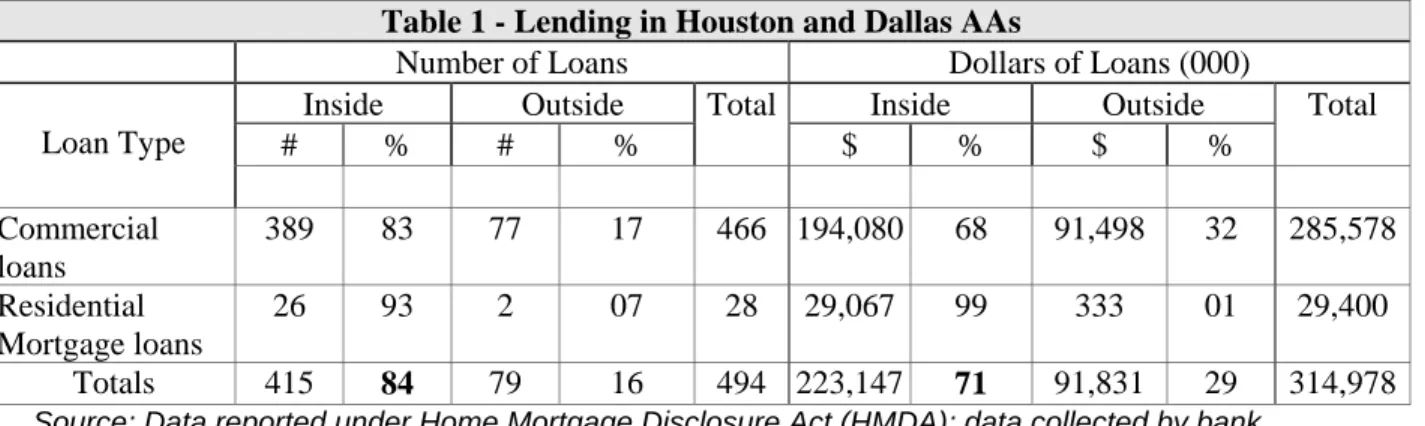
A substantial majority of lending is inside the AAs. The bank’s performance is shown in the following table:
Table 1 - Lending in Houston and Dallas AAs
Number of Loans Dollars of Loans (000)
Loan Type
Inside Outside Total Inside Outside Total
# % # % $ % $ % Commercial loans 389 83 77 17 466 194,080 68 91,498 32 285,578 Residential Mortgage loans 26 93 2 07 28 29,067 99 333 01 29,400 Totals 415 84 79 16 494 223,147 71 91,831 29 314,978
Source: Data reported under Home Mortgage Disclosure Act (HMDA); data collected by bank.
Lending to Borrowers of Different Incomes and to Businesses of Different Sizes Lending to businesses of different sizes in the Houston and Dallas AAs reflect
reasonable penetration and meets the standards for “Satisfactory” performance. We did not analyze lending to borrowers of different incomes for residential mortgage products or consumer loans since consumer lending and owner-occupied residential lending is not a significant loan product. We did review non-owner occupied residential mortgages and multi-family loans.
Non-owner occupied residential mortgages and multi-family loans were not included in tables as they were not a primary product, but tare discussed in the narratives below. Houston AA
Lending to businesses of different sizes in the Houston AA reflects reasonable
penetration and meets the standards for satisfactory performance. The percentage of loan originations to small businesses with revenues of $1 million or less by number and dollar amount is significantly less than the characteristics of the AA. In part, this can be explained by the bank’s mature customer base. Also, loans are frequently originated to assisted living centers, multi-family housing facilities, buffet restaurants, motels, and strip shopping centers. These businesses traditionally have revenues over $1 million. In particular, the strip shopping centers provide rental space for small tenants who are not always borrowers of the bank. The bank’s performance is shown in the following table:
Table 2A – Borrower Distribution of Loans to Businesses in Houston AA
Business Revenues (or Sales) $1,000,000 >$1,000,000 Unavailable/
Unknown Total % of AA Businesses 78.92 3.90 17.18 100%
% of Bank Loans in AA by # 39.07 23.91 37.02 100% % of Bank Loans in AA by $ 30.94 55.77 13.29 100%
Source: Dunn and Bradstreet data; data collected by bank
Residential lending is not a primary product of the bank. However, 17 non-owner occupied loans for one-to-four family residences were made in the Houston AA during this evaluation period. There was no penetration of these loans to low- and/or
moderate-income borrowers. The bank made three multi-family loans in the Houston AA. Borrower income is not required to be reported on multi-family loans.
Dallas AA
Similar to the Houston AA, lending to businesses of different sizes in the Dallas AA shows reasonable penetration and meets the standards for satisfactory performance. The percentage of loan originations to small businesses with revenues of $1 million or less by number is again significantly less than the characteristics of the AA and by dollar somewhat lower than the characteristics of the AA. The reasons are similar to those for the Houston AA. The bank’s location in far north Dallas County and Plano in Collin County is also a contributing factor. As of 2010, the median family income was
estimated to be $83 thousand for Collin County, above the income for the Dallas AA in general. The bank’s performance is shown in the following table:
Table 2B – Borrower Distribution of Loans to Businesses in Dallas AA
Business Revenues (or Sales) $1,000,000 >$1,000,000 Unavailable/
Unknown Total % of AA Businesses 76.09 4.35 19.56 100%
% of Bank Loans in AA by # 36.96 32.61 30.43 100% % of Bank Loans in AA by $ 46.50 31.15 22.35 100%
Source: Dunn and Bradstreet data.
The bank made three loans for non-owner-occupied one-to-four family residences in the Dallas AA during this assessment period. There was no penetration of these loans to low- and/or moderate-income borrowers. One multi-family loan was made in the Dallas AA. Borrower income is not required to be reported on multi-family loans.
Geographic Distribution of Loans
The geographic distribution of loans to businesses reflects excellent dispersion for low-and moderate-income tracts in the Houston AA low-and moderate-income tracts in the Dallas AA. The geographic distribution of loans to businesses reflects satisfactory dispersion for low-income tracts in the Dallas AA. The bank’s performance meets the standards for “Outstanding” Performance.
Houston AA
The geographic distribution of loans to businesses in the Houston AA shows excellent dispersion. It exceeds the characteristics of the AA for loan originations in both low-income and moderate-low-income CTs. The bank’s performance is shown in the following table:
Table 3A - Geographic Distribution of Loans to Businesses in Houston AA Census Tract
Income Level Low Moderate Middle Upper
Loan Type % of AA Businesse s % of Numbe r of Loans % of AA Businesses % of Numbe r of Loans % of AA Businesse s % of Numbe r of Loans % of AA Businesse s % of Numbe r of Loans Commercial * 8.58 15.45 30.43 30.90 28.69 22.45 31.23 31.20 Source: Dunn and Bradstreet data; data collected by bank.
*1.07% of the businesses are in NA census tracts.
Seventeen non-owner-occupied loans for one-to-four family residences were made in the Houston AA during this evaluation period. Geographic penetration of these loans displays the bank’s efforts to lend in low- and moderate-income areas, as 15 percent were made in low-income CTs and 11 percent were made in moderate-income CTs. This reflects excellent penetration in low-income CTs and some penetration in moderate-income CTs when compared to renter occupancy rates within the AA.
The bank made three multi-family loans in the Houston AA. Two of the loans or
67 percent were made in moderate-income CTs. Due to the low volume of multi-family loans made during this evaluation period, any further evaluation of this loan type would not be meaningful.
Dallas AA
The geographic distribution of loans to businesses in the Dallas AA shows a reasonable level of dispersion. Although the bank’s level of loan originations in low-income CTs is somewhat lower than the characteristics of the AA, it continues to meet the standards for reasonable performance. Geographic distribution exceeds the characteristics of the AA for loan originations in moderate-income CTs.
The bank’s performance is shown in the following table:
Table 3B - Geographic Distribution of Loans to Businesses in Dallas AA Census Tract
Income Level Low Moderate Middle Upper
Loan Type % of AA Businesses % of Number of Loans % of AA Businesses % of Number of Loans % of AA Businesses % of Number of Loans % of AA Businesses % of Number of Loans Commercial* 11.03 8.70 32.35 41.30 27.57 32.61 28.31 17.39
Source: Dunn and Bradstreet data; data collected by bank. * 0.74% of the businesses are in NA census tracts.
The bank made three loans for non-owner-occupied one-to-four family residences in the Dallas AA during this assessment period. Geographically, the three loans were evenly split between moderate-, middle-, and upper-income CTs. The bank did not penetrate the low-income CTs in this AA, but did meet the standard for excellent penetration in moderate-income CTs when compared to the renter occupancy rates in the AA. One multi-family loan was made in the Dallas AA. That loan was made in a moderate-income CT. Further analysis of loan type would not be meaningful due to the low volume.
Responses to Complaints
COMMUNITY DEVELOPMENT TEST
Overall, Golden Bank’s level of community development activity is Outstanding and reflects a strong responsiveness to the needs of the AAs. Community development lending is centered in assisted living facilities and affordable multi-family housing, and has remained at a significant level despite slowed loan demand nationwide which has resulted from the current economic environment. The level of qualifying investments is satisfactory and consists of two ongoing equity investments as well as various
donations. The bank’s community service activity within their AAs further supports their Outstanding rating in this area.
Number and Amount of Community Development Loans
The number and dollar volume of community development loans originated by the bank are significant. Within their AAs, the bank originated seven loans for a total of
$15.6 million, and renewed an additional one for $88 thousand. Those loans were centered in affordable multi-family housing. Based on this level of community development lending in the bank's AAs, we concluded that the bank is meeting the needs of its AAs. Therefore, we were able to consider loans made in the greater Texas statewide area during the Community Development Test.
All loans originated or renewed within the AAs were made for affordable multi-family housing facilities that serve low- to moderate-income individuals or geographies. Seven of such loans were originated during this period, for a total of $15.5 million. Of those, five were made in the Houston AA for $14.2 million and two were made in the Dallas AA for $1.3 million. In addition, one loan was renewed in the Houston AA for
$88 thousand. The bank renewed one loan to a multi-family housing complex outside of their AA for $4.4 million. This facility is within close proximity to Collin County, and therefore, we determined it provides benefit to the bank’s AA.
The bank originated two loans to an assisted living facility that serves low- and
moderate-income individuals. These loans totaled $4.9 million, and although they were made outside of the bank's AAs, they were qualified because they serve a distressed or underserved CT. All residents at this facility receive Medicaid assistance, indicating that all of those individuals have incomes below the $24,264 per year that qualifies them for this assistance according to the Texas Department of Aging and Disability Services. Number and Amount of Qualified Investments
The number and dollar volume of qualified investments is satisfactory. The bank continues to invest in two equity instruments aimed to benefit low- to moderate-income individuals. The bank also makes periodic qualifying donations to various groups and organizations.
The bank holds a $1.5 million investment in the CRA Qualified Investment Fund through Community Capital Management. This fund has been held for a significant period of time; however, the individual investments within the fund are periodically reallocated
within the bank’s AA. During this CRA examination cycle, those funds were split between a Ginnie Mae Pool in the Houston AA and individual Ginnie Mae and Fannie Mae loans in the Dallas AA.
The bank has also continued its $497 thousand investment in the Access Capital Community Investment Fund. This investment began in the fourth quarter of 2004 and these funds are also periodically reallocated to meet the bank’s CRA needs. At this time, the fund consists of 11 loans including 10 mortgages to low- and moderate-income families and 1 Small Business Administration (SBA) loan. This investment is primarily in both of the bank's AAs, with mortgages in Collin, Denton, Fort Bend, Harris, and Waller counties.
From June 2008 through June 2011, the bank made 13 donations that qualify for community development purposes. Those qualified contributions totaled $2,900, and they were predominantly centered in the Houston AA. The qualifying contributions were made to various organizations within the community. Included in these contributions were several donations to the Chinese American Relief Effort, which went to purchase school supplies for low- to moderate-income children.
Extent to Which the Bank Provides Community Development Services The bank’s level of community development services remains satisfactory. Bank officers and employees are active in several organizations that benefit low and
moderate-income individuals. In addition, management arranges for periodic seminars to be held at the bank which are open to the public and cover various financial topics. Most recently, those seminars have covered identity theft, income tax returns, lines of credit, and business strategy for Chinese immigrants.
The most notable of the services provided by bank officers and employees include: United Way – Members of the bank held “garage sales” at the Bellaire and
Richardson branches to raise funds that were donated to the United Way and benefited the Chinese Community Center Adult Program.
C.A.R.E. (Chinese American Relief Effort) – Members of the bank volunteered to raise money to purchase school supplies for children in need. Additional time was spent packaging and delivering those supplies.
Salvation Army and Paralyzed Veterans of America – Bank employees organized clothing donations to these organizations.
The bank organized and hosted various holiday and New Year parties at low-and moderate-income apartments low-and assisted living facilities within their AA. Golden Bank offers many traditional banking services. These include various checking and savings accounts, retirement accounts, consumer and commercial loans, safe deposit boxes, internet banking, Automated Teller Machine (ATM) cards, international
banking, sales of various monetary instruments, and wire transfer services. ATMs are not available at any of the six branch locations; however, customers may use any Pulse
or Cirrus network ATM at no charge. These ATM networks are available nationwide, and the free use of these facilities expands the accessibility of funds for bank customers beyond the bank’s AA. Drive-in facilities are available at three of the bank’s six
branches.
The bank offers two low-cost checking accounts. One is for business customers, offered to unincorporated customers, requiring a minimum deposit of $100 with no monthly service charge fee. No transaction fee is charged for the first 50 items. The bank also offers an affordable personal checking account for consumers. This account has a $50 minimum deposit to open and no monthly service charge. Transaction fees are not charged for the first 10 items. An ATM card is available with this account. The bank also offers savings accounts to minor children with a $25 opening deposit. These accounts do not have a service charge or minimum balance requirement.
Golden has a reasonable branch distribution with two of six, or 33 percent, of its branches in moderate-income CTs.
Responsiveness to Community Development Needs
Golden Bank has an outstanding level of responsiveness to community development needs. The bank has originated a significant level of qualified community development loans for assisted living facilities and affordable multi-family housing. The level of investments and services further supports the Outstanding level of community development activity.
Fair Lending or Other Illegal Credit Practices Review
We found no evidence of discriminatory or other illegal credit practices inconsistent with helping to meet community credit needs.