DECISION-MAKING POWER FOR WOMEN AND GIRLS: EVALUATING INTERVENTIONS IN SEXUAL AND REPRODUCTIVE HEALTH IN SUB-SAHARAN AFRICA
Wei Chang
A dissertation submitted to the faculty at the University of North Carolina at Chapel Hill in partial fulfilment of the requirements for the degree of Doctor of Philosophy in the Department of Health Policy
and Management in the Gillings School of Global Public Health.
Chapel Hill 2020
© 2020 Wei Chang
ABSTRACT
Wei Chang: Decision-making power for women and girls: Evaluating interventions in sexual and reproductive health in sub-Saharan Africa
(Under the direction of Sean Sylvia)
ACKNOWLEDGEMENTS
I am grateful to my committee, Drs. Ashu Handa, Sally Stearns, Sean Sylvia, Harsha Thirumurthy, and Kat Tumlinson, for setting the example of compassionate researchers. I feel especially fortunate to have two advisors, Harsha and Sean, who trusted me as a colleague and supported me to pursue my own path in research. I would like to thank Drs. Jim Kahn and Elliot Marseille at the University of California San Francisco for bringing me to Africa for the first time and for inspiring me to stay curious.
TABLE OF CONTENTS
LIST OF TABLES ... viii
LIST OF FIGURES ... x
LIST OF ABBREVIATIONS ... xi
CHAPTER 1: INTRODUCTION... 12
1.1 Specific Aims ... 12
1.2 Significance ... 14
1.3 Innovation ... 16
1.4 Guide to the Dissertation ... 17
CHAPTER 2: ABORTION LAWS AND LIFE CHOICES OF ADOLESCENT GIRLS AND YOUNG WOMEN IN SUB-SAHARAN AFRICA: A CROSS-COUNTRY ANALYSIS ... 18
2.1 Overview ... 18
2.2 Introduction ... 19
2.3 Methods ... 21
2.4 Results ... 25
2.5 Discussion ... 28
2.6 Conclusions ... 31
CHAPTER 3: FREE ACCESS TO A BROAD CONTRACEPTIVE METHOD MIX AND WOMEN’S CONTRACEPTIVE CHOICE IN SUB-SAHARAN AFRICA ... 41
3.1 Overview ... 41
3.2 Introduction ... 42
3.4 Results ... 48
3.5 Discussion ... 51
3.6 Conclusions ... 55
CHAPTER 4: EFFECTS OF DISCLOSING HIV-NEGATIVE STATUS ON SEXUAL RELATIONSHIPS AMONG WOMEN WITH MULTIPLE SEXUAL PARTNERS IN KENYA ... 61
4.1 Overview ... 61
4.2 Introduction ... 62
4.3 Methods ... 64
4.4 Results ... 68
4.5 Discussion ... 70
4.6 Conclusions ... 74
CHAPTER 5: CONCLUSIONS ... 85
APPENDIX: ADDITIONAL FIGURES AND TABLES ... 90
LIST OF TABLES
TABLE 1. Sample description ... 35
TABLE 2. Effects of expanding abortion legal grounds on marriage, birth, and schooling ... 36
TABLE 3. Effects of expanding abortion legal grounds by age group ... 37
TABLE 4. Effects of expanding abortion legal grounds by wealth quintiles ... 38
TABLE 5. Effects of expanding abortion legal grounds by rurality... 39
TABLE 6. Test for parallel pre-trends ... 40
TABLE 7. Descriptive statistics ... 56
TABLE 8. Effects of free access to a broad contraceptive method mix ... 57
TABLE 9: Effects of free access on contraceptive use by method type ... 58
TABLE 10. Effects of access and free access to a broad contraceptive method mix ... 59
TABLE 11. Effects of free access to a broad contraceptive method mix among key sub-groups ... 60
TABLE 12. Sample description ... 76
TABLE 13. Comparison of attrition across intervention arms... 77
TABLE 14. Baseline characteristics by experimental arm ... 78
TABLE 15. Effects of disclosing HIV-negative status on relationship outcomes ... 79
TABLE 16. Relationship dissolution and partner testing details ... 80
TABLE 17. Effects of disclosing HIV-negative status on transactional sex prices and income ... 81
TABLE 18. Effects of disclosing HIV-negative status on condom use and agency ... 82
TABLE 19. Effects of disclosing HIV-negative status by sex worker status ... 83
TABLE A1. Sample Description by Country ... 93
TABLE A3. Effects of expanding abortion legal grounds, excluding Kenya and
Senegal ... 95 TABLE A4: Effects of expanding abortion legal grounds, restricted to years
with abortion policy surveys ... 96 TABLE A5. Effects of expanding abortion legal grounds, including men and
women ... 97 TABLE A6. Balance of the treatment and comparison groups with and without
propensity score weights ... 98 TABLE A7. Free access to different types of contraceptives ... 99 TABLE A8. Variable importance from recursive partitioning... 100 TABLE A9. Free access to both long- and short-acting reversible
LIST OF FIGURES
FIGURE 1: Changes in legal grounds for abortion between 1996 and 2015 ... 33 FIGURE 2. Effects of expanding abortion legal grounds, excluding one country
at a time... 34 FIGURE A1. Standardized differences for selected covariates ... 90 FIGURE A2. Distribution of propensity scores based on generalized boosted
LIST OF ABBREVIATIONS
2SLS Two-stage least squares 2SRI Two-stage residual-inclusion ATE Average treatment effects CI Confidence interval
DHS Demographic and Health Surveys DID Difference-in-differences
GBM Generalized boosted modeling IPV Intimate partner violence IUD Intrauterine devices IV Instrumental variables KES Kenyan shillings
LARC Long-acting reversible contraceptives LATE Local average treatment effect LMIC Low-and middle-income countries
PMA Performance Monitoring and Accountability RCT Randomized controlled trial
SARC Short-acting reversible contraceptives SSA Sub-Saharan Africa
CHAPTER 1: INTRODUCTION
1.1 Specific Aims
Gender equality and empowerment of women and girls are fundamental human rights, a necessary foundation for a sustainable world, and one of the United Nations’ Sustainable Development Goals.1 Agency, or the capacity to define, pursue, and achieve goals free of violence or retribution, is central to the concept of empowerment and starts with decision-making.2,3 Despite years of efforts, women and girls today continue to play a limited role in household decision-making, lack educational and economic opportunities, and have poor access to essential health services.4 In particular, only half of women of reproductive age from developing countries can freely make their own decisions about sexual relations, contraceptive use, and health care.5
Interventions that aim to improve gender equality usually consider empowerment as a pathway to other health and development outcomes and encourage women and girls to become agents of change.6–9 However, empowerment is a development objective in its own right in addition to its instrumental value.4,7,10,11 Giving women and girls more choices and agency can be an effective approach to achieving gender equality, but evidence on whether and how health policies and programs affect decision-making in sub-Saharan Africa (SSA) is lacking.3,7,12–14
expand the grounds under which abortion is permitted may allow adolescent girls and young women to stay in school longer by delaying marriage and childbearing responsibilities. Second, financial barriers may restrict women’s ability to use their preferred contraceptive methods, especially long-acting reversible contraceptives (LARC) that - although more effective - have relatively high upfront costs.16–19 Providing free access to a broad contraceptive method mix, including both LARC and short-acting reversible contraceptives (SARC), may increase contraceptive use, meet women’s various fertility needs, and increase their autonomy in contraceptive decision-making in resource-limited settings. Third, women with multiple sexual partners who often engage in transactional sex are at increased risk of HIV infection, economic hardship, and relationship abuse, especially in a generalized HIV epidemic.20,21 Disclosing HIV-negative status to sexual partners may inform women’s decision-making in sexual relationships, allow them to negotiate higher prices for transactional sex, and facilitate safer sexual behaviors.
I tested the hypotheses above through three aims:
• Aim 1: Assess whether the impact of abortion legal reforms on marriage, birth, and schooling rates among adolescent girls and young women differed between ten countries that expanded the legal grounds for abortion and eight countries that did not over the period 1996 to 2015;
• Aim 2: Assess whether access to a broad contraceptive method mix was associated with an increase in contraceptive use, LARC use, and autonomy in contraceptive decision-making among women in eight countries with high unmet need for family planning services; and
• Aim 3: Assess whether disclosing one’s own HIV-negative status to sexual partners affected intimate partner and transactional sex relationships among women with multiple sexual partners in Kenya.
1.2 Significance
Gender gaps in access, opportunity, and voice persist in every part of the world in spite of the progress in maternal and child health over recent decades.4,7 Policymakers have pursued women’s and girls’ empowerment as a means to unlock greater development potential in low- and middle-income countries (LMIC), but the ability to exercise choice, which defines empowerment, is also an important development objective in its own right.3,10,14,22 Based on the “resources, agency, and achievements” framework of empowerment, agency is the process dimension of empowerment and focuses on decision-making.2,23 Previous research has tended to concentrate on the instrumental impact of women’s agency as a determinant of health and household welfare,6,8,9,11–13,24,25 but the ability to make decisions and exercise choices is also an essential measure of empowerment independent of the achievement dimension.7,22,23,26 Thus, research that examines the impact of policies and programs on women’s and girls’ decision-making power in its intrinsic value is needed for a more holistic approach to empowerment and policy evaluation.
To fill this gap, my dissertation aimed to assess how three specific health interventions affected women’s and girls’ decision-making power related to sexual and reproductive health. The ability to make decisions manifests in key life milestones such as marriage, childbearing, and schooling, which is the focus of Aim 1. In SSA, gender disparity in education persists as only 78 females completed upper secondary education for every 100 males, and no country has achieved gender parity in tertiary education.27 Early childbearing impedes girls’ educational attainment,15,28–36 which contributes to
Aim 2 also studied expanded access to health services but focused on the effects of costs on women’s decisions in health services utilization. User fees for family planning were introduced in the 1980s in many LMIC to ensure the quality of health services and sustainability of health systems, but charging a non-zero price for family planning services may lower demand and prevent women from choosing the contraceptive methods that best suit their needs and preferences, especially for those on the lower end of wealth spectrum.41–46 Free access to a wide range of contraceptive methods gives women more decision-making power to use the method of their choice when faced with other competing household demands. By differentiating contraceptive method types, Aim 2 took a closer look at contraceptive decision-making, assessed the impact of financial barriers on women’s agency, and provided guidance to policies and programs on scaling up family planning services in SSA.
While Aim 1 and 2 used data from multiple countries in SSA, Aim 3 focused on one country and evaluated how disclosing HIV-negative status to sexual partners affected intimate partner and transactional sex relationships among women with multiple sexual partners in Kenya. Women who engage in transactional sex are at increased risk of HIV infection due to their concurrent sexual partnerships, inconsistent condom use, and risks of violence, criminalization, and marginalization.20,21 Disclosing HIV-negative status to sexual partners may influence relationship stability, allow women to negotiate higher prices for transactional sex, and facilitate safer sexual behaviors. However, such a strategy might not increase women’s agency in sexual relationships due to gender-based power dynamics. Existing literature has focused on HIV-positive women and has not explored the potentially empowering effects of disclosing HIV-negative status on women’s agency in a generalized HIV epidemic. To illustrate these broader social and economic impacts, Aim 3 assessed the effects of disclosing HIV-negative status on women’s intimate partner relationships, transactional sex prices, and sexual behaviors.
population, is also important as countries in SSA continue to face hard choices in resource allocation in their efforts to scale up health services.
1.3 Innovation
This study is innovative because the three aims leverage rigorous econometric methods and study designs to fill important gaps in the literature. For Aim 1, previous studies have demonstrated that restrictive abortion laws negatively affect women’s well-being and abortion reforms improve schooling and employment among minority groups in high-income settings.47–51 However, no study has examined the causal effects of abortion laws on marriage, birth, and schooling outcomes among adolescent girls and young women in SSA. By using a pseudo-panel dataset constructed from multiple data sources, Aim 1 evaluated the effects of a large-scale policy intervention on decisions critical to the health and
development of adolescent girls and young women. For Aim 2, although evidence from developed countries demonstrates that removing financial barriers shifts contraceptive method choice,52,53 research on vouchers for contraceptives from SSA has produced mixed results.54–58 Linking health facility and individual data from eight countries, Aim 2 combined traditional econometric methods and machine learning techniques to examine how community-level access to family planning services affected women’s contraceptive use and decision-making. The results from this aim provided a nuanced
1.4 Guide to the Dissertation
CHAPTER 2: ABORTION LAWS AND LIFE CHOICES OF ADOLESCENT GIRLS AND YOUNG WOMEN IN SUB-SAHARAN AFRICA: A CROSS-COUNTRY ANALYSIS
2.1 Overview
Background: Early marriage and pregnancy impede the educational attainment of adolescent girls and young women in sub-Saharan Africa. Expanding the legal grounds for abortion makes it easier and safer to end unintended pregnancies, but it is not clear whether such high-level policy changes could delay marriage, reduce childbirth, and promote education among girls and young women.
Methods: Using data from 18 countries in sub-Saharan Africa, we estimate the effects of abortion liberalization on marriage, birth, and schooling rates among girls and young women aged between 13 and 22 years. We use a difference-in-differences approach, comparing outcomes in ten countries that
expanded the legal grounds for abortion and eight countries where abortion laws remained restrictive over the period 1996 to 2015.
Results: Expanding legal grounds for abortion led to a reduction of 2.5 percentage points (95% confidence intervals [CI]: -0.050 – -0.001), or 8.6%, in the annual likelihood of marriage and 0.7 percentage point (95% CI: -0.013 – -.002), or 7.3%, in the annual likelihood of birth. The legal reforms were not associated with a statistically significant effect on schooling. Effects on marriage and birth were largest among those from younger age groups, rural areas, and lower wealth quintiles. The results were robust to several sensitivity analyses.
2.2 Introduction
Early marriage and pregnancy impede the educational attainment of adolescent girls and young women in sub-Saharan Africa (SSA).15,29,31,32,35,65 In 2018, only 78 girls completed upper secondary education for every 100 boys, and no country had achieved gender equality in tertiary education in this region.27 Despite having the highest adolescent pregnancy rates in the world,66 adolescent girls and young women in SSA still face pregnancy-based discrimination in schools that do not apply to their male counterparts, including punitive measures that expel pregnant girls from schools, lack of support for young mothers to return after childbearing, and restrictive gender norms that prioritize women’s role in motherhood above all else.67 The disparities in educational attainment early in life limit women’s labor force participation and earnings, affect the health and development trajectories of both women and their children, and contribute to large gender gaps in decision-making in the household, community, and political sphere.37
Expanding the legal grounds for abortion may allow adolescent girls and young women to stay in school longer by offering the option to end unintended pregnancies, providing better access to safe reproductive health services, and delaying marriage and parenting responsibilities.38,39,68 Studies of legal reforms in the U.S. in the 1970s and Mexico in 2007 showed that more liberal abortion laws increased induced abortions, delayed marriage, and lowered fertility by providing better access to abortion services.69,70 The liberalization of abortion laws in the 1970s and 1980s was associated with women’s higher educational attainment through delaying childbearing in Norway, Spain, and the U.S.50,71,72
the African Charter on Human and People’s Rights on the Rights of Women in Africa in 2003, which recommended state parties authorize medical abortion when continued pregnancy endangers the life, physical health, and mental health of the mother.75
However, it is not clear whether such high-level policy changes would translate to greater access to abortion services and influence marriage, childbearing, and education outcomes of adolescent girls and young women. Legal changes are only the first step to make abortion safer and more accessible; clear implementation guidelines, trained healthcare providers, and resources to scale up reproductive health services are all important prerequisites.40,76,77 Even with good access, more liberal abortion laws might not increase induced abortion because countries that support women’s reproductive rights often provide better family planning services, reducing unintended pregnancies and the need for abortion.73,78 Additionally, many women do not have accurate knowledge of current abortion laws, making it difficult for them to operationalize increased legal access. Moreover, since the majority of abortions are obtained by married women,73,79 changes in abortion policies might not affect adolescent girls and young women in SSA as their marriage and childbearing decisions are often driven by poverty, inequitable gender norms, and socio-cultural values.80,81 Lastly, when given the option to delay marriage or childbearing, adolescent girls and young women might still choose to drop out of school due to economic, social, and structural barriers that play a larger and more direct role in girls’ schooling choices than early marriage and pregnancy.27
2.3 Methods
Using data from the Demographic and Health Surveys (DHS) supplemented by other policy datasets, we estimated the effects of expanding legal grounds for abortion on key life choices of adolescent girls and young women in 18 countries in SSA. Specifically, we used a difference-in-differences (DID) approach to compare trends in marriage, births, and schooling in countries that expanded abortion legal grounds to those in countries that did not in the 20-year period from 1996 to 2015. We examined the policy impacts among subgroups and performed sensitivity analyses to check the robustness of the study findings.
2.3.1 Data and sample
We combined data from three sources for the study. First, country-year data on abortion legality from 1996 to 2015 came from the World Population Policies Database maintained by the Department of Economic and Social Affairs at the United Nations.83 This dataset provides information on government views and policies from 197 countries on reproductive health. The surveys were conducted decennially from 1976 and biennially from 2001 to 2015, but data on abortion legality were only collected since 1996. The policy data were based on a detailed review of national plans and strategies, program reports,
legislative documents, and official responses to the United Nations Inquiry among Governments on Population and Development.84 Second, individual-level survey data were extracted from the Women’s Questionnaire in the DHS conducted between 1997 to 2018 in 18 countries in SSA (Benin, Burkina Faso, Burundi, Cameroon, Democratic Republic of Congo, Cote d’Ivoire, Ethiopia, Keya, Lesotho,
Using the DHS data, we constructed a longitudinal cohort with repeated observations for all female respondents that were at most 22 years of age in 1996 and at least 12 years of age in 2015. The analytical dataset consisted of binary variables to indicate marital status, birth, and school enrollment for each person-year together with other individual characteristics.
2.3.2 Measures
Abortion legal reform. We measured abortion legal reform in individual countries first as a binary indicator of whether abortion was allowed on all three grounds in a specific year: to save a woman’s life, to preserve a woman’s physical health, and to preserve a woman’s mental health. Although truly liberal laws in the abortion legality continuum should permit abortion for socioeconomic reasons or without restriction as to reason, our definition of “liberal” abortion laws accommodates the fact that Zambia was the only country in SSA with DHS data where abortion was broadly legal as of December 2017.40 Among the 18 countries that had restrictive abortion laws in 1996, ten countries had expanded the legal grounds for abortion by 2015 while the abortion laws in eight countries remained highly restrictive. Given the structure of the data collection schedule, we assumed abortion laws did not change in the years without policy surveys (e.g., we assumed the abortion laws in 1997, a year without abortion policy data, remained the same as the laws in 1996).
Since countries that eventually expanded abortion legal grounds to include “mental health” started from different places in the continuum of abortion legality, we recoded abortion legal reform to
differentiate between countries with “large” versus “small” expansion of abortion policy. A country that initially only allowed abortion to save a woman’s life and liberalized their laws to allow abortion to save a woman’s life, to preserve a woman’s physical health, and to preserve a woman’s mental health was coded as a “large-expansion” country. In contrast, countries that initially allowed abortion to preserve a
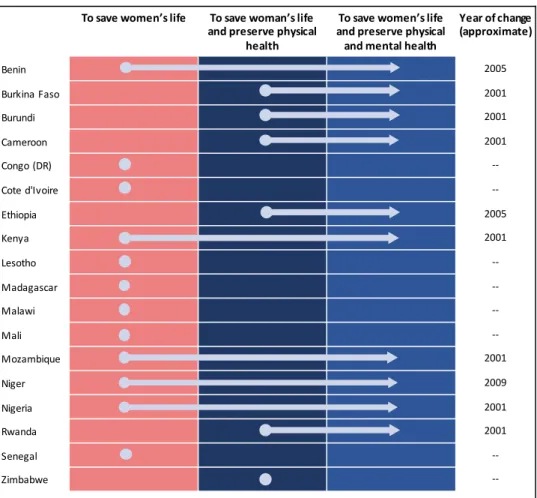
woman’s physical health in addition to saving life were coded as “small”-expansion countries. Figure 1 shows the changes in abortion legality over 20 years in the 18 countries included in the study.
marital status, we created a variable to indicate whether an individual was married in each calendar year based on year of interview, an individual’s age in the survey year, and her age of first marriage or cohabitation. For childbirth, we created a variable to indicate whether a woman or girl gave birth in a specific year based on the year of birth for all children she had. For school enrollment, we created a variable to indicate whether a woman or girl was in school based on her total years of education and country-year-specific primary school starting age. Specifically, we first calculated the individual’s year of birth by subtracting age from the year of interview. Then, we calculated the year when an individual ended schooling by summing up the year of birth, the number of years before primary school for each birth cohort by country, and the total years of education for each individual. This calculation assumed that all children in a birth-cohort in a specific country started primary school at the same age and there was no interruption in individuals’ school attendance.
Control variables. Individual characteristics, including age, residence (rural or urban), and
household wealth quintiles, were extrapolated as control variables from the year when the DHS surveys were conducted. This assumes there was no physical or social mobility among the women and girls in the dataset (e.g., an individual surveyed in rural areas was considered a rural resident across all survey years).
2.3.3. Statistical analyses
We estimated the effects of expanding the legal grounds for abortion using the following two-way fixed-effect linear probability model:
!"#$= & + ()*+,-#$+ .#+ /$+ 0"#$′2 + 3"#$
where Yijtis the outcome variable set to 1 if individual i from country j in year t was married, gave
birth, or was enrolled in school, Treatjt is set to one if individual i resided in country j that had expanded
legal grounds for abortion laws in year t, cjis a full set of country dummies to control for time-invariant
country characteristics, dtis a full set of year dummies to account for secular trends, and Zijt is a vector of
in the likelihood of schooling among women and girls in countries with more liberal abortion laws. We clustered standard errors at the country level.87
To test whether the effects vary by the extent of legal reform, we fitted a linear probability model specified below:
!"#$ = & + (45,*6+#$+ (789,::#$+ .#+ /$+ 0"#$; 2 + 3 "#$
where Largejt is set to one if individual i resided in country j that had expanded legal grounds for abortion
from only allowing abortion to save a woman’s life in year t and Smalljt is set to one if individual i resided
in country j that had expanded legal grounds for abortion from allowing abortion to save a woman’s life and to preserve her physical health in year t. The coefficients (4 and (7 capture the impacts of different extent of legal reform (i.e., “large” expansion vs. “small” expansion). We used a Wald test to assess the equality hypothesis between (4 and (7.
not affect the schooling of young men and boys and would affect their marriage, if at all, to a lesser degree than the marriage of women and girls.
Statistical tests were 2-sided and we set the statistical significance at p<.05. Analyses were performed using Stata, version 15.1 (StataCorp LLC).
2.4 Results
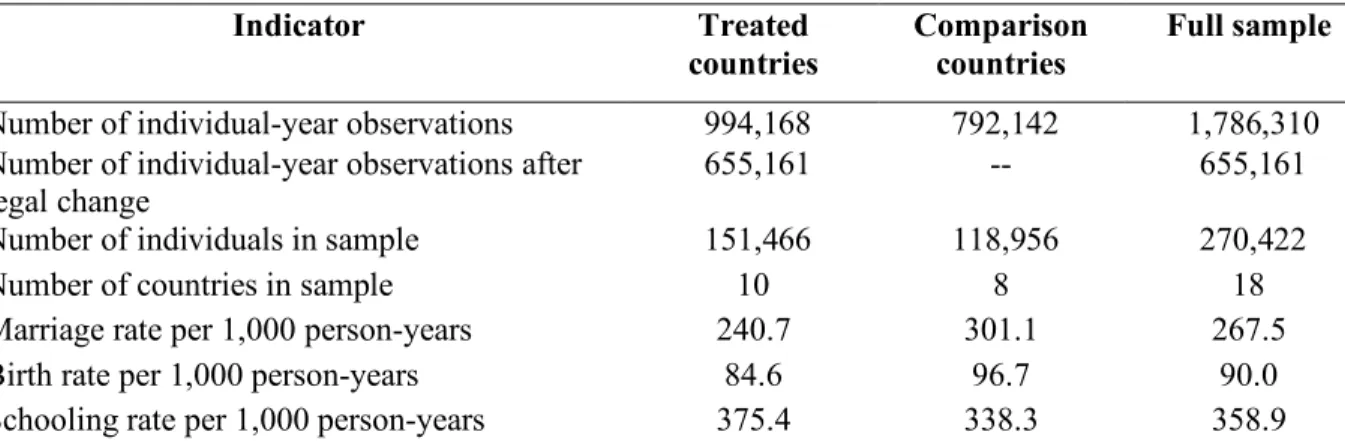
The full sample contained 1,786,310 woman-year observations, of which 994,168 (55.7%) were from the ten countries that expanded abortion legal grounds between 1996 and 2015 and the remaining 792,142 (44.3%) were from the eight comparison countries (see Table 1). Among the 270,422 individuals in the sample, at the age of 15 years, 3% were married, 0.8% gave birth, and 23% were enrolled in school; at age 22, 58.7%, 10.5%, and 1.8% were married, gave birth, and enrolled in school respectively. Detailed information showing country-specific marriage, birth, and schooling rates are presented in Table A1.
The main results are presented in Table 2. The average annual likelihood of marriage was 2.5 percentage points lower after the legal reform (95% confidence interval [CI]: -0.050 – -0.001), or a decrease of 8.6% relative to a control mean of 28.8%. The average annual likelihood of giving births was 0.7 percentage point lower after the legal reform (95% CI: -0.013 – -.002), or a decrease of 7.3% relative to a control mean of 9.5%. The legal reform was not associated with a statistically significant effect on schooling outcomes. While the effect of “small” expansion (i.e., from “saving life and preserving physical health” to “saving life and preserving physical and mental health”) on marriage was significant, we were not able to detect a statistically different effect between “small” and “large” expansions on marriage (p -value = 0.092). The effect on birth was different by the extent of legal change and “small” expansion had a larger impact than “large” expansion on birth (p-value = 0.027).
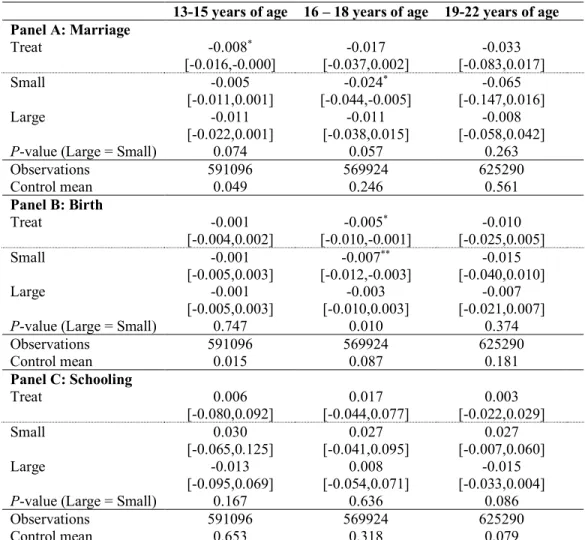
“small” expansion had stronger effects than “large” expansion. In “small” expansion countries, there is also a significant reduction in marriage by 2.4 percentage points (95% CI -0.044 – -0.005) among those between 16 and 18 years of age. For those above 18 years of age, changes in abortion laws had no statistically significant effect on any of the three outcomes despite larger point estimates of marriage and birth than those of younger groups.
Similarly, the effects of abortion legal expansion varied by wealth quintiles, assuming individuals’ household economic status remained the same as that of the DHS survey year (Table 4). For women and girls from the poorest wealth quintile, the legal change lowered the likelihood of marriage and birth by 6.0 percentage points (95% CI -0.094 – -0.026) and 1.7 percentage points (95% CI -0.028 – -0.005) respectively. In addition, “small” expansion increased school attendance among this poorest group by 3.5 percentage points (95% CI 0.001 – 0.069). For those from the richest wealth quintile, the legal change did not affect any of the three outcomes. For those in between, the legal change reduced the likelihood of birth but not marriage.
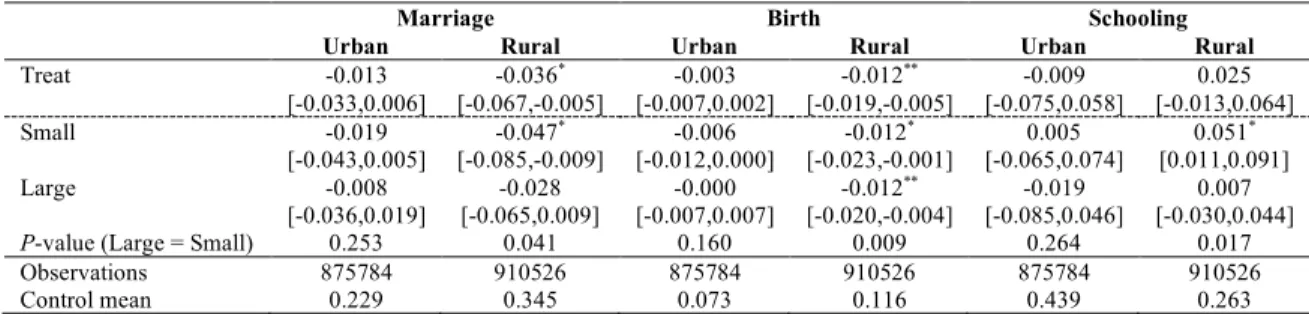
In terms of residence, abortion legal reform only affected those from rural but not urban areas (Table 5). For women and girls who lived in rural areas (at least in the DHS survey years), expanding abortion legal grounds was associated with a reduction of 3.6 percentage points (95% CI -0.067 – -0.005) in the annual likelihood of marriage, or 10.4% from before the expansion. The effect on birth was of similar magnitude at 1.2 percentage points (95% CI -0.019 – -0.005) or 10.3% from before the expansion. Moreover, “small” expansion was associated with a 5.1 percentage point increase (95% CI 0.011 – 0.091), or 19.8%, in schooling compared to no expansion and was statistically significantly different from “large” expansion (p-value = 0.017).
The effects of legal reforms were not sensitive to excluding any single country’s data, except for the effect on schooling when Senegal was dropped from the dataset (Figure 2). Without Senegal, the expansion of abortion legal grounds was associated with a 2.9 percentage point increase in schooling (Table A2; 95% CI: 0.003 – 0.051). This might be explained by other policy changes unique to Senegal that affected schooling independent of abortion laws. According to the UNESCO Institute for Statistics, only two countries among the 18 countries in the dataset changed the duration of compulsory education between 1998 and 2015: in Senegal, a comparison country, compulsory education duration was increased from six to 11 years in 2004 and in Kenya, a treatment country, compulsory education duration was increased from eight to 12 years in 2013.88 Assuming compulsory education policies were implemented well, schooling in Senegal could have increased due to the effect of longer compulsory education. Thus, including Senegal as a comparison country would have violated the common trend assumption of DID. Similarly, the effect of abortion legal expansion in Kenya, if any, might have been partially attributed to the change in compulsory education duration, but the magnitude of bias might be smaller since the change in compulsory education occurred towards the very end of the 20-year period in 2013. To minimize the potential bias due to changes in compulsory education duration, we dropped Kenya and Senegal and repeated the main analyses (Table A3), which showed that abortion legal expansion was associated with a 3.0 percentage point, or 8.7%, increase in the likelihood of being in school (95% CI 0.001 – 0.059). Similar to the patterns in marriage and birth, the effect of “small” expansion was stronger than the effect of “large” expansion. However, we were not able to rule out other potential confounders.
When the dataset included only years when abortion policy was surveyed, the effect on marriage was no longer statistically significant (Table A4). However, the average annual likelihood of giving birth was still 1.2 percentage point lower (95% CI -0.023 – -0.001), or 12.8%, after the expansion of abortion legal grounds.
gender-differential effects for older age groups, reducing the likelihood of marriage by 5.1 percentage points (95% CI: -0.098 – -0.003) and 5.8 percentage points (95% CI: -0.116 – -0.000) for women aged 16 – 18 years and 19 – 22 years respectively compared to their male counterparts. In addition, in “small-expansion” countries, abortion legal change reduced the likelihood of marriage in the full sample by 6.5 percentage points (95% CI: -0.125 – -0.006) among women compared to men, assuming men were not affected by the legal change.
2.5 Discussion
Abortion laws play a critical role in adolescent girls’ and young women’s ability to access healthcare services, make reproductive decisions, and plan for their future. For policymakers, it is important to understand the broader implications of abortion laws as 15% of all pregnancies end in abortion in Africa.73 To our knowledge, this is the first cross-country study in SSA that assessed the impacts of abortion laws on key life choices of adolescent girls and young women who usually have limited access to family planning services and face gender-based barriers to pursuing development opportunities.27,89
Using quasi-experimental methods and cross-country data sources, this study found that expanding abortion legal grounds was associated with a reduction of more than 7% in the annual likelihood of marriage and birth among adolescent girls and young women in SSA. Although legal reforms might coincide with changes in other socioeconomic factors and laws alone do not guarantee access to reproductive health services,76,77,79,90,91 a country’s decision to expand legal grounds for abortion
nonetheless signals stronger political will to protect women’s health and human rights and is likely to be correlated with greater access to reproductive health services. The results of this study demonstrated such state-level policy instruments enhanced young women’s and girls’ ability to make decisions about marriage and childbearing.
births has major implications for maternal and child health in addition to girls’ development
opportunities.93 Pregnancy and childbirth complications are the leading cause of death for girls aged 15 – 19 years in developing countries and babies of adolescent mothers face higher risks of low birth weight, preterm delivery, and severe neonatal conditions.94,95 Our results also show that such legal reforms were progressive in that they helped those with the least wealth avoid childbirth and marriage. This is a promising finding since these women are most likely to experience complications from unsafe abortions whereas wealthier women are more likely to access abortion services even in the absence of legal reforms.48
This study also found that “small” expansion of abortion legal grounds had stronger effects than “large” expansion, which seems counterintuitive as it suggests abortion reform would be less effective if a country took a larger step towards more liberal laws on the abortion legality continuum. However, all countries that had a “large” expansion of abortion laws started with extremely restrictive abortion policies in 1996 (i.e., only allowing abortion to save a woman’s life) while all countries that had a “small”
expansion started with less restrictive abortion policies (i.e., allowing abortion to save a woman’s life and preserve physical health). This difference in the starting point may reflect how ready a country’s health sector was to scale up its reproductive health services after the legal change. For example, a “small”-expansion country might have had more trained healthcare workers, better healthcare infrastructure, and more accepting social norms about abortion before the reform. As a result, women and girls could obtain an abortion under the ground of “preserving mental health” after the reform. By comparison, in a “large”-expansion country where abortion was rarely performed before the legal change, the health sector might be less prepared to expand reproductive health services and its providers who were used to prior
Despite the sizable effects on marriage and birth, the study did not find any downstream effect of abortion legal reform on schooling, except for those from the lowest wealth quintile in “small”-expansion countries. In contrast, previous studies on abortion liberalization in the 1970s and 1980s from developed countries have shown a strong link between abortion laws and young women’s education outcomes through delayed marriage and childbearing, although such effects might have only occurred to subgroups of population (e.g., black but not white women in the U.S.) and at specific educational levels (e.g., college but not high school in Norway and vice versa in Spain).50,71,72 Since child marriage and early childbearing are known factors that limit girls’ educational potential in SSA,28,32–35,65,91,96,97 it is puzzling that the reforms’ effects on marriage and childbearing did not translate into higher school enrollment in this study. This might be because early marriage and pregnancy only explained less than 20% of school dropouts in the case of francophone Africa.15 Alternatively, women and girls who chose to obtain an abortion to delay marriage or childbearing under the more liberal laws might have dropped out of school even if they did not become pregnant, perhaps due to economic shocks. A closer examination of country-specific abortion laws, education systems, and socioeconomic contexts similar to the analyses conducted in developed countries will provide stronger evidence on whether and how abortion laws affect education in low-resource settings.
duration, which is by no means the only country-specific time-varying factor. Nonetheless, the main results were not affected by the omission of any country other than Senegal. Third, we extrapolated data from cross-sectional surveys to construct a pseudo-panel dataset, an approach that has been used in other studies,100,101 which created considerable measurement errors in key demographic variables such as residence or wealth. However, these errors were unlikely to be related to abortion policy changes and the subgroup analyses showed stronger effects among those from rural areas and poorer backgrounds. Fourth, to estimate an individuals’ schooling status, we assumed every cohort of girls in a country started primary school at the same age while in reality delayed entry to primary school is common.102 Since the sample was restricted to women and girls who were still in school at the age of 12, it is possible that some observations may have been misclassified as “out of school”, but it is unlikely that such measurement errors are correlated with the abortion policy change. Fifth, related to the school-attendance criterion in sample selection, individuals in our dataset are a relatively privileged group as only 67% of women and girls completed primary education in SSA in 2018.27 This limits the generalizability of the study findings. Sixth, we chose to use linear models for easier interpretability of parameter estimates. However, such models could yield out-of-range predictions when the true probabilities are close to 0 or 1, as in the case of the birth outcome we examined. Non-linear models, such as logistic regressions, might fit the data better for rare outcomes. Last, we did not examine how abortion laws were applied in practice or assess their effects on abortion incidence. Previous studies found that abortion rates were similar regardless of the abortion legal grounds in a country.73 The effects of laws on marriage or births might be spurious if more liberal laws did not reduce the number of abortions. However, a country’s decision to adopt more liberal abortion laws is likely to prelude or reflect a shift in social norms that are more supportive of women’s agency, which enhances the ability of adolescent girls and young women to decide the timing of marriage and childbearing independent of fertility outcomes.
2.6 Conclusions
FIGURE 1: Changes in legal grounds for abortion between 1996 and 2015
This figure shows the changes in the legal grounds under which abortion was allowed in each country from 1996 to 2015 based on the World Population Policies Database – 2015 Revision (https://esa.un.org/poppolicy/wpp_datasets.aspx). The surveys on abortion policies were conducted first in 1996 and then biennially from 2001 to 2015. Given these gaps in survey years, the “Year of change” data are approximate. For example, in Benin, abortion was only allowed under the ground to save women’s life in 1996. By 2015, Benin had expanded the legal grounds to allow abortion to preserve women’s physical and mental health. The legal change, represented by an arrow in the figure, occurred on or before 2005 (a year when abortion policy was surveyed). By comparison, in Congo (DR), abortion was only allowed to save women’s life in 1996 and this did not change in 2015, represented by a dot in the figure.
To save women’s life To save woman’s life
and preserve physical health
To save women’s life and preserve physical and mental health
Year of change (approximate)
Benin 2005
Burkina Faso 2001
Burundi 2001
Cameroon 2001
Congo (DR)
--Cote d'Ivoire
--Ethiopia 2005
Kenya 2001
Lesotho
--Madagascar
--Malawi
--Mali
--Mozambique 2001
Niger 2009
Nigeria 2001
Rwanda 2001
Senegal
--FIGURE 2. Effects of expanding abortion legal grounds, excluding one country at a time
This figure shows the estimated effects of expanding abortion legal grounds on marriage, birth, and schooling using a dataset that originally included 18 countries from sub-Saharan Africa. Each bar represents the estimated effect when excluding one country at a time from the original dataset.
-.
0
5
0
.05
.1
marriage birth schooling
Each bar represents the estimated effect when one country was excluded from the dataset. excluding Senegal
TABLE 1. Sample description
Indicator Treated
countries
Comparison countries
Full sample
Number of individual-year observations 994,168 792,142 1,786,310 Number of individual-year observations after
legal change
655,161 -- 655,161
Number of individuals in sample 151,466 118,956 270,422
Number of countries in sample 10 8 18
Marriage rate per 1,000 person-years 240.7 301.1 267.5
Birth rate per 1,000 person-years 84.6 96.7 90.0
Schooling rate per 1,000 person-years 375.4 338.3 358.9
TABLE 2. Effects of expanding abortion legal grounds on marriage, birth, and schooling
Marriage Birth Schooling
Post-reform -0.025* -0.007** 0.006
[-0.050,-0.001] [-0.013,-0.002] [-0.045,0.057]
Small -0.034* -0.009* 0.024
[-0.067,-0.002] [-0.017,-0.002] [-0.031,0.078]
Large -0.018 -0.006 -0.008
[-0.050,0.013] [-0.013,0.001] [-0.058,0.043]
P-value (Large = Small) 0.092 0.027 0.139
Age 0.075*** 0.024*** -0.088***
[0.065,0.085] [0.021,0.028] [-0.095,-0.082]
Rural 0.032** 0.010** -0.049***
[0.010,0.053] [0.004,0.016] [-0.071,-0.026]
Poorer -0.029** -0.009*** 0.038***
[-0.045,-0.013] [-0.013,-0.004] [0.021,0.055]
Middle -0.058*** -0.021*** 0.091***
[-0.084,-0.032] [-0.031,-0.011] [0.061,0.120]
Richer -0.089*** -0.034*** 0.149***
[-0.117,-0.060] [-0.048,-0.021] [0.108,0.191]
Richest -0.169*** -0.063*** 0.292***
[-0.202,-0.136] [-0.080,-0.046] [0.249,0.334]
Observations 1786310 1786310 1786310
Adjusted R2 0.2669 0.0693 0.3393
Control mean 0.288 0.095 0.350
95% confidence intervals in brackets
Included country and year fixed effects. Standard errors clustered at country level. Small: abortion legal grounds expanded from “to save life & preserve physical health” to including “to preserve mental health.” Large: abortion legal grounds expanded from “to save life” only to including “to preserve mental health”. Included only individuals that were still in school at age 12.
TABLE 3. Effects of expanding abortion legal grounds by age group
13-15 years of age 16 – 18 years of age 19-22 years of age Panel A: Marriage
Treat -0.008* -0.017 -0.033
[-0.016,-0.000] [-0.037,0.002] [-0.083,0.017]
Small -0.005 -0.024* -0.065
[-0.011,0.001] [-0.044,-0.005] [-0.147,0.016]
Large -0.011 -0.011 -0.008
[-0.022,0.001] [-0.038,0.015] [-0.058,0.042]
P-value (Large = Small) 0.074 0.057 0.263
Observations 591096 569924 625290
Control mean 0.049 0.246 0.561
Panel B: Birth
Treat -0.001 -0.005* -0.010
[-0.004,0.002] [-0.010,-0.001] [-0.025,0.005]
Small -0.001 -0.007** -0.015
[-0.005,0.003] [-0.012,-0.003] [-0.040,0.010]
Large -0.001 -0.003 -0.007
[-0.005,0.003] [-0.010,0.003] [-0.021,0.007]
P-value (Large = Small) 0.747 0.010 0.374
Observations 591096 569924 625290
Control mean 0.015 0.087 0.181
Panel C: Schooling
Treat 0.006 0.017 0.003
[-0.080,0.092] [-0.044,0.077] [-0.022,0.029]
Small 0.030 0.027 0.027
[-0.065,0.125] [-0.041,0.095] [-0.007,0.060]
Large -0.013 0.008 -0.015
[-0.095,0.069] [-0.054,0.071] [-0.033,0.004]
P-value (Large = Small) 0.167 0.636 0.086
Observations 591096 569924 625290
Control mean 0.653 0.318 0.079
95% confidence intervals in brackets
Included rural/urban, wealth quintile, country, and year fixed effects. Standard errors clustered at country level. Small: abortion legal grounds expanded from “to save life & preserve physical health” to including “to preserve mental health”. Large: abortion legal grounds expanded from “to save life” only to including “to preserve mental health”.
Included only individuals that were still in school at age 12. *p < 0.05, **p < 0.01, ***p < 0.001
TABLE 4. Effects of expanding abortion legal grounds by wealth quintiles
Poorest Poorer Middle Richer Richest
Panel A: Marriage
Treat -0.060** -0.044 -0.033 -0.027 -0.006
[-0.094,-0.026] [-0.095,0.007] [-0.071,0.004] [-0.056,0.001] [-0.029,0.017]
Small -0.060** -0.057* -0.042 -0.041* -0.015
[-0.094,-0.026] [-0.105,-0.009] [-0.085,0.001] [-0.077,-0.006] [-0.047,0.017]
Large -0.060* -0.036 -0.028 -0.020 0.003
[-0.107,-0.014] [-0.100,0.028] [-0.074,0.017] [-0.055,0.015] [-0.022,0.028]
P-value (Large = Small) 0.003 0.065 0.134 0.074 0.535
Control mean 0.392 0.356 0.320 0.295 0.220
Panel B: Birth
Treat -0.017** -0.015* -0.014* -0.008* 0.000
[-0.028,-0.005] [-0.028,-0.003] [-0.024,-0.003] [-0.016,-0.000] [-0.006,0.006]
Small -0.007 -0.016* -0.014** -0.010 -0.004
[-0.019,0.004] [-0.029,-0.002] [-0.024,-0.004] [-0.024,0.003] [-0.012,0.004]
Large -0.024*** -0.015 -0.013 -0.007 0.004
[-0.037,-0.012] [-0.031,0.001] [-0.026,0.000] [-0.015,0.001] [-0.002,0.010]
P-value (Large = Small) 0.003 0.038 0.016 0.131 0.074
Control mean 0.131 0.121 0.108 0.097 0.069
Panel C: Schooling
Treat 0.014 0.023 0.008 0.015 0.007
[-0.019,0.048] [-0.022,0.068] [-0.067,0.082] [-0.049,0.080] [-0.037,0.051]
Small 0.035* 0.040 0.027 0.045 0.026
[0.001,0.069] [-0.007,0.087] [-0.055,0.109] [-0.032,0.122] [-0.023,0.074]
Large -0.003 0.013 -0.003 -0.000 -0.012
[-0.030,0.025] [-0.032,0.058] [-0.077,0.071] [-0.063,0.063] [-0.050,0.025]
P-value (Large = Small) 0.014 0.058 0.366 0.200 0.134
Control mean 0.184 0.227 0.281 0.336 0.470
Observations 158254 230557 305921 407809 683769
95% confidence intervals in brackets
Included age, urban/rural, country, and year fixed effects. Standard errors clustered at country level.
Small: abortion legal grounds expanded from “to save life & preserve physical health” to including “to preserve mental health”. Large: abortion legal grounds expanded from “to save life” only to including “to preserve mental health”.
Included only individuals that were still in school at age 12. *p < 0.05, **p < 0.01, ***p < 0.001
TABLE 5. Effects of expanding abortion legal grounds by rurality
Marriage Birth Schooling
Urban Rural Urban Rural Urban Rural
Treat -0.013 -0.036* -0.003 -0.012** -0.009 0.025
[-0.033,0.006] [-0.067,-0.005] [-0.007,0.002] [-0.019,-0.005] [-0.075,0.058] [-0.013,0.064]
Small -0.019 -0.047* -0.006 -0.012* 0.005 0.051*
[-0.043,0.005] [-0.085,-0.009] [-0.012,0.000] [-0.023,-0.001] [-0.065,0.074] [0.011,0.091]
Large -0.008 -0.028 -0.000 -0.012** -0.019 0.007
[-0.036,0.019] [-0.065,0.009] [-0.007,0.007] [-0.020,-0.004] [-0.085,0.046] [-0.030,0.044]
P-value (Large = Small) 0.253 0.041 0.160 0.009 0.264 0.017
Observations 875784 910526 875784 910526 875784 910526
Control mean 0.229 0.345 0.073 0.116 0.439 0.263
95% confidence intervals in brackets
Included age, wealth quintile, country, and year fixed effects. Standard errors clustered at country level.
Small: abortion legal grounds expanded from “to save life & preserve physical health” to including “to preserve mental health”. Large: abortion legal grounds expanded from “to save life” only to including “to preserve mental health”.
TABLE 6. Test for parallel pre-trends
Marriage Birth Schooling
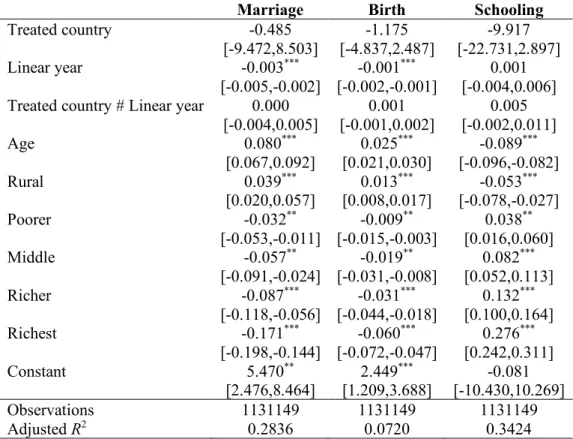
Treated country -0.485
[-9.472,8.503]
-1.175 [-4.837,2.487]
-9.917 [-22.731,2.897]
Linear year -0.003***
[-0.005,-0.002]
-0.001*** [-0.002,-0.001]
0.001 [-0.004,0.006] Treated country # Linear year 0.000
[-0.004,0.005]
0.001 [-0.001,0.002]
0.005 [-0.002,0.011]
Age 0.080***
[0.067,0.092]
0.025*** [0.021,0.030]
-0.089*** [-0.096,-0.082]
Rural 0.039***
[0.020,0.057]
0.013*** [0.008,0.017]
-0.053*** [-0.078,-0.027]
Poorer -0.032**
[-0.053,-0.011]
-0.009** [-0.015,-0.003]
0.038** [0.016,0.060]
Middle -0.057**
[-0.091,-0.024]
-0.019** [-0.031,-0.008]
0.082*** [0.052,0.113]
Richer -0.087***
[-0.118,-0.056]
-0.031*** [-0.044,-0.018]
0.132*** [0.100,0.164]
Richest -0.171***
[-0.198,-0.144]
-0.060*** [-0.072,-0.047]
0.276*** [0.242,0.311]
Constant 5.470**
[2.476,8.464] 2.449 ***
[1.209,3.688] [-10.430,10.269] -0.081
Observations 1131149 1131149 1131149
Adjusted R2 0.2836 0.0720 0.3424
95% confidence intervals in brackets
Treated country variable indicates whether a country eventually changed abortion policy. The coefficient of interest is the interaction of treated country indicator and linear time trend. Included country fixed effects.
Standard errors clustered at country level.
Excluded observations from treated countries after the abortion policy was changed. Included only individuals that were still in school at age 12.
CHAPTER 3: FREE ACCESS TO A BROAD CONTRACEPTIVE METHOD MIX AND WOMEN’S CONTRACEPTIVE CHOICE IN SUB-SAHARAN AFRICA
3.1 Overview
Background: Financial barriers may restrict women’s ability to use their preferred contraceptive methods, especially long-acting reversible contraceptives (LARC) that - although more effective - have relatively high upfront costs. Providing free access to a broad contraceptive method mix, including both LARC and short-acting reversible contraceptives (SARC), may increase contraceptive use, meet women’s various fertility needs, and increase their agency in contraceptive decision-making in resource-limited settings.
Methods: Linking health facility and individual data from eight countries in sub-Saharan Africa, we examine how free access to a broad contraceptive method mix affects women’s contraceptive choice. We use a propensity score approach combined with machine learning techniques to compare current
contraceptive use, LARC use, and contraceptive decision-making in communities that provide free access to both method types and those that do not.
Results: Free access to both LARC and SARC was associated with an increase of 3.2 percentage points (95% confidence interval: 0.006 – 0.058) in the likelihood of modern contraceptive use. This increase was driven by greater use of SARC. Among current contraceptive users, free access did not prompt women to switch to LARC and had no effect on women’s autonomy in decisions about
contraceptive methods. The price effects on contraceptive use were larger among women who were older, more educated, and more knowledgeable about contraceptive methods, while free access was associated with lower contraceptive use among adolescents.
uptake, removing user fees alone does not address all barriers women face, especially for the most vulnerable groups of women that need family planning services the most.
3.2 Introduction
Access to a wide variety of contraceptive methods is a fundamental element of quality of care and a critical dimension in multiple frameworks of family planning services.103–105 LARC, including implants and intrauterine devices (IUDs), are 20 times as effective as shorter-term methods, have much higher continuation rates, and suit women’s growing needs for limiting births.16–19 However, a number of demand- and supply-side factors continue to limit women’s uptake of LARC, such as upfront costs that often include informal fees, lack of trained providers that could perform both insertion and removal of LARC, and concerns about side effects.106–109 Free access to both LARC and SARC may increase contraceptive use by meeting women’s various fertility needs in low- and middle-income countries (LMIC).
Free access to a broad contraceptive method mix also gives women greater autonomy in contraceptive decision-making, especially for those from lower socioeconomic backgrounds. Previous research has shown that women from the poorest wealth quintiles in sub-Saharan Africa (SSA) are less likely to use LARC and such wealth-related inequalities have increased in several countries.109,110 Although the costs per couple-year served are similar or even lower for LARC compared to SARC, higher upfront out-of-pocket costs, including both the commodity prices and additional consultation charges or
insertion/removal fees, may be a barrier to LARC use.111–114 Since men usually control household spending and often have different contraceptive or fertility preferences compared to women, providing both LARC and SARC free of charge removes the concern of costs from the decision-making process and may increase a woman’s ability to use any contraceptive method without her partner’s knowledge or approval.115–117
systems, but charging a price for basic health services may prevent women from choosing the method that best suits their needs and preferences, especially for those on the lower end of the wealth spectrum.41,43–46 For public health products, field experiments have shown that any increase in price can considerably dampen demand in SSA.118–123 Specifically for LARC, recent studies showed that removing the cost barriers substantially increased LARC use among low-income women and adolescents in the United States.52,53,124
Contrary to these two strands of literature, previous reviews suggest that the effects of price on contraceptive use in LMIC have been largely inconclusive due to lack of recent studies, weak study designs, and challenges in measuring supply and demand simultaneously.41,54,55,125–127 For example, providing free vouchers for contraceptives did not increase contraceptive use or shift method choice among postpartum women in Kenya in a randomized controlled trial,56 although quasi-experimental studies have shown that vouchers were effective in increasing contraceptive use in Cambodia, Pakistan, and Madagascar.58,128,129 In addition, program evaluations of service expansion have demonstrated uptake and acceptability of LARC, such as the multi-component LARC expansion initiative (including free or subsidized family planning services) implemented by Marie Stopes International across 14 countries in SSA.57
Further evidence is needed to understand whether free access to a broad contraceptive method mix is an effective and empowering strategy to meet women’s family planning needs in SSA. To inform pricing policies for governments and international donors, this study estimates the effects of providing both LARC and SARC free of charge on women’s contraceptive use and agency.
3.3 Methods
score weighting with machine learning techniques to account for differences in selection into the treatment and estimated differential treatment effects among key subgroups.
3.3.1 Data and sample
The data source is Performance Monitoring and Accountability 2020 (PMA2020) harmonized by the IPUMS-PMA project.130 PMA2020 collected data annually from 2014 to 2017 from households, women, and service delivery points (i.e., health facilities) in 11 countries that have pledged to the Family Planning 2020 effort. These data are collected by trained enumerators using mobile devices and include key
indicators of family planning use by individuals as well as provision of reproductive health services by healthcare facilities. In particular, PMA2020 surveyed all private facilities located within each
enumeration area and public facilities that serve the enumeration area, representing facilities accessible to women in the community.131 To identify public facilities, the survey team consulted district or local authorities to locate public sector facilities designated to cover the residents of each enumeration area, which may be located outside of the community.131
The sample came from the most recent PMA2020 surveys that were conducted in 2016/2017 and are representative at the national level in eight countries in SSA, including Burkina Faso, Cote d’Ivoire, Ethiopia, Ghana, Kenya, Niger, Nigeria, and Uganda (we excluded countries that do not have nationally-representative data or are not in SSA). Individual data excluded pregnant women or women who
expressed the desire to have a child soon. The analysis dataset linked individual data with service delivery points data by enumeration area. For the main outcome, use of modern contraceptives, the sample
included all women of reproductive age. For the other outcomes, use of LARC and autonomy in
contraceptive decision-making, the sample consisted of women of reproductive age who reported using a modern contraceptive method at the time of the survey.
3.3.2 Measures
tablets) are routinely provided and offered free of charge in at least one facility that serves an enumeration area. Diaphragms, spermicide, and n tablets collectively make up less than 1% of the total method mix within our sample. We did not include permanent methods because we expect the decision-making process to be different from those for reversible methods. Similarly, we did not include emergency contraception because we expect a different user profile for emergency contraception compared to other SARC.
Free access was constructed based on two categories of questions in the Service Delivery Points Questionnaire to measure routine provision and charge of family planning services. First, routine provision is defined by whether a facility provides a contraceptive method, has trained personnel and supplies, and has the devices in stock. Service provision is measured by the question “which of the following methods are provided to clients at this facility?”. A facility is considered to routinely provide LARC only if it has trained personnel that are able to insert implants/IUDs as measured by the question “on days when you offer family planning services, does this facility have trained personnel able to insert implants/IUDs?”. A facility also needs to have the supplies necessary to perform the procedures (clean gloves, antiseptic, sterile gauze pad, anesthetic, implant pack for implants and speculums, forceps, and tenaculum for IUDs), as measured by the question “Does this facility have the following supplies needed to insert and/or remove implants/IUD?”. Moreover, a facility needs to have the LARC or SARC method in stock on the day of the survey, regardless of whether this is based on interviewers’ observation or providers’ response. Second, a LARC or SARC method was provided free of charge if a facility did not charge any consultation fee or method-specific fee. This is assessed by two questions – “Do family planning clients need to pay any fees in order to be seen by a provider even if they do not obtain a method
IUD is yes. Contraceptive method choice is measured based on the question “during that visit, who made the final decision about what method you got?” and is coded to 1 if the answer is respondent alone, respondent and provider, or respondent and partner.
Covariates. The Female Questionnaire has a wide range of individual-level covariates. These include
women’s socio-demographic characteristics (e.g., age, education, marital status, rurality, and wealth), sexual and reproductive history (e.g., age of first sex, age of first birth), fertility preference (e.g., when to have another child), knowledge about different family planning methods (e.g., ever heard of a specific method), and sources for family planning information (e.g., read about family planning in newspaper). Using a principle component analysis approach, we constructed two indices based on all knowledge or information source variables, with higher scores indicating women’s greater knowledge of different contraceptive methods or exposure to various information sources about family planning.
3.3.2 Statistical analyses
The study’s main hypothesis is that free access to a broad contraceptive method mix is associated with women’s greater overall contraceptive use, LARC use, and autonomy in decision-making. We used the propensity score approach because differences between individuals who live in communities with good access to family planning services and those that do not might affect contraceptive use and women’s agency. For example, women who prioritize health might live closer to well-funded facilities and are more likely to use effective modern contraceptives. Conventional propensity score methods reduce confounding by accounting for observed characteristics that predict treatment and often apply propensity weights in treatment effect models.132,133 However, such propensity score models assume comparability of unobserved pre-treatment characteristics between groups, are likely to be misspecified, and might omit covariates that are important to treatment selection.134–136
increasingly been applied in health and medical studies.138,139 GBM is particularly tuned to produce well-calibrated probability estimates and has been shown to outperform standard logistic regression and covariate balancing propensity methods in complex models for non-linear relationships.136,140
The propensity score approach consists of two steps. First, we used GBM to estimate probability of having free access using all available covariates at the individual level (Table A6). The algorithm was stopped at the number of iterations that minimized the average standardized absolute mean difference in the covariates. A dummy missing variable approach was used to create a missing category for all factor variables so that the algorithms would use the missingness in the predictions.
Then, weights generated from the GBM propensity scores were applied to the logistic regression model specified below:
!"#= = & + (>..+??#=$+ @=+ A"#=′2 + 3"#=
where Yijc is the outcome of interest for individual i of community j in country c, Accessi is a dummy
equal to one if the community provides access to both LARC and SARC free of charge, zc is a full set of
country fixed effects to control for time-invariant country characteristics, and Xijcis a vector of individual
characteristics including age (continuous variable), education (categorical variable for highest level of school attended), marital status (categorical variable), rurality (binary variable), household wealth index quintile (categorical variable), family planning knowledge score (continuous variable), family planning information exposure score (continuous variable), fertility preference (binary variable), and provider type (categorical variable for LARC use and decision-model only). The coefficient of interest is (, which represents the estimated effects of free access to LARC and SARC. The results are presented as average marginal effects.
effects of access to contraceptives without removing user fees. Specifically, we used multinomial logit models to generate propensity scores for a categorical treatment variable with three levels: no access, access with some fee, and free access. Lastly, to examine heterogeneity in the effects of free access among subgroups of women, we draw on the recursive partitioning approach used in previous empirical work.141–143 We first split the data into two randomly chosen sub-samples, one sample to identify the sources of heterogeneity (training subsample) and the other to estimate the treatment effects and
confidence intervals (estimation subsample). The machine learning algorithm created a decision tree that aimed to correctly classify individuals’ outcome status by splitting the training subsample into high-dimensional and mutually exclusive groups. Based on the structure of the decision tree and the variable important measure, we identified the subgroups and estimated heterogeneous treatment effects using the estimation subsample.
Statistical tests were 2-sided and the statistical significance was set at p<.05. Analyses were
performed using R v3.5.1 (the R Foundation, packages “rpart” and “twang”)144,145 and Stata, version 15.1 (StataCorp LLC).
3.4 Results
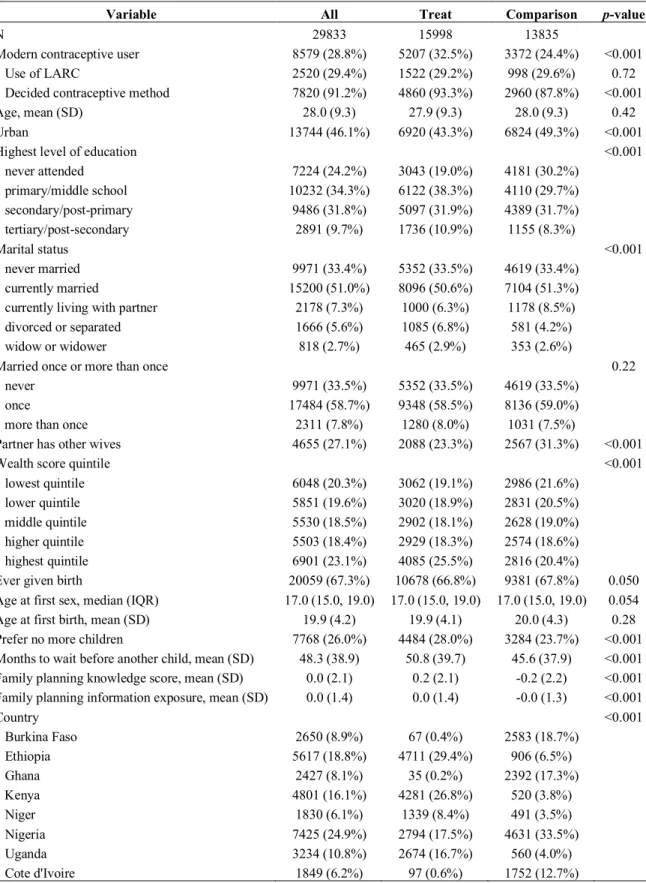
The full sample contained 29,833 individuals, of which 15,998 (53.6%) had free access to a broad contraceptive method mix and the remaining 13,835 (46.4%) did not. Overall, 28.8% of individuals were using a modern contraceptive method. Among these contraceptive users, 29.4% were using LARC and 91.2% reported having participated in the decisions about which method to use. Unweighted, 32.5% of women with free access to both LARC and SARC were using a modern contraceptive method compared to 24.4% among those without access. The proportion of LARC users did not differ by access status while more women with free access participated in contraceptive decision-making (93.3% vs. 87.8%). Most other covariates differed by treatment status (see Table 7 for the unweighted descriptive statistics).
below .06 in all variables except for one country. For comparison purposes, we also used the standard logistic regression approach to generate propensity weights, including a limited set of covariates. A comparison on covariate balance between the GBM approach and the logistic regression approach were presented in Figure A1. The distribution of propensity scores generated from GBM was presented in Figure A2.
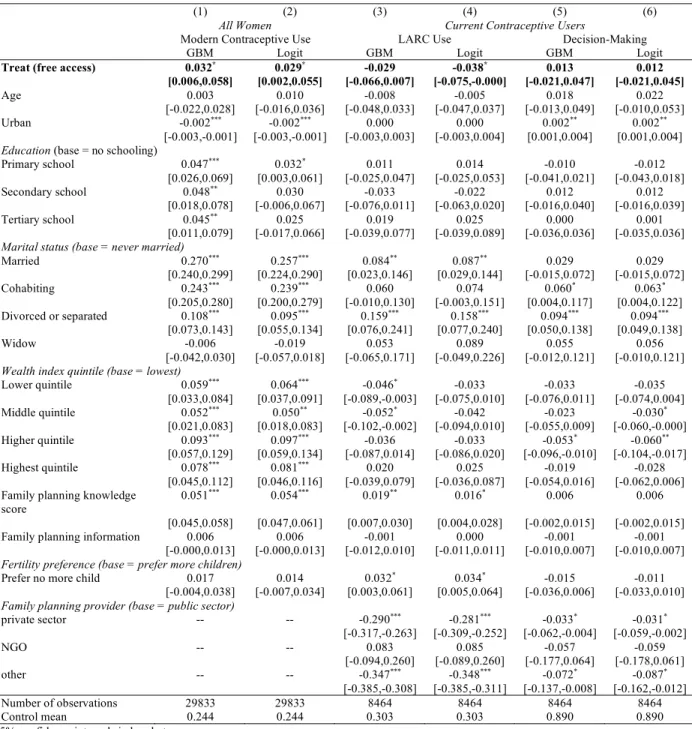
The main results are presented in Table 8. We applied the propensity weights built from GBM, our preferred approach, and the weights from logistic regression models to the main specification and presented average marginal effects. Free access to a broad contraceptive mix was associated with an increase of 3.2 percentage points (95% confidence interval [CI]: 0.006 – 0.058) in the likelihood of contraceptive use among all women, representing an increase of 13.1% from the 24.4% contraceptive use in the control group. Among current contraceptive users, free access had no effect on LARC use or women’s role in contraceptive method decision-making. The specifications using propensity weights from logistic regression models produced similar effects except for the LARC use outcome: free access was associated with a decrease of 3.8 percentage points (95% CI: -0.075 – -0.000) in the likelihood of LARC use.
To further investigate the price effects on contraceptive use, we estimated the effects of free access to different types of contraceptives on women’s contraceptive use by method-type (Table 9). Table A7 shows that 77.7% of all women and 84.0% of current contraceptive users who had free access to SARC also had free access to LARC.