1 1
Ifejiofor, Adaobi Patricia (M. Ed.) | Nwasor, Victor Chekume (M. Ed.)
1Lecturer, Department of Educational Foundations, Faculty of Education, Chukwuemeka Odumegwu Ojukwu University, Igbariam,
Nigeria.
2
Lecturer, Department of Educational Foundations, Faculty of Education, Nnamdi Azikiwe University, Awka, Nigeria.
INTRODUCTION:
The world over, inclusivity in educational settings has gone beyond fad to being an absolute and exigent reality, especially at the tertiary education level. Every-one, able-bodied and disabled, appears to require tertiary education in order to acquire the higher order skill sets needed for functioning a rapidly advancing global economy. To enable learners, acquire these skill sets in a conducive envi-ronment, certain supporting structures/systems need to be in place, to serve as pil-lars to uphold the learning experience and make it more meaningful to learners, especially the physically challenged. Such systems, according to Patrick and Ihejirika cited in Okonkwo (2017), are known as student support services or learner (student) support systems. Without learner support systems in place in ter-tiary education, it is doubtful that the goal of inclusivity in education can be achieved, even as fears in this regard abound (Namibia Education Authority, 2006).
Okafor (2015) defined learner support systems as services rendered in educa-tional institutions to help learners maximize the gains and the purpose of their studentship in all ramifications. According to Okafor, learner support systems include the supports provided to students to enable them enhance their chances at meaningful learning, beginning from the enrolment stage through the instruc-tional stage until the programme or course elapses. Ntakana in Okonkwo (2017) also explained learner support system at the university level to include course selection advisory services, peer tutoring for those struggling with learning diffi-culty, orientation programmes as well as institutional behaviours that tend to sup-port students' learning.
Amini (2012) is of the opinion that learners support system encompasses the pro-vision of library services, counselling services, feedback services, orientation, media resources centre, study guide or kits services, face-to-face tutoring and administrative support services in order to assist students in successfully achiev-ing their learnachiev-ing outcomes in the nick of time. Learner support systems can therefore be seen as those structures and student-centred services provided to learners in order to ensure that they are actually learning without hindrances and to ensure that the desired learning outcomes are achieved in terms of knowledge and aptitude. If able-bodied learners are entitled to be availed of learner support; those learners who have special needs would require it more in schools.
A special needs learner as the appellation connotes, is an individual who is study-ing in a school, but requires extra attention and facilitation in order to make the most of his learning. The true conceptualization of the term special needs learner can be gleaned from Ozoji, Unachukwu and Kolo's (2016) definition of special learning needs. Ozoji, Unachukwu and Kolo defined special learning needs as referring to “those classroom/non-classroom experiences necessarily required by exceptional children in the course of their education and which are brought about by their exceptionality (p.9). According to them, special learning needs refer to those special practices in the learning process required to address special
problems. The general understanding of special needs children by layman is handicapped or gifted children (Danlami, 2015). But to Special educators it is beyond this. Hence, Ozoji (2006) conceived special needs children as children like others which have unique learning needs based on their disabilities. Some have cognitive impairments, learning disability, physical disabilities and chronic health problems and so on.
UNESCO Salamanca Report of 1994 in Ozoji (2006) introduces a new school classification of special needs children as children who are for whatever reasons failing to benefit from school due to the following:
Ÿ Experiencing difficulties in School whether temporary or permanent
Ÿ Lacking interest and motivation in learning
Ÿ Only able to complete one or two year of primary education, forced to repeat classes
Ÿ Forced to work (Child labor, hawking)
Ÿ Living in severe poverty or suffering from chronic malnutrition
Ÿ Victims of war or armed conflict
Ÿ Suffering from continuing physical, emotional or sexual abuse or
Ÿ Simply not attending school whatever may be the reason.
UNESCO (1994) further summarized these children into main categories as fol-lows:
1. Those who are currently enrolled in to primary School but for various reasons do not progress adequately
2. Those not currently enrolled into primary schools but who could be enrolled if the schools were more responsive and
3. The relatively smaller number of children with more severe physical, mental or multiple impairments who have complex special education needs that are not being net.
Such people require support in order for them to enjoy learning at whatever stage of education they are. For instance, blindness comes with the special need of Braille for the learner's impairment to mitigate. Accordingly, a learner with ing impairment would require facilitation in the area of sign language and hear-ing aids; otherwise, the teachhear-ing would make no meanhear-ing to him (Ozoji, Unachukwu & Kolo, 2016). From the definition of Okafor (2015) therefore, the
ABSTRACT
The study set out to find out the availability of learner support systems for special needs learners in Nnamdi Azikiwe University, Awka. The study adopted the descriptive survey as its design. Two research questions were formulated and two hypotheses were tested for the study. A research population of 27 special needs learners consisting of 11 visually impaired and 16 physically challenged learners were conveniently sampled for the study. A questionnaire aptly titled, was used to elicit responses from the participants of the study. It had two sections; the first on respondents' demographic variables and the second on the actual items generated from literature. It was rated on a dichotomous scale, expert validated for face and content validity and reliability tested using the Kuder-Richardson statistics, with a yield of 0.783 as its reliability coefficient. Simple percentage was used to answer the research questions and chi-square was used to test the hypotheses at 0.05 level of significance. Findings of the study revealed that visually impaired learners and physically challenged learners perceived that learners' support systems are not available in Nnamdi Azikiwe University Awka. Also, the study disclosed no significant difference between physically challenged learners and visually impaired learners on the availability of learner support systems in Nnamdi Azikiwe University, Awka based on their gender. The study concluded that, Nnamdi Azikiwe University management has so far not provided learner supports to special needs learners in form of counselling and orientation services to help special needs learners acquiesce to learning and persevere in the face of adversity. It was recommended among others that, the university management should take inclusive education seriously so that attrition will not engulf the will and determination of the learners with special needs.
KEYWORDS: support systems, learner attrition, inclusivity, special needs.
AVAILABILITYOFSUPPORTSYSTEMSFORPREVENTING
LEARNERATTRITIONTHROUGHINCLUSIVITYAMONG
SPECIALNEEDSINNNAMDIAZIKIWEUNIVERSITY,AWKA
Research Paper
E-ISSN No : 2454-9916 | Volume : 6 | Issue : 1 | Jan 2020
act of facilitation is indicative of support systems that aid students in making thelearning experience worthwhile. In the university system, the most common among learners with special needs appear to be the visually impaired, and the physically challenged/impaired, as observable in Nnamdi Azikiwe University Awka.
Mishra, Sharma and Tripathi (2011) defined a visually impaired person as one who suffers from varying degrees of vision loss such as low vision, is legally blind or totally blind. Tatman cited in Nwasor and Ndubuisi (2012) asserted that an individual that has a visual acuity of less than 20/200 and/or has a field of vision 20 degrees or less in the better eye can be declared legally blind. This medi-cal viewpoint comes from testing by professionals using the Snellen chart (Ozoji, Unachukwu & Kolo, 2016). From the educational point of view, Ozoji, Unachukwu and Kolo pointed out that a visually impaired learner is one who can-not read print, even when they are enlarged, but can only read through tactile (Braille) and audio mode (recorded material).
Crisp cited in Okoye (2010) posited that physical challenge is not often synony-mous with handicap. Rather, handicap occurs as a result of disability. For exam-ple, due to disability, a physically challenged person might find it cumbersome gaining access to buildings. A physically challenged student, according to Ozoji, Unachukwu and Kolo (2016), displays a medical or traumatic evidence of dam-age to specific vital organs such as the legs, hands, fingers, toes, spinal cord or skeleton. These vital organs are required for functioning in everyday life and for the general coordination of the body. Therefore, the handicap comes as a result of inability to be mobile enough to manoeuvre through tasks with ease. Such people require special needs intervention such as learner support systems. With learner support systems in place in universities, it is possible that attrition will be mini-mized because inclusivity is concomitant to learner support systems.
Ozoji, Unachukwu and Kolo (2016) suggested that inclusive education is chiefly geared towards the normalization of the learning environment for persons who hitherto would have been secluded and taught in separate environments that char-acterize and highlight their disability or impairment. Inclusivity thus implies effi-cient means of managing, educating and training of students in an environment that is non-discriminatory, irrespective of learners' anatomical and physiological configurations. According to the UNESCO (1994), inclusive education is oper-ated on the principles of promoting equitability in learning, equalization of learn-ing experiences, prioritization of the functionality of learnlearn-ing, ensurlearn-ing com-mensurate learning opportunities for all learners, among others. Every special needs learner should thus be able to acquire learning with minimized stress to the learner's willpower for without willpower; attrition could rear its ugly head, lead-ing to school enrolment deficiencies.
Attrition is dictionary defined as the weakening or gradual wearing away of the human morale and the power of resistance (Microsoft Encarta Dictionary). In the school system, attrition often affects the disadvantaged group, be they the dis-abled or gender stereotyped (Omoniyi & Oloruntegbe 2014). For the physically challenged and visually impaired, this could come about as a result of not being provided with the necessary supports to their learning. It can be frustrating not to have learner supports, particularly when one obviously has special needs. When these learners do not feel included in the learning environment, the challenge is likely to overwhelm them. Therefore, to forestall attrition among learners, it is pertinent to know and understand their special learning needs, as this will serve as learner supports to them.
For the visually impaired, researchers (Beal & Shaw, 2009; Misha, Sharma & Tripathi, 2011; Nwasor & Ndubuisi, 2012; Ozoji, Unachukwu & Kolo, 2016) have identified the following special learning needs:
1. Assistive Technologies: Assistive technologies are ICT components that enable learners with learning challenges and differences achieve their full potential and be comparable to their able-bodied, non-affected peers in terms of achievement and skills (Okeke, 2017). For the visually impaired learners (V.I.L), they can be tri-categorized into low-tech (marker and stylus), mid-tech (abacus and collapsible cane) and high-tech (computer software and hardware). Examples include Window-Eyes, which is a powerful screen reader, JAWS, an accessibility option that reads information from the computer using synthesized speech, with Braille output display as an option so that the VIL can read for him-self. Others include Braille Note-mPower, which helps the VIL to com-pute Mathematics at 82 percent accuracy, and audio devices such as compact discs and audio books shortened to last at most 15-20 minutes per program to sustain attention of the VIL.
2. Touch Typing Skills: In today's knowledge based economy, the VIL must acquire this skill to be able to compete efficiently in the labour mar-ket. They also need a degree of confidentiality; hence, they have to han-dle the information by themselves using their typing skills. The same skill is needed during examinations and in submitting term papers because the majority of their lecturers can neither read nor write in Braille.
3. Orientation and Mobility Competencies: To have orientation means to
have a mental map of one's surroundings just the way a person that is not blind uses landmarks to move from place to place repeatedly. Mobility competencies that could be taught and used by VILs include independ-ent travel without aid, dog guide, travel using collapsible cane, use of sighted guide and the use of electronic aids (Sykes & Ozoji cited in Ozoji, Unachukwu & Kolo, 2017).
4. Braille Reading and Writing: Teaching the VIL on how to use Braille or determining his knowledge of it is important in ensuring that he is duly partaking in the learning experience. For those who do not know how to use Braille, they should be taught in order to give them a greater sense of participation and independence in the classroom. It will also open new doors of opportunities for them.
5. Self-determination Capacity: A counselling need of the VIL is decision making, along with self-advocacy. If the VIL is only educated but not helped to develop these capacities, he or she will not be able to adapt and fend for himself or herself after graduation from the university. Teach-ing the VIL metacognitive strategies will also aid his ability to self-determine and self-affirm in the face of challenges.
6. Career Education: Career education should be provided the VIL in order for them to be availed of several career options. They should also be provided and encouraged to use assistive technologies to help them venture into areas where they were hitherto limited.
For the physically challenged learner (PCL), researchers (Beal & Shaw, 2009; Misha, Sharma & Tripathi, 2011; Ozoji, Unachukwu & Kolo, 2017) also have identified the following special learning needs:
1. They require specialized assistance to mitigate their sufferings due to the handicaps accruing to their respective conditions, such as assistive technologies and human assistance. Drugs, lifestyle supports and mentoring important needs of learners with physical challenges (PCL s).
2. LPCs require adjustments in residential halls, open and closed spaces in order for their physical challenge not to handicap them in daily opera-tions.
3. Walkways and aisles should be widened and made private to accommo-date PCLs' movement on the campus.
4. There should be a resident physiotherapist to cater for the needs of those whose anatomies challenge them in one way or the other.
5. They should be allowed more time to finish assignments since their physical challenge might cause them a handicap in this regard.
In Nnamdi Azikiwe University, Awka however, one cannot categorically deter-mine the extent to which these learner supports exist for physically challenged and visually impaired learners. The VILs are sometimes seen being guided on a long trek to lectures by peers, while the physically handicapped are seen creeping across stairways to gain access to lecture halls. It then comes to mind, what learner support systems are available for these ones to make their learning less cumbersome and more meaningful. This is what this study set out to ascertain from these affected ones.
RESEARCH QUESTIONS:
The following research questions were formulated to guide this study:
1. What are the learner support systems available for the visually impaired learners in Nnamdi Azikiwe University, Awka?
2. What are the learner support systems available for the physically chal-lenged learners in Nnamdi Azikiwe University, Awka?
HYPOTHESES:
1. Visually impaired learners did not differ significantly in their mean ratings on the availability of learner support systems in Nnamdi Azikiwe Univer-sity, Awka based on their gender
2. Physically challenged learners did not differ significantly in their mean rat-ings on the availability of learner support systems in Nnamdi Azikiwe Uni-versity, Awka based on their gender
METHOD:
total population of special needs learners was not immediately determinable. Firstly, an individual in the VIL group could be there based on his or her visual acuity, and could leave the group at any time. Secondly, an individual in the phys-ically challenged group could be there merely due to lack of remediation / inter-vention; hence, when availed of the opportunity for palliative measures against the challenge, such a person might no longer see the need for inclusion in such a group.
A researcher developed questionnaire tagged “Availability of Learner Support Systems Questionnaire (ALSSQ)” was utilized in eliciting responses from the sample. It had two sections, A and B. Section A elicited information on the demo-graphic characteristics of the respondents, while Section B contained the items formulated based on literature and the research questions. There are a total of 20 items in the questionnaire; 10 on availability of learner support systems for the visually impaired and 10 on availability of learner support systems for the physi-cally challenged. For research questions, the responses were tabulated using fre-quency tables and were treated by calculating simple percentages and a score of 50% and above indicates available or otherwise, not available. The questionnaire was expert scrutinized for face and content validity. The instrument yielded a coefficient of 0.783 for its internal consistency after reliability computation using the Cronbach Alpha method. For the hypotheses, chi-square was used to test the hypotheses at 0.05 level of significance. If the critical or table value is greater than the calculated value, the hypothesis of no significance difference is accepted and otherwise, it is rejected.
RESULTS:
Research Question One:
What are the learner support systems available for the visually impaired learners in Nnamdi Azikiwe University, Awka?
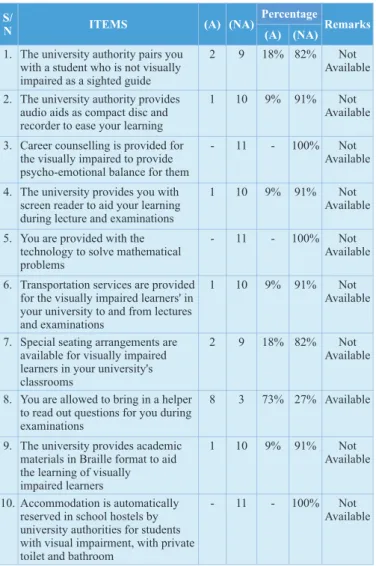
Table 1: Frequency and percentage ratings of respondents on learners support systems available for the visually impaired learners in Nnamdi
Azikiwe University Awka (N=11)
Data in Table 1 revealed that amongst the 10learner support systems, only one is available for visually impaired learners in Nnamdi Azikiwe University Awka. This is because the percentage availability of the item was above 50% which was above the cut-off point. The remaining nine learner support systems had their per-centage availability below 50% which is the cut-off point. This indicates that they were not available for visually impaired learners in Nnamdi Azikiwe versity Awka. On the whole, visually impaired learners in Nnamdi Azikiwe
Uni-versity Awka perceived that learners support systems are not available in Nnamdi Azikiwe University Awka.
Research Question Two:
What are the learner support systems available for the physically challenged learners in Nnamdi Azikiwe University, Awka?
Table 2: Frequency and percentage ratings of respondents on learners support systems available for the physically challenged learners in
Nnamdi Azikiwe University Awka (N=16)
Data in Table 2 revealed that amongst the 10learner support systems, only one is available for physically challenged learners in Nnamdi Azikiwe University Awka. This is because the percentage availability of the item was above 50% which was above the cut-off point. The remaining nine learner support systems had their percentage availability below 50% which is the cut-off point. This indi-cates that they were not available for physically challenged learners in Nnamdi Azikiwe University Awka. On the whole, physically challenged learners in Nnamdi Azikiwe University Awka perceived that learners support systems are not available in Nnamdi Azikiwe University Awka.
Hypothesis 1:
Visually impaired learners did not differ significantly in their mean ratings on the availability of learner support systems in Nnamdi Azikiwe University, Awka based on their gender.
df (r-1) (c-1) (2-1) (2-1) = 1. S/
N ITEMS (A) (NA)
Percentage
Remarks (A) (NA)
1. The university authority pairs you with a student who is not visually impaired as a sighted guide
2 9 18% 82% Not Available
2. The university authority provides audio aids as compact disc and recorder to ease your learning
1 10 9% 91% Not Available
3. Career counselling is provided for the visually impaired to provide psycho-emotional balance for them
- 11 - 100% Not Available
4. The university provides you with screen reader to aid your learning during lecture and examinations
1 10 9% 91% Not Available
5. You are provided with the technology to solve mathematical problems
- 11 - 100% Not Available
6. Transportation services are provided for the visually impaired learners' in your university to and from lectures and examinations
1 10 9% 91% Not Available
7. Special seating arrangements are available for visually impaired learners in your university's classrooms
2 9 18% 82% Not Available
8. You are allowed to bring in a helper to read out questions for you during examinations
8 3 73% 27% Available
9. The university provides academic materials in Braille format to aid the learning of visually impaired learners
1 10 9% 91% Not Available
10. Accommodation is automatically reserved in school hostels by university authorities for students with visual impairment, with private toilet and bathroom
- 11 - 100% Not Available
S/
N ITEMS (A) (NA)
Percentage
Remarks (A) (NA)
11. Accommodation is provided in school hostels for learners who are physically challenged, with private toilet and bathroom
- 16 - 100% Not Available
12. Counselling services are available for physically challenged learners who might be disoriented from their academics
1 15 6% 94% Not Available
13. Care is taken to provide comfortable seating arrangements that favour the physically challenged
in your university
3 13 19% 81% Not Available
14. Specialized walkways are provided along the road on campus to aid the movement of physically challenged learners
5 11 31% 69% Not Available
15. Specialized entrances are provided for wheelchair movement in university buildings and lecture halls
12 4 75% 25% Available
16. Physical barriers such as stairways are enabled in such a way as to accommodate the movement of physically challenged learners' in your schools building
- 16 - 100% Not Available
17. The university provides assistive and adaptive technologies to serve as learner supports for the physically challenged
3 13 19% 81% Not Available
18. Physiotherapy services are part of the services provided in the university's medical centre to carter for your anatomical needs
- 16 - 100% Not Available
19. Those who cannot write due to physical challenges are allowed to speak and have a scribe write for them during examinations
- 16 - 100% Not available
20. The school library is built for ease of access by students who are physically challenged
6 10 37% 63% Not available
Fo Fe O-E 2
(Fo-Fe) /Fe
4 11 x 6/22 3 1 0.33
2 11 x 6/22 3 1 0.33
7 11 x 16/22 8 1 0.13
9 11 x 16/22 8 1 0.13
t-table of chi-square at df 1 is 3.84 and the calculated value is 0.92.
Since, the critical value is greater than the calculated value, (3.84 > 0.92), the null hypothesis is accepted. This means that, visually impaired learners did not differ significantly in their mean ratings on the availability of learner support systems in Nnamdi Azikiwe University, Awka based on their gender
Hypothesis 2:
Physically challenged learners did not differ significantly in their mean ratings on the availability of learner support systems in Nnamdi Azikiwe University, Awka based on their gender.
df (r-1) (c-1) (2-1) (2-1) = 1.
t-table of chi-square at df 1 is 3.84 and the calculated value is 1.14.
Since, the critical value is greater than the calculated value, (3.84 > 1.14), the null hypothesis is accepted.
This means that, physically challenged learners did not differ significantly in their mean ratings on the availability of learner support systems in Nnamdi Azikiwe University, Awka based on their gender
SUMMARY OF THE MAJOR FINDINGS:
From the results of the analysis presented in this chapter, findings of the study are summarized as follows:
1. Visually impaired learners in Nnamdi Azikiwe University Awka per-ceived that learners support systems are not available in Nnamdi Azikiwe University Awka
2. Physically challenged learners in Nnamdi Azikiwe University Awka perceived that learners support systems are not available in Nnamdi Azikiwe University Awka
3. Visually impaired learners did not differ significantly in their mean rat-ings on the availability of learner support systems in Nnamdi Azikiwe University, Awka based on their gender
4. Physically challenged learners did not differ significantly in their mean ratings on the availability of learner support systems in Nnamdi Azikiwe University, Awka based on their gender
DISCUSSION:
The findings of the study indicated that on the overall in Nnamdi Azikiwe Uni-versity, Awka, learner support systems are scarcely available for visually impaired and physically challenged learners. Their accommodation and seating needs in the learning environment, among others, were apparently not taken care of. This appears to agree with the suggestions of Misha, Sharma and Tripathi (2011) and Ozoji, Unachukwu and Kolo (2017) that special provisions be made for special needs learners in order to forestall the feeling of lack of inclusivity. It also provides impetus for the findings by Okeke (2017) from an Anambra study that assistive technologies which form a fulcrum for interventions for special needs learners were nearly absent in the state.
It was also indicative from the study's findings that there could be a very low level of awareness of the special needs requirements of learners with visual impairment and physical challenges in Nnamdi Azikiwe University, Awka; hence, their non-availability. In terms of the environment, Awka cannot be said to have arrived in the technological sense, which tends to fertilize the lack of techni-cal practitechni-cal understanding required to utilize and manipulate assistive technolo-gies. It could also be that the special needs learners themselves do not know much about the interventions meant for them; hence, they may not know which sugges-tions to make to the university management as regards the learner support sys-tems needed to be in place.
The cost of procuring and maintaining learner supports with university funds could be another reason for the trend of this study's findings. That is, even if the management is aware of which learner supports to provide for special needs learners, they might not want to spend money in that regard without assurance of refund from the government who happens to be lackadaisical quite often in mat-ters pertaining to special needs individuals. Again, the university management might not be aware of the need for inclusivity in educational settings, without which attrition could set in and discourage special needs learners from attending school.
CONCLUSION:
The following conclusions were reached in the course of the study:
1. The Nnamdi Azikiwe University management has so far not provided learner supports to special needs learners in form of assistive technolo-gies and accommodation.
2. The Nnamdi Azikiwe University management has so far not provided learner supports to special needs learners in form of counselling and ori-entation services to help special needs learners acquiesce to learning and persevere in the face of adversity.
3. Special needs learners have neither been able to assert their studentship rights with the university management, nor do they appear to be aware of what it takes to meet their own needs.
4. The university management might also be lacking in manpower to han-dle the special education requirements of special needs learners in need of learner support.
5. The university management could also not be aware of what inclusive education truly implies, as this concept is often mistaken to mean the inclusion of the girl child, but it goes beyond that.
IMPLICATIONS FOR LEARNER ATTRITION AND SUSTAINABLE EDUCATION GOALS:
The implications of this study on learner attrition are highlighted as follows:
1. If special needs learners are not encouraged to remain in school by pro-viding them with requisite learner support systems, it could attrite them, leading them to withdraw from schools. This would defeat the goal of having every learner in school by 2030.
2. If there is mass withdrawal of special needs learners because their needs are not met or the school environment is not inclusive enough for them, it will affect school enrolment and paint an ugly picture of inclusivity to an observer from outside Nigeria.
3. Inclusivity is much needed in Nnamdi Azikiwe University, Awka, for there are several issues begging the question there, which would make sustainable education goals unachievable.
RECOMMENDATIONS:
The following recommendations were made, based on the findings of the study:
1. The Nnamdi Azikiwe University, Awka management should endeavour to meet with special needs learners to determine what they need to make the most of their learning.
2. The university management should take inclusive education seriously so that attrition will not engulf the will and determination of the learner with special needs.
3. In the school building designs, great care should be taken to consider special needs students by incorporating mobility enhancers as a learner support for them.
4. Accommodation should also be provided for special needs learners as a support system to avail them of ready help from fellow students in case of emergency, rather than for them to live isolated and exposed to hin-drances that disable them from normal living.
REFERENCES:
1. Amini, C.M. (2012). Students’ perception of learner support services at the National Open University of Nigeria. Prime Research on Education, 2(7), 301-308.
2. Danlami, A. (2015). Educating special needs children in the regular school: Challenges and opportunities for Nigeria. National Journal of Inclusive Education, 3(1), 47 - 53
3. Mishra, M. P., Sharma, V. K., & Tripathi, R. C. (2011). ICT as a tool for teaching and learning in respect of learner with disability. New Delhi: GNOU Press
4. Nwasor, V.C., & Ndubuisi, M.C. (2012). Interventions for visually impaired learners. Unizik Orient Journal of Education, 6 (1), 302-309.
5. Nworgu, B. G. (2015). Educational research: Basic issues and methodology. Ibadan: Wisdom Publishers.
6. Okafor, I.C. (2015). Utilization of learner support services by the students of National Open University of Nigeria (NOUN) study centres in South East of Nigeria. Unpub-lished doctoral dissertation, Department of Adult and Extra-mural, Faculty of Educa-tion, University of Nigeria, Nsukka.
7. Okeke, J. (2017). Teachers’ awareness and use of assistive technologies for English Lan-guage instruction in Awka Education Zone. Unpublished research project, Department of Educational Foundations, Faculty of Education, Nnamdi Azikiwe University, Awka.
8. Okonkwo, O.G. (2017). Perceptions of undergraduates English language students on learners’ support system in Nnamdi Azikiwe University, Awka. Unpublished research
Research Paper
E-ISSN No : 2454-9916 | Volume : 6 | Issue : 1 | Jan 2020
Fo Fe O-E 2
(Fo-Fe) /Fe
3 16 x 4/32 2 1 0.5
1 16 x 4/32 2 1 0.5
13 16 x 28/32 14 1 0.07
15 16 x 28/32 14 1 0.07
project, Department of Educational Foundations, Faculty of Education, Nnamdi Azikiwe University, Awka.
9. Okoye, U.O. (2010). Support systems and coping strategies available to physically chal-lenged students in University of Nigeria, Nsukka. Educational Research, 1 (11), 666-671.
10. Ozoji, E.D. (2006). Special needs education and rehabilitation for beginner profession-als. Jos: Deka publications.
11. Ozoji, E.D., Unachukwu, G.C., & Kolo, I.A. (2016). Modern trends and practices in special education. Lagos: Foremost Educational Service Limited.
12. UNESCO (1994). The Salamanca statement and framework for action on special needs th th
education: Access and Quality. Salamanca, Spain, June7 -10 .