• No results found

Bauer_unc_0153M_17695.pdf

N/A
N/A
Protected

Academic year: 2020

Share "Bauer_unc_0153M_17695.pdf"

Copied!
43
0
0

Loading.... (view fulltext now)

Full text

(1)

TRANSATLANTIC DIFFERENCES IN GMO PREFERENCES

Melody Bauer

A thesis submitted to the faculty of the University of North Carolina at Chapel Hill in partial

fulfillment of the requirements for the degree of Master of Arts in the Department of Political

Science, Concentration Transatlantic Studies.

Chapel Hill

2018

(2)
(3)

iii

ABSTRACT

Melody Bauer: Transatlantic Differences in GMO Preferences

(Under the direction of Gary Marks)

The transatlantic divide between the United States and the European Union on genetically

modified organisms is reflected in the distinct regulatory approaches, levels in crop cultivation,

and consumer acceptance. The purpose of this paper is to outline the key characteristics of the

different attitudes and regulatory approaches on genetically engineered crops and food as well as

connect the dots of the preferences of the actors involved and how they have influenced

(4)

ACKNOWLEDGEMENTS

(5)

v

TABLE OF CONTENTS

LIST OF TABLES ……… vi

LIST OF FIGURES ……….… vii

LIST OF ABBREVIATIONS ……….………... viii

SETTING THE STAGE ……….………...………...…. 1

Introduction ……… 1

Agricultural Biotechnology 101 .………...……… 4

OVERVIEW OF GMO REGULATORY DEVELOPMENTS

IN THE US AND THE EU ………...………….……… 6

US Regulatory System for GMOs ………. 6

GMO Regulations in Europe ………. 9

PUBLIC ATTITUDES AND CULTURAL CONTEXT ………. 14

Public attitudes toward GM Crops and Foods ………..……….…….. 14

The Impact of Culture ……….. 23

CONCLUSION ………..…….. 30

(6)

LIST OF TABLES

Table

(7)

vii

LIST OF FIGURES

Figure

(8)

LIST OF ABBREVIATIONS

BEUC

The European Consumer Organisation

DNA

Deoxyribonucleic acid

EPA

Environmental Protection Agency

EC

European Commission

EFSA

European Food Safety Authority

EU

European Union

FDA

US Department of Health and Human Services Food and Drug

Administration

GE

Genetically engineered; genetic engineering

GM

Genetically modified

GMO

Genetically modified organism

NGO

Non-governmental organization

rDNA

Recombinant DNA

US

United States

(9)

1

SETTING THE STAGE

Introduction

There is a transatlantic divide between the United States (US) and the European Union

(EU) when it comes to genetically modified organisms (GMOs), which is reflected in distinct

regulatory approaches, levels in crop cultivation, and consumer acceptance. To varying degrees

in the US and the EU, the preferences of various actors, such as government regulators,

biotechnology companies, civil society, and consumers, have played a role in shaping the

perceived benefit-risk narrative on genetic technology and the subsequent regulations. The

relatively relaxed policies in the US, based on the substantial equivalence principle, stand in

contrast to the EU’s complex regulations, which contain precautionary clauses on traceability,

mandatory labeling and thresholds for tolerable “contamination” of non-genetically modified

products (Lau, 2015; Stephan, 2015).

(10)

has been remarkably stable and permissive since the 1980s, whereas public unease in Europe led

to an increasingly negative environment toward agricultural biotechnology.

GMO acceptance can also be understood in the context of contrasting cultural identities,

agricultural practices, and perceptions of land usage. American and European societies have

historically moved along distinct cultural trajectories: American society, accelerated by

industrialist and progressive forces, embraced a utilitarian approach to technology in agriculture,

whereas many European societies continue to maintain traditional conceptions of cultural

identity, “naturalness,” and moral worldviews (Stephan, 2012). While cultural identities and

values may not cause specific outcomes, they create the essential, enabling conditions for

political mobilization, and remain highly influential in shaping the public’s judgments on, and

degree of support for, GMOs. Thus, understanding the regulatory divide between the two regions

requires considering not only domestic politics but also the long-term historical evolution of

these regions (Earle & Cvetkovich, 1995; Stephan, 2012, 2015).

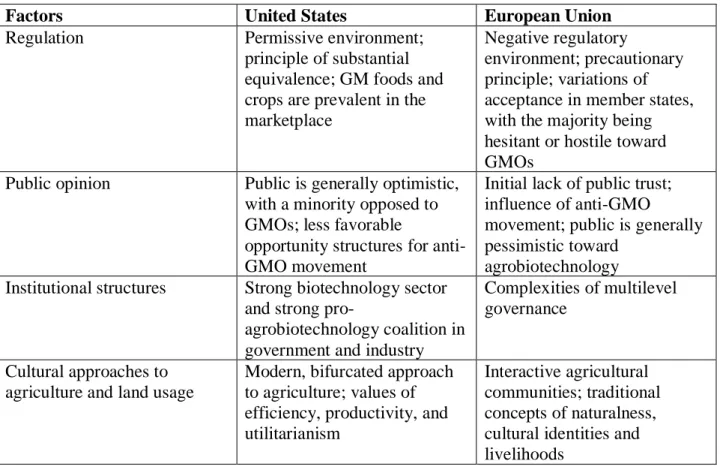
Table 1 provides an overview of the key characteristics of the transatlantic attitudes and

regulatory approaches on GMOs discussed throughout this paper. Public opinion, institutional

structures, cultural approaches to agriculture, and land usage are among the key features

influencing the contrasting approaches and regulatory outcomes seen in the US and the EU.

Ultimately, I will seek to understand the influence of some of the actors involved on the different

regulatory approaches, and to what extent the differences (for example, cultural and/or

(11)

3

Table 1: Contrasting attitudes and regulations on GMOs

Factors

United States

European Union

Regulation

Permissive environment;

principle of substantial

equivalence; GM foods and

crops are prevalent in the

marketplace

Negative regulatory

environment; precautionary

principle; variations of

acceptance in member states,

with the majority being

hesitant or hostile toward

GMOs

Public opinion

Public is generally optimistic,

with a minority opposed to

GMOs; less favorable

opportunity structures for

anti-GMO movement

Initial lack of public trust;

influence of anti-GMO

movement; public is generally

pessimistic toward

agrobiotechnology

Institutional structures

Strong biotechnology sector

and strong

pro-agrobiotechnology coalition in

government and industry

Complexities of multilevel

governance

Cultural approaches to

agriculture and land usage

Modern, bifurcated approach

to agriculture; values of

efficiency, productivity, and

utilitarianism

(12)

Agricultural biotechnology 101

Biotechnology can be defined as “any technological application that uses biological

systems, living organisms, or derivatives thereof to make or to modify products or processes for

a specific use” (United Nations, 1992, p. 3). Biotechnology is in itself nothing new. Humans

have bred crops selectively for environmental robustness or higher yields for several thousands

of years, and the knowledge of crossbreeding can be traced back to the start of sedentary

agriculture (Stephan, 2012). However, the advances of molecular genetics in the 1970s and

1980s enabled the selection of a specific part of a gene, or genes, responsible for producing an

attribute in a plant or animal, such as the production of an enzyme or resistance to a particular

disease. These genes could then be multiplied to increase a specific effect or added to an entirely

different microorganism, animal, or plant. These technological developments in genetic

engineering facilitated the targeted modification of an organism beyond traditional breeding

methods (TNS Opinion & Social, 2010).

Since the 1980s, biologists have used genetic engineering to alter a plant’s characteristics,

such as to increase resistance to diseases or longer shelf life for fruit. In 1994, Calgene’s FLAVR

SAVR tomato was the first genetically engineered food product to be commercialized in the US

market. Only some 1.7 million hectares of insect resistant Bacillus thuringiensis (Bt) corn and

cotton as well as transgenic herbicide-tolerant oilseed rape and soybeans were cultivated globally

in 1996, the year GM crops were commercialized (Lucht, 2015). By 2016, 185.1 million hectares

of genetically modified crops were planted by some 18 million farmers in 26 countries—an

increase of 110%

1

(National Academy of Sciences [NAS], 2016). GM crops are cultivated

predominately in the Americas, with the US (72.9 million hectares in 2016), Brazil (49.1) and

Argentina (23.8) being the top producers; whereas only 136 hectares were cultivated in five EU

(13)

5

(14)

OVERVIEW OF GMO REGULATORY DEVELOPMENTS IN THE US AND THE EU

US regulatory system for GMOs

From the onset, genetic technologies have been the subject of regulatory controversy. The

development of recombinant deoxyribonucleic acid (rDNA) techniques in the US during the

1970s sparked intense debate within the wider scientific community as well as public concern

that mutant organisms might be released into the environment (Marden, 2003). The 1974 Berg

letter to Science and Nature, signed by a number of prominent researchers, invited scientists

from around the world to defer voluntarily from conducting rDNA experiments until the

potential risks of such molecules had been better evaluated or adequate methods had been

developed for preventing their spread (Gaskell & Bauer, 2006). In February 1975, 140 scientists

and lawyers convened at the Asilomar conference to discuss the ramifications of the scientific

breakthrough. They decided to introduce responsible self-regulation in order to mitigate future

state and federal government regulation of genetic engineering and adopted interim guidelines,

which were then endorsed by the National Institutes of Health, a US federal medical research

agency. These guidelines and their apparent effectiveness at biological containment were a

soothing gesture to American lawmakers and the US public at large and set the stage for

declining public interest in novel genetic techniques. Additionally, the lack of safety crises in the

US in the ensuing years allowed rDNA research to gain respectability (Marden, 2003; Stephan,

2015).

By the 1980s, the introduction of GM crops and foods to commercial markets was

(15)

7

technology and a movement to draft new legislation specific to its application. As a result of

American scientists being the first movers in both the scientific and regulatory aspects of

biotechnology, the US had developed its position as a global leader in the field, and scientists

and governments supporters were reluctant to cede this (Marden, 2003; Stephan, 2015).

In 1986, the finalized Coordinated Framework for the Regulation of Biotechnology

2

outlined the coordinated, risk-based system of the federal agencies involved with the review of

biotechnology research and products. The US policy was built on three tenets: (1) the substantial

equivalence principle: a focus on the substantial equivalence of a GM crop or food product to a

traditional counterpart in terms of composition, nutrition, and safety, rather than on the fact that

genetic engineering was used in the process; (2) only regulation grounded in verifiable scientific

risk would be tolerated; and (3) as the technology used in GM products is on a continuum with

other agricultural innovations, any risks are seen as similar to those of traditionally produced

foods (Marden, 2003; Lau, 2015; USDA-APHIS, 2017). Ultimately, the approach was that

effective scientific and industry self-regulation could preclude inhibitory legislation, ensuring the

development of the GMO industry (Marden, 2003).

In the US, three federal agencies are responsible for regulating GM products under the

same laws governing the health, safety, efficacy, and environmental impacts of conventional

products. The Department of Agriculture Animal and Health Plant Inspection Service

(USDA-APHIS) controls the importation, handling, interstate movement, and environmental release of

transgenic plants, with the aim of protecting existing crops from risk. The Department of Health

and Human Services Food and Drug Administration (FDA) regulates GMOs in food, drugs, and

biological products, while GMO microorganisms and pesticides are managed by the

(16)

Environmental Protection Agency (EPA). Officials of the three regulatory agencies collaborate

to ensure that any arising safety or regulatory issues are appropriately resolved (USDA-APHIS,

2017; the Library of Congress, 2015).

Depending on the characteristics of a given GM product, it may be subject to the

jurisdiction of one or more of these agencies. The USDA requires businesses to submit a wide

range of information before GM plants can be introduced in the US under regulated or

nonregulated status. New GM foods require premarket approval if they contain high levels of

allergens or toxic substances or reduced levels of essential nutrients

3

; the FDA recommends a

voluntary consultation process to determine whether new products would require this approval.

However, as GM foods fall under the FDA classification of “generally recognized as safe,” they

typically do not require special labeling or premarket approval (Lau, 2015; FDA, 2018). The

more lenient approach seen in the US is complemented by the threat of litigation against both

individual companies and federal regulators (Stephan, 2015).

Some argue that, “The core scientific principles of US regulations, such as ‘substantial

equivalence,’ cannot be understood outside their political, legal, and cultural context” (Stephan,

2015, p. 17) and that regulatory outcomes are partial to what benefits food producers and

retailers. In addition, the revolving door migration among agrobiotechnology industry lobbyists

and regulators is seen not only as a political foible but also as an expression of a wider belief

system that produces a far-reaching consensus between the two groups: to lobbyists and

regulators, GM products are generally progressive and benign and offer impressive economic

opportunities. The data on American public opinion

4

indicate that the general population holds a

3 Insecticides are a special subclass under the jurisdiction of the EPA (Lau, 2015).

(17)

9

largely positive reading of technological progress, albeit with weaker confidence in its safety and

latent concerns about physical and moral ramifications (Stephan, 2015).

GMO regulations in Europe

The American approach to regulation stands in contrast to developments in Europe. In the

early 1990s, the topic of GM foods in the EU remained limited to parliamentary debates about

the transposition of European directives concerning the dissemination of GMOs and to various

media articles on biotechnology. The use and commercialization of GMOs started to gain

traction with the public at the end of 1996 when animated debate surrounded the authorization of

Bt corn and the very first imports of transgenic seeds arrived in Europe from the US. Public

opinion was marked strongly at this stage by various completely legitimate scares, such as

bovine spongiform encephalopathy (BSE), HIV-contaminated blood, asbestos, and other

perceived regulatory failures. While these issues had nothing to do with GM foods, they led to

strong public distrust toward the food and agricultural industry and government regulatory

agencies, which were perceived as potentially disregarding health risks in order to protect certain

political or economic interests (Bonny, 2003; Paarlberg, 2014).

Trust is an important factor for the perception of many types of risk, including those

related to GM foods (Land & Hallman, 2005). As Dan Glickman, former US Secretary of

Agriculture, observes:

With all that biotechnology has to offer, it is nothing if it’s not accepted. This boils down

to a matter of trust. Trust in the science behind the process, but particularly trust in the

regulatory process that ensures thorough review—including complete and open public

involvement. (Glickman, 1999)

Thus, because confidence in European government institutions, industry, and certain

(18)

debates on GM crops and foods in many European countries. European NGOs, such as Friends

of the Earth, Greenpeace, and the European Consumer Organisation (BEUC), saw no consumer

benefit from GM foods that might justify even a hypothetical risk and began warning consumers

against such products, simply on precautionary grounds (Paarlberg, 2014).

As a wave of public opposition to GMOs swept through Europe, the EU’s initial Novel

Foods Regulation in 1997, which included relatively moderate provisions on GMOs, became

meaningless (Stephan, 2015). The anxieties of European consumers led several EU member

states to resort to national bans on GM crops and the European Commission to establish its

general policy for GM food regulation in 2002. The Commission also founded the European

Food Safety Authority (EFSA), a scientific committee and the legislative body responsible for

conducting environmental and health risk assessments of any GMO to be cultivated or marketed

within the EU (Regulation (EC) 178/2002).

In addition to the public outrage caused by various food-industry related crises in the

1990s, the EU’s tradition of risk-averse regulation in other areas meant that the precautionary

principle became the central tenet for GMO regulation. Detailed in Article 191 of the Treaty of

the Functioning of the European Union, the precautionary principle is a risk management

strategy whereby if a given policy or action may cause harm to the public or environment, and if

there is no scientific consensus on the issue, the policy or action in question should not be

pursued (EUR-Lex, 2016; European Commission, 2015).

5

The European legislation on GMOs

(for example, Regulation (EC) 1829/2003 on GM food and feed, Regulation (EC) 1830/2003

concerning the labeling and traceability of GMOs and GM products, and Directive 2009/41/EC

5 The situation should be reviewed, however, once more scientific information is available. The

(19)

11

on the contained use of GM microorganisms) seeks to protect the environment and human and

animal health, defend consumer interests, and ensure that the EU’s single market works

effectively (Regulation (EC) 178/2002).

The EU’s GMO authorization process includes extensive and case-by-case assessment by

the EFSA. The labeling and traceability regulations of GM foods are both process- and

product-oriented and aim to label goods that involve genetic engineering at any stage of production.

Labeling is required for food products that contain over 0.9% of biotechnological events

(Regulation (EC) 1829/2003) and for GMOs for food use, food items containing or consisting of

GMOs, and GMO derivatives, regardless of whether or not the GMOs are detectable in the end

product (for example, sugar from GM sugar beets) (Regulation (EC) 1830/2003; Henard et al.,

2012; European Commission, 2015).

6

Approval of GM crops at the EU level can conflict with the regulatory policies of

individual member states, and the ultimate deciding power rests with member states. The de

facto moratorium initially set by various EU countries on the cultivation and importation of GM

seeds and foods continues today, with Directive (EU) 2015/412 allowing EU member states to

challenge EFSA risk assessments and to restrict or prohibit the cultivation and use of a particular

EU-approved GMO within their borders, if the member state provides additional data

demonstrating that the GMO poses a risk to environmental or human health (EC

MEMO/15/4779). However, such challenges are brought primarily for political or economic

(20)

reasons. An example of this is France’s ban in 2008 of EU-approved MON810 corn, which

contains an engineered insecticidal protein. France alleged that MON810 was an environmental

risk because of the potential for insects to develop resistance to insecticide (the hypothetical

impacts had been rejected by the EFSA). Because the scientific basis of the ban was unclear, the

French government’s position was seen as being largely (bio)political, with ministers deciding

against scientific opinion to give the appearance of being “green” for the sake of political

expediency. The French ban of MON810 was declared unlawful by the European Court of

Justice in 2011, yet the French government continues to ban MON810. France’s moratorium on

MON810 and other similar restrictions by individual EU member states indicate “government

interference with science to justify political handling of risk management and bypass European

and national agencies in charge of biotech risk assessment under European directives” (Kuntz et

al., 2013, p. 499).

(21)

13

Germany. Finally, there are several member states that are opposed to biotechnology: Austria,

Hungary, Slovenia, the Wallonia region of Belgium, Luxembourg, Greece, Italy, and Latvia

(Henard et al., 2012).

Despite the Commission’s stated priority for a science-based policy geared toward a

knowledge-based bio-economy, country-specific pressures have influenced the legal framework.

John Dalli, a former EU Health and Consumer Policy Commissioner, maintains that, “The

problems of implementation of the GMO legislation [at the EU level] do not stem from its design

or its objectives, which remain relevant, but rather from the way these sensitive issues are

handled at a political level” (European Commission, 2011). The multilevel governance of the EU

grants member states the role of principal agents of enforcement (with many veto points),

(22)

PUBLIC ATTITUDES AND CULTURAL CONTEXT

Public attitudes toward GM crops and foods

In addition to regulation, public perception may be a significant hurdle to the acceptance

of new technology. Consumers are generally keen to know about the foods they eat, sources of

food, and, if the food is processed, what ingredients may have been added (Wunderlich & Gatto,

2015). Because the average consumer does not have the scientific knowledge or resources to

decide for her/himself whether GM foods constitute a risk, they have to rely on the competence,

transparency, and honesty of the various actors participating in the food supply chain to assess

the risk of eating GM foods. Thus, trust is an essential component of public perception and

acceptance of genetic technology, with a broad range of actors—from civil society, scientists,

regulatory agencies, industry, and the media—contributing to the formation of this trust (Lang &

Hallman, 2004). The degree of trust that the public places in actors and institutions is influenced

by the wider cultural context (Stephan, 2012).

Consumer concerns about the safety of GMOs can have a direct impact on GMO

management, and various forums of public involvement provide opportunities for the public to

affect the policies, and therefore trajectories, of technology. Whether the public displays trust

toward the institutions that appear to control GMOs is a crucial issue for academics and

(23)

15

Stephan notes, “Too much evidently depends on how questions are framed, on what terminology

is used or on what information is supplied” (2015, p. 17).

Well before the safety crises that triggered the anti-GMO events in Europe, a groundswell

of opposition was detected, with a sizeable majority of Europeans considering agrobiotechnology

applications as harmful to health and the environment and 85% of respondents calling for stricter

regulations (Zechendorf, 1994). Surveys since the early 1990s showed that members of the

European public had generally not yet made up their minds about biotechnology, but that if they

did want more information, they were more likely to trust anti-GMO groups espousing negative,

value-based attitudes toward the technology than to trust industry and government sources (Tait,

2001). Anti-GMO groups made a strong impact on public perception, and they received

extensive publicity due to the dynamism of their actions: countless mass dissemination of

warnings, petitions, alerts, and leaflets; standard letters to elected officials and agricultural firms;

lawsuits; demonstrations; and sabotaging GM crop trials and imports. The endless circulation

and use of anti-GMO information on the Internet gave it credibility; compound repetitions made

it seem more reliable (Bonny, 2003). However, much of the anti-GMO information in circulation

at the time was partial and biased; examples of comments from anti-GMO activists include the

following: “GMOs are unsafe and must never be released into the environment.” “We don’t

know enough about GMOs to risk releasing them—what is being done about this?” “Why

doesn’t someone do something to understand the risks of what GMOs are?” (EUR 24473, 2010,

p. 209). The 1999 Eurobarometer showed that, in regards to GMOs, actors judged by

(24)

There is a greater focus nowadays on new technologies as a result of increased concern

about sustainability, with Europeans favoring the impetus toward innovation so long as the

public is involved in decisions about new technologies when social values are at stake and there

are appropriate regulations to balance the market. The latest Eurobarometer in 2010 indicates

that while the crisis of confidence in regulation and technology that characterized the 1990s is no

longer the dominant perspective in Europe, GM foods remain the Achilles’ heel of

biotechnology. Although attitudes toward genetic engineering improved slightly after the peak of

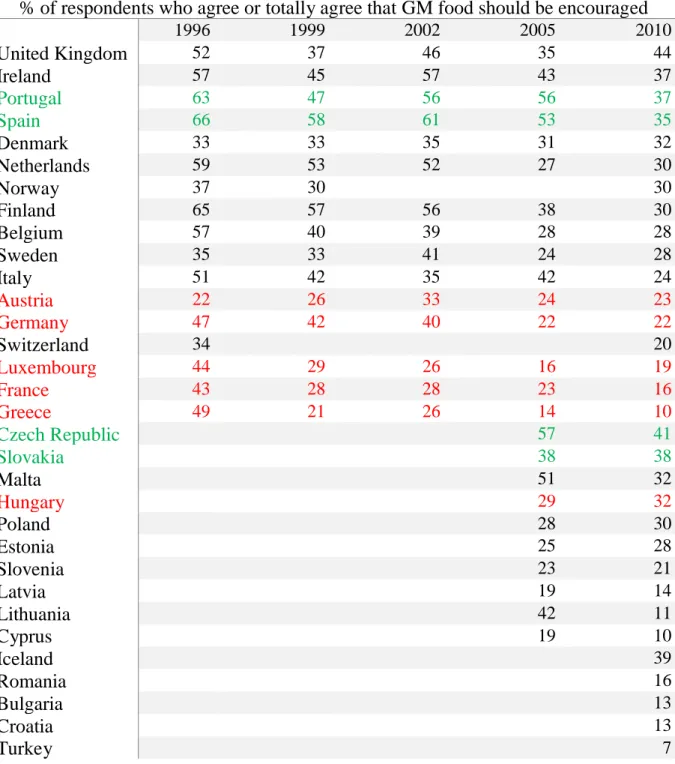
public opposition from 1996 to 2000, the overall picture throughout 1996 to 2010 as presented in

Figure 1 and Table 2 is one of declining support across many European countries; opponents

outnumber supporters three to one, and in no country is there a majority of supporters

7

(Gaskell

et al., 2006, 2010).

7 In the 2005 Eurobarometer, only 27% of respondents regarded GM food positively; this number dropped to 23% by 2010 (Gaskell et al., 2010).
Source: Gaskell et al., 2010, p. 37

(25)

17

In general, respondents believe that the governance of science should be based on moral

and ethical considerations rather than scientific evidence (Gaskell et al., 2010). Member states

with a ban on GM crop plantings generally show low values of public support and vice versa.

For example, amongst European countries, Spain has registered the highest index level of public

optimism for biotechnology/genetic engineering concurrently between 1991 to 2010. Spain is

also the EU’s leading producer of Bt corn with over 90% of total acreage in the EU (or 30% of

the annual Spanish corn crop) (Gaskell et al., 2010). Since Bt corn was first planted in Spain in

1998, farmers have had good experiences with the crop’s efficacy against the corn border

infestation, which, together with reduced pesticides costs and yield gains, translates directly into

increased revenues (Gómez-Barbero et al., 2008).

(26)

Table 2: Trends in support for GM foods in Europe

% of respondents who agree or totally agree that GM food should be encouraged

1996

1999

2002

2005

2010

United Kingdom

52

37

46

35

44

Ireland

57

45

57

43

37

Portugal

63

47

56

56

37

Spain

66

58

61

53

35

Denmark

33

33

35

31

32

Netherlands

59

53

52

27

30

Norway

37

30

30

Finland

65

57

56

38

30

Belgium

57

40

39

28

28

Sweden

35

33

41

24

28

Italy

51

42

35

42

24

Austria

22

26

33

24

23

Germany

47

42

40

22

22

Switzerland

34

20

Luxembourg

44

29

26

16

19

France

43

28

28

23

16

Greece

49

21

26

14

10

Czech Republic

57

41

Slovakia

38

38

Malta

51

32

Hungary

29

32

Poland

28

30

Estonia

25

28

Slovenia

23

21

Latvia

19

14

Lithuania

42

11

Cyprus

19

10

Iceland

39

Romania

16

Bulgaria

13

Croatia

13

Turkey

7

(27)

19

The issues associated with food safety that Europeans are most concerned about include

GMOs, pesticide residue, pollutants in food products, and the presence of antibiotics or

hormones in meat (TNS Opinion & Social, 2010). Public concerns about risks and safety

together with the perceived absence of benefits remain paramount issues; GM foods are seen as

“unnatural,” and many Europeans report feeling uneasy about the notion of GM foods. However,

while only a small number of GM-labeled products are on sale in various European countries,

and a majority of the European public is somewhat averse to GMOs, studies have also found that

most people are actually neither really interested in nor very alert to the presence of GM

ingredients in products, even when present in the foods purchased. The quality in proportion to

the price turned out to be a paramount concern, regardless of whether a food item was labelled

GM. A 2010 study concluded:

The observations underline the fact that what people say differs from what they do.

Though the data obtained are not sufficiently extensive, it may reasonably conclude that

(i) most people do not actively avoid GM foods while shopping, suggesting a divergence

between their opinions and actual shopping patterns; (ii) linking purchasing data with

answers to questionnaires is a more reliable way to establish attitudes than relying on

opinion polls only. (EUR 24473, 2010, p. 209)

(28)

farmland in 1996 but now supersede conventional crop varieties, and the adoption rate of

genetically engineered crop varieties is over 90% (Wunderlich & Gatto, 2015; Lucht, 2015). The

majority of processed foods in the US contain at least one GM ingredient, and American

consumers have been ingesting GMOs for the last two decades without ill effects (Funk &

Kennedy, 2016).

Although the US is sometimes portrayed as a non-contentious market, the picture of GM

foods there is not always clear. Between two-thirds and three-quarters of American consumers

initially expressed little to no concern about genetic techniques in food production and were

likely to buy GM products (O’Connor et al., 2004). Marked US public concern about the

technology did not emerge until 1997, driven in part by the controversy in Europe. While there

have been repeated complaints from consumer groups, NGOs, and trade partners that the safety,

allergenicity, and environmental concerns of GMOs have not been adequately considered, the

opposition has not had the same pivotal influence as in the EU (Marden, 2003). There appears to

have been a peak in both awareness and concern around 2000 to 2001; general public awareness

reached 53%, and only half the population still believed in the substantial benefits of

(29)

21

Table 3: Public opinion in the US on GM foods

% of US adults who say foods with genetically modified ingredients are generally ____ than

foods with no genetically modified ingredients

If given an option of saying “not sure”

Worse for health

Neither better nor worse

Better for health

Not sure

No answer (vol.)

33

32

7

26

1

Among those saying “not sure”

Worse for health

Neither better nor worse for health

Better for health

No answer (vol.)

22

58

11

10

Views about GM foods when both questions are combined

Worse for health

Neither better nor worse for health

Better for health

No answer or refused to lean (vol.)

39

48

10

3

Note: Respondents were first given the option of answering “not sure” when asked about the

health impacts of genetically modified foods. Those respondents (and any who gave no

answer) were then asked which option they were “leaning” toward if they had to choose.

Source: Survey conducted May10-June 6, 2016.

“The New Food Fights: US Public Divides Over Food Science”

Pew Research Center

A recent report from the National Academies of Sciences, Engineering, and Medicine

suggests that while there is scientific consensus that GM foods are safe, many Americans

perceive disagreement in the scientific community over whether or not GM foods are indeed safe

to eat. This skepticism perhaps arises from concerns regarding the motives of research scientists,

with some 30% of Americans believing that research findings on GM foods are often influenced

by the researchers’ desire to help their industries. The same number of Americans also say that

research findings on GM foods are influenced by the best available evidence. Generally,

(30)

Americans with greater knowledge of science topics are more likely to trust information from

scientists and to see scientific research findings about GM foods in a more favorable light (Funk

& Kennedy, 2016). The Eurobarometer showed comparable results regarding individuals who

are more science savvy (Gaskell et al., 2010).

In addition to the concerns raised over health and environmental risks, anti-GMO

activism in the US in the early 2000s highlighted socio-economic arguments about the corporate

monopoly control of the food chain and damage posed to small and organic farmers (Reisner,

2001). Demands were made for the mandatory labeling of GMOs and more stringent evaluations

of their potential negative impacts on the environment and human health. While these campaigns

ultimately failed to reform the US regulatory framework, they did achieve some limited

victories: In 2002, organic food labels were established, and the FDA announced more rigorous

guidelines on premarket food safety evaluations in 2004. Numerous state bills and court cases

yielded a patchwork of rudimentary segregation and labeling laws (Stephan, 2012). Several New

England states with strong positions on organic farming have led the resistance against genetic

engineering, requiring GE seed labels and allowing the voluntary labeling of GM-free products

(Tokar, 2009). In 2014, Vermont was the first state in the US to pass legislation requiring the

labeling of GM foods, effective July 1, 2016, while Maine and Connecticut passed similar

labeling laws, albeit with a trigger clause requiring other states to pass labeling requirements

before their own legislation goes into effect (Chokshi, 2014).

While anti-GMO activism in Europe has been integral in mobilizing public pressure for

stringent regulations, the success of these campaigns has been related to both political

(31)

23

success but have faced a powerful pro-agrobiotechnology coalition and less favorable political

opportunity structures. The differences in NGO narratives and the broader cultural context is

reflected in the strategies of biotechnology industry and responses of farmers’ organizations:

cautious incrementalism or indifference in Europe compared to American optimism (with some

exceptions) (Stephan, 2012).

Overall, the data from direct consumer surveys show that consumer knowledge of GMOs

in both the US and Europe is generally low and remains superficial (Lucht, 2015; Wunderlich &

Gatto, 2015). Survey respondents showing low GM knowledge also reported a

disproportionately strong reliance on popular media as a source of information. This can be

problematic, however, as the media can propel incomplete and simplified knowledge en masse,

leading to partial or inaccurate knowledge and information (Wunderlich & Gatto, 2015). For

example, the fact that intense research work is being done on the biosafety of GMOs is often

ignored in the public debate. J. E. Bering maintains that anti-GMO activists:

Have encouraged the exploited public unease very effectively because most people are

unaware that biosafety research is being done and, with the exception of GM vaccines

and other medical uses, there has been very little direct public benefit to counteract

perceived risks. (cited in EUR 24473, 2010, p. 209)

Although GMO-related information in the popular public sphere may not always originate from

scientific sources, consumers are apt to trust these sources over mainstream scientific sources

(Wunderlich & Gatto, 2015).

Cultural approaches to agriculture and land usage

(32)

technology is influenced by cultural resources from one’s symbolic past (Gaskell & Bauer,

2006).

Numerous accounts of GMO regulation implicitly acknowledge that culture plays some

role in regulatory outcomes, politics, and public opinion. Stephan (2015) notes that, “When

rendered more explicit, cultural factors manifest themselves in terms of social trust, regulatory

styles or traditions and public ‘outrage’” (p. 7). Culture embodies the context of political agency

and “is the basis for social and political identity that affects how people line up and how they act

on a wide range of matters” (Ross, 1997, p. 39). Cultural factors should be included as an

integral part of an analysis that also considers other elements derived from regulatory politics,

public mobilization, and interest group behavior (Stephan, 2015). Consequently, one manner

through which GMO acceptance can be understood is in the context of different historical

perceptions of land usage and agricultural practices.

While European relations to the natural environment were marked with spiritual precepts

and material interdependence, American settlers swiftly shook off their hereditary attitudes and

undertook the challenge of mastering a “wild” continent. These dynamics produced divergent

civilizations dispositions, or the tendency to perceive relations between nature and humanity as

either interactive or bifurcated. American bifurcated approaches shifted from the interactive

European tradition of pastoral beauty toward the magnificence of wilderness, albeit alongside a

continued exploitation of the same. Nature has taken a meaning of grandeur and truth in the US,

while in Europe it remains mired in compromises (Stephan, 2012).

(33)

25

the variety and overlap in land usage patterns (Stephan, 2012) and the accompanying “strong

ideological and physical linkages between rural and urban” (Herrick, 2005, p. 291). Methods of

heavy plowing are deeply rooted in the European farming tradition, and no-tillage

8

farming is

rarely practiced (Eurostat, 2018).

The pioneer aspect of American history created the notion of

the need to “conquer” and win a livelihood from the wilderness, while in Europe, Romanticism

in the nineteenth century saw the beginning of a shift away from technological mastery over

nature. Additionally, the destruction of Europe during the two world wars of the twentieth

century made it necessary to rebuild and restore European agriculture, while the mainland US

remained untouched and continued to develop its agricultural production without the interference

of conflict (Ujj, 2016).

In Europe, only a relatively small area is currently under no-tillage in contrast to the US,

Australia, Canada, Argentina, and Brazil (Mäder & Berner, 2012). American farmers are more

reliant on herbicides in order to preserve soil quality. While tillage is a useful weed management

option and makes the use of herbicides less necessary, it also dries and compacts soil, leading to

extensive erosion, an undesirable trait particularly in the drier central and southwest US states

(Ujj, 2016). The no-tillage method was adopted in the US after the Dust Bowl in the 1930s

(Mäder & Berner, 2012). Prior to the tragic dust storms, the plow dominated American

agriculture and represented the larger efforts of European settlers to transform and cultivate their

newly homesteaded land. Heavy steel plows were applauded for their efficiency in creating a

finely titled, smooth surface without residue. Throughout World War I, the US government

encouraged the use of the steel plow in order to maximize production as part of the home front

war effort. The push for maximum production, in addition to the use of the moldboard plow

(34)

during a devastating drought, led to the 1930s Dust Bowl, in which an estimated 282 million

acres of land—including 50 million acres of cropland—were destroyed by erosion and another

100 million acres were severely damaged (Strand et al., 2014).

In 1935, the Senate Public Land Committee created the USDA Soil Conservation and

advocates for soil conservation vilified the moldboard plow, equating soil erosion with poison

that endangered an important resource and farmers’ livelihoods. These events, along with

research in conservation tillage

9

, inspired the federal government to pass a series of policies that

supported conservation tillage and to provide financial support to those farmers willing to adopt

innovative conservation methods such as stubble mulching, contour plowing, ridge planting and

terracing. Technology also evolved, making conservation tillage more accessible and efficient

through the use of new equipment and practices such as herbicides and the Allis-Chalmers no-till

planter. Overall, such developments and policies encouraged American farmers to adopt new

practices in their soil management and engagement with agricultural landscapes (Strand et al.,

2014).

In contrast to many farms in the US, European farmers in large spaces are faced with cold

and humid conditions during crop cultivation, limiting the suitability of no-tillage practices

(Mäder & Berner, 2012). Uptake of no-tillage ranges from 4.5% to 10% of total arable land in

Greece and Finland, and from 2.5% to 4.5 percent in the UK, Spain, Slovakia and the Czech

Republic. Reduced tillage is practiced on 20% to 25% of arable land in Portugal, Germany, and

(35)

27

France, and on 40% to 50% in the UK and Finland (EUR 23767, 2009). Mixed farms with

fodder, animals and cash crops are instead considered ideal in view of environmental protection,

nutrient recycling and a farm’s impact on the soil and climate (Mäder & Berner, 2012).

The European pastoral idea of nature and landscape, which includes aesthetic and

socio-economic elements, continues and has fueled important movements of resistance against modern

industrial or technological change (Stephan, 2015). Cultural identities have frequently drawn on

images of agricultural and artisanal livelihoods and their associated humanized environments.

While the arrival of technological changes are not automatically imbued with a value judgment,

whether such changes are implemented depends on the cultural meanings attached to them

(Stephan, 2015). The pressures of domestic and global economic competition have further

increased the appeal of traditional agriculture landscapes. Many European countries continue to

emulate the agricultural civilizations they once embodied, in contrast to the American utilitarian

context (Stephan, 2012).

(36)

land is seen to reap a higher environmental value when removed from farming and returned to its

natural state (Baylis et al., 2008).

In contrast to European interactive agricultural communities that recognize associations

with nature in food products and mixed cultural landscapes, American society embodies a

modernist, bifurcationist culture in which the values of abundance, efficiency and simplicity tend

to supplant neo-traditionalist concerns about culinary heritage, stable cultural identities, and the

middle landscape. European and American societies have historically moved along distinct

cultural trajectories, and while these trajectories do not directly cause regulatory outcomes, they

still have an effect on the politics of GMOs in the EU and the US (Stephan, 2015).

(37)

29

weaker in the US, despite the fact that other anti-GMO narratives have recently gained

prominence (Stephan, 2015).

The nationalization of American cuisine in the twentieth century did not glorify authentic

ingredients as cultural heritage but rather heralded the “mass market of industrial cuisine” whose

utilitarian motives were complemented by images of gratification and symbolic associations

(Pilcher, 2006, p. 53). Food advertising campaigns carried a host of implicit signals about

beauty, health, and vitality, which became embedded in the framework of basic American

cultural themes: democracy, capitalism, industrialism, individualism, leisure, and youthfulness

(Stephan, 2012).

Nevertheless, a local food movement is beginning to make inroads into the largely

homogenized US food system, with a coalition of consumer and civil society organizations

attempting to build a broader national consensus around local and regional food systems.

Numerous farm-to-school/college programs have been established and helped to increase the

number of official farmers’ markets from 1,755 in 1994

10

to 8,144 in 2013 (Stephan, 2012; Ag

Marketing Resource Center [AGMRC], 2018). “Culinary capital,” demonstrated through detailed

knowledge of quality food products and dishes, is also becoming increasingly trendy (Smith,

2009). However, the increased attention to food provenance in the US may not be as intensely

associated with images of nature and/or traditions as in Europe, and the appeal of local food may

sometimes be combined successfully with the potential utilitarian benefits of GM crops

(Mazzocco & Novotorova, 2008; Stephan, 2012).

(38)

CONCLUSION

In the EU and the US, the benefit-risk analysis narrative on GMOs has been influenced

throughout the years by numerous actors and resulted in distinct attitudes toward, and regulations

on, genetically engineered crops and food. Circumstances in the US, such as favorable

institutional structures, a strong agrobiotechnology industry, and government support, allowed

for the adoption of a permissive environment of GMOs; while in Europe, public unease led to a

negative environment and resulted in complex regulations and a de facto moratorium on GM

crops and food in many EU member states.

The adoption of GMOs in the US and the EU, however, it is not only a matter of the

science, politics, or lobbying involved but also about the public preferences, which are

(39)

31

REFERENCES

AGMRC. (2018). Farmers’ Markets. Ag Marketing Resource Center. Retrieved from

https://www.agmrc.org/markets-industries/food/farmers-markets

Baylis, K., Peplow, S., Rausser, G., & Simon, L. (2008). Agri-environmental Policies in the EU

and United States: A Comparison. Ecological Economics, 65(4), 753-764.

Bonny, S. (2003). Why Are Most Europeans Opposed to GMOs? Factors Explaining the

Rejection in France and Europe. Electronic Journal of Biotechnology, 6(1).

Chokshi, N. (2014, May 9). Vermont Just Passed the Nation’s First GMO Food Labeling Law.

Now It Prepares to Get Sued. The Washington Post. Retrieved from

https://www.washingtonpost.com/blogs/govbeat/wp/2014/04/29/how-vermont-plans-to-defend-the-nations-first-gmo-law/?utm_term=.3cc971ee7888

Earle, T. C., & Cvetkovich, G. T. (1995). Social Trust: Toward a Cosmopolitan Society.

Westport: Praeger.

EC MEMO/15/4779. (2015, April 22). Review of the Decision-making Process on GMOs in the

EU [Press release]. Retrieved from

http://europa.eu/rapid/press-release_MEMO-15-4779_en.htm

Einsiedel, E., & Kamara, M. W. (2006). The Coming of Age of Public Opinion. In G. Gaskell &

M. W. Bauer (Eds.), Genomics and Society: Legal, Ethical and Social Dimensions

(95-112). London, Sterling, VA: Earthscan.

EUR-Lex. (2016). The Precautionary Principle. European Commission Communication

(COMM (2000) 1 Final) on the Precautionary Principle. Retrieved from

http://eur-lex.europa.eu/legal-content/EN/TXT/?uri=LEGISSUM%3Al32042

Eurobarometer 52.1. (2000). The Europeans and Biotechnology. Report by INRA (Europe) –

ECOSA, on Behalf of the European Commission’s DG for Research, “Life Sciences

Directorate”, Managed and Organized by the DG for Education and Culture’s “Citizens’

Centre”. Retrieved from

https://ec.europa.eu/research/pdf/eurobarometer-en.pdf

European Commission. (2011, October 28). GMOs: EU’s Legislation on the Right Track,

Evaluation Reports Conclude. European Commission Press Release. Retrieved from

http://europa.eu/rapid/press-release_IP-11-1285_en.htm?locale=FR

European Commission. (2015). Review of the Decision-Making Process on GMOs in the EU:

Questions and Answers. Retrieved from

http://europa.eu/rapid/press-release_MEMO-15-4779_en.htm

(40)

Commission Eurostat. Retrieved from

http://ec.europa.eu/eurostat/statistics-explained/index.php?title=Agri-environmental_indicator_-_tillage_practices

EUR 23767. (2009). Addressing Soil Degradation in EU Agriculture: Relevant Processes,

Practices and Policies - Report on the Project ‘Sustainable Agriculture and Soil

Conservation (SoCo)’. SoCo Project Team; European Commission Joint Research Centre

Scientific and Technical Reports. Retrieved from

https://esdac.jrc.ec.europa.eu/ESDB_Archive/eusoils_docs/other/EUR23767_Final.pdf

EUR 24473. (2010). A Decade of EU-funded GMO Research (2001-2010). European

Commission DG for Research and Innovation, Publications Office of the EU. Retrieved

from:

http://ec.europa.eu/research/biosociety/pdf/a_decade_of_eu-funded_gmo_research.pdf

FDA. (2018, January 17). Biotechnology Consultation on Food for GE Plant Varieties. US Food

and Drug Administration. Retrieved from

https://www.accessdata.fda.gov/scripts/fdcc/index.cfm?set=Biocon

Funk, C., & Kennedy, B. (2016). The New Food Fights: US Public Divides Over Food Science.

Pew Research Center. Retrieved from

http://www.pewinternet.org/2016/12/01/public-

opinion-about-genetically-modified-foods-and-trust-in-scientists-connected-with-these-foods/

Gaskell, G., & Bauer, M. W. (2006). The Genomic Society and Its Public: Introduction. In G.

Gaskell & M. W. Bauer (Eds.), Genomics and Society: Legal, Ethical and Social

Dimensions (1-6). London, Sterling, VA: Earthscan.

Gaskell, G., Allansdottir, A., Allum, N., Corchero, C., Fischler, C., Hampel, J., Jackson, J.,

Kronberger, N., Mejlgaard, N., Revuelta, G., Schreiner, C., Stares, S., Torgersen, H., &

Wagner, W. (2006, May). Europeans and Biotechnology in 2005: Patterns and Trends:

Eurobarometer 64.3. Retrieved

from:

http://www.ec.europa.eu.libproxy.lib.unc.edu/research/press/2006/pdf/pr1906_eb

_64_3_final_report-may2006_en.pdf

Gaskell, G., Stares, S., Allansdottir, A., Allum, N., Castro, P., Esmer, Y., Fischler, C., Jackson,

J., Kronberger, N., Hampel, J., Mejlgaard, N., Quintanilha, A., Rammer, A., Revuelta, G.,

Stoneman, P., Torgersen, H., & Wagner, W. (2010, October). Europeans and

Biotechnology in 2010: Winds of Change? A Report to the European Commission’s DG

for Research: EUR 24537. Retrieved from

http://www.eurosfaire.prd.fr/7pc/doc/1291370105_europeans_biotechnology_in_2010_e

n.pdf

(41)

33

Glickman, D. (1999). New Crops, New Century, New Challenges: How Will Scientists, Farmers,

and Consumers Learn to Love Biotechnology and What Happens If They Don't? National

Press Club, Washington, DC.

Henard, M-C., Rehder, L., Williams, B. and the EU FAS Biotechnology Specialists Group.

(2012). EU-27: Agricultural Biotechnology Annual. USDA, Global Agricultural

Information Network, Report No. FR9105. Retrieved from

https://gain-fas-usda-gov.libproxy.lib.unc.edu/Recent%20GAIN%20Publications/Agricultural%20Biotechnolo

gy%20Annual_Paris_EU-27_8-3-2012.pdf

Herrick, C. B. (2005). ‘Cultures of GM’: Discourses of Risk and Labeling of GMOs in the UK

and EU. Wiley on Behalf of The Royal Geographical Society (with the Institute of British

Geographers), 37(3), 286-294.

ISAAA. (2016) ISAAA brief 52-2016: Executive Summary. International Service for the

Acquisition of Agri-biotech Applications. Retrieved from

https://www.isaaa.org/resources/publications/briefs/52/executivesummary/default.asp

Kuntz, M., Davison, J., & Ricroch, A. E. (2013). What the French Ban of Bt MON810 Maize

Means for Science-based Risk Assessment. Nature Biotechnology, 31(6), 498-500.

The Library of Congress. (2015, June 9). Restrictions on Genetically Modified Organisms:

United States. Retrieved from

https://www.loc.gov/law/help/restrictions-on-gmos/usa.php

Lang, J. T., & Hallman, W. K. (2005). Who Does the Public Trust? The Case of Genetically

Modified Food in the US. Risk Analysis, 25(5), 1241-1252.

Lau, J. (2015). Same Science, Different Policies: Regulation Genetically Modified Foods in the

US and Europe. Science in the News: Harvard University. Retrieved from

http://sitn.hms.harvard.edu/flash/2015/same-science-different-policies/

Lucht, J. M. (2015). Public Acceptance of Plant Biotechnology and GM Crops. Viruses, 7(8),

4254-4281.

Mäder, P., & Berner, A. (2012). Development of Reduced Tillage Systems in Organic Farming

in Europe. Renewable Agriculture and Food Systems, 27(1), 7-11.

Marden, E. (2003). Risk and Regulation: US Regulatory Policy on Genetically Modified Food

and Agriculture. Boston College Law Review, 44(3), 733-787.

Marris, C. (2001). Public Views on GMOs: Deconstructing the Myths. EMBO Reports, 2(7),

545-548.

(42)

Locally Grown and Genetically Modified Apples: A Conjoint Analysis Approach.

International Food and Agribusiness Management Review, 11(4), 81-103.

NAS (2016). Report in Brief: Genetically Engineered Crops:

Experiences and Prospects. The National Academy of Sciences. Retrieved from

https://www.nap.edu/resource/23395/GE-crops-report-brief.pdf

O’Connor, E., Williams, G., Cowan, C., O’Connell, J. and Boland, M. P. (2004). Biotechnology

and GM Foods at the Turn of the Twenty-first Century. Irish Marketing Review; Dublin,

17(1/2), 37-48.

Paarlberg, R. (2014). A Dubious Success: the NGO Campaign Against GMOs. GM Crops Food,

5(3), 223-228.

Pilcher, J. (2006). Food in World History. New York: Routledge.

Regulation (EC) 178/2002. (2002). Regulation (EC) 178

/

2002 of the European Parliament and

of the Council of 28 January 2002 Laying Down the General Principles and

Requirements of Food Law, Establishing the European Food Safety Authority and Laying

Down Procedures in Matters of Food Safety. Retrieved from

http://eur-lex.europa.eu/legal-content/EN/ALL/?uri=celex:32002R0178

Regulation (EC) 1829/2003. Regulation (EC) No 1829/2003 of the European Parliament and of

the Council of 22 September 2003 on Genetically Modified Food and Feed (Text with

EEA Relevance). Retrieved from

https://eur-lex.europa.eu/legal-content/en/ALL/?uri=CELEX:32003R1829

Regulation (EC) 1830/2003. (2003). Regulation (EC) No 1830/2003 of the European Parliament

and of the Council of 22 September 2003 Concerning the Traceability and Labeling of

Genetically Modified Organisms and the Traceability of Food and Food Products

Produced from Genetically Modified Organisms and Amending Directive 2001/18/EC.

Retrieved from

http://eur-lex.europa.eu/LexUriServ/LexUriServ.do?uri=OJ:L:2003:268:0024:0028:EN:PDF

Reisner, A. E. (2001). Social Movement Organizations’ Reactions to Genetic Engineering in

Agriculture. American Behavioral Scientist, 44(8), 1389-1404.

Ross, M. H. (1997). Culture and Identity in Comparative Political Analysis. In M. Lichbach & A.

Zuckerman (Eds.), Comparative Politics: Rationality, Culture, and Structure (39-70).

New York: Palgrave Macmillan.

Smith, A. F. (2009). Eating History: 30 Turning Points in the Making of American Cuisine. New

York: Columbia University Press.

(43)

35

political Analysis. Global Environmental Politics, 12(4), 104-124.

Stephan, H. (2015). Cultural Politics and the Transatlantic Divide Over GMOs. New York:

Palgrave Macmillan.

Strand, K., Arnould, E., & Press, M. (2014). Tillage Practices and Identity Formation in High

Plains Farming. Journal of Material Culture, 19(4), 355-373.

Tait, J. (2001). More Faust than Frankenstein: The European Debate About the Precautionary

Principle and Risk Regulation for Genetically Modified Crops. Journal of Risk Research,

4(2), 175-189.

Thompson, P. B. (2001). The Reshaping of Conventional Farming: A North American

Perspective. Journal of Agricultural and Environmental Ethics, 14(2), 217-229.

Tokar, B. (2009, May 19). Toward Food Sovereignty in Vermont and Northern New England.

Institute for Social Ecology. Retrieved from

http://social-ecology.org/2009/05/toward-food-sovereignty-in-vermont-and-northern-new-england/

Toke, D. (2004). The Politics of GM Food: A Comparative Study of the UK, USA, and EU. New

York: Routledge.

TNS Opinion & Social. (2010). Biotechnology Report: Special Eurobarometer 341 / Wave 73.1.

Retrieved from

http://ec.europa.eu/commfrontoffice/publicopinion/archives/ebs/ebs_341_en.pdf

Twardowski, T., & Malyska, A. (2015). Uninformed and Disinformed Society and the GMO

Market. Trends in Biotechnology; Oxford, 33(1), 1-3.

Ujj, O. (2017). European and American Views on Genetically Modified Foods. The New

Atlantis, 49(Spring/Summer 2016), 77-92.

United Nations. (1992). The Convention on Biological Diversity. Retrieved from

https://www.cbd.int/doc/legal/cbd-en.pdf

USDA-APHIS. (2017, July 31). Coordinated Framework: How the Federal Government

Regulates Biotech Plants. Retrieved from

https://www.aphis.usda.gov/aphis/ourfocus/biotechnology/sa_regulations/ct_agency_fra

mework_roles

Wunderlich, S., & Gatto, K. A. (2015). Consumer Perception of Genetically Modified

Organisms and Sources of Information. Advances in Nutrition, 6(6), 842-851.

Figure

Table 1: Contrasting attitudes and regulations on GMOs
Figure 1: Support for GM foods in the (then) 27 EU member states
Table 2: Trends in support for GM foods in Europe
Table 3: Public opinion in the US on GM foods

References

Related documents

The Model of Volunteer Retention in Youth Sports (Kim et al., 2007), reasons for a coach to continue coaching, and reasons for coach withdrawal all relate to coach retention

We found that cord blood from new- born offspring affected by fetal growth restriction (FGR) had significant DNA methylation differences compared with appropriately grown

The precipitation occurring in extreme events has increased 1.5% per decade from 1910 to 1970, and by a much larger 14.1% per decade from 1970 to 1999. The Intergovernmental Panel

• Dynamic spectrum markets are expected to improve spectrum utilization and enable the satisfaction of the growing demand for spectrum and associated wireless services. •

The learning content of this app, on the other hand, is mainly based on oral language, since all tasks, grammar and vocabulary contents of the app are focused on video passages that

scenarios?; What is the optimum allocation of shelters required to maximise spatial coverage of late evacuees in bushfire affected area?; How can the most efficient routes

The present study aimed to explore the current views, perceptions, and knowledge of child sleep difficulties amongst primary school staff, parents of primary school aged

Sotiriou, Panagiotis & Vasiliki Soultanakis, Trudith Soupos, Tom & Bobbie Spiropoulos, James & Marina Spiropoulos, Troy & Gina Sprague, Ron & Mary