G. Bharathi et al JMSCR Volume 06 Issue 10 October 2018 Page 57
Hemodynamic Changes in Propofol and Etomidate General Anaesthesia- A
Comparative Study
Authors
G.Bharathi
1, Gullapalli Hanumantharao
2, K. Nagarjuna Reddy
31,2
Associate Professor, Dept of Anaesthesiology, MGM Hospital, Kakatiya Medical College, Warangal, Telangana state, India
3
Associate Professor and Head, Dept of Anaesthesiology, MGM Hospital, Kakatiya Medical College, Warangal, Telangana State, India
Corresponding Author
Gullapalli Hanumantharao
Email: [email protected], Mobile no: 9848073707
Abstract
It is now a standard practice to induce general anesthesia by using intravenous anaesthetic agent. The propofol was commonly used for induction. The hemodynamic stability during induction is poorly maintained with propofol. Hemodynamic instability during induction can be prevented by using etomidate which maintains hemodynamic stability during induction. Hence in this study we compared etomidate with propofol as induction agents. 60 patients undergoing general anaesthesia were randomly divided into 2 groups to receive the induction agent etomidate, propofol. The hemodynamic parameters namely heart rate, systolic, diastolic, and mean blood pressure were monitored before induction and after induction every minute for three minutes. There was fall in systolic, diastolic and mean blood pressure after propofol induction. But the fall in blood pressure in propofol group was significant. The propofol induction there is decrease in heart rate. But the change in heart rate was insignificant in both groups. With etomidate induction there is no significant change in heart rate, systolic, diastolic, and mean blood pressure. Etomidate offers the superior hemodynamic stability during induction. In conclusion etomidate is found to be a better induction agent for general anaesthesia with respect to haemodynamic stability compared to propofol. Etomidate can be an induction agent of choice in patients with comorbid cardiovascular ill ness.
Keywords: Propofol, Etomidate, General anaesthesia, haemodynamics.
Introduction
An ideal induction agent for general anesthesia should have haemodynamic stability, minimal respiratory side effects, minimal intubation stress response and rapid clearance. Over years there has been a continuous search for better and safer intravenous agent. Presently etomidate and propofol are popular, rapid acting and safe induction agent,
however these two drugs have different induction characteristics. In 1970 a new inducing agent 2, 6-di-isopropofol was discovered and introduced in clinical practice in 1977[1] Propofol provided faster onset of action, rapid recovery and potent attenuation of pharyngeal, laryngeal reflexes, adequate depth of anesthesia during intubation and antiemesis[2]. The major disadvantage of propofol is
www.jmscr.igmpublication.org Impact Factor (SJIF): 6.379
G. Bharathi et al JMSCR Volume 06 Issue 10 October 2018 Page 58 rapid fall in blood pressure due to vasodilatation[3].
Etomidate an inducing agent was synthesized in 1964 and introduced in clinical practice in 1972. It provided faster onset of action and rapid recovery with hemodynamic stability and minimal respiratory depression. These beneficial properties lead to wide spread use of etomidate[4]. Use of etomidate declined due to reports of adrenocortical suppression and other minor side effects (pain on injection, myoclonus, and ponv). To study and compare the haemodynamic response to induction with propofol and induction with etomidate in adult patients scheduled for elective surgery. The various parameters being observed are Pulse rate, Systolic blood pressure, Diastolic blood pressure and Mean arterial pressures. To study any untoward effects of either of the drugs perioperatively such as pain on injection, myoclonus, nausea and vomiting or any other
Materials and Methods
Data was randomly collected from 60 ASA grade I and II adult patients aged between 15-60 years of both sexes scheduled for elective general surgical, gynaecological and orthopaedic procedures under general anaesthesia at Mahatma Gandhi Memorial Hospital, Warangal, Telangana. Informed written consent was obtained from the patient. A sample size of 60 was calculated. It was calculated by taking a difference of 25mmHg in blood pressure as significant, with p-Value 0.05 (Z=2.58) and the power of study as 90% (Zβ = 1.64). The study population was divided into two groups of 30 each, Group E – Inj. Etomidate Group P – Inj. Propofol ASA grades I and II. The objective of the study was to compare the hemodynamic effects of etomidate and propofol during induction in general anesthesia. The hemodynamic parameters were compared just before induction, during induction, one minute after induction, two minutes after induction and three minutes after induction. The number of patients was 22 in general surgical category, 18 in orthopaedic and 20 in gynaecological category.
No patient in group P had any complication while one patient in group E had post-operative nausea
and vomiting (PONV). In all 2 groups there is no significant change in heart rate, 1st, 2nd and 3rd minute after induction when compared with induction value, as shown in table 1.
Inclusion Criteria
Age between 15-60 years.
Patients undergoing General anesthesia.
Exclusion Criteria
Patients refusal, Patients belonging to ASA grade III and above.
Age less than 15 years and age more than 60 years. Patients undergoing emergency surgeries.
Patients having co morbid conditions including epilepsy, COPD etc. Obstetric, paediatric and obese patients.
Patients with shock. Drug allergies
A thorough pre-anaesthetic evaluation was done with particular attention to the pulse rate, blood pressures (systolic, diastolic and mean) recordings. Apart from general physical and systemic examination, routine investigations, blood urea, serum creatinine, serum electrolytes, ECG and X-Ray chest were performed in all patients. Upon arrival in the operating room, IV access was established and lactated Ringer’s infusion started. Monitors included an automated blood pressure cuff, electrocardiogram with lead II monitoring, peripheral pulseoximeter, and capnometer.
G. Bharathi et al JMSCR Volume 06 Issue 10 October 2018 Page 59 lash reflex in both groups. Nitrous oxide, oxygen
was used for mask ventilation in both study groups. Respiration was controlled with rate between 12 to 14 cycles per minute and tidal volume adjusted to maintain EtCO2 between 30 to 35
Subsequently, heart rate and blood pressure were recorded at, one, two and three minutes after induction (level 1-3). During this period patient was left undisturbed except for the mask ventilation in order to avoid alterations due to stimulation. ECG was monitored through out to note down any rhythm or ischaemic changes. Any untoward complications such as pain on injection, myoclonus and hiccups during induction were noted down. Trachea was intubated at the end of 3 minutes. Patients were followed up for 24 hours for any untoward complications such as nausea, vomiting and haemodynamic changes
Statistical Methods: Descriptive and inferential statistical analysis has been carried out in the present study. Results on continuous measurements are presented on Mean ± SD (Min.-Max.) and results on categorical measurements are presented in Number (%). Significance is assessed at 5% level of significance
Results
The objective of the study was to compare the hemodynamic effects of etomidate and propofol during induction in general anesthesia. The hemodynamic parameters were compared just before induction, during induction, one minute after induction, two minutes after induction and three minutes after induction. The number of patients was 22 in general surgical category, 18 in orthopaedic and 20 in gynaecological category.
No patient in group P had any complication while one patient in group E had post-operative nausea and vomiting (PONV). In all 2 groups there is no significant change in heart rate, 1st, 2nd and 3rd minute after induction when compared with induction value, as shown in table 1.
Table 1: Changes in Mean Heart Rate
Time Group – P Group – E p Value Base Line 88.8 ± 16.64 83.2 ± 11.04 0.13 Pre–Medication 83.9 ± 16.94 79.2 ± 11.28 0.21 Induction 83.2 ± 13.36 77.5 ± 10.34 0.06 1 Minute After
Induction
81.3 ± 12.14 77.3 ± 9.75 0.16
2 Minutes After Induction
80.9 ± 12.57 77.7 ± 9.62 0.27
3 Minutes After Induction
82.6 ± 12.46 77.5 ± 10.19 0.78
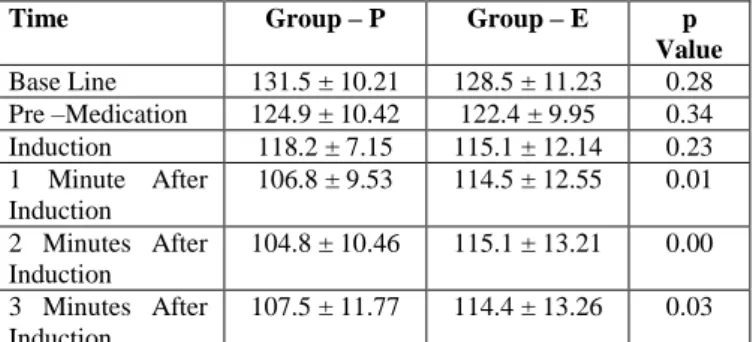
In group P there is significant fall in mean systolic blood pressure at 1st, 2nd and 3rd minute after induction when compared with induction value, the maximum fall is during 2nd minute, as shown in table 2. In group E there is no significant change in mean systolic blood pressure at 1st, 2nd and 3rd minute after induction when compared with induction value, as shown in table 2.
Table 2: Changes in Mean Systolic Blood Pressure Time
Time Group – P Group – E p Value Base Line 131.5 ± 10.21 128.5 ± 11.23 0.28 Pre –Medication 124.9 ± 10.42 122.4 ± 9.95 0.34
Induction 118.2 ± 7.15 115.1 ± 12.14 0.23
1 Minute After Induction
106.8 ± 9.53 114.5 ± 12.55 0.01
2 Minutes After Induction
104.8 ± 10.46 115.1 ± 13.21 0.00
3 Minutes After Induction
107.5 ± 11.77 114.4 ± 13.26 0.03
In group P there is significant fall in mean systolic blood pressure at 1st, 2nd and 3rd minute after induction when compared with induction value, the maximum fall is during 2nd minute, as shown in table 2. In group E there is no significant change in mean systolic blood pressure at 1st, 2nd and 3rd minute after induction when compared with induction value, as shown in table 2.
Table – 3: Changes in Mean Diastolic Blood Pressure Time
Time Group – P Group – E p Value
Base Line 84.6 ± 10.03 80.6 ± 9.17 0.112 Pre-Medication 79.2 ± 12.84 77.2 ± 10.37 0.509 Induction 74.4 ± 10.15 72.4 ± 11.23 0.472 1 Minute After
Induction
66.6 ± 9.56 71.5 ± 8.96 0.0451
2 Minutes After Induction
64.9 ± 10.71 71.9 ± 11.87 0.019
3 Minutes After Induction
G. Bharathi et al JMSCR Volume 06 Issue 10 October 2018 Page 60 In group P there is significant fall in mean diastolic
blood pressure at 1st and 2nd minute after induction when compared with induction value. In group E there is no significant fall in mean diastolic blood pressure at 1st, 2nd and 3rd minute after induction when compared with induction value, as shown in table 3
Table – 4: Changes in Mean Arterial Pressure Time
Time Group – P Group – E p-Value Base Line 100.3 ± 9.35 97.5 ± 9.50 0.254 Pre-Medication 94.3 ± 11.16 92.5 ± 9.74 0.508 Induction 88.9 ± 8.63 86.6 ± 11.08 0.373 1 Minute After
Induction
79.9 ± 9.98 85.8 ± 11.72 0.040
2 Minutes After Induction
78 ± 9.62 86.1 ± 11.79 0.005
3 Minutes After Induction
78.9 ± 10.90 85.6 ± 12.13 0.206
In group P there is significant fall in mean blood pressure at 1st, 2nd and 3rd minute after induction when compared with induction value, as shown in table 4. In group E there is no significant fall in mean blood pressure at 1st, 2nd and 3rd minute after induction when compared with induction value, as shown in table 4
Discussion
Induction of anaesthesia is one important event in the conduct of general anaesthesia. Rapid induction and haemodynamic stability in the absence of any side effects are important characteristics desired from an ideal induction agent therefore appropriate drug is chosen to maintain haemodynamic stability during induction of anesthesia. The main aim of the study was to compare the effects of etomidate and propofol for the induction of general anesthesia with reference to hemodynamic parameters, myoclonus and pain at the site of injection. Results showed that patients had no significant differences regarding their underlying variable such as sex, age and weight. Hence, the confounding effect of these variables has probably been neutralized and the results are all about the drugs. Results showed that there was a significant difference between two groups regarding SBP, DBP and mean arterial blood pressure. This study was conducted with primary objective for safety, recovery time and
complications were the secondary objectives. Equipotent doses of induction agents should be used in the comparison of hemodynamic effects. Hence taking into account the relevant literature and clinical experience we have used etomidate 0.3mg/kg and propofol 2mg/kg to do a comparative study of the hemodynamic effects of both drugs and any side effects during the 3 minutes following induction.
Propofol provides faster onset of action, antiemesis, rapid recovery, potent attenuation of upper airway reflexes and adequate depth of anaesthesia during intubation[3]. Major disadvantage of induction with propofol is decrease in systemic blood pressure and pain during injection. Etomidate is known as propofol of 70s and 80s because of its reputation for noncumulative and cardiostable properties, rapid onset with no stimulation of epileptoform properties. It provides more cardiac stability with faster onset of action and rapid recovery[5].
Effects of Heart Rate
G. Bharathi et al JMSCR Volume 06 Issue 10 October 2018 Page 61 group E, and in 8 patients among group P (16.7%)
but there was no significant difference the groups (p=0.19). Pain during injection was seen in two patients of group P. Myoclonus was not seen[9]. In our study there was decrease in mean heart rate following induction of Anaesthesia with both propofol (88.8 ± 16.64 to 80.9 ± 12.57) and etomidate (83.2 ± 11.04 to 77.3 ± 9.75). Maximum change occurred at 2 minutes with propofol and at 1 minute with etomidate, the values returning back to almost zero value in both groups. In group P there, was decrease in mean heart rate, but the decrease was not significant, this observation was similar to studies conducted in the past. They attributed it to the resetting of the baroreflex mechanism that enables a reduced Heart rate to be sustained, despite decreased arterial pressure due to propofol. The comparison of the extent of change in heart rate from level zero to post induction levels (1-3) between the two groups was insignificant at all levels. (p>0.05) (Table 6 graph 7, 8). There was no bradycardia or rhythm disturbances at any time in the two groups.
In our study we found that the heart rate was more stable in group E as compared to group P. Etomidate, maintains hemodynamic stability through preservation of both sympathetic outflow and autonomic reflexes.
Systolic and Diastolic Blood Pressures
In Arvind Kharke[8] et al, done a randomized clinical study to compare the hemodynamic effects of etomidate with propofol during induction of general anesthesia. The changes in SBP, DBP in 50 patients of ASA grade I and II of age group 18 to 60 years with etomidate 0.3mg/kg and propofol 2mg/kg. Patients in propofol group showed significant fall of systolic blood pressure, diastolic blood pressure, mean arterial blood pressure and compared to etomidate. The study concluded that etomidate is a better induction agent over propofol as it provides more hemodynamic stability and less pain of injection as compared to propofol.
In Kaushal Kabir[9] et al, done a prospective comparative study to compare cardiovascular
response to laryngoscopy and intubation after induction of anesthesia by propofol and etomidate. In 100 healthy patients of both sex aged between 18 to 45 years, ASA physical status I and II with propofol 2mg/kg and etomidate 0.3mg/kg. There was significant difference regarding systolic blood pressure, diastolic blood pressure and mean arterial blood pressure among two groups. Hypotension was seen in 18.8% of patients in group propofol after induction while none in group etomidate. This study concluded that etomidate is having more stable cardiovascular response as compared to propofol during laryngoscopy and intubation.
G. Bharathi et al JMSCR Volume 06 Issue 10 October 2018 Page 62 diastolic blood pressure from (level zero) 84.6 ±
10.03 to a maximum fall of 64.9 ± 10.71 at level 2. In group E there is no significant fall in mean diastolic pressure from 80.6 ± 9.17 to a minimal fall of 71.4 ± 12.26 at level 3. The mean diastolic blood pressure was significantly lower in group P at one minute, two minute, three minute, after induction when compared to mean diastolic blood pressure at induction. There was a maximum fall in mean diastolic blood pressure by 9.5mmHg in group P. But in group E the fall in mean diastolic blood pressure is 1.0mmHg
Our findings of variation in diastolic blood pressure are similar to that of Gauss[11] et al. The comparison of the extent of change in systolic and diastolic blood pressure variations from level zero to post induction levels (1-3) between the two groups following induction was significant (p>0.05)
Mean Arterial Pressure
Minutes, after induction there was a fall in cardiac output, mean arterial pressure[3]. In 2008 Jack and colleagues[12] conducted a study on 10 patients to know cardiovascular changes after achieving constant effect site concentration of propofol, it was observed that there was a fall in heart rate by 21%, cardiac index by 14% mean arterial pressure by 28% due to vasodilatation.Karliczek[13] et al studied etomidate-analgesic combinations for the induction of anaesthesia in 150 cardiac patients with coronary artery disease undergoing coronary revasculari-zation procedures. The aim of this study was to establish a method which the result showed in the smallest possible changes in arterial blood pressure and heart rate during the whole of the induction period, including the stressful phase of endotracheal intubation.
In 2014 Supriya Aggarwal[7] et al done comparative study between propofol and etomidate in age group 18 to 60 years in elective surgical procedure with propofol (2mg/kg) and etomidate (0.3mg/kg) as induction agent. In this study hypotension occurs with propofol is mainly due to reduction of sympathetic activity causing vasodilation or direct effect on vascular smooth muscles. The
hemodynamic stability observed with etomidate may be due to its unique lack of effect on the sympathetic nervous system and on baroreceptor functions. There was a significant difference between two groups regarding SBP, DBP, MAP this study was concluded the propofol induced hypotension is due to reduction of sympathetic activity causing vasodilation, direct effect on intracellular calcium mobilization, inhibition of prostaglandin synthesis in endothelial cells. The hemodynamic stability seen with Etomidate may be due to its lack effect on sympathetic nervous system, baroreceptor function and capacity to bind stimulation peripheral alpha2-B adrenergic receptor with a subsequent vasoconstriction. Decreases in SBP, DBP and MAP was significant in propofol group as compared to etomidate group. Kaushal et al[9] and various other studies also concluded that etomidate provides better hemodynamic stability than propofol during induction An ideal intravenous anesthetic induction agent should produce minimal cardiovascular and respiratory functions, should induce sleep in one arm brain arm circulation time, should be chemically stable ,nonirritant to the vein, non-toxic, non-allergic easy to administer and with rapid recovery properties. These hemodynamic effects were dose dependent, attributable to a decrease in sympathetic activity, direct vasodilation and myocardial depression. Concluded that etomidate could be used as a safe alternative and effective intravenous induction agent with mimimal side effects when compared to propofol . Sarkar et al[4] reported that effect of etomidate had more haemodynamic stability than propofol. This study concluded that etomidate is having more stable cardiovascular response as compared to propofol during laryngoscopy and intubation.
G. Bharathi et al JMSCR Volume 06 Issue 10 October 2018 Page 63
Adverse Effects
Patients in our study did not have any myoclonus probably because of fentanyl premedication. In our study patients in either group did not complaint of any pain or injection probably because of use of etomidate Lipuro-an advanced formulation. One patient in group E and none in group P had vomiting which was amenable to treatment. Thus our study showed that induction of anesthesia with etomidate there was insignificant fall in blood pressure. However our study group belonged to ASA I and II and did not include patients with low cardiac reserve or patients with hemodynamic instability eg. patients with shock etc. From the drug profile available etomidate should show similar hemodynamic stability even in these patients. Hence it would be interesting to determine the hemodynamic effects of etomidate in such patients who have low cardiac reserve or who are hemodynamically unstable.
Conclusion
We conclude from out study etomidate is a better alternative to propofol as an induction agent, because of hemodynamic stability and less pain on injection. However, use of appropriate premedication is required for decreasing incidence and severity of myoclonus with etomidate.
References
1. Miller RD, ed. Anesthesia, 5th ed. New York: Churchill Livingstone, 2005; 318: 1625 – 28. 2. Stoelting RK. Non-barbiturate Induction Drugs.
In Stoeiting RK editors, Pharmacology and Physiology in Anesthetic practice. 3rd edition. Philidelphia, Lippincorr Raven; 1999; 140-57. 3. J.E. Fairfield, A. Dritsas, R.J.Beale.
Hemodynamic effects of propofol. Br. J. anaesth.1991; 67: 618-620.
4. Molly Sarkar, Peter C. Laussen, David Zurakowski. Hemodynamic Responses to Etomidate on Induction of Anesthesia in Pediatric Patients. Anesth Analg 2005; 101:645–50.
5. Reves JG, Glass PSA, David L, Mathew DM. Intravenous Nonopioid Anaesthetics. In: Miller RD, editors. Miller`s Anaesthesia. New York: Elsevier Churchill Livingstone 2005.350-355. 6. Raven Singh: hemodynamic effects of
induction of anaesthesia with etomidate, thiopentone, propofol and midazolam. annals of cardiac anaesthesia,vol 13.3 sep-dec-2010. 7. Supriya Aggarwal, Vipin Kumar Goyal et al, a
comparative study between propofol and etomidate in patients under general anaesthesia. Rev Bras Anestesiol. 2016:66(3):237-241. 8. A randomized clinical study to compare the
hemodynamic effects of etomidate with propofol during induction of general anaesthesia. Khare A et al. Int. J Res Med Sci 2016 Oct.
9. Kaushal Kabir et al, Indian journal of clinical anaesthesia, 2017;4(1);41-45. A prospective study to compare cardiovascular response to laryngoscopy and intubation after induction by propofol and etomidate.
10.Mackenzie N, Grant IS. Comparison of a new emulsion formulation of propofol with methohexitone and thiopentone for induction of anaesthesia in day cases. Br J Anaesth 1985; 57:725-31.
11.A,Gauss, H. Heinrich and O.H.G. Wilder-Smith: Echo cardiograpic assessment of the hemodynamic effects of propofol- a comparison with etomidate and thiopentone. Anaesthesia 1991; 46:99-105.
12.E.S Jack, M.Shaw, J.M.Harten, K.Anderson. Cardiovascular changes after achieving constant effect site concentration of propofol. Anaesthesia. 2008; 63:116-120.