Address for correspondence Dr. Tasleem Arif.
Postgraduate Department of Dermatology, STD and leprosy, Government Medical College, Srinagar, Jammu and Kashmir, India
Email: [email protected]
Original Article
Does systemic sclerosis affect thyroid functions? A
study upholding association
Introduction
Systemic sclerosis (SS) is a connective tissue
disease of unknown etiology, characterized by
vascular abnormalities, multi-organ fibrosis and
complex immune system alterations.
1,2The
association of autoimmune disorders with each
other is a well known phenomenon, and
similarly the association of rheumatic diseases
particularly systemic sclerosis with thyroid
disorders.
3,4The immunologic basis for this
association may be because of predominant Th1
lymphokine profile in target organs of patients
with chronic autoimmune thyroid disease
5-7while both Th1 and Th2 activation is present in
SS
8,9with common Th1 factor, under the
combined action of genetic and environmental
conditions playing predominant role.
10Immune
reactions in organ-specific autoimmune diseases
may be activated to the production of antibodies
against both organ, and non-organ specific
auto-antigens.
11-14The association of SS with thyroid
fibrosis,
hypothyroidism
and
thyroid
autoimmunity has been variably reported by
several studies.
15-20Very few studies from India
and none from Kashmir have been conducted
regarding this subject. We present our study, the
first from our state, in order to uphold the
association between systemic sclerosis and
thyroid dysfunctions, and review the literature.
Tasleem Arif, Iffat Hassan, Parvaiz AnwarPostgraduate Department of Dermatology, STD and leprosy, Government Medical College, Srinagar, Jammu and Kashmir, India
Abstract
Objective To study the association of clinical and subclinical thyroid dysfunction in patients of systemic sclerosis and compare with age and sex matched controls without systemic sclerosis. Methods This hospital-based study involved 56 patients of systemic sclerosis and 300 age and sex matched controls without systemic sclerosis. Thyroid function tests, such as thyroid-stimulating hormone (TSH), free tri-iodothyronine (T3), free thyroxine (T4), were advised in all cases, and anti thyroid peroxidase (anti-TPO) antibody, thyroid gland ultrasonography and fine needle aspiration cytology in selected patients only.Results Abnormal thyroid functions were found in 37.5% cases compared to 18.7% in control group, and 26.78% of cases had hypothyroidism compared to 16.7% among the controls. 21.4% patients among cases had subclinical hypothyroidism (SCH) compared to 13.33% among controls. Conclusion Thyroid dysfunctions are common in systemic sclerosis and the same should be evaluated as routine clinical profiling of patients with systemic sclerosis.
Key words
Methods
This hospital-based study was conducted on old
and new cases of SS, visiting the dermatology
department of our hospital, a tertiary referral
centre. After thorough history and examination,
details regarding age and sex distribution,
duration and type of disease were recorded.
Thyroid function tests such as
thyroid-stimulating
hormone
(TSH),
free
tri-iodothyronine (T3), free thyroxine (T4), were
advised in all cases. Normal values for TSH, T3
and T4 were respectively taken as 0.30-5.5
µIU/mL, 60-200ng/dL, 4.5-12 µg/dL. Anti
thyroid peroxidase (anti-TPO) antibody and
thyroid gland ultrasonography (USG) were
advised in selected patients who showed
abnormal results in thyroid function tests. Fine
needle cytology (FNAC) was done in those with
visible or palpable thyroid swellings. The results
were compared with age and sex matched
controls group with similar status of iodine
intake, and having some minor dermatological
diseases generally not known to be associated
with thyroid dysfunction. At the end of study,
the data was compiled and subjected to
statistical analysis through computer software
SPSS version 16, using chi square (χ²) test, and
taking p value <0.05 as significant for
determining differences in the results.
Results
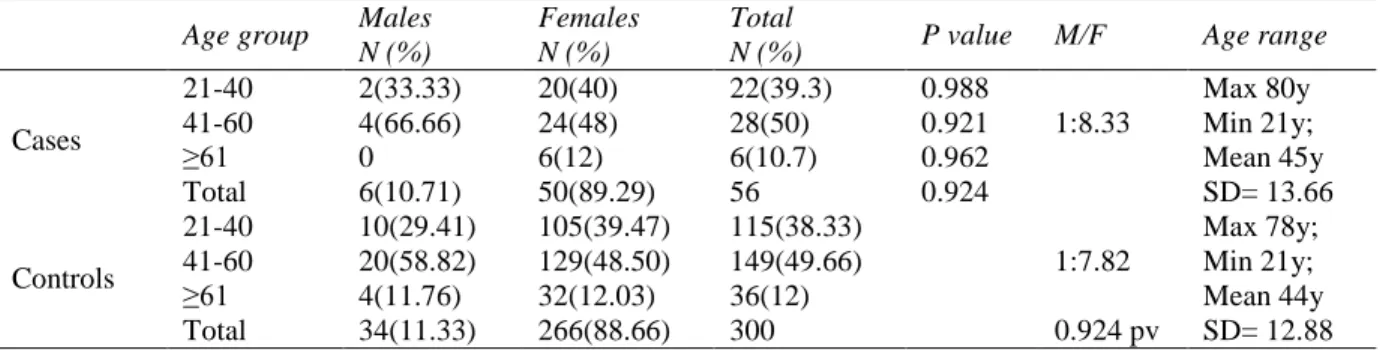
In the SS cases group [total 56 patients], there
were 6 males and 50 females with a male to
female sex ratio of 1:8.33. The age of patients
ranged from minimum 21 years to a maximum
of 80 years, with average age 45 years [SD
13.66]. 28 (50%) patients, 4 males and 24
females, were in the age group 41-60, followed
by 22 (39.3%), 2 males and 20 females, in age
group 21-40 and 6 (10.7%), all females, in the
age group >61 years. There was no patient
below 20 years of age.
In the 300 age and sex matched control group,
there were 34 males and 266 females, with a
male to female sex ratio of 1:7.82. The age in
controls ranged from minimum 21 years to
maximum 78 with average age 44 ± 12.88 years.
The age and sex variables in control group were
not statistically significant to that of cases, as
shown in
Table 1
.
Out of 56 cases of systemic sclerosis, 39
(69.6%), 6 males and 33 females, had limited
disease, and 17 (30.4%) patients, all females had
diffuse form of the disease. The duration of
disease in cases ranged from 6 months to 34
years with average disease duration of 8.76
years (SD 6.73) as shown in
Table 2
.
Among the cases, 21 (37.5%) patients, 1 male
and 20 female, had abnormality in thyroid
function tests. Subclinical hypothyroidism
(SCH) was found in 12 (21.4%) cases, 11
females
and
the
only
male
patient.
Hyperthyroidism was found in 3 (5.4%) patients,
clinical hypothyroidism and thyroiditis in 2
(3.6%) each, thyroiditis with colloid goitre and
with hypothyroidism in 1 each (1.8%), all found
in females only. One patient with thyroiditis on
USG showed homogenous texture with multiple
nodules in both lobes and isthmus, and anti-TPO
antibodies of 482 (normal <50). One patient of
thyroiditis with hypothyroidism on thyroid scan
showed residual thyroiditis with hypothyroid
state. One patient of thyroiditis with colloid
goitre showed both lobes enlarged with multiple
nodules and hypo-echoic pattern, with areas of
cystic dilatation in right lobe. The same patient
on FNAC had features of colloid goitre. Rest of
the patients had normal USG, anti- TPO
antibodies and FNAC.
Table 1 Age and sex distribution between systemic sclerosis cases and controls. Age group Males
N (%)
Females N (%)
Total
N (%) P value M/F Age range
Cases
21-40 2(33.33) 20(40) 22(39.3) 0.988
1:8.33
Max 80y Min 21y; Mean 45y SD= 13.66
41-60 4(66.66) 24(48) 28(50) 0.921
≥61 0 6(12) 6(10.7) 0.962
Total 6(10.71) 50(89.29) 56 0.924
Controls
21-40 10(29.41) 105(39.47) 115(38.33)
1:7.82
Max 78y; Min 21y; Mean 44y SD= 12.88 41-60 20(58.82) 129(48.50) 149(49.66)
≥61 4(11.76) 32(12.03) 36(12)
Total 34(11.33) 266(88.66) 300 0.924 pv
Table 2 Disease parameters of systemic sclerosis patients
Males Females Total Duration of disease
LCSS 6 33 39 (69.6)
Max 34 years; Min 6 months; Mean ±8.7582 years
DCSS 0 17 17 (30.4)
Total 6 50 56
DCSS: Diffuse cutaneous systemic sclerosis, LCSS: Limited cutaneous systemic sclerosis Table 3 Thyroid function status in cases and control group.
Cases Control
Males (n=6)
Females (n=50)
Total (n=56)
Male (n=34)
Females (n=266)
Total
(n=300) p valve
Normal 5 30 35 (62.5%) 29 215 244 (81.3%) 0.003 (S)
Abnormal
SCH 1 11 12 3 37 40 0.171
Clinical
hyperthyroidism 0 3 3 1 5 6 0.315
Clinical
hypothyroidism 0 2 2 1 9 10 0.755
Thyroiditis 0 2 2 0 0 0 0.021 (S)
Thyroiditis with
colloid goitre 0 1 1 0 0 0 0.346
Thyroiditis with
hypothyroidism 0 1 1 0 0 0 0.346
Thyroiditis with
hyperthyroidism 0 0 0 0
0
0
Total 1 20 21 (37.5%) 5 51 56 (18.7%) 0.003 (S)
SCH: Subclinical hypothyroidism.
Table 3 Thyroid function status in each type of systemic sclerosis. DCSS
(n=17)
LCSS (n=39)
Total (n=56)
p valve (DCSS vs. LCSS)
Normal 9 26 35 (62.5%) 0.499
Abnormal
SCH 3 9 12 0.331
Clinical hyperthyroidism 1 2 3 0.647
Clinical hypothyroidism 1 1 2 0.688
Thyroiditis 1 1 2 0.688
Thyroiditis with colloid goitre 1 0 1 0.802
Thyroiditis with hypothyroidism 1 0 1 0.802
Thyroiditis with hyperthyroidism 0 0 0
Total 8 13 21 (37.5%) 0.499
1/21 (4.8%) each had thyroiditis with colloid
goitre and thyroiditis with hypothyroidism. No
patient had thyroiditis with hyperthyroidism.
In the control group, 56 (18.7%) patients, 5
males and 51 females, had abnormal thyroid
function tests. SCH was found in 40 (13.3%)
patients, 3 males and 37 females. Clinical
hypothyroidism was found in 10 (3.3%), 1 male
and 9 female, and hyperthyroidism in 6 (2%), 1
male and 5 female patients. Among the
abnormal thyroid functions, SCH was found in
40/56 (71.4%), clinical hypothyroidism in 10/56
(17.9%), and 6/51 (10.7%) had hyperthyroidism.
No patient in the control group had thyroiditis of
any type. The status of thyroid functions and the
significance of difference between cases and
controls are summarized in
Table 3
.
Out of 35 (62.5%) patients with normal thyroid
functions, 9 (16.1%) had diffuse cutaneous
systemic sclerosis (DCSS) and 26 (46.4%) had
limited cutaneous systemic sclerosis (LCSS).
Among the 21 (37.5%) cases with abnormal
thyroid function, 8/21 (38.1%) had DCSS and
13/21 (61.9%) had LCSS. Out of 12 patients
with SCH, 9 had LCSS and 3 had DCSS.
Similarly out of 3 patients with hyperthyroidism,
and 2 each with hypothyroidism and thyroiditis,
LCSS was respectively found in 2, 1, 1, and
DCSS in 1 patient each. Thyroiditis with colloid
goitre and with hypothyroidism found in 1
patient each had DCSS. These results were
statistically insignificant. This is summarized in
Table 4
.
Discussion
Association between rheumatic and autoimmune
thyroid diseases has been well accepted, and
thyroid
abnormalities
[hypothyroidism,
hyperthyroidism, nodular goiter] have been
frequently described along with SS.
4SS is an
autoimmune disease and expected to be
associated with other autoimmune phenomena,
and also thyroid immune dysfunction. Thyroid
dysfunction in SS may be explained on many
lines such as production of auto-antibodies and
cell-mediated immune response with consequent
thyroid gland involvement, and cannot be
limited only to gland fibrosis.
21,22In the present study, there was a male to female
ratio of 1:8.33, with 89.3% females as compared
to 10.7% males. The female predominance of SS
is in accordance with the findings in literature.
3,23Most of the patients (89.3%) were in the age
range 21-60 years, and no patient below 20
years, in accordance with that described in
literature.
24The 56 cases were compared with 300 age and
sex matched control group. The age and sex
variables between the two groups were not
statistically significant, thereby removing any
confounding factors.
Scleroderma may occur in a localized form or as
a systemic disease. Systemic scleroderma is
subdivided by the extent of the skin involvement
into diffuse cutaneous systemic sclerosis
(DCSS) and limited cutaneous systemic sclerosis
(LCSS).
25Majority of patients in our study had
limited disease (69.6%). 37.5% cases had
abnormal thyroid functions as compared to
18.7% in controls, which was statistically
significant. This thyroid dysfunction was found
in many previous studies as well.
3,20,23among the cases, and 40 SCH and 10 clinical
hypothyroids in controls. This is similar to, but
higher than 21% in study by Antenolli et al.
3and
20% by Marasini et al.
23and contrasts with that
of Innocencio
et al.
20who found no significant
difference in hypothyroidism. The significant
difference regarding thyroid functions but no
statistically significant difference with respect to
hypothyroidism may be because of less sample
size of cases than controls. These results are
similar to a study by Innocencio et al.
20who also
found
no
significant
difference
in
hypothyroidism, and in contrast to Antenolli
et
al.
3who found more hypothyroidism (clinical
and subclinical) in cases than controls.
12/56 (21.4%) patients among cases had SCH
compared to 40/300 (13.3%) patients among
controls, almost comparable to 17% by
Antenolli
et al.
3and 17.7% by Marasini
et al.
23and contrasts with others.
2613.3% controls in
our study had hypothyroidism, compared to 6%
controls in study by Antonelli et al.
3and 5.8-8%
in other studies.
20,27Clinical hyperthyroidism was found in 3/56
(5.36%), compared to 6/300 (2%) in controls.
Low prevalence of hyperthyroidism was also
found in other studies
23,28and in contrast to
others.
3Thyroiditis, with or without colloid
goiter and/ or hypothyroidism was found in
cases only. This may be because of autoimmune
nature of the thyroid dysfunction found in
systemic sclerosis.
Among the 37.5% with abnormal thyroid
function, 8/21 (38.1%) had DCSS and 13/21
(61.9%) had LCSS, and similarly 9 LCSS and 3
DCSS patients had SCH. Also, clinical
hyperthyroidism, hypothyroidism and thyroiditis
was respectively found in 2, 1, 1 patients with
LCSS, and 1 each with DCSS. Reports of more
thyroid dysfunction in limited SS was also found
in the literature.
22These results were not
statistically significant and may be because of
more number of LCSS than DCSS. Only DCSS
showed thyroiditis with colloid goitre and with
hypothyroidism (1 patient each].
Conclusion
In conclusion, evaluation for thyroid dysfunction
in SS and its timely diagnosis is important, as
also looking for associated systemic sclerosis in
patients of thyroid dysfunction. This has a
bearing on the clinical manifestations of SS; for
example, Raynaud’s phenomenon is more
difficult to control in hypothyroid individuals,
and pulmonary hypertension can be seriously
influenced
by
hemodynamic
changes
of
hypothyroidism.
Thus,
various
evaluation
methods for detecting thyroid abnormalities
should be considered important in the clinical
profiling of SS patients.
References
1. Medsger TA Jr. Systemic sclerosis (scleroderma): clinical aspects. In: WJ Koopman, editor. Arthritis and Allied Conditions. 14th ed. Philadelphia: Lippincott Williams & Wilkins; 2001. pp. 1590-1624.
2. Black CM, Denton CP. Scleroderma and related disorders in adults and children. In: Isenberg DA, Maddison PJ, Woo P, Glass D, Breedveld FC, editors. Oxford Textbook of Rheumatology. 3rd ed. Oxford: Oxford Writing Press; 2004. pp 872-95.
3. Antonelli A, Fallahi P, Ferrari SM, Mancusi C, Giuggioli D, Colaci M et al. Incidence of thyroid disorders in systemic sclerosis: results from a longitudinal follow-up. J Clin Endocrinol Metab. 2013;98:198-202. 4. Delamer JP, Scott DL, Felix-Davies DD.
Thyroid dysfunction and rheumatic diseases. J R Soc Med. 1982;75:102-6.
6. Antonelli A, Rotondi M, Fallahi P, Romagnani P, Ferrari SM, Buonamano A et al. High levels of circulating CXC chemokine ligand 10 are associated with chronic autoimmune thyroiditis and hypothyroidism. J Clin Endocrinol Metab. 2004;89:5496-9.
7. Antonelli A, Rotondi M, Ferrari SM, Fallahi P, Romagnani P, Franceschini SS et al. Interferon-gamma inducible alpha-chemokine CXCL10 involvement in Graves’ ophthalmopathy: modulation by peroxisome proliferator-activated receptor-gamma agonists. J Clin Endocrinol Metab. 2006;91:614-20.
8. Valentini G, Baroni A, Esposito K, Naclerio C, Buommino E, Farzati A et al. Peripheral blood T lymphocytes from systemic sclerosis patients show both Th1 and Th2 activation. J Clin Immunol. 2001;21:210-17. 9. Fujii H, Shimada Y, Hasegawa M, Takehara K, Sato S. Serum levels of a Th1 chemoattractant IP-10 and Th2 chemoattractants, TARC and MDC, are elevated in patients with systemic sclerosis. J Dermatol Sci. 2004;35:43-51.
10. Romagnani S. The Th1/Th2 paradigm. Immunol Today. 1997;18:263-6.
11. Morita S, Arima T, Matsuda M. Prevalence of nonthyroid specific autoantibodies in autoimmune thyroid diseases. J Clin Endocrinol Metab. 1995;80:1203-6.
12. Chardes T, Chapal N, Bresson D, Bes C, Giudicelli V, Lefranc MP et al. The human antithyroid peroxidase autoantibody repertoire in Graves’ and Hashimoto’s autoimmune thyroid diseases. Immunogenetics. 2002;54:141-57.
13. Jasani B, Ternynck T, Lazarus JH, Phillips DI, Avrameas S, Park. Natural antibody status in patients with Hashimoto’s thyroiditis. J Clin Lab Immunol. 1999;51:9-20.
14. Saravanan P, Dayan CM. Thyroid autoantibodies. Endocrinol Metab Clin North Am. 2001;30:315-37.
15. Gordon MB, Klein I, Dekker A, Rodnan GP, Medsger TA Jr. Thyroid disease in progressive systemic sclerosis: increased frequency of glandular fibrosis and hypothyroidism. Ann Intern Med. 1981;95:431-5.
16. Serup J, Hangdrup H. Thyroid hormones in generalized scleroderma. A controlled study. Acta Dermatol Venereol. 1986;66:35-8.
17. Kahl LE, Medsger TA Jr, Klein I. Prospective evaluation of thyroid function in patients with systemic sclerosis (scleroderma). J Rheumatol. 1986;13:103-7. 18. De Keyser L, Narhi DC, Furst DE,
Huberman AK, Ross R, Clements J et al. Thyroid dysfunction in a prospectively followed series of patients with progressive systemic sclerosis. J Endocrinol Invest. 1990;13:161-9.
19. Molnar I, Balazs C, Szabo E, Czirjak L. Anti-thyroid antibodies and hypothyroidism in systemic sclerosis. J Endocrinol Invest. 1992;15:311.
20. Innocencio RM, Romaldini JH, Ward LS. Thyroid autoantibodies in autoimmune diseases. Medicina (B Aires). 2004;64:227-30.
21. Kucharz EJ. Thyroid disorders in patients with progressive systemic sclerosis: a review. Clin Rheumatol. 1993;12:159-61. 22. Gordon MB, Klein I, Dekker A, Rodnan GP,
Thomas A, Medsger TA Jr. Thyroid disease in progressive systemic sclerosis: Increased frequency of glandular fibrosis and hypothyroidism. Ann Intern Med. 1981;95:431-5.
23. Marasini B, Ferrari PA, Solaro N, Selmi C. Thyroid dysfunction in women with systemic sclerosis. Ann N Y Acad Sci. 2007;1108:305-11.
24. Zulian F. Scleroderma in children. Pediatr Clin N Am. 2005;52:521-45.
25. Davidson J, Cleary AG, Bruce C. Disorders of bone, joints and connective tissue. In: McIntosh N, Helms PJ, Smyth RL, editors. Forfar and Arneil's Textbook of Pediatrics. 6th ed. Edinburgh, New York: Churchill Livingstone; 2003. pp 1525-89.
26. Regina MI, João HR, Laura SW. Thyroid autoantibodies in autoimmune diseases. Medicina (Buenos Aires) 2004;64:227-30. 27. Molteni M, Barili M, Eisera N, Scrofani S,
Mascagni B, Zulian C et al. Anti-thyroid antibodies in Italian scleroderma patients: association of anti-thyroid peroxidase (anti-TPO) antibodies with HLA-DR15. Clin Exp Rheumatol. 1997;15:529-34.