Workplace amenities
and work environment
Application 2 Health and safety considerations for duty holders 2 What are workplace amenities and facilities? 3 Why do employees need amenities and facilities? 3 How should I use this compliance code? 4
Identifying and maintaining amenities and facilities 5
What amenities do employers need to provide? 5 Maintaining amenities and facilities 7
Amenities 8
Drinking water 8
Toilets 9
Hand washing 12
Dining facilities 14
Personal storage 17
Change rooms 17
Shower facilities 18
Amenities and facilities for special workplaces 20
Outdoor work 20
Mobile, temporary and remote work 20 Employer-provided accommodation 21
Lighting 25
Seating 27
Floors 28
Responding to emergencies 29
Emergency planning 29
First aid 30
Appendix A – The compliance framework 32
Appendix B – Consultation 33
Appendix C – Documents adopted by this
compliance code 34
Appendix D – Documents associated with this
compliance code 35
Appendix E – Amenities and facilities planning
checklist 36
WorkSafe Victoria is a trading name of the Victorian WorkCover Authority.
This publication is protected by copyright. WorkSafe encourages the free transfer, copying and printing
WorkSafe Victoria Compliance code / Workplace amenities and work environment 1
This compliance code provides practical guidance to those who have duties under the Occupational Health and Safety Act 2004 (the OHS Act) or Occupational Health and Safety Regulations 2007 (the Regulations) on how to comply with those duties or obligations.
It was made under the OHS Act and was approved by The Hon. Tim Holding MP, Minister for Finance, WorkCover and the Transport Accident Commission, on 19 September 2008.
This compliance code has been developed by WorkSafe Victoria. Representatives of employers, employees and government agencies were consulted during its preparation.
Employers, employees, self-employed persons and those with management and control of workplaces need to use the compliance code in conjunction with the Act and Regulations.
This compliance code is not mandatory. A relevant duty holder who complies with the compliance code will – to the extent the compliance code deals with their duties or obligations under the OHS Act and Regulations – be considered to have complied with their duties and obligations.
If conditions at the workplace or the way work is done raise different or additional risks not covered by the compliance code, compliance needs to be achieved by another means.
WorkSafe publishes guidance to assist with this process at worksafe.vic.gov.au. Evidence of a failure to observe a compliance code may be used as evidence in proceedings for an offence under the OHS Act or Regulations. However, a duty holder will not fail to meet their duty or obligation simply because of a failure to observe a compliance code.
A WorkSafe inspector may cite a compliance code in a direction or condition in an improvement notice or a prohibition notice as a means of achieving compliance. A health and safety representative (HSR) may cite a compliance code in a provisional improvement notice when providing directions as to how to remedy an alleged contravention of the OHS Act or Regulations.
The approval of a compliance code may be varied or revoked by the Minister. To confirm that this compliance code is current and in force, go to worksafe.vic.gov.au.
Purpose
1. This compliance code provides practical guidance to employers on how to comply with the law in relation to providing adequate facilities for employees. Section 21(1) of the Occupational Health and Safety Act 2004 (the OHS Act) requires employers to provide and maintain a working environment that is safe and without risk to employees’ health, so far as is reasonably practicable. 2. Section 21(2)(d) requires that, in meeting their duty under section 21(1),
an employer must provide, so far as is reasonably practicable, adequate facilities for the welfare of employees at any workplace under the employer’s management and control. Employers owe the same duty to independent contractors and their employees who are working at the workplace, but only for matters over which the employer has, or should have, control. 3. This compliance code provides practical guidance on how to fulfil these
duties to the extent that they relate to providing appropriate facilities for the work environment and appropriate workplace amenities for employees.
Scope
4. This compliance code covers the provision of workplace amenities and facilities for the working environment in all workplaces other than construction workplaces.
Application
5. This compliance code applies to all employers except employers of construction employees.
Health and safety considerations for duty holders
6. Providing amenities and facilities for the health, safety and welfare of employees is an important employer duty. However, it is only one part of an employer’s duty to provide and maintain a working environment that is safe and without risks to health.
7. Amenities and facilities are integral to the health, safety and welfare of employees. This compliance code addresses duties to provide amenities and facilities. It does not provide guidance on other employer duties to provide the highest reasonably practicable level of protection against risks to health and safety.
WorkSafe Victoria Compliance code / Workplace amenities and work environment 3
What are workplace amenities and facilities?
9. Workplace amenities and facilities are things provided for the health, safety, welfare and personal hygiene needs of employees. They include toilets, shelter, seating, dining rooms, change rooms, drinking water, personal storage and washing facilities. They also include work environment facilities such as workspace, temperature and air quality, lighting and flooring.
10. The provision of first aid facilities is addressed in WorkSafe’s First aid in the workplace compliance code.
Why do employees need amenities and facilities?
11. The provision of appropriate workplace amenities and facilities is important for the basic health, safety and welfare of employees.
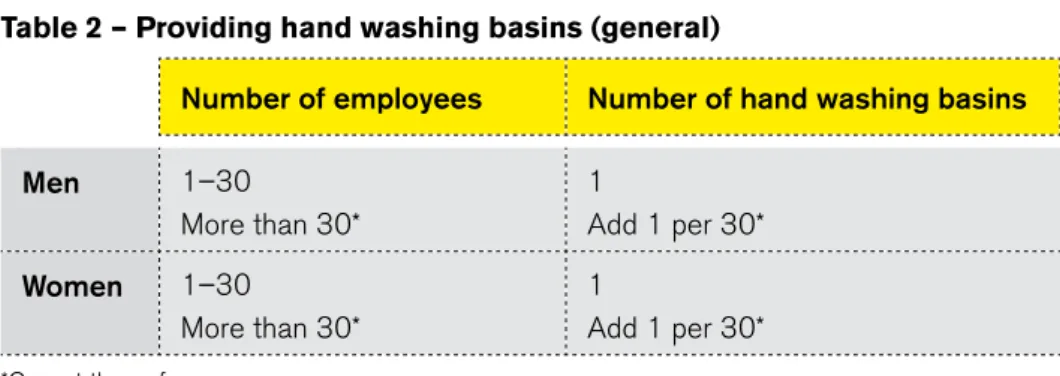
Workplace facility
or amenity
Link to employee health, safety and welfare
Drinking water For basic health and welfare. Water is essential for bodily functioning.
Toilets For basic health, welfare, privacy and dignity. Washing facilities For personal hygiene.
Dining rooms Provides a hygienic area and a place away from the work environment for rest breaks and the consumption of food. This reduces the likelihood of food being contaminated by substances used in work processes. Shelter For respite from weather (eg heat, cold, rain, wind). Seating Provides the opportunity to alternate between standing
and sitting to reduce fatigue and discomfort.
Temperature Workplace temperature ranges appropriate to the work help improve employee comfort and reduce workplace incidents and fatigue.
Workspace Enhances welfare by allowing employees a full range of movement required to do the job and to move without strain or knocking against obstructions.
Lighting Allows employees to move about easily and carry out their work safely without straining to see.
Change rooms Enables employees to change (eg uniforms or dirty work clothing) with privacy and security. Reduces employee exposure to and potential spread of contaminating substances used in work processes. Personal storage For the secure and clean storage of personal belongings
How should I use this compliance code?
12. This compliance code provides practical guidance on employer duties to provide workplace amenities and facilities. Following the guidance in the ‘How to comply’ sections of this compliance code is one reasonably practicable way to meet these duties.
13. However, compliance codes are not mandatory and employers can put in place other compliance solutions. To do this, employers should use the chapter ‘Identifying and maintaining amenities and facilities’ to identify what needs to be provided for employees and independent contractors. The amenities and facilities should be provided to the same standard as outlined in this compliance code.
WorkSafe Victoria Compliance code / Workplace amenities and work environment 5
facilities
What amenities do employers need to provide?
14. The law requires that employers must, so far as is reasonably practicable, provide adequate facilities for the welfare of employees at any workplace under their management and control. However, before they can provide adequate amenities and facilities, employers need to identify and assess the needs and requirements of their employees.
How to comply
15. Some amenities – toilets, clean drinking water, hand washing facilities and access to a clean area for eating – will be required for all workplaces. But to some extent, decisions about workplace amenities and facilities will also depend on the industry and the activities or operations carried out at those workplaces. 16. Employers need to consider the type and place of work, the composition of
their workforce, employee access, and cleaning and maintenance when working out what amenities need to be provided for employees. They also need to consult with affected employees and health and safety representatives (HSRs) and periodically review whether the amenities are meeting employee needs. Employers can also use the checklist in Appendix E of this compliance code to help them decide on amenities.
Consultation
17. Employers are required by law to consult with affected employees and HSRs, so far as is reasonably practicable, when making decisions about the adequacy of facilities for the welfare of employees.
The type of work performed
18. Employers need to understand and analyse their workplace activities. For example:
• How many employees are at the workplace? Calculating the number of
toilets and hand washing facilities will need to take account of the number of employees who usually use them at the same time.
• Does the work require physical effort that leaves employees dirty or
smelly, or exposed to infectious material or contaminants? Employees will require access to shower facilities before they leave the workplace.
• Are employees required to change out of their clothes? They will need
change rooms and appropriate personal storage.
• Is the work mostly conducted standing or sitting? Floor coverings and
• Is the work sedentary or physically active? This will affect the ideal
comfortable air temperature.
• Is the work done in shifts? Cleaning and maintenance schedules will need
to take into account the times amenities and facilities are used.
19. Employees undertaking different work within the one workplace may also have different requirements for amenities and facilities, depending on the tasks undertaken and the equipment used.
The place of work
20. Employers need to consider whether the workplace is in a building or structure, or whether work is undertaken outdoors or in a remote location away from the primary workplace of the employer – such as agency or labour hire employees. Some employees may be mobile, for example sales representatives,
tradespeople or visiting health care employees.
21. The following are some of the questions that need to be answered:
• Does the workplace cover an extensive area or is work undertaken
in a relatively compact location?
• Do employees travel between workplaces to numerous work sites
or to other locations?
• Is the workplace permanent or temporary? • Is the workplace close to appropriate facilities?
• How long would it take to access the nearest amenities and facilities
if necessary?
• Will the amenities and facilities be available at the times employees need
to use them, such as during a night shift?
• Is the means of access safe?
Composition of the workforce – the number of employees, men, women and people with special needs
22. The number of employees at the workplace will influence the size and type of amenities and facilities required.
23. Amenities and facilities need to ensure adequate privacy and security for the needs of men and women. Employers also need to ensure that the requirements of employees with special needs or disabilities are addressed in the choice and design of amenities and facilities.
Access to amenities and facilities
24. Employees need to have access to the amenities and facilities provided. 25. In most workplaces, this will mean that the facility or amenity is provided by the
employer. In some workplaces or in some circumstances, amenities and facilities may already be available. The employer also needs to ensure that employees have appropriate opportunities to use them. This could mean, for example, that:
• employees need to have breaks to use toilets
• the toilets need to be within a reasonable distance from the work area • night shift employees have the same access as employees working in the day • the means of access is safe.
WorkSafe Victoria Compliance code / Workplace amenities and work environment 7
Maintaining amenities and facilities
26. Workplace amenities need to be maintained so that they continue to meet the needs of employees. This means they need to be hygienic, safe, secure and in serviceable condition.
27. Consumable items, such as soap and toilet paper, need to be replenished regularly. Broken or damaged infrastructure and fittings (such as plumbing, airconditioning and lighting) needs to be repaired promptly. Equipment and furniture such as toasters, fridges, lockers or seating need to be maintained in good repair so that employees can use them safely.
28. Workplaces and amenities need to be cleaned regularly, usually daily. The cleaning schedule needs to take into account the requirement for hygienic maintenance of amenities such as dining areas, toilets, hand basins and showers. These amenities need to be cleaned more frequently, taking into account shift work, the type of work performed and the number of employees.
Monitoring and review
29. Employers need to periodically review their amenities and facilities, consulting the affected employees and HSRs. Reviews also need to be done when:
• work practices, equipment or workplaces are modified • more employees are engaged
• new work processes are introduced
• an incident impacting on the health, safety or welfare of employees occurs,
or
• requested by an HSR.
For information
30. As well as duties under section 21(2)(d) of the OHS Act regarding facilities for employees, employers may have duties under other legislation regarding amenities and facilities. For example, new buildings and major renovations must comply with the Building Code of Australia. It specifies, amongst other things, the number of toilets that need to be provided for employees in buildings that are used as workplaces.
31. Clean drinking water, access to toilets, hand washing facilities and a clean place to eat are amenities that are a minimum requirement for every workplace. 32. These amenities are essential for the basic health and wellbeing, personal
hygiene, dignity and welfare of employees.
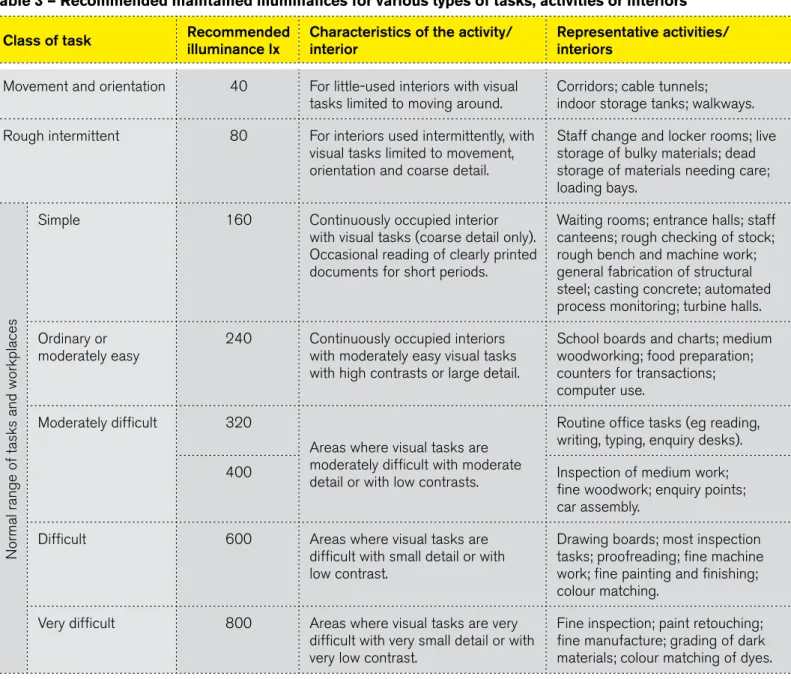
33. Additional amenities, such as showers and change rooms, will also be required in some workplaces.
Drinking water
34. Clean drinking water needs to be provided for employees at all times. Drinking enough fluids is essential for normal body functioning.
How to comply Access
35. Water needs to be:
• free of charge
• supplied so that there is one drinking point for every 40 employees
or part thereof
• situated within 30 metres of each employee or within reach of employees
who cannot leave their work task.
36. Sometimes, when workplaces are temporary, remote or mobile, employers are unable to provide drinking points for employees. Employees such as transport drivers, security personnel, park rangers and gardeners, forestry employees, sales representatives or mobile community health employees could be affected. In these cases, employers need to provide the amenity by ensuring access to public drinking water facilities, bottled water or containers for employees to take water with them.
WorkSafe Victoria Compliance code / Workplace amenities and work environment 9
Water quality
37. Drinking water needs to be clean, safe for consumption, cool and palatable.
For information
38. More information on the quality of drinking water can be found in the
Australian Drinking Water Guidelines endorsed by the National Health and Medical Research Council (nhmrc.gov.au).
Design
39. Drinking water provided by employers needs to be:
• from outlets that are separate from toilet or washing facilities
to avoid contamination
• hygienically provided by means of disposable or washable drinking
containers or delivered by a drinking fountain so that employees do not share drinking containers.
Toilets
40. All employees need to have access to clean and hygienic toilet facilities at all times.
How to comply
Number and gender ratios
41. The number of toilets required for employees depends on the number of employees, the composition of the workforce and the type of building. In some workplaces, the scheduling of employees’ breaks will also affect the number of toilets required. In most workplaces, toilets provided for employees need to be separate from those for other people, such as visitors, clients or the public. 42. Generally, separate toilets need to be provided in workplaces where there are
both male and female employees. However, one unisex toilet may be provided in workplaces with both male and female employees where:
• the total number of people who normally work at the workplace is 10 or fewer • there are two or fewer employees of one gender.
43. For example, a workplace with two male and eight female employees or with one female and three male employees could have a unisex toilet because there are 10 or fewer employees in total and two or fewer employees of one gender. A unisex toilet comprises one closet pan, one washbasin and means for the disposal of sanitary items.
44. In all other workplaces, separate toilets need to be provided in at least the following ratios:
Table 1 – Providing toilets
Number of employees (including owners and managers) Number of
closet pans Number of employees Number of urinal stations
Men 1–20
More than 20 1
Add 1 per 20*
1–10 11–25 26–50 More than 50
0 1 2
Add 1 per 50*
Women 1–15 More than 15
1
Add 1 per 15*
_ _
* Or part thereof
45. Employers need to bear in mind that these ratios are minimums. In providing toilets for employees, employers should also take into account the number of employees who are likely to require access to toilets at the same time. For example, in workplaces such as factories, where the work is continuous and employees are limited to specified times for work breaks, employers need to ensure that there are enough toilets available for the number of employees who usually need to use them at one time.
For information
46. Employers may also have duties under legislation in relation to the number of toilets provided. For example, new buildings and major renovations must comply with the Building Code of Australia. It specifies the number of toilets that need to be provided for employees in buildings that are used as workplaces.
Design
47. Toilets need to comply with authorised or approved design standards.
48. Where it is not reasonably practicable to provide access to permanent toilets, portable toilets need to be provided. Portable toilets need to be installed securely to prevent them toppling over or becoming unstable and need to be provided with a lockable door, lighting and ventilation.
WorkSafe Victoria Compliance code / Workplace amenities and work environment 11
49. Toilets need to be:
• fitted with a hinged seat and lid
• provided with adequate lighting and ventilation • clearly marked
• fitted with a hinged door capable of locking from the inside on each cubicle • designed to enable emergency access
• located separately from any other room by a soundproof wall
or by a separate entrance
• separated from any other room by an airlock.
Access
50. In most cases, employers are expected to provide toilet facilities for employees, rather than relying on access to external public toilets.
51. Toilets need to be accessible, preferably located inside a building or as close as possible to the workplace, to eliminate or reduce any risk to employee safety while accessing them. In multi-storey buildings, toilets need to be located on at least every second storey. For short-term temporary workplaces and workplaces in remote areas, a temporary toilet needs to be provided in a secure place with safe access.
52. Sometimes, when workplaces are temporary, remote or mobile, employers are unable to provide toilets for employees. In these cases employers need to provide the amenity by ensuring employees have access to other toilets, such as public toilets or toilets at client premises. Clear directions on where the toilets are located also need to be provided.
Facilities for toilets
53. Toilets provided by employers need to be equipped with:
• an adequate supply of toilet paper for each toilet
• hand washing facilities consistent with the requirements of this
compliance code
• rubbish bins
• adequate and hygienic means for disposing of sanitary items for toilets
Hand washing
54. Employees need to have access to hand washing facilities at all times. Washing hands enables employees to maintain personal hygiene and to clean the
by-products of their work from their hands before eating or leaving the workplace. 55. Employees need to wash their hands at different intervals (eg after visits to the
toilet, performing personal or health care tasks, handling animals or chemicals, or handling dirty or greasy items such as machinery).
How to comply Design
56. Hand washing facilities need to:
• be accessible at all times to the work areas, the dining room or eating areas
and the toilets
• be separate from troughs or sinks used in connection with work processes • be protected from the weather
• have an area of at least 1m2 of clear space allocated for each water outlet,
including water outlets located in areas to which a minimum size applies, such as dining rooms.
Facilities
57. Hand washing facilities need to include:
• both hot and cold water outlets or temperature mixing outlets
• non-irritating soap or other cleaning product, such as by means of a dispenser • hygienic hand drying (eg disposable paper towels and disposal facilities,
a laundered continuous cloth towel or hot air dryers for hand drying). Hand drying cloth towels cannot be shared.
Number
58. The number of hand washing basins required depends on the number of employees, the composition of the workforce, the type of building and the kind of work that is done.
WorkSafe Victoria Compliance code / Workplace amenities and work environment 13
59. In most cases, employers need to provide hand washing basins in at least the following ratios:
Table 2 – Providing hand washing basins (general)
Number of employees Number of hand washing basins Men 1–30
More than 30*
1
Add 1 per 30*
Women 1–30
More than 30*
1
Add 1 per 30*
*Or part thereof
60. Employers need to bear in mind that these requirements are minimums. In workplaces where the work is continuous and employees are limited to specified times for work breaks, employers need to ensure that there are enough hand washing basins available for the number of employees who usually need to use them at one time.
For information
61. A risk assessment may demonstrate that work processes require an increase in the number of hand washing basins depending on the work being undertaken. For example, some work activities involve exposure to infectious agents or other contaminants, which can present a risk to employees. These conditions would require the provision of hand washing facilities in addition to those provided with toilets.
62. Employers may also have legislated duties in relation to hand washing basins. Workplaces such as kitchens and health care facilities must comply with hand washing requirements under health regulations and guidelines. New buildings and major renovations must also comply with the
Dining facilities
63. Employees need to have access to hygienic facilities for preparing and eating meals while at work.
How to comply Access
64. Access to dining facilities and the types of facilities required will depend on the nature of the work and the workplace, the number of employees, the working environment, the location, any existing facilities that may be readily available and the times at which employees may be working.
65. This means that depending on the circumstances, a range of facilities and access arrangements may be appropriate, such as a shared or public facility like a canteen or cafeteria, a separate dining room, or appropriate allowance of time to access facilities for remotely located or mobile employees.
Designing dining facilities
66. A separate dining room needs to be provided where:
• 10 or more employees usually eat at a workplace at one time • the nature of the work causes a risk to the health, safety or welfare
of employees from preparing food or eating in the workplace. 67. The dining room needs to:
• be hygienic and waterproof
• be separated from any hazard (including noise, heat, atmospheric
contaminants and toilet facilities)
• be separate from any work process
• meet the temperature range requirements contained in this compliance code.
68. Dining rooms also need to allow 1m2 of clear space for each person likely
to use the dining room at one time. The clear space is calculated free of any furniture, fittings or obstructions. This means that the minimum size of a dining room for 10 employees would be 10m2, plus additional space for dining
furniture, fittings such as sinks and benches, and obstructions such as pillars. 69. A separate dining room does not have to be provided where there are nine
or fewer employees who usually eat at one time as long as there is no risk to the health, safety or welfare of employees from preparing food or eating in the workplace. However, a dining area needs to be provided that is:
• hygienic and waterproof • separated from hazards
• separated from the work process • free of tools and work materials.
70. Some employees may have access to dining facilities in a shared or public canteen or cafeteria, although the employees may work for different employers. Employers need to ensure that these dining facilities are able to accommodate all their employees who may use them and that employees can access the facilities free of charge.
WorkSafe Victoria Compliance code / Workplace amenities and work environment 15
Tables
71. A dining table (or tables) needs to be provided that allows a minimum of 600mm width by 300mm depth of table space per person.
Seating
72. Chairs or seats with back support need to be provided for each person likely to be eating at one time.
Food handling and hygiene
73. Employers need to ensure that dining facilities are equipped for ease of use and that employees are able to prepare and consume food in hygienic conditions. 74. Facilities need to be provided for washing utensils. This should be a sink and
draining board with hot and cold water, but buckets or tubs may be provided for washing when fixed facilities are not possible. Any buckets or tubs used need to be clean and kept solely for dishwashing purposes. Washing utensils and detergent also need to be provided.
75. Food warming facilities, such as a microwave oven, need to be provided. 76. Vermin and dust-proof storage needs to be provided for all food and utensils.
This needs to include a refrigerator big enough to store perishable foods for all employees using the facilities.
77. Rubbish bins or containers need to be provided for the dining facility and be emptied at least daily. Bins or containers need to be fly and vermin-proof.
Water
78. Boiling water and clean drinking water need to be provided for dining rooms and dining areas. The water supply needs to be separate from any basin used for washing hands. An appliance that provides boiling water as required is desirable, but an electric jug may be appropriate in workplaces where a small number of staff are present. At workplaces remote from a fixed room or building, the water may either be boiled on site or transported there, provided that it arrives as hot as practicable.
79. There needs to be sufficient water to supply those employees dining at one time. The water always needs to be of drinking quality.
Examples of providing dining facilities
For large permanent workplaces (10 or more employees)A separate dining room needs to be provided. The dining room needs to be hygienic, separated from the work area, separated from all hazards, protected from weather and allow 1m2 of clear space (plus extra for furnishings, fittings
and obstructions) per employee using it at any one time.
It needs to provide an appropriate number of seats and tables (of an appropriate size) as well as the appropriate crockery and cutlery. A sink, microwave,
refrigerator, hot and cold running water and clean storage for utensils and food need to be available. Washing utensils and detergent, facilities for boiling water and rubbish bins need to be provided. The room and appliances need to be cleaned regularly and rubbish removed at least daily.
For smaller permanent workplaces (nine or fewer employees) where the work poses no risk from preparing food or eating in the workplace
A separate dining area needs to be provided. It needs to be hygienic, protected from the weather and hazards, and free of tools and work materials. If a facility such as a shared or public canteen or cafeteria is accessible to employees in a building near the workplace, employers need to ensure that this facility is available to all employees free of charge.
The workplace needs to have a sink with running water and a clean storage cupboard. Some crockery and cutlery needs to be provided, as well as washing utensils and detergent, facilities for boiling water and rubbish bins. The eating area and appliances need to be cleaned regularly and rubbish removed at least daily.
Workplaces where work processes pose a risk to the health, safety and welfare of employees
In workplaces where the nature of the work causes a risk to the health, safety or welfare of employees from preparing food or eating in the workplace, a separate dining room needs to be provided, no matter how few the number of employees.
For mobile, temporary or remote workplaces
Where the work involves travelling between different workplaces or is remote or seasonal, access to dining facilities may involve organising rosters for mobile employees (such as bus drivers or couriers) to ensure that they are back at their base location for meal breaks. Alternatively, mobile employees such as sales representatives may need to use a shared or public canteen or cafeteria. Employers need to ensure these facilities are available to use free of charge. It may be appropriate for some temporary workplaces to provide portable dining facilities. Mobile caravans or transportable lunchrooms could be suitable. Employees working in remote areas, such as forestry or mining employees, may face severe constraints in accessing dining facilities. At times, the only enclosed facility available to them may be their vehicle. In this instance, portable food storage facilities may be required, such as a car fridge or insulated lunch box.
WorkSafe Victoria Compliance code / Workplace amenities and work environment 17
Personal storage
80. Secure storage needs to be provided for employees to accommodate personal property. There needs to be sufficient space to reach and use the facility. 81. Secure storage of personal property also needs to be ensured when employees
are not normally working in one workplace.
How to comply
82. Employers need to provide accessible, secure storage at the workplace for the personal property of employees that:
• enables personal items (such as handbags, jewellery, personal identification
documents, personal medication or hygiene supplies) to be stored securely while the employee is at work
• is separate from the storage facilities provided for personal protective
clothing and equipment to avoid contamination of personal property. 83. Where any work involves the use of tools provided by an employee, provision
needs to be made for the secure and weatherproof storage of those tools during non-working hours. Where the workplace is temporary or mobile, lockable containers that can be held in a safe place need to be provided. 84. Where lockers are provided, they may also serve as secure storage for other
personal items.
Change rooms
85. Employees who are required to change in and out of clothing or other apparel need to have access to private, convenient changing areas with secure storage for personal belongings.
How to comply Design
86. Employers need to ensure privacy for all the employees who are required to change at the workplace. This includes employees who:
• need to wear personal protective clothing while they are working
• are required for other reasons to wear particular clothing, such as uniforms,
while they are working
• must leave their work clothing at the workplace.
87. Employers need to provide employees with access to a dedicated changing room. If male and female employees need to change at the same time, separate male and female changing rooms need to be provided.
88. The changing room needs to allow a clear space of at least 0.5m2 for each
employee. This requirement excludes the space allocated for other facilities such as lockers.
89. The temperature in the changing room needs to be maintained at a level to enable employees to be comfortable when changing. Additional heating or cooling may be required.
Fittings
90. Changing rooms need to be equipped with:
• sufficient seating to enable the numbers of employees changing at one time
to sit when dressing or undressing
• accessible mirrors, either within the changing room or directly outside it • an adequate number of hooks.
Storage
91. Each employee needs to be provided with a locker for storing clothing and personal belongings, which needs to be:
• well ventilated, accessible and secure
• at least 300mm wide, 450mm deep and 1800m high • fitted with hooks and a coat hanger rail.
92. There also needs to be a clear space of at least 1800mm between rows of lockers facing each other and at least 900mm between lockers and a seat or a wall.
Temporary workplaces
93. Where the workplace is located away from buildings or other fixed accommodation, portable private facilities containing secure storage and seating need to be provided.
Shower facilities
94. Employees who undertake work that requires strenuous effort, leaves them dirty or smelly, or could expose them to infectious agents or other contaminants, need to have access to showers before leaving work.
How to comply Number
95. Employers need to provide at least one shower cubicle for every 10 employees who may need to shower.
96. Separate facilities need to be provided for male and female employees unless the shower facilities are capable of being secured to ensure privacy.
Design
97. Showers need to have:
• a floor area of not less than 1.8m2
• a slip-resistant surface which is capable of being sanitised
• partitions between each shower which are at least 1650mm high and
no more than 300mm above the floor
• an adjacent dressing area for each shower containing a seat and hooks • a lockable door enclosing the shower and dressing cubicle.
98. Portable shower units of the same standard need to be provided for employees working in remote or temporary locations.
WorkSafe Victoria Compliance code / Workplace amenities and work environment 19
Facilities for showers
99. Each shower needs to be provided with clean hot and cold water and individual non-irritating soap or another cleaning product.
100. If grime or other by-products of the work process cannot be removed just by washing, individual nail or scrubbing brushes need to be provided. Drying facilities such as towels need to be provided when the work necessitates employees showering before they can leave the workplace.
Access
101. All passageways to showers need to be in addition to the required shower space.
For information
102. In some workplaces, the work process involves substances that can be a contamination hazard, such as chemicals, lead, asbestos or infectious agents. In some workplaces, employers are required to provide facilities to enable employees to decontaminate themselves by showering and other means before leaving work. These additional duties are in the Regulations.
workplaces
103. Some employees undertake work in workplaces with special amenity and facility requirements.
Outdoor work
104. Outdoor employees need to have access to shelter for eating meals and taking breaks, and for protection when weather conditions become unsafe.
How to comply
105. Employers need to ensure access to shelter such as shelter sheds, caravans, tents, windbreaks or portable shade canopies. In some situations, vehicles or public facilities may provide appropriate short-term shelter.
For information
106. Prolonged exposure to UV radiation is a risk factor for skin cancer. Detailed information on protecting outdoor employees from the risk of skin cancer is in the WorkSafe Guidance Note Sun protection for construction and other outdoor workers.
Mobile, temporary and remote work
107. Many employees are required to work remotely from the employer’s primary workplace, either in other workplaces or moving between workplaces. Sales representatives, labour hire or agency employees, bus and truck drivers, visiting community welfare and health care employees, park rangers, forestry employees and security personnel are examples of employees who are mobile or are required to work remotely.
How to comply
108. Employers need to ensure that mobile and remote employees have reasonable access to amenities and facilities. For example, procedures need to be
developed that provide mobile employees with access to dining facilities, hygienic storage of food and water, and toilets. This may include ensuring arrangements are made at customers’ or suppliers’ workplaces or the provision of information regarding publicly located facilities.
WorkSafe Victoria Compliance code / Workplace amenities and work environment 21
For information
109. Information for employers on providing amenities and facilities for line haul truck drivers is in the WorkSafe Guidance Note Queuing at distribution centres – Preventing fatigue.
110. In an emergency, mobile and remote employees also need to be able to access a means of communicating that is reliable in their location, such as a satellite or mobile phone.
111. Temporary amenities and facilities, such as dining caravans or sheds, bottled water, portable toilets and mobile change rooms and storage facilities, need to be provided by employers when employees are working remotely at a single location. Temporary amenities and facilities need to be located close to where the employees are working to enable easy access.
Employer-provided accommodation
112. Employees working in regional and remote areas are often required to make use of employer-provided accommodation. Examples of these arrangements are where accommodation is provided for remote or seasonal work such as mining, hospitality, shearing or fruit picking.
How to comply
113. The accommodation needs to be separated from any hazards at the workplace likely to present a risk to the health or safety of an employee using the accommodation. The facilities also need to meet the following standards:
• the accommodation is lockable, with safe access and egress • fire safety arrangements are in place
• electrical safety standards are implemented • drinking water is available
• there are appropriate toilets, as well as washing, bathing and laundry facilities • procedures are in place to ensure cleanliness
• suitable sleeping accommodation is provided, ensuring noise is reduced
so far as is reasonably practicable
• crockery, utensils and dining facilities are available • rubbish is collected
• heating, cooling and ventilation meet the standard of workplaces • adequate lighting is available
• there are storage cupboards and other appropriate furniture • a refrigerator or cool room is provided
• the accommodation meets all relevant structural and stability requirements • the fittings, appliances and any other equipment supplied are maintained
Workspace
114. Sufficient clear space needs to be allocated to ensure employees have the full range of movement required to do the job and can move without strain or injury. 115. The space allocated for employees within a workplace needs to be appropriate
to the work performed.
How to comply Work area
116. Workplace design and layout needs to enable workstations to be accommodated in the safest configuration. Workstations need to provide clear space for
employees. The clear space needs to be exclusive of desks, benches, machinery and any other fittings. The space required needs to be based on an assessment that takes into account:
• the task
• the physical actions needed to perform the task • the need to move around while working
• whether the task is to be performed from a sitting or standing position • access to and egress from the workstation
• the equipment to be handled and personal protective equipment that
might have to be used.
117. Where relevant to their workplace, employers need to comply with the work area requirements in WorkSafe‘s Officewise, chapter 4.
118. Work processes and the ergonomics of materials or manual handling tasks may justify the clear workstation space being increased. Some work activities involve plant such as knives, and the risk of injury will be exacerbated by close working conditions. Environmental factors such as heat or noise may also require increases to the recommended size.
For information
119. Where relevant, employers also need to ensure that workplaces that are buildings comply with the space allocation in the Building Code of Australia, table D1.13 Area per person according to use. Further information on workspace can be found in WorkSafe’s Code of practice for manual handling.
WorkSafe Victoria Compliance code / Workplace amenities and work environment 23
Access ways
120. Movement in and around workstations needs to be free of obstructions such as plant, furniture, materials or other employees. Employers need to ensure that the space for employees to move and work between plant, equipment, structures and materials is at least 800mm. This is to enable employees to work safely between machines, benches or counters. It will also allow them
to evacuate quickly in an emergency.
121. Aisles, passageways and access to cupboards, storage or doors need to be in addition to the calculated clear workstation space.
Temperature
122. Workplaces that are buildings need to be capable of maintaining a temperature range that is comfortable and suitable to the work. Workplace temperatures that are too high or too low can contribute to fatigue, heat illness and cold-related medical conditions.
123. Perception of thermal comfort is affected by many factors, including air temperature, air speed, floor temperature, vertical air temperature gradient, humidity, clothing, the amount of physical exertion, radiant temperature asymmetry, mean radiant temperature (the average temperature of the surroundings) and sun penetration.
How to comply
124. The best temperature is the temperature that most people find comfortable. Optimum comfort for sedentary work is between 20°C and 26°C, depending on the time of the year and clothing worn. Employees undertaking work requiring physical exertion usually prefer a lower temperature range. 125. The means of maintaining a comfortable temperature will depend on the
working environment and the weather, and could include any of the following:
• airconditioning • fans
• electric heating • open windows • building insulation • the layout of workstations • direct sunlight control
• controlling air flow and the source of draughts • a work and rest regime.
126. All heating and cooling facilities need to be serviced regularly and maintained in a safe condition.
For information
127. In some workplaces, temperature is more than an issue of comfort and can become a hazard. Plant, humidity, ambient and radiant temperature, the level of physical activity, air movement and acclimatisation can all be factors in pushing temperatures to hazardous extremes of hot or cold. In meeting their duties to eliminate or reduce hazards and risks from extremes of temperature, employers need to consult the WorkSafe Guidance Note Heat hazards in the workplace and the publication Working in heat. Where special cold temperature requirements result from the work process, appropriate protective clothing needs to be provided.
Ventilation, air quality and airconditioning
128. Air movement throughout a workplace is necessary for the health and comfort of employees.
How to comply
129. Employers need to ensure workplaces that are buildings provide:
• natural ventilation, or
• mechanical ventilation or airconditioning which complies with AS 1668
The use of ventilation and airconditioning in buildings, where applicable.
130. Natural ventilation needs to consist of permanent openings such as windows and doors which:
• in total are the size of at least five per cent of the floor area of the room • are open to the sky, an open covered area or an appropriately ventilated
adjoining room.
131. In enclosed workplaces, employers need to ensure that comfortable rates of air movement (usually between 0.1m and 0.2m per second) are maintained.
WorkSafe Victoria Compliance code / Workplace amenities and work environment 25
For information
132. In some workplaces, ventilation and air quality are more than issues of comfort and need to be addressed by employers when working out how to eliminate or reduce risks from airborne particles. Hazardous airborne particles can result from some work processes, such as those involving biological materials, lead, asbestos or chemicals. In meeting their duties to eliminate or reduce hazards and risks from airborne particles, employers need to consult the Regulations. Employers also need to ensure that, where applicable, they comply with the requirements of the Health (Legionella) Regulations 2001 to inspect, monitor and maintain
airconditioning and warm water systems in safe order. Other information on protecting employees on the hazards of airborne particles is in the WorkSafe Guidance Note The dangers of poorly ventilated workplaces.
Lighting
133. Lighting from natural and/or artificial sources needs to be provided for employees to ensure working conditions that are appropriate to the nature of the work, the location of the work and the times at which the work is performed.
How to comply
134. If the workplace is a building, employers need to comply with the lighting specifications contained in the Building Code of Australia, part F4.2 to F4.4
Table 3 — Recommended maintained illuminances for various types of tasks, activities or interiors
Class of task Recommended illuminance lx Characteristics of the activity/interior Representative activities/interiors
Movement and orientation 40 For little-used interiors with visual tasks limited to moving around.
Corridors; cable tunnels; indoor storage tanks; walkways. Rough intermittent 80 For interiors used intermittently, with
visual tasks limited to movement, orientation and coarse detail.
Staff change and locker rooms; live storage of bulky materials; dead storage of materials needing care; loading bays.
Normal range of tasks and workplaces
Simple 160 Continuously occupied interior with visual tasks (coarse detail only). Occasional reading of clearly printed documents for short periods.
Waiting rooms; entrance halls; staff canteens; rough checking of stock; rough bench and machine work; general fabrication of structural steel; casting concrete; automated process monitoring; turbine halls. Ordinary or
moderately easy 240 Continuously occupied interiors with moderately easy visual tasks with high contrasts or large detail.
School boards and charts; medium woodworking; food preparation; counters for transactions; computer use.
Moderately difficult 320
Areas where visual tasks are moderately difficult with moderate detail or with low contrasts.
Routine office tasks (eg reading, writing, typing, enquiry desks). 400 Inspection of medium work;
fine woodwork; enquiry points; car assembly.
Difficult 600 Areas where visual tasks are difficult with small detail or with low contrast.
Drawing boards; most inspection tasks; proofreading; fine machine work; fine painting and finishing; colour matching.
Very difficult 800 Areas where visual tasks are very difficult with very small detail or with very low contrast.
Fine inspection; paint retouching; fine manufacture; grading of dark materials; colour matching of dyes.
WorkSafe Victoria Compliance code / Workplace amenities and work environment 27
135. The lighting in a workplace needs to allow employees and others to move about easily. It needs to allow them to carry out their work effectively, without adopting awkward postures or straining their eyes to see.
136. Some tasks may require local lighting in a particular area in addition to general lighting for the workplace or different lighting at different times of the day. For example, employees loading a transport vehicle outdoors will have different lighting requirements when they work at night than they will during the day. 137. Factors that employers need to consider when providing lighting include:
• the nature of the work activity
• the nature of hazards and risks in the workplace • the work environment
• illumination levels, including both natural and artificial light • transition of natural light over the day
• glare • contrast • reflections.
138. The lighting provided needs to improve the visual environment and be free from glare including reflective glare, flicker and stroboscopic effect.
Seating
139. Wherever a task can be effectively performed from a sitting position, employees need to have access to appropriate seating. Employers also need to provide appropriate seating where the work cannot be effectively performed from a sitting position, but it is possible for employees to sit from time to time. This allows the employee to vary their position between sitting and standing.
How to comply
140. The type and design of any seating supplied needs to provide suitable body support and be appropriate to the type of work being performed. Employers need to comply with:
• the seating requirements in WorkSafe’s Officewise, chapter 4
• AS 4438 Height adjustable swivel chairs
where relevant.
For information
141. Employers must also comply with the Regulations in relation to manual handling. Seating that is inappropriate for the task being performed can present a health and safety risk to employees. Employees must not be forced to adopt sustained, inappropriate or awkward body positions. Prolonged sitting may affect the trunk muscles and increase compression on the spinal discs and the incidence of lower back pain.
Floors
142. Employees who are required to undertake static standing work need to be protected from the discomfort and jarring effects of direct contact with concrete, masonry or steel floors.
How to comply
143. The choice of floor surfaces or covering will depend on the type of work undertaken, the materials used during the work process, the likelihood of spillages and the need for washing.
144. Where the nature of the work process permits its use, employers need to ensure that floor insulation is provided at workstations where employees are required to stand on concrete, masonry or steel floors. The insulation may consist of any suitable material such as carpet, cushion-backed vinyl, shock-absorbent underlay, anti-fatigue matting, grates or duckboards.
For information
145. Some floor surfaces or coverings can become hazardous in certain work situations and the selection of floor coverings needs to take the work processes into account. For example, machining of metals can produce hot scrap and requires floor sealing or surfaces safe from fire risk. Sometimes, uninsulated flooring presents a risk from electricity. The use of chemicals requires a resistant flooring material. Some work processes create hazardous floor conditions, such as spillages, (eg grease, water or body fluids or off-cuts of materials), which can create slip and trip risks. 146. Floor coverings also need to be selected for hygiene and for their lack of
resistance to push/pull forces exerted by employees on mobile equipment. Floor coverings and surfaces need to be inspected regularly and maintained to eliminate slip and trip hazards. Cleaning methods need to take account of slip potential, which may be increased by the use of some cleaning agents. 147. Worksafe’s Choosing safe floor coverings for workplaces in health and
aged care provides detailed advice on floor coverings in the health and aged care sector. Information on floor surface risk assessments and choosing suitable floor materials is also contained in AS/NZS 4663:2004
Slip resistance measurement of existing pedestrian surfaces,
AS/NZS 4586:2004 Slip resistance classification of new pedestrian surface materials and HB 197:1999 An introductory guide to the slip resistance of pedestrian surface materials.
WorkSafe Victoria Compliance code / Workplace amenities and work environment 29
Emergency planning
148. All employees need to have access to and training in a plan that clearly explains appropriate responses in case of an emergency, including the controlled movement of people from the workplace.
How to comply
Emergency management plans
149. Employers need to ensure that all workplaces under their management and control have an emergency management plan. The plan needs to be adequate to help employees deal with incidents or situations that create an emergency which could pose a threat to life, health or property. It needs to supplement action required under Victorian legislation, regulations and guidelines to prevent risks to life, health or property.
For information
150. Further information for employers:
• WorkSafe Guidance Note Emergency management – Developing
a plan for a small organisation
• AS 3745 Emergency control organisation and procedures for buildings,
structures and workplaces
• AS 4083 Planning for emergencies – Health care facilities
• AS 4485.2 Security for health care facilities – Procedures guide.
151. There are different types of emergency situations, including fire or explosion, dangerous chemical release, medical emergency, natural disaster, bomb threats, violence or robbery. The plan needs to be adequate to help employers and employees deal with incidents or situations that create an emergency that could pose a threat to life, health or property.
152. The plan needs to be based on an assessment of hazards associated with the work activity or workplace and the possible consequences of an incident occurring as a result of those hazards. External hazards may also affect the safety of the workplace (eg a chemical storage facility across the road) and need to be considered when preparing the plan. The plan needs to be appropriate to the size and complexity of the work site and the number and type of occupants.
Access to the plan
153. Employers need to ensure that the plan is written. The procedures in the plan need to be simple, clear and flexible. The plan needs to be readily obtainable by all employees or on display in the workplace (eg on a noticeboard).
For information
154. WorkSafe’s Communicating occupational health and safety across languages compliance code contains practical advice to employers in providing information to employees in languages other than English.
Training
155. Employers need to ensure that employees, managers and supervisors are instructed and trained in the procedures and regular practice runs of all relevant procedures are held.
Emergency response features and equipment
156. Employers need to comply with the relevant parts of Section E of the Building Code of Australia, which specifies requirements for emergency response features in buildings. These provisions include the requirements for fire fighting equipment, smoke hazard management and emergency lighting, exits and warnings in buildings.
For information
157. Further information for employers can be found in AS 1851.1 Maintenance of fire protection equipment – Portable fire extinguishers and fire blankets. Emergency exits
158. In workplaces that are buildings, the location of doors needs to be appropriately marked and signs need to be posted to show the direction to exit doors to aid emergency evacuation. Employers need to ensure that emergency exits in buildings comply with the requirements contained in the Building Code of Australia, part D1 Provision for escape.
Emergency access and egress
159. Employers need to ensure that paths to exits comply with the specifications in the Building Code of Australia, part D1 Provision for escape.
160. Aisles and passageways in factories, warehouses, depots and similar buildings need to be kept free of furniture or other obstructions at all times and clearly marked to enable the routes to the exits to be easily seen in the event of an emergency. For example, side boundaries can be marked by a permanent line of white, yellow or clearly contrasting colour at least 50mm wide or by glowing markers.
First aid
161. Practical guidance on appropriate first aid facilities is in WorkSafe’s First aid in the workplace compliance code.
WorkSafe Victoria Compliance code / Workplace amenities and work environment 31
Appendix A
The compliance framework
Appendix B
Consultation
Appendix C
Documents applied, adopted or incorporated by this compliance code,
in whole or in part, under section 149(2) of the Occupational Health
and Safety Act 2004 (the OHS Act)
Appendix D
Documents associated with this compliance code
Appendix E
Occupational Health and Safety Act 2004
Act No. 107/2004
The Occupational Health and Safety Act 2004 (the OHS Act) sets out the key principles, duties and rights in relation to occupational health and safety (OHS).
Occupational Health and Safety Regulations 2007 Statutory Rule No. 54/2007
The Occupational Health and Safety Regulations 2007 (the Regulations) specify the way in which a duty imposed by the OHS Act must be performed, or prescribe procedural or administrative matters to support the OHS Act (eg requiring licences for specific activities, the keeping of records or giving notice).
Compliance codes provide practical guidance to duty holders. If a person complies with a provision of a compliance code, they are deemed to comply with the OHS Act or Regulation duty covered by the code provision. However, compliance codes are not mandatory and a duty holder may choose to use some other way to achieve compliance.
WorkSafe Positions are guidelines made under section 12 of the OHS Act that state how WorkSafe will apply the OHS Act or Regulations or exercise discretion under a provision of the OHS Act or Regulations. WorkSafe Positions are intended to provide certainty to duty holders and other affected parties.
Non-statutory guidance includes information published by WorkSafe aimed at building people’s knowledge and awareness of OHS issues, risks to health and safety, and the disciplines and techniques that can be applied to manage and control risks. Non-statutory guidance is not mandatory, nor does it provide any ‘deemed to comply’ outcomes for duty holders. This guidance does, however, form part of the ‘state of knowledge’ about OHS.
WorkSafe Victoria Compliance code / Workplace amenities and work environment 33
Appendix B – Consultation
By law, employers must consult with employees on a range of matters that directly affect (or are likely to directly affect) their health and safety, so far as is reasonably practicable.
Consultation must involve sharing information with employees, giving employees a reasonable opportunity to express their views and taking those views into account. Where employees are represented by HSRs, these representatives must be involved in the consultation, so far as reasonably practicable.
The law sets out specific requirements on how HSRs are to be involved in consultation. These are as follows:
• Provide HSRs with all the information about the matter that the employer
provides, or intends to provide, to employees. If it is reasonably practicable, the information must be provided to the HSRs a reasonable time before it is provided to employees.
• Invite the HSRs to meet with the employer to consult on the matter or meet
with the HSRs at their request.
• Give the HSRs a reasonable opportunity to express their views on the matter and
take those views into account.
The employer must include independent contractors and their employees in the consultation, so far as is reasonably practicable, if the employer has, or should have, control of a relevant matter that affects their health and safety.
Consultation is required when:
• identifying or assessing hazards or risks • making decisions on how to control risks
• making decisions about the adequacy of facilities for employee welfare
(such as dining facilities, change rooms, toilets or first aid)
• making decisions about procedures to:
– resolve health and safety issues
– consult with employees on health and safety – monitor employee health and workplace conditions – provide information and training
• determining the membership of any health and safety committee in the workplace • proposing changes that may affect employee health and safety, such as changes to:
– the workplace
– plant, substances or other things used in the workplace – the work performed at the workplace
• doing any other thing prescribed by the Regulations.
In practice, this means that when planning to implement measures identified in this compliance code, or when making decisions to implement alternative measures to those specified in this compliance code, consultation must take place.
Appendix C – Documents applied, adopted or
incorporated by this compliance code, in whole
or in part, under section 149(2) of the
Occupational
Health and Safety Act 2004
(the OHS Act)
The documents or parts of documents listed below are applied, adopted or incorporated into this compliance code. This means that the documents in whole or in part as referenced form part of this compliance code.
WorkSafe publications Officewise, chapters 3 and 4
Other publications
Building Code of Australia 2007, volume 1, class 2 to class 9 buildings, parts F4.2 – 4.4 Light and ventilation
Building Code of Australia 2007, volume 1, class 2 to class 9 buildings, section E, Services and equipment
Australian standards
AS 1668.2-2002 The Use of ventilation and airconditioning in buildings
WorkSafe Victoria Compliance code / Workplace amenities and work environment 35
Appendix D – Documents associated with this
compliance code
The Australian Standards and other references listed below are not incorporated into this compliance code. This means that they do not form part of this compliance code, although they may have regulatory status in their own right. They are included only to provide an indication of sources of further information.
Regulations
Occupational Health and Safety Regulations 2007 Health (Legionella) Regulations 2001
WorkSafe publications
Code of practice for manual handling
Compliance code – Communicating occupational health and safety across languages Compliance code – First aid in the workplace
The dangers of poorly ventilated workplaces
Emergency management – Developing a plan for a small organisation Heat hazards in the workplace
Sun protection for construction and other outdoor workers Working in heat
Queuing at distribution centres – Preventing fatigue Other publications
Australian Drinking Water Guidelines, National Health and Medical Research Council
Building Code of Australia 2007, volume 1, class 2 to class 9 buildings
Choosing safe floor coverings for workplaces in health and aged care, VHIA Design Advisory Service 2005
Australian standards
AS 1851.1 Maintenance of fire protection equipment – Portable fire extinguishers and fire blankets
AS 3745 Emergency control organisation and procedures for buildings, structures and workplaces
AS 4083 Planning for emergencies – Health care facilities
AS 4485.2 Security for health care facilities – Procedures guide
AS/NZS 4586:2004: Slip resistance classification of new pedestrian surface materials
AS/NZS 4663:2004: Slip resistance measurement of existing pedestrian surfaces
Appendix E – Amenities and facilities planning checklist
Location and nature of the workplace (page 6)
P
/
O
Action to be takenIs the workplace near appropriate facilities?
Is the means of access safe?
Do all employees on all shifts have access to the facilities?
Planning amenities
Drinking water (page 8)
P
/
O
Action to be takenAre the drinking water outlets accessible to indoor employees?
Are the drinking water outlets separate from toilet and washing facilities?
Is the water hygienically provided – no shared cups or glasses?
WorkSafe Victoria Compliance code / Workplace amenities and work environment 37
Toilets (page 9)
P
/
O
Action to be takenIf the workplace has 10 or fewer employees (and two or fewer of one gender), has at least one unisex toilet been provided? If the workplace has more than 10 employees, is there at least one male toilet for every 20 men and one female toilet for every 15 women?
Are there adequate toilet facilities for employees with special needs?
Are toilets connected to the sewer or an appropriate alternative?
Are toilets clearly marked and do they have lockable doors, adequate lighting and ventilation?
Are the employee toilets separate from toilets for visitors, clients and the public?
Is there adequate toilet paper, hand washing facilities and soap, rubbish bins and sanitary disposal?
Hand washing (page 12)
P
/
O
Action to be takenAre there enough hand washing basins for men and women (taking into account the guidance on page 12 of this compliance code)? Does the nature of the work require additional hand washing facilities (taking into account exposure to dirty conditions, infectious agents, contaminants and health regulations)?
Are the hand washing facilities separate from work-related troughs or sinks, protected from weather and accessible from work areas, dining facilities and toilets?
Is there at least 1m2 of clear space per water outlet?
Is hot and cold water, soap or another cleaning product provided?
Is hygienic hand drying provided that does not involve employees sharing towels?