University of South Carolina
Scholar Commons
Theses and Dissertations
2017
Polarization Observables T and F in the yp -> pi p
Reaction
Hao Jiang
University of South Carolina
Follow this and additional works at:https://scholarcommons.sc.edu/etd Part of thePhysics Commons
This Open Access Dissertation is brought to you by Scholar Commons. It has been accepted for inclusion in Theses and Dissertations by an authorized administrator of Scholar Commons. For more information, please [email protected].
Recommended Citation
Jiang, H.(2017).Polarization Observables T and F in the yp -> pi p Reaction.(Doctoral dissertation). Retrieved from
Polarization Observables T and F in the γp→π0p Reaction
by
Hao Jiang
Bachelor of Science
Shanghai Jiaotong University 2010
Submitted in Partial Fulfillment of the Requirements
for the Degree of Doctor of Philosophy in
Physics
College of Arts and Sciences
University of South Carolina
2017
Accepted by:
Steffen Strauch, Major Professor
Chaden Djalali, Committee Member
Ralf Gothe, Committee Member
Matthias Schindler, Committee Member
Acknowledgments
This analysis has been done with the support from many people. I would like first
to thank my advisor Professor Steffen Strauch for the instruction and help in these
years. I also appreciate the support from Professor Chaden Djalali, Professor Ralf
Gothe, Professor Matthias Schindler in my doctoral committee and other people in
the Department of Physics and Astronomy at University of South Carolina. I would
also like to thank Dr. M. Dugger, Dr. N. Walford and others in the FROST group at
Jefferson Lab for their useful work. The funding support from the National Science
Foundation and other funding agencies are also appreciated. This work is supported
Abstract
The theory that describes the interaction of quarks is Quantum Chromodynamics
(QCD), but how quarks are bound inside a nucleon is not yet well understood. Pion
photoproduction experiments reveal important information about the nucleon excited
states and the dynamics of the quarks within it and thus provide a useful tool to study
QCD. Detailed information about this reaction can be obtained in experiments that
utilize polarized photon beams and polarized targets.
Pion photoproduction in theγp→π0preaction has been measured in the FROST
experiment at the Thomas Jefferson National Accelerator Facility. In this experiment
circularly polarized photons with electron-beam energies up to 3.082 GeV impinged
on a transversely polarized frozen-spin target. Final-state protons were detected in
the CEBAF Large Acceptance Spectrometer. Results of the polarization observables
T and F have been extracted. The data generally agree with predictions of present
partial wave analyses, but also show marked differences. The data will constrain
further partial wave analyses and improve the extraction of proton resonance
Table of Contents
Acknowledgments . . . ii
Abstract . . . iii
List of Tables . . . vi
List of Figures . . . viii
Chapter 1 Introduction . . . 1
1.1 Baryon Spectroscopy . . . 1
1.2 Single-Pion Photoproduction . . . 9
1.3 Formalism . . . 10
1.4 Previous Measurements and Theoretical Predictions . . . 12
Chapter 2 Experiment . . . 18
2.1 Photon Beam . . . 19
2.2 FROST Target . . . 21
2.3 CLAS Detector . . . 23
2.4 Beamline Devices . . . 27
Chapter 3 Data Analysis . . . 30
3.2 Reaction Vertex . . . 35
3.3 Particle Identification and Coincidence Time . . . 36
3.4 Corrections . . . 43
3.5 Channel Identification . . . 44
3.6 Moments of Yields . . . 47
3.7 Acceptance and Observable Extraction . . . 50
3.8 Target-Polarization Orientation . . . 54
3.9 Systematic Uncertainties . . . 56
Chapter 4 Results . . . 57
4.1 Observable T and F . . . 57
4.2 Outlook . . . 75
Chapter 5 Conclusion . . . 79
List of Tables
Table 1.1 Baryon Table for N∗ and ∆∗ . . . 5
Table 1.2 A complete list of all pseudoscalar photoproduction observables . . 11
Table 1.3 Beam-target observables in single-pion photoproduction . . . 11
Table 3.1 Raw asymmetry of the butanol-target events . . . 34
Table 3.2 Run information for the g9b experiment . . . 35
Table 3.3 z-vertex ranges for all targets . . . 36
Table 3.4 Removed TOF paddles . . . 40
Table 3.5 Missing-mass-squared fit ranges . . . 46
Table 3.6 Differences in observables from various missing-mass-squared ranges 53 Table 3.7 Systematic uncertainties for T and F . . . 56
Table 4.1 Results for kinematic bins centered from 1505 to 1565 MeV . . . . 64
Table 4.2 Results for kinematic bins centered from 1565 to 1655 MeV . . . . 65
Table 4.3 Results for kinematic bins centered from 1655 to 1715 MeV . . . . 66
Table 4.4 Results for kinematic bins centered from 1715 to 1805 MeV . . . . 67
Table 4.5 Results for kinematic bins centered from 1805 to 1865 MeV . . . . 68
Table 4.6 Results for kinematic bins centered from 1865 to 1955 MeV . . . . 69
Table 4.7 Results for kinematic bins centered from 1955 to 2015 MeV . . . . 70
Table 4.9 Results for kinematic bins centered from 2105 to 2195 MeV . . . . 72
Table 4.10 Results for kinematic bins centered from 2195 to 2315 MeV . . . . 73
List of Figures
Figure 1.1 The 20-plet with an SU(3) octet . . . 2
Figure 1.2 The 20-plet with an SU(3) decuplet . . . 3
Figure 1.3 Relation between experimental observables, baryon properties, and QCD . . . 4
Figure 1.4 Effective degrees-of-freedom in quark models . . . 4
Figure 1.5 Comparisons of results from LQCD and experiment . . . 7
Figure 1.6 Spin-identified spectrum of Nucleons and Deltas . . . 7
Figure 1.7 Predicted N resonances and the experimental spectrum . . . 8
Figure 1.8 The s-channel diagram of the single-pion photoproduction . . . . 9
Figure 1.9 Schematic of theγp→π0preaction . . . 12
Figure 1.10 The observables T, P, and H from J. Hartmann et al. . . 14
Figure 1.11 The T observable from J. R. M. Annand et al. . . 15
Figure 1.12 The F observable from J. R. M. Annand et al. . . 16
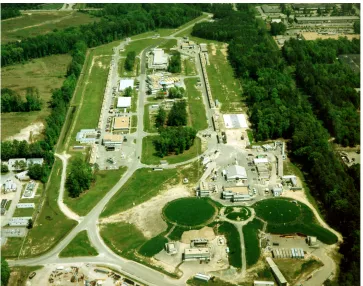
Figure 2.1 Areal view of Jefferson Lab . . . 19
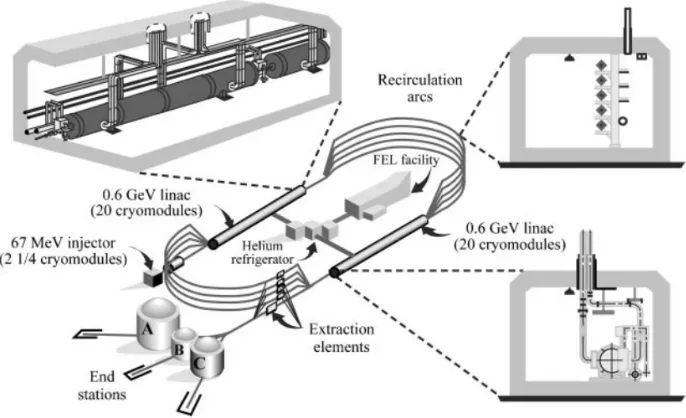
Figure 2.2 Overview of the CEBAF accelerator and experimental halls . . . 20
Figure 2.3 Overview of the Hall B photon tagger . . . 21
Figure 2.4 Sectional view of the frozen spin target . . . 22
Figure 2.5 Cycles of the operation of the frozen spin target . . . 23
Figure 2.7 Schematic view of the CLAS detector perpendicular to beam . . . 25
Figure 2.8 Magnetic field for the CLAS toroid . . . 26
Figure 2.9 The magnetic field orientation . . . 27
Figure 2.10 Drift process measured by the drift chambers . . . 28
Figure 2.11 TOF counters of the time-of-flight system . . . 28
Figure 2.12 Sketch of the start counter . . . 29
Figure 3.1 Møller measurements of the electron-beam polarization . . . 31
Figure 3.2 Target polarization orientation in the lab- and reaction frames . . 32
Figure 3.3 Target polarization of the run groups used measured by NMR . . 33
Figure 3.4 Raw asymmetry of butanol-target events . . . 34
Figure 3.5 Examples of the reconstructedz-vertex distributions of protons . 37 Figure 3.6 Raw asymmetry of observable F as a function of z . . . 38
Figure 3.7 Reconstructed (x, y)-vertex distribution of protons . . . 39
Figure 3.8 ∆tp distributions of each paddle in sector 3 for run group 2 . . . . 39
Figure 3.9 Momentum distributions of ∆tp and Edep . . . 41
Figure 3.10 Event selection cuts . . . 41
Figure 3.11 Example of the fitting ∆tc in one momentum slice . . . 42
Figure 3.12 CLAS-tagger coincidence time and proton time distribution . . . 43
Figure 3.13 Examples of missing-mass-squared distributions . . . 44
Figure 3.14 Examples of the dilution distribution for various data ranges . . . 48
Figure 3.15 Differences between observables for two consecutive data ranges . 52
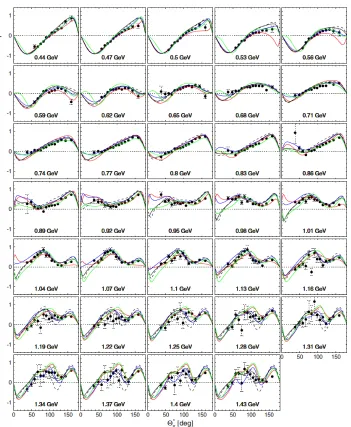
Figure 4.1 Polarization observableT from 1490 to 1790 MeV . . . 58
Figure 4.2 Polarization observableT from 1790 to 2150 MeV . . . 59
Figure 4.3 Polarization observableT from 2150 to 2510 MeV . . . 60
Figure 4.4 Polarization observableF from 1490 to 1790 MeV . . . 61
Figure 4.5 Polarization observableF from 1790 to 2150 MeV . . . 62
Figure 4.6 Polarization observableF from 2150 to 2510 MeV . . . 63
Figure 4.7 Examples of the preliminary fits from SAID . . . 76
Figure 4.8 Observable F data compared to JüBo results . . . 76
Chapter 1
Introduction
1.1 Baryon Spectroscopy
As baryons are the major components of the real world, the interests in baryons
by nuclear physicists never stop growing. Baryons are composed of three valence
quarks and any number of quark-antiquark pairs and gluons. The baryon number
of a baryon is one. Baryons are fermions with 3-quark (qqq) configurations for all
established baryons [1]. The wave function of the three-quark system is antisymmetric
under interchange of any two equal-mass quarks. It has color, space, spin, and flavor
degrees of freedom. The wave function containing the color degrees of freedom is
antisymmetric and separates out from the rest,
|qqqiA =|coloriA× |space, spin, flavoriS, (1.1)
where the subscripts S indicates symmetry and the subscripts A indicates
antisym-metry under quark interchange. All baryons can be sorted in two groups: spin-1/2
baryons and spin-3/2 baryons. For the nonstrange baryons, there are two kinds of
resonances,N∗ and ∆∗. In theSU(6)⊗O(3) symmetry, the groupSU(6) contains the
intrinsic spin group SU(2) and the internal symmetry group SU(3), containing the
light quarks flavors u, d, and s. When combined with the group of rotations in the
three-dimensional space, O(3), the result SU(6)⊗O(3) symmetry is used to describe
the structure of strongly interacting particles [2]. In theSU(3) flavor group, the
spin-1/2 baryons are categorized into a octet and the spin-3/2 baryons are categorized into
Figure 1.1 The 20-plet with an SU(3) octet. This figure is from [1].
Quantum Chromodynamics (QCD) describes the strong interactions of quarks and
gluons. QCD is a gauge field theory with the color SU(3) symmetry. Perturbative
QCD at high energies is successful. In the low-energy regime, the perturbative QCD
is not successful. The non-perturbative QCD works in the low energy regime. The
baryons at low energies are the major components of the real world. This makes
it important to study the baryons. Additionally, the study of baryons is ideal to
understand the strong interaction in the low energy regime.
The study of the excited baryon resonances reveals the strong interaction in the
quark confinement and provides complementary information on the structure of the
nucleon. The determination of the excited states, the identification of new
symme-tries, and the microscopic-level structure of states have been the objective of recent
baryon-spectroscopy experiments [3]. Baryon spectroscopy is a useful tool in the study
Figure 1.2 The 20-plet with an SU(3) decuplet. This figure is from [1].
There are several challenges of baryon spectroscopy. Most baryon states are
short-lived and have a large decay widths. This makes it difficult to identify resonances as
peak in the excitation spectrum as they are broad and overlapping.
So far, by analyzing the observables from existing measurements of pion
scatter-ing, meson-electroproduction, and meson-photoproduction, a large number of baryon
resonances and their properties, like mass, width, quantum numbers, and coupling
constants, are known. The relation between experimental observables, baryon
proper-ties, and QCD is shown in Fig. 1.3. The connection between experimental observables
and baryon resonances is the partial-wave analysis. Table 1.1 gives a list of knownN∗
and ∆∗resonances, including the corresponding total angular momentums and parity
in the format of JP. However, the number of baryon resonances detected by using
existing experimental data is less than that predicted by SU(6)⊗O(3) symmetry of
Figure 1.3 Relation between experimental observables, baryon properties, and QCD [4].
There are several quark models with different degrees-of-freedom. Three examples
of degrees-of-freedom in quark models are shown in Fig. 1.4 [4]. From left to right
there are: three equivalent constituent quarks, quark-diquark model structure, and
quark and flux-tube. The effective degrees of freedom of baryons determine the
number of excited states.
Figure 1.4 Three examples of effective degrees-of-freedom in quark models [4].
From left to right: three equivalent constituent quarks, quark-diquark structure, and quarks and flux-tubes.
Among all the quark models, the constituent quark model [5] is the most basic
one. In this model, there are three equivalent constituent quarks that determine
Table 1.1 Baryon Table for N∗ and ∆∗ from PDG 2016 [1]. Four stars indicate the existence is certain, and properties are at least fairly well explored. Three stars indicate the existence ranges from very likely to certain, but further conformation is desirable and/or quantum numbers, branching fractions, etc. are not well
determined. Two stars indicate the evidence of existence is only fair. One star indicates the evidence of existence is poor.
N∗ JP 2016 ∆∗ JP 2016
p 1/2+ **** ∆(1232) 3/2+ ****
n 1/2+ **** ∆(1600) 3/2+ ***
N(1440) 1/2+ **** ∆(1620) 1/2− ****
N(1520) 3/2− **** ∆(1700) 3/2− ****
N(1535) 1/2− **** ∆(1750) 1/2+ *
N(1650) 1/2− **** ∆(1900) 1/2− **
N(1675) 5/2− **** ∆(1905) 5/2+ ****
N(1680) 5/2+ **** ∆(1910) 1/2+ ****
N(1700) 3/2− *** ∆(1920) 3/2+ ***
N(1710) 1/2+ **** ∆(1930) 5/2− ***
N(1720) 3/2+ **** ∆(1940) 3/2− **
N(1860) 5/2+ ** ∆(1950) 7/2+ ****
N(1875) 3/2− *** ∆(2000) 5/2+ **
N(1880) 1/2+ ** ∆(2150) 1/2− *
N(1895) 1/2− ** ∆(2200) 7/2− *
N(1900) 3/2+ *** ∆(2300) 9/2+ **
N(1990) 7/2+ ** ∆(2350) 5/2− *
N(2000) 5/2+ ** ∆(2390) 7/2+ *
N(2040) 3/2+ * ∆(2400) 9/2− **
N(2060) 5/2− ** ∆(2420) 11/2+ ****
N(2100) 1/2+ * ∆(2750) 13/2− **
N(2120) 3/2− ** ∆(2950) 15/2+ **
N(2190) 7/2− ****
N(2220) 9/2+ ****
N(2250) 9/2− ****
N(2300) 9/2+ **
N(2570) 9/2− **
N(2600) 11/2− ***
N(2700) 13/2+ **
surrounded by quarks and gluons. The effective quark masses in a nucleon are the
constituent quark masses. The constituent quarks in the constituent quark model by
this model was proven to be successful as the discovered resonances were correctly
described by using this model, but the number of states predicted by this model is
more than the number observed in experiments.
Some variants were proposed afterwards and derived from three equivalent quarks
in a collective potential. For example, the flux tube model [7] was extracted from
the strong-coupling Hamiltonian lattice formulation of QCD. The interaction among
quarks was a short range residual interaction instead. In this model, the flux tubes
are considered as degrees of freedom besides the quark degrees of freedom. Because
of the additional degrees of freedom, this model predicts even more states [8].
Later, models based on other degrees-of-freedom were proposed. An example is
the quark-diquark model [9]. In this model, the diquark is bound strongly and
sup-presses its excitations in the low lying excitations of the nucleon because an attractive
hyperfine interaction between a u and d-quark in the isospin-zero channel [8]. Fewer
states are predicted in this model as there are fewer degrees of freedom at low
ener-gies, but the number of states predicted by this model is still more than the number
observed in experiments. Missing resonances are expected in symmetric but not in
diquark models.
Recently, another approach rather than quark models is developing. Lattice QCD
(LQCD), which describes the four-dimensional space as lattice of points as
regular-ization. The hardon spectrum is one of the most basic predictions of LQCD. After
30 years of development of LQCD, the algorithms and analysis techniques for light
quarks became feasible but it was still a challenging task to reach the same level
of precision for excited states [10]. An example are the computational results [11]
which observed the first excited states of the N∗ resonance from LQCD are similar
to the results from quark models. Recent comparisons of results from LQCD and
experiment are shown in Fig. 1.5. The excited states have also been calculated by
Figure 1.5 Comparisons of results from LQCD and experiment. The figure is from [12].
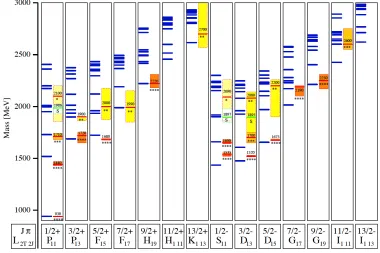
Figure 1.6 Spin-identified spectrum of Nucleons and Deltas. The figure is from
[13].
Although the list of known resonances, Table 1.1, has been updated by the PDG
group frequently, there are still many resonances missing from the SU(6)⊗O(3)
pre-dictions of the constituent quark model, especially in the mass range higher than 1.7
predicted and discovered N resonances is displayed in Fig. 1.7.
The ’missing’ resonance problem originates from the difference between the
num-ber of states predicted by the quark model and the numnum-ber observed. Resonances
may not have been observed due to a weak coupling of the missing states to the
reaction channel of the experiment or may not exist because the degrees of freedom
used in the quark model is incorrect. For example, fewer states are predicted in the
quark-diquark model as there are fewer degrees of freedom at low energies, but the
number of states predicted by this model is still more than the number observed in
ex-periments although less than the number of states predicted by the constituent quark
model. This means more studies are needed to determine the degrees of freedom in
quark models. A more completed knowledge of resonances will improve our
under-standing of the underlying symmetries and quark-quark interactions as resonances
reflect the dynamics and relevant degrees-of-freedom within hadrons.
Figure 1.7 The predicted N resonances and the spectrum discovered in
experiments. The blue lines are for the predictedN resonances and the
1.2 Single-Pion Photoproduction
There are several ways to probe the baryon excited states. To improve the
interpre-tation of the resonance spectrum confused by the missing resonances, the single-pion
photoproduction has its advantage; e.g. supporting evidence for a previously poorly
known ∆(2200)7/2− state was found in an analysis [15] that included results of a
recent measurement of the polarizedγp→π+nreaction [16]. In addition to the mass
and width values provided by the elastic pion-nucleon scattering, the single-pion
photoproduction process provides confirmations to the baryon excited states and
de-termines the amplitudes. The information about baryon resonances can be obtained
from the complex amplitudes of the single-pion photoproduction process, which can
be extracted from the observables. The measurement of double-polarization
observ-ables with a polarized target are needed in addition of the unpolarized cross section
and single-polarization observables, as they carry additional information about the
complex amplitudes which does not exist in the unpolarized cross section and
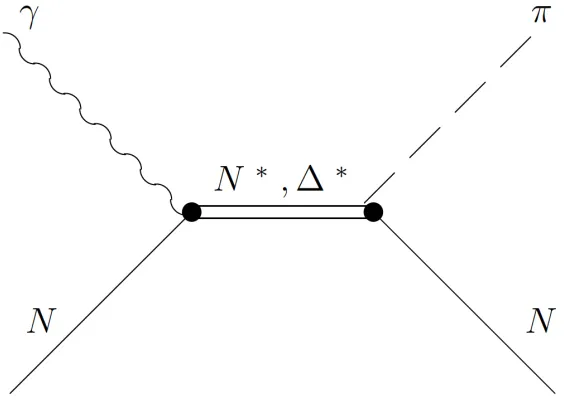
single-polarization observables. The diagram of this reaction is shown in Fig. 1.8.
Figure 1.8 The s-channel diagram of the single-pion photoproduction process with
It can be described in terms of four complex amplitudes since the product of the
number of spin states for each particle halfed by the parity conservation is four. In
the s-channel helicity representation, they are the no-flip, N, single-flip, S1 and S2,
as well as double-flip,D, amplitudes [18]. The unpolarized differential cross section,
dσ0
dΩ =|N|
2+|S
1|2+|S2|2+|D|2, (1.2)
cannot reveal the full information of the complex amplitudes.
Additional information, including phase relations, can be provided by polarization
observables. For example, in the helicity representation, the polarization observables
T and F are defined as
Tdσ0
dΩ = 2Im(S1N
∗−S
2D∗), (1.3)
and
Fdσ0
dΩ = 2Re(S2D ∗
+S1N∗). (1.4)
As polarization observables are sensitive to small amplitudes and phase differences,
they provide important constraints to reveal the dynamics and relevant
degrees-of-freedom within hadrons. In addition to the single-polarization observables (S), the
double-polarization observables are categorized into three types: beam-target (BT),
target-recoil (TR), and beam-recoil (BR) asymmetries. Since the recoil polarization
is difficult to measure for the pion-proton finalstate, the most common observables
in experiments are the single-polarization observables and the beam-target
double-polarization observables. A complete list of all pseudoscalar photoproduction
observ-ables is shown in Table 1.2.
1.3 Formalism
For the single-pion photoproduction reaction, with a polarized photon beam and a
Table 1.2 A complete list of all pseudoscalar photoproduction observables [18]
Symbol Helicity Representation Type
dσ0
dΩ |N|
2+|S
1|2+|S2|2+|D|2 S
Σdσ0dΩ 2Re(S1∗S2 −N D∗) S
Tdσ0dΩ 2Im(S1N∗−S2D∗) S
Pdσ0
dΩ 2Im(S2N
∗−S
1D∗) S
Gdσ0dΩ −2Im(S1S2∗+N D
∗) BT
Hdσ0dΩ −2Im(S1D∗−S2N∗) BT
Edσ0dΩ |N|2− |S
1|2+|S2|2− |D|2 BT
Fdσ0dΩ 2Re(S2D∗+S1N∗) BT
Oxdσ0dΩ −2Im(S1N∗+S2D∗) BR
Ozdσ0dΩ −2Im(S2S1∗+N D
∗) BR
Cxdσ0dΩ −2Re(S2N∗+S1D∗) BR
Czdσ0dΩ −|N|2− |S1|2+|S2|2 +|D|2 BR
Txdσ0dΩ 2Re(S1S2∗+N D
∗) TR
Tzdσ0dΩ 2Re(S1N∗−S2D∗) TR
Lxdσ0dΩ 2Re(S2N∗−S1D∗) TR
Lzdσ0dΩ −|N|2+|S1|2+|S2|2− |D|2 TR
Table 1.3 Beam-target observables in single-pion photoproduction
Photon
unpolarized circularly polarized linearly polarized
Target
unpolarized dσ/dΩ - Σ
longitudinally - E G
transversely T F H,P
cross section is given as [18]
dσ dΩ =
dσ0
dΩ (1−P`Σ cos(2α)
+PX[−P`Hsin(2α) +PF]
−PY [−T +P`Pcos(2α)]
−PZ[−P`Gsin(2α) +PE]) , (1.5)
where P is the right-circular beam polarization, P` is the linear beam polarization
the target polarization in the x,y, andz directions, respectively.
For experiments with circularly polarized beam and transversally polarized target,
P` = 0 and, because the z-axis is perpendicular to the target polarization, PX =
PT cos(ϕ), PY =PT sin(ϕ), andPZ = 0, Eq. (1.5) can be simplified to
dσ dΩ =
dσ0
dΩ (1 +PTT sin(ϕ) +PTPF cos(ϕ)) , (1.6)
where PT is the target polarization and ϕ the angle from the reaction plane to the
target polarization direction. The reaction is shown in Fig. 1.9.
Figure 1.9 Schematic of the γp→π0p reaction in the center-of-mass frame with
circularly polarized photon beam and transversally polarized target.
1.4 Previous Measurements and Theoretical Predictions
The research of pion photoproduction reactions started in 1970s. By the end of 1979,
the first experimental data were taken and analyzed in several research facilities, by
M. Fukushima [19], P. Feller [20], P.J. Bussey [21], and P.S.L. Booth [22]. As the
spearhead in this area, although the precision of the data analysis was limited by
immature experimental equipment and computing technology, the research in that
proton resonance properties. Moreover, the pioneers of that era have built a solid
foundation for the following research. For example, I. S. Barker, A. Donnachie, and
J. K. Storrow [18] established the formalism for the research of pion
photoproduc-tion reacphotoproduc-tions. Another important publicaphotoproduc-tion was made by D. Besset in 1979 [23].
It explaines the procedure and the necessary estimators in the data analysis of
po-larization measurements, which solved some technical problems with the data from
real-world detectors such as the nonuniform acceptance of detectors.
In 1990s, as some reasearch facilities of the new generation became operational,
the study of pion photoproduction reactions continued developing. Besides the CLAS
detector at Jefferson Lab, the Bonn Electron Stretcher Accelerator (ELSA) and the
Mainz Microtron (MAMI) are among the most advanced reasearch facilities for
pho-toproduction reactions.
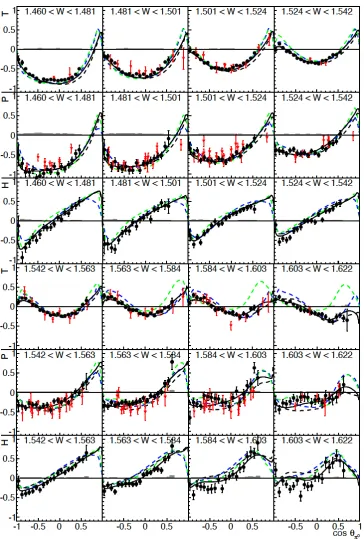
In the year of 2014, J. Hartmann et al. [24] published their experimental results
of observableT on the photoproduction of neutral pions at ELSA. Their results cover
the center-of-mass energy W range from 1.460 GeV to 1.622 GeV and are shown
in Fig. 1.10. The result from J. Hartmann et al. found no evidence for additional
structures beyond established resonances and the N(1520)3/2− helicity amplitudes
are deduced.
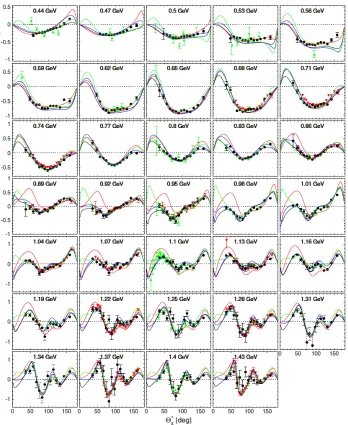
Experimental data ofT andF from MAMI were published by J. R. M. Annand et
al. [25] in 2016. The photon energies of their results are from 425 MeV to 1445 MeV
as shown in Fig. 1.11 and Fig. 1.12. The result from J. R. M. Annand et al. shows
the presence of the resonancesN(1520)3/2− and N(1680)5/2+ and their interference
with ∆(1232)3/2+, ∆(1700)3/2−, and ∆(1950)7/2+ and nonresonant background.
So far, the results of observables T and F in this analysis agree with previous
measurements in the overlapped range of energies. The major difference between the
results in this analysis and the results from previous measurements is the difference
Figure 1.11 The T observable from J. R. M. Annand et al. [25]. The data (filled circles) are compared to experimental data (triangle) and predictions from MAID (red), SAID PR15 (blue), BG2014-2 (black), and JuBo2015-B (green).
is much larger, up to 2850 MeV, compare to the photon energy of 1445 MeV from the
most recent measurement. This will make it possible for the theoretical researchers
to study the pion photoproduction of this reaction channel in a much larger energy
range.
Figure 1.12 The F observable from J. R. M. Annand et al. [25]. The data (filled circles) are compared to experimental data (triangle) and predictions from MAID (red), SAID PR15 (blue), BG2014-2 (black), and JuBo2015-B (green).
of development in recent years, the theoretical researchers in this area are also
updat-ing their fits to newer data. There are several leadupdat-ing groups focusupdat-ing on the
devel-opment of their models through partial-wave analyses of experimental data, such as
the SAID partial-wave analysis [26], Bonn-Gatchina partial-wave analysis [27], and
Jülich-Bonn group [29]. Currently, the SAID MA27 is the latest prediction for the
polarization observables T and F. The SAID predictions were frequently updated
since the SM95 solution.
The complex amplitudes that determine the pion-photoproduction reaction
re-quire eight observables to make a complete partial-wave analysis. However, the
exist-ing data consist mainly of unpolarized cross sections and sexist-ingle-polarization
observ-ables. Thus, data of double-polarization observables, especially in the energy range
that was not included in previous measurement, become useful for the partial-wave
analysis to fulfill the completeness in the determination of the pion-photoproduction
reaction.
The purpose of this work is to extract polarization observables T and F for the
single-pion photoproduction reaction in order to be used for the partial-wave analysis
to fulfill the completeness in the determination of the pion-photoproduction reaction
and study the pion photoproduction of this reaction channel in a much larger energy
range. The data will partially solve the problem of the incomplete set of required
ob-servables that determine the pion-photoproduction for further partial-wave analyses
and the extraction of proton resonance properties. The details of the methods in this
Chapter 2
Experiment
This experiment, E03-015 “Pion Photoproduction from a Polarized Target” [30], was
conducted at the Thomas Jefferson National Accelerator Facility (Jefferson Lab) [31].
As one of 17 national laboratories funded by the U.S. Department of Energy, the
primary mission of the laboratory is to conduct basic research of the atom’s nucleus
and its fundamental constituents [32]. Jefferson Lab is located in Newport News,
VA. An aerial view of the Continuous Electron Beam Accelerator Facility (CEBAF)
accelerator complex and domed, partly underground experimental Halls A, B, and C
in the foreground, is shown in Fig. 2.1.
Figure 2.2 shows a schematic overview of the CEBAF accelerator and experimental
halls. Longitudinally polarized electrons from the electron source were accelerated to
67 MeV and injected into the accelerator. The electrons were accelerated up to 6 GeV
after five accelerating passes through pairs of antiparallel 600 MeV linear accelerators
(linacs) connected by recirculation arcs and delivered to the experimental halls. The
maximum capacity of this system was to deliver highly polarized continuous-wave
beams to three experimental halls with a current of up to 200 µA. The beam had a
2.004 ns bunch structure. The facility has now been upgraded to accelerate electrons
up to 12 GeV and includes a new Hall D.
The data of the experiment for this analysis were taken as part of the g9 run group
from March 18 to August 12, 2010 using the CEBAF large acceptance spectrometer
(CLAS) in Hall B at Jefferson Lab. An overview of experimental parameters of the
Figure 2.1 Areal view of Jefferson Lab with the Continuous Electron Beam Accelerator Facility (CEBAF) and experimental halls before the 12 GeV energy upgrade. This figure is from [32].
2.1 Photon Beam
After receiving the accelerated electrons from the CEBAF accelerator, a polarized
photon beam was produced by using the bremsstrahlung technique. Figure 2.3 shows
an overview of the Hall B photon tagger [34]. Longitudinally polarized electrons
were incident on the radiator and produced circularly polarized tagged photons as
the bremsstrahlung radiation of the incoming electrons. The energy of the outgoing
photonEγ was determined from the energy of the incident electronE0 and the energy
of the electron after the bremsstrahlung reaction Ee. Neglecting the small energy
transfer to the nucleus,
Figure 2.2 Overview of the CEBAF accelerator and experimental halls. The electrons were injected and accelerated up to 6 GeV then delivered to experimental halls. This figure is from [33].
The energy of the outgoing electron was determined by a magnetic spectrometer.
Electron hits in any of 384 narrow scintillators (E-counters) determined the electron
path through the tagger magnet. The scintillators in the E-plane were partially
overlapped to increase segmentation and a photon-energy resolution of 0.001E0 were
achieved. The time of the hits were also determined in a similar way by 61 T-counters
and allowed for the determination of the start time of the events of interest. The
maximum range of the tagged photon energy was 20% to 95% of the energy of the
incoming electron beam. The size of the scintillators in the E-plane had a thickness of
4 mm, a length of 20 cm, and a width that ranged from 6 to 18 mm. The scintillators
in the T-plane were 20 mm thick and the scintillators in the E-plane were 4 mm thick.
The T-plane provided a time resolution of 300 ps.
For the circularly polarized photon beam, the polarization was determined by the
polarization of the electron beam, the energy of the electron beam, and the energy
Figure 2.3 Overview of the Hall B photon tagger. Longitudinally polarized electrons were incident on the radiator and produced circularly polarized tagged photons as bremsstrahlung radiation of the incoming electrons. This figure is from [34].
2.2 FROST Target
The FROzen Spin Target (FROST) [35] was used in the g9 experiment. It was
particularly designed for the experimental study of baryon resonances with the large
acceptance CLAS detector. Particle detection over a large polar angle up to 135◦
was permitted by the FROST target. The major components of FROST include the
polarizing magnet, the dilution refrigerator, target material, and the holding coils.
The material of the FROST target is butanol and centered at z = 0 and covered
a range of 52.7 mm along the beamline. Additional 1.5-mm thick carbon and 3.5-mm
thick polyethylene disks were mounted approximately 9 cm and 16 cm downstream
of the butanol sample. The target material (butanol) was polarized with microwaves
via Dynamic Nuclear Polarization (DNP) in the field generated by the polarizing
magnet with a maximum field of 5.1 T. The target was then cooled to a temperature
less than 50 mK without the microwaves and the polarization was maintained with
shown in Fig. 2.4.
Figure 2.4 Sectional view of the frozen spin target [35]. A, beam pipe; B, LHe
inlet; C, 3He pump port; D, 4 K pot; E, 1 K pot; F, 1 K heat exchanger; G, still; H,
vacuum chamber; I, sintered heat exchanger; J, mixing chamber; K, holding coil; L, target cup; M, target insert; N, 1 K heat shield; O, 20 K heat shield; P, beam pipe
heat shield (one of three); Q,3He pump tube; R, copper cold plate; S, waveguide; T,
precool heat exchanger.
The target polarization was measured by the Nuclear Magnetic Resonance (NMR)
measurements [35]. There were two NMR systems in the g9 experiments. The first
system was utilized during the DNP process and was tuned to 212.2 MHz. The second
system was utilized when the spin was frozen and was tuned to 21.9 MHz. The result
of the NMR measurements is discussed in Chapter 3.
When operated, the system could run continuously for a typical period of 6
months. During the full length of the running period, there were several cycles
separated by the flip of the polarization direction of the target. The flips of the
polarization direction are useful in the analysis and are explained in Sec. 3.8. A
typical cycle of operation started with the dynamic nuclear polarization process with
a maximum field of 5.1 T. After the target was polarized to approximately 90%, it
was cooled by with a 3He–4He dilution refrigerator to below 50 mK and the field
of the holding coils held the polarization of the target for several weeks until the
polarization reached approximately 70% in the g9b experiment. The cycles of the
Figure 2.5 Cycles of the operation of the frozen spin target [35]. Three full operation cycles are shown. The polarization direction of the target is flipped between two adjacent cycles.
A carbon target was placed down stream to provide bound protons to measure
the bound nucleon background of the butanol data since the butanol-target events
contain both free-proton and bound-proton events. In the g9b experiment, the carbon
target was placed approximately 9 cm downstream of the butanol target.
2.3 CLAS Detector
The CEBAF Large Acceptance Spectrometer (CLAS) [36] was based on a multigap
magnet with six super-conducting coils, symmetrically arranged to generate an
ap-proximately toroidal field distribution. The CLAS detector has been used for various
experiments including the present pion photoproduction experiment. One distinct
aspect of the CLAS detector was the large-acceptance detection with a polar-angle
range from 8◦ to 142◦. It is particularly suited in the study of reactions with low
lu-minosity (e.g., experiments using a tagged-bremsstrahlung photon beam) or reactions
with multi-particle final states. The CLAS detector had several major parts including
the torus magnet, the time-of-flight counters, the Cherenkov counters, and the drift
chambers. The schematic view of the CLAS detector can be found in Fig. 2.6. This
design made it possible to detect final-states particles in a wide angular range.
An-other schematic view of the CLAS detector cut perpendicular to the beam is shown
Figure 2.6 Schematic view of the CLAS detector, including drift chambers, Cherenkov counters, electromagnetic calorimeter, and the time-of-flight counters. These detectors cover almost the entire sphere except the very forward and backward angles along the beamline. This figure is from [37].
The purpose of the torus magnet [38] in the CLAS detector was to analyze the
momentum of the final-states particles with the tracking assistance of the drift
cham-bers. The magnetic field was generated by six coils installed around the beam line.
Each coil consisted of four layers of 54 turns of aluminum-stabilized NbTi/Cu
super-conductor and was cooled to 4.5 K by liquid helium through cooling tubes located
at the edge of the windings. The maximum current was 3860 A with a maximum
integral magnetic field of 2.5 Tm.
The contours of constant magnetic field in the midplane between two coils are
Figure 2.7 Schematic view of the CLAS detector perpendicular to beam [36]. These detectors have a large azimuthal coverage.
was set to positive, the positively charged particles were bent toward the beam axis
and the negatively charged particles were bent away from the beam axis. When the
current was set to negative, the positively charged particles were bent away from
the beam axis and the negatively charged particles were bent toward the beam axis.
In the g9 experiment, the system was running at +1920 A to moderately bend the
positively charged particles and negatively charged particles toward and away from
the beam axis, respectively, and make both positively and negatively charged particles
have large acceptances over the θlab angle.
The drift chambers [39] were used to track the final-state charged particles. In the
Figure 2.8 The magnetic field for the CLAS toroid in the midplane between two coils [36].
charged particle traveled through a drift chamber, the drift cells along its trajectory
were triggered. By aligning the triggered drift cells, the trajectory of the particle
was known. The three momentum and the charge of the particles were calculated
from the trajectory of the particle and the magnetic field. The track length and the
reaction vertex were also reconstructed by using information of particles from the
drift chambers. This process is illustrated in Fig. 2.10 [39].
The CLAS time-of-flight system [40] consisted of 57 scintillator paddles in each
of the six sectors. Each scintillator paddle was 5.08 cm thick and 15 or 22 cm wide,
with lengths from 32 cm at the most forward angle to 450 cm at larger angles. For
each scintillator paddle, two photomultiplier tubes were placed at both ends of the
scintillator paddle. The whole area of coverage was 206 m2. The view of TOF counters
in one sector is shown in Fig. 2.11 [40]. The performance of the system allowed for
particle separation by using the time-of-flight information measured for momenta up
to 2 GeV due to a time resolution of typically 150 ns.
Figure 2.9 The magnetic field orientation. Magnetic field vectors transverse to the beam in a plane centered on the target [36].
placed right outside the target. It was used to measure the start time of events. A
sketch of the start counter is shown in Fig. 2.12. Outgoing particles produced light
in the 2.2-mm thick scintillators and triggered signals in the PMTs that were coupled
to the scintillators with a light guide. The time resolution of the start counter was
350 ps. It is less than the 2.004 ns bunch structure of the beam.
2.4 Beamline Devices
To measure the electron beam position, three beam-position monitors were installed
Figure 2.10 The drift process measured by the drift chambers [39]. The drift cells of region 3 along its trajectory that triggered are drawn in dark.
Figure 2.12 Sketch of the start counter [41].
position and intensity were measured with a measurement rate of about 1 Hz. The
profile of the electron beam was also measured. Thin wires were moved through the
beam and scattered electrons were detected to reconstruct the electron beam profile.
The wires were oriented along the horizontal and vertical axes with the moving device
(harp). There were three harps installed at 36.7, 22.1, and 15.5 m upstream of the
target.
The Møller measurements [36] was used to measure the electron-beam
polariza-tion. It was installed upstream of the tagging system. To make a high-precision
measurement of the beam polarization, the asymmetry in elastic electron-electron
scattering has been measured. The scattering target was a 25-µm thick permendur
foil, magnetized with a Helmholtz-coil system. Additionally, there are two quadrupole
magnets and two detectors on both sides. The scattered electrons were detected in
coincidence to determine the reaction kinematics. The Møller measurements were
Chapter 3
Data Analysis
For theγp→π0preaction in the FROST g9b experiment with CLAS, the circularly
polarized tagged photons in the energy range from 0.62 GeV to 2.93 GeV of the
electron beam were produced by the radiator of the Hall-B Photon Tagger from
incident longitudinally-polarized electrons with energies of 3.082 GeV. The
photon-beam helicity was flipped pseudo randomly at a rate of 240 Hz or 30 Hz. The
collimated photon beam irradiated the FROST target. The nuclear spin of free
protons in the target was polarized and the target polarization direction was changed
periodically. A carbon target and a polyethylene target were used downstream of
the butanol target for background subtraction and comparison use. The final-state
protons from those targets were detected by the CLAS detector.
3.1 Beam and Target Polarizations
The circularly polarized tagged photons were produced by the Bremsstrahlung process
from incident longitudinally polarized electrons. The polarization of the photon beam
depends on the ratio between the photon energy Eγ and the electron energy E0.
Specifically, the degree of the circular polarization is expressed as [42]
P =Pe
4x−x2
4−4x+ 3x2, (3.1)
where x=Eγ/E0.
The electron-beam polarization was measured by Møller measurements [43]. The
and was found to be consistent with a constant polarization throughout the
ex-periment. The average electron-beam polarization and statistical uncertainty are
Pe = 0.873±0.006, while the systematic uncertainty of Møller measurements in Hall
B were 3% [43]. The electron-beam helicity was pseudo-randomly flipping at a rate
of 240 Hz (30 Hz for the Møller measurements). The g9b experiment ran
concur-rently with the Qweak experiment [44]. The helicity reporting was delayed. This
is common for parity-violation experiments, like Qweak, with special demanding
re-quirements on helicity-correlated beam properties. The beam helicity of a given event
was determined during initial data analysis and stored event-by-event in the event’s
header bank (HEAD): bit 29 contains the helicity bit of the event and bit 30 indicates
whether or not the helicity was correctly reconstructed [43].
Figure 3.1 The electron-beam polarization measured by the Møller measurements.
The horizontal line indicates the mean value of the six measurements.
The free protons in the butanol target were transversally polarized by dynamic
nuclear polarization and kept at low temperature [35]. The target-polarization
direc-tion was oriented at an angle ϕ0 with respect to the horizontal direction in the lab
frame (xlab) for the nominally positive polarization direction. The angle ϕ between
event from the measured azimuthal angle of the detected proton,ϕlab
p ,
ϕ=−ϕlab
π +ϕ0 =π−ϕlabp +ϕ0. (3.2)
All relevant angles are illustrated in Fig. 3.2. In this analysis a value ofϕ0 = 116.3◦±
1.4◦ was used that was determined in a moment-method analysis, see Sec. 3.8.
ylab
pπ
pp
xlab
ϕπ ϕ0
ϕp
Reaction plane
Target-polarization orientation
ϕ
x
lab
lab
Figure 3.2 Target polarization orientation in the lab- and reaction frames.
The Nuclear Magnetic Resonance (NMR) measurements provide the degree of
tar-get polarization. The tartar-get polarization values were determined by Y. Mao in [45].
The target polarization as a function of the run number is shown in Fig. 3.3. Spin
alignments along theϕ0 = 116.3◦ direction are marked with blue symbols; alignments
in the opposite direction are marked with red symbols. The target polarization
de-creased with time and the target was routinely repolarized to the opposite direction
after a number of runs. The relaxation time during g9b was about 3400 h for positive
polarization with beam and 4000 h without [35]. In this analysis it was assumed that
the magnitude of the target polarization is constant within a given run.
An experimental asymmetry signal from the butanol target was analyzed for each
Figure 3.3 The target polarization of the run groups used measured by NMR. Spin
alignments along the nominally positive direction (ϕ0 = 116.3◦) are marked with
blue symbols; alignments in the opposite direction are marked with red symbols. The change of color indicates the target was repolarized to the opposite direction.
investigate systematic uncertainties in the target polarization. The raw asymmetry
of observableF served for that purpose, Eq. (3.27) withh= 1, as detector acceptances
cancel for this observable but not for observable T. The raw asymmetry is inversely
proportional to the product of electron beam and target polarizationsPePT, Eq. (3.1)
and Eq. (3.27). For the center-of-mass energy range from W = 1.5 GeV to 1.9 GeV
and the cosθ range from−0.4 to 0.8, the average raw asymmetry is shown in Fig. 3.4
as a function of run number for the runs used in this analysis. The figure also shows
the mean values for each of the five run groups (red horizontal lines) and the mean
value over all runs (black horizontal line).
Table 3.1 gives the values for those mean values with their statistical uncertainties.
The result indicates that the raw asymmetries of all run groups are consistent with
each other within their relative uncertainties of 3% to 4%. Within that range, there is
no indication of run-group-dependent systematic uncertainties of the product PePT.
Figure 3.4 The raw asymmetry, Eq. (3.27) with h= 1, of the butanol-target events for the run groups 1 through 5 used in the analysis. The horizontal red lines
indicate the mean values for the five run groups and the black line indicates the average raw asymmetry over all runs.
Table 3.1 Raw asymmetry of the butanol-target events for the first 5 run groups.
Run group Raw Asymmetry (F)
1 0.0526±0.0021
2 0.0494±0.0018
3 0.0485±0.0019
4 0.0489±0.0015
5 0.0491±0.0016
Avg. 0.0495±0.0008
and the 4% difference of measured FROST target polarizations with two separate
NMR coils reported in [35].
The run information for all run groups is summarized and listed in Table 3.2. The
group number, the run-number range, incident electron-beam energy, the number of
events, the frequency of the helicity flip, the target polarization, and the orientation of
the target holding field [46] are given. The target magnet quenched from a power surge
10 contain only 22% of the statistics and were run with an average target polarization
that was about a factor of 0.75 smaller. Assuming everything else being equal, that
would result in statistical uncertainties of results from run groups 6 through 10 that
are about a factor 3 larger than for results of the first five run groups. On the
one hand, including the final five run groups in a combined result could improve
the statistical uncertainty by merely 6%. On the other hand, additional systematic
uncertainties could affect the final result, given that the replacement target had a
different geometry than the original one. In this analysis only the first five run
groups were used.
Table 3.2 The g9b run information for circularly polarized beam runs. Given are
the group number, the run number, incident electron-beam energy, the number of
primary events, the frequency of the helicity flip f, the target polarization and the
sign of the target polarization, and the orientation of the target holding field [46].
Group Run range Ee (GeV) Events f (Hz) Target pol. Field
1 62207 - 62289 3.082 723.1 M 240 .83 - .80 (+) (+)
2 62298 - 62372 3.082 894.9 M 240 .86 - .80 (−) (+)
3 62374 - 62464 3.082 1129.7 M 240 or 30 .79 - .75 (+) (+)
4 62504 - 62604 3.082 1307.1 M 240 .81 - .76 (−) (−)
5 62609 - 62704 3.082 972.6 M 240 or 30 .85 - .79 (+) (−)
runs not used in this analysis
6 63508 - 63525 2.266 138.2 M 943 .77 - .58 (+) (+)
7 63529 - 63542 2.266 166.8 M 240 or 943 .56 - .57 (−) (−)
8 63543 - 63564 2.266 321.7 M 943 .74 - .61 (+) (+)
9 63566 - 63581 2.266 249.6 M 943 .70 - .64 (−) (−)
10 63582 - 63598 2.266 242.3 M 240 .48 - .46 (+) (+)
3.2 Reaction Vertex
The reconstructed reaction vertex were utilized to categorize events from the butanol,
carbon, and polyethylene targets in the beamline. Two distributions of thez
coordi-nate of the reconstructed reaction vertex are shown in Fig. 3.5 for different W and
coordinate of the reconstructed reaction vertex. The z-range of the butanol target
was chosen to align with the highest average raw asymmetry from z = −3 cm to
z = 2 cm. The raw asymmetry of observable F starts to decrease beyondz = 2.0 cm
as shown in Fig. 3.6 because the fraction of events from polarized protons starts to
decrease as the reconstructed reaction vertex is approaching the end of actual target
at z = 2.5 cm. This cut helps to maintain a high average dilution factor. A wider
cut would have increased the overall statistics of the data but at the expense of a
more diluted asymmetry signal. The ranges of the appliedz-vertex cuts for the three
targets are listed in Table 3.3.
Table 3.3 Selection criteria for the three targets based on the reconstructed z
coordinate of the reaction vertex.
Target Reaction Vertex (z)
Butanol −3 cm to 2 cm
Carbon 8 cm to 11 cm
Polyethylene 14 cm to 17 cm
Following Ref. [48] additional cuts have been applied on the transverse vertex
coordinates to suppress the fraction of poorly reconstructed proton tracks. The x
coordinate andycoordinate of the reconstructed reaction vertex are shown in Fig. 3.7.
The distribution peaks at (x, y) = (−0.31 cm,−0.28 cm) and only events with a
transverse distance of less than 2 cm from that point were kept in the analysis.
3.3 Particle Identification and Coincidence Time
To identify final-state protons in coincidence with the initial-state photons, events
with one positively charged particle and zero negatively charged particles were
con-sidered.
The time-of-flight difference of the positively charged particle in each event ∆tp
Figure 3.5 Examples of the reconstructed z-vertex distributions of protons. The
main structures in the distribution are from the butanol (z ≈0), carbon (z ≈9 cm),
and polyethylene (z ≈16 cm) targets. According to the implementation of the
target geometry in Ref. [47], the structure atz ≈12.5 cm comes from the 1 K end
Figure 3.6 The raw asymmetry of observable F as a function of the reconstructed
z vertex. Events within the z-range from z =−3 cm to 2 cm were chosen for the
analysis as indicated between the red lines. The raw asymmetry is increasingly diluted for z >2 cm.
calculated from the momentum p and speed β of the particle under the assumption
that the particle was a proton with rest mass mp:
∆tp =texp−tcalc=
`SC
c
1
β −
v u u t
m2
pc2
p2 + 1
, (3.3)
where `SC is the path length from the reaction vertex to the TOF paddles and β is
determined from the time of flight and `SC. ∆tp is used to distinguish a proton from
other positively charged particles; for protons ∆tp ≈0.
The performance of all TOF paddles has been examined by checking ∆tp of each
paddle for each run group to reduce the probability of particle misidentification.
Examples are shown in Fig. 3.8. Problematic paddles were removed from the analysis
as listed in Table 3.4.
The distribution of ∆tp for positively charged particles as function of
momen-tum is shown in the left panel of Fig. 3.9. The central maximum with ∆tp ≈ 0
Figure 3.7 The reconstructed (x, y)-vertex distribution of protons. The maximum
of the distribution is at (−0.31 cm,−0.28 cm). Events within the black circle have
been selected for further analysis.
Figure 3.8 The ∆tp distributions of each paddle in sector 3 for run group 2. Paddle
Table 3.4 Paddles that were removed from the analysis for the full run range from run 62207 to 62704.
Sector Paddles
1 24, 40, 42, 43, 44
2 29, 36, 37, 39
3 23, 26, 37
4 33, 39, 40
5 23
6 —
corresponds to pions. Although most problematic TOF paddles have been removed,
timing-related issues remain visible in the distribution as narrow, almost vertical
bands at low momenta; most pronounced at about 0.5 GeV/c. These events have
signals from paddle readouts that are far smaller than the typical energy deposition
Edep in TOF paddles. The right panel of Fig. 3.9 shows the Edep distribution as a
function of particle momentum together with a momentum-dependent cut that helps
discriminating proton-candidate events with high energy deposition in the paddles
from mostly background events with a low signal in the detectors.
To select from all recorded photons the photon that led to the reaction, we also
need the CLAS-tagger coincidence time, ∆tc, which is defined as
∆tc =tv,γ−tv,p=
tγ+
z c
− tp,ST −
`ST
βc
!
, (3.4)
wheretγ is the time measured by the tagger and reported at the center of the CLAS
detector, z is the reaction vertex z coordinate, tp,ST is the proton time of the Start
Counter (ST) subsystem, and`ST is the path length of the proton from the reaction
vertex to the ST subsystem hit position. The distribution of ∆tcis shown as function
of momentum in the left panel of Fig. 3.10. The central maximum at ∆tc≈0 includes
true coincidences between the tagged photon and the event in the CLAS detector.
Side peaks are random coincidences. As previously in Fig. 3.9, the distribution of
Figure 3.9 ∆tp distribution for positively charged particles in CLAS after removing the TOF paddels of Table 3.4 (left panel). Remaining timing issues are visible in the almost vertical stripes at low momenta. The right panel shows the
measured energy deposition Edep in the TOF paddles as a function of particle
momentum along with a momentum-dependent cut on that helps suppressing background events with small signals in the detectors.
Figure 3.10 The left panel shows the CLAS-tagger coincidence time ∆tc with a
shift at low momentum due to large energy loss of low-energy protons. The
selection of coincident events is shown in red. The right panel shows the ∆tp
distribution for positively charged particles in CLAS after applying the momentum
dependent cut onEdep. Events between the red curves were selected as protons in
the momentum-dependent Edep cut that effectively suppresses the background from
misidentified particles. The ∆tc and ∆tp distributions are slightly asymmetric at low
momenta due to the large energy loss of low-momentum protons. Event selections
were made in either case with complex momentum-dependent cuts. The ∆tcand ∆tp
distributions were sliced in 0.2-GeV/c wide momentum bins and fitted with gaussian
distributions. The cut limits in the center of each momentum bin were chosen as
±2σ off the distribution’s maximum. An example of a gaussian fit to ∆tc data for
one slice in momentum between 1.4 GeV/c and 1.6 GeV/c is shown in Figure 3.11.
Figure 3.11 An example of the fitting in one momentum slice for the complex ∆tc
selection cut. It shows the gaussian fit of the ∆tc distribution in the momentum
range from 1.4 GeV/c to 1.6 GeV/c.
Figure 3.12 shows the integrated ∆tc and ∆tp distributions for various selection
criteria: for the raw data, after applying the momentum dependent ∆tp and ∆tccuts,
Figure 3.12 The left panel shows the CLAS-tagger coincidence time distribution for various selection criteria. The right panel shows the time distribution of proton candidates for various selection criteria.
reaction close to Mπ20. After the reaction-channel selection with a missing mass cut,
the background from random coincidences appears to be less than 2% based on the
yields in the true and random coincidence peaks. Proton misidentification appears
to be negligible.
3.4 Corrections
The standard eloss package [47] was utilized to determine from the measured
momen-tum the momenmomen-tum of the protons at the reaction vertex in the target. The correction
accounts for energy losses in the target material, target wall, carbon cylinder, and
start counter. Additionally, momentum corrections were applied to the detected
pro-tons following the procedure of CLAS Note 2013-011, “Momentum corrections forπ+
and protons in g9b data” [49]. These momentum corrections make an attempt to
correct errors in the momentum determination that may be caused by drift-chamber
) 4 /c 2 (GeV X 2 M 0.4
− −0.2 0.0 0.2 0.4
Events
0 1000 2000 3000
Missing Mass Squared W = 1.565 GeV
) = -0.45
π θ
cos( 0.01
±
h = 0.57
Missing Mass Squared
) 4 /c 2 (GeV X 2 M 0.4
− −0.2 0.0 0.2 0.4
Events
0 500 1000
Missing Mass Squared W = 1.715 GeV
) = 0.25
π θ
cos( 0.01
±
h = 0.48
Missing Mass Squared
) 4 /c 2 (GeV X 2 M 0.4
− −0.2 0.0 0.2 0.4
Events
0 100 200 300
W = 1.895 GeV ) = -0.15
π θ
cos( 0.02
±
h = 0.57
) 4 /c 2 (GeV X 2 M 0.4
− −0.2 0.0 0.2 0.4
Events 0 20 40 60 80
W = 2.225 GeV ) = 0.55
π θ
cos( 0.03
±
h = 0.35
Figure 3.13 Examples of missing-mass-squared distributions from butanol-target
(black histograms) and carbon-target data (gray histograms). The solid red and green curves are fits to the butanol and carbon data, respectively. The scaled carbon-data fit is shown as red dashed curve and the scaled carbon distribution as
green histogram. Also indicated are the dilution factorsh.
3.5 Channel Identification
The channel identification process was based on individual kinematic bins. The data
were binned in W from 1.49 GeV to 2.51 GeV with a bin size of 0.03 GeV and in
cosine of the center-of-mass angle, cosθcm
π , from −1 to 1 with a bin size of 0.1. The
missing-mass-squared distributions in the γp→pX reaction from both butanol and
carbon targets were accumulated for each bin. Figure 3.13 shows four examples of
missing-mass distributions for various energy and angular bins.
The black histograms show data from the butanol target and the gray histograms,
with much smaller statistics, show data from the carbon target. The central peaks
at M2
X = m2π0 ≈ 0.018 GeV2/c4 above a broad background correspond to events
from the γp → π0p reaction off free protons in the butanol target. To determine
the bound-nucleon background in the missing-mass-squared distributions from the
butanol target, a composite fit was applied to each distribution. For each bin, the
carbon-target distribution was described with a cubic splinep3(x) with four nodes and
the butanol-target distribution was described by the same spline function multiplied
by a scale factor for the bound-nucleon background and a gaussian function for the
free-proton events of the expected reaction channel. The fit functions that described
the signal,S(x), the carbon-target,C(x), and the butanol-target,B(x), distributions
are
S(x) = Y0exp −
(x−M02)2 2σ2
!
, (3.5)
C(x) = p3(x;x1, y1, x2, y2, x3, y3, x4, y4, b2, e2), and (3.6)
B(x) = κC(x) +S(x). (3.7)
The signal parameters Y0,M02, andσ, the parameters of the spline functionxi,yi,
and the second derivative at the first and last nodes, b2 and e2, respectively, as well
as the scale factorκ were determined by simultaneous fits to the carbon and butanol
distributions. The quantity
χ2MLE = 2
X
i
[B(Mi2)−NiB·logB(Mi2)] +X j
[C(Mi2)−NjC ·logC(Mj2)]
(3.8)
was minimized in the fits. It is the sum of the negative logarithm of the likelihood
function for Poisson-distributed butanol and carbon data. Those functions introduce
the least bias in the estimation of the parameters [50]. The first sum in Eq. (3.8) runs
over all bins in the butanol missing-mass-squared distribution within a specified fit
range, listed in Table 3.5, and the second sum runs similarly over bins in the
carbon-data histograms. NB
k and NkC are the number of events in the bins of the butanol
and carbon histogram at a missing-mass-squaredM2
k. The minimization of Eq. (3.8)
![Fig ur e 1 .1T he 2 0 - ple t w it h a n S U( 3 ) o c t e t . T his fig ur e is f r o m [1 ].](https://thumb-us.123doks.com/thumbv2/123dok_us/8383352.1384810/13.612.150.467.81.342/fig-t-ple-s-u-t-g-ur.webp)
![Fig ur e 1 .2T he 2 0 - ple t w it h a n S U( 3 ) de c uple t . T his fig ur e is f r o m [1 ].](https://thumb-us.123doks.com/thumbv2/123dok_us/8383352.1384810/14.612.148.470.74.355/fig-ur-t-ple-s-u-uple-g.webp)
![Fig ur e 1 .6Spin- ide nt ifie d s pe c t r um o f Nuc le o ns a nd D e lt a s . T he fig ur e is f r o m[1 3 ].](https://thumb-us.123doks.com/thumbv2/123dok_us/8383352.1384810/18.612.131.480.74.295/fig-spin-ide-ie-nuc-g-ur-is.webp)