A contemporary reference framework
Working paper
Ralf Wagner
August 11, 2013
Abstract
The Internet is becoming more and more important for businesses. A practical reference framework of Internet business models can help companies to be successful in the Internet. Ideally such a reference framework is able to structure the Internet market into different seg-ments and supports businesses in practically developing their business models. This paper shows that existing classifications of Internet business models have some shortcomings in both respects and offers a new classification which tries to avoid these shortcomings. The new reference framework defines five basic business models which are mutually exclusive and which can be combined with a practical schematic of business model elements. Thus, this ref-erence framework can be easily applied in practice in analyzing and developing business models in today‘s Internet.
Keywords: Internet, business model, E-Commerce, social networks, content
1
Introduction: Need for a contemporary reference
framework
The Internet is growing at a fast pace. In June 2013 about 2.5 billion people had access to it.1
With the increasing number of users, the Internet also presents more and more business op-portunities. The global E-Commerce revenues alone are growing about 20 % annually.2 But
E-Commerce represents just one type of business in the Internet, there are several others. In order to facilitate the analysis and development of an Internet business, it is useful to classify the basic business models, since each business model category has some specific traits and mechanisms to become successful.
There already are some classifications of Internet business models (and one of them is dominating the literature).3 However, those classifications are not satisfactory any more in
analyzing and developing successful business models in the Internet today. They do not al-ways correctly distinguish the specific characteristics of the basic business models, which sometimes leads to a mixture of actually different business models in one category or to in-cluding a specific business in two categories. Therefore, this paper aims at presenting an ad-justed classification of Internet business models by concisely distinguishing the basic catego-ries with their specifics and by simultaneously reflecting the actual state of the Internet. This contemporary reference framework is supposed to facilitate and advance the analysis and de-velopment of today‘s Internet business models.
Chapter 2 of this paper shows some shortcomings of selected existing classifications of Internet business models, which are nevertheless used by many authors. In chapter 3 I present an adjusted reference framework which addresses these deficiencies. This new reference framework can be used as a basis to develop Internet business models in more detail. It can be combined with a practical approach of business models which uses four elements to guide an entrepreneur (chapter 4). These elements can be used to develop a specific Internet business model by building on the specific traits of each business model category of the new reference
1 See Internet World Stats (2013), see also The World Bank (2013).
2 According to Goldman Sachs, cited in Internet Retailer (2013), and according to J.P. Morgan, cited in
Bertelsmann AG (2012), p. 25; for Germany according to Bundesverband des Deutschen Versandhandels, cited in Weinfurtner et al. (2013), p. 9.
framework, which is quickly demonstrated using Amazon as an example. Chapter 5 concludes the paper by roughly applying this new reference framework and the elements of a business model to one prominent example: Facebook. Especially with the IPO of Facebook, the under-lying business model has been widely discussed – which somehow shows the importance of a useful reference framework to capture Internet business models.
2
Shortcomings of some existing classifications
Besides some older classifications and descriptions of Internet business models,4 two more
recent classifications receive a broad acceptance. Especially the classification of Wirtz is re-ferred to very often from a broad range of authors.5 Also Kollmann builds on it by adjusting
the categories somehow and introducing a fifth one, however, this does not necessarily lead to a sharper segmentation (section 2.2). Let‘s first look at some problems of Wirtz‘ classification (section 2.1).
2.1
Classification of Wirtz
Wirtz distinguishes the following Internet business models:6
Content Commerce Context Connection
There are several shortcomings in this classification. The business model Content includes retailers selling content as well,7 however, this reselling is not materially different from the
business model Commerce. So, from a business model perspective there is no significant dif-ference in this case. Just compare iTunes (belongs to Content according to Wirtz) and Amazon
4 See, for instance, Lumpkin/Dess (2004), pp. 162-167, Eisenmann/Brown (2000), pp. 2f., Afuah/Tucci (2003),
pp. 38-44.
5 See as a prominent example Welge/Al-Laham (2012), pp. 546-550. 6 See Wirtz (2011), pp. 681f., Wirtz (2010), p. 221.
(belongs to Commerce). Both are retailers with similar business model characteristics (e.g. processes and revenue models as outlined in chapter 4).
Part of the business model Commerce are pricing search engines and logistics companies as DHL or UPS.8 However, pricing search engines are very similar to search engines from a
business model perspective – they are search engines after all and are, for instance, not paid by the user –, so they should be part of the business model Context. And logistics companies do not represent a genuine Internet business model, instead they are shipping parcels inde-pendent of the sales channel (e.g. classic mail-order).
The business model Context encompasses search engines and similar businesses. Strangely, Wirtz includes social bookmarking into this model as well.9 But according to him,
social networks are part of the business model Connection.10
Finally, the business model Connection covers technical connection (e.g. through Internet service providers) as well as social connections like Facebook.11 From a business model
per-spective these are very different businesses (just think of the revenue model)12 and should not
be put into the same business model. They may have had something in common at the times when AOL was the most common way to access the Internet. However, that was more than fifteen years ago.
We can conclude that this classification at least poses some questions as to its suitability for a practical typology of Internet business models. Probably Kollmann has seen some issues as well.
2.2
Classification of Kollmann
Kollmann builds upon the classification of Wirtz, but works with some adjustments. He pro-poses a classification of five Internet business models:13
8 See Wirtz (2011), pp. 691-693. 9 See Wirtz (2011), pp. 693-695. 10 See Wirtz (2011), pp. 696f. 11 See again Wirtz (2011), pp. 696f.
12 See also chapter 5 for an illustration of this point. 13 See Kollmann (2011), pp. 49-51.
Content Commerce Context Connection Communication
With this typology he can avoid some – but not all – of the problems described above. How-ever, his adjustments lead to other shortcomings. He includes pricing search engines into the Content business model.14 Again, pricing search engines much more resemble search engine
business models than Content business models as explained above.15
The business model Connection is limited to the technical connection and Communication covers the social connections,16 which makes sense. However, Kollmann includes brokers
(e.g. autoscout24 and eBay) in both these business models.17 Even if there are different types
of brokers, they should not be split into two business model categories. They have both a very similar revenue model. In addition, the broker business model fits much better to Commerce (just think of the revenue model) than to an Internet service provider or a social network like Facebook.18
In conclusion, Kollmann tries to avoid some shortcomings inherent in Wirtz‘ classification. But as indicated he does not fully succeed in presenting a clear and concise typology which facilitates the practical analysis and development of a business model in the Internet. This can be achieved with a new reference framework.
14 See Kollmann (2011), p. 49.
15 See chapter 3 for a description of the “genuine” Content business model. 16 See Kollmann (2011), pp. 49-51.
17 See Kollmann (2011), pp. 49 and 50f.
3
Description of an adjusted reference framework
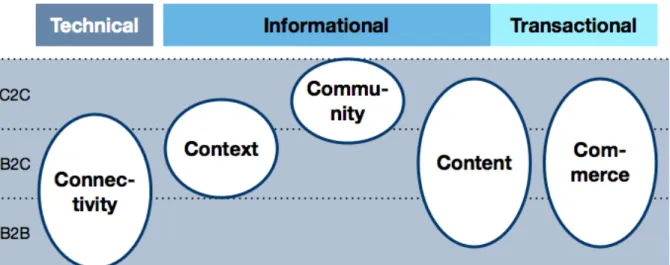
The adjusted reference framework of Internet business models as presented in figure 1 builds upon existing classifications (as mentioned at the beginning of chapter 2), but tries to avoid all shortcomings identified in sections 2.1 and 2.2. In addition, the reference framework aims at presenting a contemporary view reflecting today‘s Internet world. The reference framework does not imply that a business can only follow one business model, hybrid business models are possible and will probably be becoming more common as Internet businesses develop fur-ther. When developing an Internet business, a business should be aware of the specific charac-teristics of each business model category and carefully plan each element of the respective business model category.19
Figure 1: Contemporary reference framework of Internet business models
The sections 3.1-3.3 describe the “Five C‘s”. Section 3.1 starts with the technical business model Connectivity which represents a specific business model very different from the re-maining four. The informational business models are introduced in section 3.2, and section 3.3 describes the transactional business model usually referred to as E-Commerce.
3.1
Technical business model
Connectivity covers all businesses providing technical access to the Internet, i.e. data connec-tivity as well as mobile connecconnec-tivity.20 This service is usually offered by Internet service
pro-viders and the users are either consumers (B2C) or businesses as well (B2B). New thoughts are mentioning the use of personal WLAN stations (of consumers) for public Internet access which would open up the business model into the C2C area.
From a business model perspective Connectivity is a rather simple business model in terms of the revenue model. Providers usually charge a monthly fee for the Internet access. Some-times the fee is based on traffic volume and speed. Businesses can order additional services and higher service levels. This business model does not have much in common with any of the other four Internet business models and, therefore, needs to be treated as a separate busi-ness model and not be confused with these other busibusi-ness models.
3.2
Informational business models
Context business models deal with organizing information already available in the Internet. The most common forms are search engines like Google. The information is usually provided by businesses and received by consumers (B2C). More and more search engines also include information from social networks and other “personal” websites (C2C). Businesses as a whole are usually not consuming search engine content extensively, they usually prefer professional content (which is part of the Content business model).
Social networks play an increasingly important role in the Internet and have specific char-acteristics from a business model perspective. Therefore, they should enjoy their own busi-ness model category. Community business models are creating social networks for exchange of information and free content (including facilitating such an exchange). Examples for this business model are Facebook, LinkedIn and Flickr.21 Social networks are built for consumers,
they are used by individuals and except for some fan pages and company profiles the informa-tion comes from consumers as well.
20 The third type of connectivity, voice connectivity, is not part of this business model, since it does not provide
access to the Internet. VoIP (Voice over IP), which is using the Internet, is part of data connectivity.
The Content business model is offering content with content being anything from news, information and education to entertainment. Content can be created by consumers for con-sumers (user-generated content, C2C) as well as by businesses for concon-sumers (B2C) or for businesses (B2B). It is important to notice that the Content business model requires the copy-rights or broadcasting licenses for such content. So selling music (like iTunes) or books (like Amazon) as a retailer is not covered by the Content business model. Since content is not only provided for free, for instance by newspaper websites, the Content business model is partly transactional, which means focusing on selling content. However, it is still significantly dif-ferent from the Commerce business model (e.g. with its revenue model).
3.3
Transactional business model
The Commerce business model is about initiating and executing commercial transactions. It covers retailers (like Amazon) as well as brokers (like eBay and AirBnB) and marketplaces and can also include additional services facilitating such transactions like payment services (e.g. PayPal). Products or services are sold by businesses and consumers and are bought by consumers and businesses.
As indicated above, selling one‘s own content like a magazine publisher is not part of the Commerce business model. The reason is that, for instance, the revenue model is very differ-ent compared to a classical retailer. Let‘s take a closer look at the elemdiffer-ents of a business model.
4
Elements of a practical business model
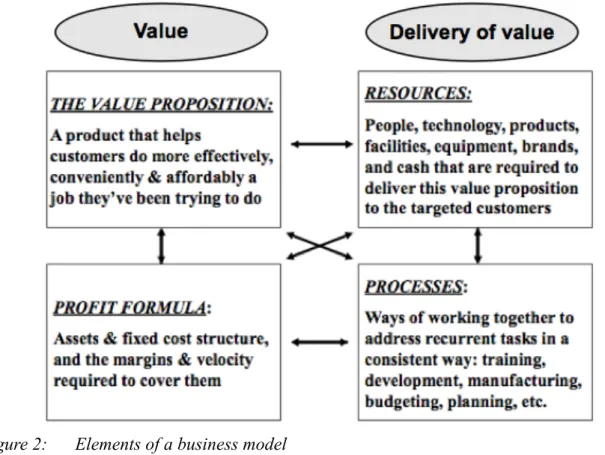
In my university courses I use the business model concept of Christensen/Johnson (2009) as shown in figure 2.22 In my view it covers the core elements of a business model and structures
them in an easily applicable format. Two of the four elements describe the value of each busi-ness – for the customer and for the company – (sections 4.1 and 4.3), and the other two out-line how the value is delivered (section 4.2).23
22 See Johnson/Christensen/Kagermann (2008) for an earlier (and very similar) version of this concept. 23 See for this concept and its description Christensen/Johnson (2009), pp. 1-3.
Figure 2: Elements of a business model
Source: Christensen/Johnson (2009), pp. 1-3
4.1
Value proposition
The value proposition is a product (or service) which provides a “ real” value to the respective customer. Following Christensen‘s view of regarding customers‘ needs as “jobs to be done”, the value proposition should describe exactly how the product can help a customer to do a certain “job”.
Taking Amazon‘s Commerce business as an example, the value proposition is – depending on the customer – a broad range of products, fast delivery, low prices, convenient ordering or a reliable service. As you can see the concept is similar to the “unique selling proposition” (USP), but has a somewhat different focus. This value for the customer is realized through resources and processes.
4.2
Resources and processes
The resources are the assets a company needs to have to deliver the value to the customer. At Amazon these are, for instance, the software for its online shop, the warehouses, the employ-ees and its brand.
The processes make use of the resources and are actually delivering the value. The main processes for Amazon are probably the logistics processes. In order to be able to deliver fast – sometimes at the same day –, you need to organize your logistics processes extremely well. That covers the inclusion and management of suppliers and third-party providers into these processes as well. Besides realizing value for the customer through these processes a business also needs to create value for itself.
4.3
Profit formula
The fourth element, the profit formula, is the most important one for the business itself, espe-cially in the Internet world. This element directs the attention to the requirement, that each business eventually needs to earn some money and make profit. In the most basic form a business needs to ensure that its revenues cover its costs.
For Commerce businesses like Amazon this simply means that the retail margin, i.e. reve-nues minus costs, needs to be positive in the long run. Although Jeff Bezos seems to be satis-fied with a relatively low margin and is accepting losses in the short term, Amazon‘s objective clearly is making a profit in the long term.24 This and the remaining three elements of a
busi-ness model can be used along with each Internet busibusi-ness model defined in chapter 3.
5
Conclusion: Exemplary application of the new
refer-ence framework
The new reference framework of Internet business models distinguishes five business models. Each business model has specific traits, which can be demonstrated by using the four core elements of a business model as outlined in chapter 4. That means that, for instance, the proc-esses or the revenue model of two businproc-esses in the same Internet business model are much more similar than those of two businesses belonging to different business models.
In order to illustrate this, let‘s exemplarily apply the new reference framework to Face-book, which was mixed with other business models in the existing classifications referred to in chapter 2. In this paper I will just focus on the revenue model (i.e. the profit formula) to reinforce the point. In my university courses I elaborate on each element and business model.
According to Wirtz, Facebook as a social network and Deutsche Telekom as an Internet service provider are part of the same business model Connection.25 The revenue model of
Facebook is – simplified – to sell advertising, whereas Deutsche Telekom usually charges a monthly fee for Internet access from its customers, there is no advertising at all.
In Kollmann‘s classification, Facebook is part of the Communication business model, as is eBay.26 eBay‘s revenues may also include some (minor) advertising fees, however, the most
significant share of revenues consists of broker fees.27
Both examples show that the same business model – Connection or Communication – cov-ers totally different revenue models in the existing classifications. Assuming that the revenue model represents the most important part of a business model, the question of the applicability of these existing business model classifications unfolds.28
The new reference framework of Internet business models is supposed to differentiate much better between similar and different business models. Therefore, it can hopefully lead to a sharper analysis of existing and development of future business models in the Internet.
References
Afuah, Allan/Tucci, Christopher L. (2003): Internet Business Models and Strategies – Text and Cases, 2nd ed., McGraw-Hill, Boston et al. 2003
Amazon.com, Inc. (2013): 2012 Annual Report, http://phx.corporate-ir.net/phoenix.zhtml? c=97664&p=irol-reportsAnnual (August 11, 2013)
Bertelsmann AG (2012): Press Conference on Annual Report for Fiscal Year 2011, Berlin 2012
Christensen, Clayton M./Johnson, Mark W. (2009): What Are Business Models, and How Are They Built?, research note, Harvard Business School, Boston 2009
25 See Wirtz (2011), pp. 696f.
26 See Kollmann (2011), pp. 49 and 51.
27 Marketplace (i.e. broker) revenues were $7.4 billion of $14.1 billion total net revenues of eBay Inc. in 2012
(with PayPal revenues representing another 40 % of eBay Inc. revenues), see eBay Inc. (2013) and PayPal (2013).
28 Similar reasonings can be done for the remaining elements of a business model and will very likely lead to a
eBay Inc. (2013): eBay Inc. Reports Strong Fourth Quarter and Full Year 2012 Results, http:// investor.ebayinc.com/financial_releases.cfm (August 11, 2013)
Eisenmann, Thomas/Brown, Alastair (2000): Online Content Providers, research note, Har-vard Business School, Boston 2000
Internet Retailer (2013): Global E-Commerce Sales, http://www.internetretailer.com/static/ uploads/GlobalSalesChart_011311.jpg (August 11, 2013)
Internet World Stats (2013): World Internet Users and Population Stats, http://www.internet worldstats.com/list2.htm (August 9, 2013)
Johnson, Mark W./Christensen, Clayton M./Kagermann, Henning (2008): Reinventing Your Business Model, in: Harvard Business Review, December 2008, pp. 2-10
Kollmann, Tobias (2011): E-Business – Grundlagen elektronischer Geschäftsprozesse in der Net Economy, 4th ed., Gabler, Wiesbaden 2011
Lumpkin, G.T./Dess, Gregory G. (2004): E-Business Strategies and Internet Business Models – How the Internet Adds Value, in: Organizational Dynamics, vol. 33 (2004), no. 2, pp. 161-173
PayPal (2013): Financials, https://www.paypal-media.com/about (August 11, 2013)
The World Bank (2013): Internet Users (per 100 People), http://data.worldbank.org/indicator/ IT.NET.USER.P2/countries?order=wbapi_data_value_2012%20wbapi_data_value%20wbapi _data_value-last&sort=asc&display=graph (August 9, 2013)
Weinfurtner, Stefan et al. (2013): Erfolgsfaktor Payment – Der Einfluss der Zahlungsver-fahren auf Ihren Umsatz, Aktuelle Ergebnisse zum Bezahlverhalten der Endkunden aus dem Projekt E-Commerce-Leitfaden, 2nd ed., ibi research, Regensburg 2013
Welge, Martin K./Al-Laham, Andreas (2012): Strategisches Management – Grundlagen, Pro-zess, Implementierung, 6th ed., Gabler, Wiesbaden 2012
Wirtz, Bernd W. (2010): Electronic Business, 3rd ed., Gabler, Wiesbaden 2010